lights OPEL ASTRA SALOON 2014 User Guide
[x] Cancel search | Manufacturer: OPEL, Model Year: 2014, Model line: ASTRA SALOON, Model: OPEL ASTRA SALOON 2014Pages: 245, PDF Size: 7.12 MB
Page 113 of 245
Instruments and controls111Lighting
Important exterior lights, including
cables and fuses, are monitored. In
trailer mode, trailer lighting is also
monitored. Trailers with LED lighting
must have an adapter that enables
light monitoring as with conventional
bulbs.
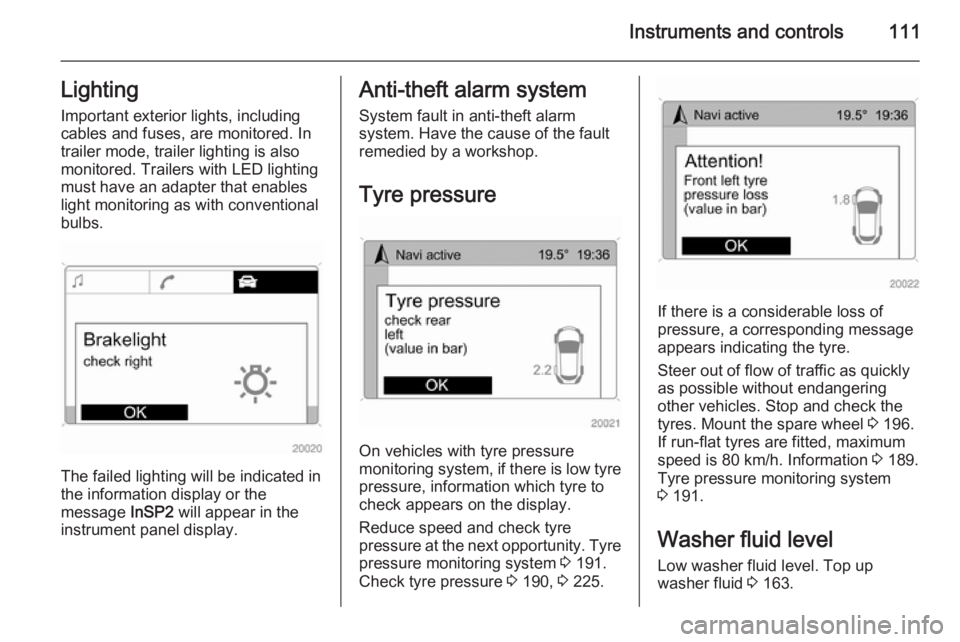
The failed lighting will be indicated in
the information display or the
message InSP2 will appear in the
instrument panel display.
Anti-theft alarm system
System fault in anti-theft alarm
system. Have the cause of the fault
remedied by a workshop.
Tyre pressure
On vehicles with tyre pressure
monitoring system, if there is low tyre pressure, information which tyre to
check appears on the display.
Reduce speed and check tyre
pressure at the next opportunity. Tyre
pressure monitoring system 3 191.
Check tyre pressure 3 190, 3 225.
If there is a considerable loss of
pressure, a corresponding message
appears indicating the tyre.
Steer out of flow of traffic as quickly as possible without endangering
other vehicles. Stop and check the
tyres. Mount the spare wheel 3 196.
If run-flat tyres are fitted, maximum
speed is 80 km/h. Information 3 189.
Tyre pressure monitoring system
3 191.
Washer fluid level
Low washer fluid level. Top up
washer fluid 3 163.
Page 119 of 245
Lighting117LightingExterior lighting.......................... 117
Interior lighting ........................... 121
Lighting features ........................122Exterior lighting
Light switch
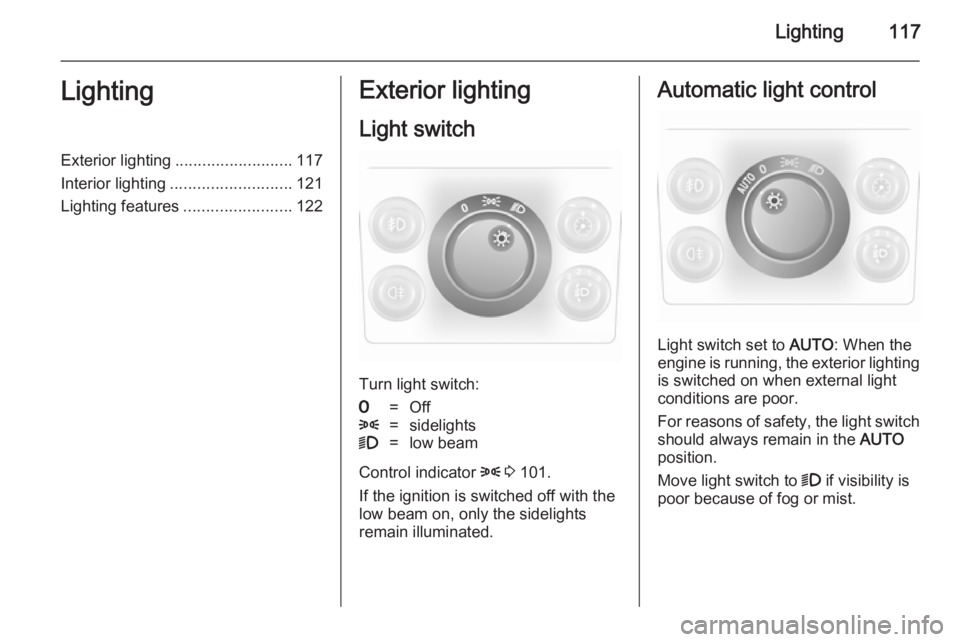
Turn light switch:
7=Off8=sidelights9=low beam
Control indicator 8 3 101.
If the ignition is switched off with the
low beam on, only the sidelights
remain illuminated.
Automatic light control
Light switch set to AUTO: When the
engine is running, the exterior lighting is switched on when external light
conditions are poor.
For reasons of safety, the light switch
should always remain in the AUTO
position.
Move light switch to 9 if visibility is
poor because of fog or mist.
Page 120 of 245
118LightingHigh beam
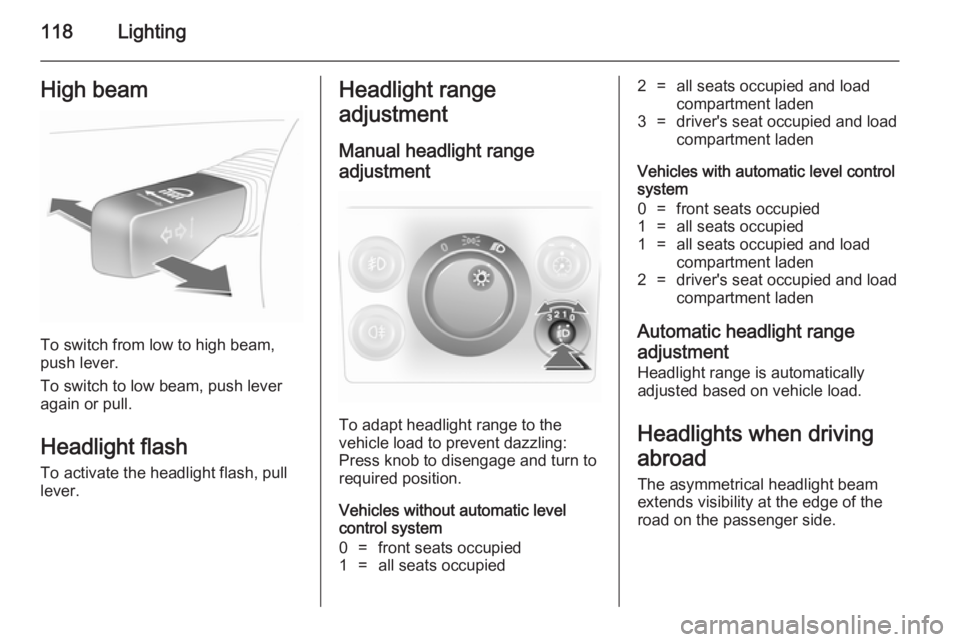
To switch from low to high beam,
push lever.
To switch to low beam, push lever
again or pull.
Headlight flash To activate the headlight flash, pull
lever.
Headlight range
adjustment
Manual headlight range
adjustment
To adapt headlight range to the
vehicle load to prevent dazzling:
Press knob to disengage and turn torequired position.
Vehicles without automatic level
control system
0=front seats occupied1=all seats occupied2=all seats occupied and load
compartment laden3=driver's seat occupied and load
compartment laden
Vehicles with automatic level control
system
0=front seats occupied1=all seats occupied1=all seats occupied and load
compartment laden2=driver's seat occupied and load
compartment laden
Automatic headlight range
adjustment
Headlight range is automatically
adjusted based on vehicle load.
Headlights when driving
abroad
The asymmetrical headlight beam
extends visibility at the edge of the
road on the passenger side.
Page 121 of 245
Lighting119
However, when driving in countries
where traffic drives on the opposite
side of the road, adjust the headlights to prevent dazzling of oncoming
traffic.
Vehicles with halogen headlight
system
Have the headlights adjusted by a
workshop.
Vehicles with adaptive forward
lighting
Adapting the aim of the headlight
beam:
1. Pull lever and hold.
2. Switch on ignition.
3. An acoustic signal sounds after approx. 3 seconds.
Control indicator B 3 101.
Daytime running lights
With the ignition on and the light
switch set to 7 or AUTO , the sidelights
are switched on. When the engine is
running, headlights illuminate.On vehicle without automatic light
control, 9 must be switched on when
it gets dark for illumination of the
instrument panel.
The daytime running lights switch off
when the ignition is switched off.
Adaptive forward lighting
Adaptive forward lighting with Bi-
Xenon headlights improves lighting in
curves and increases headlight
range.
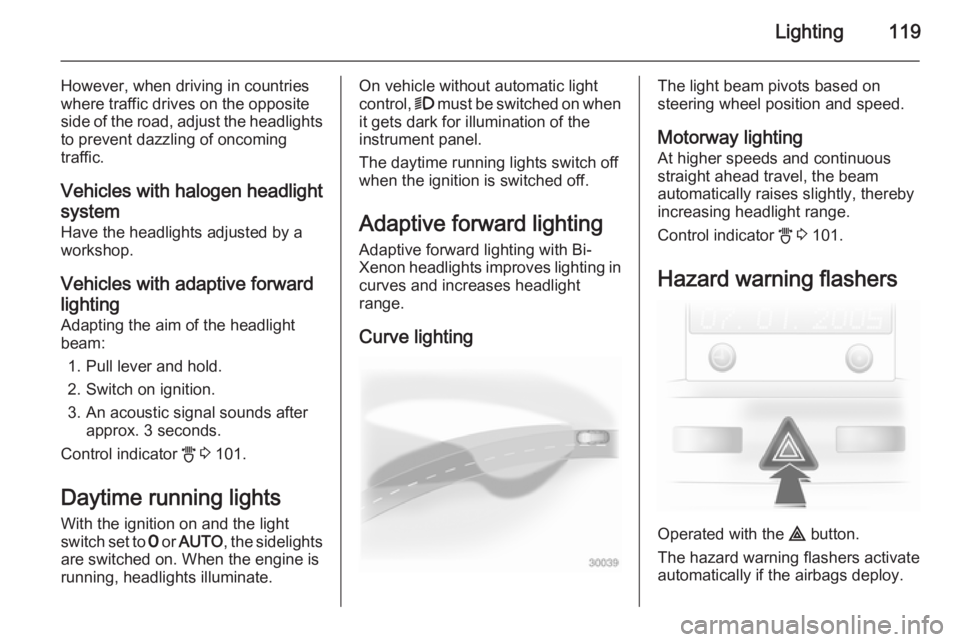
Curve lightingThe light beam pivots based on
steering wheel position and speed.
Motorway lighting
At higher speeds and continuous
straight ahead travel, the beam
automatically raises slightly, thereby
increasing headlight range.
Control indicator B 3 101.
Hazard warning flashers
Operated with the ¨ button.
The hazard warning flashers activate
automatically if the airbags deploy.
Page 122 of 245
120LightingTurn and lane-change
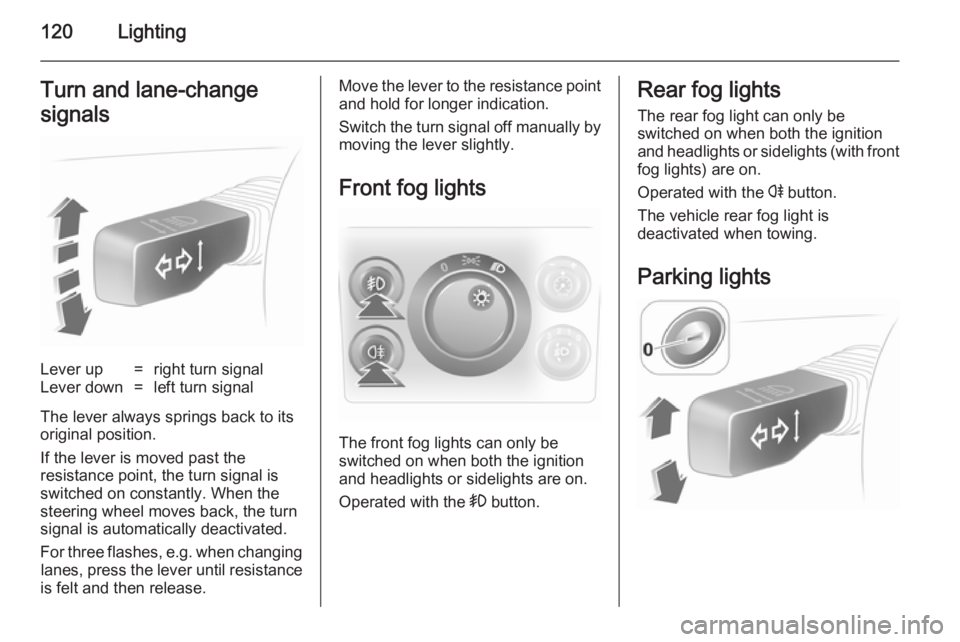
signalsLever up=right turn signalLever down=left turn signal
The lever always springs back to its
original position.
If the lever is moved past the
resistance point, the turn signal is
switched on constantly. When the
steering wheel moves back, the turn
signal is automatically deactivated.
For three flashes, e.g. when changing lanes, press the lever until resistance
is felt and then release.
Move the lever to the resistance point
and hold for longer indication.
Switch the turn signal off manually by moving the lever slightly.
Front fog lights
The front fog lights can only be
switched on when both the ignition and headlights or sidelights are on.
Operated with the > button.
Rear fog lights
The rear fog light can only be
switched on when both the ignition
and headlights or sidelights (with front fog lights) are on.
Operated with the r button.
The vehicle rear fog light is
deactivated when towing.
Parking lights
Page 123 of 245
Lighting121
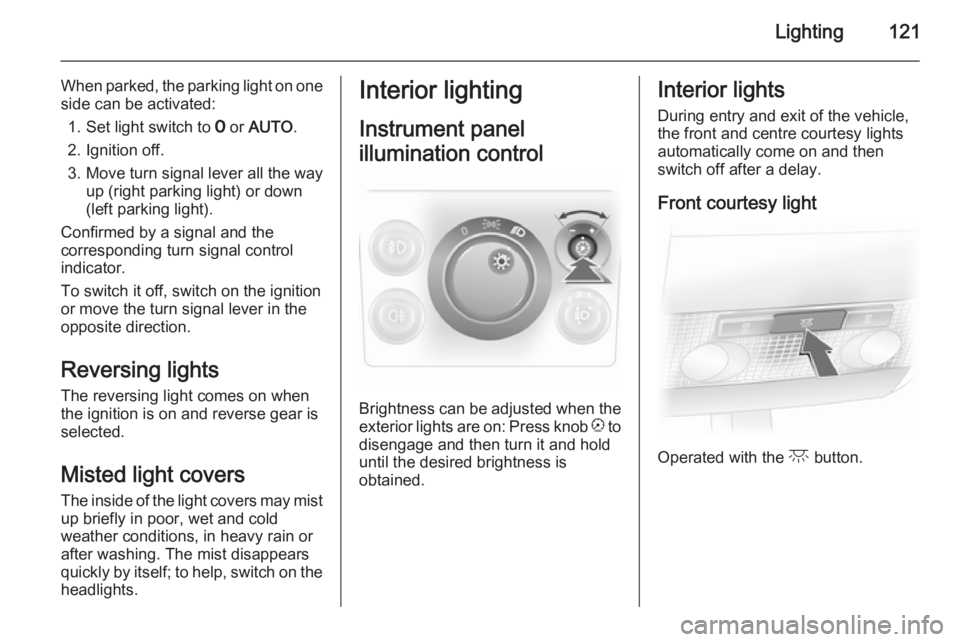
When parked, the parking light on oneside can be activated:
1. Set light switch to 7 or AUTO .
2. Ignition off.
3. Move turn signal lever all the way up (right parking light) or down
(left parking light).
Confirmed by a signal and the
corresponding turn signal control
indicator.
To switch it off, switch on the ignition
or move the turn signal lever in the
opposite direction.
Reversing lights The reversing light comes on when
the ignition is on and reverse gear is
selected.
Misted light covers
The inside of the light covers may mist up briefly in poor, wet and cold
weather conditions, in heavy rain or
after washing. The mist disappears
quickly by itself; to help, switch on the headlights.Interior lighting
Instrument panel
illumination control
Brightness can be adjusted when the exterior lights are on: Press knob k to
disengage and then turn it and hold
until the desired brightness is
obtained.
Interior lights
During entry and exit of the vehicle,
the front and centre courtesy lights
automatically come on and then
switch off after a delay.
Front courtesy light
Operated with the c button.
Page 124 of 245
122Lighting
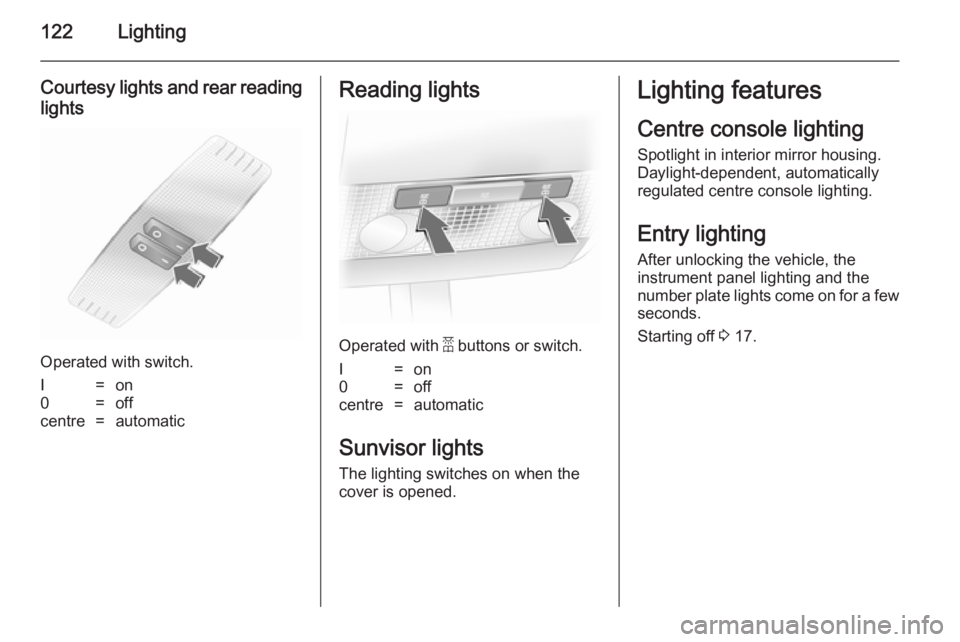
Courtesy lights and rear readinglights
Operated with switch.
I=on0=offcentre=automaticReading lights
Operated with a buttons or switch.
I=on0=offcentre=automatic
Sunvisor lights
The lighting switches on when the
cover is opened.
Lighting features
Centre console lighting Spotlight in interior mirror housing.
Daylight-dependent, automatically
regulated centre console lighting.
Entry lighting
After unlocking the vehicle, the
instrument panel lighting and the
number plate lights come on for a few
seconds.
Starting off 3 17.
Page 125 of 245
Lighting123Exit lighting
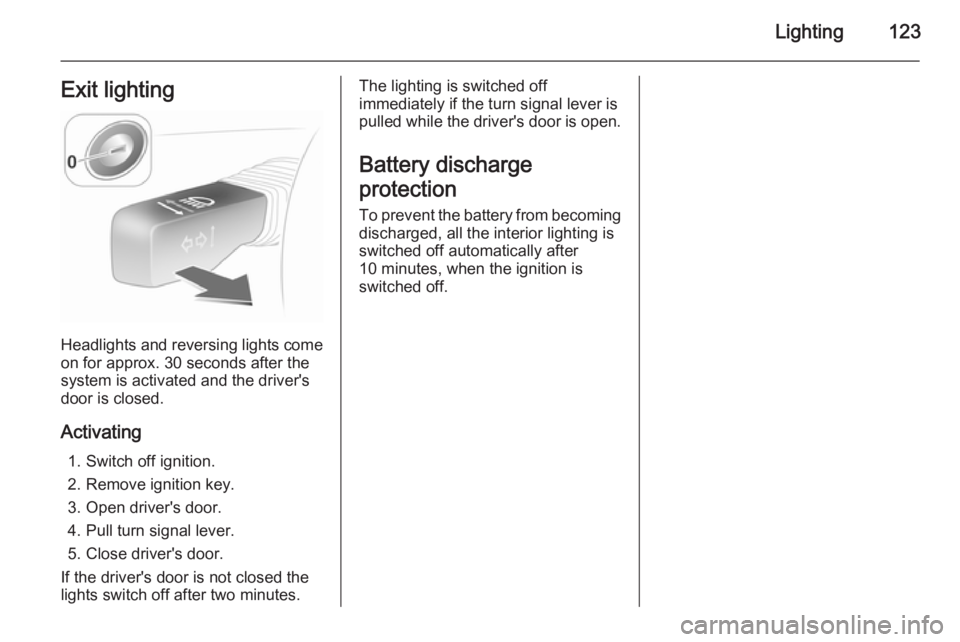
Headlights and reversing lights comeon for approx. 30 seconds after the
system is activated and the driver's
door is closed.
Activating 1. Switch off ignition.
2. Remove ignition key.
3. Open driver's door.
4. Pull turn signal lever.
5. Close driver's door.
If the driver's door is not closed the
lights switch off after two minutes.
The lighting is switched off
immediately if the turn signal lever is pulled while the driver's door is open.
Battery discharge
protection To prevent the battery from becomingdischarged, all the interior lighting is
switched off automatically after
10 minutes, when the ignition is
switched off.
Page 144 of 245
142Driving and operatingManual transmission
automated
The Easytronic transmission permits manual (manual mode) or automatic
gear shifting (automatic mode), both
with automatic clutch control.
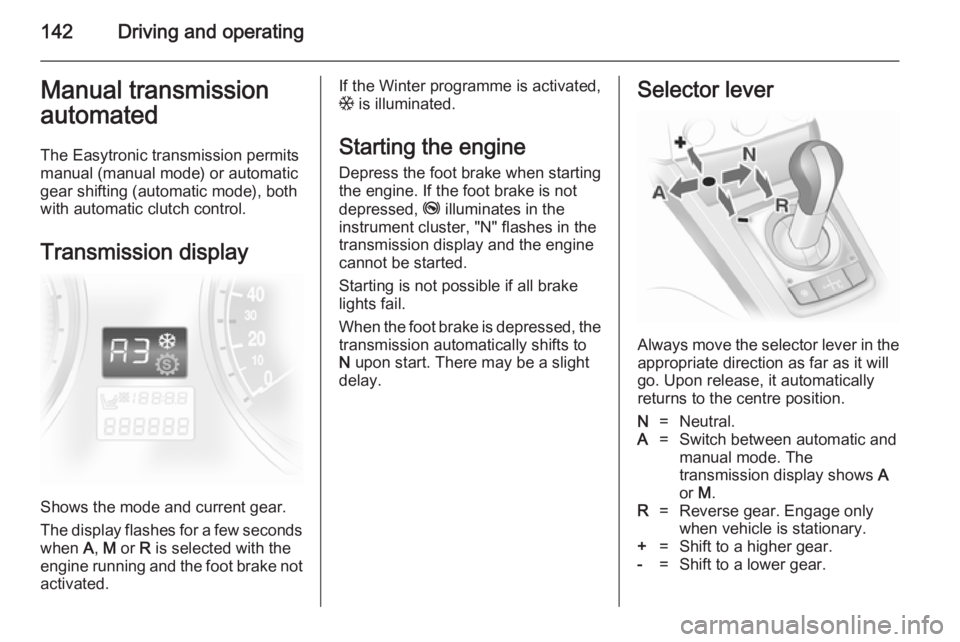
Transmission display
Shows the mode and current gear.
The display flashes for a few seconds
when A, M or R is selected with the
engine running and the foot brake not
activated.
If the Winter programme is activated,
T is illuminated.
Starting the engine
Depress the foot brake when starting
the engine. If the foot brake is not
depressed, j illuminates in the
instrument cluster, "N" flashes in the
transmission display and the engine
cannot be started.
Starting is not possible if all brake
lights fail.
When the foot brake is depressed, the
transmission automatically shifts to
N upon start. There may be a slight
delay.Selector lever
Always move the selector lever in the
appropriate direction as far as it will
go. Upon release, it automatically
returns to the centre position.
N=Neutral.A=Switch between automatic and
manual mode. The
transmission display shows A
or M.R=Reverse gear. Engage only
when vehicle is stationary.+=Shift to a higher gear.-=Shift to a lower gear.
Page 163 of 245
Vehicle care1619Danger
The ignition system and Xenon
headlights use extremely high
voltage. Do not touch.
The caps for topping up the engine oil, the coolant, the washing fluid and theoil dipstick handle are yellow for ease
of identification.
Bonnet
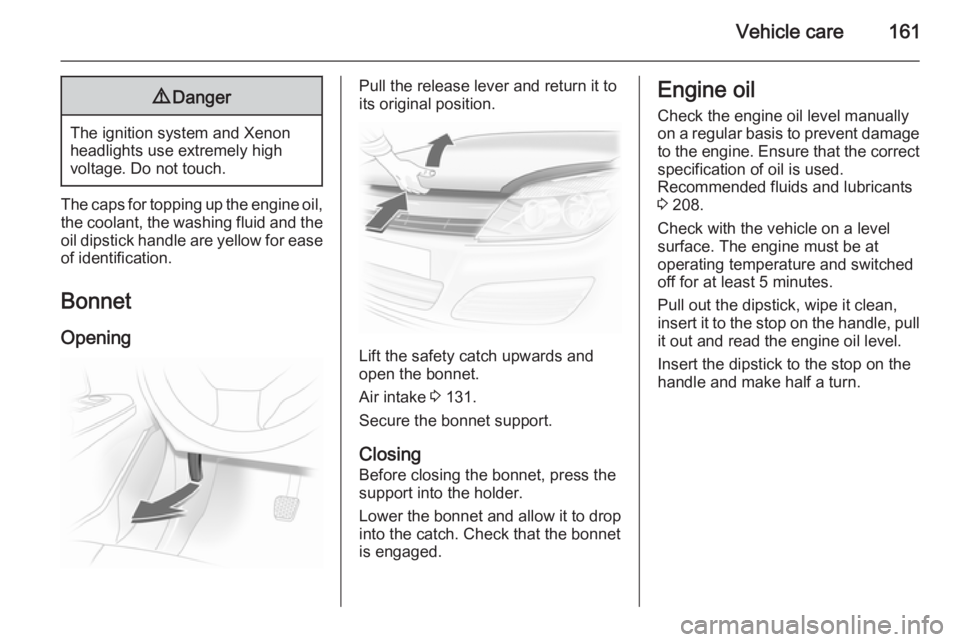
Opening
Pull the release lever and return it to
its original position.
Lift the safety catch upwards and
open the bonnet.
Air intake 3 131.
Secure the bonnet support.
Closing Before closing the bonnet, press the
support into the holder.
Lower the bonnet and allow it to drop into the catch. Check that the bonnet
is engaged.
Engine oil
Check the engine oil level manuallyon a regular basis to prevent damage
to the engine. Ensure that the correct specification of oil is used.
Recommended fluids and lubricants
3 208.
Check with the vehicle on a level
surface. The engine must be at
operating temperature and switched
off for at least 5 minutes.
Pull out the dipstick, wipe it clean, insert it to the stop on the handle, pull
it out and read the engine oil level.
Insert the dipstick to the stop on the
handle and make half a turn.