warning OPEL ASTRA SALOON 2014 User Guide
[x] Cancel search | Manufacturer: OPEL, Model Year: 2014, Model line: ASTRA SALOON, Model: OPEL ASTRA SALOON 2014Pages: 245, PDF Size: 7.12 MB
Page 43 of 245
Keys, doors and windows41Retractable hardtop9Warning
Take care when operating the
convertible hardtop. Risk of injury. Monitor the action zone above, to
the side and to the rear of the
vehicle during roof operation.
Make sure that nothing could
become pinched. Make sure no
one is in the action zone of the roof
or boot lid during roof operation.
Risk of injury.
Check the amount height, length
and width of available space
before operating the roof, e. g. in a
garage, parking garage or when a bicycle rack is fitted.
Vehicle passengers should be
informed accordingly.
Before leaving the vehicle, remove
the ignition key in order to prevent unauthorised operation of the
windows and sunroof.
Stand-by with key in ignition switch from position 1, or for Open&Start-
System switch on ignition.
Requirements: ■ Vehicle is stationary or driving no more than 30 km/h
■ Load compartment blind is closed and engaged 3 73
■ Boot lid is closed
If any of these requirements are not
fulfilled, a warning buzzer sounds
when the switch is actuated and the
roof does not open or close.
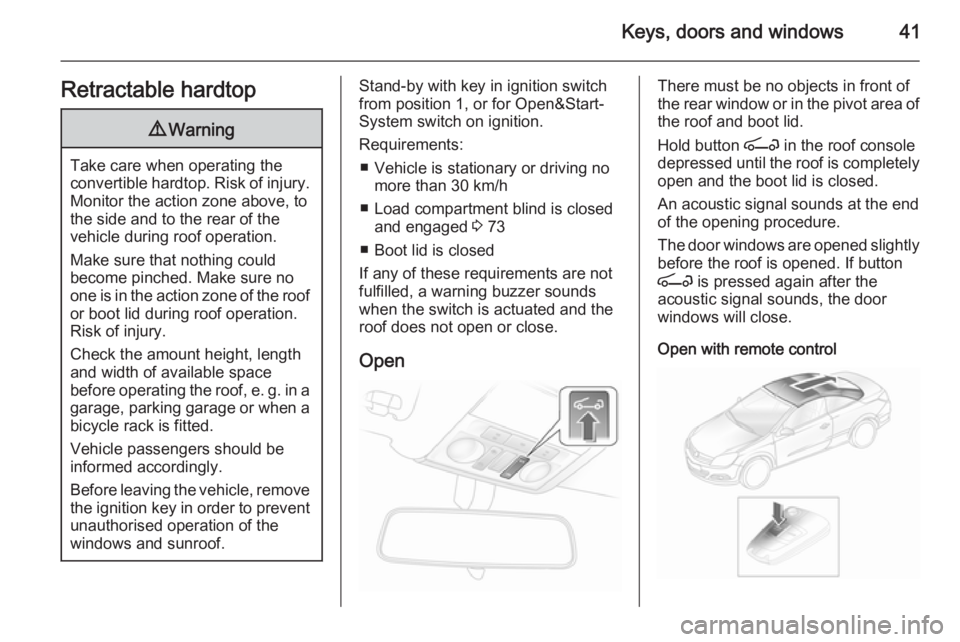
OpenThere must be no objects in front of
the rear window or in the pivot area of the roof and boot lid.
Hold button > in the roof console
depressed until the roof is completely
open and the boot lid is closed.
An acoustic signal sounds at the end
of the opening procedure.
The door windows are opened slightly before the roof is opened. If button
> is pressed again after the
acoustic signal sounds, the door
windows will close.
Open with remote control
Page 44 of 245
42Keys, doors and windows
With vehicle stationary unlock the
vehicle. Press button q again and
keep pressed until the roof has
opened fully and the boot lid has
closed.
During operation with the remote
control, the door windows are opened completely.
Close
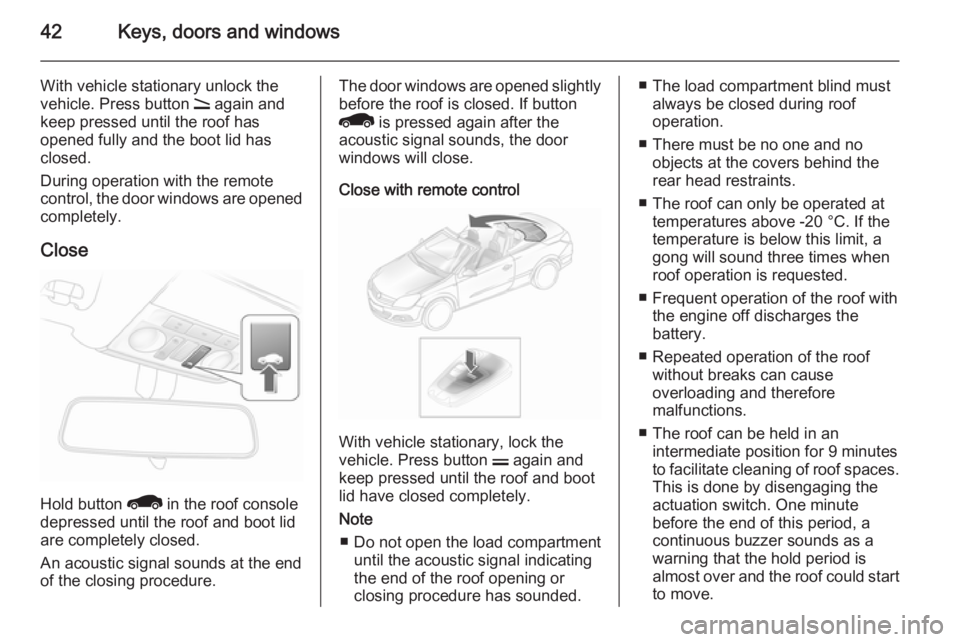
Hold button < in the roof console
depressed until the roof and boot lid are completely closed.
An acoustic signal sounds at the end
of the closing procedure.
The door windows are opened slightly before the roof is closed. If button
< is pressed again after the
acoustic signal sounds, the door
windows will close.
Close with remote control
With vehicle stationary, lock the
vehicle. Press button p again and
keep pressed until the roof and boot
lid have closed completely.
Note ■ Do not open the load compartment until the acoustic signal indicating
the end of the roof opening or
closing procedure has sounded.
■ The load compartment blind must always be closed during roof
operation.
■ There must be no one and no objects at the covers behind the
rear head restraints.
■ The roof can only be operated at temperatures above -20 °C. If the
temperature is below this limit, a
gong will sound three times when
roof operation is requested.
■ Frequent operation of the roof with the engine off discharges the
battery.
■ Repeated operation of the roof without breaks can cause
overloading and therefore
malfunctions.
■ The roof can be held in an intermediate position for 9 minutes
to facilitate cleaning of roof spaces.
This is done by disengaging the
actuation switch. One minute
before the end of this period, a
continuous buzzer sounds as a
warning that the hold period is
almost over and the roof could start to move.
Page 46 of 245
44Keys, doors and windows
The convertible roof must not be
operated if the anti-roll bars have
been deployed. A continuous warning will sound if the switch is actuated.
The airbag control indicator v
illuminates if the anti-roll bars have
been deployed.
Note
Do not place any objects on the
covers of the anti-roll bars behind
the head restraints.
Extended anti-roll bars can be
retracted (e.g. in order to close the
roof after a collision).
Press the lever between the rods of
an anti-roll bar to unlock the system.
Push the anti-roll bar all the way down
until it engages. Fit the cover.
Repeat the procedure on the other
anti-roll bar.
Control indicator v will remain
illuminated and the anti-roll bars will not deploy in the event of another
collision. Seek the assistance of a workshop.9 Warning
The roof cannot be closed or
opened if the anti-roll bars are
extended. The anti-roll bars must
first be retracted.
After deployment of the anti-roll
bar, have the system repaired by
a workshop immediately.
Manually retracted anti-roll bars
will not deploy in the event of a
collision.
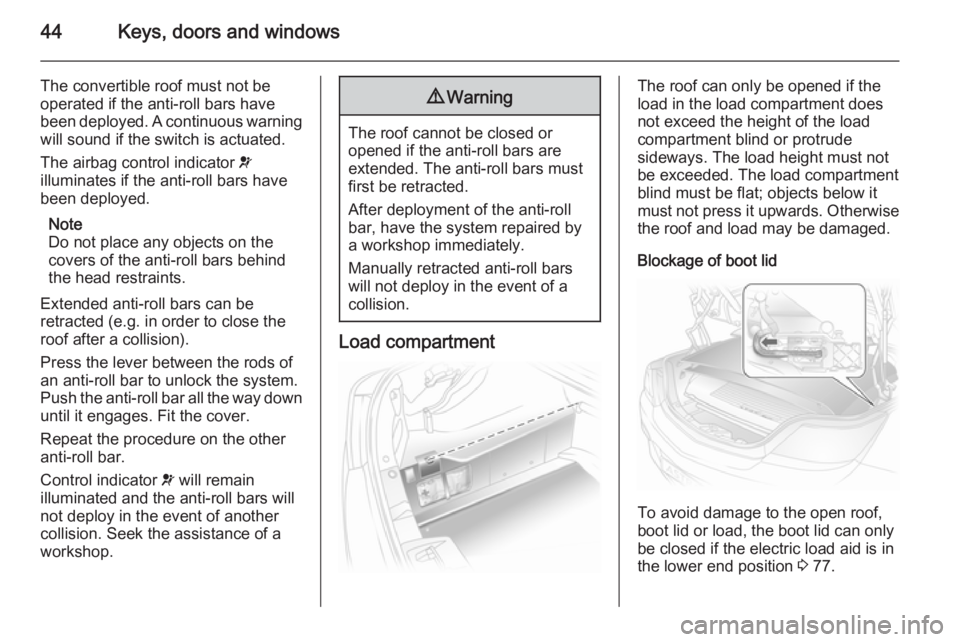
Load compartment
The roof can only be opened if the
load in the load compartment does
not exceed the height of the load
compartment blind or protrude
sideways. The load height must not
be exceeded. The load compartment
blind must be flat; objects below it must not press it upwards. Otherwise the roof and load may be damaged.
Blockage of boot lid
To avoid damage to the open roof,
boot lid or load, the boot lid can only
be closed if the electric load aid is in
the lower end position 3 77.
Page 49 of 245
Seats, restraints47Seats, restraintsHead restraints............................ 47
Front seats ................................... 49
Rear seats ................................... 53
Seat belts ..................................... 54
Airbag system .............................. 57
Child restraints ............................. 61Head restraints
Position9 Warning
Only drive with the head restraint
set to the proper position.
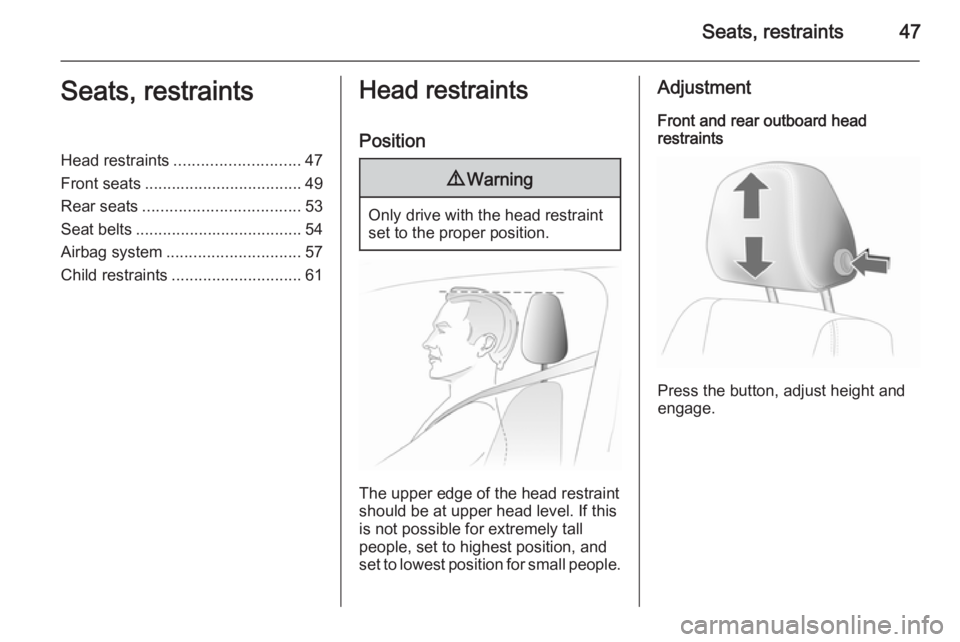
The upper edge of the head restraint
should be at upper head level. If this
is not possible for extremely tall
people, set to highest position, and
set to lowest position for small people.
Adjustment
Front and rear outboard head
restraints
Press the button, adjust height and
engage.
Page 51 of 245
Seats, restraints49
Note
Approved accessories may only be
attached to the front passenger seat head restraint if the seat is not in use.Front seats
Seat position9 Warning
Only drive with the seat correctly
adjusted.
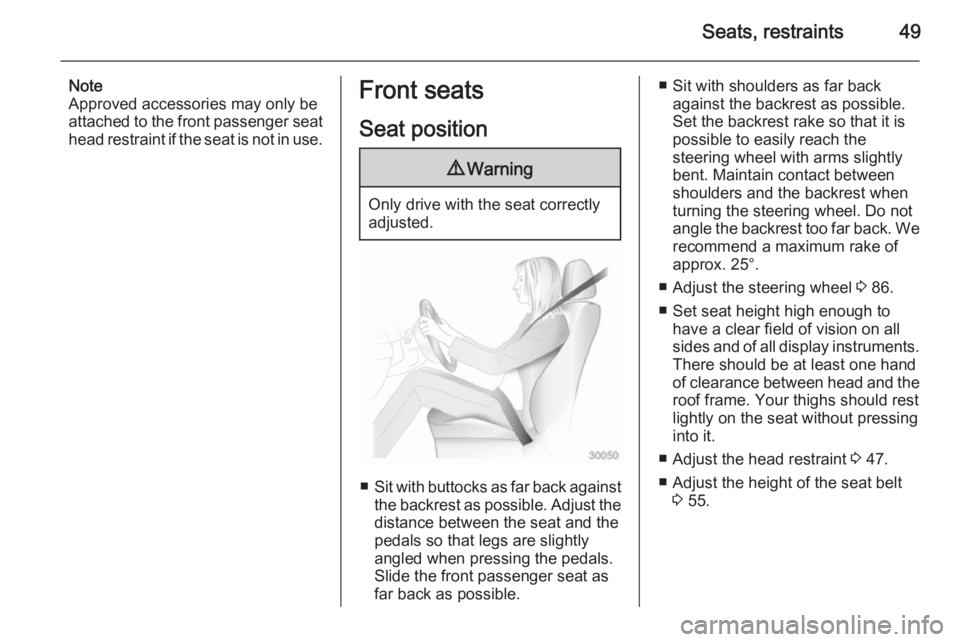
■ Sit with buttocks as far back against
the backrest as possible. Adjust the distance between the seat and the
pedals so that legs are slightly
angled when pressing the pedals.
Slide the front passenger seat as
far back as possible.
■ Sit with shoulders as far back against the backrest as possible.
Set the backrest rake so that it is possible to easily reach the
steering wheel with arms slightly bent. Maintain contact between
shoulders and the backrest when
turning the steering wheel. Do not
angle the backrest too far back. We recommend a maximum rake of
approx. 25°.
■ Adjust the steering wheel 3 86.
■ Set seat height high enough to have a clear field of vision on allsides and of all display instruments.
There should be at least one hand
of clearance between head and the
roof frame. Your thighs should rest
lightly on the seat without pressing
into it.
■ Adjust the head restraint 3 47.
■ Adjust the height of the seat belt 3 55.
Page 52 of 245
50Seats, restraints
■ Adjust the thigh support so thatthere is a space approx. two fingers
wide between the edge of the seat
and the hollow of the knee.
■ Adjust the lumbar support so that it
supports the natural shape of the
spine.
Seat adjustment9 Danger
Do not sit nearer than 25 cm from
the steering wheel, to permit safe
airbag deployment.
9 Warning
Never adjust seats while driving as
they could move uncontrollably.
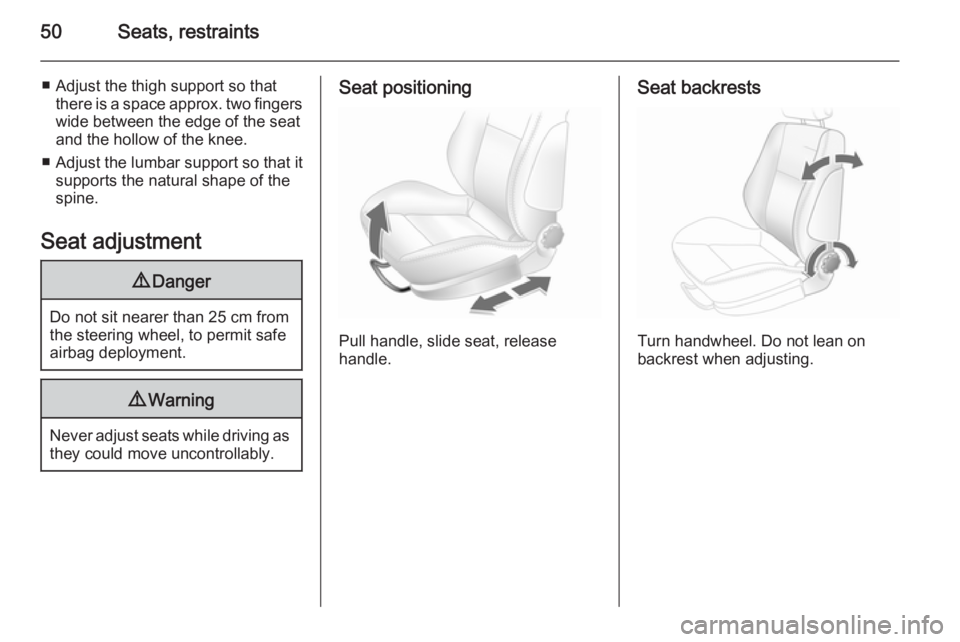
Seat positioning
Pull handle, slide seat, release
handle.
Seat backrests
Turn handwheel. Do not lean on
backrest when adjusting.
Page 56 of 245
54Seats, restraintsSeat belts
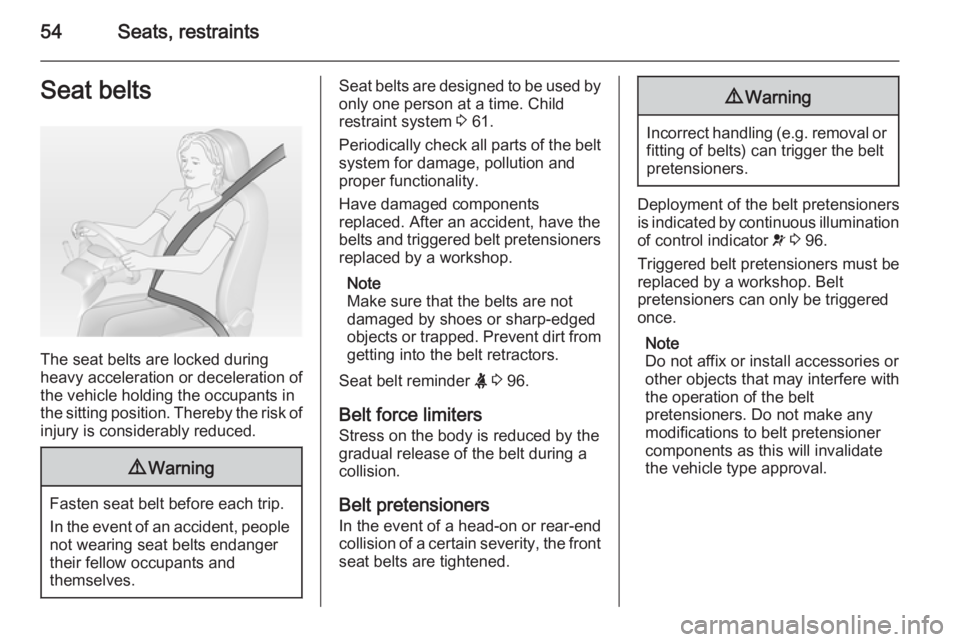
The seat belts are locked during
heavy acceleration or deceleration of
the vehicle holding the occupants in
the sitting position. Thereby the risk of injury is considerably reduced.
9 Warning
Fasten seat belt before each trip.
In the event of an accident, people
not wearing seat belts endanger their fellow occupants and
themselves.
Seat belts are designed to be used by only one person at a time. Child
restraint system 3 61.
Periodically check all parts of the belt
system for damage, pollution and
proper functionality.
Have damaged components
replaced. After an accident, have the
belts and triggered belt pretensioners replaced by a workshop.
Note
Make sure that the belts are not
damaged by shoes or sharp-edged
objects or trapped. Prevent dirt from
getting into the belt retractors.
Seat belt reminder X 3 96.
Belt force limiters
Stress on the body is reduced by the
gradual release of the belt during a
collision.
Belt pretensionersIn the event of a head-on or rear-endcollision of a certain severity, the front
seat belts are tightened.9 Warning
Incorrect handling (e.g. removal or
fitting of belts) can trigger the belt
pretensioners.
Deployment of the belt pretensioners
is indicated by continuous illumination
of control indicator v 3 96.
Triggered belt pretensioners must be replaced by a workshop. Belt
pretensioners can only be triggered
once.
Note
Do not affix or install accessories or
other objects that may interfere with
the operation of the belt
pretensioners. Do not make any
modifications to belt pretensioner components as this will invalidate
the vehicle type approval.
Page 57 of 245
Seats, restraints55Three-point seat belt
Fastening seat belt
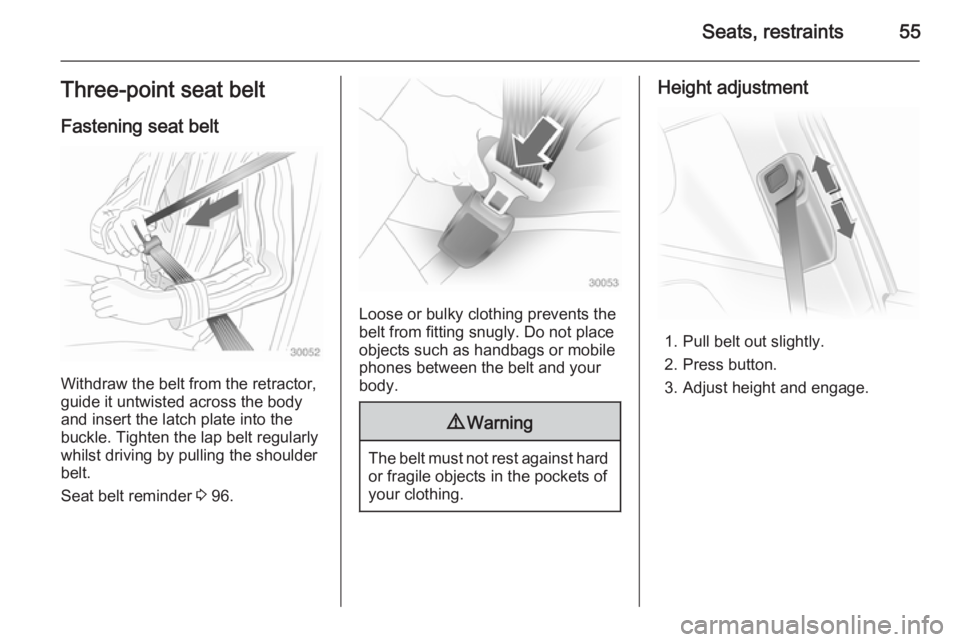
Withdraw the belt from the retractor,
guide it untwisted across the body
and insert the latch plate into the
buckle. Tighten the lap belt regularly
whilst driving by pulling the shoulder
belt.
Seat belt reminder 3 96.
Loose or bulky clothing prevents the
belt from fitting snugly. Do not place
objects such as handbags or mobile
phones between the belt and your body.
9 Warning
The belt must not rest against hard
or fragile objects in the pockets of
your clothing.
Height adjustment
1. Pull belt out slightly.
2. Press button.
3. Adjust height and engage.
Page 58 of 245
56Seats, restraints
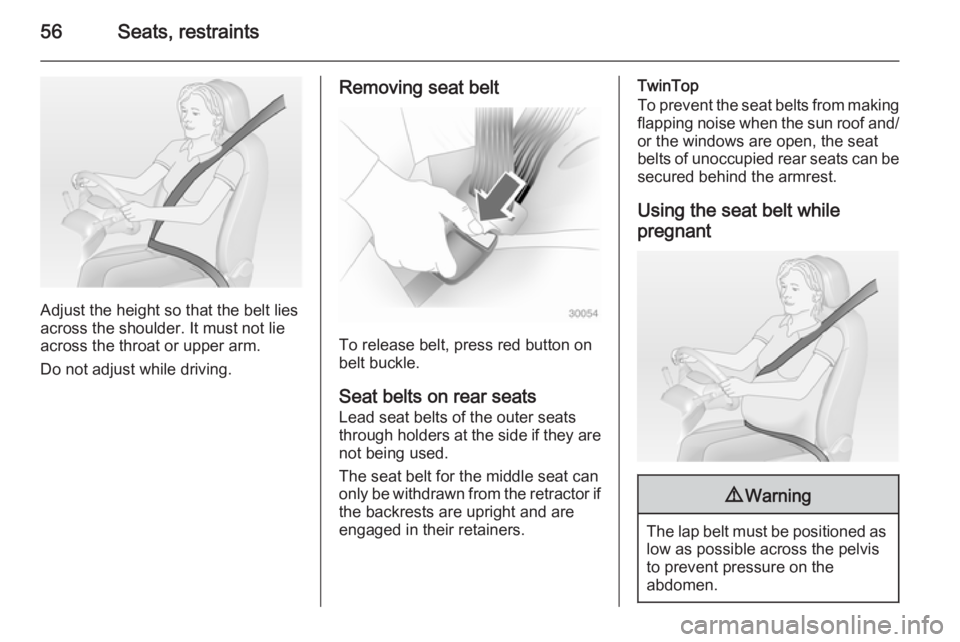
Adjust the height so that the belt lies
across the shoulder. It must not lie across the throat or upper arm.
Do not adjust while driving.
Removing seat belt
To release belt, press red button on
belt buckle.
Seat belts on rear seats
Lead seat belts of the outer seats
through holders at the side if they are not being used.
The seat belt for the middle seat can
only be withdrawn from the retractor if
the backrests are upright and are
engaged in their retainers.
TwinTop
To prevent the seat belts from making
flapping noise when the sun roof and/ or the windows are open, the seat
belts of unoccupied rear seats can be
secured behind the armrest.
Using the seat belt whilepregnant9 Warning
The lap belt must be positioned as
low as possible across the pelvis
to prevent pressure on the
abdomen.
Page 59 of 245
Seats, restraints57Airbag system
The airbag system consists of a
number of individual systems
depending on the scope of
equipment.
When triggered, the airbag inflates
within milliseconds. They also deflate
so quickly that it is often unnoticeable during the collision.9 Warning
If handled improperly the airbag
systems can be triggered in an
explosive manner.
Note
The control electronics of the airbag systems, belt pretensioners and
deployable anti-roll bars are located
in the centre console area. Do not
put any magnetic objects in this
area.
Do not stick anything on the airbag
covers and do not cover them with
other materials.
Each airbag/anti-roll bar is triggered
only once. Have deployed airbags/
anti-roll bars replaced by a
workshop. Furthermore, it might be
necessary to have the steering
wheel, the instrument panel, parts of
the panelling, the door seals,
handles and the seats replaced.
Do not make any modifications to
the airbag system/anti-roll bars as
this will invalidate the vehicle type
approval.
When the airbags inflate, escaping
hot gases may cause burns.
Control indicator v for airbag systems
and anti-roll bars 3 96.
Child restraint systems on front
passenger seat with airbag
systems
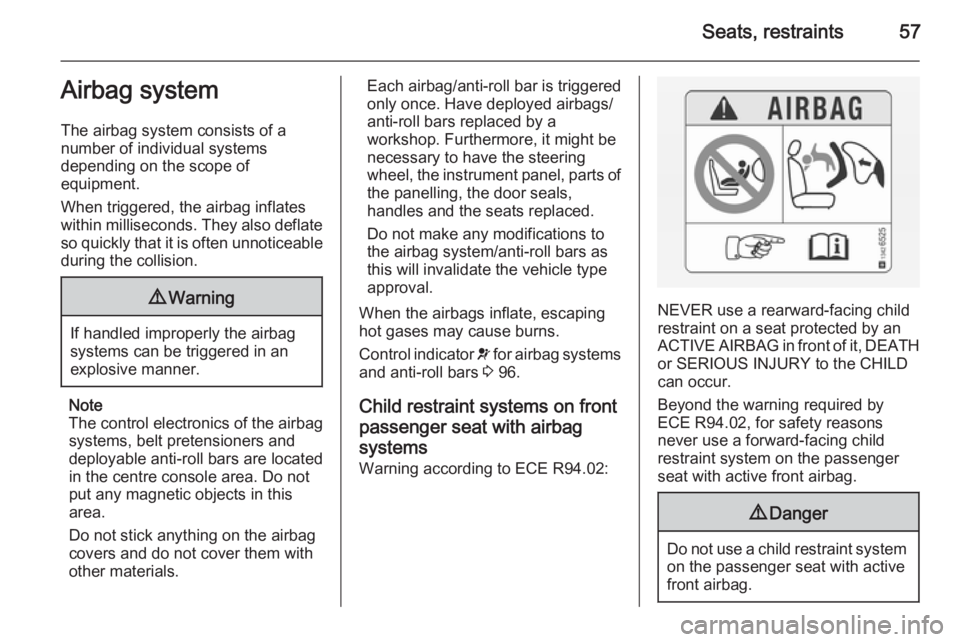
Warning according to ECE R94.02:
NEVER use a rearward-facing child
restraint on a seat protected by an
ACTIVE AIRBAG in front of it, DEATH or SERIOUS INJURY to the CHILD
can occur.
Beyond the warning required by
ECE R94.02, for safety reasons
never use a forward-facing child
restraint system on the passenger
seat with active front airbag.
9 Danger
Do not use a child restraint system
on the passenger seat with active
front airbag.