warning OPEL ASTRA SALOON 2014 Workshop Manual
[x] Cancel search | Manufacturer: OPEL, Model Year: 2014, Model line: ASTRA SALOON, Model: OPEL ASTRA SALOON 2014Pages: 245, PDF Size: 7.12 MB
Page 190 of 245
188Vehicle care
TwinTop
The tools for emergency operation of
the convertible hardtop are stowed in
the glove compartment.Wheels and tyres
Tyre condition, wheel condition
Drive over edges slowly and at right
angles if possible. Driving over sharp
edges can cause tyre and wheel
damage. Do not trap tyres on the kerb when parking.
Regularly check the wheels for
damage. Seek the assistance of a
workshop in the event of damage or
unusual wear.
Tyres
Tyres of size 225/45 R 17 are only
permitted if the vehicle is equipped
with electronic stability program.Astra OPC "Nürburgring
Edition" with tyres 225/40 ZR 18
This model is factory-fitted with high-
performance sports tyres, size
225/40 ZR 18. These tyres are
approved for use on public roads but
have typical racing characteristics
and a correspondingly shallow tread.
The tyres provide sportily oriented
and experienced drivers with better
performance at faster speeds on dry
road surfaces but can cause the
vehicle to break away without
warning if this limit is exceeded. Avoid adopting a risky driving style because
of this improved performance. In wet conditions adapt your driving style
and speed to the shallow tread.
Winter tyres Winter tyres improve driving safety at
temperatures below 7 °C and should
therefore be fitted on all wheels.
Page 191 of 245
Vehicle care189
Tyres of size 185/65 R 15,
195/60 R 15, 195/65 R 15 and
205/55 R 16 can be used as winter
tyres.
Tyres of size 205/50 R17 must only
be used as winter tyres.
Tyres of size 215/45 R 17,
225/45 R 17, 225/40 R 18 1)
,
225/40 ZR18 and 235/35 R 19 must not be used as winter tyres.
Saloon, Station wagon, Van: tyres of
size 215/45 R 17 are only approved
as winter tyres if the vehicle was equipped with 18-inch wheels in the
factory.
Winter tyres may only be used on the Astra OPC on special alloy wheels
approved by Opel.
Run-flat winter tyres may only be
used on factory approved alloy
wheels.
In accordance with country-specific
regulations, affix the speed sticker in
the driver's field of view.Run-flat tyres
Run-flat tyres have reinforced, self-
supporting sidewalls, which ensure
that the tyres always have a certain
amount of driveability, even when
there is no pressure.
Run-flat tyres are only permitted on
vehicles with electronic stability
program and tyre pressure monitoring system or deflation detection system.Caution
Check tyre pressures regularly
even if run-flat tyres are fitted.
Depending on tyre manufacturer, run-
flat tyres can be identified from a
marking on the tyre wall. E.g.
ROF=RunonFlat for Goodyear orSSR=Self Supporting Runflat Tyre
for Continental.
Use of run-flat tyres is only permitted
in combination with factory approved
alloy wheels.
Do not use a tyre repair kit.
The ECO tyre pressure must not be
used.
Run-flat tyres must not be combined
with standard tyres.
If converting to standard tyres, note
that the vehicle is not equipped with a spare wheel or tyre repair kit.
Driving with a damaged tyre
A loss in tyre pressure is indicated by
the tyre pressure monitoring system
or the deflation detection system.
If a tyre has no pressure, continued
driving is possible
■ at a speed of max. 80 km/h
■ up to a distance of 80 km9 Warning
The vehicle will be more difficult to
steer and handle. Braking
distance will be longer.
Adapt driving style and speed to the changed conditions.
1) Astra OPC: Permitted as winter tyres without tyre chains.
Page 193 of 245
Vehicle care191
The tyre pressure tables show all
possible tyre combinations 3 225.
For the tyres approved for your
vehicle, refer to the EEC Certificate of Conformity provided with your vehicle
or other national registration
documents.
The driver is responsible for correct
adjustment of tyre pressure.9 Warning
If the pressure is too low, this can
result in considerable tyre warm-
up and internal damage, leading to tread separation and even to tyre
blow-out at high speeds.
Tyre pressure monitoring
system
The tyre pressure monitoring system
continually checks the pressure of all
four wheels when vehicle speed
exceeds a certain limit.
All wheels must be equipped with
pressure sensors and the tyres must
have the prescribed pressure.
Otherwise, the tyre pressure will be monitored by the deflation detection
system 3 191.
Note
In countries where the tyre pressure
monitoring system is legally
required, the use of wheels without
pressure sensors will invalidate the
vehicle type approval.
The current tyre pressures can be
shown in the Info-Display 3 116.
Vehicle messages, tyre pressure
3 111.
Control indicator w 3 99.
If a complete set of wheels without
sensors is mounted (e.g. four winter
tyres), no error message will be
displayed. The tyre pressure
monitoring system is not operational.
Retrofitting of sensors is possible.
The use of commercially available
liquid tyre repair kits can impair the
function of the system. Factory-
approved systems can be used.
External high-power radio equipment
could disrupt the tyre pressure
monitoring system.System initialisation
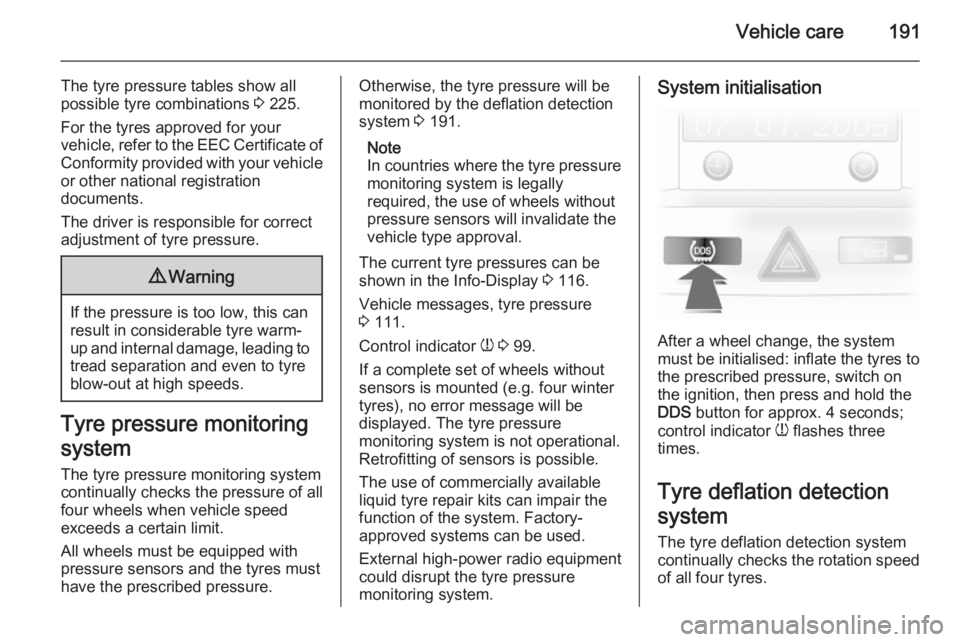
After a wheel change, the system
must be initialised: inflate the tyres to
the prescribed pressure, switch on
the ignition, then press and hold the
DDS button for approx. 4 seconds;
control indicator w flashes three
times.
Tyre deflation detection
system
The tyre deflation detection system
continually checks the rotation speed
of all four tyres.
Page 194 of 245
192Vehicle care
If a tyre loses pressure the control
indicator w illuminates red. Stop
immediately and check tyre pressure.
Control indicator w 3 99.
System initialisation
After tyre pressure correction or
wheel change, the system must be
initialised: Switch on the ignition,
press and hold the DDS button for
approx. 4 seconds, control indicator
w flashes three times.
Tread depth
Check tread depth at regular
intervals.
Tyres should be replaced for safety
reasons at a tread depth of 2-3 mm
(4 mm for winter tyres).
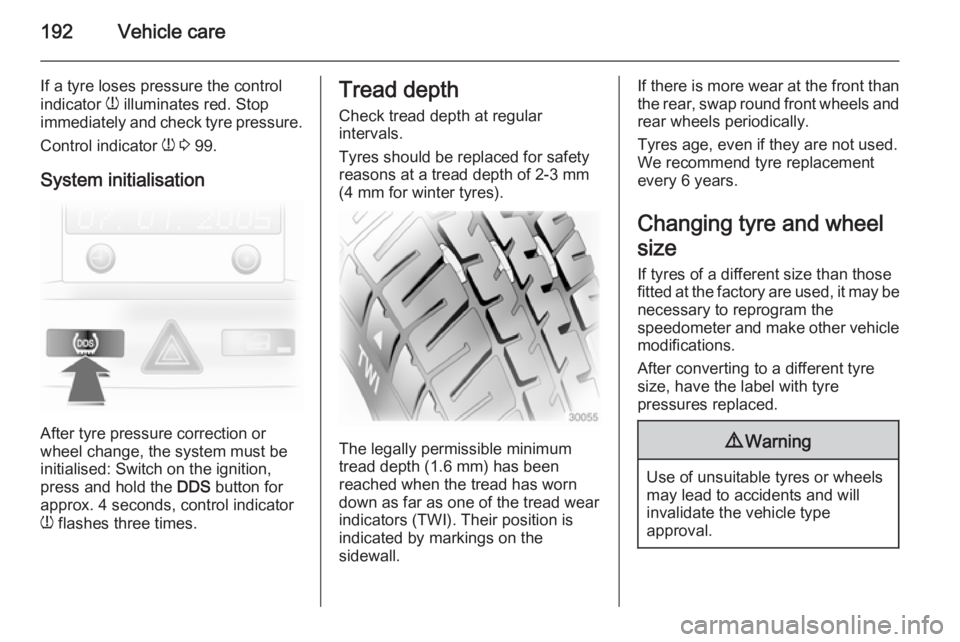
The legally permissible minimum
tread depth (1.6 mm) has been
reached when the tread has worn
down as far as one of the tread wear
indicators (TWI). Their position is
indicated by markings on the
sidewall.
If there is more wear at the front than
the rear, swap round front wheels and rear wheels periodically.
Tyres age, even if they are not used.
We recommend tyre replacement
every 6 years.
Changing tyre and wheel
size If tyres of a different size than those
fitted at the factory are used, it may be necessary to reprogram the
speedometer and make other vehicle
modifications.
After converting to a different tyre
size, have the label with tyre
pressures replaced.9 Warning
Use of unsuitable tyres or wheels
may lead to accidents and will
invalidate the vehicle type
approval.
Page 195 of 245
Vehicle care193Wheel coversWheel covers and tyres that are
factory approved for the respective
vehicle and comply with all of the
relevant wheel and tyre combination
requirements must be used.
If the wheel covers and tyres used are
not factory approved, the tyres must
not have a rim protection ridge.
Wheel covers must not impair brake
cooling.
Remove the wheel covers if tyre
chains are to be installed.9 Warning
Use of unsuitable tyres or wheel
covers could lead to sudden
pressure loss and thereby
accidents.
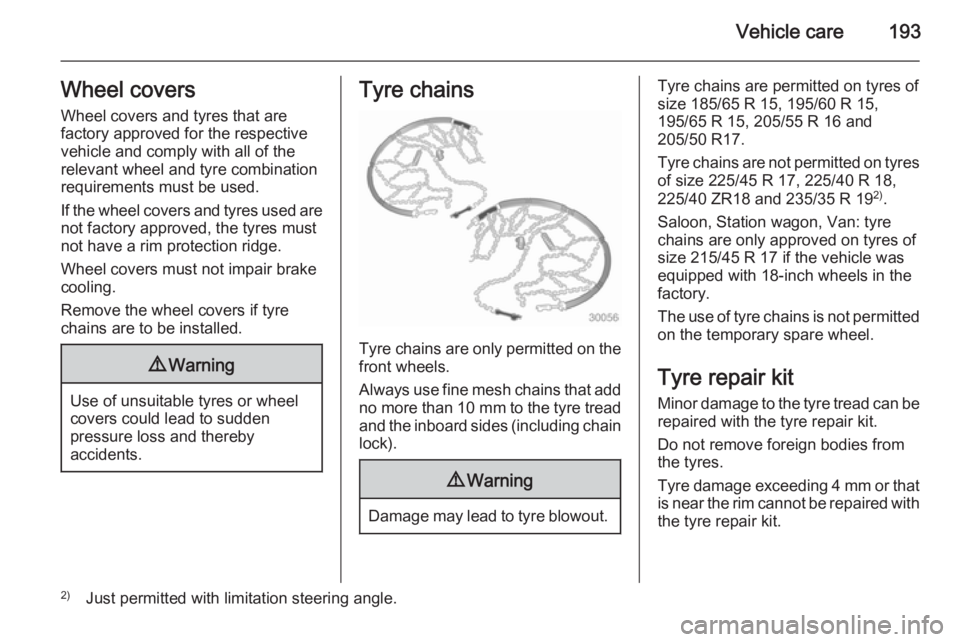
Tyre chains
Tyre chains are only permitted on the
front wheels.
Always use fine mesh chains that add no more than 10 mm to the tyre tread
and the inboard sides (including chain lock).
9 Warning
Damage may lead to tyre blowout.
Tyre chains are permitted on tyres of
size 185/65 R 15, 195/60 R 15,
195/65 R 15, 205/55 R 16 and
205/50 R17.
Tyre chains are not permitted on tyres of size 225/45 R 17, 225/40 R 18,
225/40 ZR18 and 235/35 R 19 2)
.
Saloon, Station wagon, Van: tyre chains are only approved on tyres of
size 215/45 R 17 if the vehicle was
equipped with 18-inch wheels in the
factory.
The use of tyre chains is not permitted on the temporary spare wheel.
Tyre repair kit Minor damage to the tyre tread can be
repaired with the tyre repair kit.
Do not remove foreign bodies from
the tyres.
Tyre damage exceeding 4 mm or that
is near the rim cannot be repaired with the tyre repair kit.2) Just permitted with limitation steering angle.
Page 196 of 245
194Vehicle care9Warning
Do not drive faster than 80 km/h.
Do not use for a lengthy period.
Steering and handling may be
affected.
If you have a flat tyre:
Apply parking brake and engage first
gear, reverse gear or P.
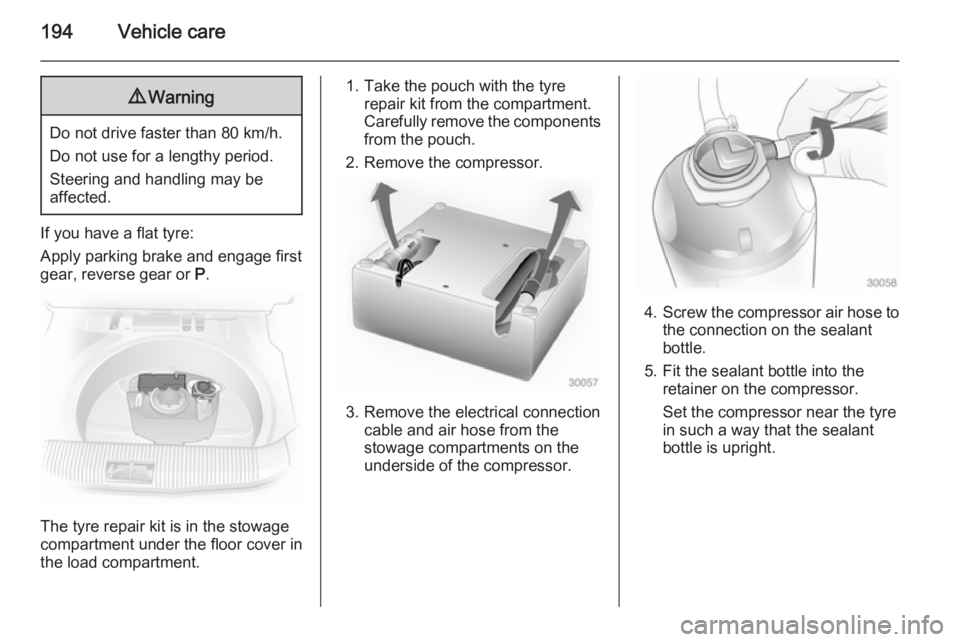
The tyre repair kit is in the stowage
compartment under the floor cover in
the load compartment.
1. Take the pouch with the tyre repair kit from the compartment.
Carefully remove the components
from the pouch.
2. Remove the compressor.
3. Remove the electrical connection cable and air hose from the
stowage compartments on the
underside of the compressor.
4. Screw the compressor air hose to
the connection on the sealant
bottle.
5. Fit the sealant bottle into the retainer on the compressor.
Set the compressor near the tyre
in such a way that the sealant
bottle is upright.
Page 202 of 245
200Vehicle careJump startingDo not start with quick charger.
A vehicle with a discharged battery
can be started using jump leads and the battery of another vehicle.9 Warning
Be extremely careful when starting
with jump leads. Any deviation
from the following instructions can
lead to injuries or damage caused
by battery explosion or damage to the electrical systems of both
vehicles.
9 Warning
Avoid contact with eyes, skin,
fabrics, and painted surfaces. The fluid contains sulphuric acid which can cause injuries and damage in
the event of direct contact.
■ Never expose the battery to naked flames or sparks.
■ A discharged battery can already freeze at temperatures of 0 °C.Defrost the frozen battery before
connecting jump leads.
■ Wear eye protection and protective
clothing when handling a battery.
■ Use a booster battery with the same voltage (12 Volts). Its
capacity (Ah) must not be much
less than that of the discharged
battery.
■ Use jump leads with insulated terminals and a cross section of at
least 16 mm 2
(25 mm 2
for diesel
engines).
■ Do not disconnect the discharged battery from the vehicle.
■ Switch off all unnecessary electrical
consumers.
■ Do not lean over the battery during jump starting.
■ Do not allow the terminals of one lead to touch those of the other
lead.■ The vehicles must not come into contact with each other during the
jump starting process.
■ Apply the parking brake, transmission in neutral, automatic
transmission in P.
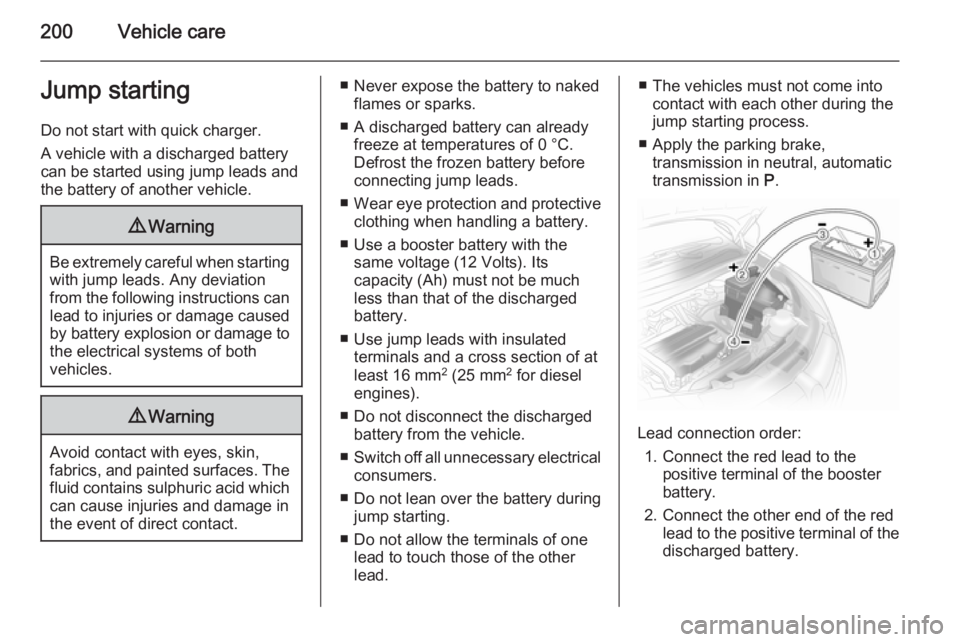
Lead connection order:
1. Connect the red lead to the positive terminal of the booster
battery.
2. Connect the other end of the red lead to the positive terminal of the
discharged battery.
Page 210 of 245
208Service and maintenance
Fixed service interval
When service is due, InSP appears in
the service display for approx.
10 seconds when the ignition is
switched on. Have the next service
performed by a workshop within
one week or 500 km (whichever
occurs first).
Service display 3 94.
Flexible service interval
The service interval is based on
several parameters depending on
usage and is calculated using these
parameters.
If the remaining distance is less than
1500 km, InSP is displayed with a
remaining distance of 1000 km when
the ignition is switched on and off. If
less than 1000 km remain, InSP is
displayed for several seconds. Have the next service performed by a
workshop within one week or
500 km (whichever occurs first).Display of remaining distance:
1. Switch off ignition.
2. Briefly press the trip odometer reset button. The odometer
reading is shown.
3. Press and hold the reset button for
about 2 seconds. InSP and the
remaining distance are displayed.
Service display 3 94.Recommended fluids,
lubricants and parts
Recommended fluids and
lubricants Only use products that meet the
recommended specifications.
Damage resulting from the use of
products not in line with these
specifiations will not be covered by
the warranty.9 Warning
Operating materials are
hazardous and could be
poisonous. Handle with care. Pay
attention to information given on
the containers.
Engine oil
Engine oil is identified by its quality
and its viscosity. Quality is more
important than viscosity when
selecting which engine oil to use. The oil quality ensures e.g. engine
cleanliness, wear protection and oil
Page 241 of 245
239
Child restraint systems ................61
Cigarette lighter ........................... 91
Climate control ............................. 15
Climate control systems .............124
Clock ............................................ 89
Continuous damping control ......149
Control indicators.......................... 94
Control of the vehicle .................132
Controls ........................................ 86
Convex shape .............................. 32
Coolant and antifreeze ...............208
Cruise control ....................102, 149
Cupholders .................................. 67
Curtain airbag system .................. 59
Curve lighting.............................. 119
D
Danger, Warnings and Cautions ...3
Daytime running lights ...............119
Declaration of conformity ............235
Deflation detection system and tyre pressure monitoring system 99
Diesel fuel system bleeding .......165
Diesel particle filter ....................135
Door open .................................. 102
Doors ............................................ 28
Drain diesel fuel filter .................110
Driving characteristics and towing tips .............................. 154
Driving hints ................................ 132E
Easytronic ................................... 142
Electric adjustment ......................33
Electrical system......................... 181
Electronic climate control system 127
Electronic driving programmes . ........................................ 139, 143
Electronic Stability Program 99, 147
End-of-life vehicle recovery .......160
Engine compartment fuse box ...182
Engine coolant ........................... 162
Engine coolant temperature ........99
Engine cooling level ..................110
Engine data ............................... 216
Engine exhaust .......................... 135
Engine identification ...................212
Engine oil ................... 161, 208, 213
Engine oil pressure ....................100
Entry lighting .............................. 122
Event data recorders ..................235
Exit lighting ................................ 123
Exterior care .............................. 203
Exterior light ............................... 101
Exterior lighting ....................13, 117
Exterior mirrors ............................. 32
F
Fault ................................... 140, 144
First aid ......................................... 81First aid kit ................................... 81
Fixed air vents ........................... 130
Fog light ..................................... 102
Fog lights ................................... 171
Folding mirrors ............................. 33
Folding tray .................................. 80
Front airbag system .....................58
Front fog lights ........................... 120
Front seats.................................... 49
Front turn signal light ..................166
Front turn signal lights ...............171
Fuel............................................. 151
Fuel consumption - CO 2-
Emissions ............................... 153
Fuel for diesel engines ..............152
Fuel for petrol engines ...............151
Fuel gauge ................................... 94 Fuses ......................................... 181
G
Gauges ......................................... 93
General information ...................154
Glovebox ..................................... 67
Graphic-Info-Display, Colour- Info-Display ............................ 105
H Halogen headlights ....................166
Hand brake ......................... 146, 147
Hazard warning flashers ............119
Page 244 of 245
242
Turn and lane-change signals ...120
Turn signal ................................... 96
Tyre chains ................................ 193
Tyre deflation detection system . 191
Tyre designations ......................190
Tyre pressure ....................111, 190
Tyre pressure monitoring system 191
Tyre pressures ................... 116, 225
Tyre repair kit ............................. 193
Tyres .......................................... 188
U Ultrasonic parking assist .............. 98
Upholstery .................................. 205
Using this manual ..........................3
V Vehicle battery ........................... 164
Vehicle checks............................ 160
Vehicle data ................................ 213
Vehicle data recording and privacy ..................................... 235
Vehicle dimensions .................... 223
Vehicle Identification Number ....211
Vehicle jack ................................ 187
Vehicle messages .....................109
Vehicle security ............................ 30
Vehicle specific data ......................3
Vehicle storage ........................... 159
Vehicle tools ............................... 187Vehicle unlocking ........................... 6
Vehicle weight ........................... 220
Ventilation ................................... 124
W
Warning chimes .........................109
Warning lights ............................... 93
Warning triangle .......................... 80
Washer and wiper systems .........14
Washer fluid ............................... 163
Washer fluid level ......................111
Wheel changing .........................196
Wheel covers ............................. 193
Wheels and tyres .......................188
Windows ....................................... 35
Windscreen................................... 35
Windscreen wiper/washer ...........87
Winter mode ................................ 98
Winter tyres ............................... 188
Wiper blade replacement ..........165
X Xenon headlights .......................169