ESP OPEL ASTRA SALOON 2014 Owner's Manual
[x] Cancel search | Manufacturer: OPEL, Model Year: 2014, Model line: ASTRA SALOON, Model: OPEL ASTRA SALOON 2014Pages: 245, PDF Size: 7.12 MB
Page 193 of 245
Vehicle care191
The tyre pressure tables show all
possible tyre combinations 3 225.
For the tyres approved for your
vehicle, refer to the EEC Certificate of Conformity provided with your vehicle
or other national registration
documents.
The driver is responsible for correct
adjustment of tyre pressure.9 Warning
If the pressure is too low, this can
result in considerable tyre warm-
up and internal damage, leading to tread separation and even to tyre
blow-out at high speeds.
Tyre pressure monitoring
system
The tyre pressure monitoring system
continually checks the pressure of all
four wheels when vehicle speed
exceeds a certain limit.
All wheels must be equipped with
pressure sensors and the tyres must
have the prescribed pressure.
Otherwise, the tyre pressure will be monitored by the deflation detection
system 3 191.
Note
In countries where the tyre pressure
monitoring system is legally
required, the use of wheels without
pressure sensors will invalidate the
vehicle type approval.
The current tyre pressures can be
shown in the Info-Display 3 116.
Vehicle messages, tyre pressure
3 111.
Control indicator w 3 99.
If a complete set of wheels without
sensors is mounted (e.g. four winter
tyres), no error message will be
displayed. The tyre pressure
monitoring system is not operational.
Retrofitting of sensors is possible.
The use of commercially available
liquid tyre repair kits can impair the
function of the system. Factory-
approved systems can be used.
External high-power radio equipment
could disrupt the tyre pressure
monitoring system.System initialisation
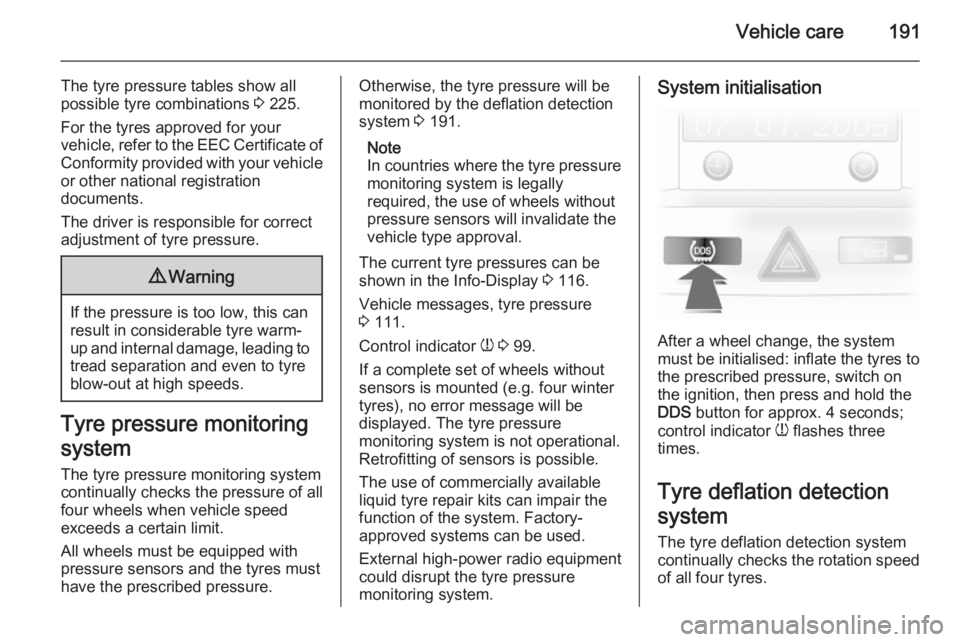
After a wheel change, the system
must be initialised: inflate the tyres to
the prescribed pressure, switch on
the ignition, then press and hold the
DDS button for approx. 4 seconds;
control indicator w flashes three
times.
Tyre deflation detection
system
The tyre deflation detection system
continually checks the rotation speed
of all four tyres.
Page 195 of 245
Vehicle care193Wheel coversWheel covers and tyres that are
factory approved for the respective
vehicle and comply with all of the
relevant wheel and tyre combination
requirements must be used.
If the wheel covers and tyres used are
not factory approved, the tyres must
not have a rim protection ridge.
Wheel covers must not impair brake
cooling.
Remove the wheel covers if tyre
chains are to be installed.9 Warning
Use of unsuitable tyres or wheel
covers could lead to sudden
pressure loss and thereby
accidents.
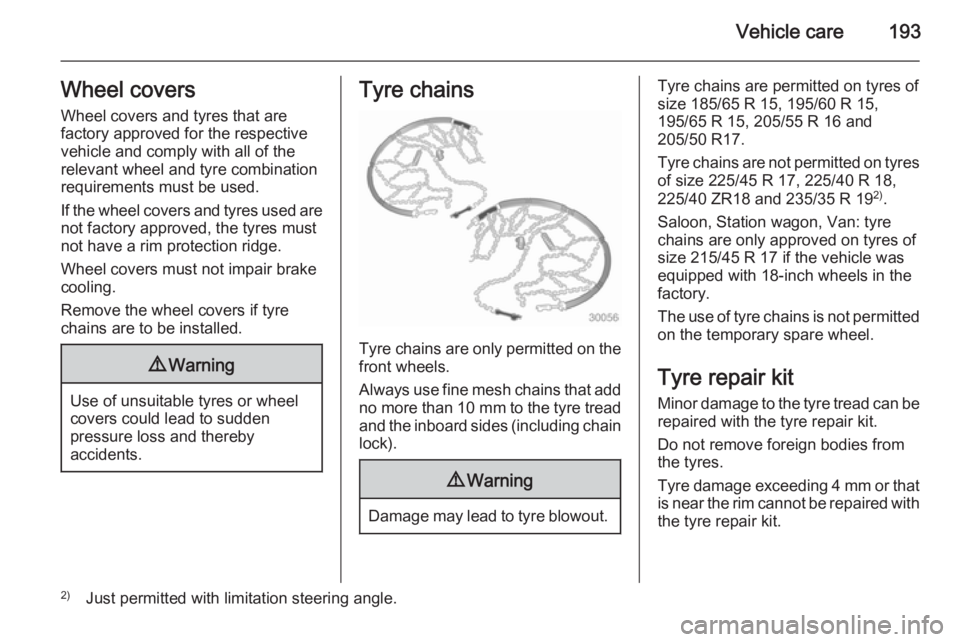
Tyre chains
Tyre chains are only permitted on the
front wheels.
Always use fine mesh chains that add no more than 10 mm to the tyre tread
and the inboard sides (including chain lock).
9 Warning
Damage may lead to tyre blowout.
Tyre chains are permitted on tyres of
size 185/65 R 15, 195/60 R 15,
195/65 R 15, 205/55 R 16 and
205/50 R17.
Tyre chains are not permitted on tyres of size 225/45 R 17, 225/40 R 18,
225/40 ZR18 and 235/35 R 19 2)
.
Saloon, Station wagon, Van: tyre chains are only approved on tyres of
size 215/45 R 17 if the vehicle was
equipped with 18-inch wheels in the
factory.
The use of tyre chains is not permitted on the temporary spare wheel.
Tyre repair kit Minor damage to the tyre tread can be
repaired with the tyre repair kit.
Do not remove foreign bodies from
the tyres.
Tyre damage exceeding 4 mm or that
is near the rim cannot be repaired with the tyre repair kit.2) Just permitted with limitation steering angle.
Page 208 of 245
206Vehicle care
Clean the leather upholstery with
clear water and a soft cloth. In case of heavy soiling, use leather care.
The instrument cluster and the
displays should only be cleaned using
a soft damp cloth. If necessary use a
weak soap solution.
Clean fabric upholstery with a
vacuum cleaner and brush. Remove
stains with an upholstery cleaner.
Clothing fabrics may not be
colourfast. This could cause visible
discolourations, especially on light-
coloured upholstery. Removable
stains and discolourations should be
cleaned as soon as possible.
Clean seat belts with lukewarm water or interior cleaner.Caution
Close Velcro fasteners as open
Velcro fasteners on clothing could damage seat upholstery.
The same applies to clothing with
sharp-edged objects, e.g. zips, belts or studded jeans.
Plastic and rubber parts
Plastic and rubber parts can be
cleaned with the same cleaner as
used to clean the body. Use interior
cleaner if necessary. Do not use any
other agent. Avoid solvents and petrol in particular. Do not use high-
pressure jet cleaners.
Page 214 of 245
212Technical dataIdentification plate
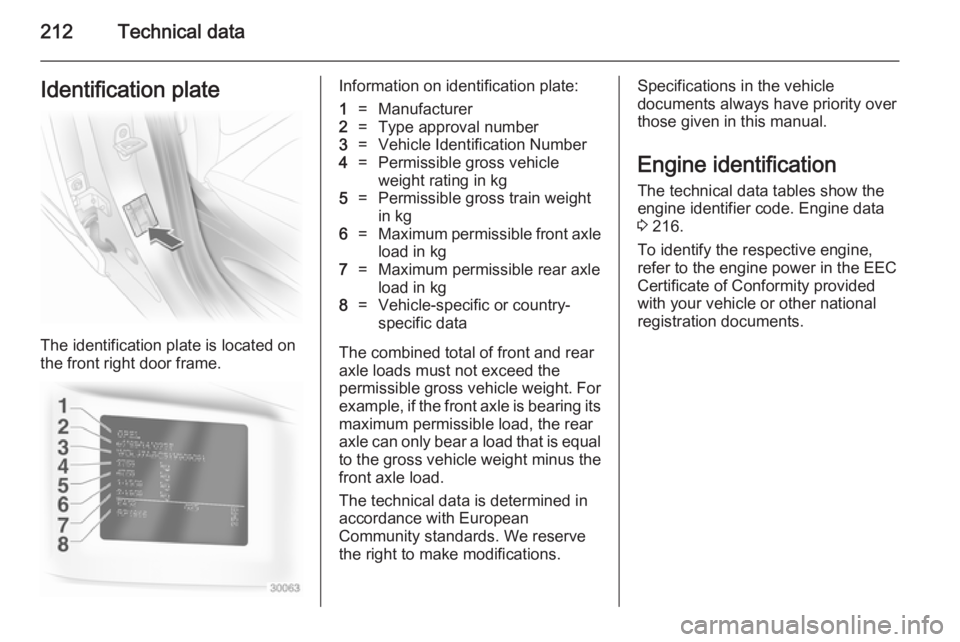
The identification plate is located on
the front right door frame.
Information on identification plate:1=Manufacturer2=Type approval number3=Vehicle Identification Number4=Permissible gross vehicle
weight rating in kg5=Permissible gross train weight
in kg6=Maximum permissible front axle load in kg7=Maximum permissible rear axle
load in kg8=Vehicle-specific or country-
specific data
The combined total of front and rear
axle loads must not exceed the
permissible gross vehicle weight. For
example, if the front axle is bearing its
maximum permissible load, the rear
axle can only bear a load that is equal
to the gross vehicle weight minus the front axle load.
The technical data is determined in
accordance with European
Community standards. We reserve
the right to make modifications.
Specifications in the vehicle
documents always have priority over
those given in this manual.
Engine identification
The technical data tables show the
engine identifier code. Engine data
3 216.
To identify the respective engine,
refer to the engine power in the EEC
Certificate of Conformity provided
with your vehicle or other national
registration documents.
Page 215 of 245
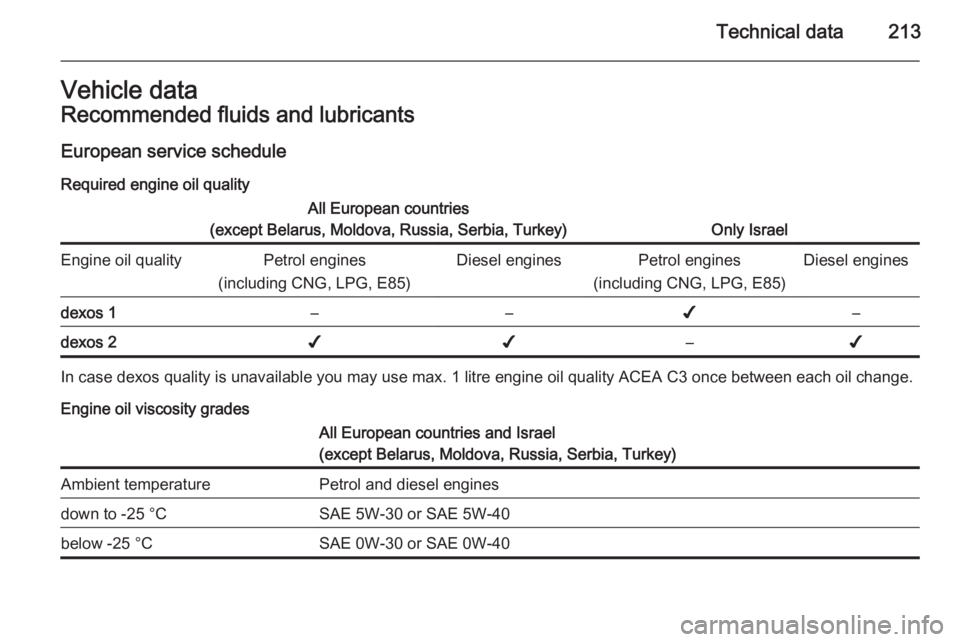
Technical data213Vehicle dataRecommended fluids and lubricantsEuropean service scheduleRequired engine oil qualityAll European countries
(except Belarus, Moldova, Russia, Serbia, Turkey)
Only Israel
Engine oil qualityPetrol engines
(including CNG, LPG, E85)Diesel enginesPetrol engines
(including CNG, LPG, E85)Diesel enginesdexos 1––✔–dexos 2✔✔–✔
In case dexos quality is unavailable you may use max. 1 litre engine oil quality ACEA C3 once between each oil change.
Engine oil viscosity grades
All European countries and Israel (except Belarus, Moldova, Russia, Serbia, Turkey)Ambient temperaturePetrol and diesel enginesdown to -25 °CSAE 5W-30 or SAE 5W-40below -25 °CSAE 0W-30 or SAE 0W-40
Page 216 of 245
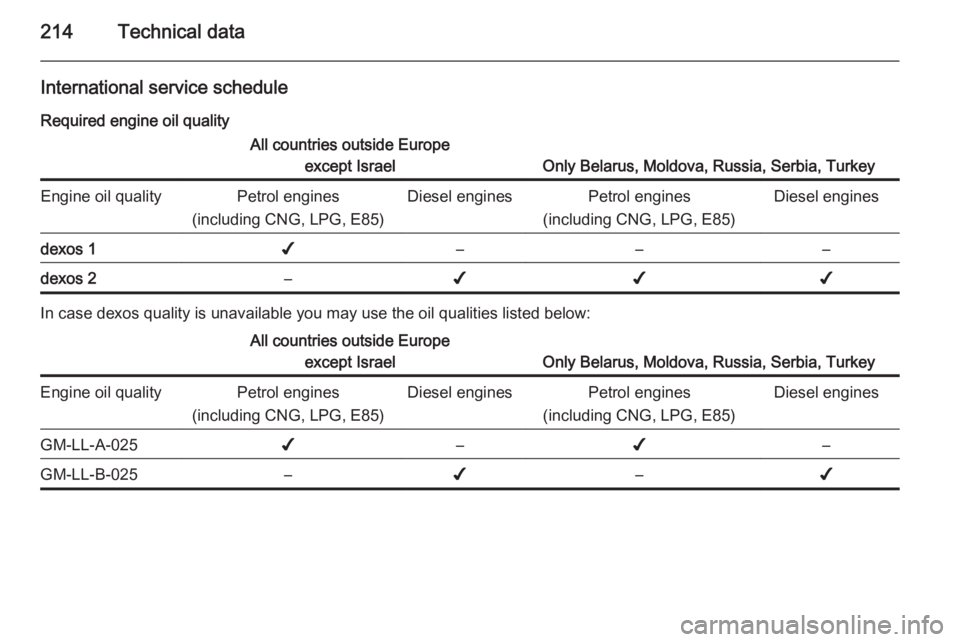
214Technical data
International service scheduleRequired engine oil qualityAll countries outside Europe except Israel
Only Belarus, Moldova, Russia, Serbia, Turkey
Engine oil qualityPetrol engines
(including CNG, LPG, E85)Diesel enginesPetrol engines
(including CNG, LPG, E85)Diesel enginesdexos 1✔–––dexos 2–✔✔✔
In case dexos quality is unavailable you may use the oil qualities listed below:
All countries outside Europe except Israel
Only Belarus, Moldova, Russia, Serbia, Turkey
Engine oil qualityPetrol engines
(including CNG, LPG, E85)Diesel enginesPetrol engines
(including CNG, LPG, E85)Diesel enginesGM-LL-A-025✔–✔–GM-LL-B-025–✔–✔
Page 217 of 245
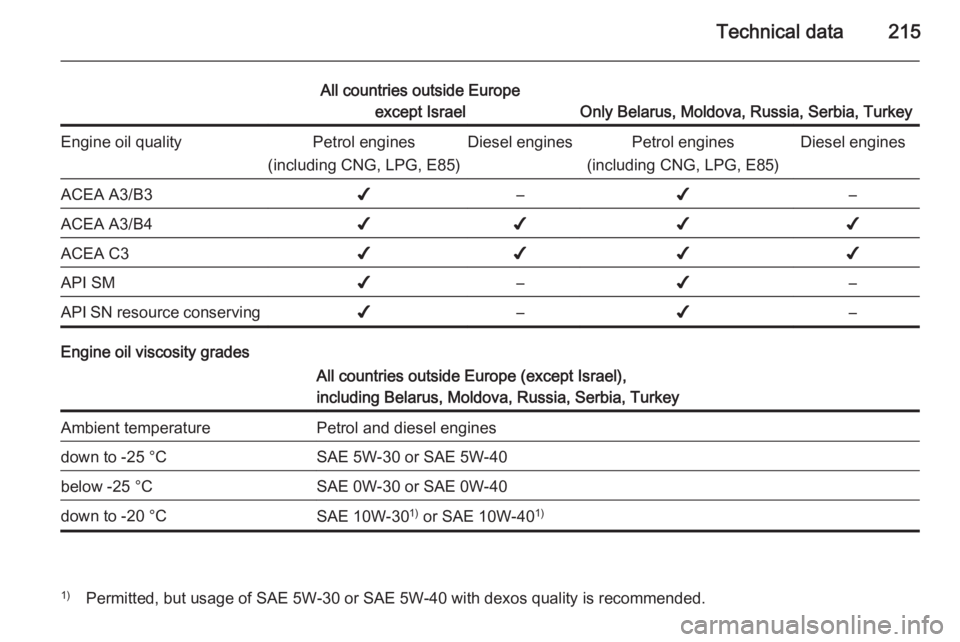
Technical data215
All countries outside Europeexcept Israel
Only Belarus, Moldova, Russia, Serbia, Turkey
Engine oil qualityPetrol engines
(including CNG, LPG, E85)Diesel enginesPetrol engines
(including CNG, LPG, E85)Diesel enginesACEA A3/B3✔–✔–ACEA A3/B4✔✔✔✔ACEA C3✔✔✔✔API SM✔–✔–API SN resource conserving✔–✔–
Engine oil viscosity grades
All countries outside Europe (except Israel),
including Belarus, Moldova, Russia, Serbia, TurkeyAmbient temperaturePetrol and diesel enginesdown to -25 °CSAE 5W-30 or SAE 5W-40below -25 °CSAE 0W-30 or SAE 0W-40down to -20 °CSAE 10W-30 1)
or SAE 10W-40 1)1)
Permitted, but usage of SAE 5W-30 or SAE 5W-40 with dexos quality is recommended.