steering OPEL ASTRA SALOON 2014 Owner's Manual
[x] Cancel search | Manufacturer: OPEL, Model Year: 2014, Model line: ASTRA SALOON, Model: OPEL ASTRA SALOON 2014Pages: 245, PDF Size: 7.12 MB
Page 122 of 245
120LightingTurn and lane-change
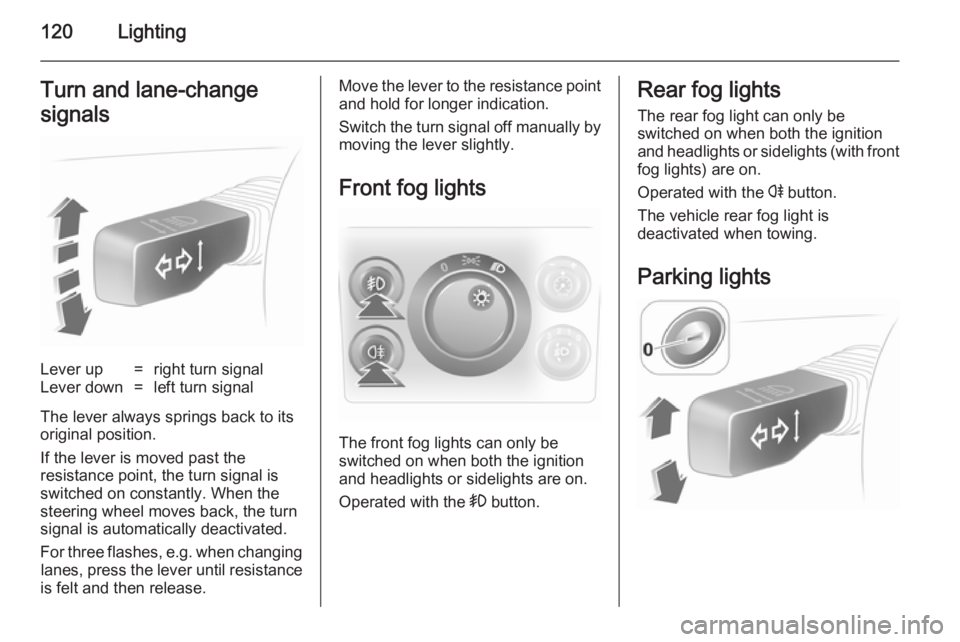
signalsLever up=right turn signalLever down=left turn signal
The lever always springs back to its
original position.
If the lever is moved past the
resistance point, the turn signal is
switched on constantly. When the
steering wheel moves back, the turn
signal is automatically deactivated.
For three flashes, e.g. when changing lanes, press the lever until resistance
is felt and then release.
Move the lever to the resistance point
and hold for longer indication.
Switch the turn signal off manually by moving the lever slightly.
Front fog lights
The front fog lights can only be
switched on when both the ignition and headlights or sidelights are on.
Operated with the > button.
Rear fog lights
The rear fog light can only be
switched on when both the ignition
and headlights or sidelights (with front fog lights) are on.
Operated with the r button.
The vehicle rear fog light is
deactivated when towing.
Parking lights
Page 134 of 245
132Driving and operatingDriving and operatingDriving hints............................... 132
Starting and operating ...............132
Engine exhaust .......................... 135
Automatic transmission .............. 136
Manual transmission ..................141
Manual transmission automa‐
ted .............................................. 142
Brakes ........................................ 146
Ride control systems .................147
Cruise control ............................. 149
Object detection systems ........... 150
Fuel ............................................ 151
Trailer hitch ................................ 154Driving hints
Control of the vehicleNever coast with engine not
running
Many systems will not function in this
situation (e.g. brake servo unit, power
steering). Driving in this manner is a
danger to yourself and others.
Pedals To ensure the pedal travel is
uninhibited, there must be no mats in
the area of the pedals.Starting and operating
New vehicle running-in Do not brake unnecessarily hard for
the first few journeys.
During the first drive, smoke may
occur because of wax and oil
evaporating off the exhaust system.
Park the vehicle in the open for a
while after the first drive and avoid
inhaling the fumes.
Fuel and engine oil consumption may be higher during the running-in
period.
Page 135 of 245
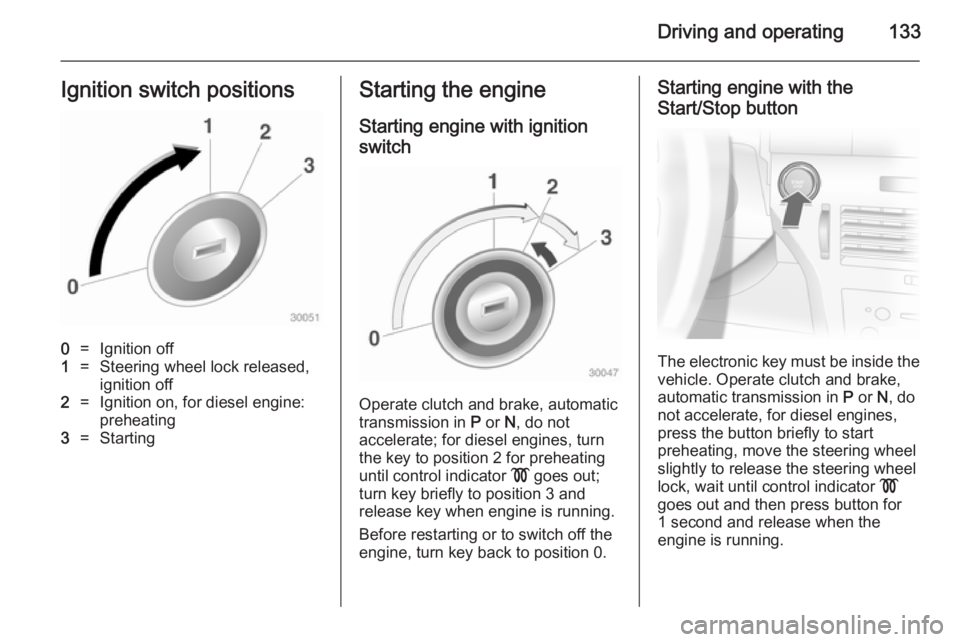
Driving and operating133Ignition switch positions0=Ignition off1=Steering wheel lock released,ignition off2=Ignition on, for diesel engine:
preheating3=StartingStarting the engine
Starting engine with ignition
switch
Operate clutch and brake, automatic
transmission in P or N, do not
accelerate; for diesel engines, turn
the key to position 2 for preheating
until control indicator ! goes out;
turn key briefly to position 3 and
release key when engine is running.
Before restarting or to switch off the
engine, turn key back to position 0.
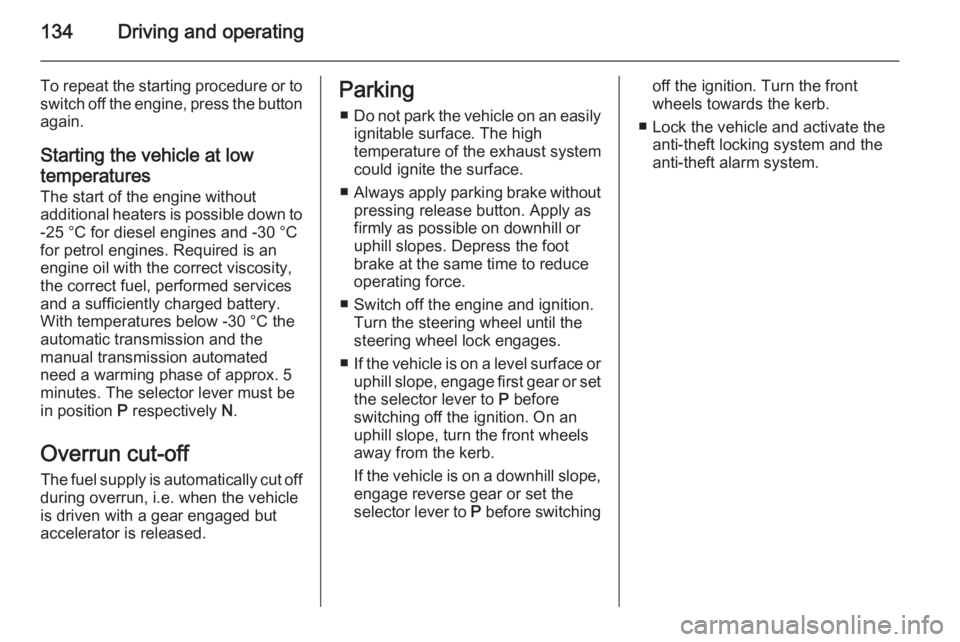
Starting engine with the
Start/Stop button
The electronic key must be inside the
vehicle. Operate clutch and brake,
automatic transmission in P or N, do
not accelerate, for diesel engines,
press the button briefly to start
preheating, move the steering wheel
slightly to release the steering wheel
lock, wait until control indicator !
goes out and then press button for
1 second and release when the
engine is running.
Page 136 of 245
134Driving and operating
To repeat the starting procedure or to
switch off the engine, press the button again.
Starting the vehicle at low
temperatures
The start of the engine without
additional heaters is possible down to -25 °С for diesel engines and -30 °C
for petrol engines. Required is an engine oil with the correct viscosity,
the correct fuel, performed services
and a sufficiently charged battery.
With temperatures below -30 °C the
automatic transmission and the
manual transmission automated
need a warming phase of approx. 5
minutes. The selector lever must be
in position P respectively N.
Overrun cut-off The fuel supply is automatically cut off
during overrun, i.e. when the vehicle
is driven with a gear engaged but
accelerator is released.Parking
■ Do not park the vehicle on an easily
ignitable surface. The high
temperature of the exhaust system
could ignite the surface.
■ Always apply parking brake without
pressing release button. Apply as
firmly as possible on downhill or
uphill slopes. Depress the foot
brake at the same time to reduce
operating force.
■ Switch off the engine and ignition. Turn the steering wheel until the
steering wheel lock engages.
■ If the vehicle is on a level surface or
uphill slope, engage first gear or set
the selector lever to P before
switching off the ignition. On an uphill slope, turn the front wheels
away from the kerb.
If the vehicle is on a downhill slope, engage reverse gear or set the
selector lever to P before switchingoff the ignition. Turn the front
wheels towards the kerb.
■ Lock the vehicle and activate the anti-theft locking system and the
anti-theft alarm system.
Page 150 of 245
148Driving and operating9Warning
Do not let this special safety
feature tempt you into taking risks
when driving.
Adapt speed to the road
conditions.
Control indicator v 3 99.
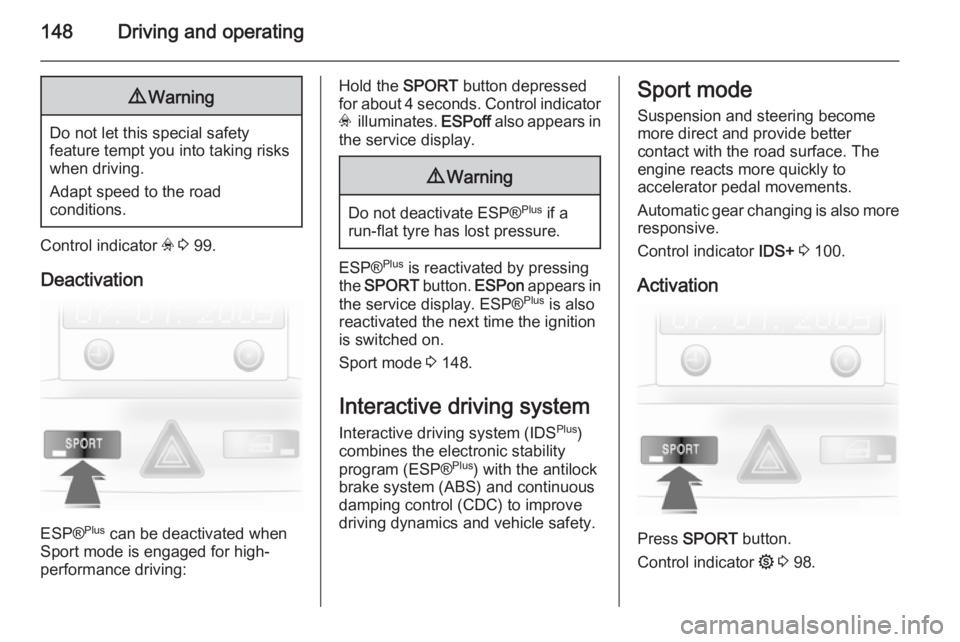
Deactivation
ESP® Plus
can be deactivated when
Sport mode is engaged for high-
performance driving:
Hold the SPORT button depressed
for about 4 seconds. Control indicator v illuminates. ESPoff also appears in
the service display.9 Warning
Do not deactivate ESP® Plus
if a
run-flat tyre has lost pressure.
ESP® Plus
is reactivated by pressing
the SPORT button. ESPon appears in
the service display. ESP® Plus
is also
reactivated the next time the ignition is switched on.
Sport mode 3 148.
Interactive driving system Interactive driving system (IDS Plus
)
combines the electronic stability
program (ESP® Plus
) with the antilock
brake system (ABS) and continuous damping control (CDC) to improve
driving dynamics and vehicle safety.
Sport mode
Suspension and steering become
more direct and provide better
contact with the road surface. The
engine reacts more quickly to
accelerator pedal movements.
Automatic gear changing is also more
responsive.
Control indicator IDS+ 3 100.
Activation
Press SPORT button.
Control indicator 1 3 98.
Page 156 of 245
154Driving and operating
higher fuel consumption and
CO 2 emission levels and a lower
maximum speed.Trailer hitch
General information
Only use towing equipment that has
been approved for your vehicle.
Entrust retrofitting of towing
equipment to a workshop. It may be
necessary to make changes that
affect the cooling system, heat
shields or other equipment.
Do not mount towing equipment to
vehicles with Z 20 LEH engine.
Fitting of towing equipment could
cover the opening of the towing eye.
If this is the case, use the coupling ball bar for towing. Always keep the
coupling ball bar in the vehicle.
Installation dimensions of factory-
fitted towing equipment 3 232.Driving characteristics and
towing tips Before attaching a trailer, lubricate
the coupling ball. However, do not do
so if a stabiliser, which acts on the
coupling ball, is being used to reduce snaking movements.
For trailers with low driving stability
and trailers with a permitted gross
vehicle weight of more than 1300 kg
(Saloon) /1200 kg (Station wagon) a
speed of 80 km/h must not be
exceeded; the use of a stabiliser is
recommended.
If the trailer starts snaking, drive more
slowly, do not attempt to correct the
steering and brake sharply if
necessary.
When driving downhill, drive in the
same gear as if driving uphill and
drive at a similar speed.
Adjust tyre pressure to the value
specified for full load 3 225.
Page 185 of 245
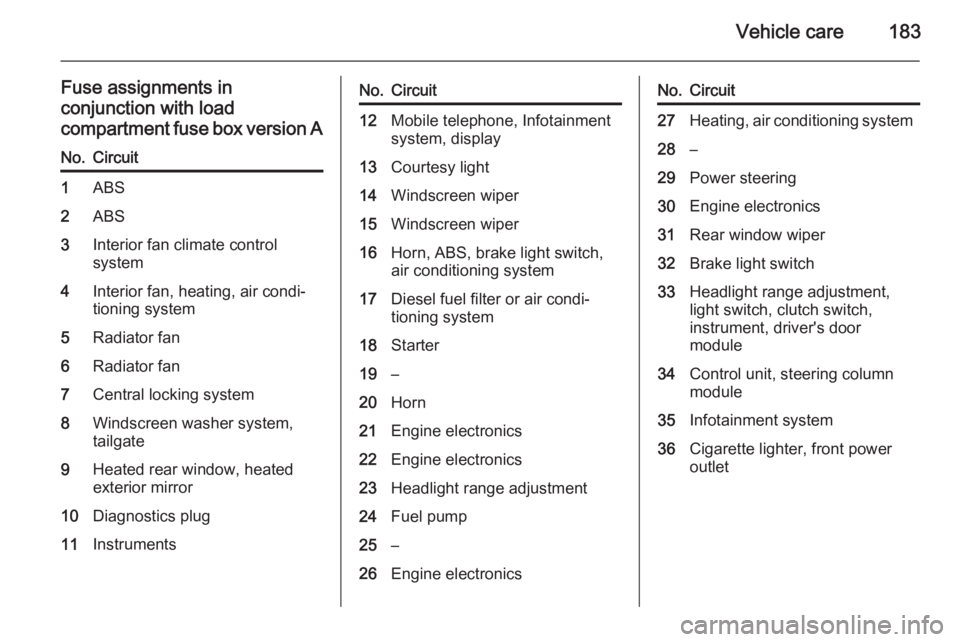
Vehicle care183
Fuse assignments inconjunction with loadcompartment fuse box version ANo.Circuit1ABS2ABS3Interior fan climate control
system4Interior fan, heating, air condi‐
tioning system5Radiator fan6Radiator fan7Central locking system8Windscreen washer system,
tailgate9Heated rear window, heated
exterior mirror10Diagnostics plug11InstrumentsNo.Circuit12Mobile telephone, Infotainment
system, display13Courtesy light14Windscreen wiper15Windscreen wiper16Horn, ABS, brake light switch,
air conditioning system17Diesel fuel filter or air condi‐
tioning system18Starter19–20Horn21Engine electronics22Engine electronics23Headlight range adjustment24Fuel pump25–26Engine electronicsNo.Circuit27Heating, air conditioning system28–29Power steering30Engine electronics31Rear window wiper32Brake light switch33Headlight range adjustment,
light switch, clutch switch,
instrument, driver's door
module34Control unit, steering column
module35Infotainment system36Cigarette lighter, front power
outlet
Page 186 of 245
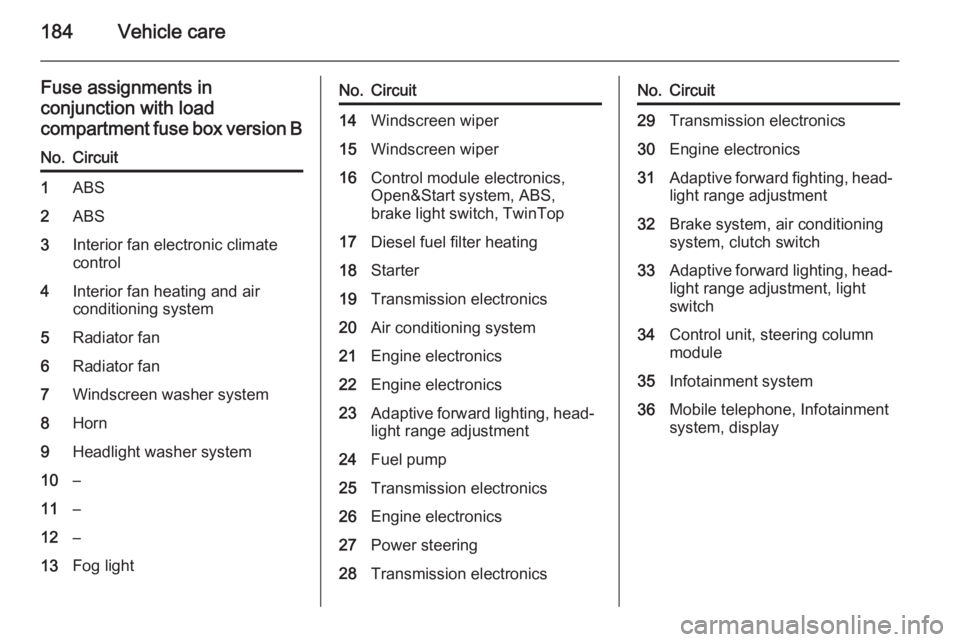
184Vehicle care
Fuse assignments inconjunction with load
compartment fuse box version BNo.Circuit1ABS2ABS3Interior fan electronic climate control4Interior fan heating and air
conditioning system5Radiator fan6Radiator fan7Windscreen washer system8Horn9Headlight washer system10–11–12–13Fog lightNo.Circuit14Windscreen wiper15Windscreen wiper16Control module electronics,
Open&Start system, ABS,
brake light switch, TwinTop17Diesel fuel filter heating18Starter19Transmission electronics20Air conditioning system21Engine electronics22Engine electronics23Adaptive forward lighting, head‐
light range adjustment24Fuel pump25Transmission electronics26Engine electronics27Power steering28Transmission electronicsNo.Circuit29Transmission electronics30Engine electronics31Adaptive forward fighting, head‐ light range adjustment32Brake system, air conditioning
system, clutch switch33Adaptive forward lighting, head‐
light range adjustment, light
switch34Control unit, steering column
module35Infotainment system36Mobile telephone, Infotainment
system, display
Page 195 of 245
Vehicle care193Wheel coversWheel covers and tyres that are
factory approved for the respective
vehicle and comply with all of the
relevant wheel and tyre combination
requirements must be used.
If the wheel covers and tyres used are
not factory approved, the tyres must
not have a rim protection ridge.
Wheel covers must not impair brake
cooling.
Remove the wheel covers if tyre
chains are to be installed.9 Warning
Use of unsuitable tyres or wheel
covers could lead to sudden
pressure loss and thereby
accidents.
Tyre chains
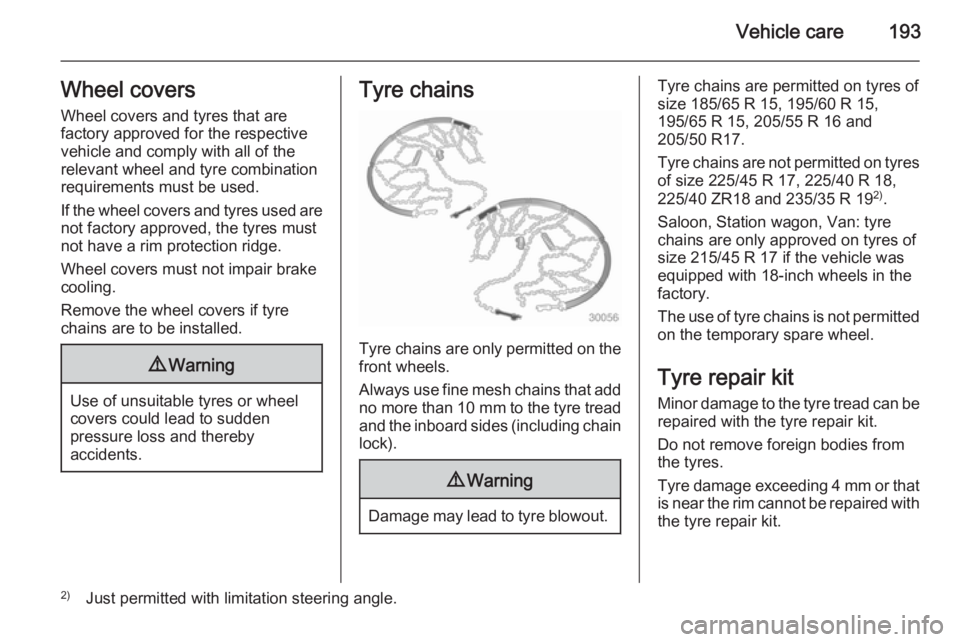
Tyre chains are only permitted on the
front wheels.
Always use fine mesh chains that add no more than 10 mm to the tyre tread
and the inboard sides (including chain lock).
9 Warning
Damage may lead to tyre blowout.
Tyre chains are permitted on tyres of
size 185/65 R 15, 195/60 R 15,
195/65 R 15, 205/55 R 16 and
205/50 R17.
Tyre chains are not permitted on tyres of size 225/45 R 17, 225/40 R 18,
225/40 ZR18 and 235/35 R 19 2)
.
Saloon, Station wagon, Van: tyre chains are only approved on tyres of
size 215/45 R 17 if the vehicle was
equipped with 18-inch wheels in the
factory.
The use of tyre chains is not permitted on the temporary spare wheel.
Tyre repair kit Minor damage to the tyre tread can be
repaired with the tyre repair kit.
Do not remove foreign bodies from
the tyres.
Tyre damage exceeding 4 mm or that
is near the rim cannot be repaired with the tyre repair kit.2) Just permitted with limitation steering angle.
Page 196 of 245
194Vehicle care9Warning
Do not drive faster than 80 km/h.
Do not use for a lengthy period.
Steering and handling may be
affected.
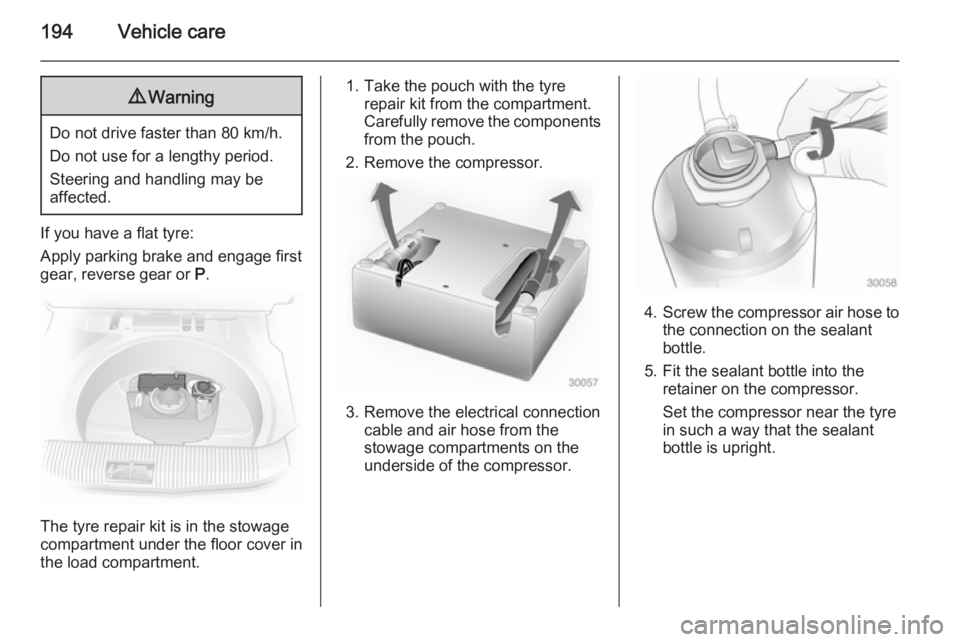
If you have a flat tyre:
Apply parking brake and engage first
gear, reverse gear or P.
The tyre repair kit is in the stowage
compartment under the floor cover in
the load compartment.
1. Take the pouch with the tyre repair kit from the compartment.
Carefully remove the components
from the pouch.
2. Remove the compressor.
3. Remove the electrical connection cable and air hose from the
stowage compartments on the
underside of the compressor.
4. Screw the compressor air hose to
the connection on the sealant
bottle.
5. Fit the sealant bottle into the retainer on the compressor.
Set the compressor near the tyre
in such a way that the sealant
bottle is upright.