roof OPEL ASTRA SALOON 2014 Owner's Guide
[x] Cancel search | Manufacturer: OPEL, Model Year: 2014, Model line: ASTRA SALOON, Model: OPEL ASTRA SALOON 2014Pages: 245, PDF Size: 7.12 MB
Page 198 of 245
196Vehicle care
Drain excess tyre pressure with
the button over the pressure indicator.
Do not run the compressor longer than 10 minutes.
14. Detach the tyre repair kit. Screw the filler hose to the free
connection on the sealant bottle.
This prevents sealant leakage.
Stow the tyre repair kit in the load
compartment.
15. Remove any excess sealant using a cloth.
16. Take the label indicating maximum permitted speed from
the sealant bottle and affix in the
driver's field of view.
17. Continue driving immediately so that sealant is evenly distributed
in the tyre. After driving approx.
10 km (but no more than
10 minutes), stop and check tyre
pressure. Screw compressor air
hose directly onto tyre valve and
compressor when doing this.
If tyre pressure is more than
1.3 bar , set it to the correct value.Repeat the procedure until there
is no more loss of pressure.
If the tyre pressure has fallen
below 1.3 bar, the vehicle must
not be used. Seek the assistance
of a workshop.
18. Stow away tyre repair kit in load compartment.
Note
The driving characteristics of the
repaired tyre is severely affected,
therefore have this tyre replaced.
If unusual noise is heard or the
compressor becomes hot, turn
compressor off for at least 30
minutes.
The built-in safety valve opens at a
pressure of 7 bar.
Note the expiry date of the kit. After
this date its sealing capability is no
longer guaranteed. Pay attention to
storage information on sealant
bottle.
Replace the used sealant bottle. Dispose of the bottle as prescribed
by applicable laws.The compressor and sealant can be used from approx. -30 °C.
The adapters supplied can be used
to pump up other items e.g.
footballs, air mattresses, inflatable
dinghies etc. They are located on the underside of the compressor. To
remove, screw on compressor air
hose and withdraw adapter.
Wheel changing Some vehicles are equipped with a
tyre repair kit instead of a spare wheel 3 193.
Make the following preparations and
observe the following information:
■ Park the vehicle on a level, firm and
non-skid surface. The front wheels
must be in the straight-ahead
position.
■ Apply the parking brake and engage first gear, reverse gear or
P .
■ Remove the spare wheel 3 198.
■ On the Astra TwinTop, the roof must be closed before the vehicle
is raised.
Page 201 of 245
Vehicle care199
The spare wheel well is not designedfor all permitted tyre sizes. If a wheel
wider than the spare must be stowed
in the spare wheel well after changing
wheels, the floor cover can be placed on the projecting wheel.
This must be taken into consideration
when the load compartment is being
loaded, particularly with the Astra
TwinTop 3 41.
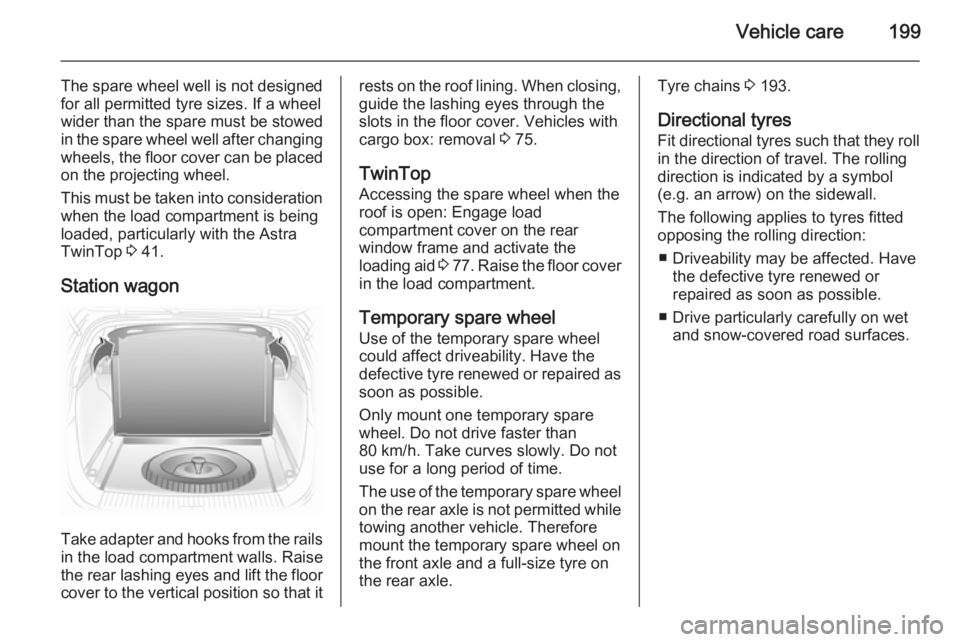
Station wagon
Take adapter and hooks from the rails
in the load compartment walls. Raise
the rear lashing eyes and lift the floor cover to the vertical position so that it
rests on the roof lining. When closing,
guide the lashing eyes through the
slots in the floor cover. Vehicles with
cargo box: removal 3 75.
TwinTop
Accessing the spare wheel when the roof is open: Engage load
compartment cover on the rear
window frame and activate the
loading aid 3 77 . Raise the floor cover
in the load compartment.
Temporary spare wheel
Use of the temporary spare wheel
could affect driveability. Have the
defective tyre renewed or repaired as soon as possible.
Only mount one temporary spare
wheel. Do not drive faster than
80 km/h. Take curves slowly. Do not
use for a long period of time.
The use of the temporary spare wheel
on the rear axle is not permitted while
towing another vehicle. Therefore
mount the temporary spare wheel on
the front axle and a full-size tyre on
the rear axle.Tyre chains 3 193.
Directional tyres Fit directional tyres such that they rollin the direction of travel. The rolling
direction is indicated by a symbol
(e.g. an arrow) on the sidewall.
The following applies to tyres fitted
opposing the rolling direction:
■ Driveability may be affected. Have the defective tyre renewed or
repaired as soon as possible.
■ Drive particularly carefully on wet and snow-covered road surfaces.
Page 206 of 245
204Vehicle care
If using a car wash, comply with the
car wash manufacturer's instructions. The windscreen wipers and rear
window wiper must be switched off.
Remove antenna and external
accessories such as roof racks etc.
If you wash your vehicle by hand,
make sure that the insides of the
wheel housings are also thoroughly
rinsed out.
Clean edges and folds on opened
doors and the bonnet as well as the
areas they cover.Caution
Always use a cleaning agent with
a pH value of 4 to 9.
Do not use cleaning agents on hot surfaces.
Do not clean the engine compartmentwith a steam-jet or high-pressure jet
cleaner.
Thoroughly rinse and leather-off the vehicle. Rinse leather frequently. Use
separate leathers for painted and
glass surfaces: remnants of wax on
the windows will impair vision.
Do not use hard objects to remove
spots of tar. Use tar removal spray on
painted surfaces.
Exterior lights
Headlight and other light covers are
made of plastic. Do not use any
abrasive or caustic agents, do not use an ice scraper, and do not clean them
dry.
Polishing and waxing Wax the vehicle regularly (at the
latest when water no longer beads).
Otherwise, the paintwork will dry out.
Polishing is necessary only if the paint
has become dull or if solid deposits
have become attached to it.
Paintwork polish with silicone forms a
protective film, making waxing
unnecessary.
Plastic body parts must not be treated with wax or polishing agents.Windows and windscreen wiper
blades
Use a soft lint-free cloth or chamois
leather together with window cleaner and insect remover.
When cleaning the rear window from
inside, always wipe in parallel to the
heating element to prevent damage.
For mechanical removal of ice, use a
sharp-edged ice scraper. Press the
scraper firmly against the glass so
that no dirt can get under it and
scratch the glass.
Clean smearing wiper blades with a
soft cloth and window cleaner.
Sun roof Never clean with solvents or abrasive
agents, fuels, aggressive media
(e.g. paint cleaner, acetone-
containing solutions etc.), acidic or
highly alkaline media or abrasive
pads. Do not apply wax or polishing
agents to the middle part of the sun
roof.
Page 207 of 245
Vehicle care205
Wheels and tyresDo not use high-pressure jet
cleaners.
Clean rims with a pH-neutral wheel
cleaner.
Rims are painted and can be treated
with the same agents as the body.
Paintwork damageRectify minor paintwork damage witha touch-up pen before rust forms.
Have more extensive damage or rust
areas repaired by a workshop.
Underbody Some areas of the vehicle underbody
have a PVC undercoating while other critical areas have a durable
protective wax coating.
After the underbody is washed, check
the underbody and have it waxed if
necessary.
Bitumen/rubber materials could
damage the PVC coating. Have
underbody work carried out by a
workshop.Before and after winter, wash the
underbody and have the protective
wax coating checked.
Engine compartment
Areas of the engine compartment that
are painted in the same colour as the vehicle must be looked after like any
other painted surface.
It is advisable to wash the engine
compartment before and after winter
and preserve it with wax. Protect the
alternator and brake fluid reservoir
with plastic sheets before washing
the engine.
When washing the engine with a
steam-jet cleaner, do not direct the
steam jet towards components of the
antilock brake system, air
conditioning system or the belt drive
and its components.
After an engine wash, have all engine
room components preserved
thoroughly by a workshop using
protective wax.
Do not use high-pressure jet
cleaners.TwinTop
Clean all seals with a damp soft lint- free cloth. Allow to dry completely. Treat all seals, e.g. on the roof and
windscreen frame, with the special
maintenance kit (available from your
Opel Service Partner) from time to
time. Good contact between the fine
rubber lips and the sealing surfaces
prevents leaks and reduces clamping
forces.
Intermediate roof position for cleaning
3 41.
Do not use high-pressure jet
cleaners.
Towing equipment
Do not clean the coupling ball bar with
a steam-jet or high-pressure jet
cleaner.
Interior care Interior and upholsteryOnly clean the vehicle interior,
including the instrument panel fascia
and panelling, with a dry cloth or
interior cleaner.
Page 209 of 245
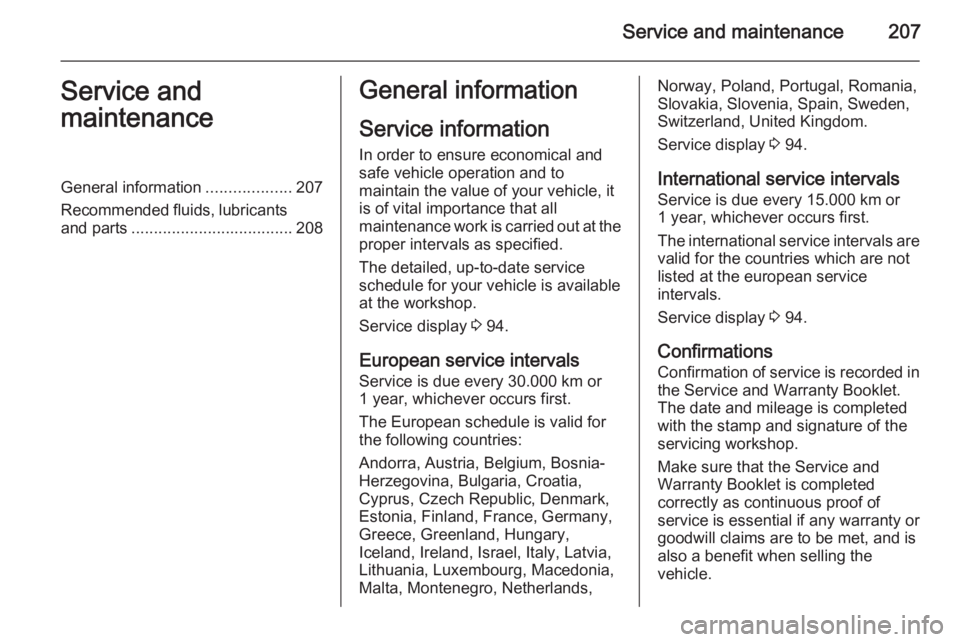
Service and maintenance207Service and
maintenanceGeneral information ...................207
Recommended fluids, lubricants and parts .................................... 208General information
Service information In order to ensure economical and
safe vehicle operation and to
maintain the value of your vehicle, it
is of vital importance that all
maintenance work is carried out at the proper intervals as specified.
The detailed, up-to-date service
schedule for your vehicle is available
at the workshop.
Service display 3 94.
European service intervals
Service is due every 30.000 km or
1 year, whichever occurs first.
The European schedule is valid for
the following countries:
Andorra, Austria, Belgium, Bosnia-
Herzegovina, Bulgaria, Croatia,
Cyprus, Czech Republic, Denmark,
Estonia, Finland, France, Germany,
Greece, Greenland, Hungary,
Iceland, Ireland, Israel, Italy, Latvia, Lithuania, Luxembourg, Macedonia,
Malta, Montenegro, Netherlands,Norway, Poland, Portugal, Romania,
Slovakia, Slovenia, Spain, Sweden, Switzerland, United Kingdom.
Service display 3 94.
International service intervals Service is due every 15.000 km or
1 year, whichever occurs first.
The international service intervals are
valid for the countries which are not
listed at the european service
intervals.
Service display 3 94.
Confirmations
Confirmation of service is recorded in the Service and Warranty Booklet.The date and mileage is completed
with the stamp and signature of the
servicing workshop.
Make sure that the Service and
Warranty Booklet is completed
correctly as continuous proof of
service is essential if any warranty or
goodwill claims are to be met, and is
also a benefit when selling the
vehicle.
Page 225 of 245
![OPEL ASTRA SALOON 2014 Owners Guide Technical data223
Heavy accessoriesAccessoriesSun roofTowing equipmentSplit rear seat backrestHeadlamp washer systemWeight [kg]23 (not on Saloon 4-door)
17 (Saloon 4-door)21 (not on TwinTop)
26 (TwinT](/img/37/58218/w960_58218-224.png "OPEL ASTRA SALOON 2014 Owners Guide Technical data223
Heavy accessoriesAccessoriesSun roofTowing equipmentSplit rear seat backrestHeadlamp washer systemWeight [kg]23 (not on Saloon 4-door)
17 (Saloon 4-door)21 (not on TwinTop)
26 (TwinT")
Technical data223
Heavy accessoriesAccessoriesSun roofTowing equipmentSplit rear seat backrestHeadlamp washer systemWeight [kg]23 (not on Saloon 4-door)
17 (Saloon 4-door)21 (not on TwinTop)
26 (TwinTop)20 (Station wagon)
9 (Saloon 3-door / 5-door)2 (Saloon 4-door / 5-door)Vehicle dimensionsSaloon 5-doorSaloon 3-doorSaloon 4-doorStation wagonVanTwinTopLength [mm]424942904587451545154476Width without exterior mirrors [mm]175317531753175317531759Width with two exterior mirrors [mm]203220322033203220322021Height (without antenna) [mm]146014351458150015001411Length of load compartment floor [mm]81981990510851825805Load compartment width [mm]944944102710881103734Height of load compartment opening [mm]614555–766775–Wheelbase [mm]261426142703270327032614Turning circle diameter [m]11.2011.2011.5011.5011.5011.20
Page 243 of 245
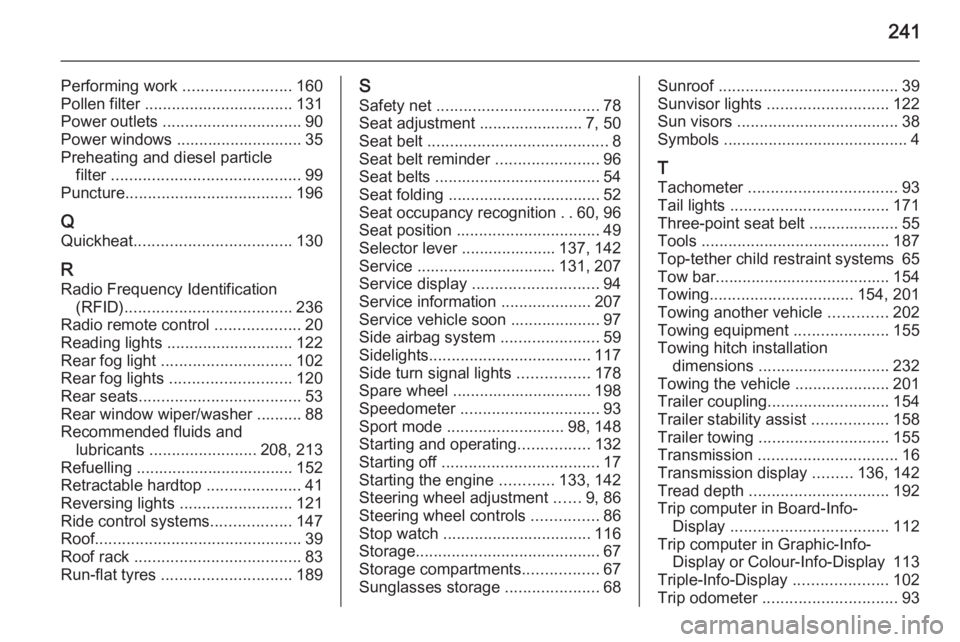
241
Performing work ........................160
Pollen filter ................................. 131
Power outlets ............................... 90
Power windows ............................ 35
Preheating and diesel particle filter .......................................... 99
Puncture ..................................... 196
Q
Quickheat ................................... 130
R Radio Frequency Identification (RFID) ..................................... 236
Radio remote control ...................20
Reading lights ............................ 122
Rear fog light ............................. 102
Rear fog lights ........................... 120
Rear seats .................................... 53
Rear window wiper/washer .......... 88
Recommended fluids and lubricants ........................ 208, 213
Refuelling ................................... 152
Retractable hardtop .....................41
Reversing lights .........................121
Ride control systems ..................147
Roof .............................................. 39
Roof rack ..................................... 83
Run-flat tyres ............................. 189S
Safety net .................................... 78
Seat adjustment ....................... 7, 50
Seat belt ........................................ 8
Seat belt reminder .......................96
Seat belts ..................................... 54
Seat folding .................................. 52
Seat occupancy recognition ..60, 96
Seat position ................................ 49
Selector lever ..................... 137, 142
Service ............................... 131, 207
Service display ............................ 94
Service information ....................207
Service vehicle soon .................... 97
Side airbag system ......................59
Sidelights .................................... 117
Side turn signal lights ................178
Spare wheel ............................... 198
Speedometer ............................... 93
Sport mode .......................... 98, 148
Starting and operating ................132
Starting off ................................... 17
Starting the engine ............133, 142
Steering wheel adjustment ......9, 86
Steering wheel controls ...............86
Stop watch ................................. 116
Storage ......................................... 67
Storage compartments .................67
Sunglasses storage .....................68Sunroof ........................................ 39
Sunvisor lights ........................... 122
Sun visors .................................... 38
Symbols ......................................... 4
T
Tachometer ................................. 93
Tail lights ................................... 171
Three-point seat belt .................... 55
Tools .......................................... 187
Top-tether child restraint systems 65
Tow bar....................................... 154
Towing ................................ 154, 201
Towing another vehicle .............202
Towing equipment .....................155
Towing hitch installation dimensions ............................. 232
Towing the vehicle .....................201
Trailer coupling ........................... 154
Trailer stability assist .................158
Trailer towing ............................. 155
Transmission ............................... 16
Transmission display .........136, 142
Tread depth ............................... 192
Trip computer in Board-Info- Display ................................... 112
Trip computer in Graphic-Info- Display or Colour-Info-Display 113
Triple-Info-Display .....................102
Trip odometer .............................. 93