boot OPEL CALIBRA 1988 Service User Guide
[x] Cancel search | Manufacturer: OPEL, Model Year: 1988, Model line: CALIBRA, Model: OPEL CALIBRA 1988Pages: 525, PDF Size: 58.26 MB
Page 138 of 525
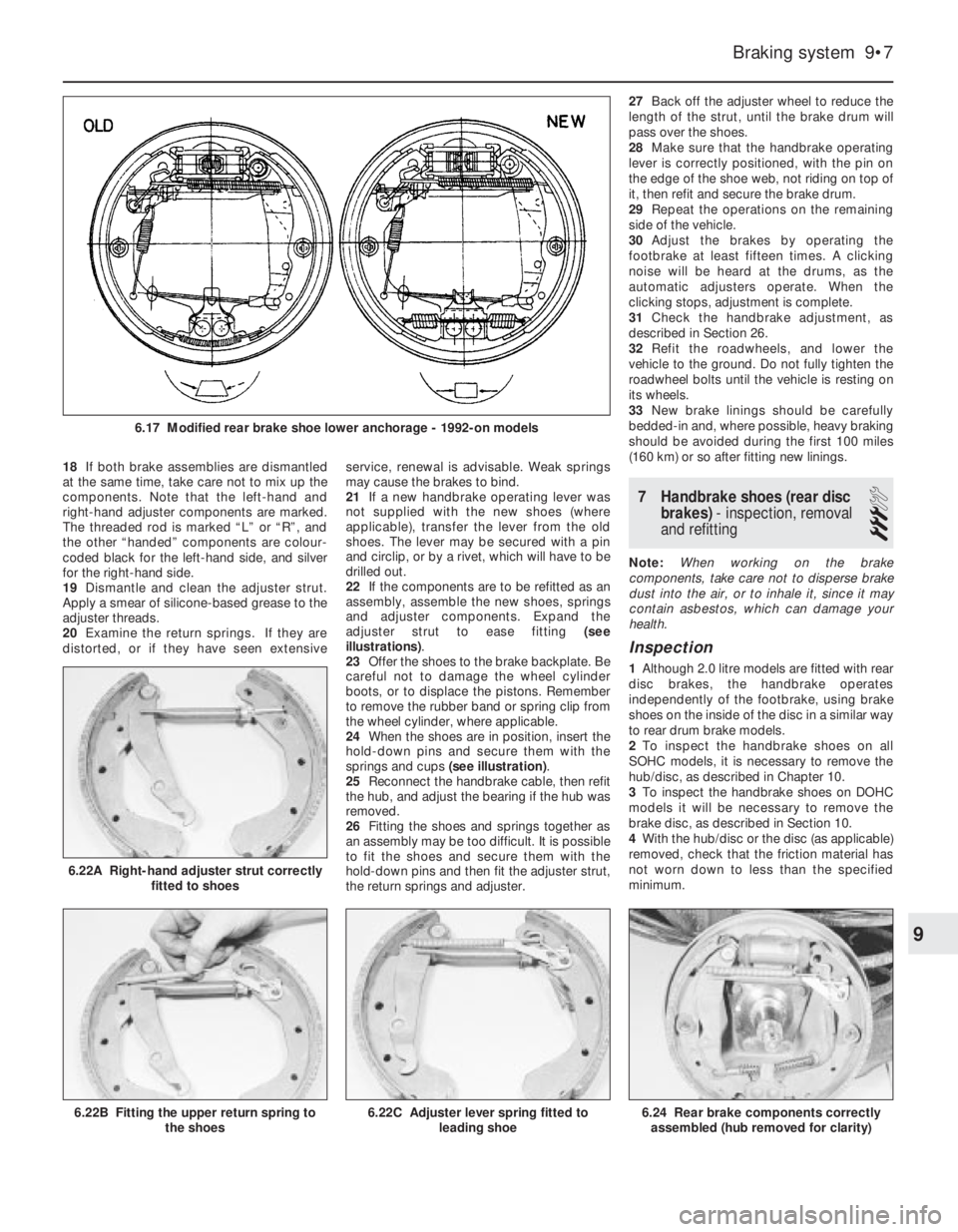
18If both brake assemblies are dismantled
at the same time, take care not to mix up the
components. Note that the left-hand and
right-hand adjuster components are marked.
The threaded rod is marked “L” or “R”, and
the other “handed” components are colour-
coded black for the left-hand side, and silver
for the right-hand side.
19Dismantle and clean the adjuster strut.
Apply a smear of silicone-based grease to the
adjuster threads.
20Examine the return springs. If they are
distorted, or if they have seen extensiveservice, renewal is advisable. Weak springs
may cause the brakes to bind.
21If a new handbrake operating lever was
not supplied with the new shoes (where
applicable), transfer the lever from the old
shoes. The lever may be secured with a pin
and circlip, or by a rivet, which will have to be
drilled out.
22If the components are to be refitted as an
assembly, assemble the new shoes, springs
and adjuster components. Expand the
adjuster strut to ease fitting (see
illustrations).
23Offer the shoes to the brake backplate. Be
careful not to damage the wheel cylinder
boots, or to displace the pistons. Remember
to remove the rubber band or spring clip from
the wheel cylinder, where applicable.
24When the shoes are in position, insert the
hold-down pins and secure them with the
springs and cups (see illustration).
25Reconnect the handbrake cable, then refit
the hub, and adjust the bearing if the hub was
removed.
26Fitting the shoes and springs together as
an assembly may be too difficult. It is possible
to fit the shoes and secure them with the
hold-down pins and then fit the adjuster strut,
the return springs and adjuster.27Back off the adjuster wheel to reduce the
length of the strut, until the brake drum will
pass over the shoes.
28Make sure that the handbrake operating
lever is correctly positioned, with the pin on
the edge of the shoe web, not riding on top of
it, then refit and secure the brake drum.
29Repeat the operations on the remaining
side of the vehicle.
30Adjust the brakes by operating the
footbrake at least fifteen times. A clicking
noise will be heard at the drums, as the
automatic adjusters operate. When the
clicking stops, adjustment is complete.
31Check the handbrake adjustment, as
described in Section 26.
32Refit the roadwheels, and lower the
vehicle to the ground. Do not fully tighten the
roadwheel bolts until the vehicle is resting on
its wheels.
33New brake linings should be carefully
bedded-in and, where possible, heavy braking
should be avoided during the first 100 miles
(160 km) or so after fitting new linings.
7Handbrake shoes (rear disc
brakes) - inspection, removal
and refitting
3
Note: When working on the brake
components, take care not to disperse brake
dust into the air, or to inhale it, since it may
contain asbestos, which can damage your
health.
Inspection
1Although 2.0 litre models are fitted with rear
disc brakes, the handbrake operates
independently of the footbrake, using brake
shoes on the inside of the disc in a similar way
to rear drum brake models.
2To inspect the handbrake shoes on all
SOHC models, it is necessary to remove the
hub/disc, as described in Chapter 10.
3To inspect the handbrake shoes on DOHC
models it will be necessary to remove the
brake disc, as described in Section 10.
4With the hub/disc or the disc (as applicable)
removed, check that the friction material has
not worn down to less than the specified
minimum.
Braking system 9•7
6.22A Right-hand adjuster strut correctly
fitted to shoes
6.24 Rear brake components correctly
assembled (hub removed for clarity)6.22C Adjuster lever spring fitted to
leading shoe6.22B Fitting the upper return spring to
the shoes
6.17 Modified rear brake shoe lower anchorage - 1992-on models
9
Page 183 of 525
14Brake fluid renewal
3
Renew the brake and bleed the system.
Refer to Chapter 9 for full details.
15Brake pad check
2
With the front or rear (as applicable) of the
vehicle raised, remove the wheels and check
brake pads for wear. Renew the pads if the
lining is below that specified. See Chapter 9,
for specifications and full details.
16Handbrake linkage check
2
With the vehicle raised, check the operation
of the handbrake and lubricate the linkages.
Refer to Chapter 9, for further details.
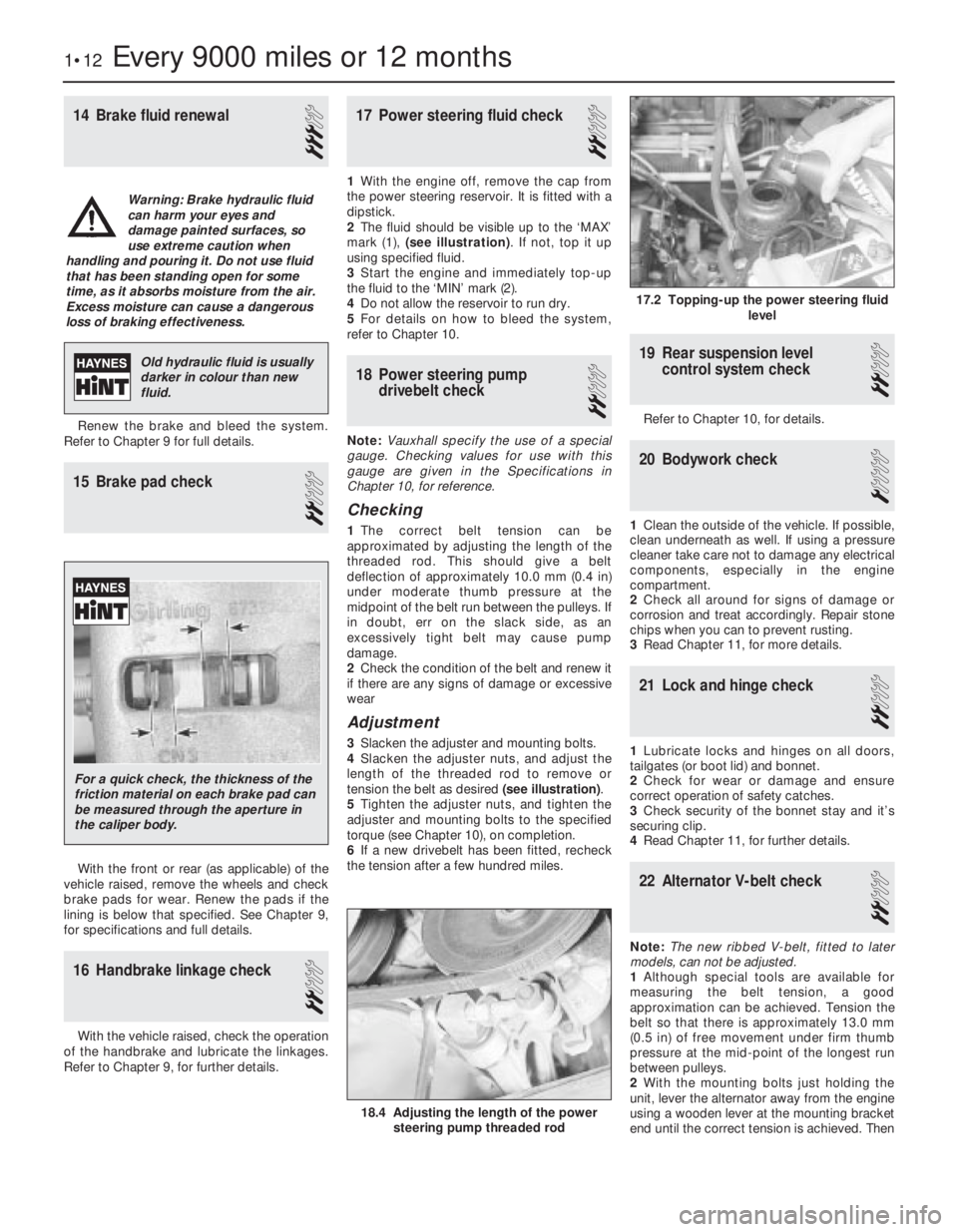
17Power steering fluid check
2
1With the engine off, remove the cap from
the power steering reservoir. It is fitted with a
dipstick.
2The fluid should be visible up to the ‘MAX’
mark (1), (see illustration). If not, top it up
using specified fluid.
3Start the engine and immediately top-up
the fluid to the ‘MIN’ mark (2).
4Do not allow the reservoir to run dry.
5For details on how to bleed the system,
refer to Chapter 10.
18Power steering pump
drivebelt check
2
Note:Vauxhall specify the use of a special
gauge. Checking values for use with this
gauge are given in the Specifications in
Chapter 10, for reference.
Checking
1The correct belt tension can be
approximated by adjusting the length of the
threaded rod. This should give a belt
deflection of approximately 10.0 mm (0.4 in)
under moderate thumb pressure at the
midpoint of the belt run between the pulleys. If
in doubt, err on the slack side, as an
excessively tight belt may cause pump
damage.
2Check the condition of the belt and renew it
if there are any signs of damage or excessive
wear
Adjustment
3Slacken the adjuster and mounting bolts.
4Slacken the adjuster nuts, and adjust the
length of the threaded rod to remove or
tension the belt as desired (see illustration).
5Tighten the adjuster nuts, and tighten the
adjuster and mounting bolts to the specified
torque (see Chapter 10), on completion.
6If a new drivebelt has been fitted, recheck
the tension after a few hundred miles.
19Rear suspension level
control system check
2
Refer to Chapter 10, for details.
20Bodywork check
1
1Clean the outside of the vehicle. If possible,
clean underneath as well. If using a pressure
cleaner take care not to damage any electrical
components, especially in the engine
compartment.
2Check all around for signs of damage or
corrosion and treat accordingly. Repair stone
chips when you can to prevent rusting.
3Read Chapter 11, for more details.
21Lock and hinge check
2
1Lubricate locks and hinges on all doors,
tailgates (or boot lid) and bonnet.
2Check for wear or damage and ensure
correct operation of safety catches.
3Check security of the bonnet stay and it’s
securing clip.
4Read Chapter 11, for further details.
22Alternator V-belt check
2
Note:The new ribbed V-belt, fitted to later
models, can not be adjusted.
1Although special tools are available for
measuring the belt tension, a good
approximation can be achieved. Tension the
belt so that there is approximately 13.0 mm
(0.5 in) of free movement under firm thumb
pressure at the mid-point of the longest run
between pulleys.
2With the mounting bolts just holding the
unit, lever the alternator away from the engine
using a wooden lever at the mounting bracket
end until the correct tension is achieved. Then
1•12Every 9000 miles or 12 months
17.2 Topping-up the power steering fluid
level
18.4 Adjusting the length of the power
steering pump threaded rod
Warning: Brake hydraulic fluid
can harm your eyes and
damage painted surfaces, so
use extreme caution when
handling and pouring it. Do not use fluid
that has been standing open for some
time, as it absorbs moisture from the air.
Excess moisture can cause a dangerous
loss of braking effectiveness.
Old hydraulic fluid is usually
darker in colour than new
fluid.
For a quick check, the thickness of the
friction material on each brake pad can
be measured through the aperture in
the caliper body.
Page 246 of 525
Tools and Working Facilities REF•7
REF
Special tools
The tools in this list are those which are not
used regularly, are expensive to buy, or which
need to be used in accordance with their
manufacturers’ instructions. Unless relatively
difficult mechanical jobs are undertaken
frequently, it will not be economic to buy
many of these tools. Where this is the case,
you could consider clubbing together with
friends (or joining a motorists’ club) to make a
joint purchase, or borrowing the tools against
a deposit from a local garage or tool hire
specialist. It is worth noting that many of the
larger DIY superstores now carry a large
range of special tools for hire at modest rates.
The following list contains only those tools
and instruments freely available to the public,
and not those special tools produced by the
vehicle manufacturer specifically for its dealer
network. You will find occasional references
to these manufacturers’ special tools in the
text of this manual. Generally, an alternative
method of doing the job without the vehicle
manufacturers’ special tool is given. However,
sometimes there is no alternative to using
them. Where this is the case and the relevant
tool cannot be bought or borrowed, you will
have to entrust the work to a dealer.
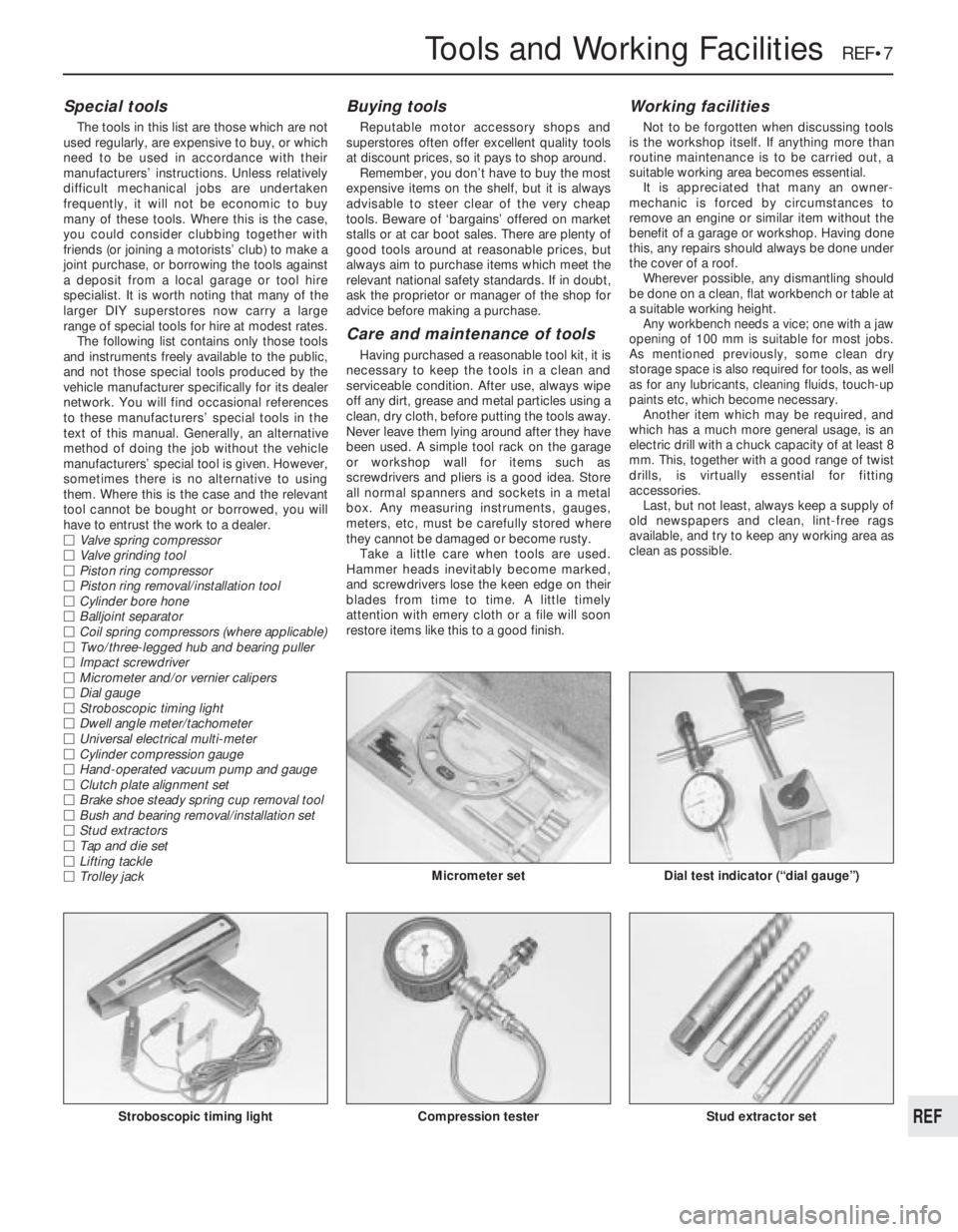
MValve spring compressor
MValve grinding tool
MPiston ring compressor
MPiston ring removal/installation tool
MCylinder bore hone
MBalljoint separator
MCoil spring compressors (where applicable)
MTwo/three-legged hub and bearing puller
MImpact screwdriver
MMicrometer and/or vernier calipers
MDial gauge
MStroboscopic timing light
MDwell angle meter/tachometer
MUniversal electrical multi-meter
MCylinder compression gauge
MHand-operated vacuum pump and gauge
MClutch plate alignment set
MBrake shoe steady spring cup removal tool
MBush and bearing removal/installation set
MStud extractors
MTap and die set
MLifting tackle
MTrolley jack
Buying tools
Reputable motor accessory shops and
superstores often offer excellent quality tools
at discount prices, so it pays to shop around.
Remember, you don’t have to buy the most
expensive items on the shelf, but it is always
advisable to steer clear of the very cheap
tools. Beware of ‘bargains’ offered on market
stalls or at car boot sales. There are plenty of
good tools around at reasonable prices, but
always aim to purchase items which meet the
relevant national safety standards. If in doubt,
ask the proprietor or manager of the shop for
advice before making a purchase.
Care and maintenance of tools
Having purchased a reasonable tool kit, it is
necessary to keep the tools in a clean and
serviceable condition. After use, always wipe
off any dirt, grease and metal particles using a
clean, dry cloth, before putting the tools away.
Never leave them lying around after they have
been used. A simple tool rack on the garage
or workshop wall for items such as
screwdrivers and pliers is a good idea. Store
all normal spanners and sockets in a metal
box. Any measuring instruments, gauges,
meters, etc, must be carefully stored where
they cannot be damaged or become rusty.
Take a little care when tools are used.
Hammer heads inevitably become marked,
and screwdrivers lose the keen edge on their
blades from time to time. A little timely
attention with emery cloth or a file will soon
restore items like this to a good finish.
Working facilities
Not to be forgotten when discussing tools
is the workshop itself. If anything more than
routine maintenance is to be carried out, a
suitable working area becomes essential.
It is appreciated that many an owner-
mechanic is forced by circumstances to
remove an engine or similar item without the
benefit of a garage or workshop. Having done
this, any repairs should always be done under
the cover of a roof.
Wherever possible, any dismantling should
be done on a clean, flat workbench or table at
a suitable working height.
Any workbench needs a vice; one with a jaw
opening of 100 mm is suitable for most jobs.
As mentioned previously, some clean dry
storage space is also required for tools, as well
as for any lubricants, cleaning fluids, touch-up
paints etc, which become necessary.
Another item which may be required, and
which has a much more general usage, is an
electric drill with a chuck capacity of at least 8
mm. This, together with a good range of twist
drills, is virtually essential for fitting
accessories.
Last, but not least, always keep a supply of
old newspapers and clean, lint-free rags
available, and try to keep any working area as
clean as possible.
Stroboscopic timing light Stud extractor setCompression tester
Dial test indicator (“dial gauge”)Micrometer set
Page 252 of 525
The pages that follow provide an easy-reference guide to the more
common problems that may occur during the operation of the vehicle.
These problems and their possible causes are grouped under headings
denoting various components or systems, such as Engine, Cooling
system, etc. The Chapter and/or Section that deals with the problem is
also shown in brackets. Whatever the fault, certain basic principles
apply. These are as follows:
Verify the fault. This is simply a matter of being sure that you know
what the symptoms are before starting work. This is particularly
important if you are investigating a fault for someone else, who may
not have described it very accurately.
Do not overlook the obvious. For example, if the vehicle will not start,
is there petrol in the tank? (Do not take anyone else’s word on this
particular point, and do not trust the fuel gauge either!) If an electrical
fault is indicated, look for loose or broken wires before digging out the
test gear.Cure the disease, not the symptom. Substituting a flat battery with a
fully charged one will get you off the hard shoulder, but if the
underlying cause is not attended to, the new battery will go the same
way. Similarly, changing oil-fouled spark plugs for a new set will get
you moving again, but remember that the reason for the fouling (if it
was not simply an incorrect grade of plug) will have to be established
and corrected.
Do not take anything for granted. Particularly, do not forget that a
“new” component may itself be defective (especially if it’s been rattling
around in the boot for months). Also do not leave components out of a
fault diagnosis sequence just because they are new or recently fitted.
When you do finally diagnose a difficult fault, you will probably realise
that all the evidence was there from the start.
Engine fails to rotate when attempting to start
MBattery terminal connections loose or corroded (Chapter 1).
MBattery discharged or faulty (Chapter 5).
MBroken, loose or disconnected wiring in the starting circuit
(Chapter 5).
MDefective starter solenoid or switch (Chapter 5).
MDefective starter motor (Chapter 5).
MStarter pinion or flywheel ring gear teeth loose or broken
(Chapters 2A and 5).
MEngine earth strap broken or disconnected (Chapter 5).
Engine rotates, but will not start
MFuel tank empty.
MBattery discharged (engine rotates slowly), (Chapter 5).
MBattery terminal connections loose or corroded (Chapter 1).
MIgnition components damp or damaged (Chapters 1 and 5).
MBroken, loose or disconnected wiring in the ignition circuit
(Chapters 1 and 5).
MWorn, faulty or incorrectly gapped spark plugs (Chapter 1).
MChoke mechanism incorrectly adjusted, worn or sticking -
carburettor models (Chapter 4A).
MFaulty fuel cut-off solenoid - carburettor models (Chapter 4A).
MFuel injection system fault - fuel-injected models (Chapter 4B).
MMajor mechanical failure (e.g. camshaft drive), (Chapter 2A or 2B).
Engine difficult to start when cold
MBattery discharged (Chapter 5).
MBattery terminal connections loose or corroded (Chapter 1).
MWorn, faulty or incorrectly gapped spark plugs (Chapter 1).
MChoke mechanism incorrectly adjusted, worn or sticking -
carburettor models (Chapter 4A).
MFuel injection system fault - fuel-injected models (Chapter 4B).
MOther ignition system fault (Chapters 1 and 5).
MLow cylinder compressions (Chapter 2A).
Engine difficult to start when hot
MAir filter element dirty or clogged (Chapter 1).
MChoke mechanism incorrectly adjusted, worn or sticking -
carburettor models (Chapter 4A).
MFuel injection system fault - fuel-injected models (Chapter 4B).
MLow cylinder compressions (Chapter 2A).
Starter motor noisy or excessively rough in
engagement
MStarter pinion or flywheel ring gear teeth loose or broken
(Chapters 2A and 5).
MStarter motor mounting bolts loose or missing (Chapter 5).
MStarter motor internal components worn or damaged (Chapter 5).
Engine starts, but stops immediately
MLoose or faulty electrical connections in the ignition circuit
(Chapters 1 and 5B).
MVacuum leak at the carburettor/throttle body or inlet manifold
(Chapter 4A or 4B).
MBlocked carburettor jet(s) or internal passages - carburettor
models (Chapter 4A).
MBlocked injector/fuel injection system fault - fuel-injected models
(Chapter 4B).
Engine idles erratically
MAir filter element clogged (Chapter 1).
MVacuum leak at the carburettor/throttle body, inlet manifold or
associated hoses (Chapter 4A or 4B).
MWorn, faulty or incorrectly gapped spark plugs (Chapter 1).
MUneven or low cylinder compressions (Chapter 2A).
MCamshaft lobes worn (Chapter 2A or 2B).
MTiming belt incorrectly tensioned (Chapter 2A or 2B).
MBlocked carburettor jet(s) or internal passages - carburettor
models (Chapter 4A).
MBlocked injector/fuel injection system fault - fuel-injected models
(Chapter 4B).
Engine misfires at idle speed
MWorn, faulty or incorrectly gapped spark plugs (Chapter 1).
MFaulty spark plug HT leads (Chapter 1).
MVacuum leak at the carburettor/throttle body, inlet manifold or
associated hoses (Chapter 4A or 4B).
MBlocked carburettor jet(s) or internal passages - carburettor
models (Chapter 4A).
MBlocked injector/fuel injection system fault - fuel-injected models
(Chapter 4B).
MDistributor cap cracked or tracking internally (where applicable),
(Chapter 1).
MUneven or low cylinder compressions (Chapter 2A).
MDisconnected, leaking, or perished crankcase ventilation hoses
(Chapter 4C).
Engine misfires throughout the driving speed
range
MFuel filter choked (Chapter 1).
MFuel pump faulty, or delivery pressure low (Chapter 4A or 4B).
MFuel tank vent blocked, or fuel pipes restricted (Chapter 4A or 4B).
MVacuum leak at the carburettor/throttle body, inlet manifold or
associated hoses (Chapter 4A or 4B).
MWorn, faulty or incorrectly gapped spark plugs (Chapter 1).
MFaulty spark plug HT leads (Chapter 1).
MDistributor cap cracked or tracking internally (where applicable),
(Chapter 1).
Fault Finding REF•13
REF
Engine
Page 264 of 525
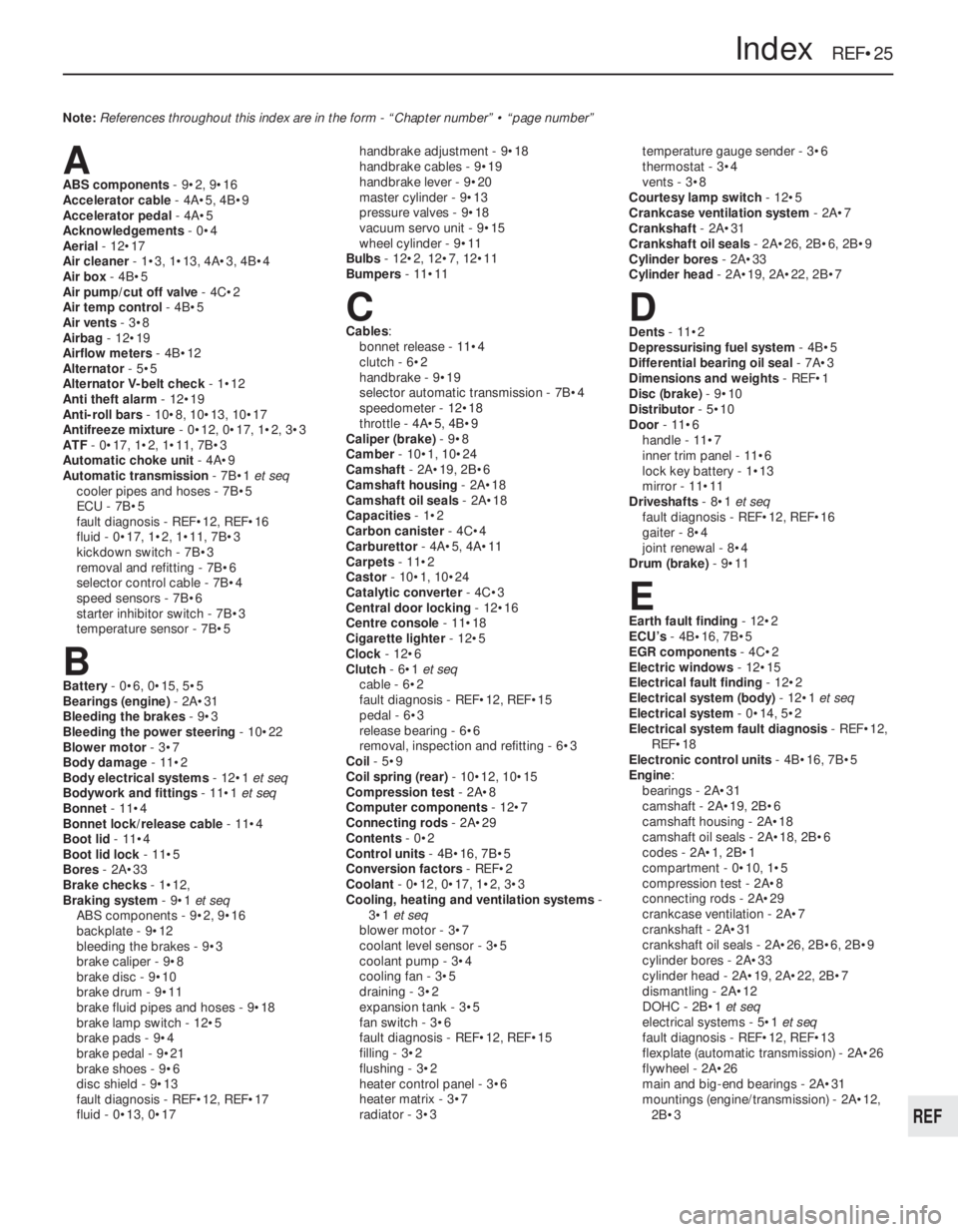
AABS components- 9•2, 9•16
Accelerator cable- 4A•5, 4B•9
Accelerator pedal- 4A•5
Acknowledgements- 0•4
Aerial- 12•17
Air cleaner- 1•3, 1•13, 4A•3, 4B•4
Air box- 4B•5
Air pump/cut off valve- 4C•2
Air temp control- 4B•5
Air vents- 3•8
Airbag- 12•19
Airflow meters- 4B•12
Alternator- 5•5
Alternator V-belt check- 1•12
Anti theft alarm- 12•19
Anti-roll bars- 10•8, 10•13, 10•17
Antifreeze mixture- 0•12, 0•17, 1•2, 3•3
ATF- 0•17, 1•2, 1•11, 7B•3
Automatic choke unit- 4A•9
Automatic transmission- 7B•1 et seq
cooler pipes and hoses - 7B•5
ECU - 7B•5
fault diagnosis - REF•12, REF•16
fluid - 0•17, 1•2, 1•11, 7B•3
kickdown switch - 7B•3
removal and refitting - 7B•6
selector control cable - 7B•4
speed sensors - 7B•6
starter inhibitor switch - 7B•3
temperature sensor - 7B•5
BBattery- 0•6, 0•15, 5•5
Bearings (engine)- 2A•31
Bleeding the brakes- 9•3
Bleeding the power steering- 10•22
Blower motor- 3•7
Body damage- 11•2
Body electrical systems - 12•1 et seq
Bodywork and fittings- 11•1 et seq
Bonnet- 11•4
Bonnet lock/release cable- 11•4
Boot lid- 11•4
Boot lid lock- 11•5
Bores- 2A•33
Brake checks- 1•12,
Braking system- 9•1 et seq
ABS components - 9•2, 9•16
backplate - 9•12
bleeding the brakes - 9•3
brake caliper - 9•8
brake disc - 9•10
brake drum - 9•11
brake fluid pipes and hoses - 9•18
brake lamp switch - 12•5
brake pads - 9•4
brake pedal - 9•21
brake shoes - 9•6
disc shield - 9•13
fault diagnosis - REF•12, REF•17
fluid - 0•13, 0•17handbrake adjustment - 9•18
handbrake cables - 9•19
handbrake lever - 9•20
master cylinder - 9•13
pressure valves - 9•18
vacuum servo unit - 9•15
wheel cylinder - 9•11
Bulbs- 12•2, 12•7, 12•11
Bumpers- 11•11
CCables:
bonnet release - 11•4
clutch - 6•2
handbrake - 9•19
selector automatic transmission - 7B•4
speedometer - 12•18
throttle - 4A•5, 4B•9
Caliper (brake)- 9•8
Camber- 10•1, 10•24
Camshaft- 2A•19, 2B•6
Camshaft housing- 2A•18
Camshaft oil seals- 2A•18
Capacities- 1•2
Carbon canister- 4C•4
Carburettor- 4A•5, 4A•11
Carpets- 11•2
Castor- 10•1, 10•24
Catalytic converter- 4C•3
Central door locking- 12•16
Centre console- 11•18
Cigarette lighter- 12•5
Clock- 12•6
Clutch- 6•1 et seq
cable - 6•2
fault diagnosis - REF•12, REF•15
pedal - 6•3
release bearing - 6•6
removal, inspection and refitting - 6•3
Coil- 5•9
Coil spring (rear)- 10•12, 10•15
Compression test- 2A•8
Computer components- 12•7
Connecting rods- 2A•29
Contents- 0•2
Control units- 4B•16, 7B•5
Conversion factors- REF•2
Coolant- 0•12, 0•17, 1•2, 3•3
Cooling, heating and ventilation systems-
3•1 et seq
blower motor - 3•7
coolant level sensor - 3•5
coolant pump - 3•4
cooling fan - 3•5
draining - 3•2
expansion tank - 3•5
fan switch - 3•6
fault diagnosis - REF•12, REF•15
filling - 3•2
flushing - 3•2
heater control panel - 3•6
heater matrix - 3•7
radiator - 3•3temperature gauge sender - 3•6
thermostat - 3•4
vents - 3•8
Courtesy lamp switch- 12•5
Crankcase ventilation system- 2A•7
Crankshaft- 2A•31
Crankshaft oil seals- 2A•26, 2B•6, 2B•9
Cylinder bores- 2A•33
Cylinder head- 2A•19, 2A•22, 2B•7DDents- 11•2
Depressurising fuel system- 4B•5
Differential bearing oil seal- 7A•3
Dimensions and weights- REF•1
Disc (brake)- 9•10
Distributor- 5•10
Door- 11•6
handle - 11•7
inner trim panel - 11•6
lock key battery - 1•13
mirror - 11•11
Driveshafts- 8•1 et seq
fault diagnosis - REF•12, REF•16
gaiter - 8•4
joint renewal - 8•4
Drum (brake)- 9•11
EEarth fault finding- 12•2
ECU’s - 4B•16, 7B•5
EGR components- 4C•2
Electric windows- 12•15
Electrical fault finding- 12•2
Electrical system (body)- 12•1 et seq
Electrical system- 0•14, 5•2
Electrical system fault diagnosis- REF•12,
REF•18
Electronic control units- 4B•16, 7B•5
Engine:
bearings - 2A•31
camshaft - 2A•19, 2B•6
camshaft housing - 2A•18
camshaft oil seals - 2A•18, 2B•6
codes - 2A•1, 2B•1
compartment - 0•10, 1•5
compression test - 2A•8
connecting rods - 2A•29
crankcase ventilation - 2A•7
crankshaft - 2A•31
crankshaft oil seals - 2A•26, 2B•6, 2B•9
cylinder bores - 2A•33
cylinder head - 2A•19, 2A•22, 2B•7
dismantling - 2A•12
DOHC - 2B•1 et seq
electrical systems - 5•1 et seq
fault diagnosis - REF•12, REF•13
flexplate (automatic transmission) - 2A•26
flywheel - 2A•26
main and big-end bearings - 2A•31
mountings (engine/transmission) - 2A•12,
2B•3
Index REF•25
REF
Note:References throughout this index are in the form - “Chapter number” • “page number”