lock OPEL CALIBRA 1988 Service User Guide
[x] Cancel search | Manufacturer: OPEL, Model Year: 1988, Model line: CALIBRA, Model: OPEL CALIBRA 1988Pages: 525, PDF Size: 58.26 MB
Page 19 of 525
8Electric door mirror switch -
removal and refitting
2
Removal
1Disconnect the battery negative lead.
2Prise the plastic surround from the door
interior handle.
3Free the trim panel from the top edge of the
door by releasing the securing clips. This can
be done using a screwdriver, but it is
preferable to use a forked tool, to minimise
the possibility of damage to the trim panel and
the clips.
4Note the position of the mirror switch wiring
connector in the bracket at the top of the
door, then separate the two halves of the
connector.
5Prise the switch from the door trim panel,
and feed the wiring through the panel.
Refitting
6Refitting is a reversal of removal, but ensure
that the wiring is correctly routed, so as not to
foul the door interior handle mechanism.
9Sunroof operating switch -
removal and refitting
2
Removal
1Disconnect the battery negative lead.
2Prise the courtesy lamp from the roof trim
panel, and disconnect the wiring.
3Remove the two trim panel securing
screws, and withdraw the trim panel from the
roof, disconnecting the wiring from the
sunroof operating switch.
4Release the securing clips, then pull the
switch from the rear face of the trim panel.
Refitting
5Refitting is a reversal of removal.
10Courtesy lamp switch -
removal and refitting
2
Removal
1Disconnect the battery negative lead.
2Open the door and remove the switch
securing screw.
3Withdraw the switch from the door pillar,
and pull the wiring out sufficiently to prevent it
from springing back into the pillar.4Disconnect the wiring and remove the
switch.
Refitting
5Refitting is a reversal of removal.
11Luggage compartment lamp
switch - removal and refitting
2
Removal
1Disconnect the battery negative lead.
2Open the boot lid or tailgate, as applicable,
and remove the switch securing screw.
3Withdraw the switch from the body panel,
and pull the wiring out sufficiently to prevent it
from springing back into the body.
4Disconnect the wiring and remove the
switch.
Refitting
5Refitting is a reversal of removal.
12Brake lamp switch - removal
and refitting
2
Removal
1Disconnect the battery negative lead.
2Remove the lower trim panel from the
driver’s footwell.
3Disconnect the wiring plug from the brake
lamp switch, then twist the switch
anti-clockwise and remove it from its bracket.
Refitting
4Refitting is a reversal of removal.
13Handbrake “on” warning
lamp switch - removal and
refitting
3
For access to the switch, the handbrake
lever must be removed. Removal and refitting
of the switch is described as part of the
handbrake lever removal and refitting
procedure, in Chapter 9.
14Oil pressure warning lamp
switch - removal and refitting
3
Removal
1Disconnect the battery negative lead.
2The switch is screwed into the oil pump, on
the inlet manifold side of the engine. On 1.4
and 1.6 litre (except C16 NZ2), models the
switch projects at right-angles to the
crankshaft axis, while on C16 NZ2, 1.8 and
2.0 litre models it is parallel to the crankshaft
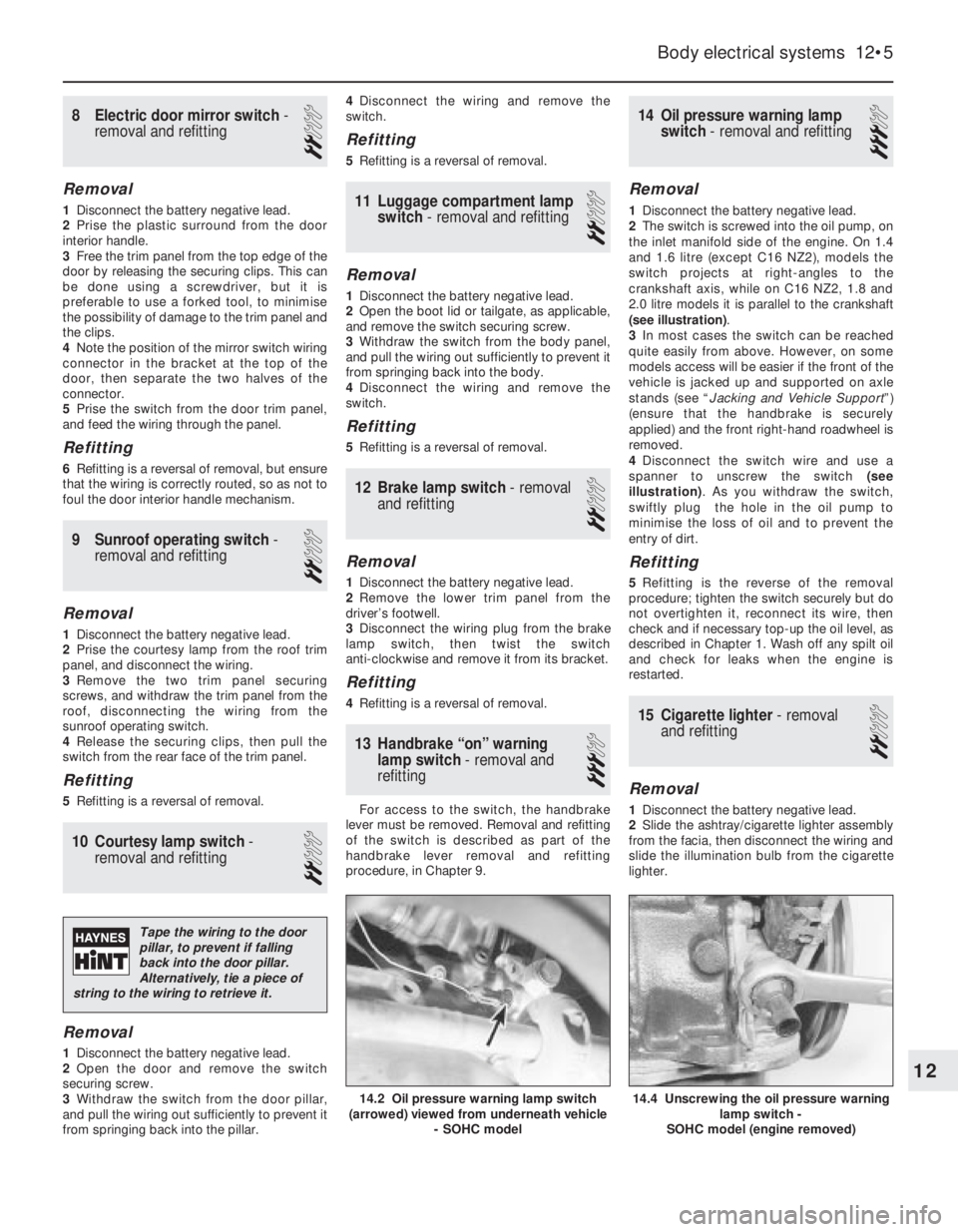
(see illustration).
3In most cases the switch can be reached
quite easily from above. However, on some
models access will be easier if the front of the
vehicle is jacked up and supported on axle
stands (see “Jacking and Vehicle Support”)
(ensure that the handbrake is securely
applied) and the front right-hand roadwheel is
removed.
4Disconnect the switch wire and use a
spanner to unscrew the switch (see
illustration). As you withdraw the switch,
swiftly plug the hole in the oil pump to
minimise the loss of oil and to prevent the
entry of dirt.
Refitting
5Refitting is the reverse of the removal
procedure; tighten the switch securely but do
not overtighten it, reconnect its wire, then
check and if necessary top-up the oil level, as
described in Chapter 1. Wash off any spilt oil
and check for leaks when the engine is
restarted.
15Cigarette lighter - removal
and refitting
2
Removal
1Disconnect the battery negative lead.
2Slide the ashtray/cigarette lighter assembly
from the facia, then disconnect the wiring and
slide the illumination bulb from the cigarette
lighter.
Body electrical systems 12•5
14.4 Unscrewing the oil pressure warning
lamp switch -
SOHC model (engine removed)14.2 Oil pressure warning lamp switch
(arrowed) viewed from underneath vehicle
- SOHC model
12
Tape the wiring to the door
pillar, to prevent if falling
back into the door pillar.
Alternatively, tie a piece of
string to the wiring to retrieve it.
Page 20 of 525
3To remove the cigarette lighter assembly,
simply pull it from the illumination ring
assembly. If desired, the illumination ring
assembly can be removed, by pulling it from
the housing after depressing the retaining
clips.
Refitting
4Refitting is a reversal of removal.
16Clock - removal and refitting
2
Removal
1Disconnect the battery negative lead.
2Using a thin-bladed screwdriver, carefully
prise the clock from the facia panel.
3Disconnect the wiring plugs and withdraw
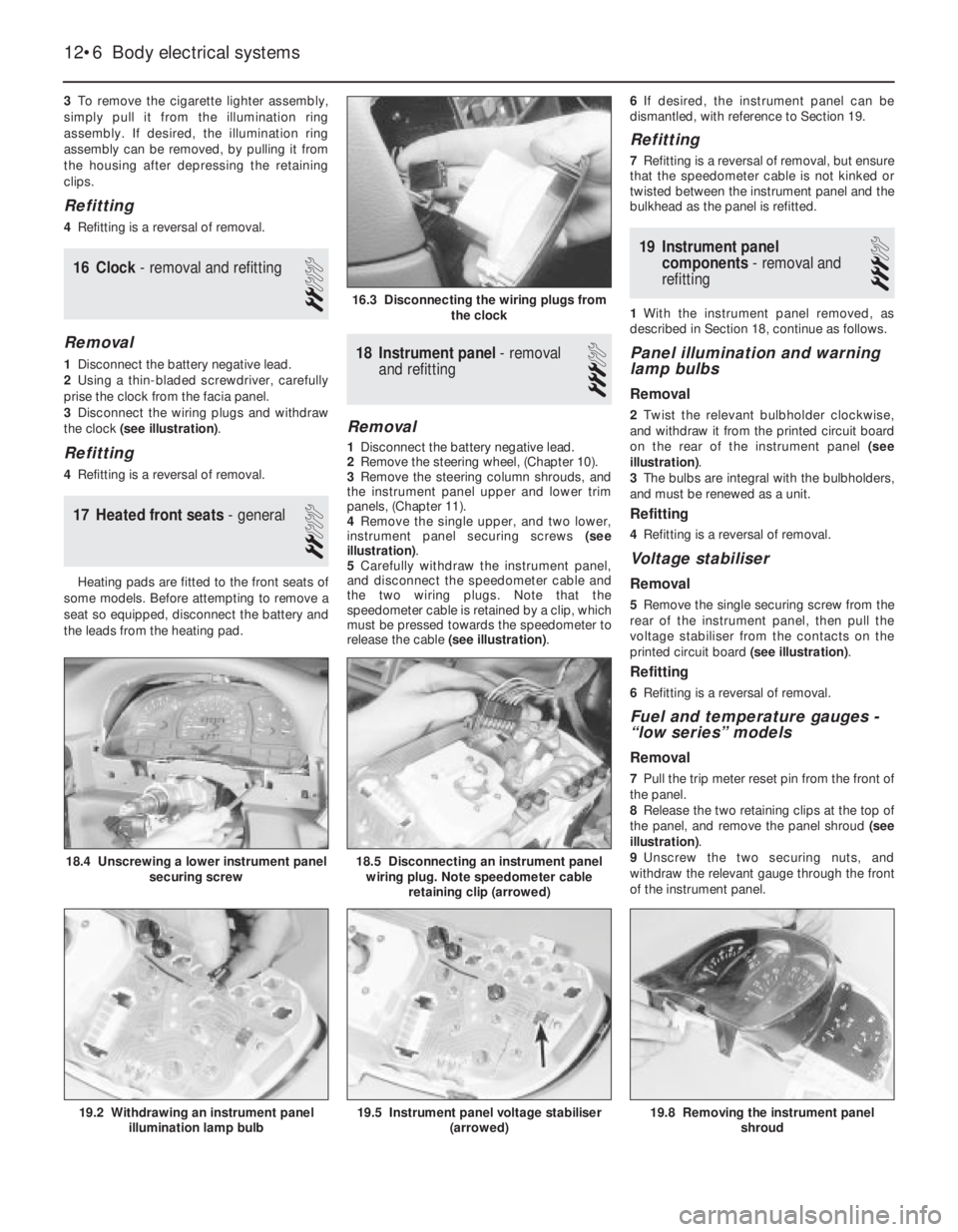
the clock (see illustration).
Refitting
4Refitting is a reversal of removal.
17Heated front seats - general
2
Heating pads are fitted to the front seats of
some models. Before attempting to remove a
seat so equipped, disconnect the battery and
the leads from the heating pad.
18Instrument panel -removal
and refitting
3
Removal
1Disconnect the battery negative lead.
2Remove the steering wheel, (Chapter 10).
3Remove the steering column shrouds, and
the instrument panel upper and lower trim
panels, (Chapter 11).
4Remove the single upper, and two lower,
instrument panel securing screws (see
illustration).
5Carefully withdraw the instrument panel,
and disconnect the speedometer cable and
the two wiring plugs. Note that the
speedometer cable is retained by a clip, which
must be pressed towards the speedometer to
release the cable (see illustration).6If desired, the instrument panel can be
dismantled, with reference to Section 19.
Refitting
7Refitting is a reversal of removal, but ensure
that the speedometer cable is not kinked or
twisted between the instrument panel and the
bulkhead as the panel is refitted.
19Instrument panel
components - removal and
refitting
3
1With the instrument panel removed, as
described in Section 18, continue as follows.
Panel illumination and warning
lamp bulbs
Removal
2Twist the relevant bulbholder clockwise,
and withdraw it from the printed circuit board
on the rear of the instrument panel (see
illustration).
3The bulbs are integral with the bulbholders,
and must be renewed as a unit.
Refitting
4Refitting is a reversal of removal.
Voltage stabiliser
Removal
5Remove the single securing screw from the
rear of the instrument panel, then pull the
voltage stabiliser from the contacts on the
printed circuit board (see illustration).
Refitting
6Refitting is a reversal of removal.
Fuel and temperature gauges -
“low series” models
Removal
7Pull the trip meter reset pin from the front of
the panel.
8Release the two retaining clips at the top of
the panel, and remove the panel shroud (see
illustration).
9Unscrew the two securing nuts, and
withdraw the relevant gauge through the front
of the instrument panel.
12•6Body electrical systems
16.3 Disconnecting the wiring plugs from
the clock
18.5 Disconnecting an instrument panel
wiring plug. Note speedometer cable
retaining clip (arrowed)
19.8 Removing the instrument panel
shroud19.5 Instrument panel voltage stabiliser
(arrowed)19.2 Withdrawing an instrument panel
illumination lamp bulb
18.4 Unscrewing a lower instrument panel
securing screw
Page 23 of 525
4Remove the courtesy lamp bulbs by
carefully prising it from its location using a
thin-bladed screwdriver. Where applicable,
the map reading lamp bulbs are a push fit in
the bulbholders.
Refitting
5Refitting is a reversal of removal.
Glovebox lamp
Removal
6Using a thin-bladed screwdriver, prise the
lamp from its location and disconnect the
wiring.
7Carefully prise the bulb from the lamp.
Refitting
8Refitting is a reversal of removal.
Luggage compartment,
underbonnet and kerb lamps
Removal
9Using a thin-bladed screwdriver, prise the
lamp from its location; disconnect the wiring.
10Carefully prise the bulb from the lamp
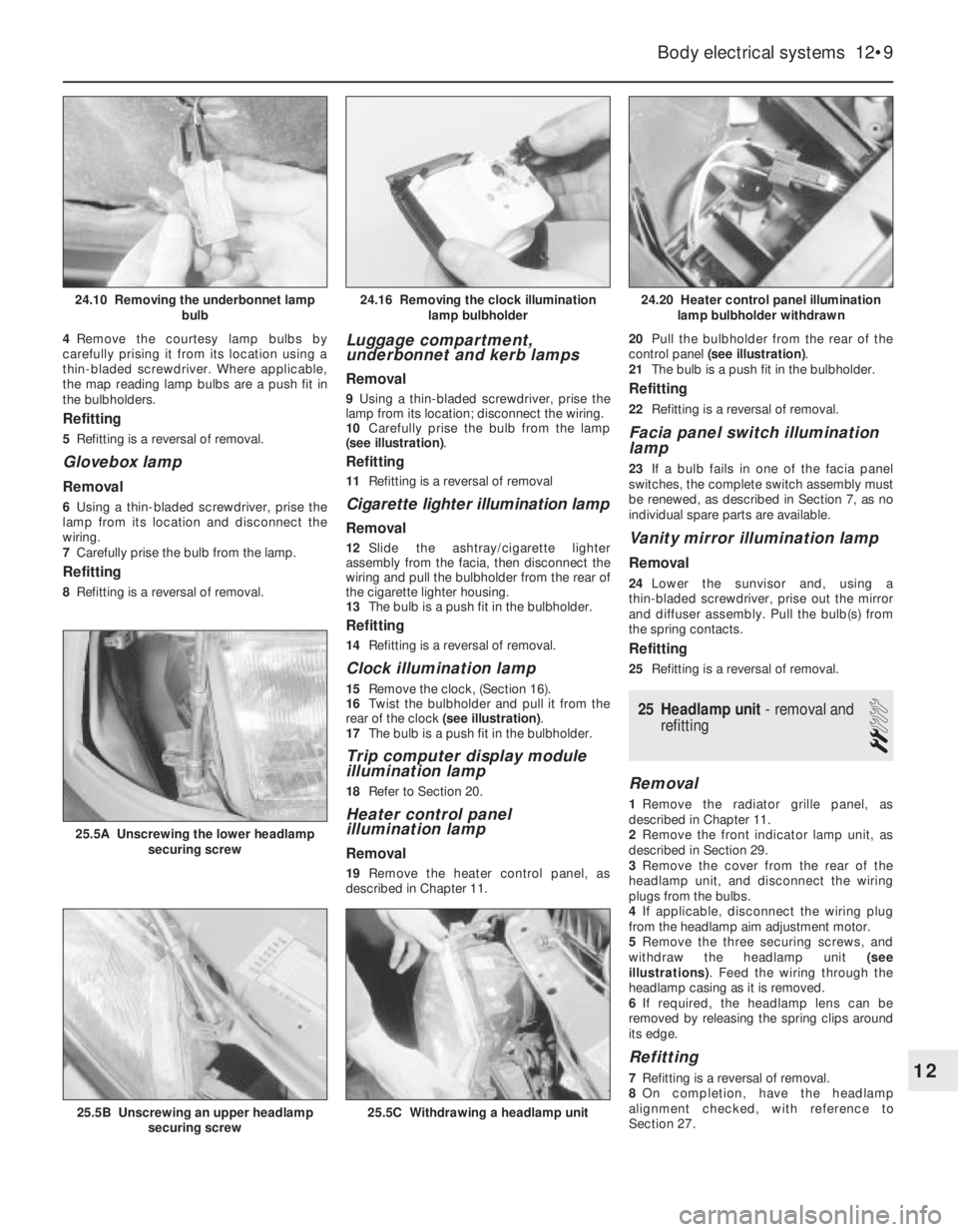
(see illustration).
Refitting
11Refitting is a reversal of removal
Cigarette lighter illumination lamp
Removal
12Slide the ashtray/cigarette lighter
assembly from the facia, then disconnect the
wiring and pull the bulbholder from the rear of
the cigarette lighter housing.
13The bulb is a push fit in the bulbholder.
Refitting
14Refitting is a reversal of removal.
Clock illumination lamp
15Remove the clock, (Section 16).
16Twist the bulbholder and pull it from the
rear of the clock (see illustration).
17The bulb is a push fit in the bulbholder.
Trip computer display module
illumination lamp
18Refer to Section 20.
Heater control panel
illumination lamp
Removal
19Remove the heater control panel, as
described in Chapter 11. 20Pull the bulbholder from the rear of the
control panel (see illustration).
21The bulb is a push fit in the bulbholder.
Refitting
22Refitting is a reversal of removal.
Facia panel switch illumination
lamp
23If a bulb fails in one of the facia panel
switches, the complete switch assembly must
be renewed, as described in Section 7, as no
individual spare parts are available.
Vanity mirror illumination lamp
Removal
24Lower the sunvisor and, using a
thin-bladed screwdriver, prise out the mirror
and diffuser assembly. Pull the bulb(s) from
the spring contacts.
Refitting
25Refitting is a reversal of removal.
25Headlamp unit - removal and
refitting
2
Removal
1Remove the radiator grille panel, as
described in Chapter 11.
2Remove the front indicator lamp unit, as
described in Section 29.
3Remove the cover from the rear of the
headlamp unit, and disconnect the wiring
plugs from the bulbs.
4If applicable, disconnect the wiring plug
from the headlamp aim adjustment motor.
5Remove the three securing screws, and
withdraw the headlamp unit (see
illustrations). Feed the wiring through the
headlamp casing as it is removed.
6If required, the headlamp lens can be
removed by releasing the spring clips around
its edge.
Refitting
7Refitting is a reversal of removal.
8On completion, have the headlamp
alignment checked, with reference to
Section 27.
Body electrical systems 12•9
24.20 Heater control panel illumination
lamp bulbholder withdrawn
25.5C Withdrawing a headlamp unit25.5B Unscrewing an upper headlamp
securing screw
25.5A Unscrewing the lower headlamp
securing screw
24.16 Removing the clock illumination
lamp bulbholder24.10 Removing the underbonnet lamp
bulb
12
Page 24 of 525
27Headlamps -alignment
2
1Correct alignment of the headlamp beams
is most important, not only to ensure good
vision for the driver, but also to protect other
drivers from being dazzled.
2Accurate alignment should be carried out
using optical beam setting equipment.
3In an emergency, adjustments may be
made by turning the adjustment screws
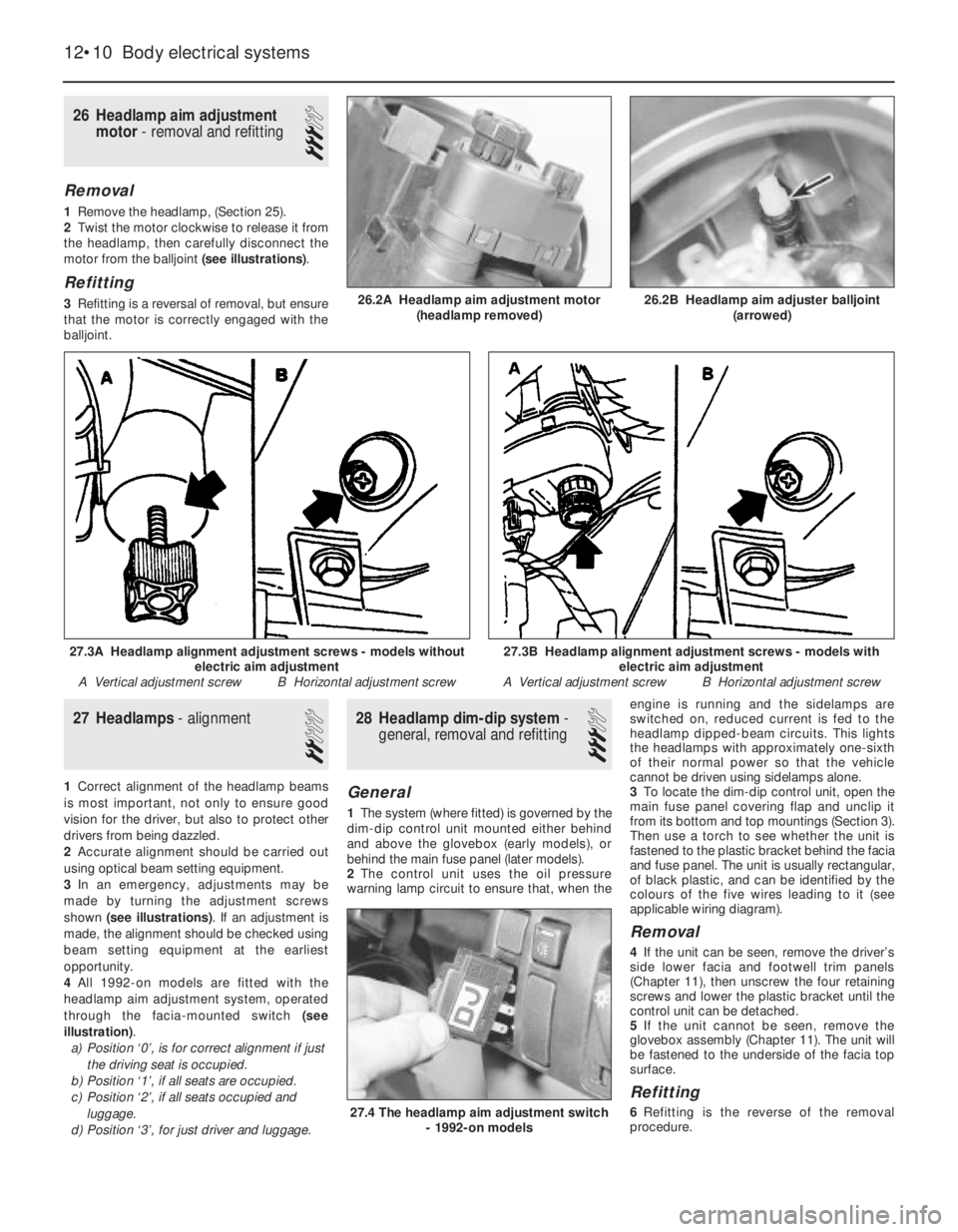
shown (see illustrations). If an adjustment is
made, the alignment should be checked using
beam setting equipment at the earliest
opportunity.
4All 1992-on models are fitted with the
headlamp aim adjustment system, operated
through the facia-mounted switch (see
illustration).
a)Position ‘0’, is for correct alignment if just
the driving seat is occupied.
b)Position ‘1’, if all seats are occupied.
c)Position ‘2’, if all seats occupied and
luggage.
d)Position ‘3’, for just driver and luggage.
28Headlamp dim-dip system -
general, removal and refitting
3
General
1The system (where fitted) is governed by the
dim-dip control unit mounted either behind
and above the glovebox (early models), or
behind the main fuse panel (later models).
2The control unit uses the oil pressure
warning lamp circuit to ensure that, when theengine is running and the sidelamps are
switched on, reduced current is fed to the
headlamp dipped-beam circuits. This lights
the headlamps with approximately one-sixth
of their normal power so that the vehicle
cannot be driven using sidelamps alone.
3To locate the dim-dip control unit, open the
main fuse panel covering flap and unclip it
from its bottom and top mountings (Section 3).
Then use a torch to see whether the unit is
fastened to the plastic bracket behind the facia
and fuse panel. The unit is usually rectangular,
of black plastic, and can be identified by the
colours of the five wires leading to it (see
applicable wiring diagram).
Removal
4If the unit can be seen, remove the driver’s
side lower facia and footwell trim panels
(Chapter 11), then unscrew the four retaining
screws and lower the plastic bracket until the
control unit can be detached.
5If the unit cannot be seen, remove the
glovebox assembly (Chapter 11). The unit will
be fastened to the underside of the facia top
surface.
Refitting
6Refitting is the reverse of the removal
procedure.
26Headlamp aim adjustment
motor - removal and refitting
3
Removal
1Remove the headlamp, (Section 25).
2Twist the motor clockwise to release it from
the headlamp, then carefully disconnect the
motor from the balljoint (see illustrations).
Refitting
3Refitting is a reversal of removal, but ensure
that the motor is correctly engaged with the
balljoint.
12•10Body electrical systems
26.2A Headlamp aim adjustment motor
(headlamp removed)
27.4 The headlamp aim adjustment switch
- 1992-on models
27.3B Headlamp alignment adjustment screws - models with
electric aim adjustment
A Vertical adjustment screw B Horizontal adjustment screw27.3A Headlamp alignment adjustment screws - models without
electric aim adjustment
A Vertical adjustment screw B Horizontal adjustment screw
26.2B Headlamp aim adjuster balljoint
(arrowed)
Page 26 of 525
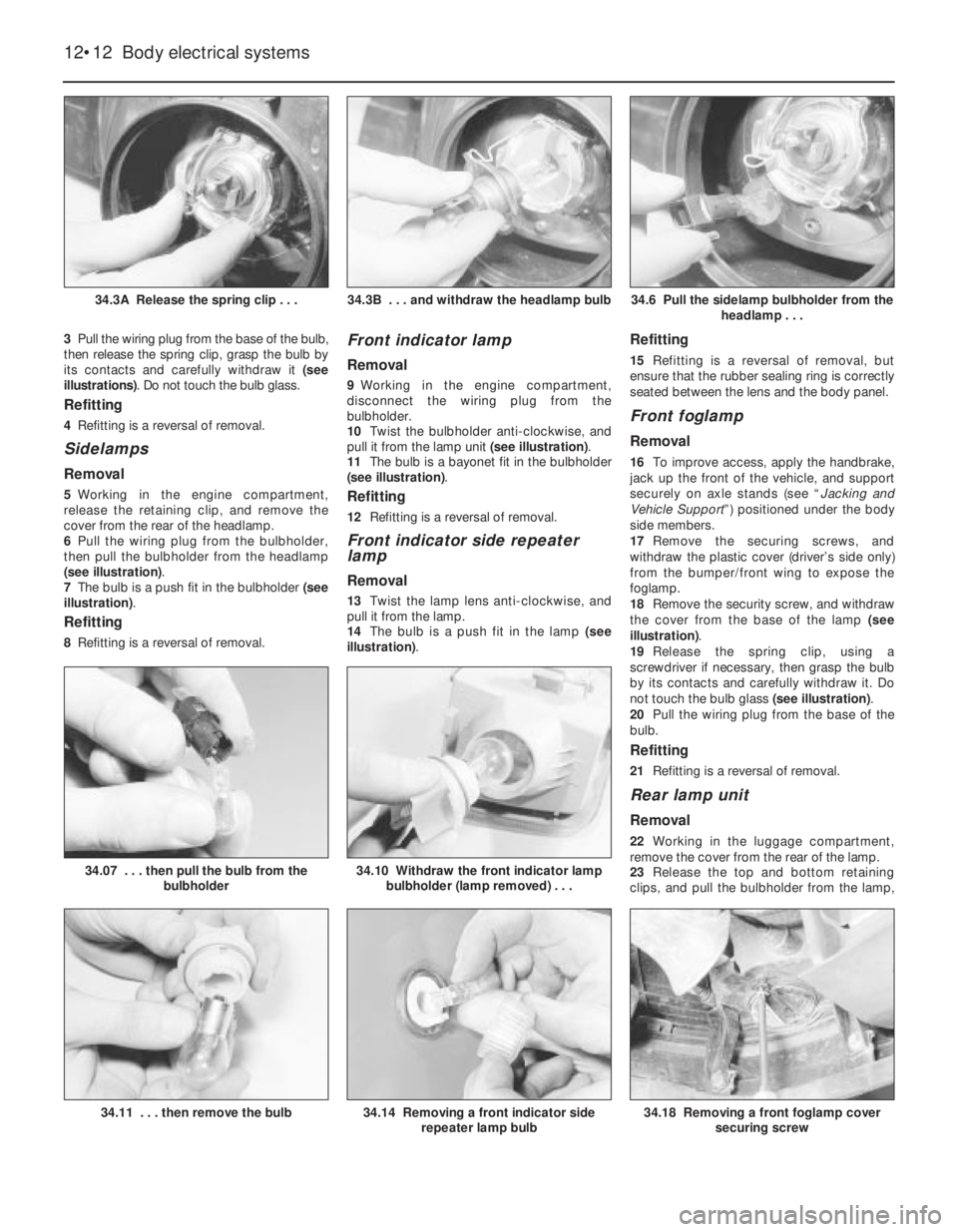
3Pull the wiring plug from the base of the bulb,
then release the spring clip, grasp the bulb by
its contacts and carefully withdraw it (see
illustrations). Do not touch the bulb glass.
Refitting
4Refitting is a reversal of removal.
Sidelamps
Removal
5Working in the engine compartment,
release the retaining clip, and remove the
cover from the rear of the headlamp.
6Pull the wiring plug from the bulbholder,
then pull the bulbholder from the headlamp
(see illustration).
7The bulb is a push fit in the bulbholder (see
illustration).
Refitting
8Refitting is a reversal of removal.
Front indicator lamp
Removal
9Working in the engine compartment,
disconnect the wiring plug from the
bulbholder.
10Twist the bulbholder anti-clockwise, and
pull it from the lamp unit (see illustration).
11The bulb is a bayonet fit in the bulbholder
(see illustration).
Refitting
12Refitting is a reversal of removal.
Front indicator side repeater
lamp
Removal
13Twist the lamp lens anti-clockwise, and
pull it from the lamp.
14The bulb is a push fit in the lamp (see
illustration).
Refitting
15Refitting is a reversal of removal, but
ensure that the rubber sealing ring is correctly
seated between the lens and the body panel.
Front foglamp
Removal
16To improve access, apply the handbrake,
jack up the front of the vehicle, and support
securely on axle stands (see “Jacking and
Vehicle Support”) positioned under the body
side members.
17Remove the securing screws, and
withdraw the plastic cover (driver’s side only)
from the bumper/front wing to expose the
foglamp.
18Remove the security screw, and withdraw
the cover from the base of the lamp (see
illustration).
19Release the spring clip, using a
screwdriver if necessary, then grasp the bulb
by its contacts and carefully withdraw it. Do
not touch the bulb glass (see illustration).
20Pull the wiring plug from the base of the
bulb.
Refitting
21Refitting is a reversal of removal.
Rear lamp unit
Removal
22Working in the luggage compartment,
remove the cover from the rear of the lamp.
23Release the top and bottom retaining
clips, and pull the bulbholder from the lamp,
12•12Body electrical systems
34.3A Release the spring clip . . .34.6 Pull the sidelamp bulbholder from the
headlamp . . .
34.18 Removing a front foglamp cover
securing screw
34.10 Withdraw the front indicator lamp
bulbholder (lamp removed) . . .34.07 . . . then pull the bulb from the
bulbholder
34.14 Removing a front indicator side
repeater lamp bulb34.11 . . . then remove the bulb
34.3B . . . and withdraw the headlamp bulb
Page 29 of 525
41Washer fluid reservoir -
removal and refitting
2
1Disconnect the battery negative lead.
Models without headlamp wash
Removal
2Disconnect the wiring from the washer
pump.
3Disconnect the washer fluid hose from the
pump. Be prepared for fluid spillage.
4Remove the screw(s) securing the reservoir
to the body, and withdraw the reservoir.
Refitting
5Refitting is a reversal of removal.
Models with headlamp wash
Removal
6On models with headlamp wash, the
reservoir is in two sections, the upper section,
which can be removed from the engine
compartment, and the lower section, which
must be removed from under the wheel arch.
7Disconnect the wiring from the headlamp
wash non-return valve in the top of the
reservoir.
8Disconnect the washer fluid hoses from the
non-return valve. Be prepared for fluid spillage.
9Remove the screw securing the upper
section of the reservoir to the wing panel.
10Loosen the plastic collar securing the
upper section of the reservoir to the lower
section, then withdraw the upper section of
the reservoir from the engine compartment.
11To remove the lower section of the
reservoir, continue as follows.
12Apply the handbrake, then jack up the
front of the vehicle, and support on axle
stands (see “Jacking and Vehicle Support”)
positioned under the body side members.
13Remove the securing screws, and
withdraw the plastic cover from thebumper/front wing to expose the lower
section of the reservoir.
14Remove the horns, (Section 22).
15Remove the wheel arch liner, (Chapter 11).
16Disconnect the wiring and the fluid hoses
from the washer pump. Be prepared for fluid
spillage.
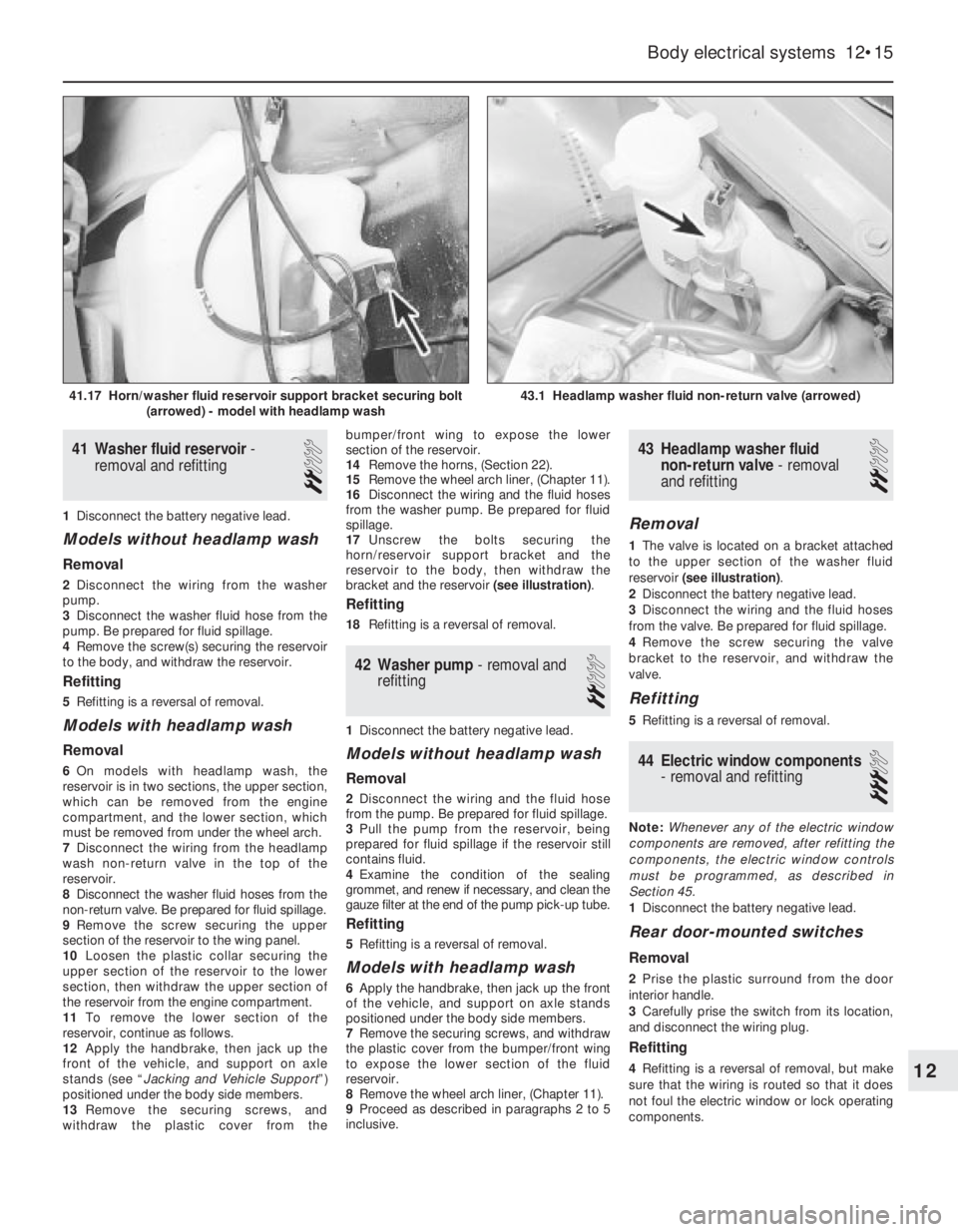
17Unscrew the bolts securing the
horn/reservoir support bracket and the
reservoir to the body, then withdraw the
bracket and the reservoir (see illustration).
Refitting
18Refitting is a reversal of removal.
42Washer pump -removal and
refitting
2
1Disconnect the battery negative lead.
Models without headlamp wash
Removal
2Disconnect the wiring and the fluid hose
from the pump. Be prepared for fluid spillage.
3Pull the pump from the reservoir, being
prepared for fluid spillage if the reservoir still
contains fluid.
4Examine the condition of the sealing
grommet, and renew if necessary, and clean the
gauze filter at the end of the pump pick-up tube.
Refitting
5Refitting is a reversal of removal.
Models with headlamp wash
6Apply the handbrake, then jack up the front
of the vehicle, and support on axle stands
positioned under the body side members.
7Remove the securing screws, and withdraw
the plastic cover from the bumper/front wing
to expose the lower section of the fluid
reservoir.
8Remove the wheel arch liner, (Chapter 11).
9Proceed as described in paragraphs 2 to 5
inclusive.
43Headlamp washer fluid
non-return valve -removal
and refitting
2
Removal
1The valve is located on a bracket attached
to the upper section of the washer fluid
reservoir (see illustration).
2Disconnect the battery negative lead.
3Disconnect the wiring and the fluid hoses
from the valve. Be prepared for fluid spillage.
4Remove the screw securing the valve
bracket to the reservoir, and withdraw the
valve.
Refitting
5Refitting is a reversal of removal.
44Electric window components
- removal and refitting
3
Note: Whenever any of the electric window
components are removed, after refitting the
components, the electric window controls
must be programmed, as described in
Section 45.
1Disconnect the battery negative lead.
Rear door-mounted switches
Removal
2Prise the plastic surround from the door
interior handle.
3Carefully prise the switch from its location,
and disconnect the wiring plug.
Refitting
4Refitting is a reversal of removal, but make
sure that the wiring is routed so that it does
not foul the electric window or lock operating
components.
Body electrical systems 12•15
43.1 Headlamp washer fluid non-return valve (arrowed)41.17 Horn/washer fluid reservoir support bracket securing bolt
(arrowed) - model with headlamp wash
12
Page 30 of 525
Centre console-mounted
switches
Removal
5The switches must be removed as a
complete assembly, and cannot be
dismantled. If one of the switches is faulty, the
complete assembly must be renewed.
6Remove the rear section of the centre
console, as described in Chapter 11.
7Release the securing clips, and withdraw
the switch assembly through the top of the
centre console.
Refitting
8Refitting is a reversal of removal.
Operating motors
9Remove the door window regulator, as
described in Chapter 11.
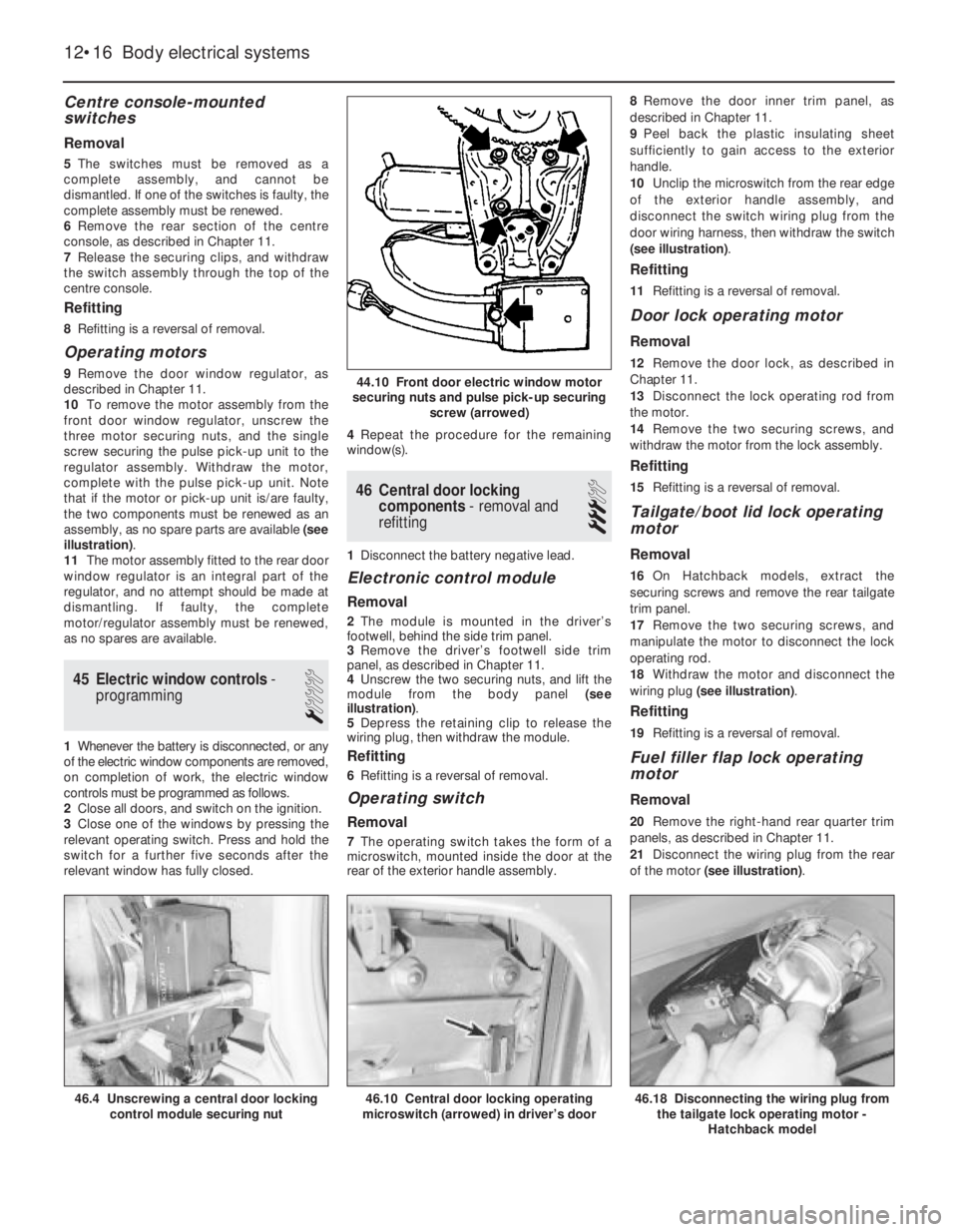
10To remove the motor assembly from the
front door window regulator, unscrew the
three motor securing nuts, and the single
screw securing the pulse pick-up unit to the
regulator assembly. Withdraw the motor,
complete with the pulse pick-up unit. Note
that if the motor or pick-up unit is/are faulty,
the two components must be renewed as an
assembly, as no spare parts are available (see
illustration).
11The motor assembly fitted to the rear door
window regulator is an integral part of the
regulator, and no attempt should be made at
dismantling. If faulty, the complete
motor/regulator assembly must be renewed,
as no spares are available.
45Electric window controls -
programming
1
1Whenever the battery is disconnected, or any
of the electric window components are removed,
on completion of work, the electric window
controls must be programmed as follows.
2Close all doors, and switch on the ignition.
3Close one of the windows by pressing the
relevant operating switch. Press and hold the
switch for a further five seconds after the
relevant window has fully closed.4Repeat the procedure for the remaining
window(s).
46Central door locking
components -removal and
refitting
3
1Disconnect the battery negative lead.
Electronic control module
Removal
2The module is mounted in the driver’s
footwell, behind the side trim panel.
3Remove the driver’s footwell side trim
panel, as described in Chapter 11.
4Unscrew the two securing nuts, and lift the
module from the body panel (see
illustration).
5Depress the retaining clip to release the
wiring plug, then withdraw the module.
Refitting
6Refitting is a reversal of removal.
Operating switch
Removal
7The operating switch takes the form of a
microswitch, mounted inside the door at the
rear of the exterior handle assembly.8Remove the door inner trim panel, as
described in Chapter 11.
9Peel back the plastic insulating sheet
sufficiently to gain access to the exterior
handle.
10Unclip the microswitch from the rear edge
of the exterior handle assembly, and
disconnect the switch wiring plug from the
door wiring harness, then withdraw the switch
(see illustration).
Refitting
11Refitting is a reversal of removal.
Door lock operating motor
Removal
12Remove the door lock, as described in
Chapter 11.
13Disconnect the lock operating rod from
the motor.
14Remove the two securing screws, and
withdraw the motor from the lock assembly.
Refitting
15Refitting is a reversal of removal.
Tailgate/boot lid lock operating
motor
Removal
16On Hatchback models, extract the
securing screws and remove the rear tailgate
trim panel.
17Remove the two securing screws, and
manipulate the motor to disconnect the lock
operating rod.
18Withdraw the motor and disconnect the
wiring plug (see illustration).
Refitting
19Refitting is a reversal of removal.
Fuel filler flap lock operating
motor
Removal
20Remove the right-hand rear quarter trim
panels, as described in Chapter 11.
21Disconnect the wiring plug from the rear
of the motor (see illustration).
12•16Body electrical systems
44.10 Front door electric window motor
securing nuts and pulse pick-up securing
screw (arrowed)
46.10 Central door locking operating
microswitch (arrowed) in driver’s door46.18 Disconnecting the wiring plug from
the tailgate lock operating motor -
Hatchback model46.4 Unscrewing a central door locking
control module securing nut
Page 31 of 525
22Unscrew the two screws securing the
motor to the mounting bracket, then
manipulate the motor to disconnect the lock
operating rod. Withdraw the motor.
Refitting
23Refitting is a reversal of removal.
47Aerial - removal and refitting
3
Removal
1On models with an electric aerial,
disconnect the battery negative lead.
2Remove the left-hand rear quarter trim
panel, as described in Chapter 11.
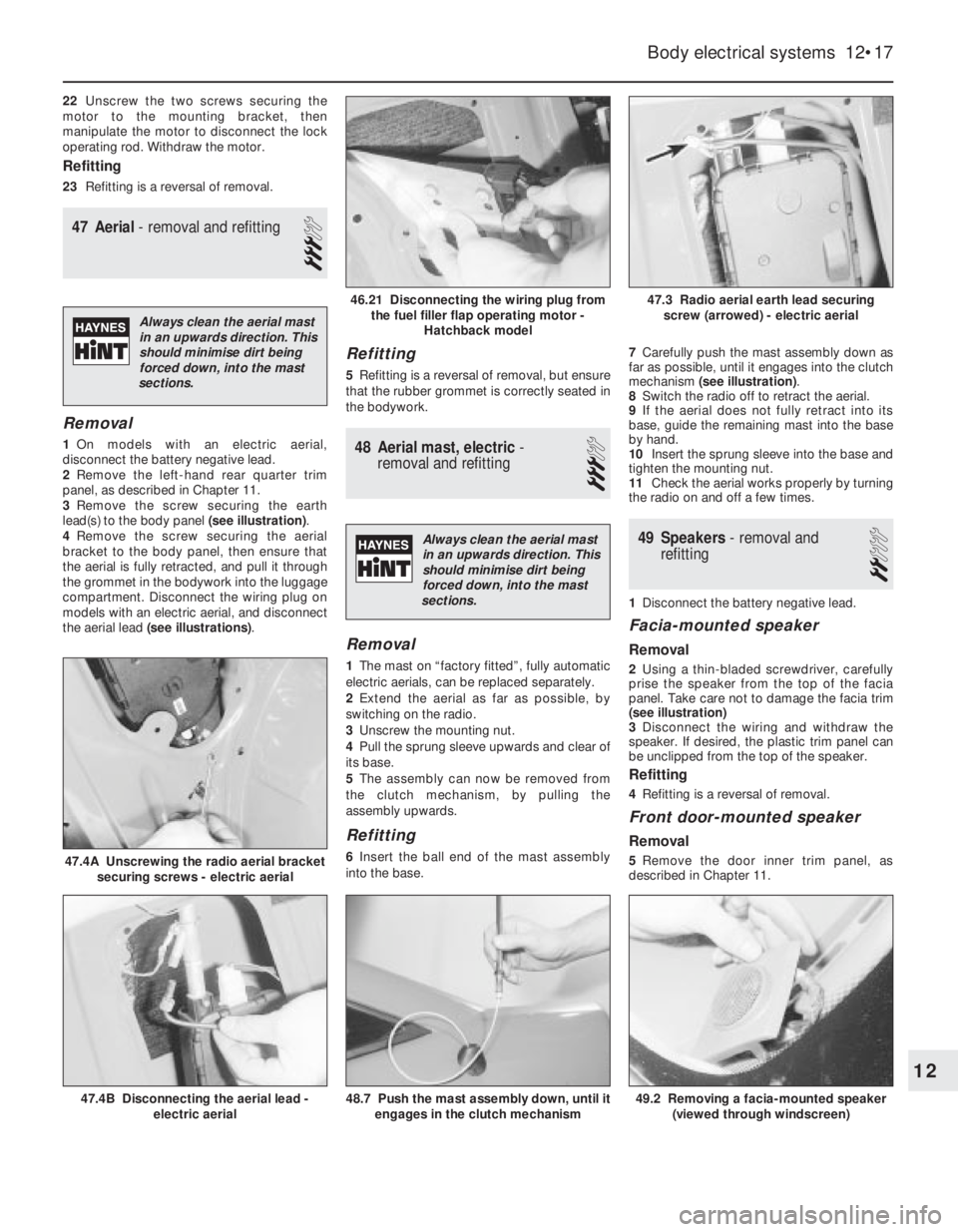
3Remove the screw securing the earth
lead(s) to the body panel (see illustration).
4Remove the screw securing the aerial
bracket to the body panel, then ensure that
the aerial is fully retracted, and pull it through
the grommet in the bodywork into the luggage
compartment. Disconnect the wiring plug on
models with an electric aerial, and disconnect
the aerial lead (see illustrations).
Refitting
5Refitting is a reversal of removal, but ensure
that the rubber grommet is correctly seated in
the bodywork.
48Aerial mast, electric -
removal and refitting
3
Removal
1The mast on “factory fitted”, fully automatic
electric aerials, can be replaced separately.
2Extend the aerial as far as possible, by
switching on the radio.
3Unscrew the mounting nut.
4Pull the sprung sleeve upwards and clear of
its base.
5The assembly can now be removed from
the clutch mechanism, by pulling the
assembly upwards.
Refitting
6Insert the ball end of the mast assembly
into the base.7Carefully push the mast assembly down as
far as possible, until it engages into the clutch
mechanism (see illustration).
8Switch the radio off to retract the aerial.
9If the aerial does not fully retract into its
base, guide the remaining mast into the base
by hand.
10Insert the sprung sleeve into the base and
tighten the mounting nut.
11Check the aerial works properly by turning
the radio on and off a few times.
49Speakers - removal and
refitting
2
1Disconnect the battery negative lead.
Facia-mounted speaker
Removal
2Using a thin-bladed screwdriver, carefully
prise the speaker from the top of the facia
panel. Take care not to damage the facia trim
(see illustration)
3Disconnect the wiring and withdraw the
speaker. If desired, the plastic trim panel can
be unclipped from the top of the speaker.
Refitting
4Refitting is a reversal of removal.
Front door-mounted speaker
Removal
5Remove the door inner trim panel, as
described in Chapter 11.
Body electrical systems 12•17
47.4A Unscrewing the radio aerial bracket
securing screws - electric aerial
49.2 Removing a facia-mounted speaker
(viewed through windscreen)48.7 Push the mast assembly down, until it
engages in the clutch mechanism47.4B Disconnecting the aerial lead -
electric aerial
47.3 Radio aerial earth lead securing
screw (arrowed) - electric aerial46.21 Disconnecting the wiring plug from
the fuel filler flap operating motor -
Hatchback model
12
Always clean the aerial mast
in an upwards direction. This
should minimise dirt being
forced down, into the mast
sections.
Always clean the aerial mast
in an upwards direction. This
should minimise dirt being
forced down, into the mast
sections.
Page 34 of 525
56Airbag unit, drivers side -
removal and refitting
4
Note:On power steering models in particular,
it will be advantageous to jack up the front of
the car and support it on axle stands placed
under the body side members, so that the
steering wheel can be turned more easily.
Removal
1Disconnect the battery negative lead and
cover the battery terminal. Wait a minimum of 1
minute.
2With the steering wheel positioned in the
straight-ahead position, turn it 90°clockwise
so that the left-hand spoke is accessible from
the rear.
3Using a Torx type socket, undo the first
airbag retaining bolt from the rear of the
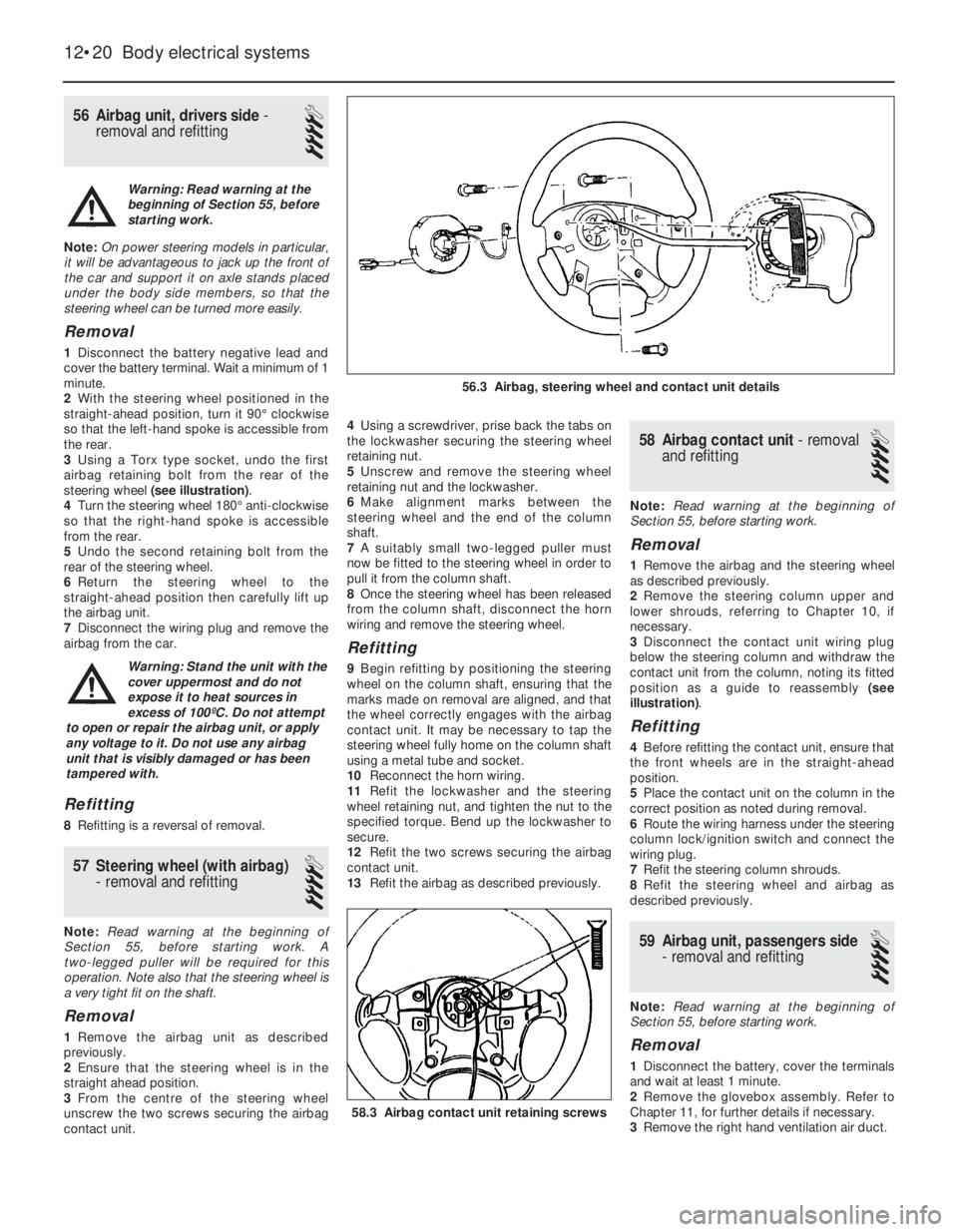
steering wheel (see illustration).
4Turn the steering wheel 180°anti-clockwise
so that the right-hand spoke is accessible
from the rear.
5Undo the second retaining bolt from the
rear of the steering wheel.
6Return the steering wheel to the
straight-ahead position then carefully lift up
the airbag unit.
7Disconnect the wiring plug and remove the
airbag from the car.
Refitting
8Refitting is a reversal of removal.
57Steering wheel (with airbag)
-removal and refitting
4
Note: Read warning at the beginning of
Section 55, before starting work. A
two-legged puller will be required for this
operation. Note also that the steering wheel is
a very tight fit on the shaft.
Removal
1Remove the airbag unit as described
previously.
2Ensure that the steering wheel is in the
straight ahead position.
3From the centre of the steering wheel
unscrew the two screws securing the airbag
contact unit.4Using a screwdriver, prise back the tabs on
the lockwasher securing the steering wheel
retaining nut.
5Unscrew and remove the steering wheel
retaining nut and the lockwasher.
6Make alignment marks between the
steering wheel and the end of the column
shaft.
7A suitably small two-legged puller must
now be fitted to the steering wheel in order to
pull it from the column shaft.
8Once the steering wheel has been released
from the column shaft, disconnect the horn
wiring and remove the steering wheel.
Refitting
9Begin refitting by positioning the steering
wheel on the column shaft, ensuring that the
marks made on removal are aligned, and that
the wheel correctly engages with the airbag
contact unit. It may be necessary to tap the
steering wheel fully home on the column shaft
using a metal tube and socket.
10Reconnect the horn wiring.
11Refit the lockwasher and the steering
wheel retaining nut, and tighten the nut to the
specified torque. Bend up the lockwasher to
secure.
12Refit the two screws securing the airbag
contact unit.
13Refit the airbag as described previously.
58Airbag contact unit -removal
and refitting
4
Note: Read warning at the beginning of
Section 55, before starting work.
Removal
1Remove the airbag and the steering wheel
as described previously.
2Remove the steering column upper and
lower shrouds, referring to Chapter 10, if
necessary.
3Disconnect the contact unit wiring plug
below the steering column and withdraw the
contact unit from the column, noting its fitted
position as a guide to reassembly (see
illustration).
Refitting
4Before refitting the contact unit, ensure that
the front wheels are in the straight-ahead
position.
5Place the contact unit on the column in the
correct position as noted during removal.
6Route the wiring harness under the steering
column lock/ignition switch and connect the
wiring plug.
7Refit the steering column shrouds.
8Refit the steering wheel and airbag as
described previously.
59Airbag unit, passengers side
- removal and refitting
4
Note: Read warning at the beginning of
Section 55, before starting work.
Removal
1Disconnect the battery, cover the terminals
and wait at least 1 minute.
2Remove the glovebox assembly. Refer to
Chapter 11, for further details if necessary.
3Remove the right hand ventilation air duct.
12•20Body electrical systems
58.3 Airbag contact unit retaining screws
56.3 Airbag, steering wheel and contact unit details
Warning: Read warning at the
beginning of Section 55, before
starting work.
Warning: Stand the unit with the
cover uppermost and do not
expose it to heat sources in
excess of 100ºC. Do not attempt
to open or repair the airbag unit, or apply
any voltage to it. Do not use any airbag
unit that is visibly damaged or has been
tampered with.
Page 36 of 525
12•22Body electrical systems
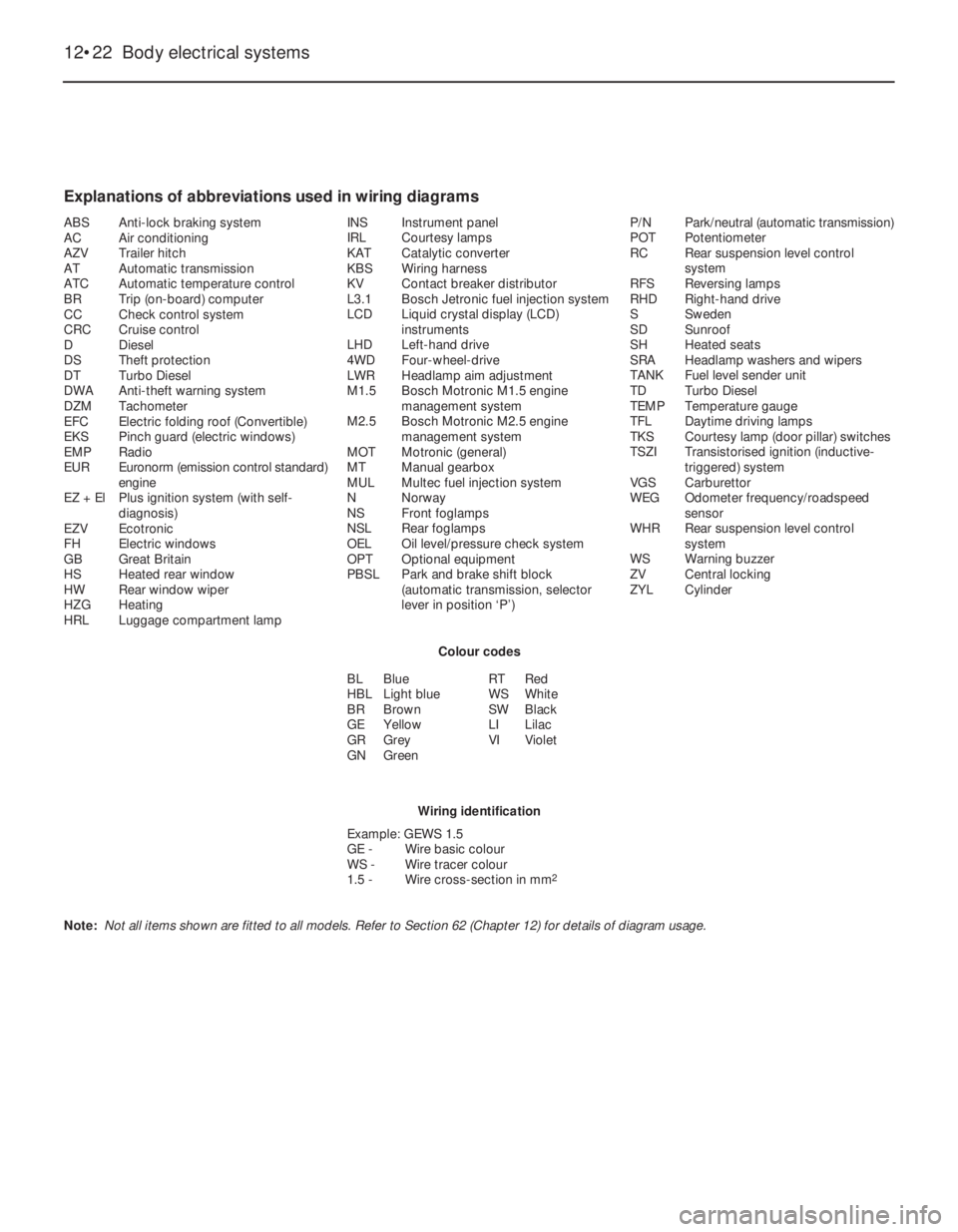
Explanations of abbreviations used in wiring diagrams
ABSAnti-lock braking system
ACAir conditioning
AZVTrailer hitch
ATAutomatic transmission
ATCAutomatic temperature control
BRTrip (on-board) computer
CCCheck control system
CRCCruise control
DDiesel
DSTheft protection
DTTurbo Diesel
DWAAnti-theft warning system
DZMTachometer
EFCElectric folding roof (Convertible)
EKSPinch guard (electric windows)
EMPRadio
EUREuronorm (emission control standard)
engine
EZ + ElPlus ignition system (with self-
diagnosis)
EZVEcotronic
FHElectric windows
GBGreat Britain
HSHeated rear window
HWRear window wiper
HZGHeating
HRLLuggage compartment lampINSInstrument panel
IRLCourtesy lamps
KATCatalytic converter
KBSWiring harness
KVContact breaker distributor
L3.1Bosch Jetronic fuel injection system
LCDLiquid crystal display (LCD)
instruments
LHDLeft-hand drive
4WDFour-wheel-drive
LWRHeadlamp aim adjustment
M1.5Bosch Motronic M1.5 engine
management system
M2.5Bosch Motronic M2.5 engine
management system
MOTMotronic (general)
MTManual gearbox
MULMultec fuel injection system
NNorway
NSFront foglamps
NSLRear foglamps
OELOil level/pressure check system
OPTOptional equipment
PBSLPark and brake shift block
(automatic transmission, selector
lever in position ‘P’)P/NPark/neutral (automatic transmission)
POTPotentiometer
RCRear suspension level control
system
RFSReversing lamps
RHDRight-hand drive
SSweden
SDSunroof
SHHeated seats
SRAHeadlamp washers and wipers
TANKFuel level sender unit
TDTurbo Diesel
TEMPTemperature gauge
TFLDaytime driving lamps
TKSCourtesy lamp (door pillar) switches
TSZITransistorised ignition (inductive-
triggered) system
VGSCarburettor
WEGOdometer frequency/roadspeed
sensor
WHRRear suspension level control
system
WSWarning buzzer
ZVCentral locking
ZYLCylinder
Colour codes
BLBlue
HBLLight blue
BRBrown
GEYellow
GRGrey
GNGreenRTRed
WSWhite
SWBlack
LILilac
VIViolet
Wiring identification
Example: GEWS 1.5
GE -Wire basic colour
WS -Wire tracer colour
1.5 -Wire cross-section in mm
2
Note: Not all items shown are fitted to all models. Refer to Section 62 (Chapter 12) for details of diagram usage.