clock OPEL CALIBRA 1988 Service Owner's Manual
[x] Cancel search | Manufacturer: OPEL, Model Year: 1988, Model line: CALIBRA, Model: OPEL CALIBRA 1988Pages: 525, PDF Size: 58.26 MB
Page 94 of 525
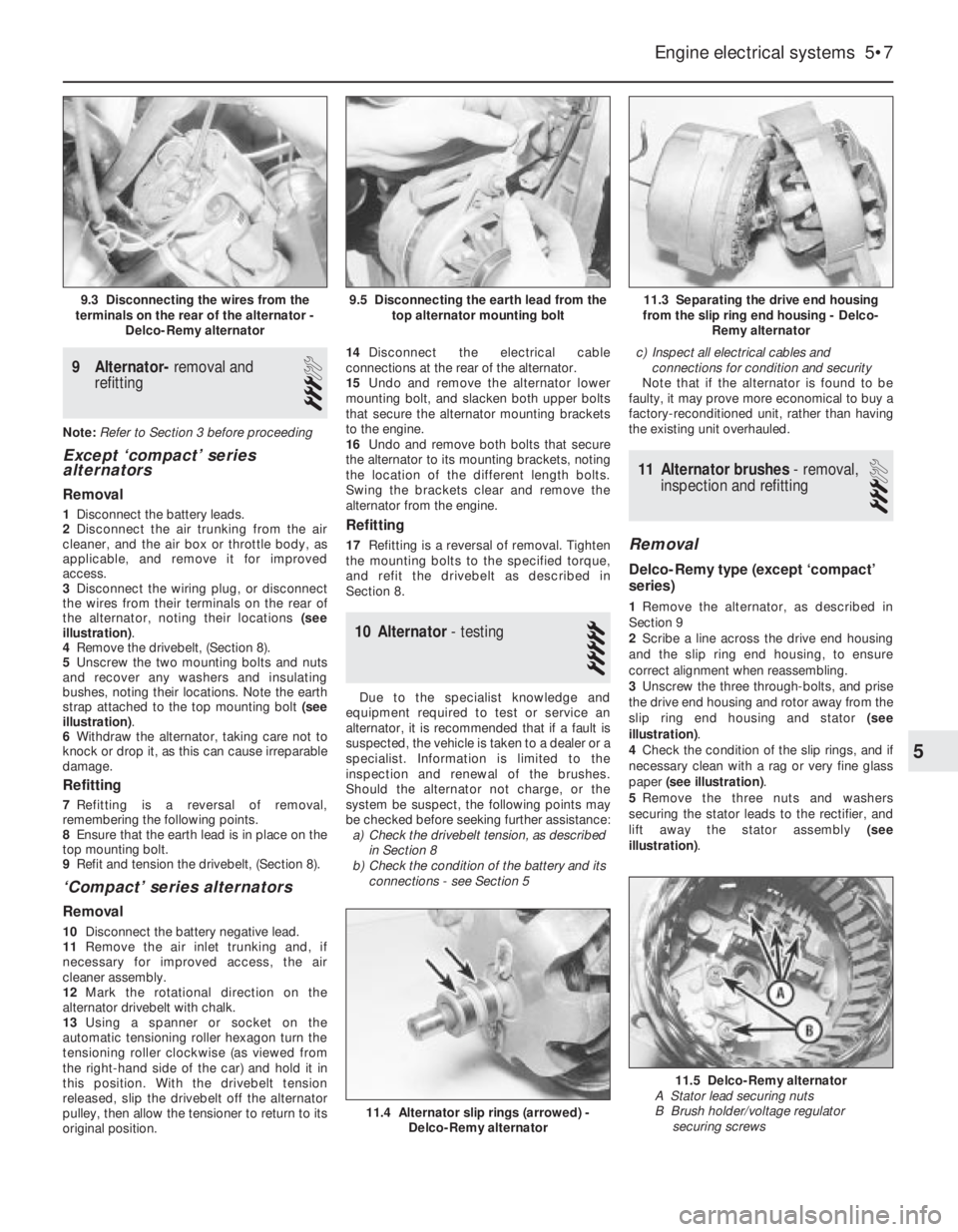
9Alternator-removal and
refitting
3
Note: Refer to Section 3 before proceeding
Except ‘compact’ series
alternators
Removal
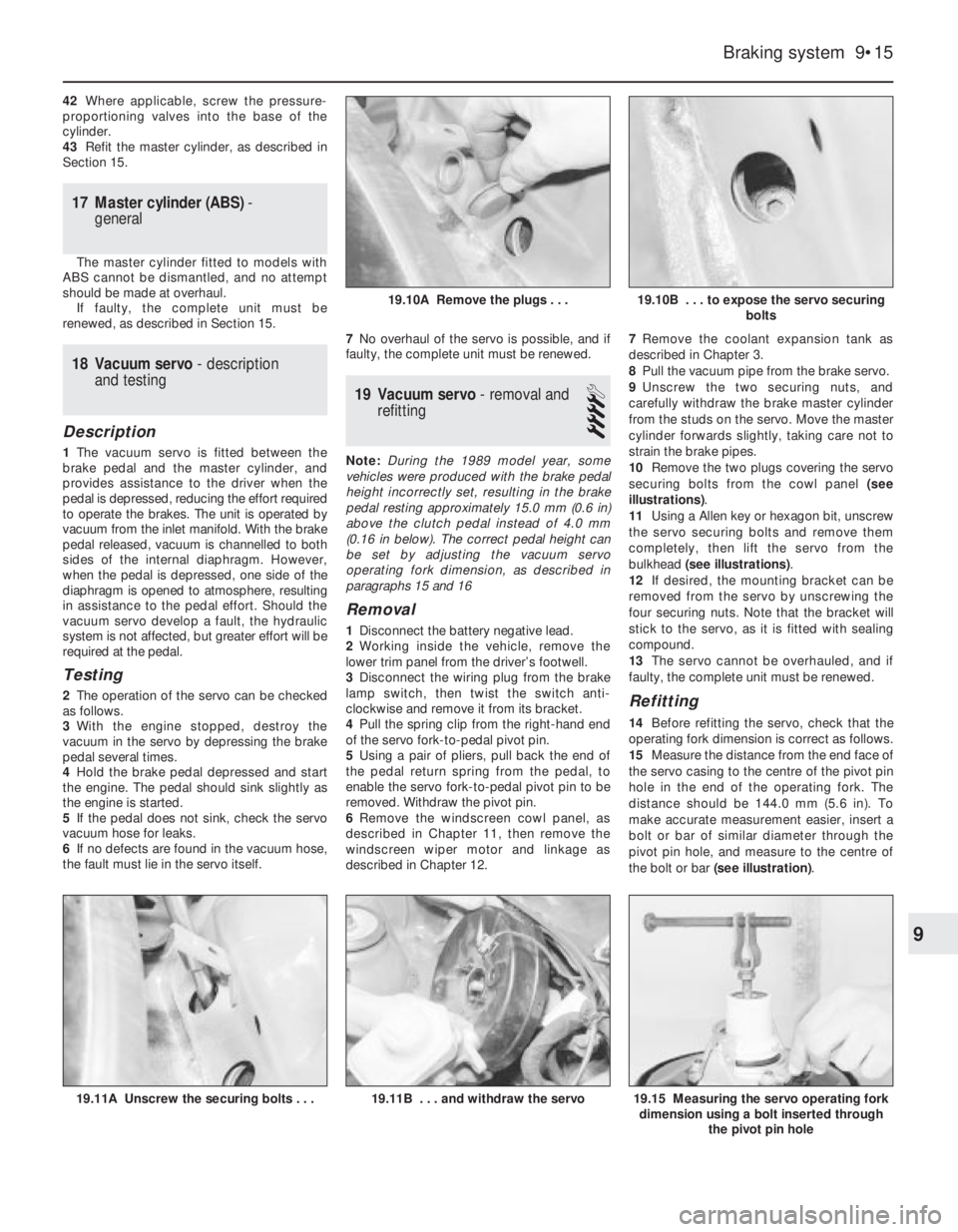
1Disconnect the battery leads.
2Disconnect the air trunking from the air
cleaner, and the air box or throttle body, as
applicable, and remove it for improved
access.
3Disconnect the wiring plug, or disconnect
the wires from their terminals on the rear of
the alternator, noting their locations (see
illustration).
4Remove the drivebelt, (Section 8).
5Unscrew the two mounting bolts and nuts
and recover any washers and insulating
bushes, noting their locations. Note the earth
strap attached to the top mounting bolt (see
illustration).
6Withdraw the alternator, taking care not to
knock or drop it, as this can cause irreparable
damage.
Refitting
7Refitting is a reversal of removal,
remembering the following points.
8Ensure that the earth lead is in place on the
top mounting bolt.
9Refit and tension the drivebelt, (Section 8).
‘Compact’ series alternators
Removal
10Disconnect the battery negative lead.
11Remove the air inlet trunking and, if
necessary for improved access, the air
cleaner assembly.
12Mark the rotational direction on the
alternator drivebelt with chalk.
13Using a spanner or socket on the
automatic tensioning roller hexagon turn the
tensioning roller clockwise (as viewed from
the right-hand side of the car) and hold it in
this position. With the drivebelt tension
released, slip the drivebelt off the alternator
pulley, then allow the tensioner to return to its
original position.14Disconnect the electrical cable
connections at the rear of the alternator.
15Undo and remove the alternator lower
mounting bolt, and slacken both upper bolts
that secure the alternator mounting brackets
to the engine.
16Undo and remove both bolts that secure
the alternator to its mounting brackets, noting
the location of the different length bolts.
Swing the brackets clear and remove the
alternator from the engine.
Refitting
17Refitting is a reversal of removal. Tighten
the mounting bolts to the specified torque,
and refit the drivebelt as described in
Section 8.
10Alternator -testing
5
Due to the specialist knowledge and
equipment required to test or service an
alternator, it is recommended that if a fault is
suspected, the vehicle is taken to a dealer or a
specialist. Information is limited to the
inspection and renewal of the brushes.
Should the alternator not charge, or the
system be suspect, the following points may
be checked before seeking further assistance:
a)Check the drivebelt tension, as described
in Section 8
b)Check the condition of the battery and its
connections -see Section 5c)Inspect all electrical cables and
connections for condition and security
Note that if the alternator is found to be
faulty, it may prove more economical to buy a
factory-reconditioned unit, rather than having
the existing unit overhauled.
11Alternator brushes -removal,
inspection and refitting
3
Removal
Delco-Remy type (except ‘compact’
series)
1Remove the alternator, as described in
Section 9
2Scribe a line across the drive end housing
and the slip ring end housing, to ensure
correct alignment when reassembling.
3Unscrew the three through-bolts, and prise
the drive end housing and rotor away from the
slip ring end housing and stator (see
illustration).
4Check the condition of the slip rings, and if
necessary clean with a rag or very fine glass
paper (see illustration).
5Remove the three nuts and washers
securing the stator leads to the rectifier, and
lift away the stator assembly (see
illustration).
Engine electrical systems 5•7
11.3 Separating the drive end housing
from the slip ring end housing - Delco-
Remy alternator
11.4 Alternator slip rings (arrowed) -
Delco-Remy alternator
11.5 Delco-Remy alternator
A Stator lead securing nuts
B Brush holder/voltage regulator
securing screws
9.5 Disconnecting the earth lead from the
top alternator mounting bolt9.3 Disconnecting the wires from the
terminals on the rear of the alternator -
Delco-Remy alternator
5
Page 100 of 525
Inspection
17Examine the distributor cap and rotor arm,
as described in paragraphs 6 and 7. Examine
the O-rings at the rear of the distributor body,
and on the rear of the shaft, and renew if
necessary.
Reassembly
18Reassembly is a reversal of dismantling,
ensuring that the thrustwashers are correctly
located. Note that the drive collar should be
refitted so that the drive peg on the collar is
aligned with the groove in the top of the
distributor shaft (it is possible to fit the drive
collar 180°out of position).
19Refit the distributor as described in
Section 18, and then check and if necessary
adjust the ignition timing, as described in
Section 21.
DOHC models (where
applicable)
20The distributor cap and rotor arm can be
examined as described in paragraphs 6 and 7.
21Ignition timing -checking and
adjustment
4
Note: Refer to Section 3 before proceeding. A
tachometer and a timing light will be required
during this procedure. For details of ignition
timing adjustment required to operate vehicles
on unleaded petrol, refer to Section 22.
14 NV and 16 SV models
Checking
1Start the engine and run it until it reaches
normal operating temperature, then switch
off.
2On 14 NV models, disconnect the vacuum
pipe from the distributor vacuum diaphragm
unit.
3On all models use a spanner applied to the
crankshaft pulley bolt to rotate the crankshaft
clockwise until the notch in the pulley’s
inboard rim aligns with the pointer protruding
from the oil pump housing. On 14 NV models,
where two notches (indicating 10°and 5°
BTDC respectively) are found, rotate the
crankshaft until the second notch (in thedirection of rotation -i.e. 5°BTDC) aligns. Use
white paint or similar to emphasise the pointer
and notch, to make them easier to see.
4Connect a timing light to No 1 cylinder
(nearest the timing belt end of the engine) HT
lead, also a tachometer; follow the equipment
manufacturer’s instructions for connection.
5Start the engine and allow it to idle -the
speed should be between 700 and 1000 rpm.
6On 14 NV models, aim the timing light at the
pointer and check that it is aligned with the
crankshaft pulley notch.
7On early 16 SV models, disconnect the
ignition timing basic adjustment coding plug.
This can be identified by a length of Black
wire joining Brown/Red and Brown/Yellow
wires in a connector plug clipped to the wiring
or heater/cooling system hoses beneath the
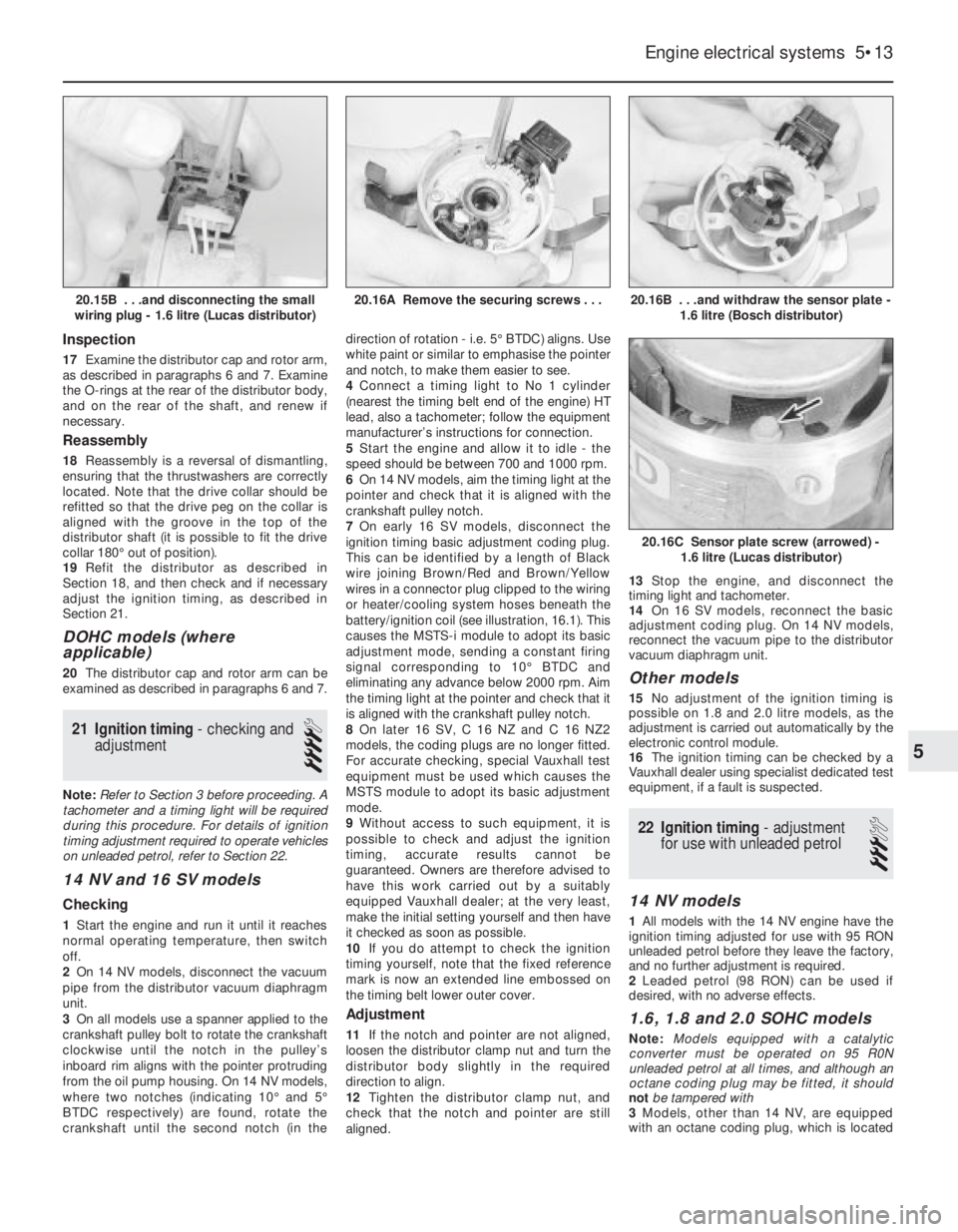
battery/ignition coil (see illustration, 16.1). This
causes the MSTS-i module to adopt its basic
adjustment mode, sending a constant firing
signal corresponding to 10°BTDC and
eliminating any advance below 2000 rpm. Aim
the timing light at the pointer and check that it
is aligned with the crankshaft pulley notch.
8On later 16 SV, C 16 NZ and C 16 NZ2
models, the coding plugs are no longer fitted.
For accurate checking, special Vauxhall test
equipment must be used which causes the
MSTS module to adopt its basic adjustment
mode.
9Without access to such equipment, it is
possible to check and adjust the ignition
timing, accurate results cannot be
guaranteed. Owners are therefore advised to
have this work carried out by a suitably
equipped Vauxhall dealer; at the very least,
make the initial setting yourself and then have
it checked as soon as possible.
10If you do attempt to check the ignition
timing yourself, note that the fixed reference
mark is now an extended line embossed on
the timing belt lower outer cover.
Adjustment
11If the notch and pointer are not aligned,
loosen the distributor clamp nut and turn the
distributor body slightly in the required
direction to align.
12Tighten the distributor clamp nut, and
check that the notch and pointer are still
aligned. 13Stop the engine, and disconnect the
timing light and tachometer.
14On 16 SV models, reconnect the basic
adjustment coding plug. On 14 NV models,
reconnect the vacuum pipe to the distributor
vacuum diaphragm unit.
Other models
15No adjustment of the ignition timing is
possible on 1.8 and 2.0 litre models, as the
adjustment is carried out automatically by the
electronic control module.
16The ignition timing can be checked by a
Vauxhall dealer using specialist dedicated test
equipment, if a fault is suspected.
22Ignition timing -adjustment
for use with unleaded petrol
3
14 NV models
1All models with the 14 NV engine have the
ignition timing adjusted for use with 95 RON
unleaded petrol before they leave the factory,
and no further adjustment is required.
2Leaded petrol (98 RON) can be used if
desired, with no adverse effects.
1.6, 1.8 and 2.0 SOHC models
Note: Models equipped with a catalytic
converter must be operated on 95 R0N
unleaded petrol at all times, and although an
octane coding plug may be fitted, it should
not be tampered with
3Models, other than 14 NV, are equipped
with an octane coding plug, which is located
Engine electrical systems 5•13
20.16B . . .and withdraw the sensor plate -
1.6 litre (Bosch distributor)
20.16C Sensor plate screw (arrowed) -
1.6 litre (Lucas distributor)
20.16A Remove the securing screws . . .20.15B . . .and disconnecting the small
wiring plug - 1.6 litre (Lucas distributor)
5
Page 117 of 525
9Where applicable, ensure that the glass
panel securing screw lockwashers engage
with the locating pins on the guide rails.
10Before fully tightening the glass panel
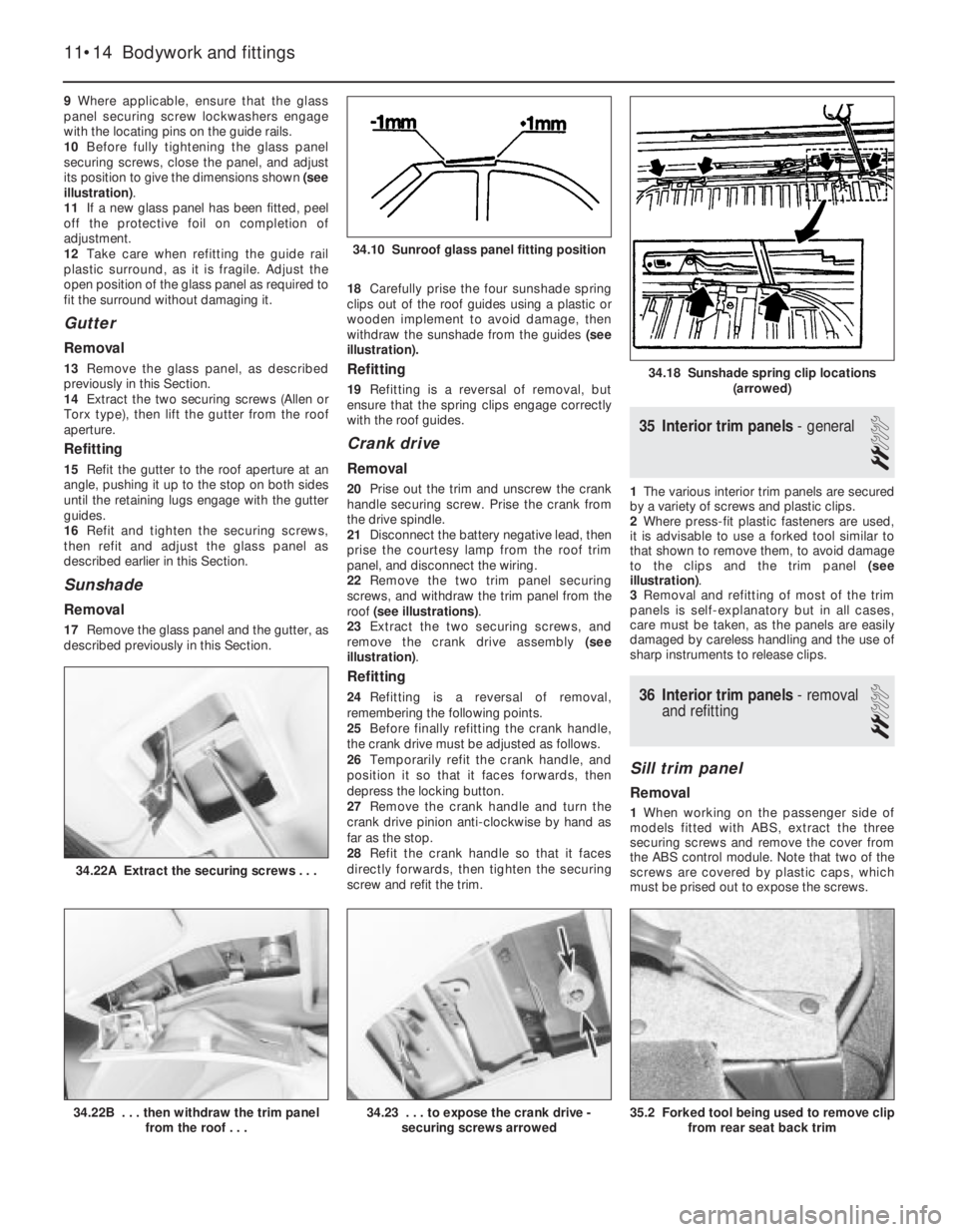
securing screws, close the panel, and adjust
its position to give the dimensions shown (see
illustration).
11If a new glass panel has been fitted, peel
off the protective foil on completion of
adjustment.
12Take care when refitting the guide rail
plastic surround, as it is fragile. Adjust the
open position of the glass panel as required to
fit the surround without damaging it.
Gutter
Removal
13Remove the glass panel, as described
previously in this Section.
14Extract the two securing screws (Allen or
Torx type), then lift the gutter from the roof
aperture.
Refitting
15Refit the gutter to the roof aperture at an
angle, pushing it up to the stop on both sides
until the retaining lugs engage with the gutter
guides.
16Refit and tighten the securing screws,
then refit and adjust the glass panel as
described earlier in this Section.
Sunshade
Removal
17Remove the glass panel and the gutter, as
described previously in this Section. 18Carefully prise the four sunshade spring
clips out of the roof guides using a plastic or
wooden implement to avoid damage, then
withdraw the sunshade from the guides (see
illustration).
Refitting
19Refitting is a reversal of removal, but
ensure that the spring clips engage correctly
with the roof guides.
Crank drive
Removal
20Prise out the trim and unscrew the crank
handle securing screw. Prise the crank from
the drive spindle.
21Disconnect the battery negative lead, then
prise the courtesy lamp from the roof trim
panel, and disconnect the wiring.
22Remove the two trim panel securing
screws, and withdraw the trim panel from the
roof (see illustrations).
23Extract the two securing screws, and
remove the crank drive assembly (see
illustration).
Refitting
24Refitting is a reversal of removal,
remembering the following points.
25Before finally refitting the crank handle,
the crank drive must be adjusted as follows.
26Temporarily refit the crank handle, and
position it so that it faces forwards, then
depress the locking button.
27Remove the crank handle and turn the
crank drive pinion anti-clockwise by hand as
far as the stop.
28Refit the crank handle so that it faces
directly forwards, then tighten the securing
screw and refit the trim.
35Interior trim panels -general
2
1The various interior trim panels are secured
by a variety of screws and plastic clips.
2Where press-fit plastic fasteners are used,
it is advisable to use a forked tool similar to
that shown to remove them, to avoid damage
to the clips and the trim panel (see
illustration).
3Removal and refitting of most of the trim
panels is self-explanatory but in all cases,
care must be taken, as the panels are easily
damaged by careless handling and the use of
sharp instruments to release clips.
36Interior trim panels -removal
and refitting
2
Sill trim panel
Removal
1When working on the passenger side of
models fitted with ABS, extract the three
securing screws and remove the cover from
the ABS control module. Note that two of the
screws are covered by plastic caps, which
must be prised out to expose the screws.
11•14Bodywork and fittings
34.22A Extract the securing screws . . .
35.2 Forked tool being used to remove clip
from rear seat back trim34.23 . . . to expose the crank drive -
securing screws arrowed34.22B . . . then withdraw the trim panel
from the roof . . .
34.18 Sunshade spring clip locations
(arrowed)
34.10 Sunroof glass panel fitting position
Page 120 of 525
Refitting
11Refitting is a reversal of removal, but
make sure that the column switch gaiters
engage in the cut-outs in the upper shroud.
Instrument panel lower trim
panel
Removal
12Remove the steering column shrouds, as
described previously in this Section.
13The panel is secured by clips at either
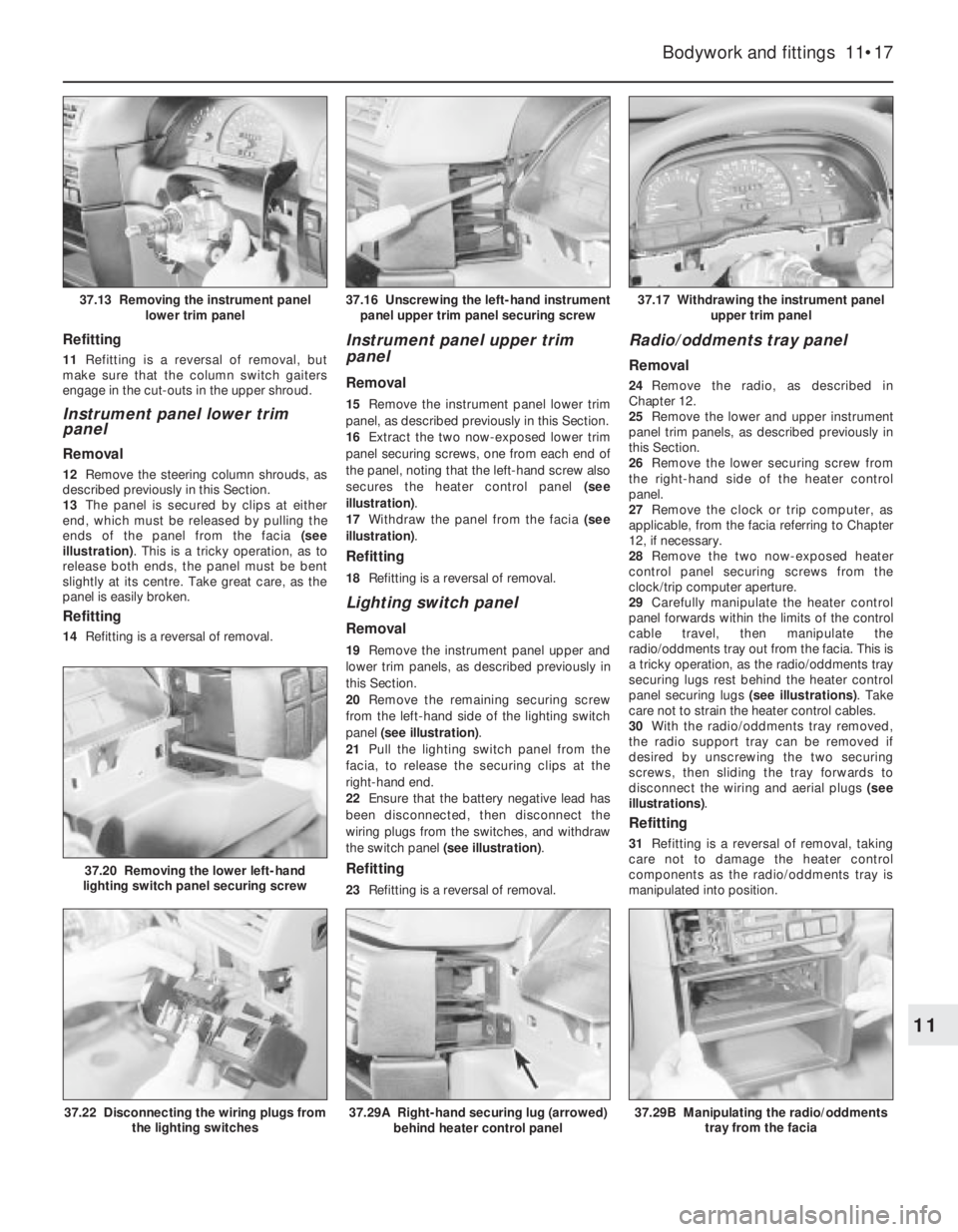
end, which must be released by pulling the
ends of the panel from the facia (see
illustration). This is a tricky operation, as to
release both ends, the panel must be bent
slightly at its centre. Take great care, as the
panel is easily broken.
Refitting
14Refitting is a reversal of removal.
Instrument panel upper trim
panel
Removal
15Remove the instrument panel lower trim
panel, as described previously in this Section.
16Extract the two now-exposed lower trim
panel securing screws, one from each end of
the panel, noting that the left-hand screw also
secures the heater control panel (see
illustration).
17Withdraw the panel from the facia (see
illustration).
Refitting
18Refitting is a reversal of removal.
Lighting switch panel
Removal
19Remove the instrument panel upper and
lower trim panels, as described previously in
this Section.
20Remove the remaining securing screw
from the left-hand side of the lighting switch
panel (see illustration).
21Pull the lighting switch panel from the
facia, to release the securing clips at the
right-hand end.
22Ensure that the battery negative lead has
been disconnected, then disconnect the
wiring plugs from the switches, and withdraw
the switch panel (see illustration).
Refitting
23Refitting is a reversal of removal.
Radio/oddments tray panel
Removal
24Remove the radio, as described in
Chapter 12.
25Remove the lower and upper instrument
panel trim panels, as described previously in
this Section.
26Remove the lower securing screw from
the right-hand side of the heater control
panel.
27Remove the clock or trip computer, as
applicable, from the facia referring to Chapter
12, if necessary.
28Remove the two now-exposed heater
control panel securing screws from the
clock/trip computer aperture.
29Carefully manipulate the heater control
panel forwards within the limits of the control
cable travel, then manipulate the
radio/oddments tray out from the facia. This is
a tricky operation, as the radio/oddments tray
securing lugs rest behind the heater control
panel securing lugs (see illustrations). Take
care not to strain the heater control cables.
30With the radio/oddments tray removed,
the radio support tray can be removed if
desired by unscrewing the two securing
screws, then sliding the tray forwards to
disconnect the wiring and aerial plugs (see
illustrations).
Refitting
31Refitting is a reversal of removal, taking
care not to damage the heater control
components as the radio/oddments tray is
manipulated into position.
Bodywork and fittings 11•17
37.17 Withdrawing the instrument panel
upper trim panel
37.29B Manipulating the radio/oddments
tray from the facia37.29A Right-hand securing lug (arrowed)
behind heater control panel37.22 Disconnecting the wiring plugs from
the lighting switches
37.20 Removing the lower left-hand
lighting switch panel securing screw
37.16 Unscrewing the left-hand instrument
panel upper trim panel securing screw37.13 Removing the instrument panel
lower trim panel
11
Page 146 of 525
42Where applicable, screw the pressure-
proportioning valves into the base of the
cylinder.
43Refit the master cylinder, as described in
Section 15.
17Master cylinder (ABS) -
general
The master cylinder fitted to models with
ABS cannot be dismantled, and no attempt
should be made at overhaul.
If faulty, the complete unit must be
renewed, as described in Section 15.
18Vacuum servo - description
and testing
Description
1The vacuum servo is fitted between the
brake pedal and the master cylinder, and
provides assistance to the driver when the
pedal is depressed, reducing the effort required
to operate the brakes. The unit is operated by
vacuum from the inlet manifold. With the brake
pedal released, vacuum is channelled to both
sides of the internal diaphragm. However,
when the pedal is depressed, one side of the
diaphragm is opened to atmosphere, resulting
in assistance to the pedal effort. Should the
vacuum servo develop a fault, the hydraulic
system is not affected, but greater effort will be
required at the pedal.
Testing
2The operation of the servo can be checked
as follows.
3With the engine stopped, destroy the
vacuum in the servo by depressing the brake
pedal several times.
4Hold the brake pedal depressed and start
the engine. The pedal should sink slightly as
the engine is started.
5If the pedal does not sink, check the servo
vacuum hose for leaks.
6If no defects are found in the vacuum hose,
the fault must lie in the servo itself.7No overhaul of the servo is possible, and if
faulty, the complete unit must be renewed.
19Vacuum servo - removal and
refitting
4
Note: During the 1989 model year, some
vehicles were produced with the brake pedal
height incorrectly set, resulting in the brake
pedal resting approximately 15.0 mm (0.6 in)
above the clutch pedal instead of 4.0 mm
(0.16 in below). The correct pedal height can
be set by adjusting the vacuum servo
operating fork dimension, as described in
paragraphs 15 and 16
Removal
1Disconnect the battery negative lead.
2Working inside the vehicle, remove the
lower trim panel from the driver’s footwell.
3Disconnect the wiring plug from the brake
lamp switch, then twist the switch anti-
clockwise and remove it from its bracket.
4Pull the spring clip from the right-hand end
of the servo fork-to-pedal pivot pin.
5Using a pair of pliers, pull back the end of
the pedal return spring from the pedal, to
enable the servo fork-to-pedal pivot pin to be
removed. Withdraw the pivot pin.
6Remove the windscreen cowl panel, as
described in Chapter 11, then remove the
windscreen wiper motor and linkage as
described in Chapter 12.7Remove the coolant expansion tank as
described in Chapter 3.
8Pull the vacuum pipe from the brake servo.
9Unscrew the two securing nuts, and
carefully withdraw the brake master cylinder
from the studs on the servo. Move the master
cylinder forwards slightly, taking care not to
strain the brake pipes.
10Remove the two plugs covering the servo
securing bolts from the cowl panel (see
illustrations).
11Using a Allen key or hexagon bit, unscrew
the servo securing bolts and remove them
completely, then lift the servo from the
bulkhead (see illustrations).
12If desired, the mounting bracket can be
removed from the servo by unscrewing the
four securing nuts. Note that the bracket will
stick to the servo, as it is fitted with sealing
compound.
13The servo cannot be overhauled, and if
faulty, the complete unit must be renewed.
Refitting
14Before refitting the servo, check that the
operating fork dimension is correct as follows.
15Measure the distance from the end face of
the servo casing to the centre of the pivot pin
hole in the end of the operating fork. The
distance should be 144.0 mm (5.6 in). To
make accurate measurement easier, insert a
bolt or bar of similar diameter through the
pivot pin hole, and measure to the centre of
the bolt or bar (see illustration).
Braking system 9•15
19.11A Unscrew the securing bolts . . .19.15 Measuring the servo operating fork
dimension using a bolt inserted through
the pivot pin hole19.11B . . . and withdraw the servo
19.10B . . . to expose the servo securing
bolts19.10A Remove the plugs . . .
9
Page 152 of 525
19On DOHC models, use a new self-locking
nut to secure the equaliser yoke to the
handbrake lever operating rod, and screw the
nut onto the rod to the position noted before
removal.
20On SOHC models, tighten the cable
adjuster to expose the length of thread noted
before removal.
21Before lowering the vehicle to the ground,
adjust the handbrake, (Section 26).
29Brake pedal - removal and
refitting
3
Removal
1Disconnect the battery negative lead.
2Remove the lower trim panel from the
driver’s footwell.3Disconnect the wiring plug from the brake
lamp switch, then twist the switch anti-
clockwise and remove it from its bracket.
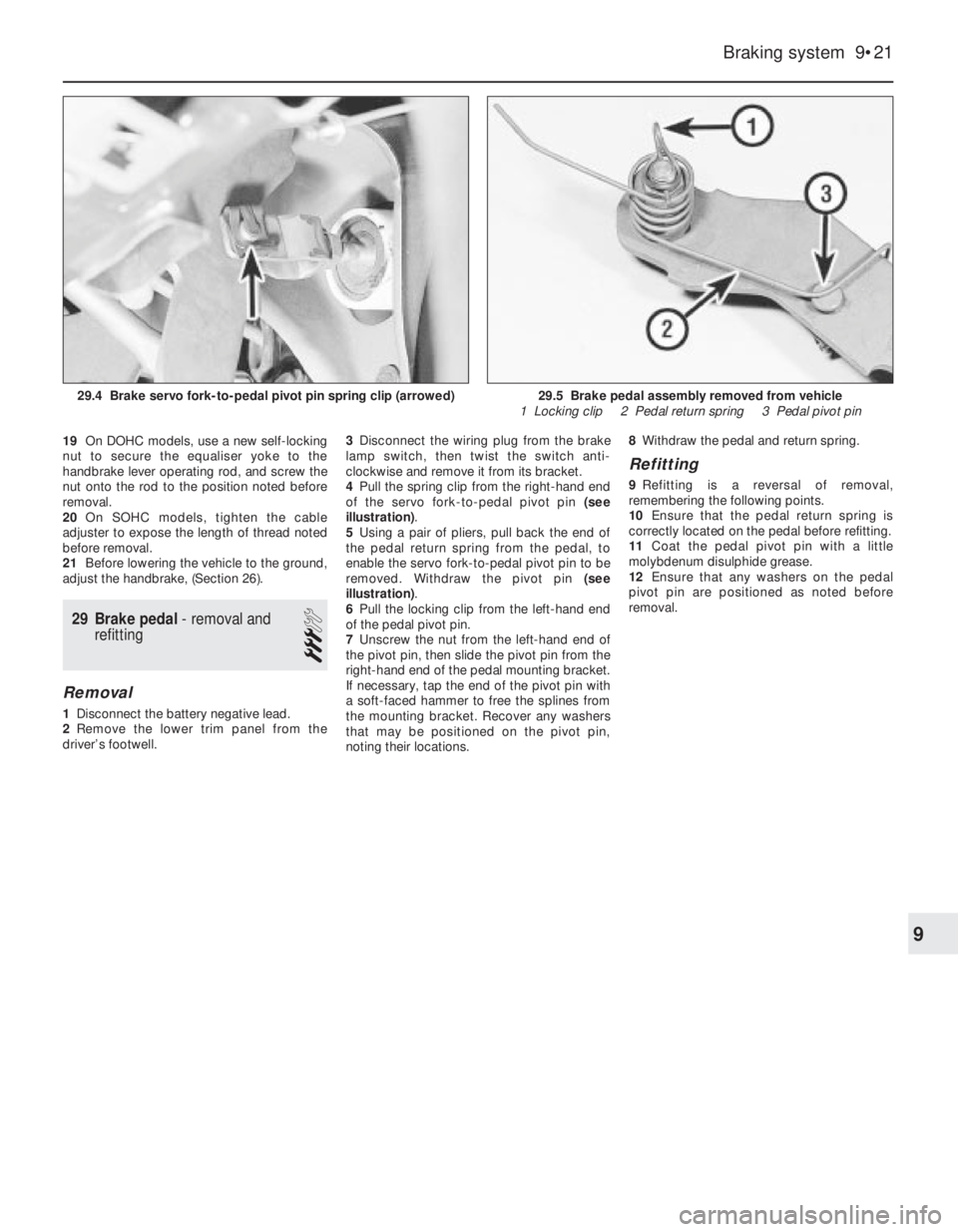
4Pull the spring clip from the right-hand end
of the servo fork-to-pedal pivot pin (see
illustration).
5Using a pair of pliers, pull back the end of
the pedal return spring from the pedal, to
enable the servo fork-to-pedal pivot pin to be
removed. Withdraw the pivot pin (see
illustration).
6Pull the locking clip from the left-hand end
of the pedal pivot pin.
7Unscrew the nut from the left-hand end of
the pivot pin, then slide the pivot pin from the
right-hand end of the pedal mounting bracket.
If necessary, tap the end of the pivot pin with
a soft-faced hammer to free the splines from
the mounting bracket. Recover any washers
that may be positioned on the pivot pin,
noting their locations.8Withdraw the pedal and return spring.
Refitting
9Refitting is a reversal of removal,
remembering the following points.
10Ensure that the pedal return spring is
correctly located on the pedal before refitting.
11Coat the pedal pivot pin with a little
molybdenum disulphide grease.
12Ensure that any washers on the pedal
pivot pin are positioned as noted before
removal.
Braking system 9•21
29.5 Brake pedal assembly removed from vehicle
1 Locking clip 2 Pedal return spring 3 Pedal pivot pin29.4 Brake servo fork-to-pedal pivot pin spring clip (arrowed)
9
Page 165 of 525
9Remove the two securing screws and
withdraw the sensor from the throttle body.
Refitting
10Refitting is a reversal of removal.
11On Motronic M4.1 system models, before
tightening the securing screws, adjust the
position of the sensor as follows:
a)Turn the sensor body anti-clockwise until
resistance is felt, then tighten the securing
screws.
b)When the throttle valve is opened, an
audible click should be noticeable from
the sensor, and similarly, this should be
repeated as the throttle valve is closed.
c)If necessary, adjust the position of the
sensor until a click is heard just as the
throttle valve begins to open.
12On M 1.5 systems, no adjustment is
required when refitting, as the sensor can only
be fitted in one position.
24Throttle valve potentiometer
- removal and refitting
3
Removal
1Disconnect the battery negative lead.
2Disconnect the wiring plugs at the inlet air
temperature sensor and at the hot film mass
airflow meter.
3Undo and remove the bolts securing the air
box to the throttle body. Remove the air box
complete with air trunking.4Disconnect the wiring plug at the throttle
valve potentiometer, then undo the two
screws and withdraw the potentiometer from
the throttle body.
Refitting
5Refitting is a reversal of removal.
25Airflow meter (if fitted) -
removal and refitting
3
Note: If the air funnel is removed, a new
gasket must be used on refitting. The airflow
meter securing bolts must be coated with
thread-locking compound on refitting
Removal
1Remove the air cleaner assembly, as
described in Section 4.
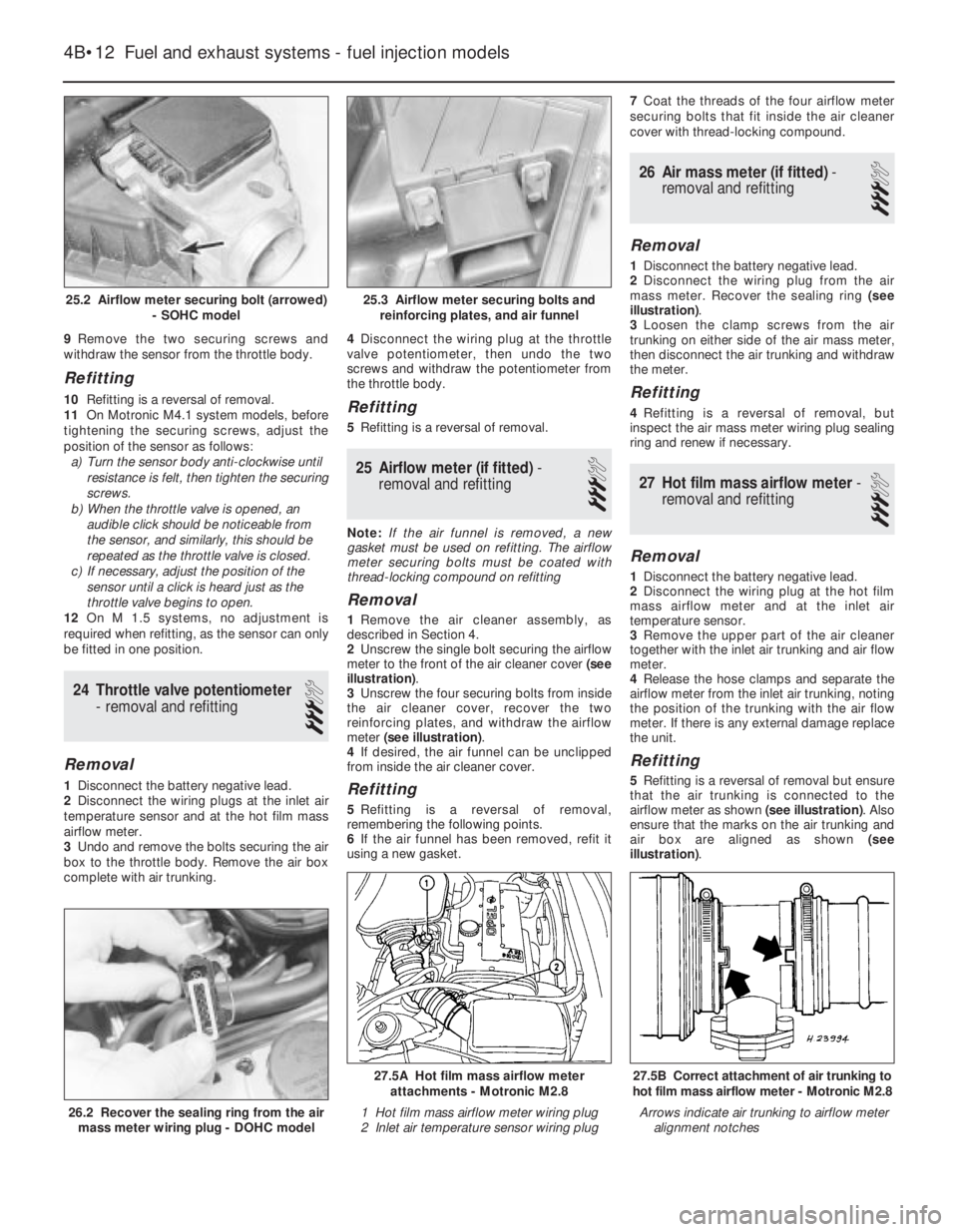
2Unscrew the single bolt securing the airflow
meter to the front of the air cleaner cover (see
illustration).
3Unscrew the four securing bolts from inside
the air cleaner cover, recover the two
reinforcing plates, and withdraw the airflow
meter (see illustration).
4If desired, the air funnel can be unclipped
from inside the air cleaner cover.
Refitting
5Refitting is a reversal of removal,
remembering the following points.
6If the air funnel has been removed, refit it
using a new gasket.7Coat the threads of the four airflow meter
securing bolts that fit inside the air cleaner
cover with thread-locking compound.
26Air mass meter (if fitted) -
removal and refitting
3
Removal
1Disconnect the battery negative lead.
2Disconnect the wiring plug from the air
mass meter. Recover the sealing ring (see
illustration).
3Loosen the clamp screws from the air
trunking on either side of the air mass meter,
then disconnect the air trunking and withdraw
the meter.
Refitting
4Refitting is a reversal of removal, but
inspect the air mass meter wiring plug sealing
ring and renew if necessary.
27Hot film mass airflow meter -
removal and refitting
3
Removal
1Disconnect the battery negative lead.
2Disconnect the wiring plug at the hot film
mass airflow meter and at the inlet air
temperature sensor.
3Remove the upper part of the air cleaner
together with the inlet air trunking and air flow
meter.
4Release the hose clamps and separate the
airflow meter from the inlet air trunking, noting
the position of the trunking with the air flow
meter. If there is any external damage replace
the unit.
Refitting
5Refitting is a reversal of removal but ensure
that the air trunking is connected to the
airflow meter as shown (see illustration). Also
ensure that the marks on the air trunking and
air box are aligned as shown (see
illustration).
4B•12Fuel and exhaust systems - fuel injection models
25.2 Airflow meter securing bolt (arrowed)
- SOHC model
26.2 Recover the sealing ring from the air
mass meter wiring plug - DOHC model
27.5B Correct attachment of air trunking to
hot film mass airflow meter - Motronic M2.8
Arrows indicate air trunking to airflow meter
alignment notches
27.5A Hot film mass airflow meter
attachments - Motronic M2.8
1 Hot film mass airflow meter wiring plug
2 Inlet air temperature sensor wiring plug
25.3 Airflow meter securing bolts and
reinforcing plates, and air funnel
Page 181 of 525
2Also check the security and condition of all
the engine related pipes and hoses. Ensure
that all cable-ties or securing clips are in
place, and in good condition. Clips that are
broken or missing can lead to chafing of the
hoses, pipes or wiring, which could cause
more serious problems in the future.
3Carefully check the radiator hoses and
heater hoses along their entire length. Renew
any hose that is cracked, swollen or
deteriorated. Cracks will show up better if the
hose is squeezed. Pay close attention to the
hose clips that secure the hoses to the
cooling system components. Hose clips can
pinch and puncture hoses, resulting in cooling
system leaks. It is always beneficial to renew
hose clips whenever possible.
4Inspect all the cooling system components
(hoses, joint faces, etc.) for leaks.
5Where any problems are found on system
components, renew the component or gasket
with reference to Chapter 3.
6Where applicable, inspect the automatic
transmission fluid cooler hoses for leaks or
deterioration.
7With the vehicle raised, inspect the petrol
tank and filler neck for punctures, cracks and
other damage. The connection between the
filler neck and tank is especially critical.
Sometimes a rubber filler neck or connecting
hose will leak due to loose retaining clamps or
deteriorated rubber.
8Carefully check all rubber hoses and metal
fuel lines leading away from the petrol tank.
Check for loose connections, deteriorated
hoses, crimped lines, and other damage. Pay
particular attention to the vent pipes and
hoses, which often loop up around the filler
neck and can become blocked or crimped.
Follow the lines to the front of the vehicle,
carefully inspecting them all the way. Renew
damaged sections as necessary.
9From within the engine compartment,
check the security of all fuel hose attachments
and pipe unions, and inspect the fuel hoses
and vacuum hoses for kinks, chafing and
deterioration.
10Where applicable, check the condition of
the power steering fluid hoses and pipes.5Steering and suspension
check
2
Front suspension and steering
check
1Raise the front of the car, and support on
axle stands (“Jacking and Vehicle Support”).
2Visually inspect the balljoint dust covers
and the steering rack-and-pinion gaiters for
splits, chafing or deterioration. Any wear of
these components will cause loss of lubricant,
together with dirt and water entry, resulting in
rapid wear of the balljoints or steering gear.
3On vehicles with power steering, check the
fluid hoses for chafing or deterioration, and
the pipe and hose unions for fluid leaks. Also
check for signs of fluid leakage under
pressure from the steering gear rubber
gaiters, which would indicate failed fluid seals
within the steering gear.
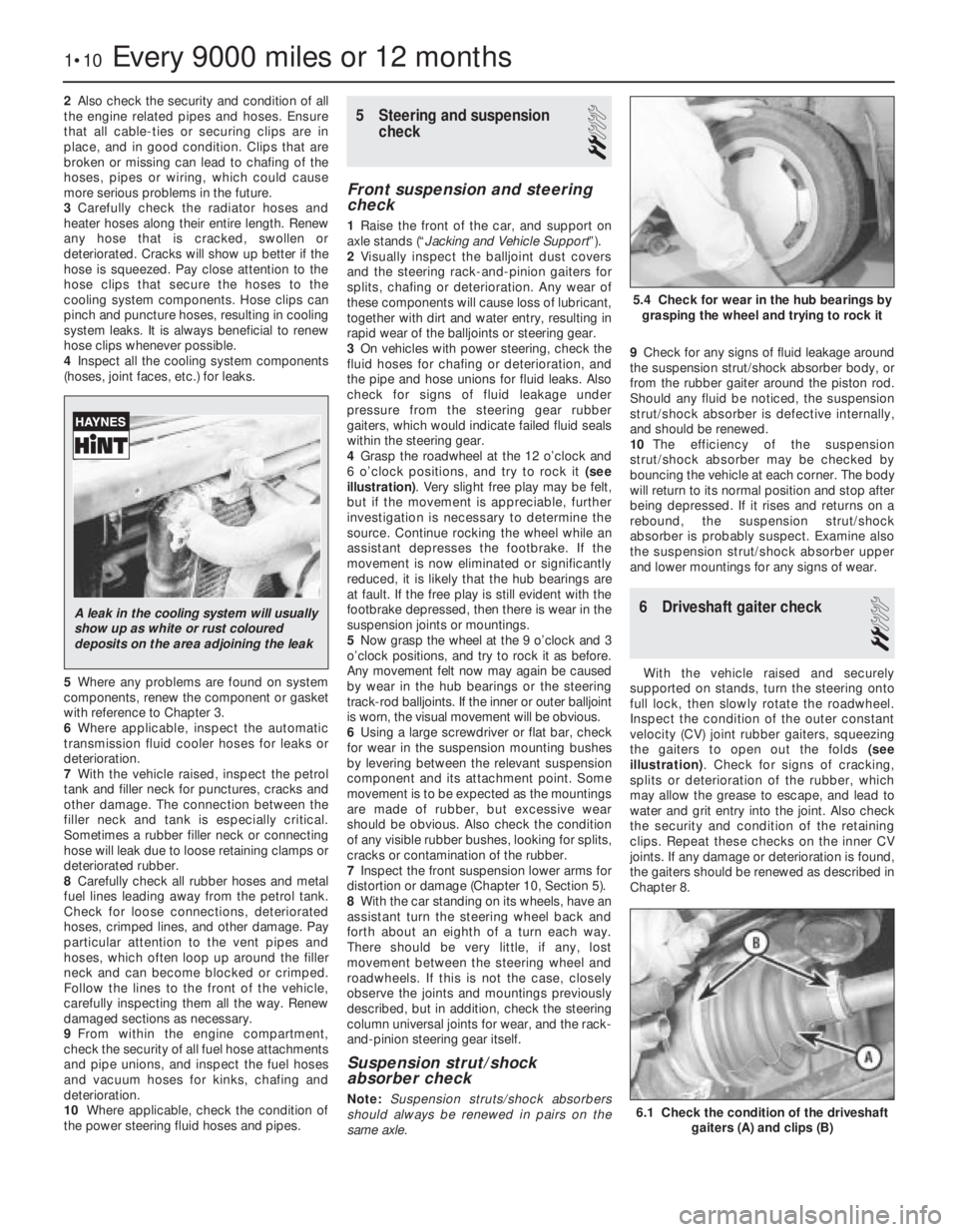
4Grasp the roadwheel at the 12 o’clock and
6 o’clock positions, and try to rock it (see
illustration). Very slight free play may be felt,
but if the movement is appreciable, further
investigation is necessary to determine the
source. Continue rocking the wheel while an
assistant depresses the footbrake. If the
movement is now eliminated or significantly
reduced, it is likely that the hub bearings are
at fault. If the free play is still evident with the
footbrake depressed, then there is wear in the
suspension joints or mountings.
5Now grasp the wheel at the 9 o’clock and 3
o’clock positions, and try to rock it as before.
Any movement felt now may again be caused
by wear in the hub bearings or the steering
track-rod balljoints. If the inner or outer balljoint
is worn, the visual movement will be obvious.
6Using a large screwdriver or flat bar, check
for wear in the suspension mounting bushes
by levering between the relevant suspension
component and its attachment point. Some
movement is to be expected as the mountings
are made of rubber, but excessive wear
should be obvious. Also check the condition
of any visible rubber bushes, looking for splits,
cracks or contamination of the rubber.
7Inspect the front suspension lower arms for
distortion or damage (Chapter 10, Section 5).
8With the car standing on its wheels, have an
assistant turn the steering wheel back and
forth about an eighth of a turn each way.
There should be very little, if any, lost
movement between the steering wheel and
roadwheels. If this is not the case, closely
observe the joints and mountings previously
described, but in addition, check the steering
column universal joints for wear, and the rack-
and-pinion steering gear itself.
Suspension strut/shock
absorber check
Note:Suspension struts/shock absorbers
should always be renewed in pairs on the
same axle.9Check for any signs of fluid leakage around
the suspension strut/shock absorber body, or
from the rubber gaiter around the piston rod.
Should any fluid be noticed, the suspension
strut/shock absorber is defective internally,
and should be renewed.
10The efficiency of the suspension
strut/shock absorber may be checked by
bouncing the vehicle at each corner. The body
will return to its normal position and stop after
being depressed. If it rises and returns on a
rebound, the suspension strut/shock
absorber is probably suspect. Examine also
the suspension strut/shock absorber upper
and lower mountings for any signs of wear.
6Driveshaft gaiter check
2
With the vehicle raised and securely
supported on stands, turn the steering onto
full lock, then slowly rotate the roadwheel.
Inspect the condition of the outer constant
velocity (CV) joint rubber gaiters, squeezing
the gaiters to open out the folds (see
illustration). Check for signs of cracking,
splits or deterioration of the rubber, which
may allow the grease to escape, and lead to
water and grit entry into the joint. Also check
the security and condition of the retaining
clips. Repeat these checks on the inner CV
joints. If any damage or deterioration is found,
the gaiters should be renewed as described in
Chapter 8.
1•10Every 9000 miles or 12 months
6.1 Check the condition of the driveshaft
gaiters (A) and clips (B)
5.4 Check for wear in the hub bearings by
grasping the wheel and trying to rock it
A leak in the cooling system will usually
show up as white or rust coloured
deposits on the area adjoining the leak
Page 192 of 525
Apply a little grease to the threads of the
securing bolt, and tighten it to the specified
torque in the two stages given in the Specifi-
cations. Ensure that the thrustwasher is in
place under the bolt head, and prevent the
crankshaft from turning as during removal.
23Refit the camshaft sprockets. Ensure that
the locating pins on the ends of the camshafts
engage with the holes in the sprockets and
with the sprocket timing marks facing
forwards. Then tighten the securing bolts to
the specified torque in the two stages given in
the Specifications. Prevent the camshafts
from turning as during removal.
24Check the condition of the camshaft
cover rubber gasket and renew if necessary,
then refit the camshaft cover and tighten the
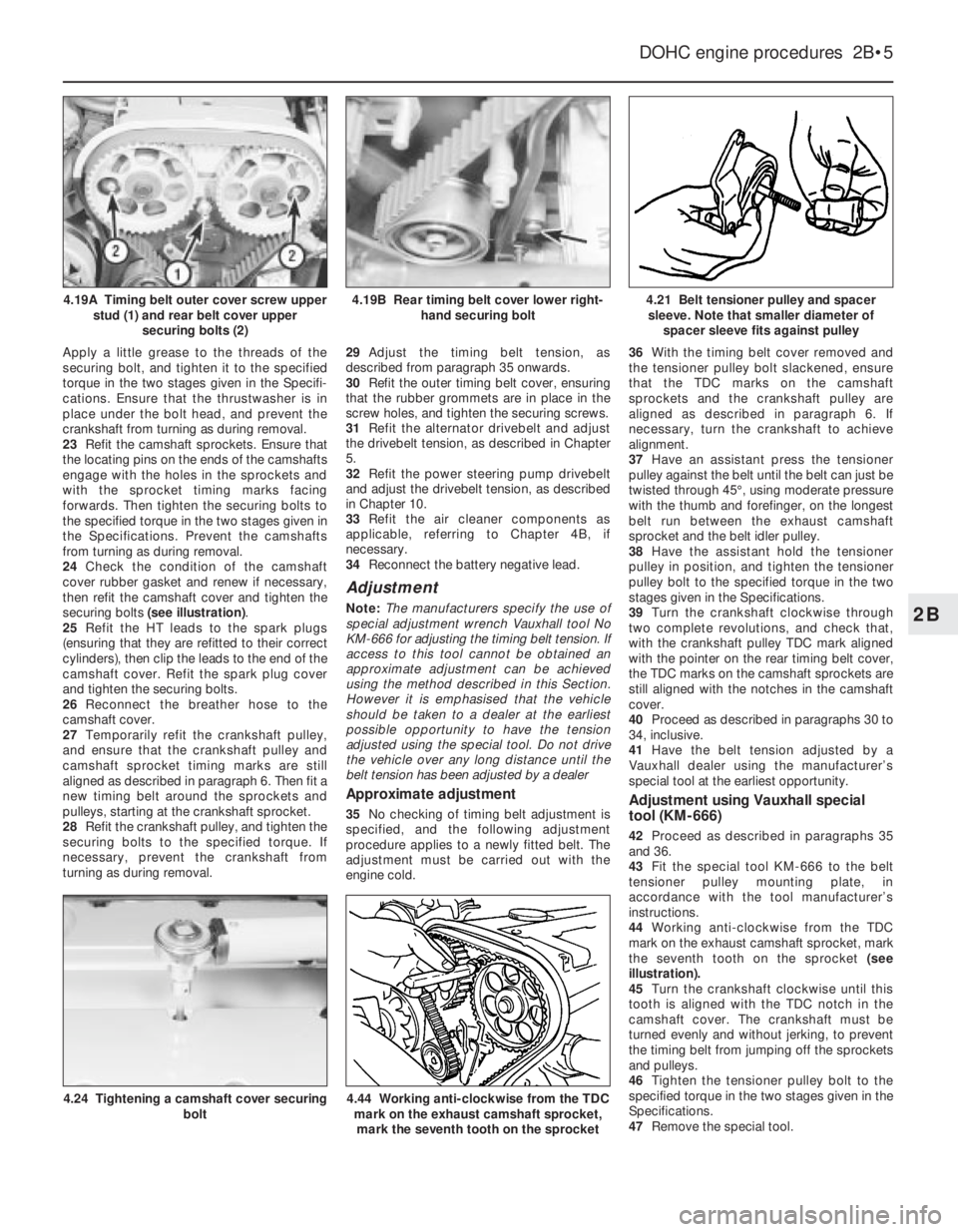
securing bolts (see illustration).
25Refit the HT leads to the spark plugs
(ensuring that they are refitted to their correct
cylinders), then clip the leads to the end of the
camshaft cover. Refit the spark plug cover
and tighten the securing bolts.
26Reconnect the breather hose to the
camshaft cover.
27Temporarily refit the crankshaft pulley,
and ensure that the crankshaft pulley and
camshaft sprocket timing marks are still
aligned as described in paragraph 6. Then fit a
new timing belt around the sprockets and
pulleys, starting at the crankshaft sprocket.
28Refit the crankshaft pulley, and tighten the
securing bolts to the specified torque. If
necessary, prevent the crankshaft from
turning as during removal. 29Adjust the timing belt tension, as
described from paragraph 35 onwards.
30Refit the outer timing belt cover, ensuring
that the rubber grommets are in place in the
screw holes, and tighten the securing screws.
31Refit the alternator drivebelt and adjust
the drivebelt tension, as described in Chapter
5.
32Refit the power steering pump drivebelt
and adjust the drivebelt tension, as described
in Chapter 10.
33Refit the air cleaner components as
applicable, referring to Chapter 4B, if
necessary.
34Reconnect the battery negative lead.
Adjustment
Note: The manufacturers specify the use of
special adjustment wrench Vauxhall tool No
KM-666 for adjusting the timing belt tension. If
access to this tool cannot be obtained an
approximate adjustment can be achieved
using the method described in this Section.
However it is emphasised that the vehicle
should be taken to a dealer at the earliest
possible opportunity to have the tension
adjusted using the special tool. Do not drive
the vehicle over any long distance until the
belt tension has been adjusted by a dealer
Approximate adjustment
35No checking of timing belt adjustment is
specified, and the following adjustment
procedure applies to a newly fitted belt. The
adjustment must be carried out with the
engine cold.36With the timing belt cover removed and
the tensioner pulley bolt slackened, ensure
that the TDC marks on the camshaft
sprockets and the crankshaft pulley are
aligned as described in paragraph 6. If
necessary, turn the crankshaft to achieve
alignment.
37Have an assistant press the tensioner
pulley against the belt until the belt can just be
twisted through 45°, using moderate pressure
with the thumb and forefinger, on the longest
belt run between the exhaust camshaft
sprocket and the belt idler pulley.
38Have the assistant hold the tensioner
pulley in position, and tighten the tensioner
pulley bolt to the specified torque in the two
stages given in the Specifications.
39Turn the crankshaft clockwise through
two complete revolutions, and check that,
with the crankshaft pulley TDC mark aligned
with the pointer on the rear timing belt cover,
the TDC marks on the camshaft sprockets are
still aligned with the notches in the camshaft
cover.
40Proceed as described in paragraphs 30 to
34, inclusive.
41Have the belt tension adjusted by a
Vauxhall dealer using the manufacturer’s
special tool at the earliest opportunity.Adjustment using Vauxhall special
tool (KM-666)
42Proceed as described in paragraphs 35
and 36.
43Fit the special tool KM-666 to the belt
tensioner pulley mounting plate, in
accordance with the tool manufacturer’s
instructions.
44Working anti-clockwise from the TDC
mark on the exhaust camshaft sprocket, mark
the seventh tooth on the sprocket (see
illustration).
45Turn the crankshaft clockwise until this
tooth is aligned with the TDC notch in the
camshaft cover. The crankshaft must be
turned evenly and without jerking, to prevent
the timing belt from jumping off the sprockets
and pulleys.
46Tighten the tensioner pulley bolt to the
specified torque in the two stages given in the
Specifications.
47Remove the special tool.
DOHC engine procedures 2B•5
4.21 Belt tensioner pulley and spacer
sleeve. Note that smaller diameter of
spacer sleeve fits against pulley
4.44 Working anti-clockwise from the TDC
mark on the exhaust camshaft sprocket,
mark the seventh tooth on the sprocket4.24 Tightening a camshaft cover securing
bolt
4.19B Rear timing belt cover lower right-
hand securing bolt4.19A Timing belt outer cover screw upper
stud (1) and rear belt cover upper
securing bolts (2)
2B
Page 193 of 525
48Turn the crankshaft clockwise until the
TDC marks on the camshaft sprockets are
aligned with the notches in the camshaft
cover, and check that the crankshaft pulley
TDC mark is aligned with the pointer on the
rear timing belt cover.
49Proceed as described in paragraphs 30 to
34 inclusive.
5Timing belt, with automatic
adjuster- removal, refitting
and adjustment
3
Removal
1The operations are essentially the same as
described in Section 4, except that the
tensioner pulley incorporates an automatic
adjuster that simplifies the procedure as
follows.
2To release the belt tension before removal,
unscrew the timing belt tensioner pulley
securing bolt slightly then, with a large
screwdriver (or similar tool) inserted in the slot
on the tensioner arm, turn the tensioner arm
until the timing belt is slack. Tighten the
securing bolt slightly to hold the tensioner in
this position.
Refitting
3To refit the timing belt, first ensure that the
coolant pump is correctly positioned by
checking that the lug on the coolant pump
flange is aligned with the corresponding lug
on the cylinder block. If this is not the case,
slacken the coolant pump mounting bolts
slightly and move the pump accordingly.
Tighten the bolts to the specified torque on
completion (see Chapter 3).
4Refit the timing belt as described in Section 4,
then tension it as follows.
Adjustment
5Slacken the tensioner pulley securing bolt
and move the tensioner arm anti-clockwise,
until the tensioner pointer lies at its stop.
Tighten the tensioner pulley securing bolt to
hold the tensioner in this position.
6Turn the crankshaft through two complete
revolutions in the normal direction of rotation
and check that with the crankshaft pulley TDC
mark aligned with the pointer on the rear
timing belt cover, the TDC marks on the
camshaft sprockets are still aligned with the
notches in the camshaft cover.
7Slacken the tensioner pulley securing bolt
once again and move the tensioner arm
clockwise, until the tensioner pointer is
aligned with the notch in the tensioner. In the
first few hours of operation a new belt will be
subjected to ‘settling-in’, (known as the
running-in procedure). If you are refitting a
used belt (one that has been ‘run-in’), align the
pointer to approximately 4 mm to the left of
the notch, refer to Section 14 in Chapter 2A.
Tighten the tensioner pulley securing bolt
securely. Turn the crankshaft through onecomplete revolution in the normal direction of
rotation and check that the crankshaft and
camshaft timing marks still align, then refit the
remainder of the components as described in
Section 4.
8With the timing belt adjustment set in this
way, correct tension will always be maintained
by the automatic tensioner and no further
checking or adjustment will be necessary.
6Camshaft front oil seal-
removal and refitting
3
Note: A new timing belt should be used on
refitting
Removal
1The camshaft front oil seals may be
renewed with the engine in the vehicle without
removing the camshafts as follows.
2Remove the timing belt and the relevant
camshaft sprocket(s), as described in Section 4.
3Punch or drill a small hole in the centre of
the now-exposed oil seal. Screw in a
self-tapping screw, and pull on the screw with
pliers to extract the seal.
4Clean the oil seal seat with a wooden or
plastic scraper.
5Turn the camshaft until the locating peg for
the camshaft sprocket is uppermost, then
lubricate the lips of a new camshaft front oil
seal with a little grease, and fit the oil seal,
using a tube or socket of similar diameter with
a washer and the camshaft sprocket bolt.Screw the camshaft sprocket bolt into the end
of the camshaft to draw the oil seal into
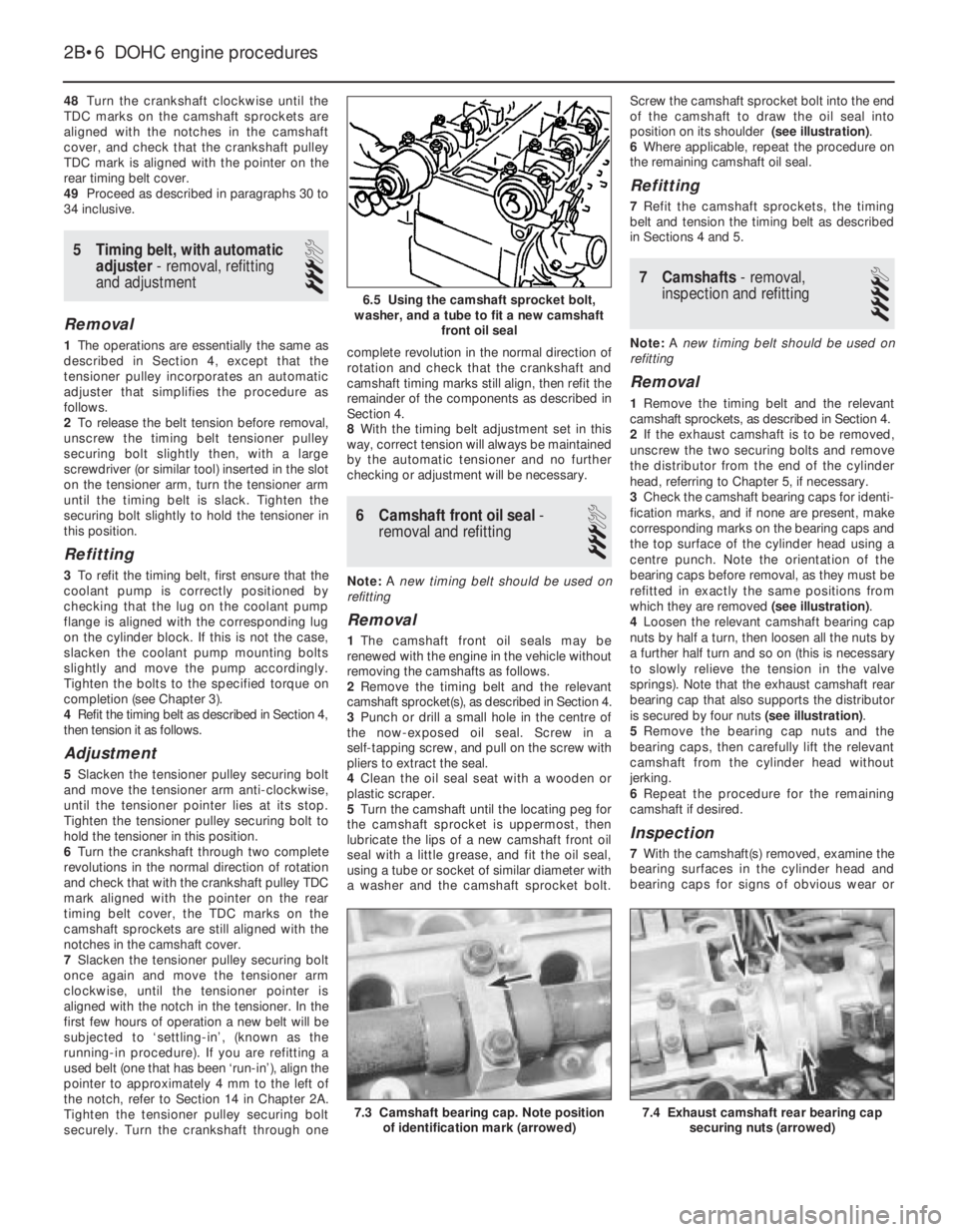
position on its shoulder (see illustration).
6Where applicable, repeat the procedure on
the remaining camshaft oil seal.
Refitting
7Refit the camshaft sprockets, the timing
belt and tension the timing belt as described
in Sections 4 and 5.
7Camshafts- removal,
inspection and refitting
4
Note: A new timing belt should be used on
refitting
Removal
1Remove the timing belt and the relevant
camshaft sprockets, as described in Section 4.
2If the exhaust camshaft is to be removed,
unscrew the two securing bolts and remove
the distributor from the end of the cylinder
head, referring to Chapter 5, if necessary.
3Check the camshaft bearing caps for identi-
fication marks, and if none are present, make
corresponding marks on the bearing caps and
the top surface of the cylinder head using a
centre punch. Note the orientation of the
bearing caps before removal, as they must be
refitted in exactly the same positions from
which they are removed (see illustration).
4Loosen the relevant camshaft bearing cap
nuts by half a turn, then loosen all the nuts by
a further half turn and so on (this is necessary
to slowly relieve the tension in the valve
springs). Note that the exhaust camshaft rear
bearing cap that also supports the distributor
is secured by four nuts (see illustration).
5Remove the bearing cap nuts and the
bearing caps, then carefully lift the relevant
camshaft from the cylinder head without
jerking.
6Repeat the procedure for the remaining
camshaft if desired.
Inspection
7With the camshaft(s) removed, examine the
bearing surfaces in the cylinder head and
bearing caps for signs of obvious wear or
2B•6DOHC engine procedures
6.5 Using the camshaft sprocket bolt,
washer, and a tube to fit a new camshaft
front oil seal
7.4 Exhaust camshaft rear bearing cap
securing nuts (arrowed)7.3 Camshaft bearing cap. Note position
of identification mark (arrowed)