towing OPEL CASCADA 2015 Manual user
[x] Cancel search | Manufacturer: OPEL, Model Year: 2015, Model line: CASCADA, Model: OPEL CASCADA 2015Pages: 253, PDF Size: 7.58 MB
Page 205 of 253

Vehicle care203Vehicle tools
Tools Vehicles with spare wheel
A label on the jack indicates the
vehicles for which the jack can be
used.
Open the load floor cover. The jack,
the tools and a strap for securing a
damaged wheel are in the tool box
below the spare wheel in the load
compartment. The wheel wrench and
the towing eye are in the tool bag
located in the spare wheel well near
the tool box. Spare wheel 3 216.
Vehicles with tyre repair kit
Some tools and the towing eye are
located together with the tyre repair
kit in a tool box in the load
compartment below the floor cover.
Vehicles with tyre repair kit and
flat load compartment floor
Some tools and the towing eye are
located together with the tyre repair
kit in a bag, which is fixed at the front left lashing eye in the load
compartment.
Page 218 of 253
216Vehicle care
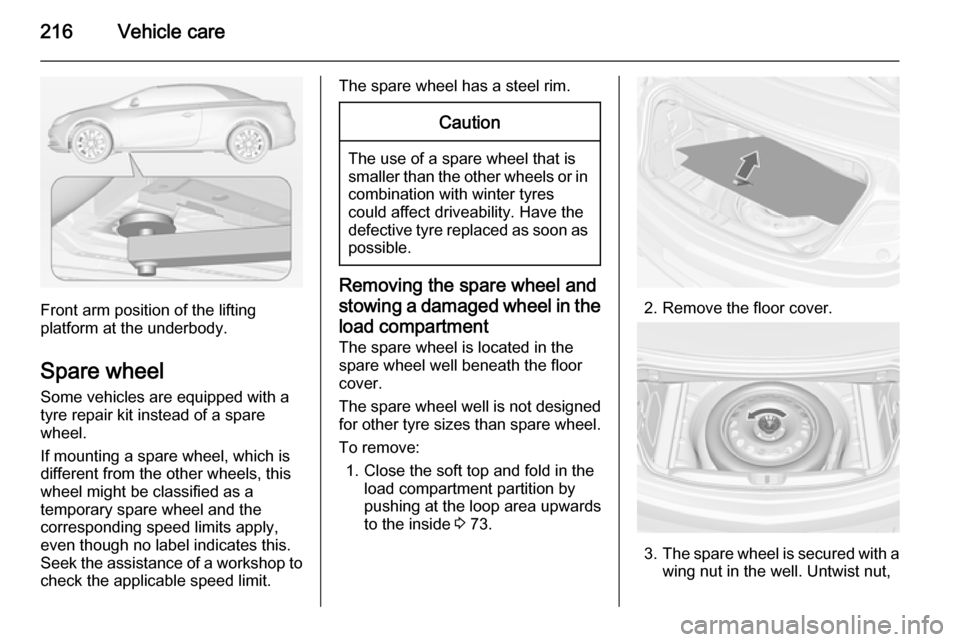
Front arm position of the lifting
platform at the underbody.
Spare wheel Some vehicles are equipped with a
tyre repair kit instead of a spare
wheel.
If mounting a spare wheel, which is
different from the other wheels, this
wheel might be classified as a
temporary spare wheel and the
corresponding speed limits apply,
even though no label indicates this.
Seek the assistance of a workshop to
check the applicable speed limit.
The spare wheel has a steel rim.Caution
The use of a spare wheel that is smaller than the other wheels or in combination with winter tyres
could affect driveability. Have the defective tyre replaced as soon as
possible.
Removing the spare wheel and
stowing a damaged wheel in the load compartment
The spare wheel is located in the
spare wheel well beneath the floor
cover.
The spare wheel well is not designed
for other tyre sizes than spare wheel.
To remove: 1. Close the soft top and fold in the load compartment partition by
pushing at the loop area upwards
to the inside 3 73.
2. Remove the floor cover.
3. The spare wheel is secured with a
wing nut in the well. Untwist nut,
Page 220 of 253

218Vehicle care
Stowing the spare wheel back in
the well after replacing the damaged wheel
1. Close the soft top and fold in the load compartment partition.
2. Remove floor cover, untwist and remove wing nut and conus.
3. Stow the tools in the tool box and the bag.
4. Place spare wheel outside up in the well.
5. Insert and turn the excentricconus in the recess of the spare
wheel so that the wheel is
positioned as far as possible to
the front. Secure the wheel by
turning the wing nut clockwise.
6. Insert and close floor cover.9 Warning
Storing a jack, a wheel or other
equipment in the load
compartment could cause injury if they are not fixed properly. During a sudden stop or a collision, loose
equipment could strike someone.
Store jack and tools always in the
respective storage compartments
and secure them by fixing.
Damaged wheel placed in the load
compartment must always be
secured by the strap.
Temporary spare wheel
Caution
The use of a spare wheel that is smaller than the other wheels or in combination with winter tyres
could affect driveability. Have thedefective tyre replaced as soon as
possible.
Only mount one temporary spare
wheel. Do not drive faster than
80 km/h. Take curves slowly. Do not use for a long period of time.
If your vehicle gets a flat tyre on the
rear while towing another vehicle,
mount the temporary spare wheel in the front and the full tyre in the rear.
Tyre chains 3 210.
Spare wheel with directional tyre Fit directional tyres such that they rollin the direction of travel. The rolling
direction is indicated by a symbol
(e.g. an arrow) on the sidewall.
The following applies to tyres fitted
opposing the rolling direction:
■ Driveability may be affected. Have the defective tyre renewed or
repaired as soon as possible.
■ Drive particularly carefully on wet and snow-covered road surfaces.
Page 222 of 253

220Vehicle care
3. Connect the black lead to thenegative terminal of the booster
battery.
4. Connect the other end of the black
lead to a vehicle grounding point,
such as the engine block or an
engine mounting bolt. Connect as far away from the discharged
battery as possible, however at
least 60 cm.
Route the leads so that they cannot
catch on rotating parts in the engine
compartment.
To start the engine: 1. Start the engine of the vehicle providing the jump.
2. After 5 minutes, start the other engine. Start attempts should be
made for no longer than
15 seconds at an interval of 1 minute.
3. Allow both engines to idle for approx. 3 minutes with the leads
connected.4. Switch on electrical consumers (e.g. headlights, heated rear
window) of the vehicle receiving
the jump start.
5. Reverse above sequence exactly when removing leads.Towing
Towing the vehicle
Insert a screwdriver in the slot at the
lower part of the cap. Release the cap
by carefully moving the screwdriver
downwards.
The towing eye is stowed with the
vehicle tools 3 203.
Page 223 of 253
Vehicle care221
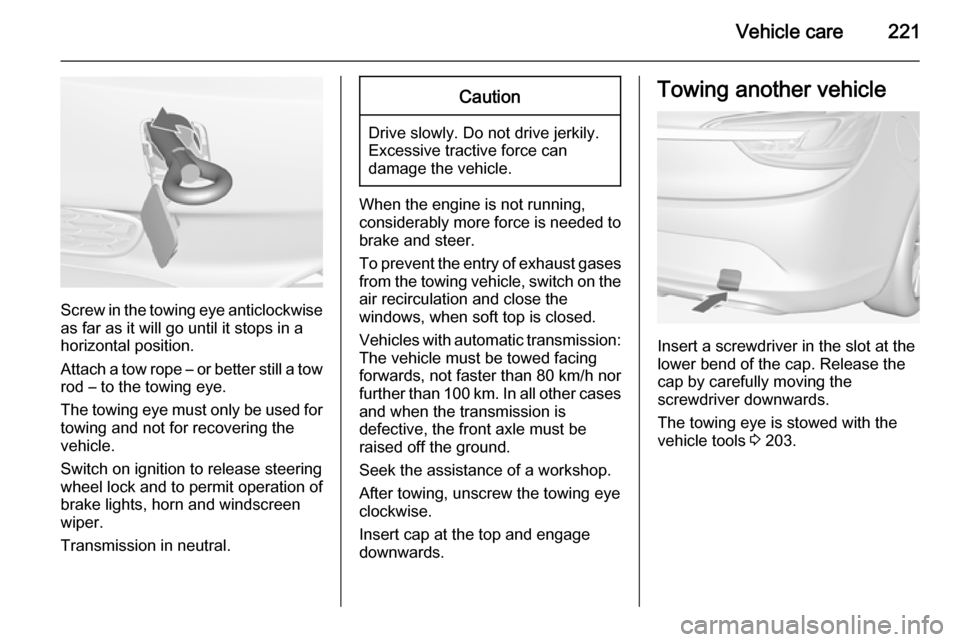
Screw in the towing eye anticlockwise
as far as it will go until it stops in a
horizontal position.
Attach a tow rope – or better still a tow
rod – to the towing eye.
The towing eye must only be used for
towing and not for recovering the
vehicle.
Switch on ignition to release steering
wheel lock and to permit operation of
brake lights, horn and windscreen
wiper.
Transmission in neutral.
Caution
Drive slowly. Do not drive jerkily.
Excessive tractive force can
damage the vehicle.
When the engine is not running,
considerably more force is needed to
brake and steer.
To prevent the entry of exhaust gases from the towing vehicle, switch on the
air recirculation and close the
windows, when soft top is closed.
Vehicles with automatic transmission: The vehicle must be towed facing
forwards, not faster than 80 km/h nor further than 100 km. In all other cases
and when the transmission is
defective, the front axle must be
raised off the ground.
Seek the assistance of a workshop.
After towing, unscrew the towing eye
clockwise.
Insert cap at the top and engage
downwards.
Towing another vehicle
Insert a screwdriver in the slot at the
lower bend of the cap. Release the
cap by carefully moving the
screwdriver downwards.
The towing eye is stowed with the
vehicle tools 3 203.
Page 224 of 253
222Vehicle care
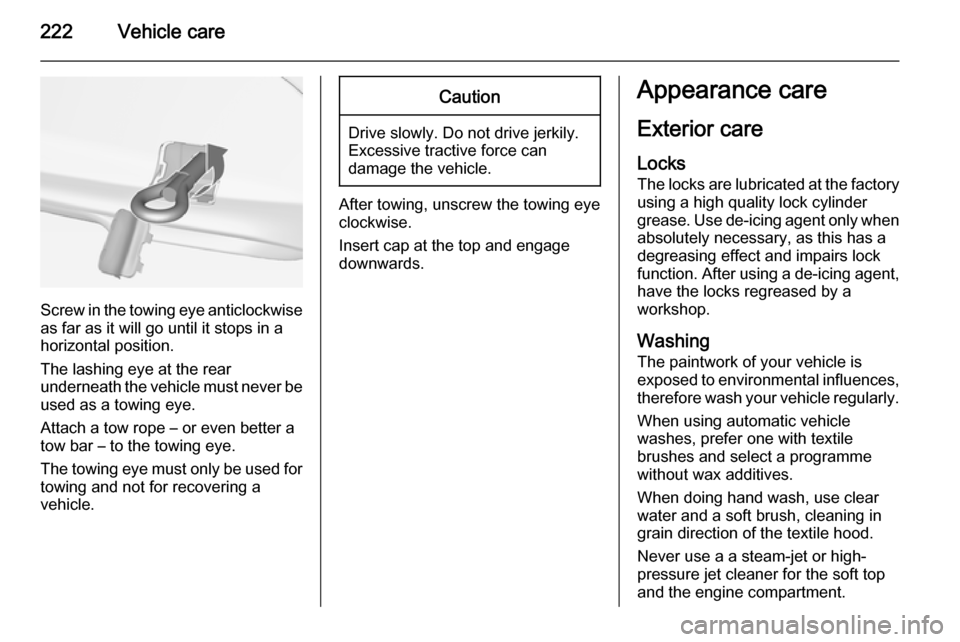
Screw in the towing eye anticlockwise
as far as it will go until it stops in a
horizontal position.
The lashing eye at the rear
underneath the vehicle must never be used as a towing eye.
Attach a tow rope – or even better a
tow bar – to the towing eye.
The towing eye must only be used for
towing and not for recovering a
vehicle.
Caution
Drive slowly. Do not drive jerkily.
Excessive tractive force can
damage the vehicle.
After towing, unscrew the towing eye clockwise.
Insert cap at the top and engage
downwards.
Appearance care
Exterior care
Locks The locks are lubricated at the factory
using a high quality lock cylinder
grease. Use de-icing agent only when absolutely necessary, as this has a
degreasing effect and impairs lock
function. After using a de-icing agent,
have the locks regreased by a
workshop.
Washing The paintwork of your vehicle is
exposed to environmental influences,
therefore wash your vehicle regularly.
When using automatic vehicle
washes, prefer one with textile
brushes and select a programme
without wax additives.
When doing hand wash, use clear
water and a soft brush, cleaning in
grain direction of the textile hood.
Never use a a steam-jet or high-
pressure jet cleaner for the soft top
and the engine compartment.
Page 226 of 253

224Vehicle care
When cleaning the rear window from
inside, always wipe in parallel to the
heating element to prevent damage.
For mechanical removal of ice, use a
sharp-edged ice scraper. Press the
scraper firmly against the glass so
that no dirt can get under it and
scratch the glass.
Remove dirt residues from smearing
wiper blades by using a soft cloth and window cleaner. Also make sure to
remove any residues such as wax,
insect residues and similar from the
window.
Ice residues, pollution and continuous wiping on dry windows will damage or
even destroy the wiper blades.
Wheels and tyres Do not use high-pressure jet
cleaners.
Clean rims with a pH-neutral wheel
cleaner.
Rims are painted and can be treated
with the same agents as the body.Paintwork damage
Rectify minor paintwork damage with a touch-up pen before rust forms.
Have more extensive damage or rust areas repaired by a workshop.
Underbody Some areas of the vehicle underbody
have a PVC undercoating while other critical areas have a durable
protective wax coating.
After the underbody is washed, check
the underbody and have it waxed if
necessary.
Bitumen/rubber materials could
damage the PVC coating. Have
underbody work carried out by a
workshop.
Before and after winter, wash the
underbody and have the protective
wax coating checked.
Towing equipment
Do not clean the coupling ball bar with
a steam-jet or high-pressure jet
cleaner.Interior care
Interior and upholsteryOnly clean the vehicle interior,
including the instrument panel fascia
and panelling, with a dry cloth or
interior cleaner.
Clean the leather upholstery with
clear water and a soft cloth. In case of
heavy soiling, use leather care.
The instrument cluster and the
displays should only be cleaned using a soft damp cloth. If necessary use a
weak soap solution.
Clean fabric upholstery with a
vacuum cleaner and brush. Remove
stains with an upholstery cleaner.
Clothing fabrics may not be
colourfast. This could cause visible discolourations, especially on light-
coloured upholstery. Removable
stains and discolourations should be
cleaned as soon as possible.
Clean seat belts with lukewarm water
or interior cleaner.
Page 249 of 253

247
Clock............................................. 82
Code ........................................... 102
Control indicators.......................... 88
Control of the vehicle .................133
Controls ........................................ 78
Convex shape .............................. 30
Coolant and antifreeze ...............227
Cruise control ...................... 95, 151
Cupholders .................................. 71
Curve lighting.............................. 114
D Danger, Warnings and Cautions ...3
Daytime running lights ...............114
Declaration of conformity ............241
Diesel fuel system bleeding .......188
Diesel particle filter ...............93, 139
Door open .................................... 95
Doors ............................................ 25
Driver assistance systems ..........151
Driver Information Centre .............96
Driving characteristics and towing tips .............................. 175
Driving hints ................................ 133
E
Electric adjustment ......................30
Electrical system......................... 197
Electric parking brake ...........92, 145
Electric parking brake fault ...........92Electronic climate control system 126
Electronic driving programmes ..142
Electronic Stability Control.......... 148
Electronic Stability Control and Traction Control system ............93
Electronic Stability Control off....... 93
End-of-life vehicle recovery .......182
Engine compartment fuse box ...198
Engine coolant ........................... 185
Engine coolant temperature gauge ....................................... 87
Engine data ............................... 234
Engine exhaust .......................... 139
Engine identification ...................230
Engine oil ................... 183, 227, 231
Engine oil pressure ......................94
Entry lighting .............................. 120
Event data recorders ..................243
Exit lighting ................................ 121
Exterior care .............................. 222
Exterior light ................................. 95
Exterior lighting ....................13, 110
Exterior mirrors ............................. 30
F
Fault ........................................... 143
First aid ......................................... 76
First aid kit ................................... 76
Fixed air vents ........................... 131
Fog light ....................................... 95Fog lights ................................... 192
Folding mirrors ............................. 30
Following distance indication ......156
Forward collision alert................. 154
Front airbag system .....................61
Front fog lights ........................... 118
Front seats.................................... 48
Front storage ................................ 71
Front turn signal lights ...............193
Fuel............................................. 172
Fuel consumption - CO 2-
Emissions ............................... 174
Fuel for diesel engines ..............173
Fuel for petrol engines ...............172
Fuel gauge ................................... 87
Fuses ......................................... 197
G
Gauges ......................................... 85
General information ...................175
Glovebox ..................................... 70
Graphic-Info-Display, Colour- Info-Display ............................ 100
Ground clearance .......................134
H Halogen headlights ....................189
Hand brake ......................... 144, 145
Hazard warning flashers ............117
Headlight flash ........................... 112
Page 251 of 253

249
Preheating ................................... 93
Puncture ..................................... 213
Q
Quickheat ................................... 131
R Radio Frequency Identification (RFID) ..................................... 244
Radio remote control ...................21
Reading lights ............................ 120
Rear floor storage cover ..............75
Rear fog light ............................... 95
Rear fog lights ........................... 118
Rear storage ................................. 75
Rear view camera ...................... 166
Recommended fluids and lubricants ........................ 227, 231
Refuelling ................................... 173 Retained power off .....................134
Reversing lights .........................119
Ride control systems ..................147
Rollover protection system ...........44
S Seat adjustment ....................... 7, 49
Seat belt ........................................ 8
Seat belt reminder .......................90
Seat belts ..................................... 55
Seat folding .................................. 51Seat position ................................ 48
Selector lever ............................. 141
Service ............................... 132, 226
Service display ............................ 87
Service information ....................226
Side airbag system ......................62
Side blind spot alert ....................164
Sidelights .................................... 110
Side turn signal lights ................195
Soft top ........................................ 35
Spare wheel ............................... 216
Speed limiter............................... 153
Speedometer ............................... 85
Starting and operating ................134
Starting off ................................... 17
Starting the engine ....................135
Steering ...................................... 133
Steering wheel adjustment ......9, 78
Steering wheel controls ...............78
Stop-start system........................ 136
Storage ......................................... 70
Storage compartments .................70
Sunvisor lights ........................... 120
Sun visors .................................... 34
Symbols ......................................... 4
T
Tachometer ................................. 86
Tail lights ................................... 194
Three-point seat belt .................... 56Tools .......................................... 203
Top-tether fastening eyes ............69
Tow bar....................................... 175
Towing ................................ 175, 220
Towing another vehicle .............221
Towing equipment .....................176
Towing the vehicle .....................220
Traction Control system ............. 147
Traction Control system off........... 93
Traffic sign assistant ...................168
Trailer coupling ........................... 175
Trailer towing ............................. 176
Transmission ............................... 16
Transmission display .................141
Tread depth ............................... 208
Trip odometer .............................. 86
Turn and lane-change signals ...117
Turn signal ................................... 90
Tyre chains ................................ 210
Tyre designations ......................204
Tyre pressure ............................ 204
Tyre pressure monitoring system ............................... 94, 205
Tyre pressures ........................... 239
Tyre repair kit ............................. 210
U
Ultrasonic parking assist............. 157
Upholstery .................................. 224