window OPEL CASCADA 2015 Manual user
[x] Cancel search | Manufacturer: OPEL, Model Year: 2015, Model line: CASCADA, Model: OPEL CASCADA 2015Pages: 253, PDF Size: 7.58 MB
Page 141 of 253
Driving and operating139key. Turn the front wheels
towards the kerb.
■ Close the windows and the soft top.
■ Remove the ignition key. Turn the steering wheel until the
steering wheel lock is felt to
engage.
For vehicles with automatic
transmission, the key can only
be removed when the selector
lever is in position P.
■ Lock the vehicle.
■ Activate the anti-theft alarm system.
Note
In the event of an accident with airbag deployment, the engine is
turned off automatically if the vehicle
comes to a standstill within a certain time.
Engine exhaust9 Danger
Engine exhaust gases contain
poisonous carbon monoxide,
which is colourless and odourless and could be fatal if inhaled.
If exhaust gases enter the interior
of the vehicle, open the windows.
Have the cause of the fault
rectified by a workshop.
Avoid driving with an open load
compartment, otherwise exhaust
gases could enter the vehicle.
Diesel particle filter
The diesel particle filter system filters
harmful soot particles out of the
exhaust gases. The system includes
a self-cleaning function that runs
automatically during driving without
any notification. The filter is cleaned
by periodically burning off the soot
particles at high temperature. This
process takes place automatically
under set driving conditions and may
take up to 25 minutes. Typically it
needs between 7 and 12 minutes. Autostop is not available and fuel
consumption may be higher during
this period. The emission of smells and smoke during this process is
normal.
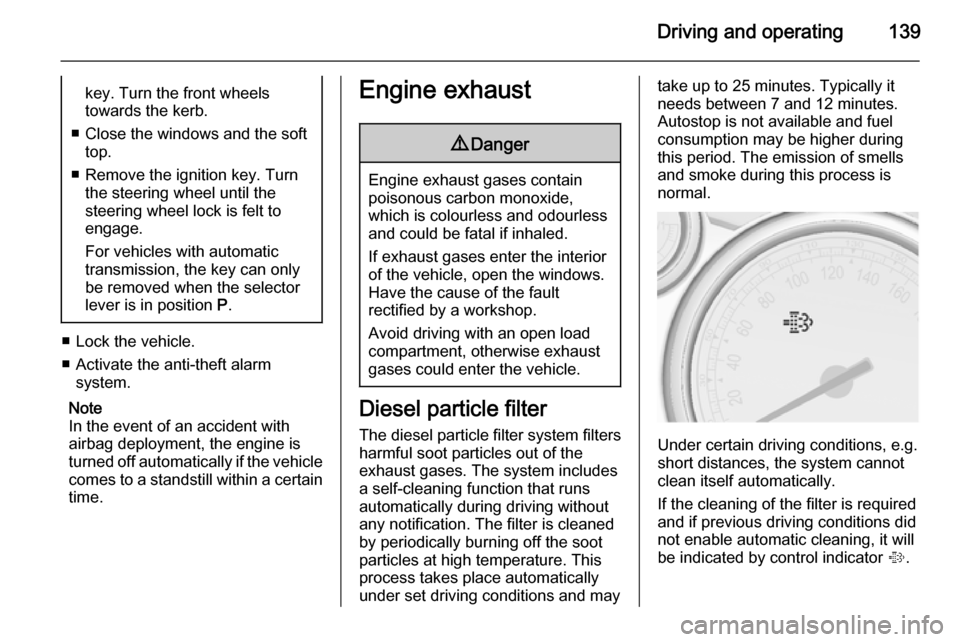
Under certain driving conditions, e.g.
short distances, the system cannot
clean itself automatically.
If the cleaning of the filter is required
and if previous driving conditions did
not enable automatic cleaning, it will
be indicated by control indicator %.
Page 184 of 253
182Vehicle care
■ Open the bonnet, close all doorsand lock the vehicle.
■ Close the soft top.
■ Cover the soft top to reduce environment influences.
■ Disconnect the clamp from the negative terminal of the vehicle
battery. Beware that all systems are not functional, e.g. anti-theft alarm
system.
Putting back into operation When the vehicle is to be put back into
operation:
■ Connect the clamp to the negative terminal of the vehicle battery.
Activate the electronics of the
power windows.
■ Check tyre pressure.
■ Fill up the washer fluid reservoir.
■ Check the engine oil level.
■ Check the coolant level.
■ Fit the number plate if necessary.End-of-life vehicle
recovery
Information on end-of-life vehicle
recovery centres and the recycling of
end-of-life vehicles is available on our website, where legally required. Only
entrust this work to an authorised
recycling centre.Vehicle checks
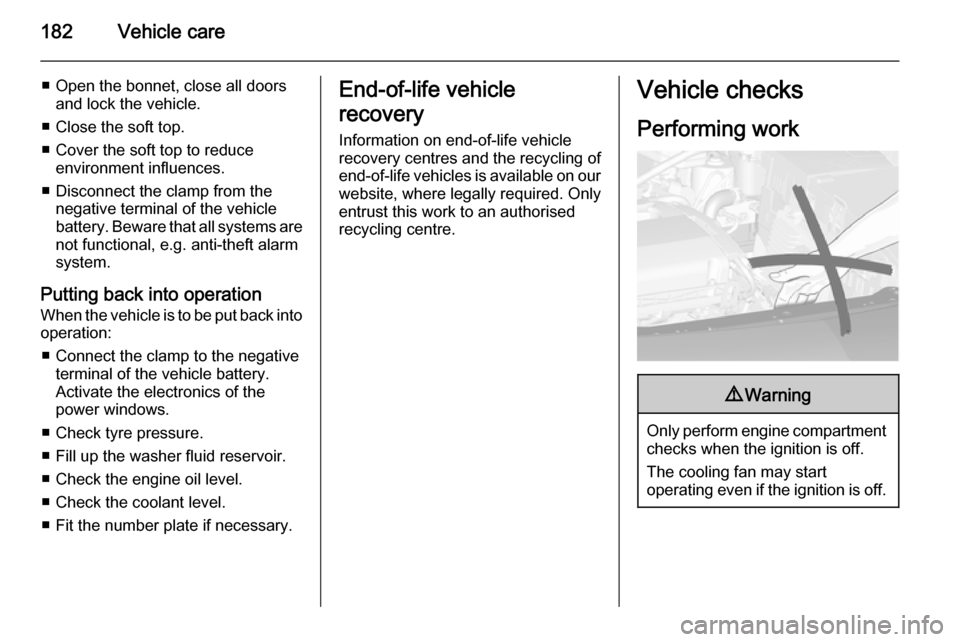
Performing work9 Warning
Only perform engine compartment
checks when the ignition is off.
The cooling fan may start
operating even if the ignition is off.
Page 201 of 253

Vehicle care199
No.Circuit1Engine control module2Lambda sensor3Fuel injection, ignition system4Fuel injection, ignition system5–6Mirror heating7Fan control8Lambda sensor, engine cooling9Rear window sensor10Vehicle battery sensor11Trunk release12Adaptive forward lighting, auto‐
matic light control13ABS Valves14–15Engine control module16StarterNo.Circuit17Transmission control module18Heated rear window19Front power windows20Rear power windows21Rear eletrical centre22Left high beam (Halogen)23Headlamp washer system24Right low beam (Xenon)25Left low beam (Xenon)26Front fog lights27Diesel fuel heating28Start stop system29Electric parking brake30ABS pump31–32AirbagNo.Circuit33Adaptive forward lighting, auto‐
matic light control34Exhaust gas recirculation35Power windows, rain sensor,
exterior mirror36Climate control37–38Vacuum pump39Fuel system control module40Windscreen washer system41Right high beam (Halogen)42Radiator fan43Windscreen wiper44–45Radiator fan46–47Horn
Page 222 of 253

220Vehicle care
3. Connect the black lead to thenegative terminal of the booster
battery.
4. Connect the other end of the black
lead to a vehicle grounding point,
such as the engine block or an
engine mounting bolt. Connect as far away from the discharged
battery as possible, however at
least 60 cm.
Route the leads so that they cannot
catch on rotating parts in the engine
compartment.
To start the engine: 1. Start the engine of the vehicle providing the jump.
2. After 5 minutes, start the other engine. Start attempts should be
made for no longer than
15 seconds at an interval of 1 minute.
3. Allow both engines to idle for approx. 3 minutes with the leads
connected.4. Switch on electrical consumers (e.g. headlights, heated rear
window) of the vehicle receiving
the jump start.
5. Reverse above sequence exactly when removing leads.Towing
Towing the vehicle
Insert a screwdriver in the slot at the
lower part of the cap. Release the cap
by carefully moving the screwdriver
downwards.
The towing eye is stowed with the
vehicle tools 3 203.
Page 223 of 253
Vehicle care221
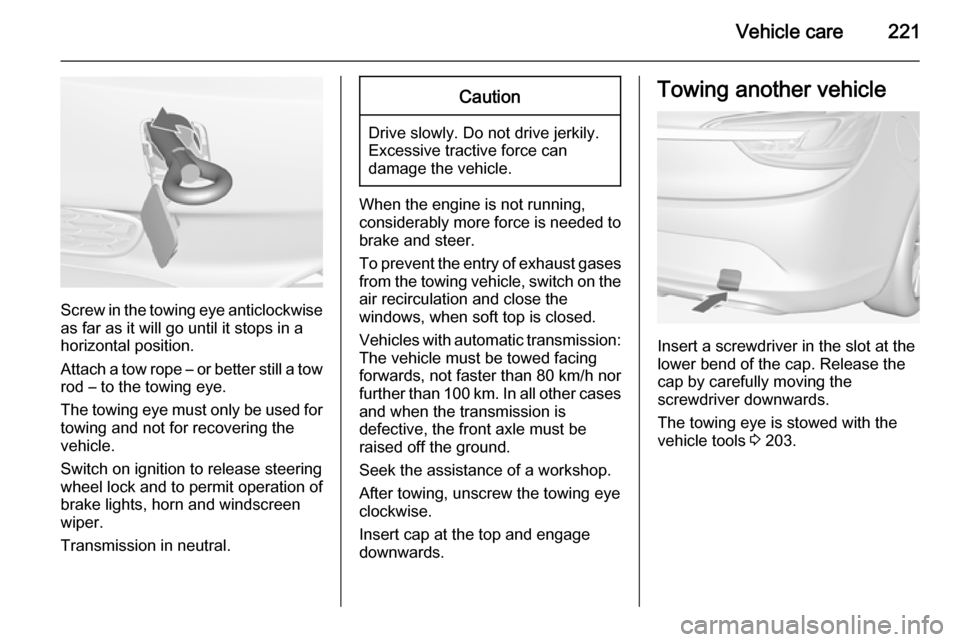
Screw in the towing eye anticlockwise
as far as it will go until it stops in a
horizontal position.
Attach a tow rope – or better still a tow
rod – to the towing eye.
The towing eye must only be used for
towing and not for recovering the
vehicle.
Switch on ignition to release steering
wheel lock and to permit operation of
brake lights, horn and windscreen
wiper.
Transmission in neutral.
Caution
Drive slowly. Do not drive jerkily.
Excessive tractive force can
damage the vehicle.
When the engine is not running,
considerably more force is needed to
brake and steer.
To prevent the entry of exhaust gases from the towing vehicle, switch on the
air recirculation and close the
windows, when soft top is closed.
Vehicles with automatic transmission: The vehicle must be towed facing
forwards, not faster than 80 km/h nor further than 100 km. In all other cases
and when the transmission is
defective, the front axle must be
raised off the ground.
Seek the assistance of a workshop.
After towing, unscrew the towing eye
clockwise.
Insert cap at the top and engage
downwards.
Towing another vehicle
Insert a screwdriver in the slot at the
lower bend of the cap. Release the
cap by carefully moving the
screwdriver downwards.
The towing eye is stowed with the
vehicle tools 3 203.
Page 225 of 253

Vehicle care223
Wax painted parts of the vehicle
regulary.
Bird droppings, dead insects, resin,
pollen and the like should be cleaned
off immediately, as they contain
aggressive constituents which can
cause paint and fabric damage.
If using a vehicle wash, comply with
the vehicle wash manufacturer's
instructions. The windscreen wiper must be switched off. Remove
additional antenna and external
accessories.
If you wash your vehicle by hand,
make sure that the insides of the
wheel housings are also thoroughly
rinsed out.
Clean edges and folds on opened
doors and the bonnet as well as the
areas they cover.Caution
Always use a cleaning agent with
a pH value of 4 to 9.
Do not use cleaning agents on hot surfaces.
Caution
After washing or cleaning, the softtop must be completely dried
before opening. If a wet soft top
remains opened for a longer time,
it would be damaged by water
spotting and mould growth.
When cleaning with a high-pressure
jet cleaner ensure a minimum
distance of 30 cm to the rear brand
emblem to prevent unintended
unlocking.
Thoroughly rinse and leather-off the
vehicle. Rinse leather frequently. Use
separate leathers for painted and
glass surfaces: remnants of wax on the windows will impair vision.
Have the door hinges of all doors
greased by a workshop.
Do not use hard objects to remove
spots of tar. Use tar removal spray on
painted surfaces.
Exterior lights
Headlight and other light covers are
made of plastic. Do not use any
abrasive or caustic agents, do not use
an ice scraper, and do not clean them dry.
Polishing and waxing
Wax painted parts of the vehicle
regularly (at the latest when water no longer beads). Otherwise, the
paintwork will dry out.
Polishing is necessary only if the paint
has become dull or if solid deposits
have become attached to it.
Paintwork polish with silicone forms a
protective film, making waxing
unnecessary.
Soft top as well as plastic body parts
must not be treated with wax or
polishing agents.
Windows and windscreen wiper blades
Use a soft lint-free cloth or chamois
leather together with window cleaner
and insect remover.
Page 226 of 253

224Vehicle care
When cleaning the rear window from
inside, always wipe in parallel to the
heating element to prevent damage.
For mechanical removal of ice, use a
sharp-edged ice scraper. Press the
scraper firmly against the glass so
that no dirt can get under it and
scratch the glass.
Remove dirt residues from smearing
wiper blades by using a soft cloth and window cleaner. Also make sure to
remove any residues such as wax,
insect residues and similar from the
window.
Ice residues, pollution and continuous wiping on dry windows will damage or
even destroy the wiper blades.
Wheels and tyres Do not use high-pressure jet
cleaners.
Clean rims with a pH-neutral wheel
cleaner.
Rims are painted and can be treated
with the same agents as the body.Paintwork damage
Rectify minor paintwork damage with a touch-up pen before rust forms.
Have more extensive damage or rust areas repaired by a workshop.
Underbody Some areas of the vehicle underbody
have a PVC undercoating while other critical areas have a durable
protective wax coating.
After the underbody is washed, check
the underbody and have it waxed if
necessary.
Bitumen/rubber materials could
damage the PVC coating. Have
underbody work carried out by a
workshop.
Before and after winter, wash the
underbody and have the protective
wax coating checked.
Towing equipment
Do not clean the coupling ball bar with
a steam-jet or high-pressure jet
cleaner.Interior care
Interior and upholsteryOnly clean the vehicle interior,
including the instrument panel fascia
and panelling, with a dry cloth or
interior cleaner.
Clean the leather upholstery with
clear water and a soft cloth. In case of
heavy soiling, use leather care.
The instrument cluster and the
displays should only be cleaned using a soft damp cloth. If necessary use a
weak soap solution.
Clean fabric upholstery with a
vacuum cleaner and brush. Remove
stains with an upholstery cleaner.
Clothing fabrics may not be
colourfast. This could cause visible discolourations, especially on light-
coloured upholstery. Removable
stains and discolourations should be
cleaned as soon as possible.
Clean seat belts with lukewarm water
or interior cleaner.
Page 250 of 253

248
Headlight range adjustment ......113
Headlights................................... 110
Headlights when driving abroad 113
Head restraint adjustment .............8
Head restraints ............................ 46
Heated mirrors ............................. 31
Heated rear window ..................... 34
Heated steering wheel .................79
Heating ........................................ 54
Heating and ventilation system . 123
High beam ........................... 95, 111
High beam assist ..................95, 112
Hill start assist ........................... 147
Horn ....................................... 14, 79
I
Identification plate .....................229
Ignition switch positions .............134
Immobiliser ............................ 29, 95
Indicators ...................................... 85
Information displays...................... 96
Instrument cluster ........................85
Instrument panel fuse box .........200
Instrument panel illumination .....197
Instrument panel illumination control .................................... 119
Instrument panel overview ........... 10
Interactive driving system ...........149
Interior care ............................... 224
Interior lighting ............................ 119Interior lights ...................... 119, 197
Interior mirrors .............................. 31
Interruption of power supply ......143
Introduction .................................... 3
ISOFIX child restraint systems ....69
J
Jump starting ............................. 219
K
Key, memorised settings ..............22
Keys ............................................. 20
Keys, locks ................................... 20
L
Lane departure warning .......93, 171
Lashing eyes ............................... 76
Light switch ................................ 110
Load compartment ................25, 73
Load compartment fuse box ......201
Loading information .....................77
Low fuel ....................................... 94
M
Malfunction indicator light ............91
Manual anti-dazzle ......................31
Manual mode ............................. 142
Manual transmission .................. 144
Memorised settings ......................22Mirror adjustment ........................... 9
Misted light covers .....................119
N New vehicle running-in ..............134
Number plate light .....................196
O Object detection systems ...........157
Odometer ..................................... 86
Oil, engine .......................... 227, 231
Operate pedal ............................... 91
Outside temperature ....................82
Overrun cut-off ........................... 136
P Parking ................................ 18, 138
Parking assist ............................ 157
Parking brake ............................ 145
Parking lights ............................. 118
Particulate filter ........................... 139
Performance .............................. 235
Performing work ........................182
Pollen filter ................................. 132
Power outlets ............................... 84
Power seat adjustment ................52
Power steering.............................. 93
Power steering fluid ....................185
Power windows ............................ 32
Page 252 of 253

250
Upshift.......................................... 93
Using this manual ..........................3
V Vehicle battery ........................... 186
Vehicle checks............................ 182
Vehicle data ................................ 231
Vehicle data recording and privacy ..................................... 243
Vehicle detected ahead ................95
Vehicle dimensions .................... 236
Vehicle Identification Number ....229
Vehicle jack ................................ 203
Vehicle messages .....................102
Vehicle personalisation .............104
Vehicle security ............................ 27
Vehicle specific data ......................3
Vehicle storage ........................... 181
Vehicle tools ............................... 203
Vehicle unlocking ........................... 6
Vehicle weight ........................... 236
Ventilating ..................................... 54
Ventilation ................................... 123
W
Warning chimes .........................103
Warning lights ............................... 85
Warning triangle .......................... 76
Washer and wiper systems .........15
Washer fluid ............................... 186Wheel changing .........................213
Wheel covers ............................. 209
Wheels and tyres .......................204
Wind deflector............................... 42
Windows ....................................... 32
Windscreen................................... 32 Windscreen wiper/washer ...........80
Winter tyres ............................... 204
Wiper blade replacement ..........188