heating OPEL COMBO 2010 User Guide
[x] Cancel search | Manufacturer: OPEL, Model Year: 2010, Model line: COMBO, Model: OPEL COMBO 2010Pages: 212, PDF Size: 2.49 MB
Page 100 of 212
94 Climate control
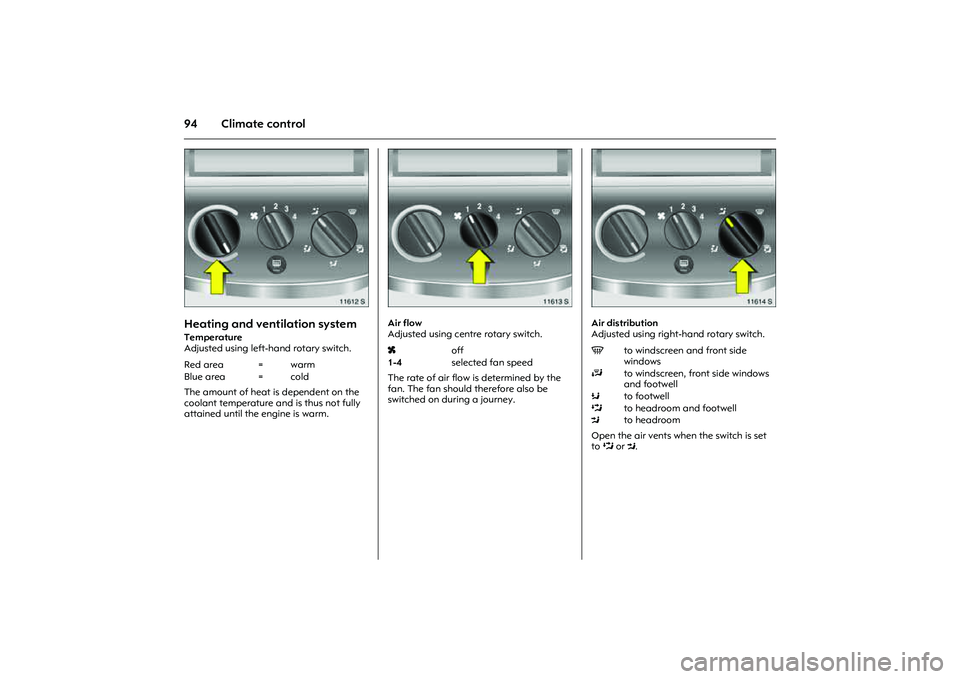
Picture no: 11612s.tif
Heating and ventilation systemTemperature
Adjusted using left-hand rotary switch.
The amount of heat is dependent on the
coolant temperature and is thus not fully
attained until the engine is warm.
Picture no: 11613s.tif
Air flow
Adjusted using centre rotary switch.
The rate of air flow is determined by the
fan. The fan should therefore also be
switched on during a journey.
Picture no: 11614s.tif
Air distribution
Adjusted using right-hand rotary switch.
Open the air vents when the switch is set
toL or M. Red area = warm
Blue area = cold
xoff
1-4selected fan speed
Vto windscreen and front side
windows
Jto windscreen, front side windows
and footwell
Kto footwell
Lto headroom and footwell
Mto headroom
Page 101 of 212
95
Climate control
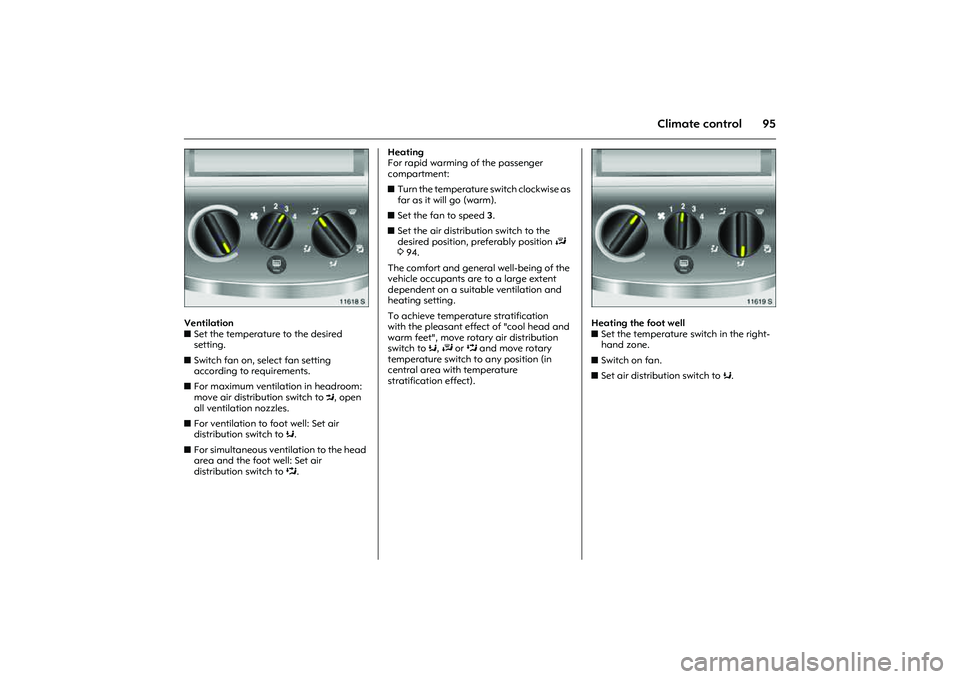
Picture no: 11618s.tif
Ventilation
zSet the temperature to the desired
setting.
zSwitch fan on, select fan setting
according to requirements.
zFor maximum ventilation in headroom:
move air distribution switch to M, open
all ventilation nozzles.
zFor ventilation to foot well: Set air
distribution switch to K.
zFor simultaneous ventilation to the head
area and the foot well: Set air
distribution switch to L. Heating
For rapid warming of the passenger
compartment:
zTurn the temperature switch clockwise as
far as it will go (warm).
zSet the fan to speed 3.
zSet the air distribution switch to the
desired position, preferably position J
394.
The comfort and general well-being of the
vehicle occupants are to a large extent
dependent on a suitable ventilation and
heating setting.
To achieve temperature stratification
with the pleasant effect of "cool head and
warm feet", move rotary air distribution
switch toK, J or L and move rotary
temperature switch to any position (in
central area with temperature
stratification effect).
Picture no: 11619s.tif
Heating the foot well
zSet the temperature switch in the right-
hand zone.
zSwitch on fan.
zSet air distribution switch to K.
Page 102 of 212
96 Climate control
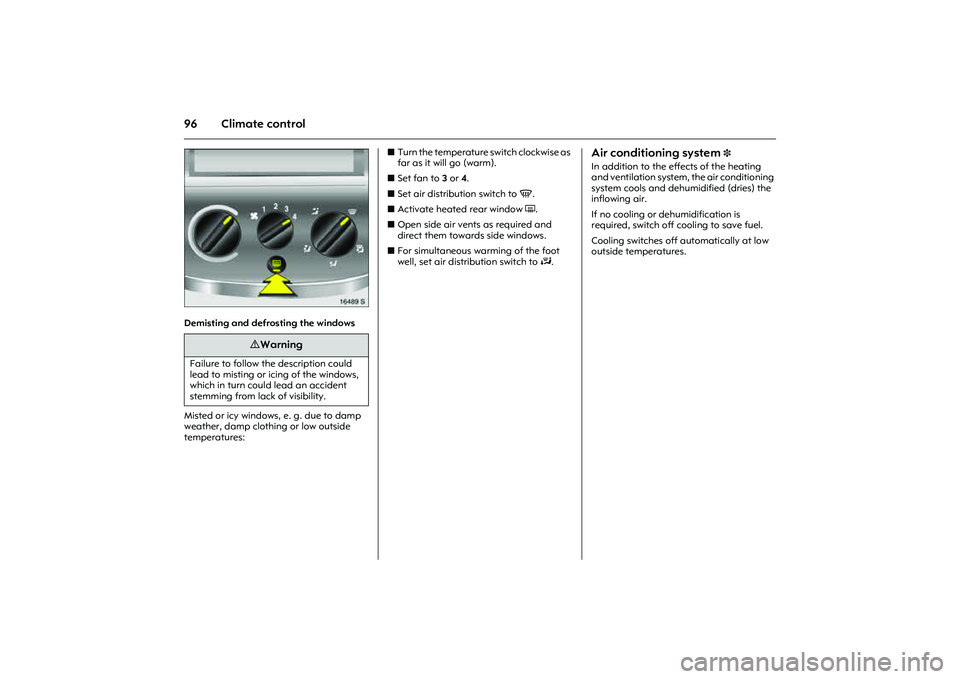
Picture no: 16489s.tif
Demisting and defrosting the windows
Misted or icy windows, e. g. due to damp
weather, damp clothing or low outside
temperatures:zTurn the temperature switch clockwise as
far as it will go (warm).
zSet fan to 3 or 4.
zSet air distribution switch to V.
zActivate heated rear window Ü.
zOpen side air vents as required and
direct them towards side windows.
zFor simultaneous warming of the foot
well, set air distribution switch to J.
Air conditioning system
3
In addition to the effects of the heating
and ventilation system, the air conditioning
system cools and dehumidified (dries) the
inflowing air.
If no cooling or dehumidification is
required, switch off cooling to save fuel.
Cooling switches off automatically at low
outside temperatures.
9 Warning
Failure to follow the description could
lead to misting or icing of the windows,
which in turn could lead an accident
stemming from lack of visibility.
Page 105 of 212
99
Climate control
zCooling n on, the air conditioning
compressor automatically switches off in
low outdoor temperatures (ice
formation),
zTurn the temperature switch clockwise.
zSet fan to 3 or 4.
zAir distribution switch to V, air
recirculation system 4 switches off
automatically.
– or –
If there is still moisture in the system after
previous air conditioning operation, the
windows may mist up. To prevent this,
set air distribution to K before starting
engine and set to V approx. 5 seconds
after starting.
zActivate heated rear window Ü.
zOpen side air vents as required and
direct them towards side windows.
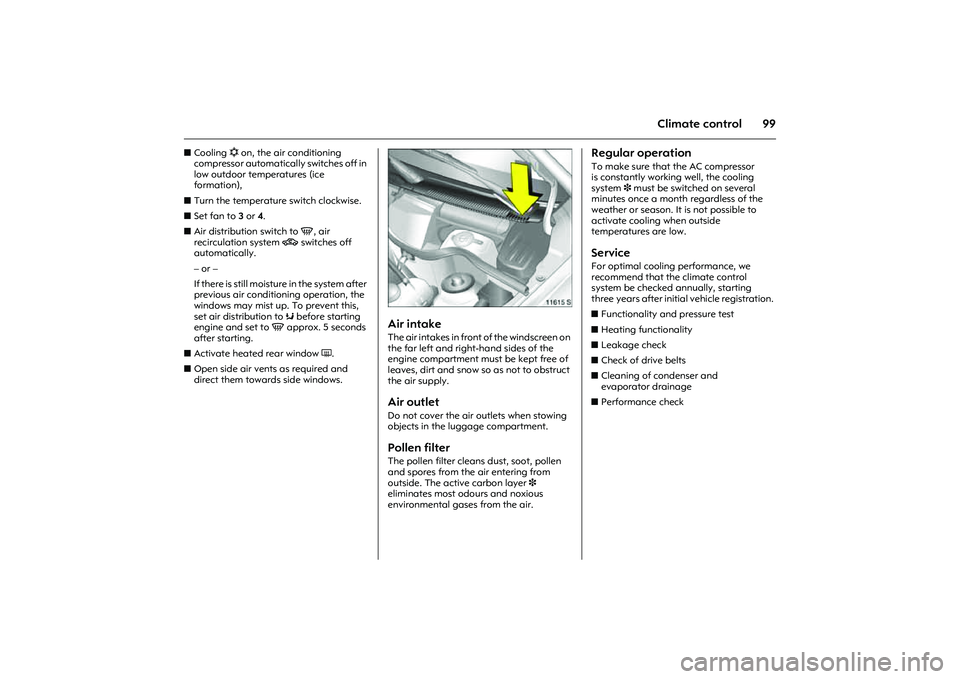
Picture no: 11615s.tif
Air intake The air intakes in front of the windscreen on
the far left and right-hand sides of the
engine compartment must be kept free of
leaves, dirt and snow so as not to obstruct
the air supply. Air outletDo not cover the air outlets when stowing
objects in the luggage compartment. Pollen filter The pollen filter cleans dust, soot, pollen
and spores from the air entering from
outside. The active carbon layer 3
eliminates most odours and noxious
environmental gases from the air.
Regular operationTo make sure that the AC compressor
is constantly working well, the cooling
system3 must be switched on several
minutes once a month regardless of the
weather or season. It is not possible to
activate cooling when outside
temperatures are low. Service For optimal cooling performance, we
recommend that the climate control
system be checked annually, starting
three years after initial vehicle registration.
zFunctionality and pressure test
zHeating functionality
zLeakage check
zCheck of drive belts
zCleaning of condenser and
evaporator drainage
zPerformance check
Page 108 of 212
102 Driving and operation
Picture no: 12466s.tif
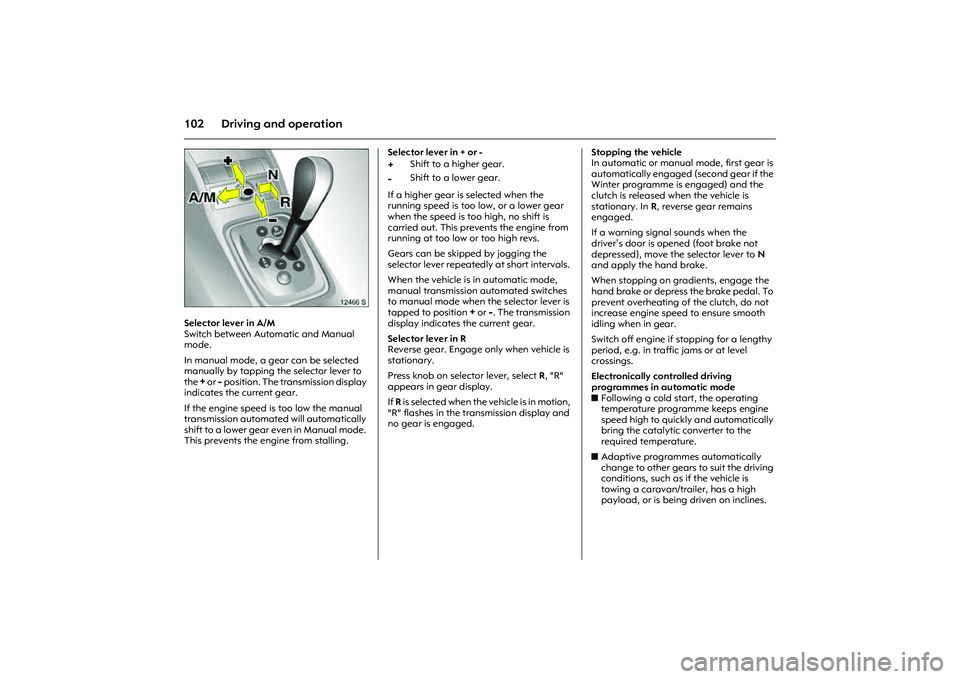
Selector lever in A/M
Switch between Automatic and Manual
mode.
In manual mode, a gear can be selected
manually by tapping the selector lever to
the
+ or
- position. The transmission display
indicates the current gear.
If the engine speed is too low the manual
transmission automated will automatically
shift to a lower gear even in Manual mode.
This prevents the engine from stalling. Selector lever in + or -
If a higher gear is selected when the
running speed is too low, or a lower gear
when the speed is too high, no shift is
carried out. This prevents the engine from
running at too low or too high revs.
Gears can be skipped by jogging the
selector lever repeatedly at short intervals.
When the vehicle is in automatic mode,
manual transmission automated switches
to manual mode when the selector lever is
tapped to position
+ or
-. The transmission
display indicates the current gear.
Selector lever in R
Reverse gear. Engage only when vehicle is
stationary.
Press knob on selector lever, select R, "R"
appears in gear display.
If R is selected when the vehicle is in motion,
"R" flashes in the transmission display and
no gear is engaged. Stopping the vehicle
In automatic or manual mode, first gear is
automatically engaged (second gear if the
Winter programme is engaged) and the
clutch is released when the vehicle is
stationary. In R, reverse gear remains
engaged.
If a warning signal sounds when the
driver’s door is opened (foot brake not
depressed), move the selector lever to N
and apply the hand brake.
When stopping on gradients, engage the
hand brake or depress the brake pedal. To
prevent overheating of the clutch, do not
increase engine speed to ensure smooth
idling when in gear.
Switch off engine if stopping for a lengthy
period, e.g. in traffic jams or at level
crossings.
Electronically controlled driving
programmes in automatic mode
zFollowing a cold start, the operating
temperature programme keeps engine
speed high to quickly and automatically
bring the catalytic converter to the
required temperature.
zAdaptive programmes automatically
change to other gears to suit the driving
conditions, such as if the vehicle is
towing a caravan/trailer, has a high
payload, or is being driven on inclines.
+
Shift to a higher gear.
-
Shift to a lower gear.
Page 116 of 212
110 Driving and operationFuels, refuellingFuel consumption
Fuel consumption is determined under
specific driving conditions 3186.
Special equipment increases the weight of
the vehicle. As a result, they can increase
fuel consumption and reduce the specified
maximum speed.
There is increased friction between engine
and transmission parts during the first
1000 kilometres. This increases fuel
consumption. Fuel for petrol engines
Only use unleaded fuel that complies with
DIN EN 228.
Fuels with ethanol content greater than 5 %
may only be used if the vehicle has been
specifically developed and approved for
these fuels.
Use fuel with the recommended octane
rating (value in bold 3184). Use of fuel
with too low an octane rating can reduce
engine power and torque and slightly
increases fuel consumption. Fuel for diesel engines
Only use diesel fuel that complies with
DIN EN 590. The fuel must have low
sulphur content (max. 50 ppm).
Do not use marine diesel oils, heating oils
or entirely or partially plant-based diesel
fuels, such as rape seed oil or bio diesel,
Aquazole and similar diesel-water
emulsions. Diesel fuels must not be diluted
with fuels for petrol engines.
The flow and filterability of diesel fuel are
temperature-dependent. When
temperatures are low, refuel with diesel fuel
with guaranteed winter properties.
Fuel for natural gas operation
Use natural gas with a methane content of
approx. 78-99 %. L-gas (low) has approx.
78-87 % and H-gas (high) has approx.
87-99 %. Biogas with the same methane
content can also be used if it has been
chemically prepared and desulphurised.
Liquid gas or LPG must not be used. Caution
Use of fuel with too low an octane rating
could lead to uncontrolled combustion
and engine damage.
Page 120 of 212
114 Driving and operationIf the natural gas tank is then not refilled,
petrol operation must be manually
selected the next time the engine is started.
This is necessary in order to prevent
damage to the catalytic converter
(overheating due to irregular fuel supply).
If the switch is pressed several times within
a brief period of time, a changeover
inhibitor is activated. The engine continues
with the current type of fuel. The inhibitor
remains active until the ignition is switched
off.
Minor power and torque losses are to
be expected during petrol operation,
therefore adjust driving style (e.g.
overtaking) and vehicle load (e.g. through
trailer load) accordingly.
Every 6 months, run the petrol tank down
to the reserve zone before refuelling. This is
necessary for petrol operation to obtain
the required system functionality and fuel
quality.Note:
Refuel and operate only w i t h f u e l o f a t l e a s t
95 octane (RON). Upon accidental
refuelling with petrol of an
octane rating (RON) less than 95, avoid
driving with fuel load (e.g. heavy
acceleration, full throttle), allow the tank to
reach the reserve zone and refuel with the
correct petrol.
In order to prevent corrosion in the tank,
please refuel the vehicle to the maximum
level at regular intervals.
Picture no: 6448u.tif
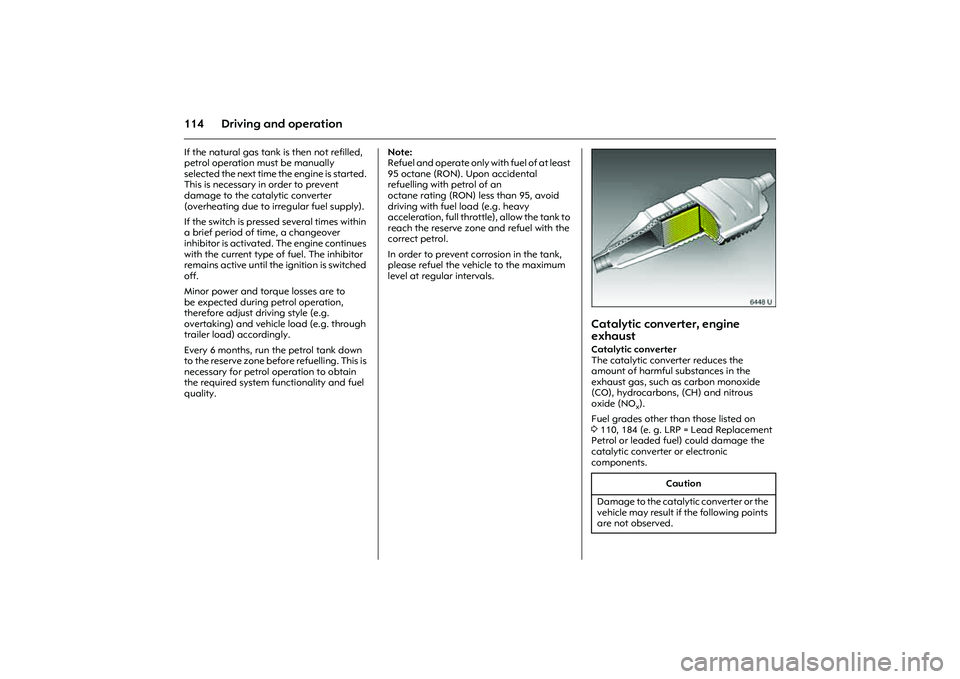
Catalytic converter, engine
exhaust Catalytic converter
The catalytic converter reduces the
amount of harmful substances in the
exhaust gas, such as carbon monoxide
(CO), hydrocarbons, (CH) and nitrous
oxide (NO
x).
Fuel grades other than those listed on
3110, 184 (e. g. LRP = Lead Replacement
Petrol or leaded fuel) could damage the
catalytic converter or electronic
components.
Caution
Damage to the catalytic converter or the
vehicle may result if the following points
are not observed.
Page 121 of 212
115
Driving and operation
zIn the event of misfiring, uneven engine
running, a clear reduction in engine
performance or other unusual problems,
have the cause of the fault rectified by a
workshop as soon as possible. In an
emergency, driving can be continued for
a short period, keeping vehicle speed
and engine speed low.
zIf unburnt fuel enters the catalytic
converter of a petrol engine, this may
result in overheating and irreparable
damage to the catalytic converter.
You should therefore avoid
unnecessarily long use of the starter
when starting off, running the tank dry
and starting the engine by pushing or
towing.
Picture no: 18087s.tif
Controlling exhaust emission
Design measures, primarily in the fuel
injection system and ignition system zones
in combination with the catalytic converter,
the amount of hazardous substances in the
exhaust emissions, such as carbon
monoxide (CO), hydrocarbons (CH) and
nitrogen oxides (NO
x), are reduced to a
minimum.
Picture no: 11717s.tif
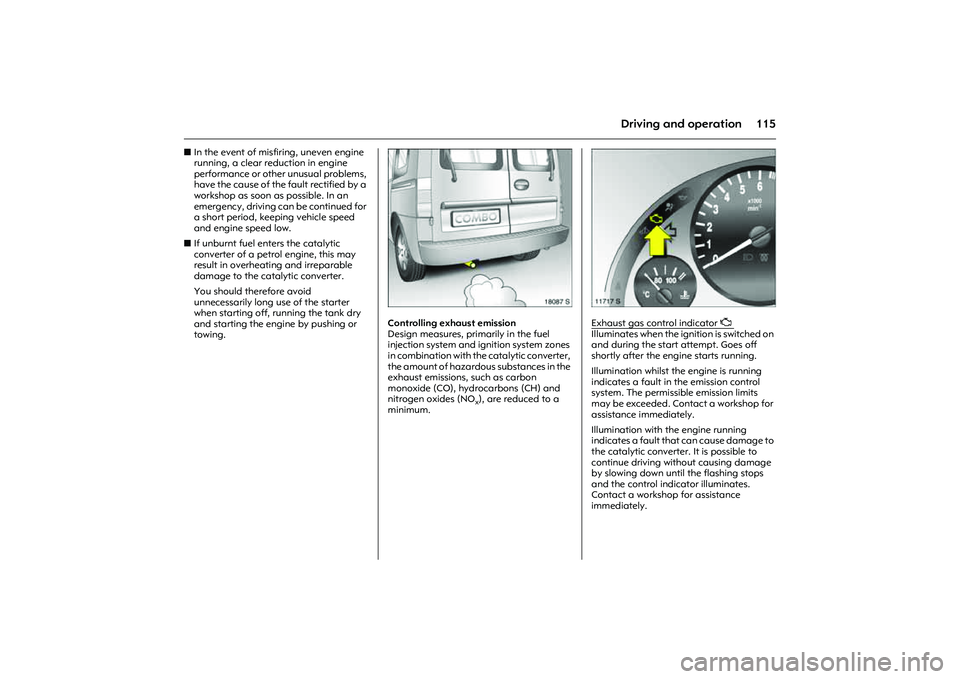
Exhaust gas control indicator
Z
Illuminates when the ignition is switched on
and during the start attempt. Goes off
shortly after the engine starts running.
Illumination whilst the engine is running
indicates a fault in the emission control
system. The permissible emission limits
may be exceeded. Contact a workshop for
assistance immediately.
Illumination with the engine running
indicates a fault that can cause damage to
the catalytic converter. It is possible to
continue driving without causing damage
by slowing down until the flashing stops
and the control indicator illuminates.
Contact a workshop for assistance
immediately.
Page 168 of 212
162 Self-help, vehicle careExterior lights
Headlamp and other lamp lens are made
of plastic. Do not use any abrasive or
caustic agents, do not use an ice scraper,
and do not clean them dry.
Plastic and rubber parts
Plastic and rubber parts can be cleaned
with the same cleaner as used to clean the
body. Use interior cleaner if necessary. Do
not use any other agent. Avoid solvents
and petrol in particular. Do not use high-
pressure jet cleaners.
Interior and upholstery
Clean the vehicle interior, including the
instrument panel fascia, using interior
cleaner.
The instrument panel is only to be cleaned
with a soft, damp cloth.
Clean the fabric upholstery with a vacuum
cleaner and brush. Remove stains with an
upholstery cleaner.
Clean seat belts with lukewarm water or
interior cleaner. Windows and windscreen wiper blades
Use a soft lint-free cloth or chamois leather
together with window cleaner and insect
remover.
When cleaning the rear window, make sure
the heating element inside the window is
not damaged.
For mechanical removal of ice, use a sharp-
edged ice scraper. Press the scraper firmly
against the glass so that no dirt can get
under it and scratch the glass.
Clean smearing wiper blades with a soft
cloth and window cleaner.
Locks
The locks are lubricated at the factory
using a high quality lock cylinder grease.
Use de-icing agent only where absolutely
necessary, as this removes grease and
impairs lock function. After using de-icing
agent, have the locks regreased by a
workshop. Engine compartment
Clean painted surfaces in the engine
compartment like any other painted
surface.
For best results, wash and wax the engine
compartment before and after winter.
Before washing the engine, cover the
alternator and brake fluid reservoir with
plastic sheeting.
When washing the engine with a steam-jet
cleaner, do not direct the steam jet at
components of the Anti-lock Braking
System 3, the automatic air conditioning
system 3 or the belt drive and its
components.
After an engine wash, have all engine room
components preserved thoroughly by a
workshop using protective wax.
Do not use high-pressure jet cleaners.
Caution
Close Velcro fasteners as open Velcro
fasteners on clothing could damage
seat upholstery.
Page 206 of 212

200 IndexFFan ............................................................ 94
Fault .......................................................... 37
Filling station
Capacities ........................................... 195
Engine oil level ................................... 175
Fuel ............................................. 110, 184
Opening the bonnet .......................... 128
Tyre pressure ...................................... 191
Vehicle data ............................... 182, 183
Windscreen washer system ............... 180
First-aid kit ............................................. 133
Flat tyre .................................................. 142
Fog lamps ................................................ 86
Bulb replacement ............................... 156
Fog tail lamp ............................................ 86
Bulb replacement ............................... 157
Foot brake ...................................... 118, 120
Front passenger airbag .......................... 56
Fuel ................................................. 110, 184
Fuel consumption ......... 108, 110, 185, 186
Fuel filter ................................................. 177
Fuel gauge ......................................... 73, 74
Fuel level ................................................... 73
Fuel selection button ............................. 113
Fuel system, diesel ................................. 128
Fuse remover ......................................... 145
Fuses ....................................................... 145
GGas type
H gas .......................................... 110, 188
L gas ................................................... 110
Gears ................................................ 15, 105
Generator, see Alternator ....................... 69
Genuine Opel Parts and Accessories ... 174
Glasses compartment ............................. 63
Glove compartment ................................ 63
Graphical information display ............... 76
Gross vehicle weight .............................. 189
Gross vehicle weight rating .................. 189HHalogen headlamp system .................. 151
Hand brake ................................ 16, 17, 120
Hazard warning lamps ........................... 86
Head restraints .................................. 40, 41
Headlamp flash ....................................... 85
Headlamp range adjustment ................. 87
Headlamp switch ................................ 6, 84
Headlamp washer system ........ 13, 83, 180
Headlamps ................................................ 6
Daytime running lights ........................ 84
Driving abroad ..................................... 89
Fog lamps ............................................ 86
Reversing lamps .................................. 85
Warning device .................................... 82
Headlights
Changing bulbs ......................... 151, 155
Heated exterior mirrors ............... 14, 35, 37Heated front seats .................................. 40
Heated rear window ......................... 14, 37
Heating .............................................. 92, 95
Seats ..................................................... 40
With the air conditioning system ....... 92
Height adjustment
Seat belts ............................................. 52
Steering wheel ........................................6
High pressure jet cleaner ...................... 163
Horn .......................................................... 13
IIdentification plate ........................ 182, 183
Idling ...................................................... 105
Ignition logic ............................................ 82
Ignition switch .......................................... 16
Ignition system .............................. 174, 180
Immobiliser .............................................. 21
Information display ................................. 76
Infotainment system ......................... 76, 90
Instrument illumination ........................... 87
Bulb replacement .............................. 159
Instrument panel ........................................9
Instruments .............................. 9, 66, 71, 72
Interior mirror ....................................... 6, 35
Interruption of power supply
Easytronic ........................................... 105
Electric windows .................................. 37JJack ................................................ 136, 139
Jump leads ............................................. 129