window OPEL COMBO 2010 Owner's Manual
[x] Cancel search | Manufacturer: OPEL, Model Year: 2010, Model line: COMBO, Model: OPEL COMBO 2010Pages: 212, PDF Size: 2.49 MB
Page 40 of 212
34 Keys, doors, windows
Picture no: 18083s.tif
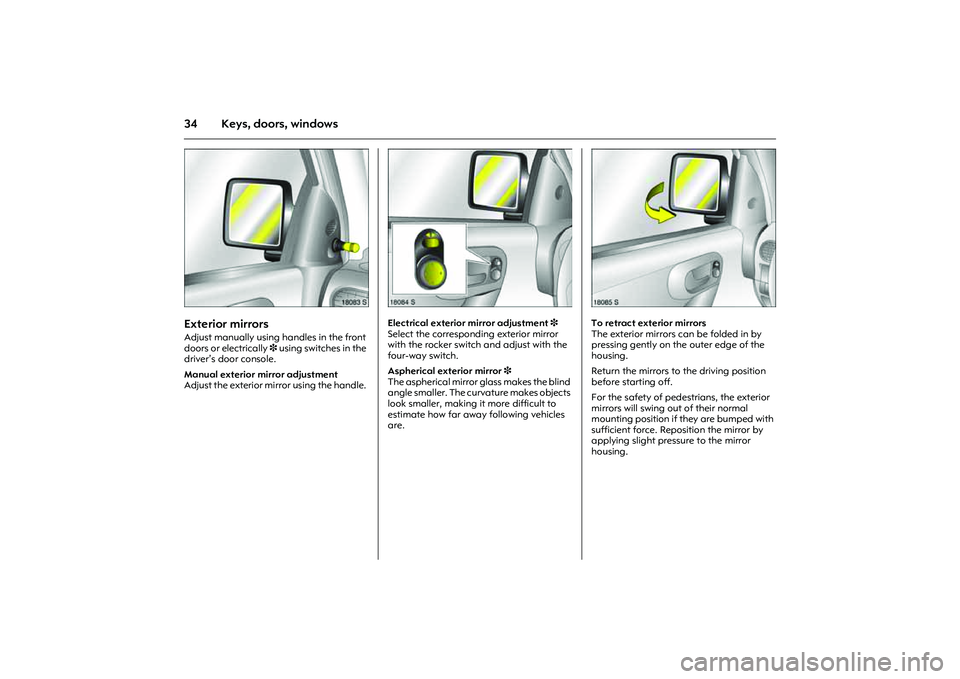
Exterior mirrors Adjust manually using handles in the front
doors or electrically 3 using switches in the
driver’s door console.
Manual exterior mirror adjustment
Adjust the exterior mirror using the handle.
Picture no: 18084s.tif
Electrical exterior mirror adjustment 3
Select the corresponding exterior mirror
with the rocker switch and adjust with the
four-way switch.
Aspherical exterior mirror 3
The aspherical mirror glass makes the blind
angle smaller. The curvature makes objects
look smaller, making it more difficult to
estimate how far away following vehicles
are.
Picture no: 18085s.tif
To retract exterior mirrors
The exterior mirrors can be folded in by
pressing gently on the outer edge of the
housing.
Return the mirrors to the driving position
before starting off.
For the safety of pedestrians, the exterior
mirrors will swing out of their normal
mounting position if they are bumped with
sufficient force. Reposition the mirror by
applying slight pressure to the mirror
housing.
Page 41 of 212
35
Keys, doors, windows
Picture no: 11549s.tif
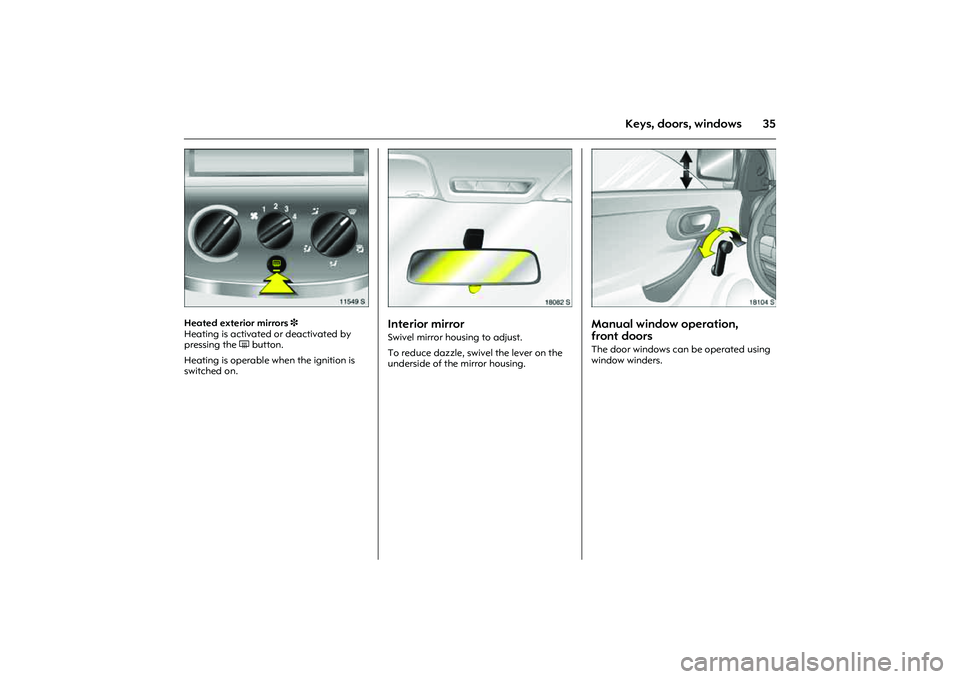
Heated exterior mirrors 3
Heating is activated or deactivated by
pressing the Ü button.
Heating is operable when the ignition is
switched on.
Picture no: 18082s.tif
Interior mirror Swivel mirror housing to adjust.
To reduce dazzle, swivel the lever on the
underside of the mirror housing.
Picture no: 18104s.tif
Manual window operation,
front doors The door windows can be operated using
window winders.
Page 42 of 212
36 Keys, doors, windows
Picture no: 18105s.tif
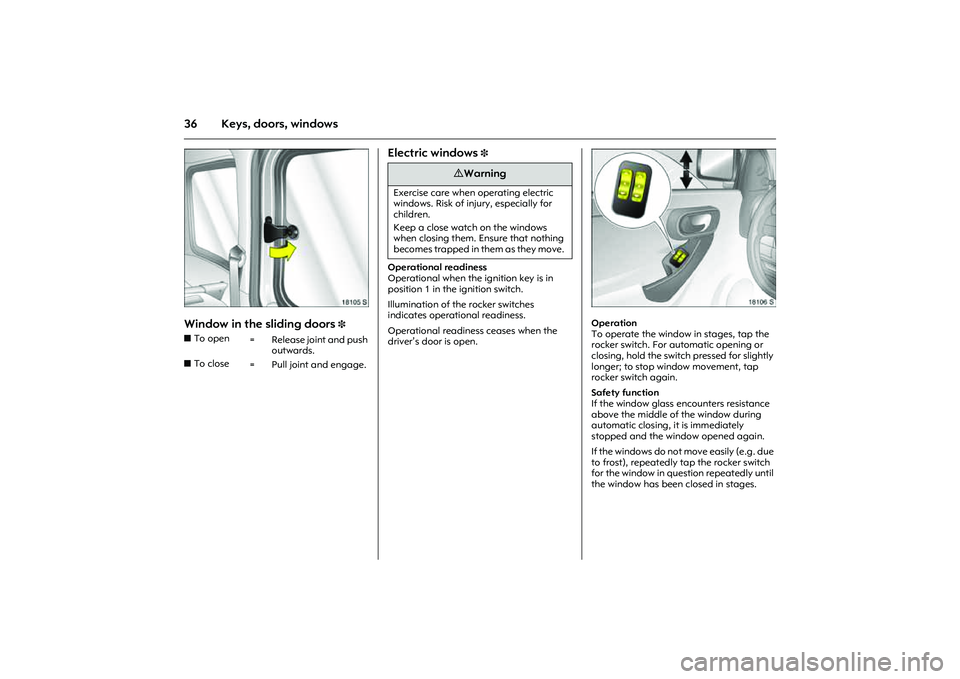
Window in the sliding doors
3 Electric windows
3
Operational readiness
Operational when the ignition key is in
position 1 in the ignition switch.
Illumination of the rocker switches
indicates operational readiness.
Operational readiness ceases when the
driver’s door is open.
Picture no: 18106s.tif
Operation
To operate the window in stages, tap the
rocker switch. For automatic opening or
closing, hold the switch pressed for slightly
longer; to stop window movement, tap
rocker switch again.
Safety function
If the window glass encounters resistance
above the middle of the window during
automatic closing, it is immediately
stopped and the window opened again.
If the windows do not move easily (e.g. due
to frost), repeatedly tap the rocker switch
for the window in question repeatedly until
the window has been closed in stages. zTo open
= Release joint and push
outwards.
zTo close
= Pull joint and engage.
9 Warning
Exercise care when operating electric
windows. Risk of injury, especially for
children.
Keep a close watch on the windows
when closing them. Ensure that nothing
becomes trapped in them as they move.
Page 43 of 212
37
Keys, doors, windows
Picture no: 17899s.tif
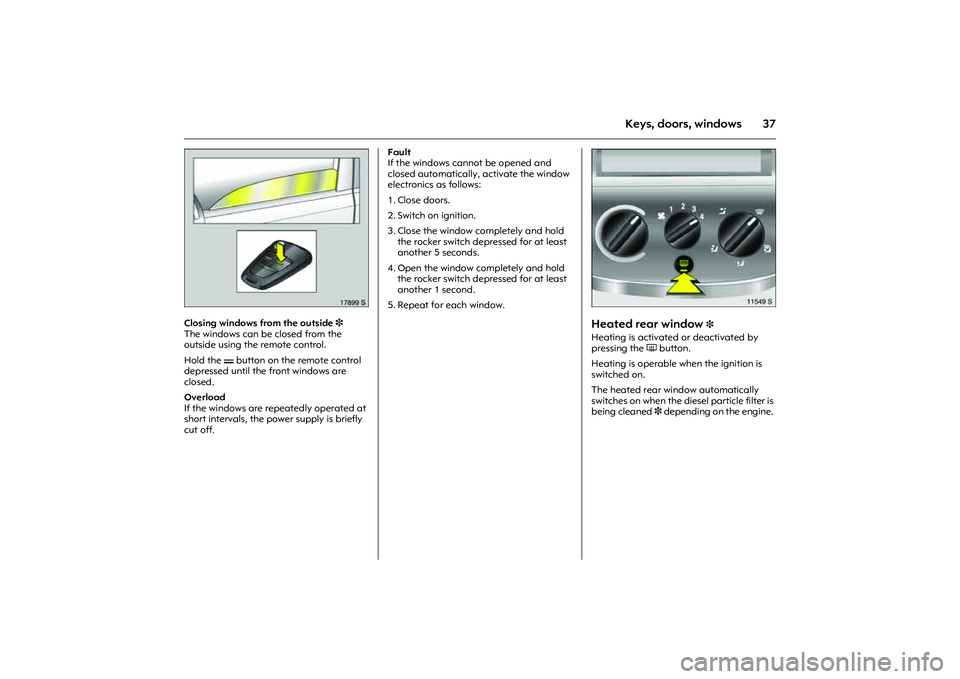
Closing windows from the outside 3
The windows can be closed from the
outside using the remote control.
Hold the p button on the remote control
depressed until the front windows are
closed.
Overload
If the windows are repeatedly operated at
short intervals, the power supply is briefly
cut off. Fault
If the windows cannot be opened and
closed automatically, activate the window
electronics as follows:
1. Close doors.
2. Switch on ignition.
3. Close the window completely and hold
the rocker switch depressed for at least
another 5 seconds.
4. Open the window completely and hold
the rocker switch depressed for at least
another 1 second.
5. Repeat for each window.
Picture no: 11549s.tif
Heated rear window
3
Heating is activated or deactivated by
pressing the Ü button.
Heating is operable when the ignition is
switched on.
The heated rear window automatically
switches on when the diesel particle filter is
being cleaned 3 depending on the engine.
Page 53 of 212
47
Seats, Interior
Picture no: 18103s.tif
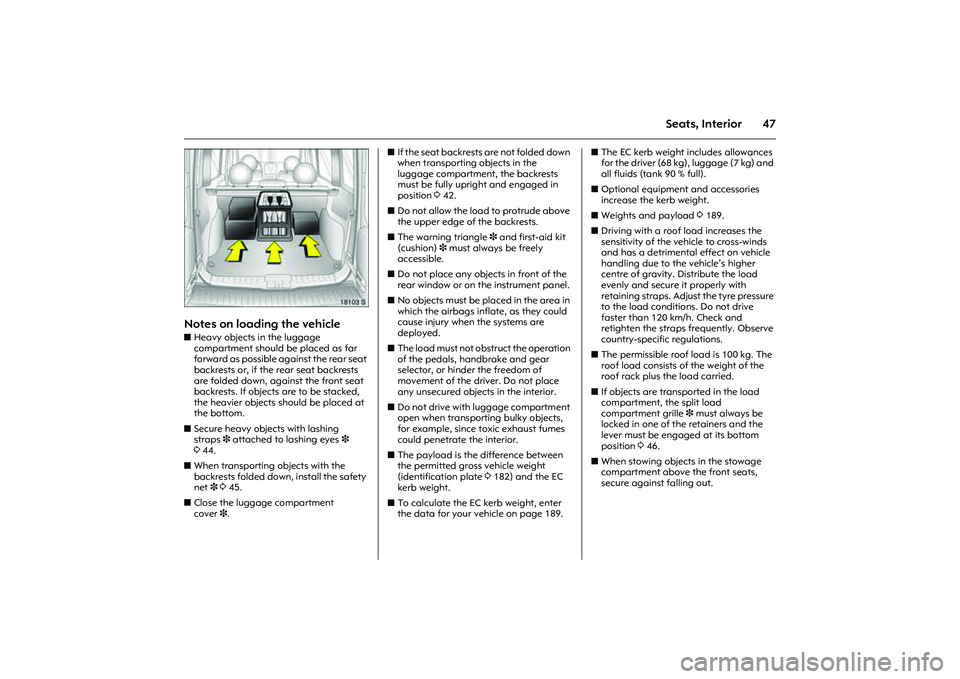
Notes on loading the vehicle zHeavy objects in the luggage
compartment should be placed as far
forward as possible against the rear seat
backrests or, if the rear seat backrests
are folded down, against the front seat
backrests. If objects are to be stacked,
the heavier objects should be placed at
the bottom.
zSecure heavy objects with lashing
straps3 attached to lashing eyes 3
344.
zWhen transporting objects with the
backrests folded down, install the safety
net 3 345.
zClose the luggage compartment
cover3. zIf the seat backrests are not folded down
when transporting objects in the
luggage compartment, the backrests
must be fully upright and engaged in
position 342.
zDo not allow the load to protrude above
the upper edge of the backrests.
zThe warning triangle 3 and first-aid kit
(cushion) 3 must always be freely
accessible.
zDo not place any objects in front of the
rear window or on the instrument panel.
zNo objects must be placed in the area in
which the airbags inflate, as they could
cause injury when the systems are
deployed.
zThe load must not obstruct the operation
of the pedals, handbrake and gear
selector, or hinder the freedom of
movement of the driver. Do not place
any unsecured objects in the interior.
zDo not drive with luggage compartment
open when transporting bulky objects,
for example, since toxic exhaust fumes
could penetrate the interior.
zThe payload is the difference between
the permitted gross vehicle weight
(identification plate 3182) and the EC
kerb weight.
zTo calculate the EC kerb weight, enter
the data for your vehicle on page 189. zThe EC kerb weight includes allowances
for the driver (68 kg), luggage (7 kg) and
all fluids (tank 90 % full).
zOptional equipment and accessories
increase the kerb weight.
zWeights and payload 3189.
zDriving with a roof load increases the
sensitivity of the vehicle to cross-winds
and has a detrimental effect on vehicle
handling due to the vehicle’s higher
centre of gravity. Distribute the load
evenly and secure it properly with
retaining straps. Adjust the tyre pressure
to the load conditions. Do not drive
faster than 120 km/h. Check and
retighten the straps frequently. Observe
country-specific regulations.
zThe permissible roof load is 100 kg. The
roof load consists of the weight of the
roof rack plus the load carried.
zIf objects are transported in the load
compartment, the split load
compartment grille
3 must always be
locked in one of the retainers and the
lever must be engaged at its bottom
position 346.
zWhen stowing objects in the stowage
compartment above the front seats,
secure against falling out.
Page 89 of 212
83
Instruments
Adjustable wiper interval
To set the wiper interval to a value between
2 and 15 seconds:
Lever to interval operation $, lever to §,
wait for required interval delay, Level to
interval operation again $.
The selected interval will remain stored
until the next time it is changed or until the
ignition is switched off.
After switching on the ignition and moving
the lever up, $ the interval is set to
7seconds.
Picture no: 14056h.tif
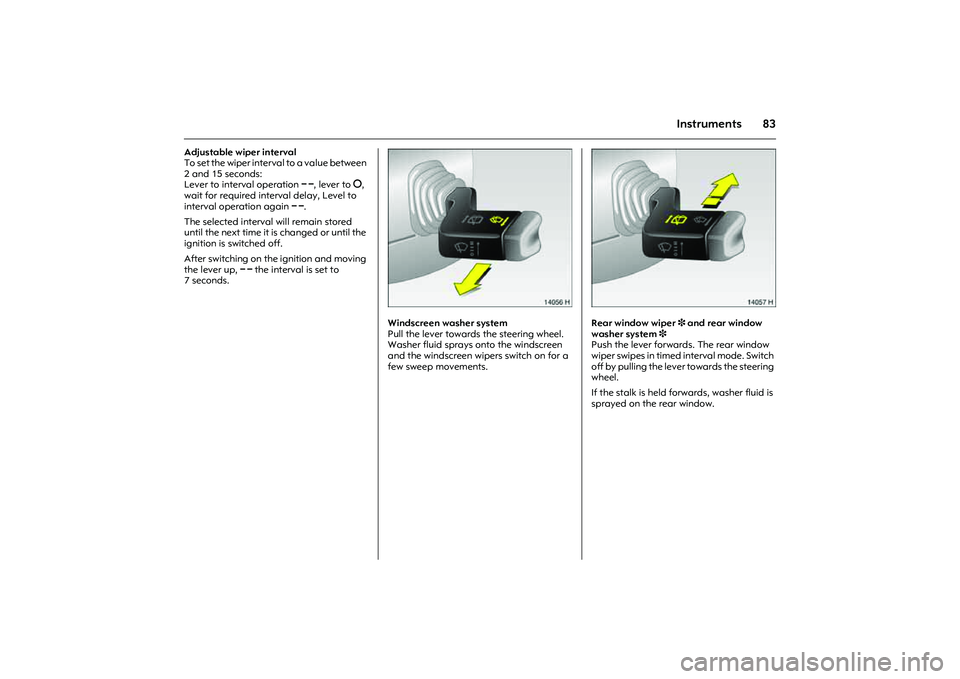
Windscreen washer system
Pull the lever towards the steering wheel.
Washer fluid sprays onto the windscreen
and the windscreen wipers switch on for a
few sweep movements.
Picture no: 14057h.tif
Rear window wiper 3 and rear window
washer system 3
Push the lever forwards. The rear window
wiper swipes in timed interval mode. Switch
off by pulling the lever towards the steering
wheel.
If the stalk is held forwards, washer fluid is
sprayed on the rear window.
Page 99 of 212
93
Climate control
Picture no: 15928s.tif
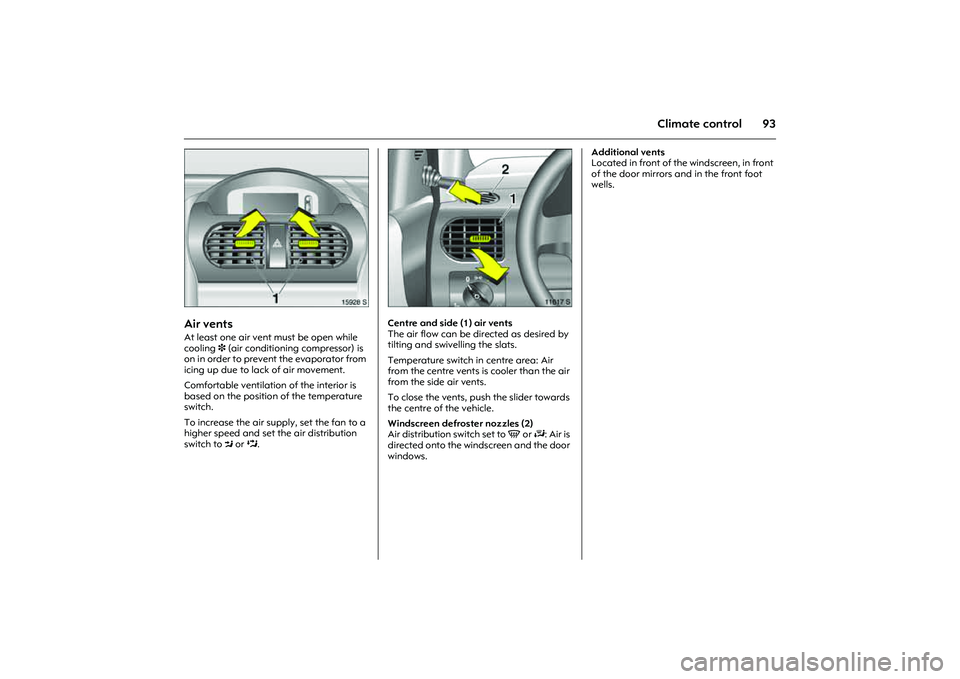
Air vents At least one air vent must be open while
cooling 3 (air conditioning compressor) is
on in order to prevent the evaporator from
icing up due to lack of air movement.
Comfortable ventilation of the interior is
based on the position of the temperature
switch.
To increase the air supply, set the fan to a
higher speed and set the air distribution
switch to M or L.
Picture no: 11617s.tif
Centre and side (1) air vents
The air flow can be directed as desired by
tilting and swivelling the slats.
Temperature switch in centre area: Air
from the centre vents is cooler than the air
from the side air vents.
To close the vents, push the slider towards
the centre of the vehicle.
Windscreen defroster nozzles (2)
Air distribution switch set to V or J: Air is
directed onto the windscreen and the door
windows. Additional vents
Located in front of the windscreen, in front
of the door mirrors and in the front foot
wells.
Page 100 of 212
94 Climate control
Picture no: 11612s.tif
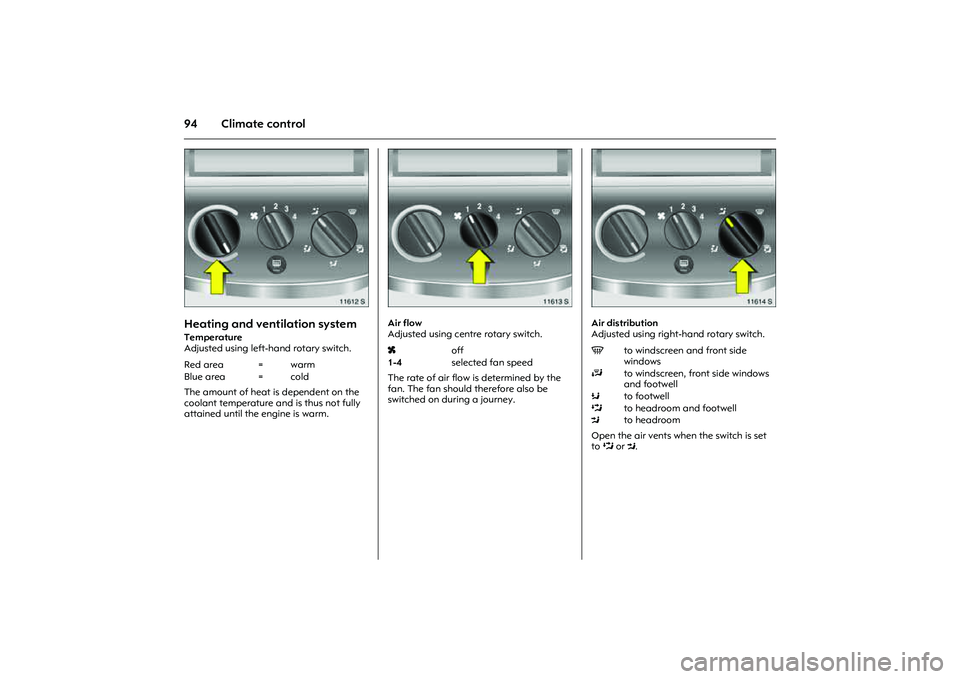
Heating and ventilation systemTemperature
Adjusted using left-hand rotary switch.
The amount of heat is dependent on the
coolant temperature and is thus not fully
attained until the engine is warm.
Picture no: 11613s.tif
Air flow
Adjusted using centre rotary switch.
The rate of air flow is determined by the
fan. The fan should therefore also be
switched on during a journey.
Picture no: 11614s.tif
Air distribution
Adjusted using right-hand rotary switch.
Open the air vents when the switch is set
toL or M. Red area = warm
Blue area = cold
xoff
1-4selected fan speed
Vto windscreen and front side
windows
Jto windscreen, front side windows
and footwell
Kto footwell
Lto headroom and footwell
Mto headroom
Page 102 of 212
96 Climate control
Picture no: 16489s.tif
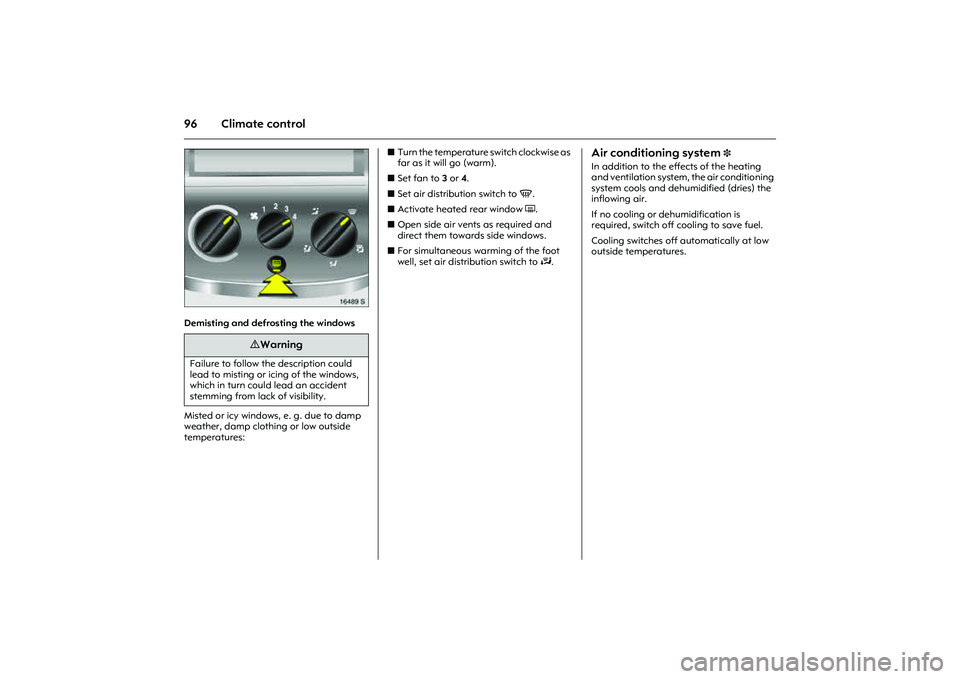
Demisting and defrosting the windows
Misted or icy windows, e. g. due to damp
weather, damp clothing or low outside
temperatures:zTurn the temperature switch clockwise as
far as it will go (warm).
zSet fan to 3 or 4.
zSet air distribution switch to V.
zActivate heated rear window Ü.
zOpen side air vents as required and
direct them towards side windows.
zFor simultaneous warming of the foot
well, set air distribution switch to J.
Air conditioning system
3
In addition to the effects of the heating
and ventilation system, the air conditioning
system cools and dehumidified (dries) the
inflowing air.
If no cooling or dehumidification is
required, switch off cooling to save fuel.
Cooling switches off automatically at low
outside temperatures.
9 Warning
Failure to follow the description could
lead to misting or icing of the windows,
which in turn could lead an accident
stemming from lack of visibility.
Page 103 of 212
97
Climate control
Picture no: 13203s.tif
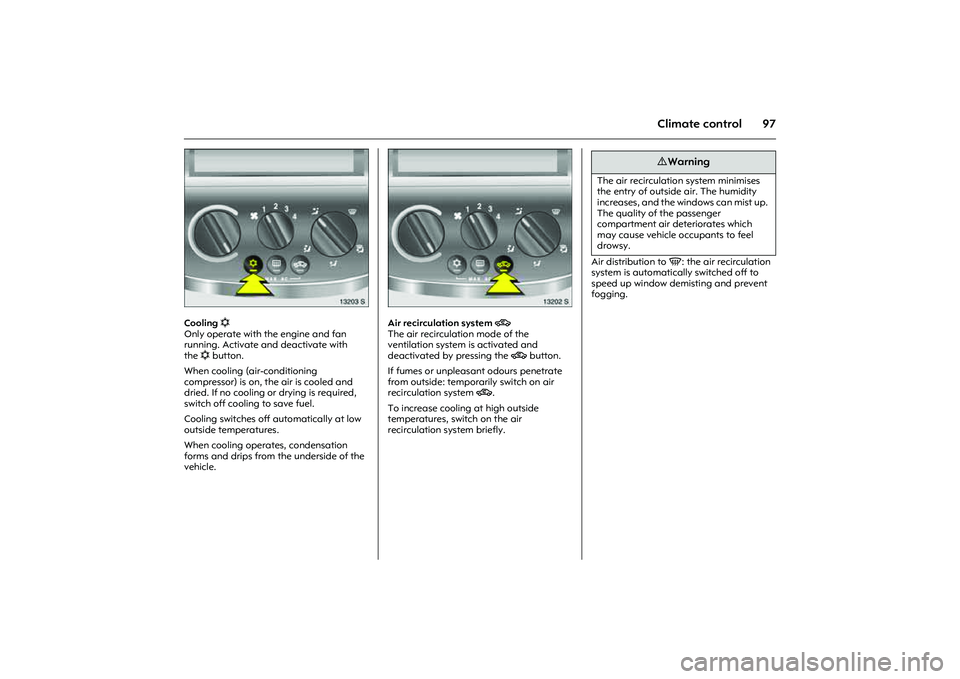
Cooling n
Only operate with the engine and fan
running. Activate and deactivate with
then button.
When cooling (air-conditioning
compressor) is on, the air is cooled and
dried. If no cooling or drying is required,
switch off cooling to save fuel.
Cooling switches off automatically at low
outside temperatures.
When cooling operates, condensation
forms and drips from the underside of the
vehicle.
Picture no: 13202s.tif
Air recirculation system 4
The air recirculation mode of the
ventilation system is activated and
deactivated by pressing the 4 button.
If fumes or unpleasant odours penetrate
from outside: temporarily switch on air
recirculation system 4.
To increase cooling at high outside
temperatures, switch on the air
recirculation system briefly.Air distribution to V: the air recirculation
system is automatically switched off to
speed up window demisting and prevent
fogging.
9 Warning
The air recirculation system minimises
the entry of outside air. The humidity
increases, and the windows can mist up.
The quality of the passenger
compartment air deteriorates which
may cause vehicle occupants to feel
drowsy.