light OPEL COMBO 2010 Workshop Manual
[x] Cancel search | Manufacturer: OPEL, Model Year: 2010, Model line: COMBO, Model: OPEL COMBO 2010Pages: 212, PDF Size: 2.49 MB
Page 164 of 212
158 Self-help, vehicle care
Picture no: 15135s.tif
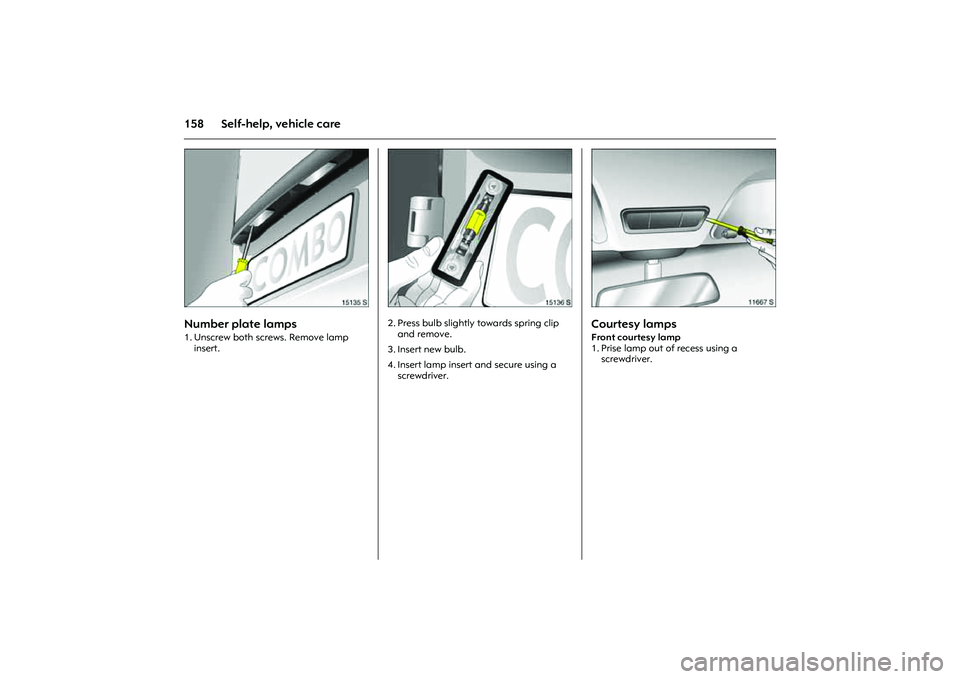
Number plate lamps 1. Unscrew both screws. Remove lamp
insert.
Picture no: 15136s.tif
2. Press bulb slightly towards spring clip
and remove.
3. Insert new bulb.
4. Insert lamp insert and secure using a
screwdriver.
Picture no: 11667s.tif
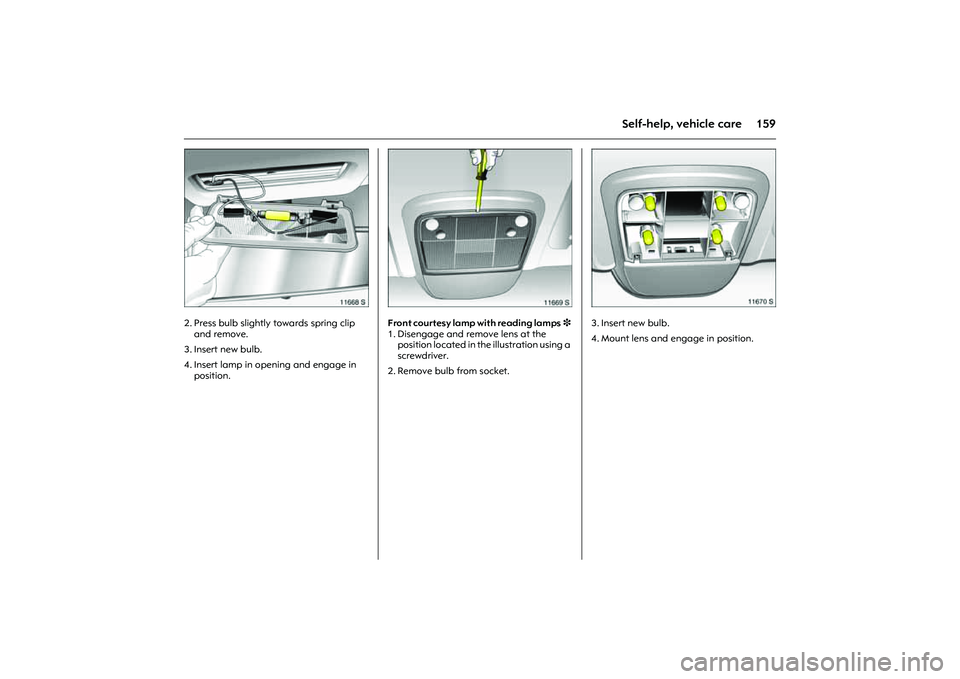
Courtesy lamps Front courtesy lamp
1. Prise lamp out of recess using a
screwdriver.
Page 165 of 212
159
Self-help, vehicle care
Picture no: 11668s.tif
2. Press bulb slightly towards spring clip
and remove.
3. Insert new bulb.
4. Insert lamp in opening and engage in
position.
Picture no: 11669s.tif
Front courtesy lamp with reading lamps3
1. Disengage and remove lens at the
position located in the illustration using a
screwdriver.
2. Remove bulb from socket.
Picture no: 11670s.tif
3. Insert new bulb.
4. Mount lens and engage in position.
Page 166 of 212
160 Self-help, vehicle care
Picture no: 18112s.tif
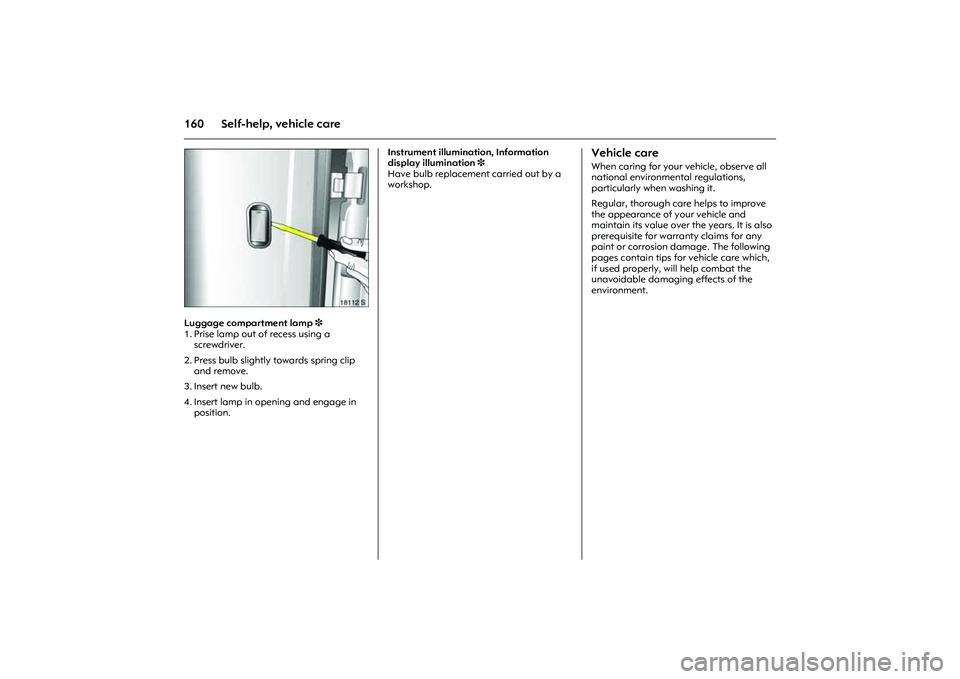
Luggage compartment lamp3
1. Prise lamp out of recess using a
screwdriver.
2. Press bulb slightly towards spring clip
and remove.
3. Insert new bulb.
4. Insert lamp in opening and engage in
position. Instrument illumination, Information
display illumination3
Have bulb replacement carried out by a
workshop.
Vehicle careWhen caring for your vehicle, observe all
national environmental regulations,
particularly when washing it.
Regular, thorough care helps to improve
the appearance of your vehicle and
maintain its value over the years. It is also
prerequisite for warranty claims for any
paint or corrosion damage. The following
pages contain tips for vehicle care which,
if used properly, will help combat the
unavoidable damaging effects of the
environment.
Page 168 of 212
162 Self-help, vehicle careExterior lights
Headlamp and other lamp lens are made
of plastic. Do not use any abrasive or
caustic agents, do not use an ice scraper,
and do not clean them dry.
Plastic and rubber parts
Plastic and rubber parts can be cleaned
with the same cleaner as used to clean the
body. Use interior cleaner if necessary. Do
not use any other agent. Avoid solvents
and petrol in particular. Do not use high-
pressure jet cleaners.
Interior and upholstery
Clean the vehicle interior, including the
instrument panel fascia, using interior
cleaner.
The instrument panel is only to be cleaned
with a soft, damp cloth.
Clean the fabric upholstery with a vacuum
cleaner and brush. Remove stains with an
upholstery cleaner.
Clean seat belts with lukewarm water or
interior cleaner. Windows and windscreen wiper blades
Use a soft lint-free cloth or chamois leather
together with window cleaner and insect
remover.
When cleaning the rear window, make sure
the heating element inside the window is
not damaged.
For mechanical removal of ice, use a sharp-
edged ice scraper. Press the scraper firmly
against the glass so that no dirt can get
under it and scratch the glass.
Clean smearing wiper blades with a soft
cloth and window cleaner.
Locks
The locks are lubricated at the factory
using a high quality lock cylinder grease.
Use de-icing agent only where absolutely
necessary, as this removes grease and
impairs lock function. After using de-icing
agent, have the locks regreased by a
workshop. Engine compartment
Clean painted surfaces in the engine
compartment like any other painted
surface.
For best results, wash and wax the engine
compartment before and after winter.
Before washing the engine, cover the
alternator and brake fluid reservoir with
plastic sheeting.
When washing the engine with a steam-jet
cleaner, do not direct the steam jet at
components of the Anti-lock Braking
System 3, the automatic air conditioning
system 3 or the belt drive and its
components.
After an engine wash, have all engine room
components preserved thoroughly by a
workshop using protective wax.
Do not use high-pressure jet cleaners.
Caution
Close Velcro fasteners as open Velcro
fasteners on clothing could damage
seat upholstery.
Page 171 of 212
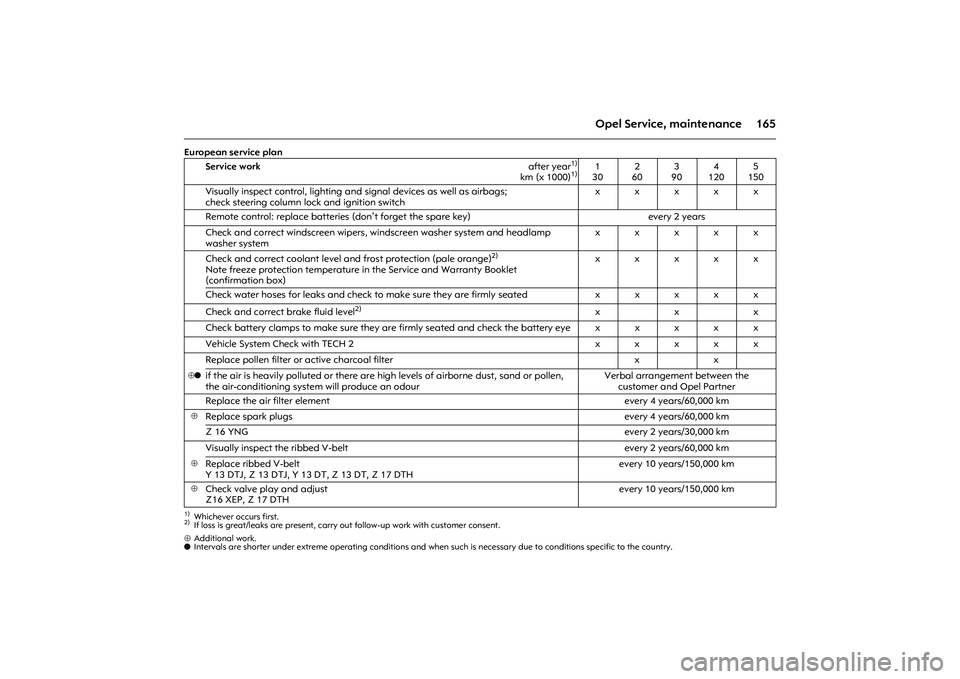
165 Opel Service, maintenance
European service plan⊕Additional work.
o Intervals are shorter under extreme operating conditions and when such is necessary due to conditions specific to the country.
Service work after year
1)
km (x 1000)
1)
1)Whichever occurs first.
1
302
603
904
1205
150
Visually inspect control, lighting and signal devices as well as airbags;
check steering column lock and ignition switchxxxxx
Remote control: replace batteries (don’t forget the spare key) every 2 years
Check and correct windscreen wipers, windscreen washer system and headlamp
washer systemxxxxx
Check and correct coolant level and frost protection (pale orange)
2)
Note freeze protection temperature in the Service and Warranty Booklet
(confirmation box)
2)If loss is great/leaks are present, carry out follow-up work with customer consent.
xxxxx
Check water hoses for leaks and check to make sure they are firmly seated x x x x x
Check and correct brake fluid level
2) xxx
Check battery clamps to make sure they are firmly seated and check the battery eye x x x x x
Vehicle System Check with TECH 2 x x x x x
Replace pollen filter or active charcoal filter x x
⊕o
if the air is heavily polluted or there are high levels of airborne dust, sand or pollen,
the air-conditioning system will produce an odourVerbal arrangement between the
customer and Opel Partner
Replace the air filter element every 4 years/60,000 km
⊕
Replace spark plugsevery 4 years/60,000 km
Z 16 YNGevery 2 years/30,000 km
Visually inspect the ribbed V-belt every 2 years/60,000 km
⊕
Replace ribbed V-belt
Y 13 DTJ, Z 13 DTJ, Y 13 DT, Z 13 DT, Z 17 DTH every 10 years/150,000 km
⊕
Check valve play and adjust
Z16 XEP, Z 17 DTHevery 10 years/150,000 km
Page 173 of 212
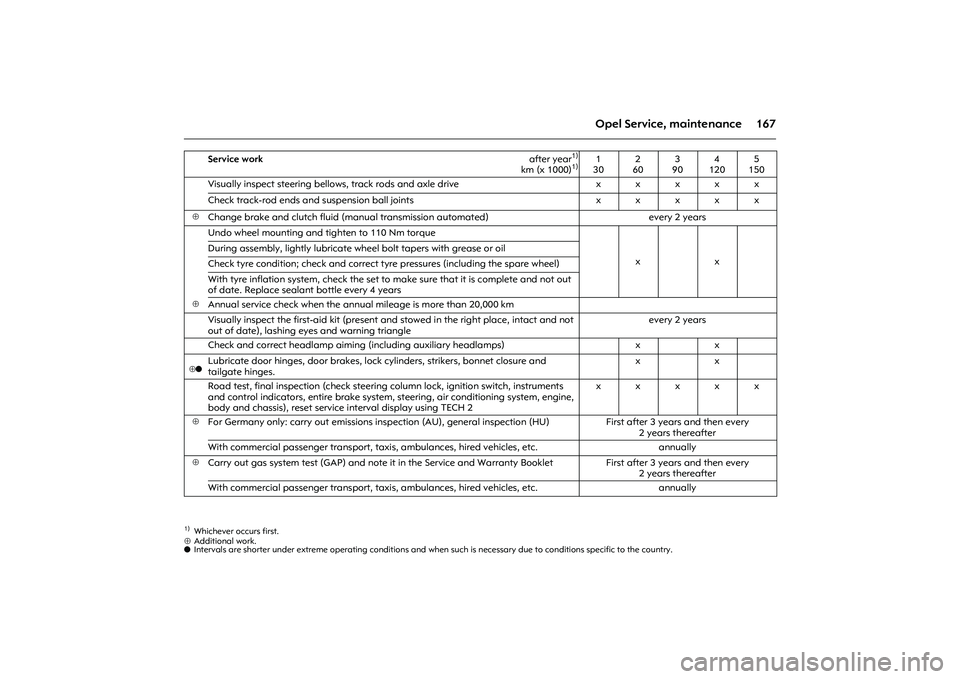
167 Opel Service, maintenance
⊕Additional work.
o Intervals are shorter under extreme operating conditions and when such is necessary due to conditions specific to the country.
Service work after year
1)
km (x 1000)
1)
1)Whichever occurs first.
1
302
603
904
1205
150
Visually inspect steering bellows, track rods and axle drive xxxxx
Check track-rod ends and suspension ball joints xxxxx
⊕
Change brake and clutch fluid (manual transmission automated) every 2 years
Undo wheel mounting and tighten to 110 Nm torque
xx During assembly, lightly lubricate wheel bolt tapers with grease or oil
Check tyre condition; check and correct tyre pressures (including the spare wheel)
With tyre inflation system, check the set to make sure that it is complete and not out
of date. Replace sealant bottle every 4 years
⊕
Annual service check when the annual mileage is more than 20,000 km
Visually inspect the first-aid kit (present and stowed in the right place, intact and not
out of date), lashing eyes and warning triangleevery 2 years
Check and correct headlamp aiming (including auxiliary headlamps) x x
⊕o
Lubricate door hinges, door brakes, lock cylinders, strikers, bonnet closure and
tailgate hinges.xx
Road test, final inspection (check steering column lock, ignition switch, instruments
and control indicators, entire brake system, steering, air conditioning system, engine,
body and chassis), reset service interval display using TECH 2xxxxx
⊕
For Germany only: carry out emissions inspection (AU), general inspection (HU) First after 3 years and then every
2 years thereafter
With commercial passenger transport, taxis, ambulances, hired vehicles, etc. annually
⊕
Carry out gas system test (GAP) and note it in the Service and Warranty Booklet First after 3 years and then every
2 years thereafter
With commercial passenger transport, taxis, ambulances, hired vehicles, etc. annually
Page 174 of 212
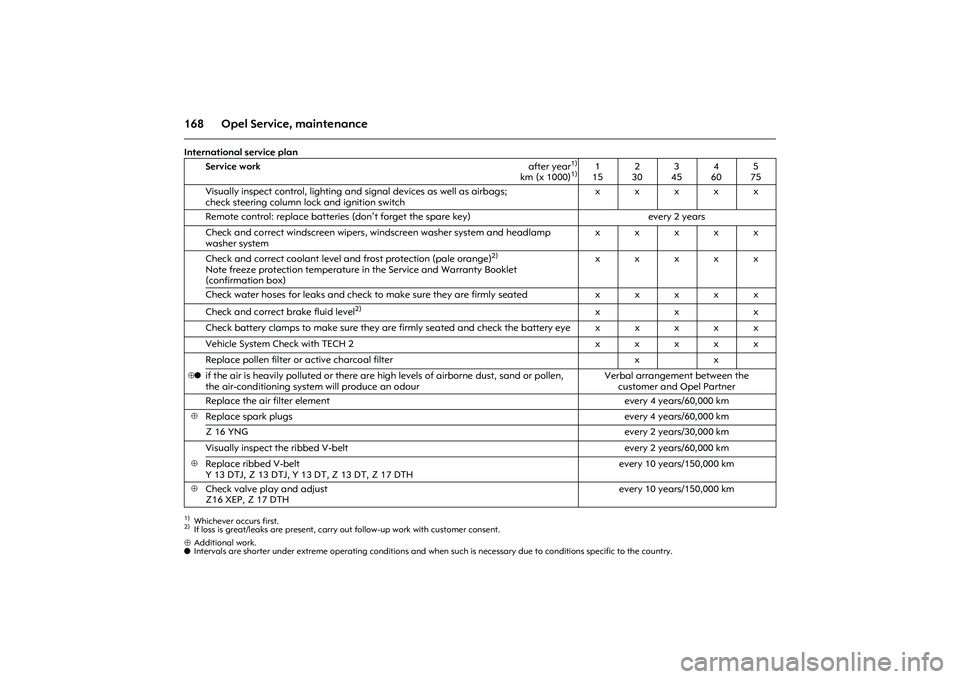
168 Opel Service, maintenanceInternational service plan⊕Additional work.
o Intervals are shorter under extreme operating conditions and when such is necessary due to conditions specific to the country.
Service work after year
1)
km (x 1000)
1)
1)Whichever occurs first.
1
152
303
454
605
75
Visually inspect control, lighting and signal devices as well as airbags;
check steering column lock and ignition switchxxxxx
Remote control: replace batteries (don’t forget the spare key) every 2 years
Check and correct windscreen wipers, windscreen washer system and headlamp
washer systemxxxxx
Check and correct coolant level and frost protection (pale orange)
2)
Note freeze protection temperature in the Service and Warranty Booklet
(confirmation box)
2)If loss is great/leaks are present, carry out follow-up work with customer consent.
xxxxx
Check water hoses for leaks and check to make sure they are firmly seated x x x x x
Check and correct brake fluid level
2) xxx
Check battery clamps to make sure they are firmly seated and check the battery eye x x x x x
Vehicle System Check with TECH 2 x x x x x
Replace pollen filter or active charcoal filter x x
⊕o
if the air is heavily polluted or there are high levels of airborne dust, sand or pollen,
the air-conditioning system will produce an odourVerbal arrangement between the
customer and Opel Partner
Replace the air filter element every 4 years/60,000 km
⊕
Replace spark plugsevery 4 years/60,000 km
Z 16 YNGevery 2 years/30,000 km
Visually inspect the ribbed V-belt every 2 years/60,000 km
⊕
Replace ribbed V-belt
Y 13 DTJ, Z 13 DTJ, Y 13 DT, Z 13 DT, Z 17 DTH every 10 years/150,000 km
⊕
Check valve play and adjust
Z16 XEP, Z 17 DTHevery 10 years/150,000 km
Page 176 of 212
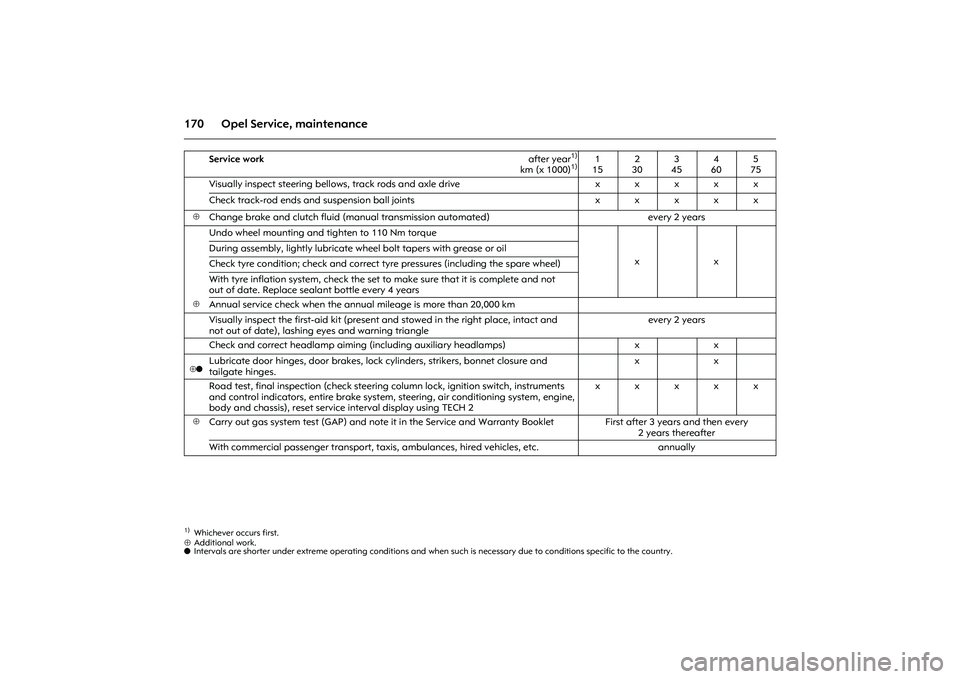
170 Opel Service, maintenance⊕Additional work.
o Intervals are shorter under extreme operating conditions and when such is necessary due to conditions specific to the country.
Service work after year
1)
km (x 1000)
1)
1)Whichever occurs first.
1
152
303
454
605
75
Visually inspect steering bellows, track rods and axle drive x x x x x
Check track-rod ends and suspension ball joints x x x x x
⊕
Change brake and clutch fluid (manual transmission automated) every 2 years
Undo wheel mounting and tighten to 110 Nm torque
xx During assembly, lightly lubricate wheel bolt tapers with grease or oil
Check tyre condition; check and correct tyre pressures (including the spare wheel)
With tyre inflation system, check the set to make sure that it is complete and not
out of date. Replace sealant bottle every 4 years
⊕
Annual service check when the annual mileage is more than 20,000 km
Visually inspect the first-aid kit (present and stowed in the right place, intact and
not out of date), lashing eyes and warning triangleevery 2 years
Check and correct headlamp aiming (including auxiliary headlamps) x x
⊕o
Lubricate door hinges, door brakes, lock cylinders, strikers, bonnet closure and
tailgate hinges.xx
Road test, final inspection (check steering column lock, ignition switch, instruments
and control indicators, entire brake system, steering, air conditioning system, engine,
body and chassis), reset service interval display using TECH 2xxxxx
⊕
Carry out gas system test (GAP) and note it in the Service and Warranty Booklet First after 3 years and then every
2 years thereafter
With commercial passenger transport, taxis, ambulances, hired vehicles, etc. annually
Page 190 of 212
![OPEL COMBO 2010 Workshop Manual 184 Technical dataEngine data Sales designation
Engine identifier code1.4 TWINPORT
Z 14 XEPCNG
Z 16 YNG1.3 CDTI
Z 13 DTJ1.7 CDTI
Z 17 DTH
Number of cylinders 4 4 4 4
Piston displacement [cm
3 ] 1364 1](/img/37/58222/w960_58222-189.png "OPEL COMBO 2010 Workshop Manual 184 Technical dataEngine data Sales designation
Engine identifier code1.4 TWINPORT
Z 14 XEPCNG
Z 16 YNG1.3 CDTI
Z 13 DTJ1.7 CDTI
Z 17 DTH
Number of cylinders 4 4 4 4
Piston displacement [cm
3 ] 1364 1")
184 Technical dataEngine data Sales designation
Engine identifier code1.4 TWINPORT
Z 14 XEPCNG
Z 16 YNG1.3 CDTI
Z 13 DTJ1.7 CDTI
Z 17 DTH
Number of cylinders 4 4 4 4
Piston displacement [cm
3 ] 1364 1598 1248 1686
Brake horse power [kW/bhp]
at rpm 66
560069
620055
400074
4400
Torque [Nm]
at rpm 125
4000133
4200170
1750 to 2500240
2300
Fuel type
1)
1)Standard high-quality fuels, unleaded DIN EN 228, diesel DIN EN 590. Any commercially available natural gas containing methane can be used for
natural gas operation.
Petrol Natural gas/petrol Diesel Diesel
Octane requirement [RON]
2)
recommended
possible
possible
Cetane requirement [CN]
2)
2)Standard high-quality fuels: R = Regular, P = Premium, PP = Premium Plus, D = Diesel. Value printed in bold: recommended fuel.
95 (P)
3)
98 (PP)
3)
91 (R)
3)4)
–
3)Knock control system automatically adjusts ignition timing according to type of fuel used (octane number). 4)Slight reduction in engine output and torque if 91 RON is used.
95 (P)
3)
98 (PP)
3)
–
––
–
–
49 (D)
5)
5)A lower value is possible with winter diesel fuels.
–
–
–
49 (D)
5)
Max. permissible engine speed,
continuous operation approx. [rpm ]. 6200 6400 5020 to 5180 5000 to 5200
Oil consumption [l/1000 km] 0.6 0.6 0.6 0.6
Page 192 of 212
186 Technical dataFuel consumption, CO
2-emissions
Directive 80/1268/EEC (last changed by
2004/3/EC) has applied for the
measurement of fuel consumption since
1996.
The directive is oriented to actual driving
practices: Urban driving is rated at
approx.
1/3 and off-road driving with
approx. 2/3 (urban and extra-urban
consumption). Cold starts and acceleration
phases are also taken into consideration.
The specification of CO
2 emission is also a
constituent of the directive.The figures given must not be taken as a
guarantee for the actual fuel consumption
of a particular vehicle.
All values stem from the EU base model
with standard equipment.
The calculation of fuel consumption as
specified by directive 2004/3/EC takes
account of the vehicle’s kerb weight,
ascertained in accordance with the said
regulation. Optional extras may result in
slightly higher fuel consumption and CO
2
emission levels than those quoted.
Saving Fuel, Protecting the Environment
3108.
Fuel consumption, natural gasThe data on fuel consumption has been
ascertained with reference fuel G20
(methane content 99 - 100 mol%) under
prescribed driving conditions (see previous
columns). The fuel consumption values will
deviate from those specified if natural gas
with a lower methane content is used.
All values stem from the EU base model
with standard equipment. The
consumption calculated according to the
1999/100/EC directive takes into
consideration the kerb weight laid down in
agreement with this regulation. Additional
equipment as well as the gas condition,
filling station pressure, mode of driving and
the road and traffic conditions can lead to
higher consumptions and CO
2 values than
those specified.