service OPEL COMBO 2010 Owners Manual
[x] Cancel search | Manufacturer: OPEL, Model Year: 2010, Model line: COMBO, Model: OPEL COMBO 2010Pages: 212, PDF Size: 2.49 MB
Page 4 of 212
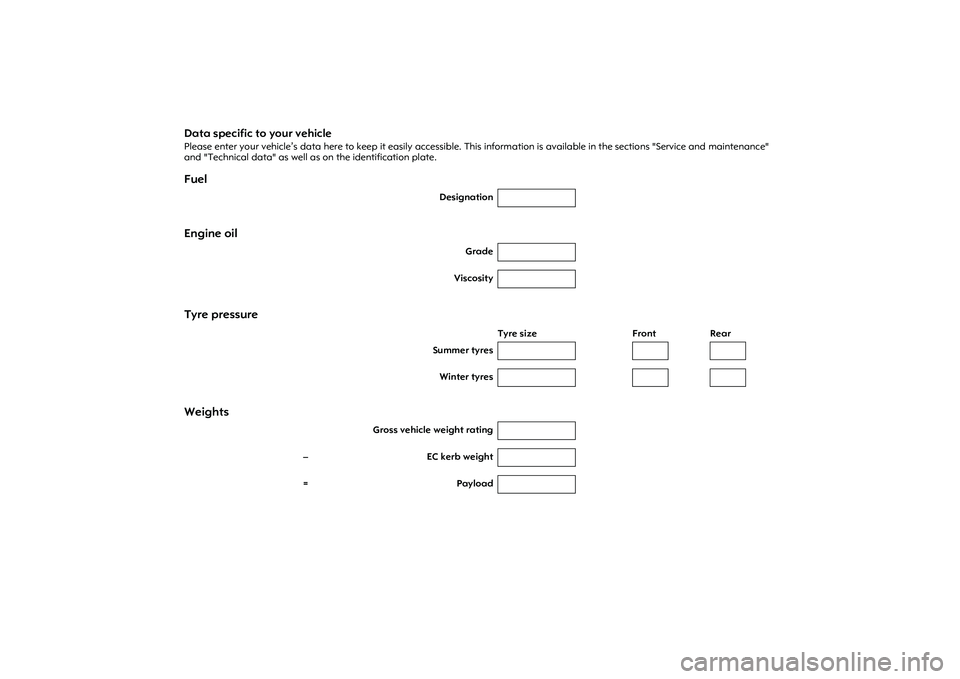
Data specific to your vehiclePlease enter your vehicle’s data here to keep it easily accessible. This information is available in the sections "Service and maintenance"
and "Technical data" as well as on the identification plate. Fuel
Designation
Engine oil
Grade
Viscosity
Tyre pressure
Tyre size Front Rear
Summer tyres
Winter tyres
Weights
Gross vehicle weight rating
– EC kerb weight
=Payload
Page 5 of 212
IntroductionYour vehicle is an intelligent combination
of forward-looking technology, impressive
safety, environmental friendliness and
economy.
It now lies with you to drive your vehicle
safely and to see it performs perfectly. This
Owner’s Manual provides you with all the
necessary information to that end.
Make sure your passengers are aware of
the possible risk of accident and injury
which may result from improper use of the
vehicle.
You must always follow the specific laws of
the country in which you are located. These
could differ from the information in this
Owner’s Manual.
When this Manual refers to a workshop
visit, we recommend your Opel Service
Partner.
All Opel Service Partners provide first-class
service at reasonable prices. Experienced
mechanics trained by Opel work according
to specific Opel instructions.
The Owner’s Manual, infotainment system
instructions and vehicle service and
warranty booklet should always be kept
ready to hand in the vehicle glove
compartment. Make use of the Owner’s Manual zThe "In Brief" section will give you an
initial overview. zThe table of contents at the beginning of
the owner’s manual and within the
individual chapters will show you where
everything is.
zIts index will help you find what you
want.
zYellow arrows in the illustrations serve as
points of reference or indicate some
action to be performed.
zBlack arrows in the illustrations indicate
a reaction or a second action to be
performed.
zThis Owner’s Manual depicts left-hand
drive vehicles. Operation is similar for
right-hand drive vehicles.
zThe Owner’s Manual uses the internal
engine codes. The corresponding sales
designations are found in the chapter
"Technical data".
zDirection references such as left or right,
forwards or backwards in the
descriptions always indicate the
direction of travel.
Symbols6 Continue reading on next page. 3 signifies equipment not fitted to all
vehicles (model variants, engine options,
models specific to one country, optional
equipment, Genuine Opel Parts and
Accessories).
Page references are indicated with 3 . 3
means "see page".
9
Danger,
9 Warning, Caution
We wish you many hours of pleasurable
driving Adam Opel GmbH
9
Danger
Text marked 9 Danger provides
information on risk of endangering life.
Failure to comply with the instructions
could endanger life.
9 Warning
Text marked 9 Warning provides
information on risk of accident or injury.
Failure to comply with the instructions
could lead to injury.
Caution
Text marked Caution provides
information on possible damage to the
vehicle Failure to comply with the
instructions could lead to vehicle
damage.
Page 7 of 212
Contents
In Brief ........................................................ 2
Keys, doors, windows ............................. 20
Seats, Interior .......................................... 38
Instruments ............................................. 66
Lighting ................................................... 84
Infotainment system .............................. 90
Climate control ....................................... 92
Driving and operation ......................... 100
Self-help, vehicle care .......................... 128
Opel Service, maintenance .................. 164
Technical data ..................................... 182
Index ...................................................... 198
Page 77 of 212
71
Instruments
Picture no: 12098s.tif.
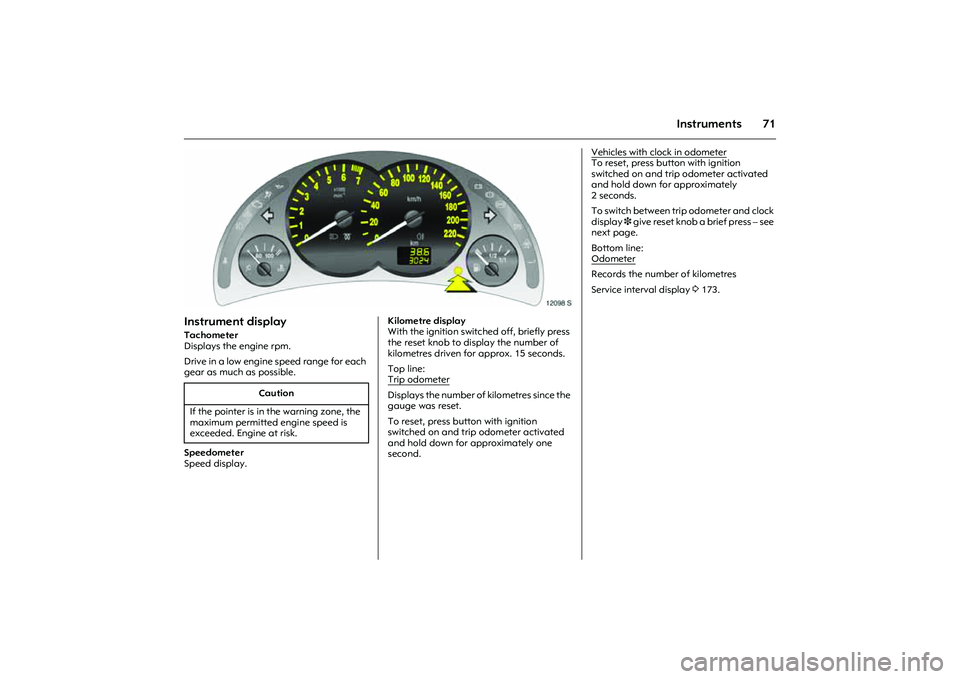
Instrument displayTachometer
Displays the engine rpm.
Drive in a low engine speed range for each
gear as much as possible.
Speedometer
Speed display.
Picture no:
Kilometre display
With the ignition switched off, briefly press
the reset knob to display the number of
kilometres driven for approx. 15 seconds.
Top line:
Trip odometerDisplays the number of kilometres since the
gauge was reset.
To reset, press button with ignition
switched on and trip odometer activated
and hold down for approximately one
second. Caution
If the pointer is in the warning zone, the
maximum permitted engine speed is
exceeded. Engine at risk.
Vehicles with clock in odometerTo reset, press button with ignition
switched on and trip odometer activated
and hold down for approximately
2seconds.
To switch between trip odometer and clock
display 3 give reset knob a brief press – see
next page.
Bottom line:
OdometerRecords the number of kilometres
Service interval display 3173.
Page 81 of 212
75
Instruments
Picture no: 12478s.tif
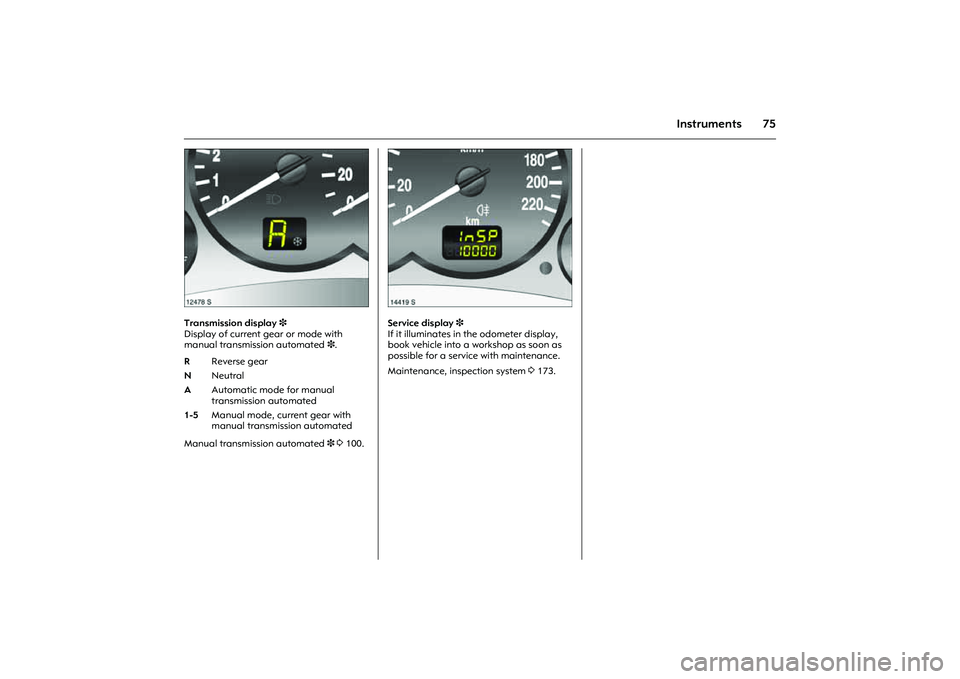
Transmission display 3
Display of current gear or mode with
manual transmission automated 3.
Manual transmission automated 3 3100.
Picture no: 14419s.tif
Service display 3
If it illuminates in the odometer display,
book vehicle into a workshop as soon as
possible for a service with maintenance.
Maintenance, inspection system 3173. RReverse gear
NNeutral
AAutomatic mode for manual
transmission automated
1-5Manual mode, current gear with
manual transmission automated
Page 97 of 212
91
Infotainment system
Picture no: 18472s.tif
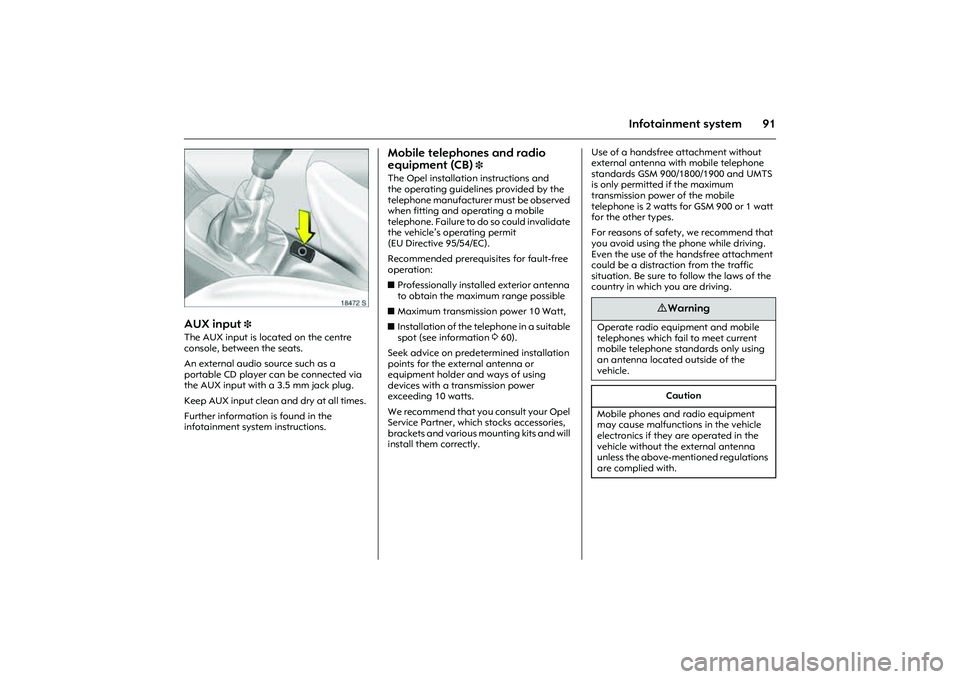
AUX input
3
The AUX input is located on the centre
console, between the seats.
An external audio source such as a
portable CD player can be connected via
the AUX input with a 3.5 mm jack plug.
Keep AUX input clean and dry at all times.
Further information is found in the
infotainment system instructions.
Mobile telephones and radio
equipment (CB)
3
The Opel installation instructions and
the operating guidelines provided by the
telephone manufacturer must be observed
when fitting and operating a mobile
telephone. Failure to do so could invalidate
the vehicle’s operating permit
(EU Directive 95/54/EC).
Recommended prerequisites for fault-free
operation:
zProfessionally installed exterior antenna
to obtain the maximum range possible
zMaximum transmission power 10 Watt,
zInstallation of the telephone in a suitable
spot (see information 360).
Seek advice on predetermined installation
points for the external antenna or
equipment holder and ways of using
devices with a transmission power
exceeding 10 watts.
We recommend that you consult your Opel
Service Partner, which stocks accessories,
brackets and various mounting kits and will
install them correctly. Use of a handsfree attachment without
external antenna with mobile telephone
standards GSM 900/1800/1900 and UMTS
is only permitted if the maximum
transmission power of the mobile
telephone is 2 watts for GSM 900 or 1 watt
for the other types.
For reasons of safety, we recommend that
you avoid using the phone while driving.
Even the use of the handsfree attachment
could be a distraction from the traffic
situation. Be sure to follow the laws of the
country in which you are driving.
9 Warning
Operate radio equipment and mobile
telephones which fail to meet current
mobile telephone standards only using
an antenna located outside of the
vehicle.
Caution
Mobile phones and radio equipment
may cause malfunctions in the vehicle
electronics if they are operated in the
vehicle without the external antenna
unless the above-mentioned regulations
are complied with.
Page 98 of 212
92 Climate controlClimate control
Picture no: 11618s.tif
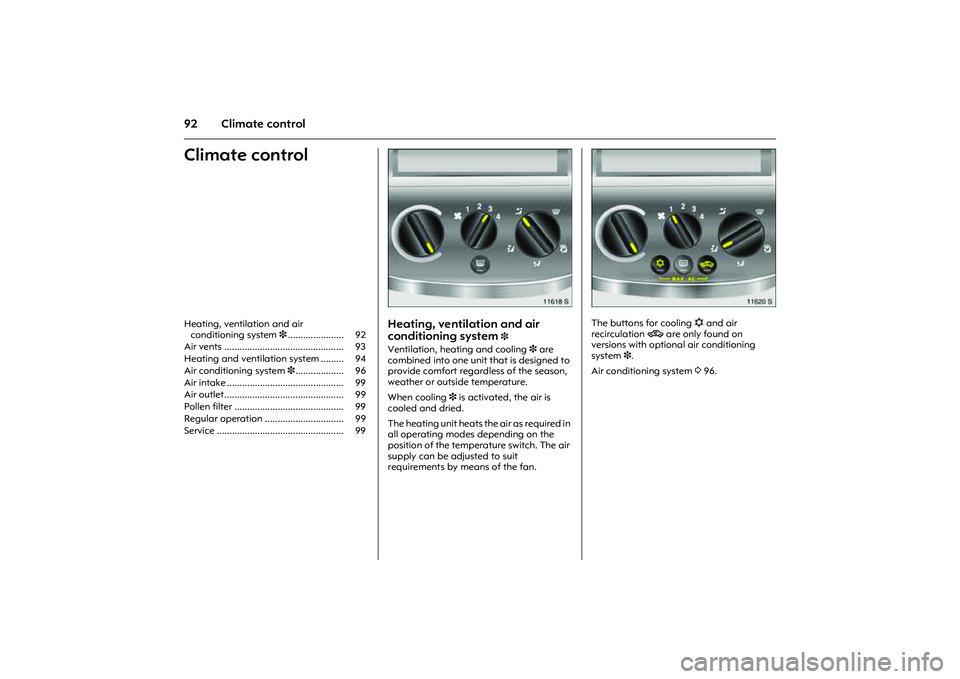
Heating, ventilation and air
conditioning system
3
Ventilation, heating and cooling 3 are
combined into one unit that is designed to
provide comfort regardless of the season,
weather or outside temperature.
When cooling 3 is activated, the air is
cooled and dried.
The heating unit heats the air as required in
all operating modes depending on the
position of the temperature switch. The air
supply can be adjusted to suit
requirements by means of the fan.
Picture no: 11620s.tif
The buttons for cooling n and air
recirculation 4 are only found on
versions with optional air conditioning
system 3.
Air conditioning system 396. Heating, ventilation and air
conditioning system 3...................... 92
Air vents ............................................... 93
Heating and ventilation system ......... 94
Air conditioning system 3................... 96
Air intake .............................................. 99
Air outlet............................................... 99
Pollen filter ........................................... 99
Regular operation ............................... 99
Service .................................................. 99
Page 105 of 212
99
Climate control
zCooling n on, the air conditioning
compressor automatically switches off in
low outdoor temperatures (ice
formation),
zTurn the temperature switch clockwise.
zSet fan to 3 or 4.
zAir distribution switch to V, air
recirculation system 4 switches off
automatically.
– or –
If there is still moisture in the system after
previous air conditioning operation, the
windows may mist up. To prevent this,
set air distribution to K before starting
engine and set to V approx. 5 seconds
after starting.
zActivate heated rear window Ü.
zOpen side air vents as required and
direct them towards side windows.
Picture no: 11615s.tif
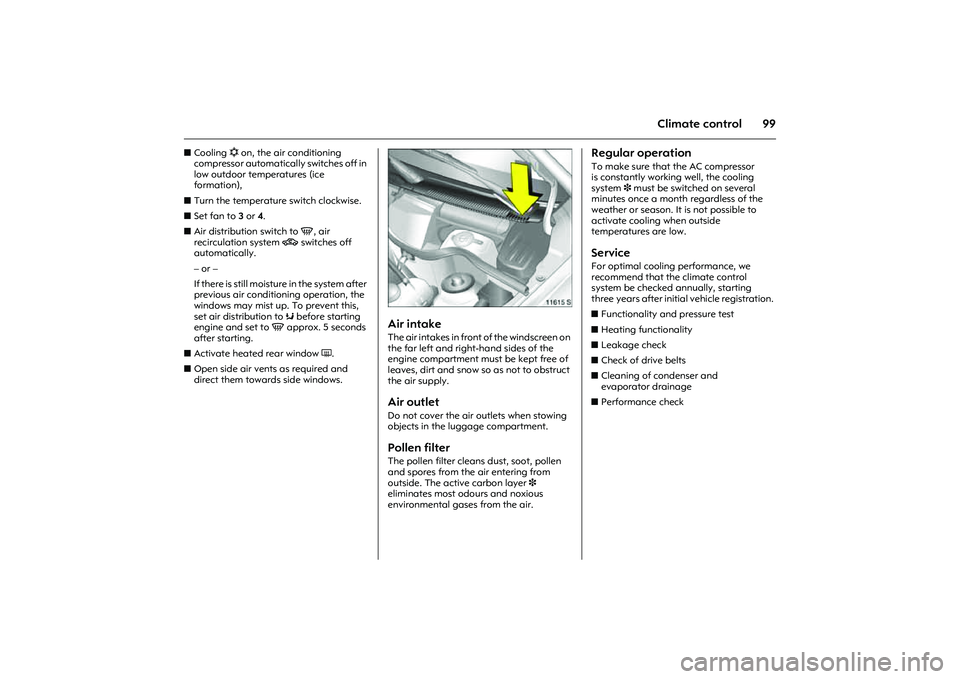
Air intake The air intakes in front of the windscreen on
the far left and right-hand sides of the
engine compartment must be kept free of
leaves, dirt and snow so as not to obstruct
the air supply. Air outletDo not cover the air outlets when stowing
objects in the luggage compartment. Pollen filter The pollen filter cleans dust, soot, pollen
and spores from the air entering from
outside. The active carbon layer 3
eliminates most odours and noxious
environmental gases from the air.
Regular operationTo make sure that the AC compressor
is constantly working well, the cooling
system3 must be switched on several
minutes once a month regardless of the
weather or season. It is not possible to
activate cooling when outside
temperatures are low. Service For optimal cooling performance, we
recommend that the climate control
system be checked annually, starting
three years after initial vehicle registration.
zFunctionality and pressure test
zHeating functionality
zLeakage check
zCheck of drive belts
zCleaning of condenser and
evaporator drainage
zPerformance check
Page 124 of 212
118 Driving and operationMaintenance
Have all maintenance work carried out at
the specified intervals. We recommend
that you entrust this work to your Opel
Partner, who has proper equipment and
trained personnel available. Electronic
testing systems permit rapid diagnosis and
remedy of faults. This way you can be
certain that all components of the vehicle’s
electrical, injection and ignition systems
operate correctly, that your vehicle has a
low level of pollutant emission and that the
catalytic converter system will have a long
service life.
You are thereby making an important
contribution towards keeping the air clean
and compliance with emissions legislation.
Checking and adjustment of the fuel-
injection and ignition systems is part of the
scope of inspection. For this reason you
should have all maintenance work carried
out at the intervals specified in your Service
and Warranty Booklet.
Picture no: 11629s.tif
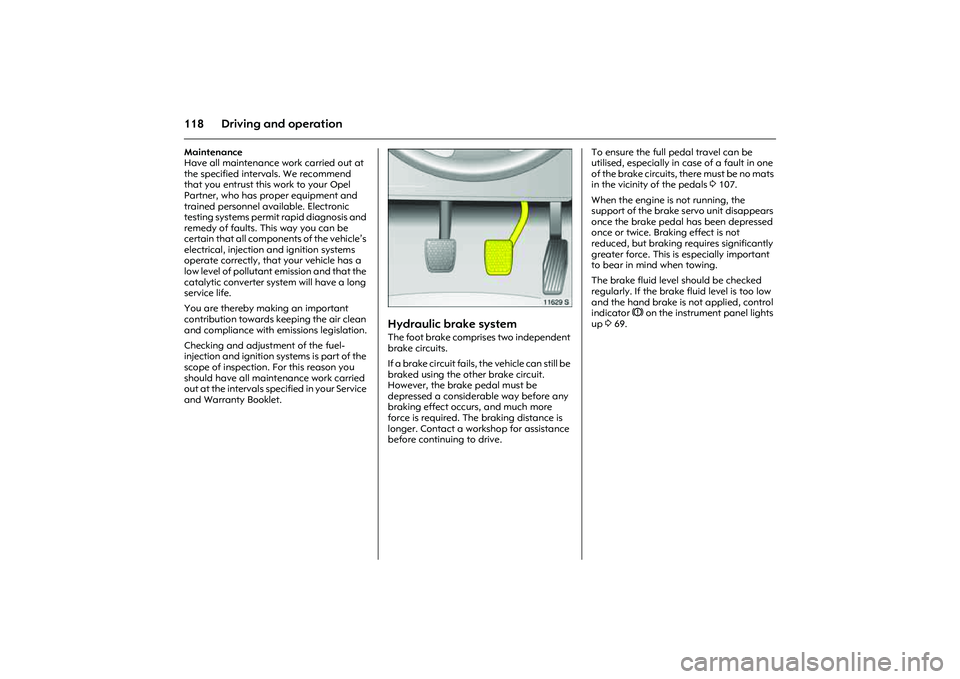
Hydraulic brake system The foot brake comprises two independent
brake circuits.
If a brake circuit fails, the vehicle can still be
braked using the other brake circuit.
However, the brake pedal must be
depressed a considerable way before any
braking effect occurs, and much more
force is required. The braking distance is
longer. Contact a workshop for assistance
before continuing to drive. To ensure the full pedal travel can be
utilised, especially in case of a fault in one
of the brake circuits, there must be no mats
in the vicinity of the pedals 3107.
When the engine is not running, the
support of the brake servo unit disappears
once the brake pedal has been depressed
once or twice. Braking effect is not
reduced, but braking requires significantly
greater force. This is especially important
to bear in mind when towing.
The brake fluid level should be checked
regularly. If the brake fluid level is too low
and the hand brake is not applied, control
indicator R on the instrument panel lights
up 369.
Page 170 of 212
164 Opel Service, maintenanceOpel Service,
maintenance
Scheduled maintenanceThe service intervals apply to normal
operating conditions. For extreme
operating conditions, 3171.
Service interval display 3173.
European service intervals
Every 30,000 km or annually, whichever
occurs first.
International service intervals
Every 15,000 km or annually, whichever
occurs first.
Confirmations
Service is confirmed in the boxes provided
for such purposes in the Service and
Warranty Booklet. The workshop confirms
the date and mileage of service through a
stamp and signature.
Make sure that the Service and Warranty
Booklet has been correctly filled in as proof
of uninterrupted service is essential to the
granting of warranty or goodwill claims
and is a benefit when selling the vehicle.
Service planThe European service plan applies to the
following countries: Andorra, Austria,
Belgium, Cyprus, Czech Republic,
Denmark, Estonia, Finland, France,
Germany, Greece, Greenland, Hungary,
Iceland, Ireland, Italy, Latvia, Lithuania,
Luxembourg, Malta, the Netherlands,
Norway, Poland, Portugal, Slovakia,
Slovenia, Spain, Sweden, Switzerland,
Great Britain.
The International service plan applies to all
other countries. Scheduled maintenance ..................... 164
Service plan .......................................... 164
Additional service work ....................... 171
Recommended fluids and lubricants . 171
Inspection system ................................ 173
Genuine Opel Parts and Accessories . 174
Performing work .................................. 174
Engine oil .............................................. 175
Diesel fuel filter .................................... 177
Coolant ................................................. 177
Brakes ................................................... 178
Brake fluid ............................................ 179
Windscreen wiper replacement .......... 179
Windscreen washer system ................. 180
Battery .................................................. 180
Protecting electronic components ..... 180
Laying the vehicle up for a long
period of time .................................... 181
Putting the vehicle back into service . 181