parking brake OPEL COMBO E 2019.75 Manual user
[x] Cancel search | Manufacturer: OPEL, Model Year: 2019.75, Model line: COMBO E, Model: OPEL COMBO E 2019.75Pages: 285, PDF Size: 10.68 MB
Page 216 of 285

214Vehicle careCaution
When transporting the vehicle on
a train or on a recovery vehicle, the
mud flaps might be damaged.
Cold protection covers
In order to prevent the accumulation
of snow at the radiator cooling fan, it is recommended to install removable
protection covers.
The protection covers must be
professionally installed, consult a
workshop.
Caution
The protection covers must be removed when one of the
following conditions occurs:
● The ambient temperature is above 10 °C.
● When the vehicle is towed.
● The vehicle is driven at speeds
above 120 km/h.
Vehicle storage
Storage for a long period of time If the vehicle is to be stored for several months:
● Wash and wax the vehicle.
● Have the wax in the engine compartment and underbody
checked.
● Clean and preserve the rubber seals.
● Fill up fuel tank completely.
● Change the engine oil.
● Drain the washer fluid reservoir.
● Check the coolant antifreeze and
corrosion protection.
● Adjust tyre pressure to the value specified for full load.
● Park the vehicle in a dry, well ventilated place. Engage first or
reverse gear or set selector lever
to P. Prevent the vehicle from
rolling.
● Do not apply the parking brake.● Open the bonnet, close all doors and lock the vehicle.
● Disconnect the clamp from the negative terminal of the vehicle
battery. Note that all systems are
not functional, e.g. anti-theft
alarm system.
Putting back into operation
When the vehicle is to be put back into
operation:
● Connect the clamp to the negative terminal of the vehicle
battery. Initialize the power
windows 3 42.
● Check tyre pressure.
● Fill up the washer fluid reservoir.
● Check the engine oil level.
● Check the coolant level.
● Fit the number plate if necessary.
Page 237 of 285
Vehicle care235After adjusting tyre pressure initialise
system to extinguish the control
indicator and restart system.Caution
Deflation detection system warns
just about low tyre pressure
condition and does not replace
regular tyre maintenance by the
driver.
In case of a system malfunction a
message is displayed in the Driver
Information Centre. Set correct tyre
pressure and reinitialise system. If the
failure continues to be displayed,
contact a workshop. The system is
inoperable when ABS or ESC has a
malfunction or a temporary spare
wheel is used. Once the road tyre has
been refitted, check the tyre pressure with cold tyres and initialise the
system.
System initialisation
After tyre pressure correction or
wheel change, the system must be
initialised to learn new circumference reference values:
1. Always ensure that all four tyres have correct tyre pressure
3 266.
2. Apply parking brake.
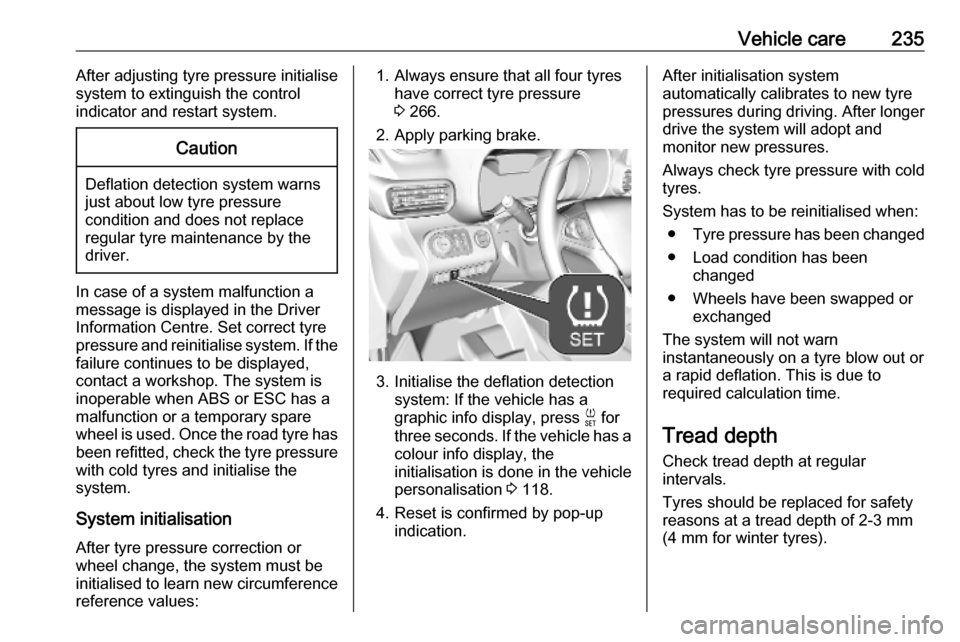
3. Initialise the deflation detection system: If the vehicle has a
graphic info display, press F for
three seconds. If the vehicle has a
colour info display, the
initialisation is done in the vehicle
personalisation 3 118.
4. Reset is confirmed by pop-up indication.
After initialisation system
automatically calibrates to new tyre
pressures during driving. After longer
drive the system will adopt and
monitor new pressures.
Always check tyre pressure with cold
tyres.
System has to be reinitialised when: ● Tyre pressure has been changed
● Load condition has been changed
● Wheels have been swapped or exchanged
The system will not warn
instantaneously on a tyre blow out or a rapid deflation. This is due to
required calculation time.
Tread depthCheck tread depth at regular
intervals.
Tyres should be replaced for safety
reasons at a tread depth of 2-3 mm
(4 mm for winter tyres).
Page 239 of 285
Vehicle care237Tyre chains
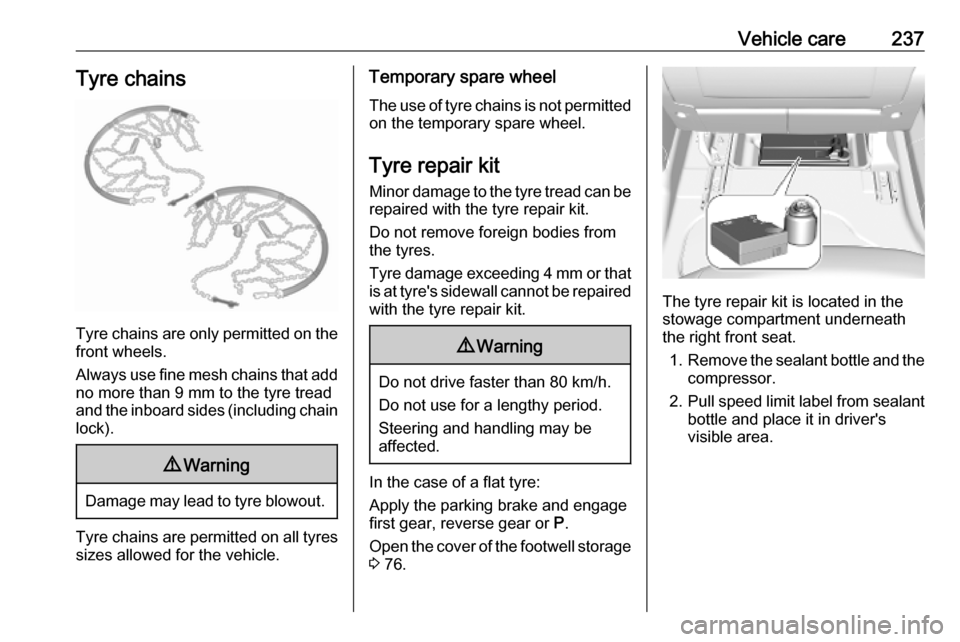
Tyre chains are only permitted on the
front wheels.
Always use fine mesh chains that add no more than 9 mm to the tyre tread
and the inboard sides (including chain
lock).
9 Warning
Damage may lead to tyre blowout.
Tyre chains are permitted on all tyres
sizes allowed for the vehicle.
Temporary spare wheel
The use of tyre chains is not permitted on the temporary spare wheel.
Tyre repair kit
Minor damage to the tyre tread can be
repaired with the tyre repair kit.
Do not remove foreign bodies from
the tyres.
Tyre damage exceeding 4 mm or that
is at tyre's sidewall cannot be repaired with the tyre repair kit.9 Warning
Do not drive faster than 80 km/h.
Do not use for a lengthy period.
Steering and handling may be
affected.
In the case of a flat tyre:
Apply the parking brake and engage
first gear, reverse gear or P.
Open the cover of the footwell storage
3 76.
The tyre repair kit is located in the
stowage compartment underneath
the right front seat.
1. Remove the sealant bottle and the
compressor.
2. Pull speed limit label from sealant
bottle and place it in driver's
visible area.
Page 242 of 285

240Vehicle careRepeat the checking procedure
once more after driving further
10 km but no more than ten
minutes to check that there is no
more loss of pressure.
If the tyre pressure has fallen
below 150 kPa (1.5 bar), the
vehicle must not be used. Seek
the assistance of a workshop.
17. Stow away tyre repair kit in load compartment.
Note
The driving characteristics of the
repaired tyre are severely affected, therefore have this tyre replaced.
If unusual noise is heard or the
compressor becomes hot, turn
compressor off for at least 30 min.
The built-in safety valve opens at a
pressure of 700 kPa (7 bar).
Note the expiry date of the kit. After
this date its sealing capability is no
longer guaranteed. Pay attention to
storage information on sealant
bottle.Replace the used sealant bottle. Dispose of the bottle as prescribed
by applicable laws.
The compressor and sealant can be used from approx. -30 °C.
Wheel changing
Make the following preparations and
observe the following information:
● Park the vehicle on a level, firm and non-skid surface. The front
wheels must be in the straight-
ahead position.
● If necessary, place a chock under
the wheel diagonally opposite the
wheel to be changed.
● Apply the parking brake and engage first gear, reverse gear orP .
● If the ground on which the vehicle
is standing is soft, a solid board
(max. 1 cm thick) should be
placed under the jack.
● Take heavy objects out of the vehicle before jacking up.
● No people or animals may be in the vehicle when it is jacked-up.● Never crawl under a jacked-upvehicle.
● Do not start the vehicle when it is
raised on the jack.
● Before screwing in the wheel bolts, clean them.9Warning
Do not grease wheel bolts.
Tightening torques
Caution
If the vehicle is equipped with alloy
wheels, tighten the wheel bolts
manually at least for the first five
turns.
There are two different types of
wheels with two different bolts and tightening torques.
Page 245 of 285

Vehicle care243●If necessary, place a chock under
the wheel diagonally opposite the wheel to be changed.
● Apply the parking brake and engage first gear, reverse gear or
P .
● Remove the spare wheel 3 241.
● Never change more than one wheel at once.
● Use the jack only to change wheels in case of puncture, not
for seasonal winter or summer
tyre change.
● The jack is maintenance-free.
● If the ground on which the vehicle
is standing is soft, a solid board
(max. 1 cm thick) should be
placed under the jack.
● Take heavy objects out of the vehicle before jacking up.
● No people or animals may be in the vehicle when it is jacked-up.
● Never crawl under a jacked-up vehicle.
● Do not start the vehicle when it is
raised on the jack.● Before screwing in the wheel bolts, clean them.9Warning
Do not grease wheel bolts.
9Warning
Ensure to use always the correct
wheel bolts if changing the
wheels. When installing the spare
wheel, the bolts for alloy wheels can also be used.
● Note that the spare wheel is secured by the conical contact ofeach bolt if the wheel bolts for the
alloy wheels are used. In this
case, the washers do not come
into contact with the spare wheel.
1. Disengage wheel bolt caps with the wheel bolt cover remover.
3 232
Steel wheels with cover: Pull off
the wheel cover.
Alloy wheels: Disengage wheel
bolt caps with the wheel bolt cover remover.
2. Fold out the wheel wrench and install ensuring that it locates
Page 248 of 285

246Vehicle care● The vehicles must not come intocontact with each other during
the jump starting process.
● Apply the parking brake, transmission in neutral,
automatic transmission in P.
Open the positive terminal protection
caps of both vehicle batteries.
Lead connection order: 1. Connect the red lead to the positive terminal of the booster
battery.
2. Connect the other end of the red lead to the positive terminal of the
discharged battery.
3. Connect the black lead to the negative terminal of the boosterbattery.
4. Connect the other end of the black
lead to a vehicle grounding point
of your vehicle in the engine
compartment.
Route the leads so that they cannot
catch on rotating parts in the engine
compartment.
To start the engine: 1. Start the engine of the vehicle providing the jump.
2. After five minutes, start the other engine. Start attempts should be
made for no longer than 15 s at an interval of 1 min.
3. Allow both engines to idle for approx. three minutes with the
leads connected.
4. Switch on electrical consumers e.g. headlights, heated rear
window of the vehicle receiving
the jump start.
5. Reverse above sequence exactly when removing leads.Towing
Towing the vehicle
Wrap a cloth around the tip of a flat
screwdriver, for example, to prevent
paint damage. Insert the screwdriverin the slot at the lower part of the cap.
Release the cap carefully.
The towing eye is stowed with the vehicle tools 3 232.
Page 249 of 285

Vehicle care247
Screw in the towing eye as far as it will
go until it stops in a horizontal
position.
Attach a tow rope – or better still a tow
rod – to the towing eye.
The towing eye must only be used for towing and not for recovering the
vehicle.
Switch on ignition to release steering
wheel lock and to permit operation of
brake lights, horn and windscreen
wiper.
Caution
Deactivate the driver assistance
systems like active emergency
braking 3 183, otherwise the
vehicle may automatically brake during towing.
Switch the selector lever to neutral.
Release the parking brake.
Caution
Never tow a vehicle equipped with All Wheel Drive (AWD) with the
front or rear tyres on the road. If
you tow a vehicle equipped with
AWD while the front or rear tyres
are rolling on the road, the drive
system in the vehicle could be
severely damaged. When towing
vehicles equipped with AWD, all
four tyres must not be in contact
with the road.
Caution
Drive slowly. Do not drive jerkily.
Excessive tractive force can
damage the vehicle.
When the engine is not running,
considerably more force is needed to
brake and steer.
To prevent the entry of exhaust gases from the towing vehicle, switch on the
air recirculation and close the
windows.
Vehicles with automatic transmission: The vehicle must be towed facing
forwards, not faster than 80 km/h nor further than 100 km. In all other cases
and when the transmission is
defective, the front axle must be
raised off the ground.
Seek the assistance of a workshop.
After towing, unscrew the towing eye.
Insert cap with the flange into the
recess and fix cap by pushing.
Page 280 of 285

278IndexAAccessories and vehicle modifications .......................... 213
Active emergency braking ..110, 183
Adaptive cruise control .......110, 175
AdBlue ................................ 108, 155
Adjustable air vents ...................143
Advanced parking assist ............190
Airbag and belt tensioners .........104
Airbag deactivation ..............65, 104
Airbag label................................... 60 Airbag system .............................. 60
Air conditioning regular operation ................................ 144
Air conditioning system .............. 134
Air intake .................................... 144
Air vents...................................... 143
Antilock brake system ................ 162
Antilock brake system (ABS) .....106
Anti-theft alarm system ................36
Anti-theft locking system .............. 36 Appearance care ........................249
Armrest ......................................... 52
Ashtrays ....................................... 98
Automatic anti-dazzle ..................41
Automatic crash notification (ACN) ...................................... 122
Automatic light control ...............125
Automatic locking ........................29Automatic transmission .............158
Autostop ............................. 109, 150
B Battery discharge protection ......132
BlueInjection ............................... 155
Bonnet ....................................... 215
Brake and clutch system ...........105
Brake assist ............................... 165
Brake fluid .......................... 218, 257
Brakes ............................... 162, 218
Breakdown.................................. 246
Bulb replacement ....................... 221
C Capacities .................................. 266
Cargo management system ........81
Catalytic converter .....................154
Central locking system ................26
Centre console lighting ..............131
Centre console storage ...............76
Changing tyre and wheel size ...236
Charging system ........................ 104
Child locks ................................... 29
Child restraint installation locations ................................... 69
Child restraints.............................. 66
Child restraint systems ................66
Child surveillance mirror ...............41
Cigarette lighter ........................... 98
Climate control ............................. 17
Page 281 of 285

279Climate control systems.............133
Clock............................................. 96
Colour Info Display .....................118
Control indicators........................ 103
Control of the vehicle .................146
Controls ........................................ 92
Convex shape .............................. 39
Coolant and antifreeze ...............257
Cornering lights .......................... 127
Cruise control ....................109, 170
Cupholders .................................. 72
Curtain airbag system .................. 64
D Danger, Warnings and Cautions ...4
Daytime running lights ...............127
Declaration of conformity ............269
DEF ............................................ 155
Deflation detection system .........108
Descent control system .....107, 167
Diesel exhaust fluid ....................155
Diesel fuel system bleeding .......220
Door open .................................. 110
Doors ................................ 31, 32, 33
Driver alert .................................. 204
Driver assistance systems ..........170
Driver Information Centre ...........111
Driving characteristics and towing tips .............................. 209
Driving hints ................................ 146E
Eco mode ................................... 160
Electric adjustment ......................39
Electrical system......................... 229
Electric parking brake. 106, 162, 163
Electric parking brake fault .........106
Electronic climate control system 137
Electronic driving programmes ..160
Electronic key system ...................24
Electronic Stability Control and Traction Control system ..107, 166
Emergency call ........................... 122
End-of-life vehicle recovery .......215
Engine compartment fuse box ...230
Engine coolant ........................... 217
Engine coolant temperature ......107
Engine coolant temperature gauge ..................................... 101
Engine data ............................... 263
Engine exhaust .......................... 154
Engine identification ...................260
Engine oil ................... 216, 257, 261
Engine oil level monitor ..............102
Engine oil pressure ....................108
Entry lighting .............................. 131
Event data recorders ..................273
Exhaust filter ....................... 107, 154
Exit lighting ................................ 131
Exterior care .............................. 249
Exterior light ............................... 109Exterior lighting ....................14, 124
Exterior mirrors ............................. 39
F Fault ........................................... 160
First aid ......................................... 87
First aid kit ................................... 87
Fixed air vents ........................... 144
Floor mats................................... 251
Folding front passenger seat ........50
Folding mirrors ............................. 39
Folding seats .......................... 53, 54
Footwell storage ........................... 76
Forward collision alert................. 181
Front airbag system .....................63
Front fog lights ...........109, 128, 224
Front passenger seat Table position ............................ 50
Front pedestrian protection ........185
Front seats.................................... 48
Front storage ................................ 73
Front turn lights .......................... 225
Fuel............................................. 206
Fuel for diesel engines ..............206
Fuel for petrol engines ...............206
Fuel gauge ................................. 101
Fuses ......................................... 229
G Gauges ....................................... 100
Gear selection ........................... 158
Page 283 of 285

281Overload indicator................89, 106
Overrun cut-off ........................... 150
P Panoramic view system ..............196
Parking ................................ 21, 153
Parking assist ............................ 186
Parking brake ..................... 106, 163
Parking heater ............................ 141
Parking lights ............................. 129
Particulate filter ........................... 154
Passenger side camera ..............196
Performing work ........................215
Peripheral lighting .......................132
Power button .............................. 147
Power outlets ............................... 96
Power windows ............................ 42
Preheating ................................. 107
Puncture ..................................... 241
R Radio Frequency Identification (RFID) ..................................... 276
Radio remote control ...................23
Rain sensor ................................ 109
REACH ....................................... 272
Reading lights ............................ 130
Rear doors ................................... 32
Rear fog light .............109, 129, 225
Rear view camera ...................... 199
Rear view display .................41, 116Rear windows .............................. 44
Rear window wiper and washer ..95
Recommended fluids and lubricants ........................ 257, 261
Refuelling ................................... 207
Registered trademarks ...............272
Removing seats ............................ 54
Reversing lights .........................129
Ride control systems ..................166
Roadside assistance ..................122
Roller blinds ................................. 45
Roof .............................................. 46
Roof load ...................................... 88
Roof rack ..................................... 87
S
Safety net .................................... 82
Seat adjustment ....................... 7, 49 Seat belt ........................................ 8
Seat belt reminder .....................103
Seat belts ..................................... 57
Seat folding .................................. 50
Seat heating ................................. 52
Seat position ................................ 48
Second row seats ........................53
Selective catalytic reduction .......155
Selective ride control ..................168
Selector lever.............................. 158
Service ............................... 144, 254
Service display .......................... 102Service information ....................254
Service vehicle soon .................. 105
Side airbag system ......................63
Side blind spot alert ............110, 194
Sidelights .................................... 124
Side turn lights ........................... 228
Sliding door .................................. 31
Sliding side door ........................... 31
SOS ............................................ 122
Spare wheel ............................... 241
Speed limiter....................... 110, 173
Speedometer ............................. 100
Starting and operating ................146
Starting off ................................... 19
Starting the engine ....................148
Steering ...................................... 146
Steering wheel adjustment ......9, 92
Steering wheel controls ...............92
Stop engine ................................ 105
Stop-start system........................ 150
Storage ......................................... 72
Storage compartments .................72
Sunvisor lights ........................... 131
Sun visors .................................... 45
Symbols ......................................... 4
System check ............................. 105
T Tachometer ............................... 101
Tailgate ......................................... 33