lights OPEL CORSA 2009 Owner's Manual
[x] Cancel search | Manufacturer: OPEL, Model Year: 2009, Model line: CORSA, Model: OPEL CORSA 2009Pages: 284, PDF Size: 4.96 MB
Page 154 of 284
148 Driving and operation
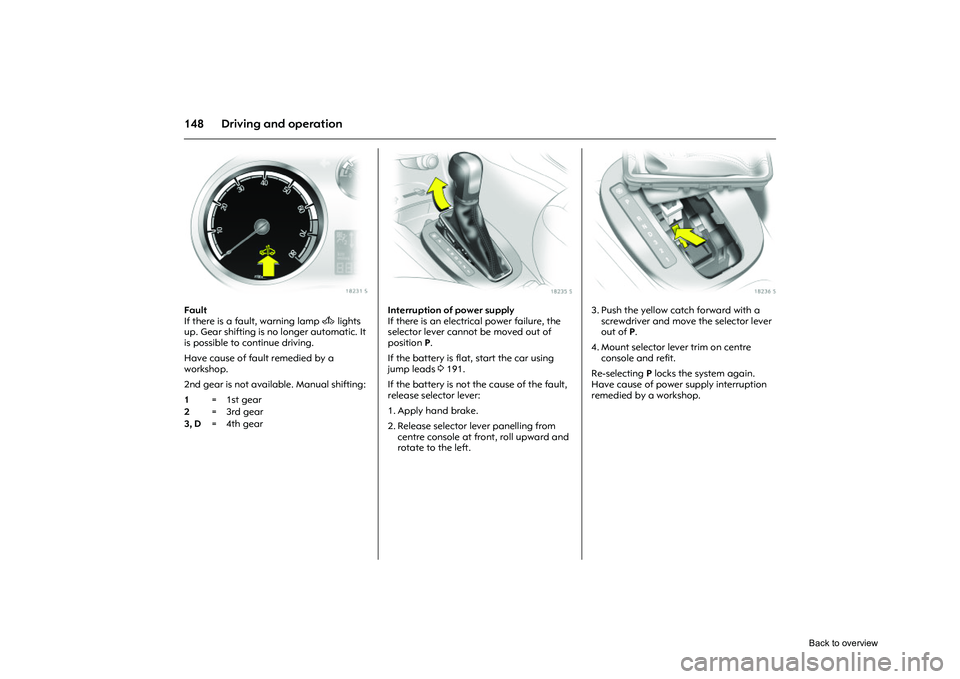
Picture no: 18231s.tif
Fault
If there is a fault, warning lamp A lights
up. Gear shifting is no longer automatic. It
is possible to continue driving.
Have cause of fault remedied by a
workshop.
2nd gear is not available. Manual shifting:
Picture no: 18235s.tif
Interruption of power supply
If there is an electrical power failure, the
selector lever cannot be moved out of
position P.
If the battery is flat, start the car using
jump leads 3191.
If the battery is not the cause of the fault,
release selector lever:
1. Apply hand brake.
2. Release selector lever panelling from centre console at front, roll upward and
rotate to the left.
Picture no: 18236s.tif
3. Push the yellow catch forward with a
screwdriver and move the selector lever
out of P.
4. Mount selector lever trim on centre console and refit.
Re-selecting P locks the system again.
Have cause of power supply interruption
remedied by a workshop.
1 =1st gear
2 =3rd gear
3, D =4th gear
Back to overview
Page 157 of 284
151
Driving and operation
Saving fuel, protecting
the environment Trend-setting technology
Environmentally friendly and mainly
recyclable materials were used when your
vehicle was being developed and
manufactured. The production methods
used to make your vehicle are also
environmentally-compatible.
Recycling of production wastes keeps the
circulation of material closed. Reduction of
energy and water requirements also helps
to conserve natural resources.
A highly advanced design means that your
vehicle can be easily disassembled at the
end of its working life, and the individual
materials separated for subsequent re-use.
Materials such as asbestos and cadmium
are not used. The refrigerant in the air
conditioning system 3 is CFC-free.
New painting techniques employ water as
a solvent. End-of-life vehicle recovery
Information on end-of-life vehicle recovery
centres and the recycling of end-of-life
vehicles is availabl
e at www.opel.com.
Energy and environment-conscious
driving
z High noise levels and exhaust emissions
are often a result of driving without due
attention to saving energy and
protecting the environment.
z You should therefore drive with energy in
mind: "more miles – less fuel".
Reduce the noise level and exhaust
emissions by adopting an environment-
conscious driving style. This is extremely
worthwhile and improves the quality of
life.
Fuel consumption depends to a great
extent on your own personal driving
style. The following hints are intended to
help you consume fuel at a rate that is as
close as possible to the specified levels
3256.
Check your vehicle’s fuel consumption
every time you refuel. This facilitates
early detection of any irregularities
causing increased fuel consumption. Warming up
z
Full throttle and warming up at idle
speed increase wear, fuel consumption,
exhaust emission, the amount of
pollutant in the exhaust and the amount
of noise.
z Drive off as soon as possible after
starting.
Uniform speed
z Hectic driving significantly increases fuel
consumption, the exhaust emissions, the
proportion of pollutant in the exhaust
gas and the noise level.
z Do not accelerate and brake
unnecessarily. Drive at uniform speed,
watching the road.
Avoid frequent starting off and stopping
e.g. at traffic lights, in short distance
traffic and in queues of traffic by means
of clever planning. Select roads with
good traffic flow.
Idling
z The engine also consumes fuel when
idling.
z If you have to wait for more than one
minute, it is worthwhile switching off the
engine. Five minutes of idling
corresponds to approximately one
kilometre of driving.
Back to overview
Page 162 of 284

156 Driving and operation
Picture no: 18251s.tif
Control indicator
Z for exhaust
Illuminates when the ignition is switched on
and during the start attempt. Goes off
shortly after the engine starts running.
Illumination whilst the engine is running
indicates a fault in the emission control
system. The permissible emission limits
may be exceeded. Contact a workshop for
assistance immediately.
Illumination with the engine running
indicates a fault that can cause damage to
the catalytic converter. It is possible to
continue driving without causing damage
by slowing down until the flashing stops
and the control indicator illuminates.
Contact a workshop for assistance
immediately.
Picture no: 18231s.tif
Control indicator
A
for engine electronics
Illuminates for a few seconds after the
ignition is switched on.
If it illuminates when the engine is running,
there is a fault in engine or transmission
electronics. The electr onic system switches
to an emergency runni ng programme. Fuel
consumption may be increased and the
driveability of the vehicle may be impaired.
In some cases the fault can be remedied by
switching the engine off and starting it
again. If the control indicator continues to
illuminate whilst the en gine is running,
contact a workshop for assistance in
remedying the cause of the fault. If it illuminates briefly, but does not recur, it
is of no significance.
If
A lights up, this could mean that there
is water in the diesel fuel filter 3. A
message appears at the same time on the
service display 391. Have the fuel filter
checked for possible water contamination
by a workshop.
If it flashes after the ignition is switched on,
there is a fault in the immobiliser system.
The engine cannot be started 327.
Back to overview
Page 165 of 284
159
Driving and operation
Drive Control Systems Electronic Stability Program
(ESP
®Plus
) 3
ESP®
Plus
improves driving stability when
necessary in any driving situation
regardless of the type of road surface or
tyre grip. It also prevents the drive wheels
from spinning.
As soon as the vehicle starts to swerve
(understeer/oversteer), engine output is
reduced and the wheels are braked
individually. This considerably improves
the driving stability of the vehicle on
slippery road surfaces.
ESP®
Plus
is ready for operation as soon as
the ignition is switched on and control
indicator v goes out.
When the ESP®
Plus
comes into action,
v flashes. The vehicle is now in
a critical situation;
ESP®
Plus
allows you to keep control of the
vehicle and reminds you to match your
speed to the road conditions.
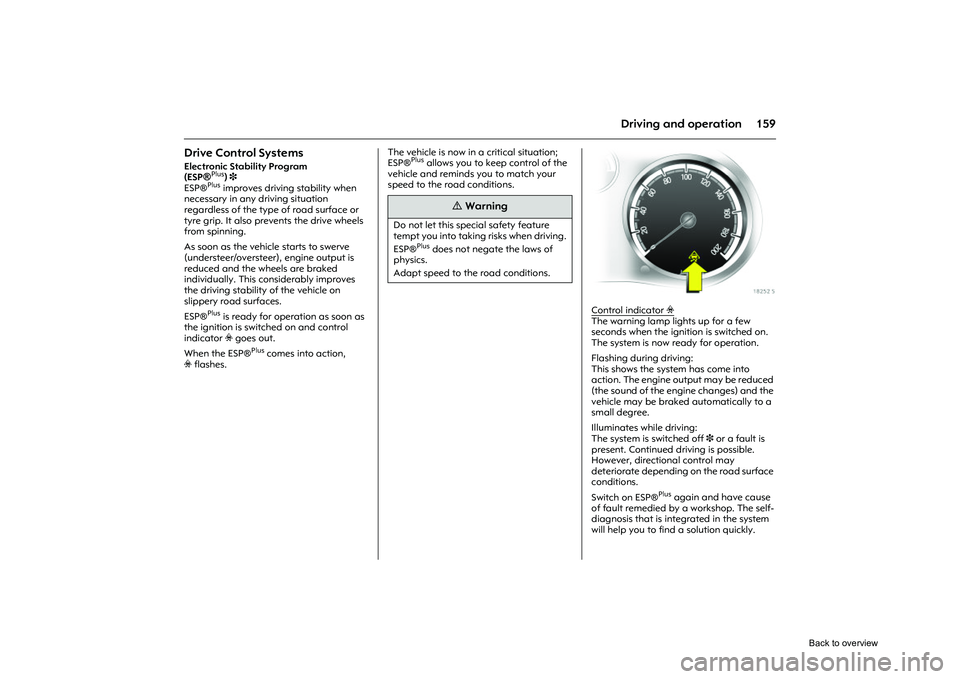
Picture no: 18252s.tif
Control indicator
v
The warning lamp lights up for a few
seconds when the ignition is switched on.
The system is now ready for operation.
Flashing during driving:
This shows the system has come into
action. The engine output may be reduced
(the sound of the engine changes) and the
vehicle may be braked automatically to a
small degree.
Illuminates while driving:
The system is switched off 3 or a fault is
present. Continued driving is possible.
However, directional control may
deteriorate depending on the road surface
conditions.
Switch on ESP®
Plus
again and have cause
of fault remedied by a workshop. The self-
diagnosis that is integrated in the system
will help you to find a solution quickly.
9
Warning
Do not let this special safety feature
tempt you into taking risks when driving.
ESP®
Plus
does not negate the laws of
physics.
Adapt speed to the road conditions.
Back to overview
Page 170 of 284
164 Driving and operation
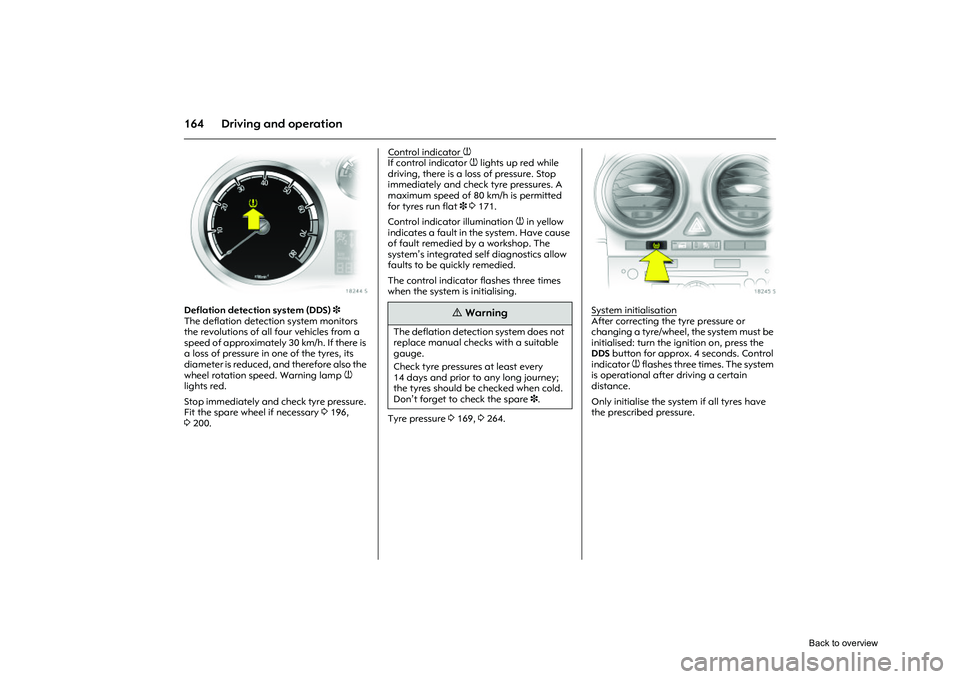
Picture no: 18244s.tif
Deflation detection system (DDS)3
The deflation detection system monitors
the revolutions of all four vehicles from a
speed of approximately 30 km/h. If there is
a loss of pressure in one of the tyres, its
diameter is reduced, and therefore also the
wheel rotation speed. Warning lamp w
lights red.
Stop immediately and check tyre pressure.
Fit the spare wheel if necessary 3 196,
3 200. Control indicator
w
If control indicator w lights up red while
driving, there is a loss of pressure. Stop
immediately and check tyre pressures. A
maximum speed of 80 km/h is permitted
for tyres run flat 3 3 171.
Control indicator illumination w in yellow
indicates a fault in the system. Have cause
of fault remedied by a workshop. The
system’s integrated se lf diagnostics allow
faults to be quickly remedied.
The control indicator flashes three times
when the system is initialising.
Tyre pressure 3169, 3264.
Picture no: 18245s.tif
System initialisationAfter correcting the tyre pressure or
changing a tyre/wheel, the system must be
initialised: turn the ignition on, press the
DDS button for approx. 4 seconds. Control
indicator w flashes three times. The system
is operational after driving a certain
distance.
Only initialise the system if all tyres have
the prescribed pressure.
9
Warning
The deflation detection system does not
replace manual checks with a suitable
gauge.
Check tyre pressures at least every
14 days and prior to any long journey;
the tyres should be checked when cold.
Don’t forget to check the spare 3.
Back to overview
Page 171 of 284
165
Driving and operation
Picture no: 17206t.tif
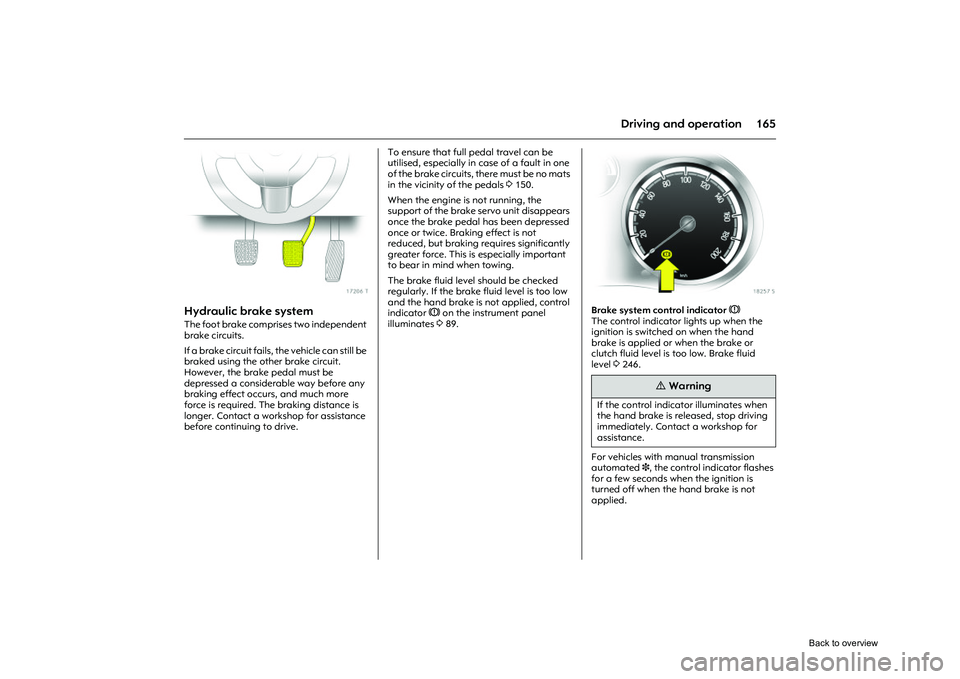
Hydraulic brake system The foot brake comprises two independent
brake circuits.
If a brake circuit fails, the vehicle can still be
braked using the other brake circuit.
However, the brake pedal must be
depressed a considerable way before any
braking effect occurs, and much more
force is required. The braking distance is
longer. Contact a workshop for assistance
before continuing to drive. To ensure that full
pedal travel can be
utilised, especially in case of a fault in one
of the brake circuits, there must be no mats
in the vicinity of the pedals 3150.
When the engine is not running, the
support of the brake servo unit disappears
once the brake pedal has been depressed
once or twice. Braking effect is not
reduced, but braking requires significantly
greater force. This is especially important
to bear in mind when towing.
The brake fluid level should be checked
regularly. If the brake fluid level is too low
and the hand brake is not applied, control
indicator R on the instrument panel
illuminates 389.
Picture no: 18257s.tif
Brake system control indicator R
The control indicator lights up when the
ignition is switched on when the hand
brake is applied or when the brake or
clutch fluid level is too low. Brake fluid
level 3246.
For vehicles with manual transmission
automated 3, the control indicator flashes
for a few seconds when the ignition is
turned off when the hand brake is not
applied.
9
Warning
If the control indicator illuminates when
the hand brake is released, stop driving
immediately. Contact a workshop for
assistance.
Back to overview
Page 189 of 284
183
Driving and operation
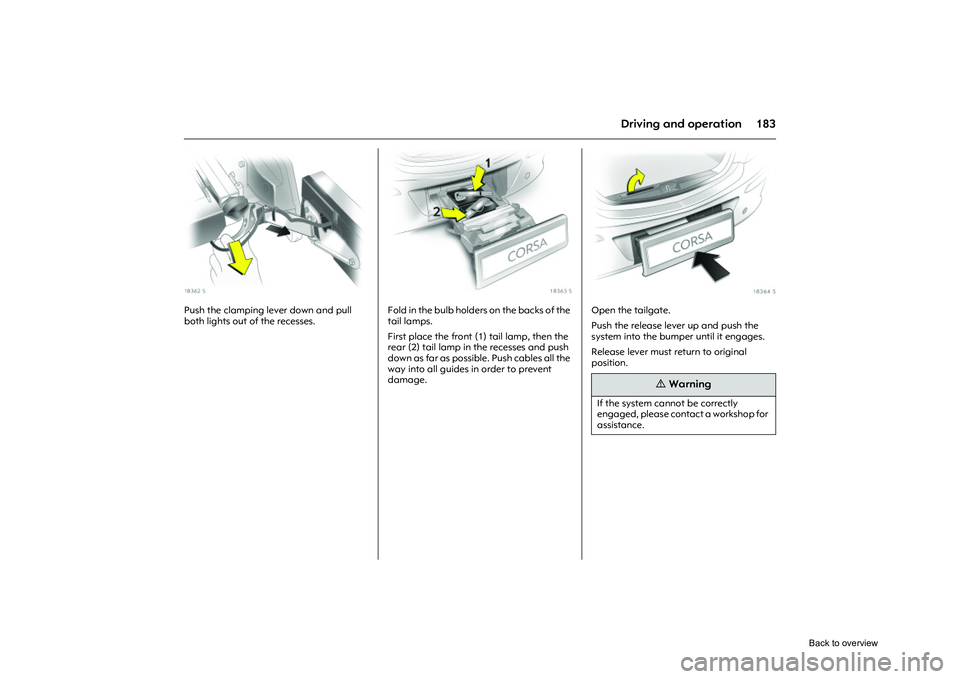
Picture no: 18362s.tif
Push the clamping lever down and pull
both lights out of the recesses.
Picture no: 18363s.tif
Fold in the bulb holders on the backs of the
tail lamps.
First place the front (1) tail lamp, then the
rear (2) tail lamp in the recesses and push
down as far as possible. Push cables all the
way into all guides in order to prevent
damage.
Picture no: 18364s.tif
Open the tailgate.
Push the release lever up and push the
system into the bumper until it engages.
Release lever must return to original
position.
9
Warning
If the system cannot be correctly
engaged, please contact a workshop for
assistance.
Back to overview
Page 206 of 284
200 Self-help, vehicle careChanging wheels There may be a tyre repair kit instead of a
spare wheel 3204.
Make the following preparations and
observe the following information:
z Park the vehicle on a level, firm and non-
skid surface. The front wheels must be in
the straight-ahead position.
z Switch on hazard warning lights, apply
hand brake, automa tic transmission 3 -
selector lever in P , manual transmission
or manual automatic transmission 3 -
engage 1st or reverse gear.
z Erect warning triangle 3 as specified.
Warning triangle 3196.
z Remove spare wheel from luggage
compartment 3196. z
Never change more than one wheel at
once.
z Use the jack 3 only to change wheels.
z If the ground on which the vehicle is
standing is soft, a solid board (max. 1 cm
thick) should be placed under the jack 3.
z Block the wheel diagonally opposite the
wheel to be changed by placing wedge
blocks or equivalent in front and behind
the wheel. z
No people or animals may be in the
vehicle when it is jacked up.
z Never crawl under a jacked-up vehicle.
z Do not start the vehicle when it is raised
on the jack.
z Before screwing in the wheel bolts, clean
them and lightly coat the taper of each
wheel bolt with comm ercially available
grease.
Back to overview
Page 210 of 284
204 Self-help, vehicle careTyre repair kit
3
Minor damage to the tyre tread or side wall
can be repaired using the tyre repair kit
(does not apply to run-flat tyres).
Do not remove the foreign body from the
tyre.
T y r e d a m a g e e x c e e d i n g 4 m m o r t ha t i s o n
the rim cannot be repaired with the tyre
repair kit.
Important 3207.
In the event of a flat tyre:
z Switch on hazard warning lights, apply
handbrake, engage 1st or reverse gear,
in the case of automatic transmission 3
move selector lever to position P.
z Erect warning triangle 3 as specified.
Warning triangle 3196.
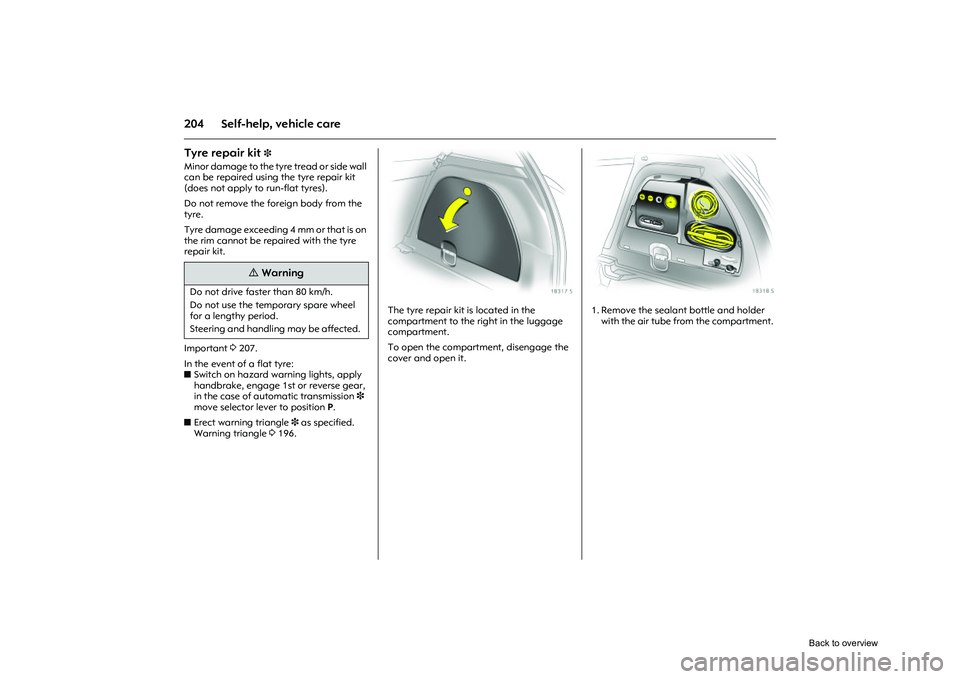
Picture no: 18317s.tif
The tyre repair kit is located in the
compartment to the right in the luggage
compartment.
To open the compartment, disengage the
cover and open it.
Picture no: 18318s.tif
1. Remove the sealant bottle and holder
with the air tube from the compartment.
9
Warning
Do not drive faster than 80 km/h.
Do not use the temporary spare wheel
for a lengthy period.
Steering and handling may be affected.
Back to overview
Page 235 of 284

229
Self-help, vehicle care
Polishing and waxing
Wax the vehicle regularly (by the time the
water no longer beads at the latest).
Otherwise, the paintwork will dry out.
Polishing is necessary only if the paint has
become dull or if solid deposits have
become attached to it.
Paintwork polish with silicone forms a
protective film, making waxing
unnecessary.
Plastic body parts should not be treated
with wax and polish.
Wheels and tyres
Do not use high-pressure jet cleaners.
Clean wheels with a pH-neutral wheel
cleaner.
Wheels are painted and can be treated
with the same agents as the body.
Paintwork damage
Rectify minor paintwork damage with a
touch-up pen before rust forms. Have more
extensive damage or rust areas repaired
by a workshop. Exterior lights
Headlamp and other lamp covers are
made of plastic. Do not use any caustic
agents, do not use an ice scraper, and do
not clean them when dry.
Plastic and rubber parts
Plastic and rubber parts can be cleaned
with the same cleaner as used to clean the
body. Use interior cleaner if necessary. Do
not use any other agent. Avoid solvents
and petrol in particular. Do not use high-
pressure jet cleaners.
Interior and upholstery
Only clean the vehicle interior, including
the instrument panel fa
scia and panelling,
with a dry cloth or interior cleaner.
The instrument pane l should only be
cleaned using a soft damp cloth.
Clean fabric upholstery with a vacuum
cleaner and brush. Remove stains with an
upholstery cleaner.
Clean seat belts with lukewarm water or
interior cleaner.
Caution
Close Velcro fasteners as open Velcro
fasteners on clothing could damage
seat upholstery.
Back to overview