warning OPEL CORSA 2009 Owners Manual
[x] Cancel search | Manufacturer: OPEL, Model Year: 2009, Model line: CORSA, Model: OPEL CORSA 2009Pages: 284, PDF Size: 4.96 MB
Page 5 of 284
IntroductionYour vehicle is an intelligent combination
of forward-looking technology, impressive
safety, environmental friendliness and
economy.
It now lies with you to drive your vehicle
safely and to see it performs perfectly. This
Owner’s Manual provides you with all the
necessary information to that end.
Make sure your passengers are aware of
the possible risk of accident and injury
which may result from improper use of the
vehicle.
You must always comply with the specific
laws of the country that you are in. These
laws may differ from the information in this
Owner’s Manual.
When this Manual refers to a workshop visit,
we recommend your Opel Service Partner.
All Opel Service Partners provide first-class
service at reasonable prices. Experienced
mechanics trained by Opel work according
to specific Opel instructions.
The Owner’s Manual, infotainment system
instructions and the vehicle Service and
Warranty Booklet should always be kept
ready to hand in the vehicle glove
compartment. Make use of the Owner’s Manual zThe "In Brief" section will give you an
initial overview. z
The table of contents at the beginning of
the owner’s manual and within the
individual chapters will show you where
everything is.
z Its index will help you find what you
want.
z Yellow arrows in the illustrations serve as
points of reference or indicate some
action to be performed.
z Black arrows in the illustrations indicate
a reaction or a second action to be
performed.
z This Owner’s Manual depicts left-hand
drive vehicles. Right-hand drive vehicles
are operated in the same way.
z The Owner’s Manual uses the internal
engine codes. The corresponding sales
designations are found in the chapter
"Technical data".
z Directional data, e.g. left or right, or
front or back, in the descriptions always
relate to the direction of travel.
Symbols6 Continue reading on next page. 3
signifies equipment not fitted to all
vehicles (model variants, engine options,
models specific to one country, optional
equipment, Genuine Opel Parts and
Accessories).
Page references are indicated with 3 .
3 means "see page".
9
Danger,
9 Warning, Caution
Safe driving! Adam Opel GmbH
9
Danger
Text marked 9Danger provides
information on risk of endangering life.
Failure to comply with the instructions
could endanger life.
9
Warning
Text marked 9 Warning provides
information on risk of accident or injury.
Failure to comply with the instructions
could lead to injury.
Caution
Text marked Caution provides
information on possible damage to the
vehicle Failure to comply with the
instructions could lead to vehicle
damage.
Back to overview
Page 12 of 284
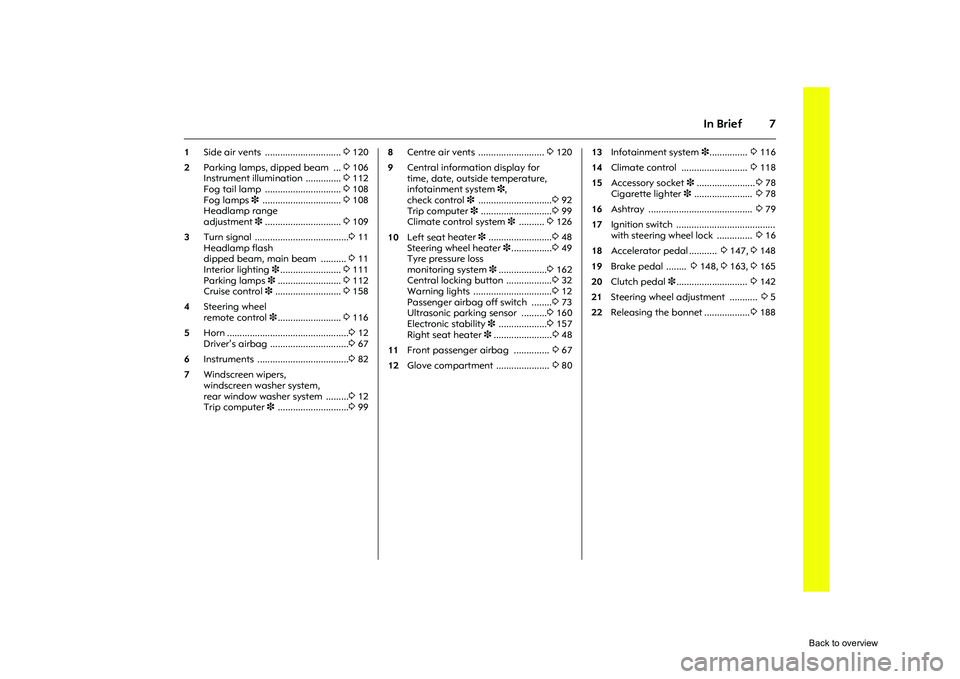
7
In Brief
1Side air vents .............................. 3120
2 Parking lamps, dipped beam ... 3106
Instrument illumination .............. 3112
Fog tail lamp .............................. 3108
Fog lamps 3 ............................... 3108
Headlamp range
adjustment 3 .............................. 3109
3 Turn signal ..................................... 311
Headlamp flash
dipped beam, main beam .......... 311
Interior lighting 3 ........................3111
Parking lamps 3 ......................... 3112
Cruise control 3 .......................... 3158
4 Steering wheel
remote control 3......................... 3116
5 Horn ................................................ 312
Driver’s airbag ............................... 367
6 Instruments .................................... 382
7 Windscreen wipers,
windscreen washer system,
rear window washer system ......... 312
Trip computer 3 ............................ 399 8
Centre air vents .......................... 3120
9 Central information display for
time, date, outside temperature,
infotainment system 3,
check control 3 ............................. 392
Trip computer 3 ............................ 399
Climate control system 3 .......... 3126
10 Left seat
heater 3 ......................... 348
Steering wheel heater 3................ 349
Tyre pressure loss
monitoring system 3................... 3162
Central locking button .................. 332
Warning lights ............................... 312
Passenger airbag off switch ........ 373
Ultrasonic parking sensor .......... 3160
Electronic stability 3 ................... 3157
Right seat heater 3....................... 348
11 Front passenger airbag .............. 367
12 Glove compartment ..................... 380 13
Infotainment system 3 ............... 3116
14 Climate control .......................... 3118
15 Accessory socket 3 ....................... 378
Cigarette lighter 3 ....................... 378
16 Ashtray ......................................... 379
17 Ignition switch .......................................
with steering wheel lock .............. 316
18 Accelerator pedal ........... 3147, 3148
19 Brake pedal ........ 3148, 3163, 3165
20 Clutch pedal 3............................ 3142
21 Steering wheel ad justment ........... 35
22 Rel
easing the bonnet .................. 3188
Back to overview
Page 15 of 284
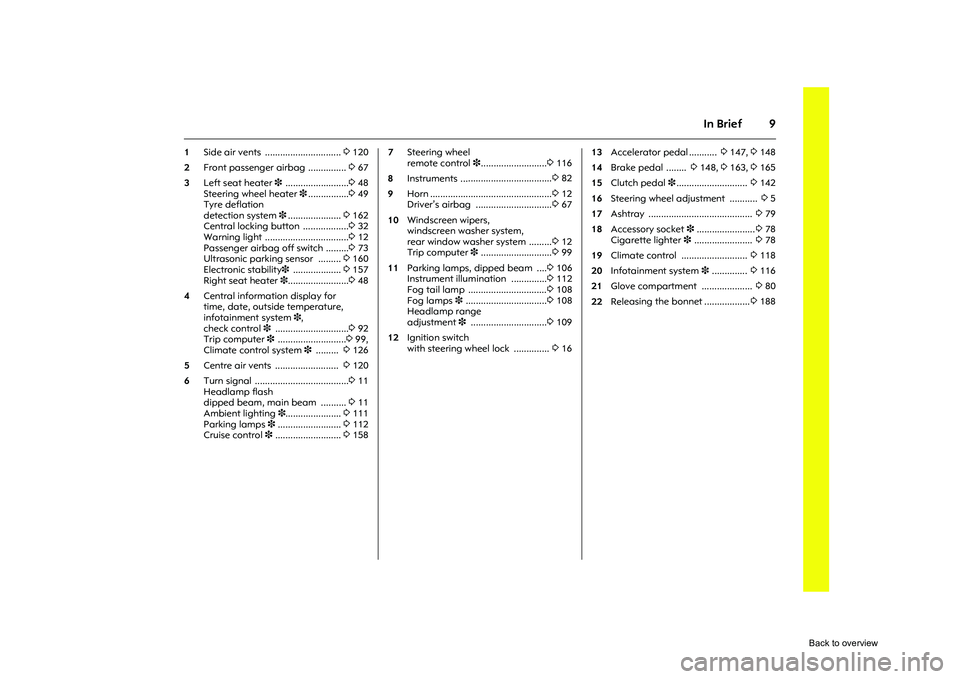
9
In Brief
1Side air vents .............................. 3120
2 Front passenger airbag ............... 367
3 Left seat heater 3 .........................348
Steering wheel heater 3................ 349
Tyre deflation
detection system 3..................... 3162
Central locking button .................. 332
Warning light ................................. 312
Passenger airbag off switch ......... 373
Ultrasonic parking sensor ......... 3160
Electronic stability 3 ................... 3157
Right seat heater 3........................ 348
4 Central information display for
time, date, outside temperature,
infotainment system 3,
check control 3 ............................. 392
Trip computer 3 ........................... 399,
Climate control system 3 ......... 3126
5 Centre air vents ......................... 3120
6 Turn signal ..................................... 311
Headlamp flash
dipped beam, main beam .......... 311
Ambient lighting 3...................... 3111
Parking lamps 3 ......................... 3112
Cruise control 3 .......................... 3158 7
Steering wheel
remote control 3.......................... 3116
8 Instruments ...
................................. 382
9 Horn ................................................ 312
Driver’s airbag .............................. 367
10 Windscreen wipers,
windscreen washer system,
rear window washer system ......... 312
Trip computer 3 ............................ 399
11 Parking lamps, dipped beam .... 3106
Instrument illum ination .............. 3112
Fog tail lamp ............................... 3108
Fog lamps 3 ................................ 3108
Headlamp range
adjustment 3 .............................. 3109
12 Ignition switch
with steering wheel lock .............. 316 13
Accelerator pedal ........... 3147, 3148
14 Brake pedal ........ 3148, 3163, 3165
15 Clutch pedal 3............................ 3142
16 Steering wheel ad justment ........... 35
17 Ashtray ......................................... 379
18 Accessory socket 3 ....................... 378
Cigarette lighter 3 ....................... 378
19 Climate control .......................... 3118
20 Infotainment system 3 .............. 3116
21 Glove compartment .................... 380
22 Rel
easing the bonnet .................. 3188
Back to overview
Page 17 of 284

11
In Brief
Picture no: 18164s.tif
Exterior lightsRotate
Press
Lighting 3108,
headlamp warning device 3105.
Picture no: 18165s.tif
Headlamp flash, main beam and
dipped beamMain beam, headlamp flash 3109.
Picture no: 18167s.tif
Switch turn signal onTurn signals 3109.
7
=Off
8 = Parking lamps
9 = Dipped or main beam
A Automatic dipped beam activation 3
> =Fog lamps 3
r = Fog tail lamp
Headlamp flash = Pull stalk towards
steering wheel
Main beam = Push stalk forwards
Dipped beam = Lever forward again or toward steering
wheel
Right = Lever upwards
Left = Lever downwards
Back to overview
Page 18 of 284
12 In Brief
Picture no: 18169s.tif
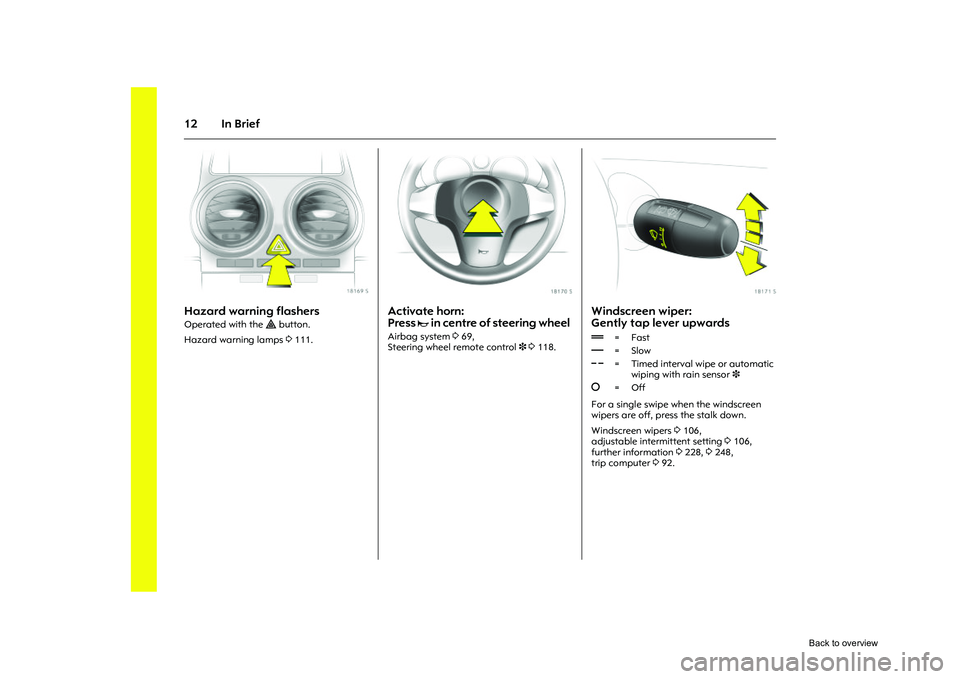
Hazard warning flashersOperated with the ¨ button.
Hazard warning lamps 3111.
Picture no: 18170s.tif
Activate horn:
Press
j in centre of steering wheel
Airbag system 3 69,
Steering wheel remote control 3 3 118.
Picture no: 18171s.tif
Windscreen wiper:
Gently tap lever upwards For a single swipe when the windscreen
wipers are off, press the stalk down.
Windscreen wipers 3106,
adjustable intermittent setting 3106,
further information 3228, 3248,
trip computer 392. & =Fast
% =Slow
$ = Timed interval wipe or automatic
wiping with rain sensor 3
§ =Off
Back to overview
Page 22 of 284
16 In Brief
Picture no: 16982t.tif
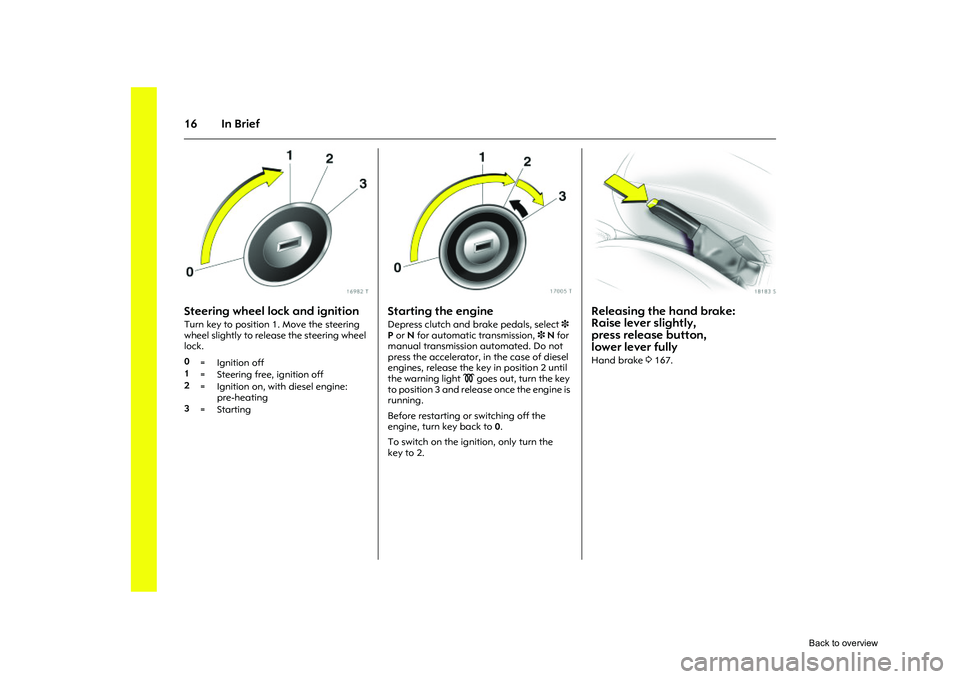
Steering wheel lock and ignitionTurn key to position 1. Move the steering
wheel slightly to release the steering wheel
lock.
Picture no: 17005t.tif
Starting the engineDepress clutch and brake pedals, select 3
P or N for automatic transmission, 3N for
manual transmission automated. Do not
press the accelerator, in the case of diesel
engines, release the key in position 2 until
the warning light ! goes out, turn the key
to position 3 and release once the engine is
running.
Before restarting or switching off the
engine, turn key back to 0.
To switch on the ignition, only turn the
key to 2.
Picture no: 18183s.tif
Releasing the hand brake:
Raise lever slightly,
press release button,
lower lever fully Hand brake 3167.
0
=Ignition off
1 = Steering free, ignition off
2 = Ignition on, with diesel engine:
pre-heating
3 =Starting
Back to overview
Page 28 of 284
22 In Brief
Picture no: 18189s.tif
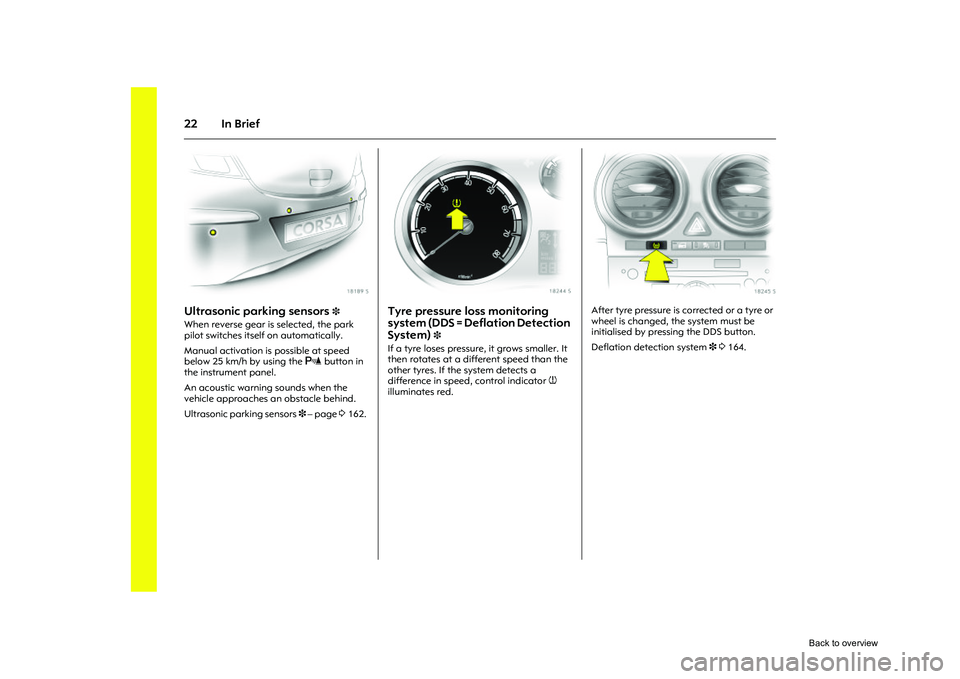
Ultrasonic parking sensors
3
When reverse gear is selected, the park
pilot switches itself on automatically.
Manual activation is possible at speed
below 25 km/h by using the r button in
the instrument panel.
An acoustic warning sounds when the
vehicle approaches an obstacle behind.
Ultrasonic parking sensors 3 – page 3 162.
Picture no: 18244s.tif
Tyre pressure loss monitoring
system (DDS = Deflation Detection
System)
3
If a tyre loses pressure, it grows smaller. It
then rotates at a different speed than the
other tyres. If the system detects a
difference in speed, control indicator w
illuminates red.
Picture no: 18245s.tif
After tyre pressure is corrected or a tyre or
wheel is changed, the system must be
initialised by pressing the DDS button.
Deflation detection system 3 3 164.
Back to overview
Page 34 of 284
28 Keys, doors, windows, sun roof
Picture no: 18407s.tif
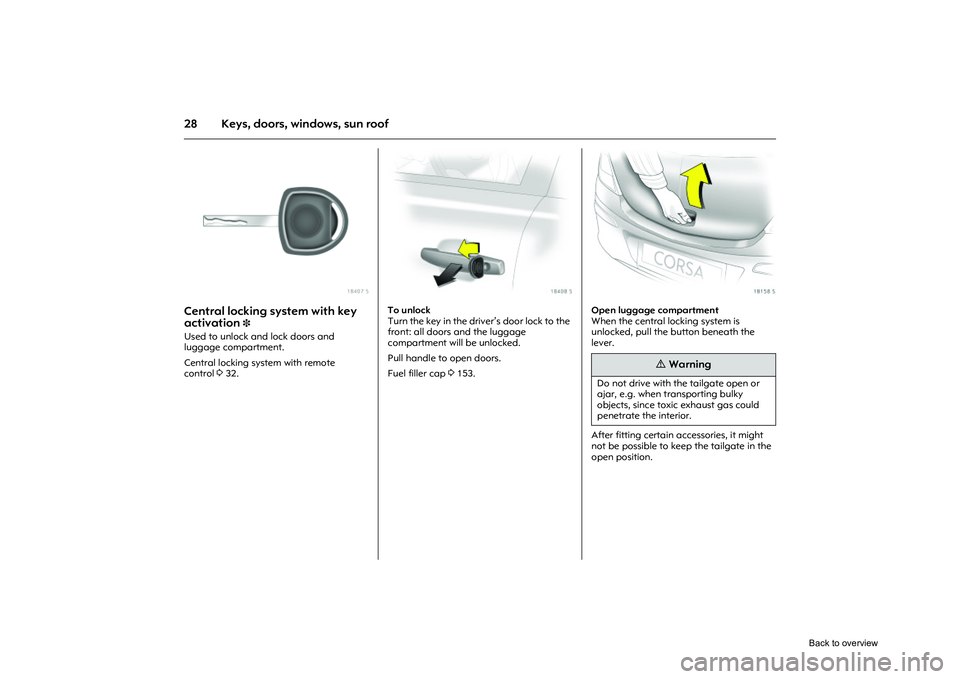
Central locking system with key
activation
3
Used to unlock and lock doors and
luggage compartment.
Central locking system with remote
control332.
Picture no: 18408s.tif
To unlock
Turn the key in the driver’s door lock to the
front: all doors and the luggage
compartment will be unlocked.
Pull handle to open doors.
Fuel filler cap 3153.
Picture no: 18158s.tif
Open luggage compartment
When the central locking system is
unlocked, pull the button beneath the
lever.
After fitting certain accessories, it might
not be possible to keep the tailgate in the
open position.
9
Warning
Do not drive with the tailgate open or
ajar, e.g. when transporting bulky
objects, since toxic exhaust gas could
penetrate the interior.
Back to overview
Page 36 of 284
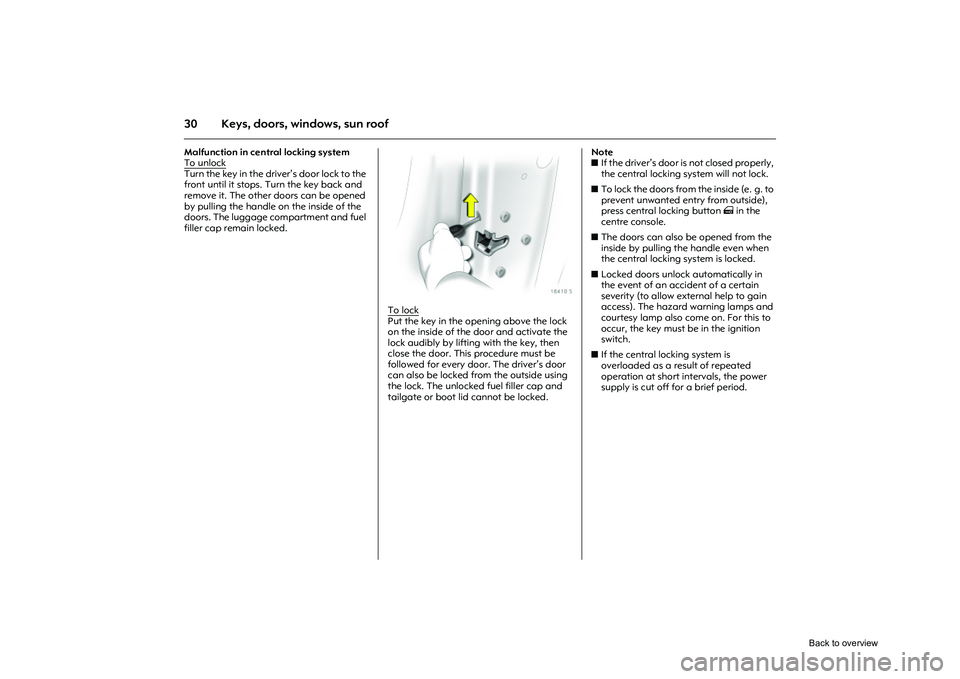
30 Keys, doors, windows, sun roofMalfunction in central locking system
To unlockTurn the key in the driver’s door lock to the
front until it stops. Turn the key back and
remove it. The other doors can be opened
by pulling the handle on the inside of the
doors. The luggage compartment and fuel
filler cap remain locked.
Picture no: 18410s.tif
To lockPut the key in the opening above the lock
on the inside of the door and activate the
lock audibly by lifting with the key, then
close the door. This procedure must be
followed for every door. The driver’s door
can also be locked from the outside using
the lock. The unlocked fuel filler cap and
tailgate or boot lid cannot be locked. Note
z
If the driver’s door is not closed properly,
the central locking system will not lock.
z To lock the doors from the inside (e. g. to
prevent unwanted entry from outside),
press central locking button m in the
centre console.
z The doors can also be opened from the
inside by pulling the handle even when
the central locking system is locked.
z Locked doors unlock automatically in
the event of an accident of a certain
severity (to allow external help to gain
access). The hazard warning lamps and
courtesy lamp also come on. For this to
occur, the key must be in the ignition
switch.
z If the central locking system is
overloaded as a result of repeated
operation at short intervals, the power
supply is cut off for a brief period.
Back to overview
Page 37 of 284

31
Keys, doors, windows, sun roof
Picture no: 17029t.tif
Remote control
3
Depending on the equipment of the
vehicle, one of the remote controls
depicted on this page will be used.
The remote control is integrated in the key.
Used to operate:
zcentral locking system,
z mechanical anti-the ft locking system 3,
z anti-theft alarm system 3.
On cars with electric windows, the windows
can be opened and closed from outside
using the remote control 3345.
Picture no: 17030t.tif
The remote control has a range of
approx. 5 metres. This range can be
affected by outside influences. Aim the
remote control at the vehicle to operate.
The hazard warning lamps flash to confirm
remote control operation.
Handle the remote control with care,
protect it from mo isture and high
temperatures and avoid unnecessary
operation. Fault
If the central locking system cannot be
operated with the remote control, it may be
due to the following:
z
Range exceeded.
z Remote control battery voltage too low.
Change battery.
z Frequent, repeated operation of the
remote control outside the reception
range of the vehicle (e.g. too far from
vehicle, remote control is then no longer
recognised). Remote control
synchronisation.
z If the central locking system is
overloaded as a result of repeated
operation at short intervals. The power
supply is cut off for a brief period.
z Interference from higher-power radio
waves from other sources.
Open driver’s door with key 335.
Back to overview