roof OPEL CORSA 2009 Owner's Manual
[x] Cancel search | Manufacturer: OPEL, Model Year: 2009, Model line: CORSA, Model: OPEL CORSA 2009Pages: 284, PDF Size: 4.96 MB
Page 50 of 284
44 Keys, doors, windows, sun roof
Picture no: 18283s.tif
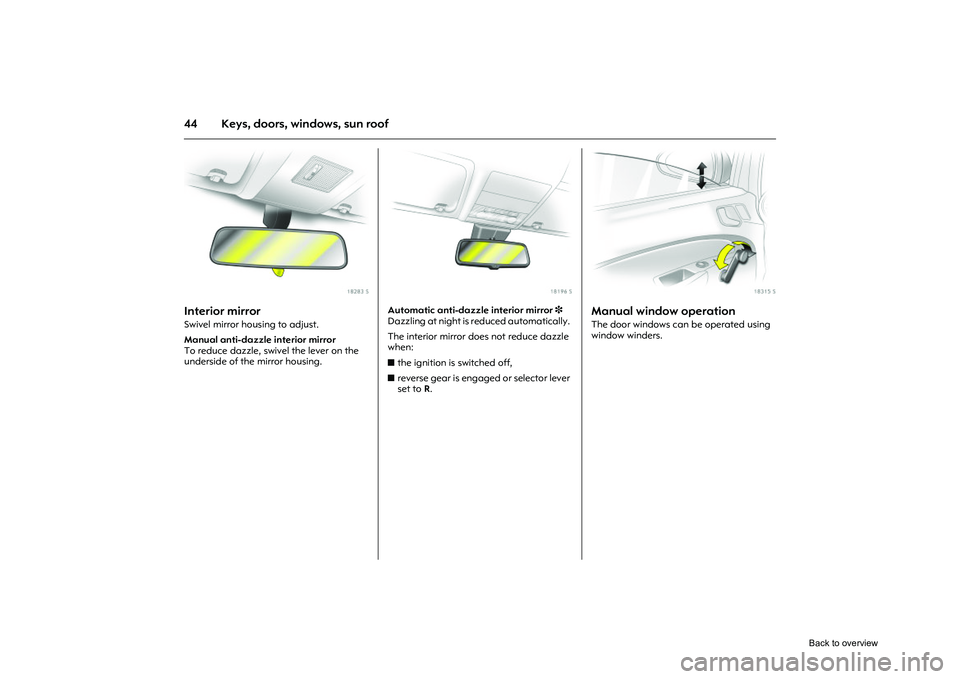
Interior mirror Swivel mirror housing to adjust.
Manual anti-dazzle interior mirror
To reduce dazzle, swivel the lever on the
underside of the mirror housing.
Picture no: 18196s.tif
Automatic anti-dazzle interior mirror3
Dazzling at night is reduced automatically.
The interior mirror does not reduce dazzle
when:
z the ignition is switched off,
z reverse gear is engaged or selector lever
set to R.
Picture no: 18315s.tif
Manual window operationThe door windows can be operated using
window winders.
Back to overview
Page 51 of 284
45
Keys, doors, windows, sun roof
Electric windows
3 on the
front doors
Operational readiness
The electric windows can be used
z with ignition on,
z within 5 minutes of sw itching ignition off,
z within 5 minutes of switching ignition key
to position 1.
After switching off the ignition, the
operational readiness is terminated by
opening the driver’s door.
Picture no: 18202s.tif
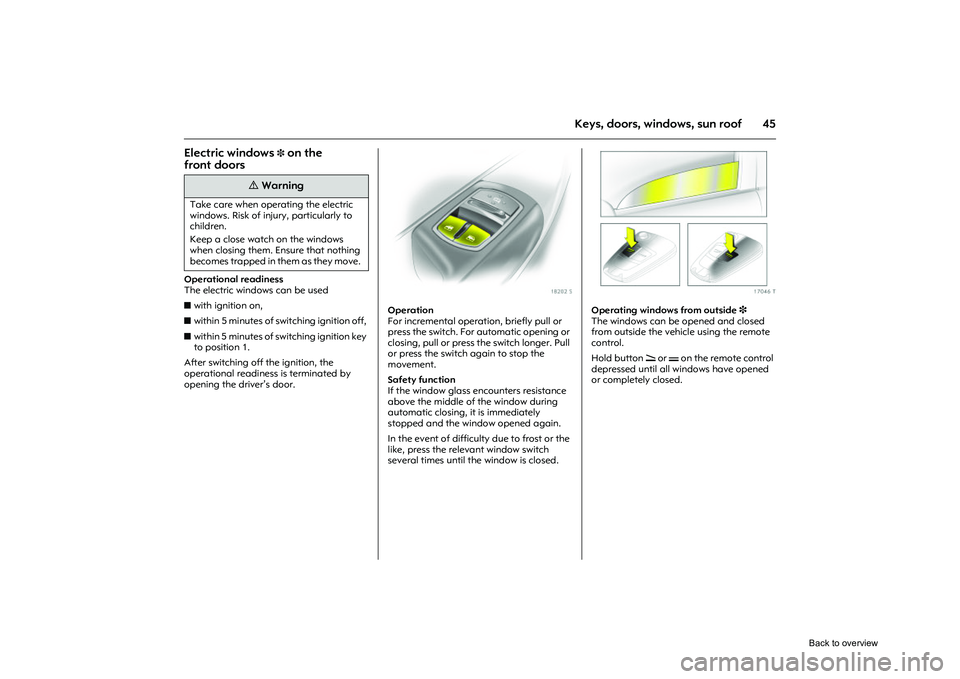
Operation
For incremental operation, briefly pull or
press the switch. For automatic opening or
closing, pull or press the switch longer. Pull
or press the switch again to stop the
movement.
Safety function
If the window glass encounters resistance
above the middle of the window during
automatic closing, it is immediately
stopped and the window opened again.
In the event of difficulty due to frost or the
like, press the releva nt window switch
several times until the window is closed.
Picture no: 17046t.tif
Operating windows from outside 3
The windows can be opened and closed
from outside the vehicle using the remote
control.
Hold button q or p on the remote control
depressed until all windows have opened
or completely closed.
9
Warning
Take care when oper ating the electric
windows. Risk of injury, particularly to
children.
Keep a close watch on the windows
when closing them. Ensure that nothing
becomes trapped in them as they move.
Back to overview
Page 52 of 284
46 Keys, doors, windows, sun roof
Picture no: 18206s.tif
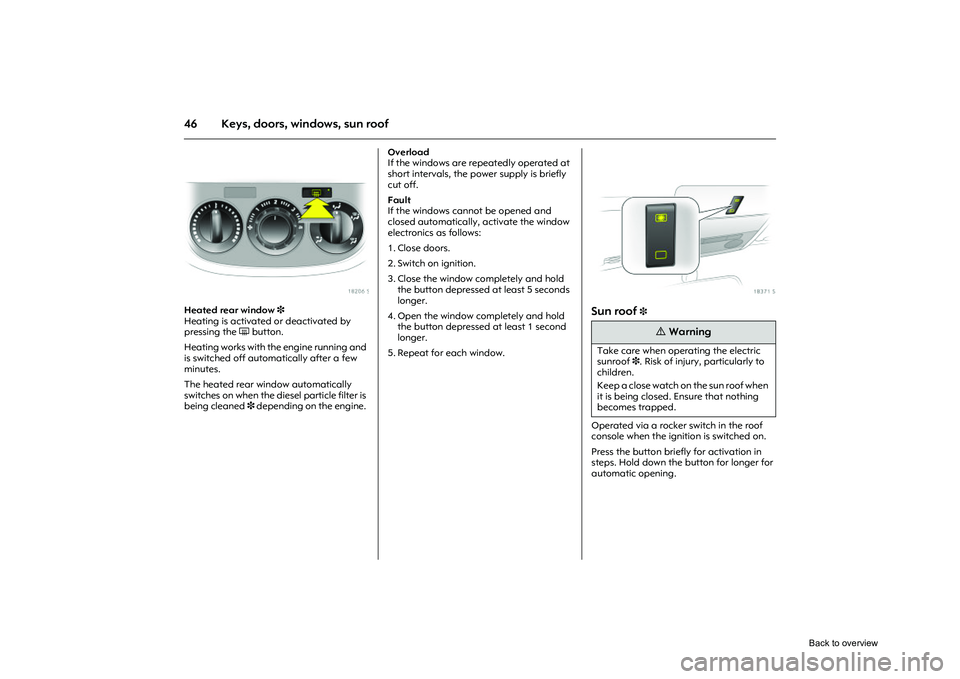
Heated rear window 3
Heating is activated or deactivated by
pressing the Ü button.
Heating works with the engine running and
is switched off automatically after a few
minutes.
The heated rear window automatically
switches on when the diesel particle filter is
being cleaned 3 depending on the engine. Overload
If the windows are repeatedly operated at
short intervals, the power supply is briefly
cut off.
Fault
If the windows cannot be opened and
closed automatically, activate the window
electronics as follows:
1. Close doors.
2. Switch on ignition.
3. Close the window completely and hold
the button depressed at least 5 seconds
longer.
4. Open the window completely and hold the button depressed at least 1 second
longer.
5. Repeat for each window.
Picture no: 18371s.tif
Sun roof
3
Operated via a rocker switch in the roof
console when the ignition is switched on.
Press the button briefly for activation in
steps. Hold down the button for longer for
automatic opening.
9
Warning
Take care when oper ating the electric
sunroof 3. Risk of injury, particularly to
children.
Keep a close watch on the sun roof when
it is being closed. Ensure that nothing
becomes trapped.
Back to overview
Page 53 of 284

47
Keys, doors, windows, sun roof
To raise
With the sun roof closed, press button ü.
The sun roof is raised at the rear.
To open
Press button ü again with the sun roof in
the raised position. The sun roof opens
automatically until it reaches its limit
position.
To close
Hold down button d until the sun roof is
completely closed.
Picture no: 18372s.tif
Sunblind
The sun blind can be opened and closed
manually whether the sun roof is open or
closed.
Note
z If the top of the roof is wet, tilt sun roof,
allow water to run off and then open sun
roof.
z When using a roof rack 3, check the free
movement of the sun roof in order to
avoid damage. It is only permitted to
raise the sun roof. Overload
If the system is overloaded, the power
supply is automatically cut off for a short
time.
The system is protected by fuses in the fuse
box – see page
3208.
Fault
If perfect function of the sun roof is not
guaranteed. Activate the electronics as
follows:
1. Switch on ignition.
2. Close the sun roof and hold button d
depressed at least 10 seconds.
Please contact a workshop to have the
cause of the fault remedied.
Back to overview
Page 63 of 284
57
Seats, Interior
Picture no: 18281s.tif
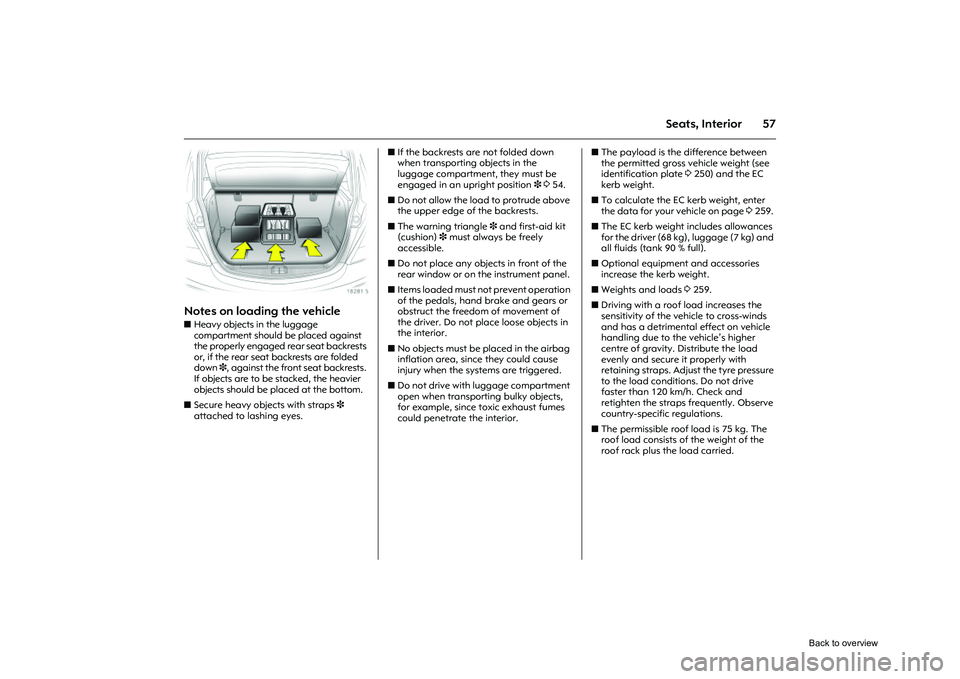
Notes on loading the vehicle zHeavy objects in the luggage
compartment should be placed against
the properly engaged rear seat backrests
or, if the rear seat backrests are folded
down 3, against the front seat backrests.
If objects are to be stacked, the heavier
objects should be placed at the bottom.
z Secure heavy objects with straps 3
attached to lashing eyes. z
If the backrests are not folded down
when transporting objects in the
luggage compartment, they must be
engaged in an upright position 3354.
z Do not allow the load to protrude above
the upper edge of the backrests.
z The warning triangle 3 and first-aid kit
(cushion) 3 must always be freely
accessible.
z Do not place any objects in front of the
rear window or on the instrument panel.
z Items loaded must not prevent operation
of the pedals, hand brake and gears or
obstruct the freedom of movement of
the driver. Do not place loose objects in
the interior.
z No objects must be placed in the airbag
inflation area, since they could cause
injury when the systems are triggered.
z Do not drive with luggage compartment
open when transporting bulky objects,
for example, since toxic exhaust fumes
could penetrate the interior. z
The payload is the difference between
the permitted gross vehicle weight (see
identification plate 3250) and the EC
kerb weight.
z To calculate the EC kerb weight, enter
the data for your vehicle on page 3259.
z The EC kerb weight includes allowances
for the driver (68 kg), luggage (7 kg) and
all fluids (tank 90 % full).
z Optional equipment and accessories
increase the kerb weight.
z Weights and loads 3259.
z Driving with a roof load increases the
sensitivity of the vehicle to cross-winds
and has a detrimental effect on vehicle
handling due to the vehicle’s higher
centre of gravity. Distribute the load
evenly and secure it properly with
retaining straps. Adjust the tyre pressure
to the load conditions. Do not drive
faster than 120 km/h. Check and
retighten the straps frequently. Observe
country-specific regulations.
z The permissible roof load is 75 kg. The
roof load consists of the weight of the
roof rack plus the load carried.
Back to overview
Page 74 of 284
68 Seats, Interior
Picture no: 18299s.tif
Mounting clips
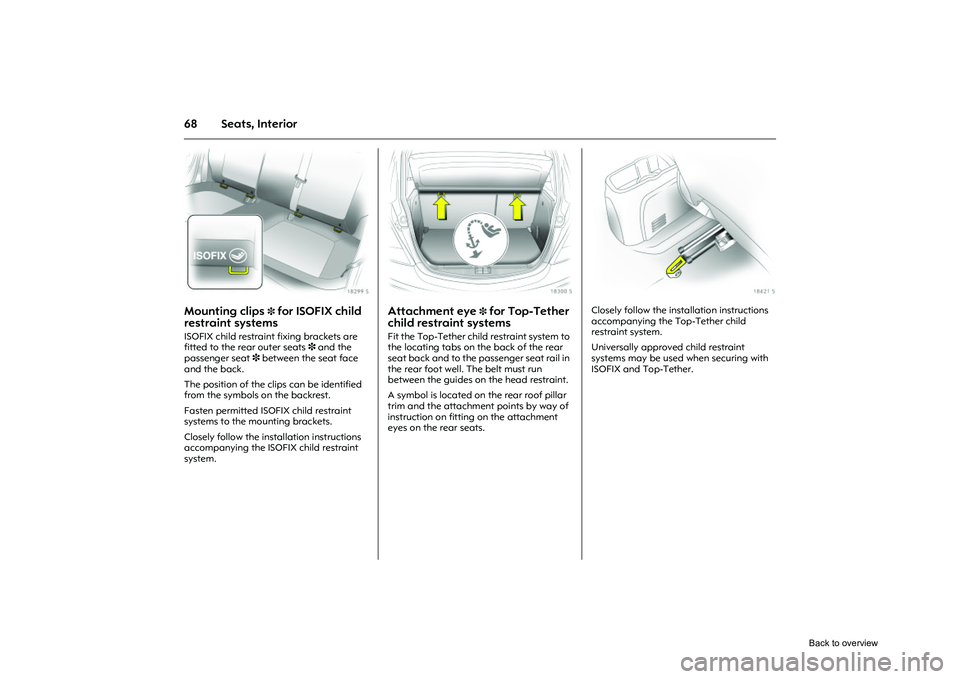
3 for ISOFIX child
restraint systems
ISOFIX child restraint fixing brackets are
fitted to the rear outer seats 3 and the
passenger seat 3 between the seat face
and the back.
The position of the clips can be identified
from the symbols on the backrest.
Fasten permitted ISOF IX child restraint
systems to the mounting brackets.
Closely follow the installation instructions
accompanying the ISOFIX child restraint
system.
Picture no: 18300s.tif
Attachment eye
3 for Top-Tether
child restraint systems
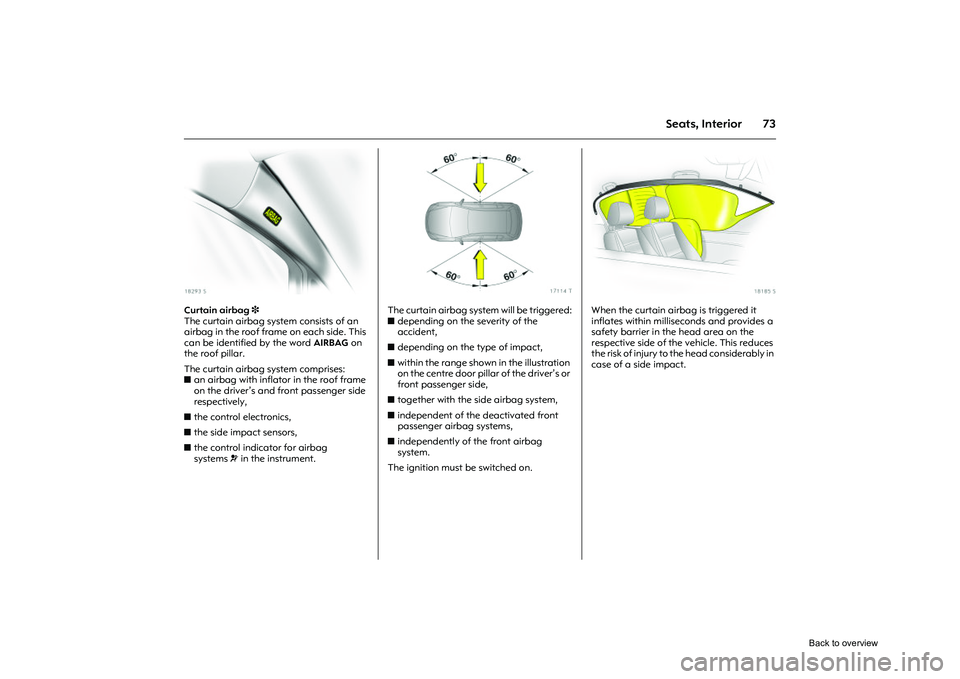
Fit the Top-Tether child restraint system to
the locating tabs on the back of the rear
seat back and to the passenger seat rail in
the rear foot well. The belt must run
between the guides on the head restraint.
A symbol is located on the rear roof pillar
trim and the attachment points by way of
instruction on fitting on the attachment
eyes on the rear seats.
Picture no: 18421s.tif
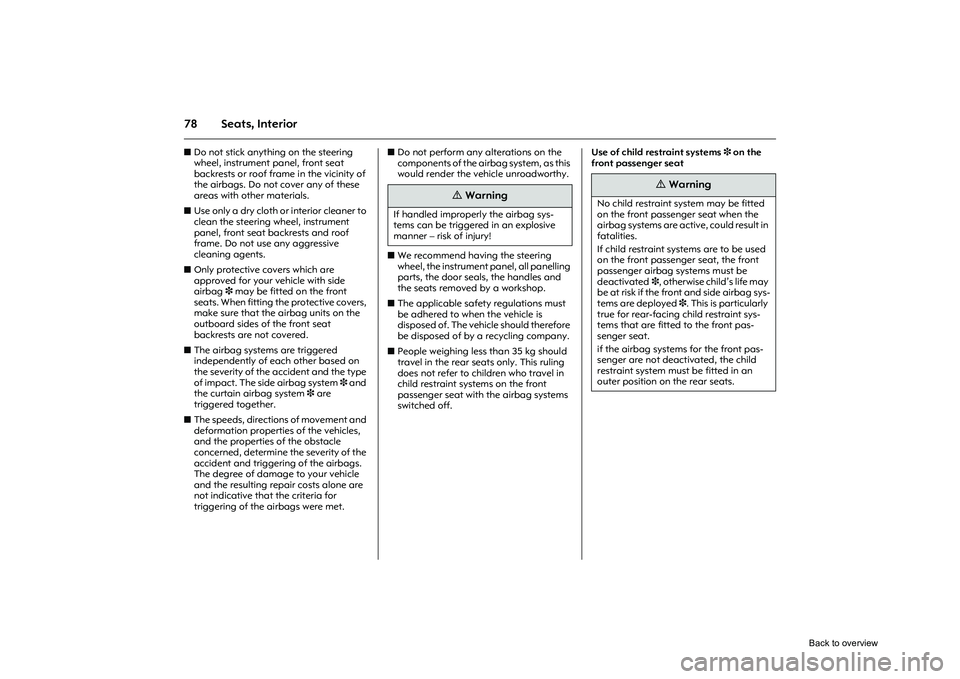
Closely follow the installation instructions
accompanying the Top-Tether child
restraint system.
Universally approved child restraint
systems may be used when securing with
ISOFIX and Top-Tether.
Back to overview
Page 79 of 284
73
Seats, Interior
Picture no: 18293s.tif
Curtain airbag 3
The curtain airbag system consists of an
airbag in the roof fram e on each side. This
can be identified by the word AIRBAG on
the roof pillar.
The curtain airbag system comprises:
z an airbag with inflator in the roof frame
on the driver’s and front passenger side
respectively,
z the control electronics,
z the side impact sensors,
z the control indicator for airbag
systems v in the instrument.
Picture no: 17114t.tif
The curtain airbag system will be triggered:
z depending on the severity of the
accident,
z depending on the type of impact,
z within the range shown in the illustration
on the centre door pillar of the driver’s or
front passenger side,
z together with the side airbag system,
z independent of the deactivated front
passenger airbag systems,
z independently of the front airbag
system.
The ignition must be switched on.
Picture no: 18185s.tif
When the curtain airb ag is triggered it
inflates within milliseconds and provides a
safety barrier in the head area on the
respective side of the vehicle. This reduces
the risk of injury to th e head considerably in
case of a side impact.
Back to overview
Page 83 of 284
77
Seats, Interior
Picture no: 18298s.tif
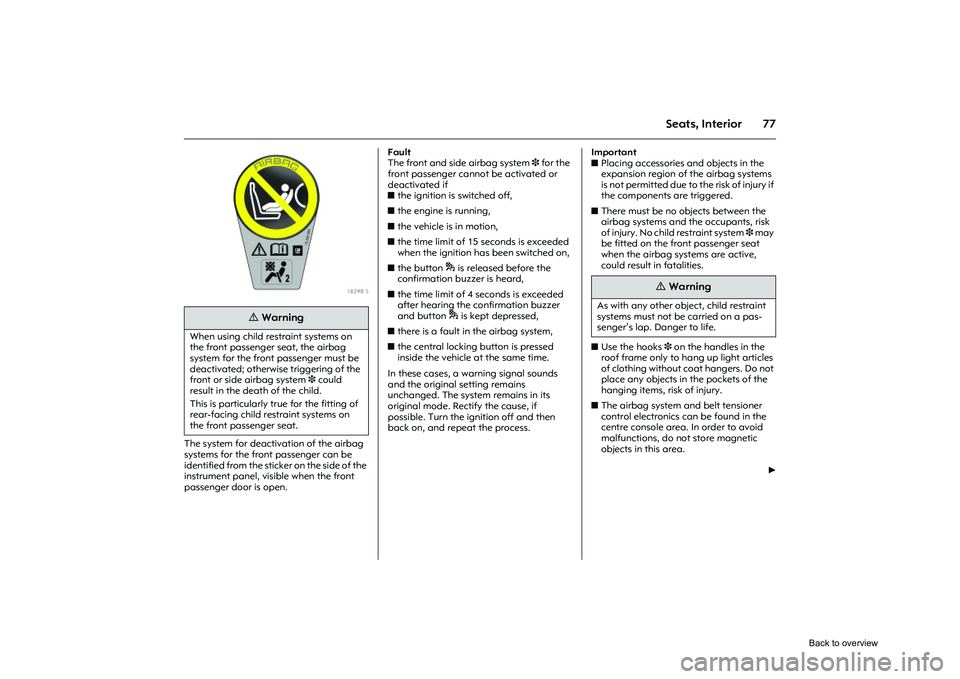
The system for deactivation of the airbag
systems for the front passenger can be
identified from the sticker on the side of the
instrument panel, visible when the front
passenger door is open. Fault
The front and side airbag system
3 for the
front passenger cannot be activated or
deactivated if
z the ignition is switched off,
z the engine is running,
z the vehicle is in motion,
z the time limit of 15 seconds is exceeded
when the ignition has been switched on,
z the button * is released before the
confirmation buzzer is heard,
z the time limit of 4 seconds is exceeded
after hearing the confirmation buzzer
and button * is kept depressed,
z there is a fault in the airbag system,
z the central locking button is pressed
inside the vehicle at the same time.
In these cases, a warning signal sounds
and the original setting remains
unchanged. The system remains in its
original mode. Rectify the cause, if
possible. Turn the ignition off and then
back on, and repeat the process. Important
z
Placing accessories and objects in the
expansion region of the airbag systems
is not permitted due to the risk of injury if
the components are triggered.
z There must be no objects between the
airbag systems and the occupants, risk
of injury. No child restraint system 3 may
be fitted on the front passenger seat
when the airbag systems are active,
could result in fatalities.
z Use the hooks 3 on the handles in the
roof frame only to hang up light articles
of clothing without co at hangers. Do not
place any objects in the pockets of the
hanging items, risk of injury.
z The airbag system and belt tensioner
control electronics can be found in the
centre console area. In order to avoid
malfunctions, do not store magnetic
objects in this area.
6
9
Warning
When using child restraint systems on
the front passenger seat, the airbag
system for the front passenger must be
deactivated; otherwise triggering of the
front or side airbag system 3 could
result in the death of the child.
This is particularly true for the fitting of
rear-facing child restraint systems on
the front passenger seat.
9
Warning
As with any other object, child restraint
systems must not be carried on a pas-
senger’s lap. Danger to life.
Back to overview
Page 84 of 284
78 Seats, InteriorzDo not stick anything on the steering
wheel, instrument panel, front seat
backrests or roof frame in the vicinity of
the airbags. Do not cover any of these
areas with other materials.
z Use only a dry cloth or interior cleaner to
clean the steering wheel, instrument
panel, front seat backrests and roof
frame. Do not use any aggressive
cleaning agents.
z Only protective covers which are
approved for your vehicle with side
airbag 3 may be fitted on the front
seats. When fitting the protective covers,
make sure that the airbag units on the
outboard sides of the front seat
backrests are not covered.
z The airbag systems are triggered
independently of each other based on
the severity of the accident and the type
of impact. The side airbag system 3 and
the curtain airbag system 3 are
triggered together.
z The speeds, directions of movement and
deformation properties of the vehicles,
and the properties of the obstacle
concerned, determine the severity of the
accident and triggering of the airbags.
The degree of damage to your vehicle
and the resulting repair costs alone are
not indicative that the criteria for
triggering of the airbags were met. z
Do not perform any alterations on the
components of the airbag system, as this
would render the vehicle unroadworthy.
z We recommend having the steering
wheel, the instrument panel, all panelling
parts, the door seals, the handles and
the seats removed by a workshop.
z The applicable safety regulations must
be adhered to when the vehicle is
disposed of. The vehicle should therefore
be disposed of by a recycling company.
z People weighing less than 35 kg should
travel in the rear se ats only. This ruling
does not refer to ch ildren who travel in
child restraint systems on the front
passenger seat with the airbag systems
switched off. Use of child restraint systems
3 on the
front passenger seat
9
Warning
If handled improperly the airbag sys-
tems can be triggered in an explosive
manner – risk of injury!
9
Warning
No child restraint sy stem may be fitted
on the front passenger seat when the
airbag systems are active, could result in
fatalities.
If child restraint systems are to be used
on the front passenger seat, the front
passenger airbag systems must be
deactivated 3, otherwise child’s life may
be at risk if the front and side airbag sys-
tems are deployed 3. This is particularly
true for rear-facing child restraint sys-
tems that are fitted to the front pas-
senger seat.
if the airbag systems for the front pas-
senger are not deactivated, the child
restraint system must be fitted in an
outer position on the rear seats.
Back to overview
Page 133 of 284
127
Climate control
Air distribution to l: the air recirculation
system is automatically switched off to
speed up window demisting and prevent
fogging.
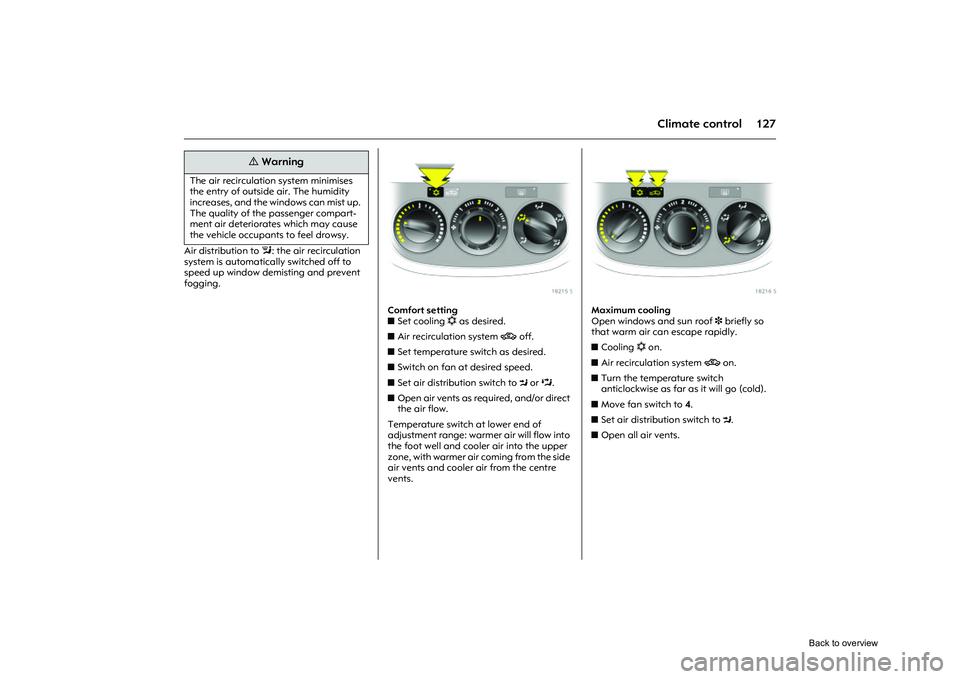
Picture no: 18215s.tif
Comfort setting
z Set cooling n as desired.
z Air recirculation system 4 off.
z Set temperature switch as desired.
z Switch on fan at desired speed.
z Set air distribution switch to M or L.
z Open air vents as required, and/or direct
the air flow.
Temperature switch at lower end of
adjustment range: warm er air will flow into
the foot well and cooler air into the upper
zone, with warmer air coming from the side
air vents and cooler air from the centre
vents.
Picture no: 18216s.tif
Maximum cooling
Open windows and sun roof 3 briefly so
that warm air can escape rapidly.
z Cooling n on.
z Air recirculation system 4 on.
z Turn the temperature switch
anticlockwise as far as it will go (cold).
z Move fan switch to 4.
z Set air distribution switch to M.
z Open all air vents.
9
Warning
The air recirculation system minimises
the entry of outside air. The humidity
increases, and the windows can mist up.
The quality of the passenger compart-
ment air deteriorates which may cause
the vehicle occupants to feel drowsy.
Back to overview