roof OPEL CORSA 2009 Owner's Guide
[x] Cancel search | Manufacturer: OPEL, Model Year: 2009, Model line: CORSA, Model: OPEL CORSA 2009Pages: 284, PDF Size: 4.96 MB
Page 142 of 284
136 Driving and operationDriving and operation
Manual transmission automated
3
The Easytronic transmission permits
manual (manual mode ) or automatic gear
shifting ( automatic mode ), both with
automatic clutch control.
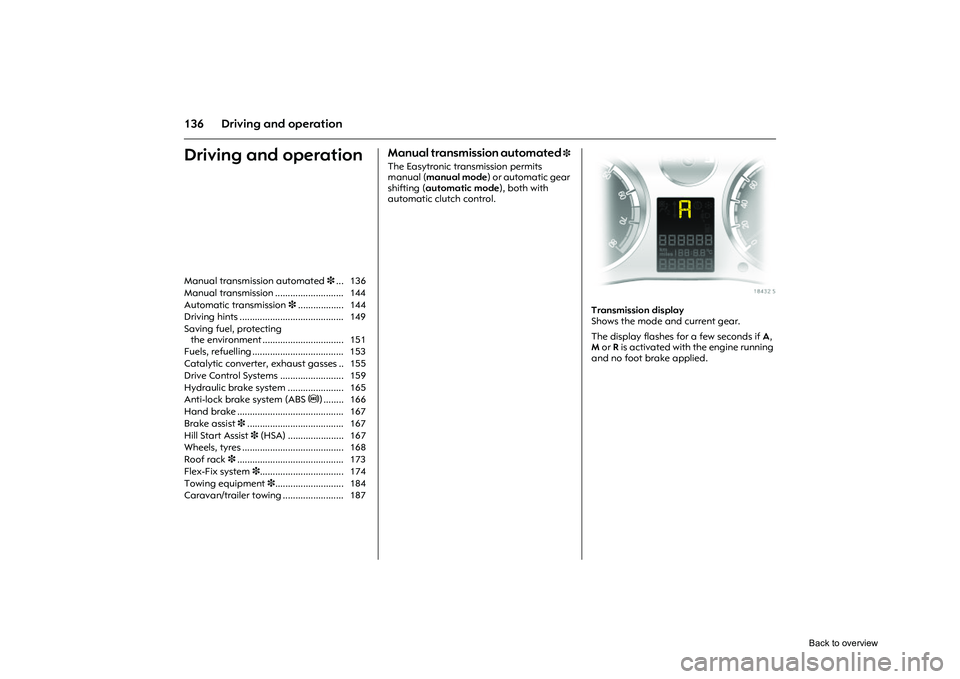
Picture no: 18432s.tif
Transmission display
Shows the mode and current gear.
The display flashes for a few seconds if A,
M or R is activated with the engine running
and no foot brake applied.
Manual transmission automated
3... 136
Manual transmission ........................... 144
Automatic transmission 3.................. 144
Driving hints ......................................... 149
Saving fuel, protecting the environment ................................ 151
Fuels, refuelling .................................... 153
Catalytic converter, exhaust gasses .. 155
Drive Control Systems ......................... 159
Hydraulic brake system ...................... 165
Anti-lock brake system (ABS u ) ........ 166
Hand brake .......................................... 167
Brake assist 3...................................... 167
Hill Start Assist 3 (HSA) ...................... 167
Wheels, tyres ........................................ 168
Roof rack 3.......................................... 173
Flex-Fix system 3................................. 174
Towing equipment 3........................... 184
Caravan/trailer towing ........................ 187
Back to overview
Page 155 of 284

149
Driving and operation
Driving hints The first 1000 km
Drive your vehicle at various speeds. Do
not use full throttle. Never allow the engine
to labour at low revs.
Make good use of all gears. Depress the
accelerator pedal a maximum of about
3/4
of the available pedal travel in all gears.
Do not drive faster than three quarters of
maximum speed.
Do not brake unnecessarily hard for the
first 200 km.
During the first drive smoke may develop
because of wax and oil evaporating on the
exhaust system. Park the vehicle in the
open for a while after the first drive and
avoid inhaling the fumes.
Fuel and engine oil consumption is higher
than normal during the running-in period.
Never coast with engine not running
Many units will not function in this situation
(e.g. brake servo unit, electro-hydraulic
power steering). Driving in this manner is a
danger to yourself and others. Brake servo unit
When the engine is not running, the brake
servo unit is no longer effective once the
brake pedal has been depressed once or
twice. Braking effect is not reduced, but
significantly greater force is required for
braking.
Electro-hydraulic power assisted steering
If the power assisted steering fails when
being towed with the engine switched off,
the vehicle can still be steered, but
considerably more force is required.
Driving in mountainous terrain or with a
trailer/caravan
The cooling fan is elec
trically operated. Its
cooling power is therefore independent of
the engine speed.
Since a considerable amount of heat is
generated at high engine speeds and less
at slower speeds, do not shift down when
climbing hills whilst the vehicle is still coping
with the gradient in the higher gear. Driving with a roof load
Do not exceed the permissible roof load
3
173, 3259. For reasons of safety,
distribute the load evenly and secure it
properly with retaining straps. Adjust tyre
pressure to load conditions. Do not drive
faster than 120 km/h. Check and re-tighten
the straps frequently. Observe country-
specific regulations.
Switching off the engine
When you switch off, fans in the engine
compartment may continue running for a
time to cool the engine.
If the engine temperature is very high, e.g.
after driving in mountainous terrain: allow
the engine to idle for approximately two
minutes in order to prevent heat
accumulation.
Vehicles with turbocharged engine
After running at high engine speeds or
high engine loads, operate the engine
briefly at a low load or run in neutral for
approx. 30 seconds befo re switching off
in order to protect the turbocharger.
Back to overview
Page 158 of 284

152 Driving and operationOverrun
zThe fuel supply is shut off automatically
on overrun, e.g. when descending steep
hills or when braking 3150.
z To enable the overrun cut-off to come
into action and save fuel, do not
accelerate or declutch during overrun.
Correct gear selection
z High revs increase engine wear and fuel
consumption.
z Do not race your engine. Avoid driving at
high engine speeds.
Making use of the tachometer helps to
save fuel. Drive in a low engine speed
range for each gear as much as possible
with uniform engine speeds. Drive as
often as possible in top gear, select the
next higher gear as soon as possible,
and only change down when the engine
is no longer running perfectly smoothly.
High speed
z The higher the speed, the higher the
consumption and the noise level. At top
speed, you consume a great deal of fuel
and produce excessive noise and
exhaust emissions. z
Slightly releasing th e accelerator pedal
results in distinct fu el savings with no
major loss of speed.
Drive at no more than around three
quarters of maximum speed and you will
use up to 50 % less fuel, without losing a
great deal of time.
Tyre pressure
z Inadequate tyre pressure, leading to
higher road resistance, costs money in
two ways: for more fuel and increased
tyre wear.
z Regular checks (every 14 days) pay off.
Electrical loads
z The power consumption of electrical
equipment increases fuel consumption.
z Switch off all additional consumers (e.g.
air conditioning 3, heated rear window)
when not needed.
Roof racks, ski-holders
z Roof loads can increase fuel consumption
by approximately 1l/100 km due to air
resistance.
z Remove them if they are not being used. Repair and maintenance
z
Improper repairs or adjustment and
maintenance work can increase fuel
consumption. Do not carry out work on
the engine yourself.
You may out of ignorance infringe
environmental laws by not disposing of
materials properly.
Appropriate parts might not be recycled.
Contact with some of the materials
involved may pose a health hazard.
z We recommend that repair and
maintenance be entrusted to your Opel
Partner.
Extreme driving conditions
z Driving up steep slopes, cornering,
driving on poor roads and driving in ice
and snow all increase fuel consumption.
Fuel consumption increases dramatically
in urban traffic and at low temperatures,
especially on short trips when the engine
operating temperature is not reached.
z Following the instructions given above
will minimise consumption under these
conditions.
Back to overview
Page 179 of 284
173
Driving and operation
Remove the wheel trims if using tyre chains
3201.
Tyre chains may only be used at speeds up
to 50 km/h. When travelling on roads that
are free of snow, they may only be used for
brief periods.
Tyre chains must not be used on the
temporary spare wheel. If you need to use
tyre chains after suffering a flat front tyre,
fit the temporary spare on the rear axle
and transfer one of the rear wheels to the
front axle.
Roof rack
3
For safety reasons and to avoid roof
damage we recommend using the Opel
roof rack system that is approved for your
vehicle.
Follow the usage instructions for the roof
rack.
Remove the roof rack when not in use.
Driving hints 3 149
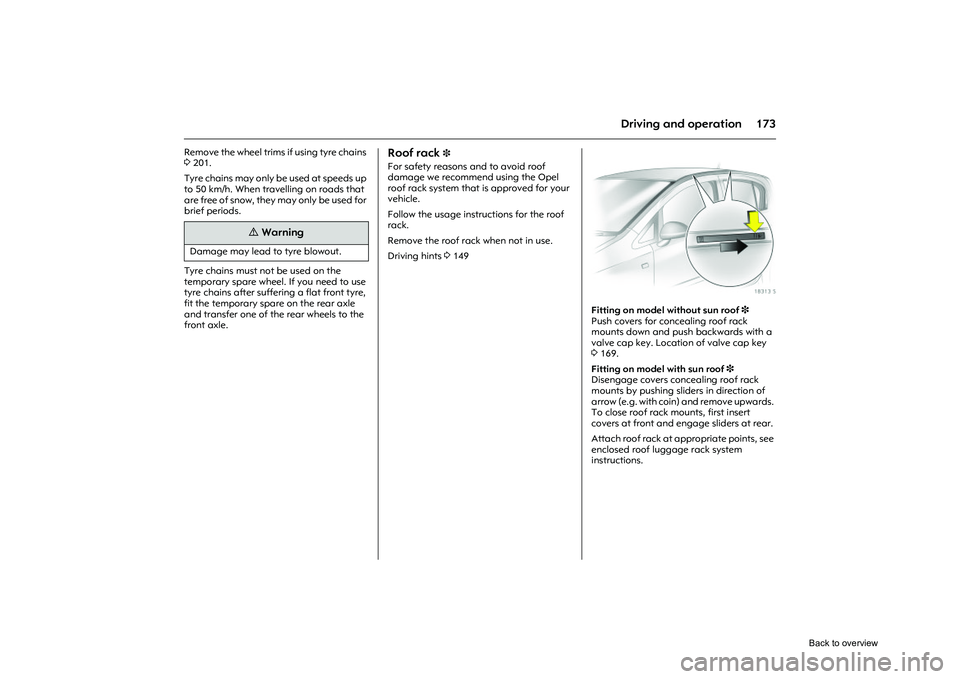
Picture no: 18313s.tif
Fitting on model without sun roof 3
Push covers for concealing roof rack
mounts down and push backwards with a
valve cap key. Location of valve cap key
3 169.
Fitting on model with sun roof 3
Disengage covers concealing roof rack
mounts by pushing sliders in direction of
arrow (e.g. with coin) and remove upwards.
To close roof rack mounts, first insert
covers at front and engage sliders at rear.
Attach roof rack at appropriate points, see
enclosed roof luggage rack system
instructions.
9
Warning
Damage may lead to tyre blowout.
Back to overview
Page 217 of 284
211
Self-help, vehicle care
Picture no: 18590s.tifPicture no: 18261s.tif
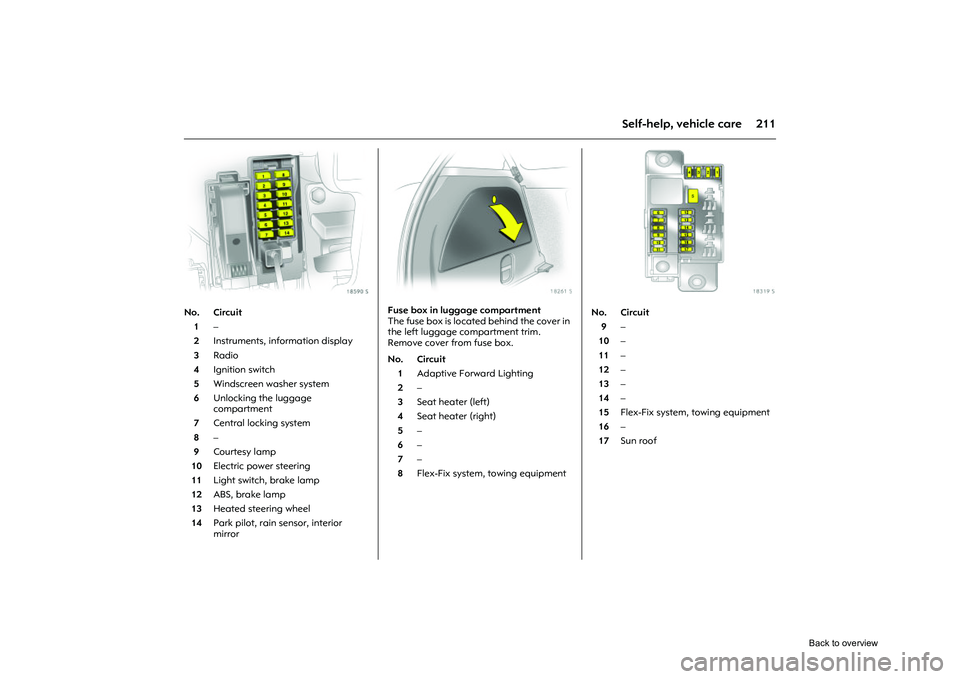
Fuse box in luggage compartment
The fuse box is located behind the cover in
the left luggage compartment trim.
Remove cover from fuse box.
Picture no: 18319s.tif
No. Circuit
1 –
2 Instruments, information display
3 Radio
4 Ignition switch
5 Windscreen washer system
6 Unlocking the luggage
compartment
7 Central locking system
8 –
9 Courtesy lamp
10 Electric power steering
11 Light switch, brake lamp
12 ABS, brake lamp
13 Heated steering wheel
14 Park pilot, rain sensor, interior
mirror
No. Circuit
1 Adaptive Forward Lighting
2 –
3 Seat heater (left)
4 Seat heater (right)
5 –
6 –
7 –
8 Flex-Fix system, towing equipment
No. Circuit
9 –
10 –
11 –
12 –
13 –
14 –
15 Flex-Fix system, towing equipment
16 –
17 Sun roof
Back to overview
Page 234 of 284
228 Self-help, vehicle careVehicle careWhen caring for your vehicle, observe all
national environmental regulations,
particularly when washing it.
Regular, thorough care helps to improve
the appearance of your vehicle and
maintain its value over the years. It is also
prerequisite for warranty claims for any
paint or corrosion da mage. The following
pages contain tips for vehicle care which, if
used properly, will help combat the
unavoidable, damaging effects of the
environment. Washing
The paintwork of your vehicle is exposed to
environmental influences. Wash and wax
your vehicle regularly. When using
automatic car washes, select a program
that includes waxing.
Bird droppings, dead insects, resin, pollen
and the like should be cleaned off
immediately, as they contain aggressive
constituents which can cause paint
damage.
If using a car wash, comply with the car
wash manufacturer’s instructions. The
windscreen wipers and rear window wiper
must be switched off. Remove antenna
3
and roof rack 3. Stand on the door sill to
reach them more easily. If you wash your vehicle by hand, make
sure that the insides
of the wings are also
thoroughly rinsed out.
Clean edges and folds on opened doors
and flaps as well as the areas they cover.
Thoroughly rinse off and leather-off the
vehicle. Rinse leather frequently. Use
separate leathers for paint and window
surfaces: remnants of wax on the windows
will impair vision.
Do not use hard objects to remove spots of
tar. Use tar removal spray on painted
surfaces.
Back to overview
Page 236 of 284
230 Self-help, vehicle careWindows
Use a soft lint-free cloth or chamois leather
together with window cleaner and insect
remover.
When cleaning the rear window, make sure
the heating element inside the window is
not damaged.
For mechanical removal of ice, use a sharp-
edged ice scraper. Press the scraper firmly
against the glass so that no dirt can get
under it and scratch the glass.
Clean smearing wiper blades with a soft
cloth and window cleaner.
Sun roof 3
Never clean with solvents or abrasives,
fuels, aggressive agents (e.g. paintwork
cleaner, solutions containing acetone,
etc.), acidic or strongly alkaline agents or
scourers.
No stickers may be applied to the sun roof. Locks
The locks are lubricated with a high-quality
locking cylinder grease
in the factory. Only
use de-icer in urgent cases, since it has a
de-greasing effect and affects the
operation of the locks. Have the locks re-
greased in a workshop after using de-icer.
Engine compartment
Clean painted surfaces in the engine
compartment like any other painted
surface.
It is advisable to wash the engine
compartment before and after winter and
preserve it with wax. Cover alternator and
brake fluid reservoir with plastic sheets
before washing the engine.
When washing the engine with a steam-jet
cleaner, do not direct the steam jet at
components of the anti-lock brake system,
the air conditioning system, the climate
control system, belt drive or the fuse box.
After an engine wash, have all engine room
components preserved thoroughly by a
workshop using protective wax.
Do not use high-pressure jet cleaners. Underbody
Some areas of the vehicle underbody have
a PVC undercoating while other critical
areas have a durable protective wax
coating.
After the underbody is washed, check the
underbody and have more protective wax
applied if necessary.
Bitumen/rubber materials could damage
the PVC coating. Have underbody work
carried out by a workshop.
Before and after winter, wash the
underbody and have the protective wax
coating checked.
Towing equipment
Do not clean the coupling ball bar with a
steam-jet or high-pressure jet cleaner.
Back to overview
Page 256 of 284

250 Technical DataTechnical Data
Picture no: 18330s.tif
Vehicle data The technical data is determined in
accordance with European Community
standards. We reserve the right to make
modifications. Specifications in the vehicle
documents always have priority over those
given in this manual.
The identification plate is affixed to the
front right door frame.
Picture no: 17322t.tif
Information on identification plate:
Vehicle data ......................................... 250
Engine data.......................................... 252
Performance 5-door ............................ 254
Performance 3-door ............................ 255
Performance, delivery vehicle............. 255
Fuel consumption, CO
2-emissions ......
256
Weights, payload and roof load ........ 259
Tyres ..................................................... 264
Capacities ............................................ 267
Dimensions ........................................... 268
Trailer hitch installation dimensions .. 269
1 Manufacturer
2 Type approval number
3 Vehicle identification number
4 Gross vehicle weight rating
5 Permissible gross train weight
6 Maximum permissible front axle load
7 Maximum permissible rear axle load
8 Vehicle-specific or country-specific
data
Back to overview
Page 265 of 284

259
Technical Data
Weights, payload and roof load The payload is the difference between the
permitted gross vehicle weight (see
identification plate, page 3250) and the
EC kerb weight.
To calculate the kerb weight, enter the
data for your vehicle below:
is the EC kerb weight.
Optional equipmen t and accessories
increase the kerb weight, which means that
the payload will also change slightly.
Note the weights given in the vehicle
documents. The combined total of front and rear axle
loads must not exceed the permissible
gross vehicle weight. For example, if the
front axle is bearing its maximum
permissible load, the rear axle can only
bear a load that is equal to the gross
vehicle weight minus
the front axle load.
With the trailer attached and the towing
vehicle fully loaded, including all the
passengers, the permitted rear axle load
(specified on identification plate and
vehicle documents) for passenger vehicles
may be exceeded by 45 kg and the
permitted total load may be exceeded
by 50 kg.
For vans the permitted rear axle load may
be exceeded by 25 kg. The permitted total
load may be exceeded by the following
amounts with the engines
1) specified
below:
Trailer operation is not permitted for vans
with tyre size 215/45 R 17. If the permitted rear axle load is exceeded
a maximum speed of 100 km/h applies. If
lower national maximum speeds are
specified for trailer operation, they must be
complied with.
See the identification
plate or vehicle
documents for permissible axle loads.
Roof load
The permissible roof load is 75 kg. The roof
load consists of the weight of the roof rack
plus the load carried.
Driving instructions 3149. Caravan/trailer
towing 3187, roof rack 3173.
z
Unladen weight from
table 1 3260 +.............. kg
z Added weight for
different specifications
are given in
table 2 3263 +.............. kg
z Weight of heavy
accessories from table 3
3263 +.............. kg
Total =.............. kg
1)Sales designation – see pages
3252,
3253.
Z 10 XEP 30 kg
Z 12 XEP 15 kg
Z 13 DTH 40 kg
Z 13 DTJ 35 kg
Back to overview
Page 269 of 284
![OPEL CORSA 2009 Owners Guide 263
Technical Data
Table 2, added weight for different specifications 5-door passenger vehicle
Engine Z 10 XEP Z 12 XEP Z 14 XEP Z 16 LEL Z 13 DTJ Z 13 DTH Z 17 DTR
Enjoy [kg] 7 7 7 7 7 7 7
Sport [kg](/img/37/58224/w960_58224-268.png "OPEL CORSA 2009 Owners Guide 263
Technical Data
Table 2, added weight for different specifications 5-door passenger vehicle
Engine Z 10 XEP Z 12 XEP Z 14 XEP Z 16 LEL Z 13 DTJ Z 13 DTH Z 17 DTR
Enjoy [kg] 7 7 7 7 7 7 7
Sport [kg")
263
Technical Data
Table 2, added weight for different specifications 5-door passenger vehicle
Engine Z 10 XEP Z 12 XEP Z 14 XEP Z 16 LEL Z 13 DTJ Z 13 DTH Z 17 DTR
Enjoy [kg] 7 7 7 7 7 7 7
Sport [kg] 12 12 12 12 12 12 12
Cosmo [kg] 14 14 14 14 14 14 14
3-door passenger vehicle
Engine Z 10 XEP Z 12 XEP Z 14 XEP Z 16 LEL Z 13 DTJ Z 13 DTH Z 17 DTR
Enjoy [kg] 15 15 15 15 15 15 15
Sport [kg] 21 21 21 21 21 21 21
Cosmo [kg] 14 14 14 14 14 14 14Weights, table 3, heavy accessoriesAccessories Sun roof Towing equipment Flex-Fix system17-inch wheels
on van
Weight [kg] 20 15 23.520
Back to overview