brake OPEL CORSA 2009 Workshop Manual
[x] Cancel search | Manufacturer: OPEL, Model Year: 2009, Model line: CORSA, Model: OPEL CORSA 2009Pages: 284, PDF Size: 4.96 MB
Page 243 of 284
237
Opel Service, maintenance
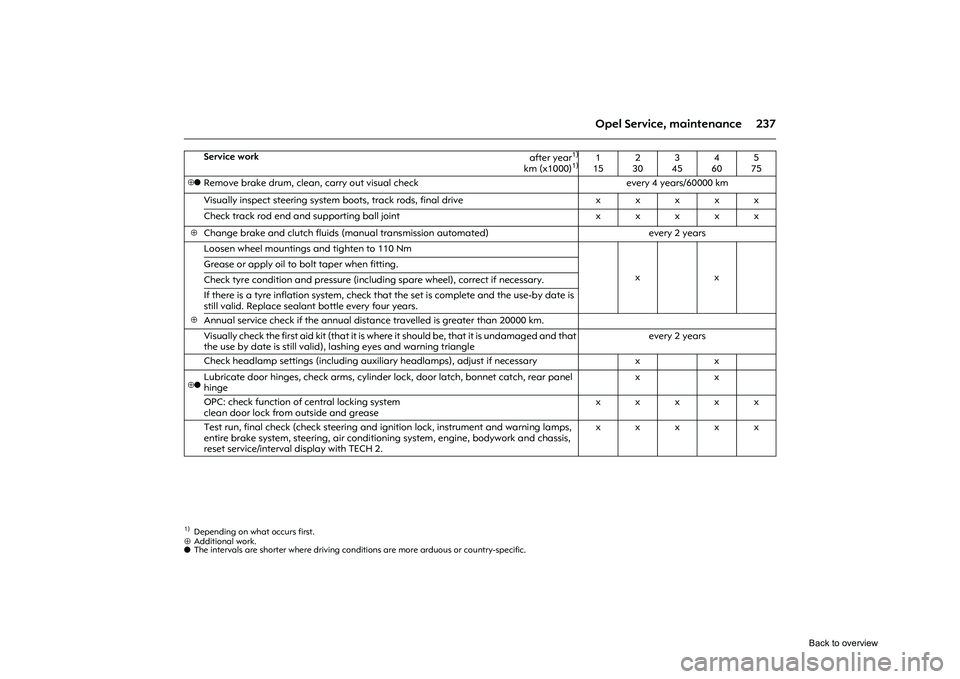
⊕ Additional work.
o The intervals are shorter where driving conditions are more arduous or country-specific.
Service work
after year
1)
km (x1000)
1)
1)Depending on what occurs first.
1
15 2
30 3
45 4
60 5
75
⊕o
Remove brake drum, clean, carry out visual check every 4 years/60000 km
Visually inspect steering system boots, track rods, final drive xxxxx
Check track rod end and supporting ball joint xxxxx
⊕
Change brake and clutch fluids (manual transmission automated) every 2 years
Loosen wheel mountings and tighten to 110 Nm
xx
Grease or apply oil to
bolt taper when fitting.
Check tyre condition and pressure (inclu ding spare wheel), correct if necessary.
If there is a tyre inflation system, check that the set is complete and the use-by date is
still valid. Replace sealant bottle every four years.
⊕
Annual service check if the annual distance travelled is greater than 20000 km.
Visually check the first aid kit (that it is wher e it should be, that it is undamaged and that
the use by date is still valid), lashing eyes and warning triangle every 2 years
Check headlamp settings (including auxi liary headlamps), adjust if necessary x x
⊕o
Lubricate door hinges, check arms, cylinder lo ck, door latch, bonnet catch, rear panel
hinge xx
OPC: check function of central locking system
clean door lock from outside and grease xxxxx
Test run, final check (check steering and ig nition lock, instrument and warning lamps,
entire brake system, steering, air conditioni ng system, engine, bodywork and chassis,
reset service/interval display with TECH 2. xxxxx
Back to overview
Page 247 of 284
241
Opel Service, maintenance
Genuine Opel Parts and
Accessories We recommend that you use "Genuine
Opel Parts and Accessories" and
conversion parts expressly approved for
your vehicle model. These parts have
undergone special tests to establish their
reliability, safety and specific suitability for
Opel vehicles. Despit e continuous market
monitoring, we cannot assess or guarantee
these attributes for other products, even if
they – have been granted approval – by
the relevant authorities or in some other
form.
"Genuine Opel Parts and Accessories" and
conversion parts approved by Opel can of
course be obtained from your Opel
Partner, who can provide – comprehensive
advice about permissible technical
changes – and ensure that the part is
installed correctly.
Picture no: 17304t.tif
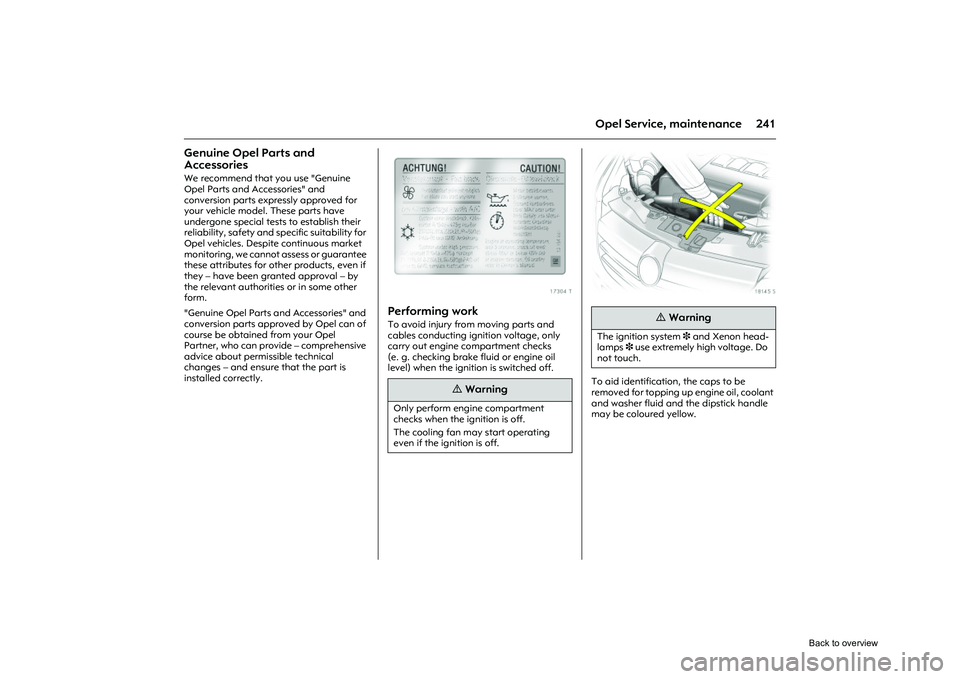
Performing work To avoid injury from moving parts and
cables conducting ignition voltage, only
carry out engine compartment checks
(e. g. checking brake fluid or engine oil
level) when the igniti on is switched off.
Picture no: 18145s.tif
To aid identification, the caps to be
removed for topping up engine oil, coolant
and washer fluid and the dipstick handle
may be coloured yellow.
9
Warning
Only perform engine compartment
checks when the ignition is off.
The cooling fan may start operating
even if the ignition is off.
9
Warning
The ignition system 3 and Xenon head-
lamps 3 use extremely high voltage. Do
not touch.
Back to overview
Page 251 of 284

245
Opel Service, maintenance
Picture no: 18149s.tif
Coolant level
In a closed cooling system, there is hardly
any loss.
If the cooling system is cold, the coolant
should lie above the KALT/COLD mark.
Top up if the level is low. Top up with anti-freeze. If no anti-freeze is
available, fill with clean tap water or
distilled water. Have the anti-freeze
concentration checked.
Have the cause of coolant loss rectified by
a workshop.
Fit the cap on straight and tighten it.
Brakes A screeching noise indicates that the brake
lining is at its minimum thickness.
Continued driving is possible. Have the
brake lining replace as soon as possible.
Once new brake lining is
fitted, do not brake
unnecessarily hard for the first 200 km.
9
Warning
Allow the engine to cool before opening
the cap. Carefully open the cap,
relieving the overpressure slowly.
Caution
Too low a coolant level can cause
engine damage.
Back to overview
Page 252 of 284
246 Opel Service, maintenance
Picture no: 18151s.tif
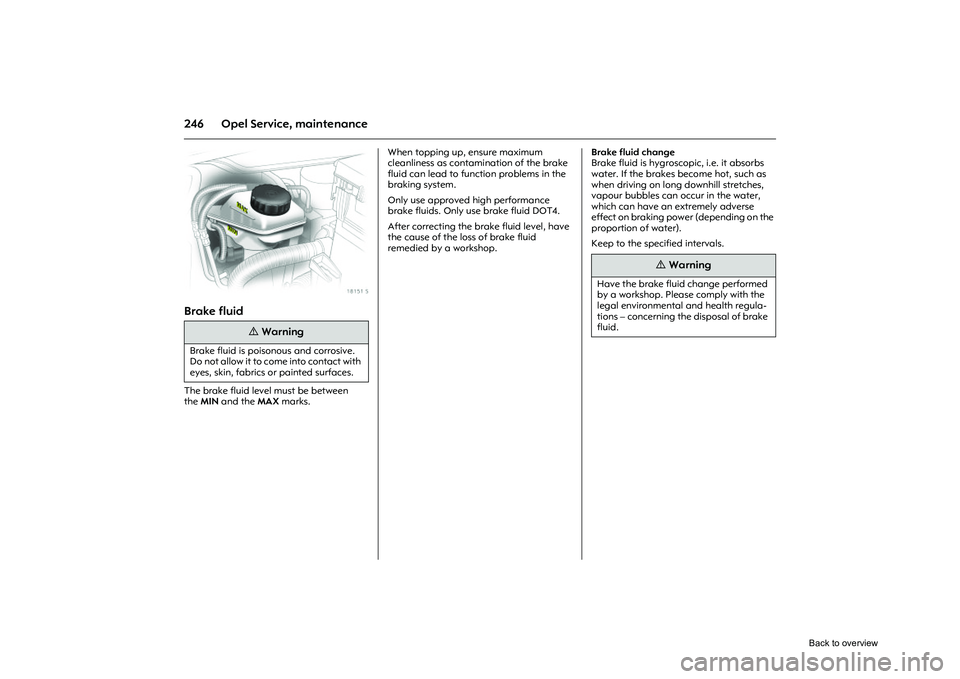
Brake fluid The brake fluid level must be between
theMIN and the MAX marks. When topping up, ensure maximum
cleanliness as contamination of the brake
fluid can lead to func
tion problems in the
braking system.
Only use approved high performance
brake fluids. Only us e brake fluid DOT4.
After correcting the brake fluid level, have
the cause of the loss of brake fluid
remedied by a workshop. Brake fluid change
Brake fluid is hygroscopic, i.e. it absorbs
water. If the brakes become hot, such as
when driving on long downhill stretches,
vapour bubbles can occur in the water,
which can have an extremely adverse
effect on braking power (depending on the
proportion of water).
Keep to the specified intervals.
9
Warning
Brake fluid is poisonous and corrosive.
Do not allow it to come into contact with
eyes, skin, fabrics or painted surfaces.
9
Warning
Have the brake fluid change performed
by a workshop. Please comply with the
legal environmental and health regula-
tions – concerning the disposal of brake
fluid.
Back to overview
Page 255 of 284

249
Opel Service, maintenance
Protecting electronic components In order to prevent faults in electronic
components in the electrical system, never
connect or disconnect battery with engine
running or ignition switched on. Never start
engine with battery disconnected, e.g.
when starting using jump leads.
To avoid damaging th e vehicle, do not
make any modifications to the electrical
system, e. g. connecting additional
consumers or tampering with electronic
control units (chip tuning).
Laying the vehicle up for a long
period of time If the vehicle is to be laid up for several
months, the following work should be
undertaken to prevent damage:
z Wash and wax the vehicle 3228.
z Have the wax in the engine
compartment and underbody checked.
z Clean and preserve rubber seals.
z Change engine oil.
z Check antifreeze and corrosion
protection 3244.
z Check coolant level, add antifreeze if
necessary 3245.
z Drain the windscreen washer system.
z Increase tyre pressure to value given for
full load 3264. z
Park the vehicle in dry and well
ventilated place. Select first gear or
reverse gear, and with automatic
transmission 3 move selector lever to P.
Use chocks or something similar to
prevent vehicle from rolling.
z Do not apply hand brake.
z Disconnect the clamp from the negative
terminal of the vehicle battery.
Putting the vehicle back into
servicePerform the following work before
recommissioning the vehicle:
zConnect the clamp to the negative
terminal of the vehicle battery.
z Check tyre pressure 3264.
z Top up windscreen washer system 3248.
z Check engine oil level 3242.
z Check coolant level 3245.
z Fit the number plate if necessary.
9
Warning
Electronic ignition systems generate very
high voltages. Do not touch the ignition
system; high voltage can be fatal.
Back to overview
Page 258 of 284

252 Technical DataEngine data Sales designation
Engine identifier code1.0
Z 10 XEP1.2
Z 12 XEP 1.4
Z 14 XEP 1.6
Z 16 LEL 1.6 OPC
Z 16 LER
Number of cylinders 3 4 4 4 4
Piston displacement [cm
3] 9981229 13641598 1598
Brake horse power [kW/bhp] at rpm 44
560059
5600 66
5600 110
5000 141
5850
Torque [Nm] at rpm 88
3800110
4000 125
4000210
1850 to 5000 230
1980 to 5850
Fuel type PetrolPetrol PetrolPetrol Petrol
Octane rating RON
1)
recommended
possible
possible1)Standard high-quality fuels, e.g. unleaded DIN EN 228; N = Normal (Regular), S = Super (Premium), SP = Super Plus (Premium Plus ); value printed in
bold: recommended fuel.
95 (S)
2)
98 (SP)
2)
91 (N)
2)3)
2)Knock control system automatically adjusts ignition timing according to type of fuel used (octane number).
95 (S)
2)
98 (SP)
2)
91 (N)
2)3)
95 (S)
2)
98 (SP)
2)
91 (N)
2)3)
3)Use of 91 RON fuel reduces power and torque. Slight increase in fuel consumption.
95 (S)
2)4)
98 (SP)2)
–
5)
4)Use of 95 RON fuel reduces power and torque. Slight increase in fuel consumption.
95 (S)
2)4)
98 (SP)
2)
–
5)
5)91 RON fuel must not be used. Max. permissible engine speed,
continuous operation (rpm) approx. 6200 6200 6200 6500 6500
Oil consumption [l/1000 km] 0.6 0.6 0.6 0.6 0.6
Back to overview
Page 259 of 284
![OPEL CORSA 2009 Workshop Manual 253
Technical Data
Engine data Sales designation
Engine identifier code 1.3 CDTI
Z 13 DTJ1.3 CDTI
Z 13 DTH1.7 CDTI
Z 17 DTR
Number of cylinders 4 4 4
Piston displacement [cm
3 ] 1248 12481686
Brake h](/img/37/58224/w960_58224-258.png "OPEL CORSA 2009 Workshop Manual 253
Technical Data
Engine data Sales designation
Engine identifier code 1.3 CDTI
Z 13 DTJ1.3 CDTI
Z 13 DTH1.7 CDTI
Z 17 DTR
Number of cylinders 4 4 4
Piston displacement [cm
3 ] 1248 12481686
Brake h")
253
Technical Data
Engine data Sales designation
Engine identifier code 1.3 CDTI
Z 13 DTJ1.3 CDTI
Z 13 DTH1.7 CDTI
Z 17 DTR
Number of cylinders 4 4 4
Piston displacement [cm
3 ] 1248 12481686
Brake horse power [kW/bhp] at rpm 55
400066
400092
4000
Torque [Nm] at rpm 170
1750 to 2500200
1750 to 2500280
2300
Fuel type DieselDieselDiesel
Cetane requirement [CZ]1)
1)standard high-quality fuels; Di esel DIN EN 590; D = Diesel.
49 (D)
2)
2)A lower value is possible with winter diesel fuels.
49 (D)
2)
49 (D)
2)
Max. permissible engine speed,
continuous operation (rpm) approx. 5100 5100 4730
Oil consumption [l/1000 km] 0.6 0.6 0.6
Back to overview
Page 272 of 284
![OPEL CORSA 2009 Workshop Manual 266 Technical DataTyre pressure (overpressure) Passenger vehicle, vanSuspension behaviour when
loaded with up to 3 people
[kPa/bar] ECO
1) when loaded with up
to 3 people [kPa/bar]
1)To achieve the](/img/37/58224/w960_58224-271.png "OPEL CORSA 2009 Workshop Manual 266 Technical DataTyre pressure (overpressure) Passenger vehicle, vanSuspension behaviour when
loaded with up to 3 people
[kPa/bar] ECO
1) when loaded with up
to 3 people [kPa/bar]
1)To achieve the")
266 Technical DataTyre pressure (overpressure) Passenger vehicle, vanSuspension behaviour when
loaded with up to 3 people
[kPa/bar] ECO
1) when loaded with up
to 3 people [kPa/bar]
1)To achieve the smallest amount of fuel consumption possible. Not for use with run-flat tyres.
Tyre pressure when fully laden
[kPa/bar]
Engine Tyres Front Rear Front Rear Front Rear
Z 13 DTJ 185/70 R14
2),
185/65 R 15,
195/55 R16,
195/55 RF 16,
195/60 R 15,
215/45 R 173)
2)Only with 14-inch brake.3)Not with low-pollution version.
200/2.0 180/1.8 270/2.7 250/2.5 260/2.6 320/3.2
185/60 R15
4)
4)Only approved as winter tyres.
220/2.2 180/1.8 – –260/2.6 320/3.2
Z 13 DTJ
ECO 175/70 R14 220/2.2 200/2.0 270/2.7 250/2.5 260/2.6
320/3.2
Z 13 DTH 185/65 R 15, 195/55 R16,
195/55 RF 16,
195/60 R 15,
215/45 R 17 220/2.2 200/2.0 270/2.7 250/2.5 260/2.6
320/3.2
185/60 R15
4)
240/2.4 200/2.0 – –260/2.6 320/3.2
Z 17 DTR 185/65 R 15, 195/55 R16,
195/55 RF 16,
195/60 R 15,
215/45 R 17 240/2.4 220/2.2 270/2.7 250/2.5 260/2.6
320/3.2
185/60 R15
4)
260/2.6 220/2.2 – –260/2.6 320/3.2
Back to overview
Page 276 of 284
270 IndexIndex
AABS (Anti-lock Brake System) ............... 166
Accessories ....................................... 63, 196
Accessory socket ..................................... 80
Adaptive Forward Lighting (AFL) .. 23, 112Bulb replacement .............................. 216
Driving abroad ................................... 117
Adaptive Forward Lighting = AFL ................................ 23, 112
Air conditioning system ................ 120, 126
Air intake ................................................ 135
Air recirculation system ......................... 126
Air vents ................................................. 122
Airbag systems which can be deactivated .......................... 19, 75, 88
Airbags ..................................................... 69
Alarm system ........................................... 37
Alternator ................................................. 87
Antenna ......................................... 118, 228
Antifreeze ............................................... 244 Antifreeze protection .................... 244, 248
Anti-theft alarm system .......................... 37
Anti-theft locking system ........................ 33
Towing equipment ............................ 186
Anti-theft protection ............................... 17
Aquaplaning .......................................... 170
Ashtray ..................................................... 81
Automatic Anti-dazzle interior mirror .................. 44
Automatic transmission .......................... 15 automatic mode ................................ 145
Driving programme ........................... 146
Fault ................................................... 148
Interruption of power supply ............ 148
Kickdown ............................................ 146
Selector lever ............................... 15, 145
Winter programme ............................ 146
Automatic wiping .................................. 106
Auxiliary heater ..................................... 134
Back to overview
Page 277 of 284

271
Index
BBattery ............................................ 150, 248Interruption of
power supply ........................46, 143, 148
Battery discharge protection ................ 116
Before starting off ................................... 15
Belt force limiters ..................................... 59
Belt tensioners .......................................... 60
Bleeding, diesel fuel system .................. 190
Bonnet .................................................... 190
Boot, see Luggage co mpartment .... 36, 53
Brake assist ............................................ 167
Brake lamp ............................................. 166
Brake system ............................................ 89
Brakes ABS ...................................................... 166
Brake assist ........................................ 167
Brake fluid .......................................... 246
Brake lamps ....................................... 221
Brake servo unit ................................. 149
Foot brake .......................................... 167
Hand brake ........................................ 167
Bulb replacement .................................. 212
Bulbs ....................................................... 212
CCapacities .............................................. 267
Car dimensions ...................................... 268
Car Pass ................................................... 26
Caravan/trailer towing .......................... 149
Care ........................................................ 228
Catalytic converter ................................ 158
Central locking system ...................... 28, 32
Changing the battery Remote control .............................. 32, 33
Changing tyre/wheel type .................... 168
Changing wheels ................................... 200
Chassis number, see vehicle identification number .......................... 251
Check control ................................... 21, 104
Child restraint system .............................. 63
Child safety locks ..................................... 39
Cigarette lighter ...................................... 80
Climate control ...................................... 120
Climate control system ................. 121, 128
Clutch operation .................................... 144
CO
2-emissions ........................................ 256
Cold start ............................................... 150
Colour information display ..................... 94
Contrast .................................................. 100
Control indicator ABS (Anti-lock Brake System) ........... 166
Airbag ................................................... 74
Engine electronics .............................. 156
Exhaust ............................................... 156
Immobiliser ........................................... 27
Park pilot ............................................ 163 Control indicators .............................. 10, 86
Adaptive Forward
Lighting (AFL) .............................. 85, 112
Belt tensioners ..................................... 61
Brake system ...................................... 165
Cruise control ..................................... 161
DDS ..................................................... 164
Deflation detection system ............... 164
ESP (Electronic Stability Program) .... 151
Seat belts ............................................. 59
Coolant .................................................. 244
Coolant level .......................................... 245
Coolant temperature .............................. 87
Cooling ................................................... 127
Cornering light ....................................... 112 Bulb replacement .............................. 218
Correcting time ........................................ 99
Coupling socket load ............................ 188
Courtesy lamp ............................... 114, 115
Courtesy lamps Bulb replacement .............................. 226
Cruise control ......................................... 160
Curtain airbags ....................................... 73
Curve lighting .................................. 23, 112
Back to overview