ignition OPEL CORSA 2009 Repair Manual
[x] Cancel search | Manufacturer: OPEL, Model Year: 2009, Model line: CORSA, Model: OPEL CORSA 2009Pages: 284, PDF Size: 4.96 MB
Page 146 of 284
140 Driving and operation
Picture no: 18228s.tif
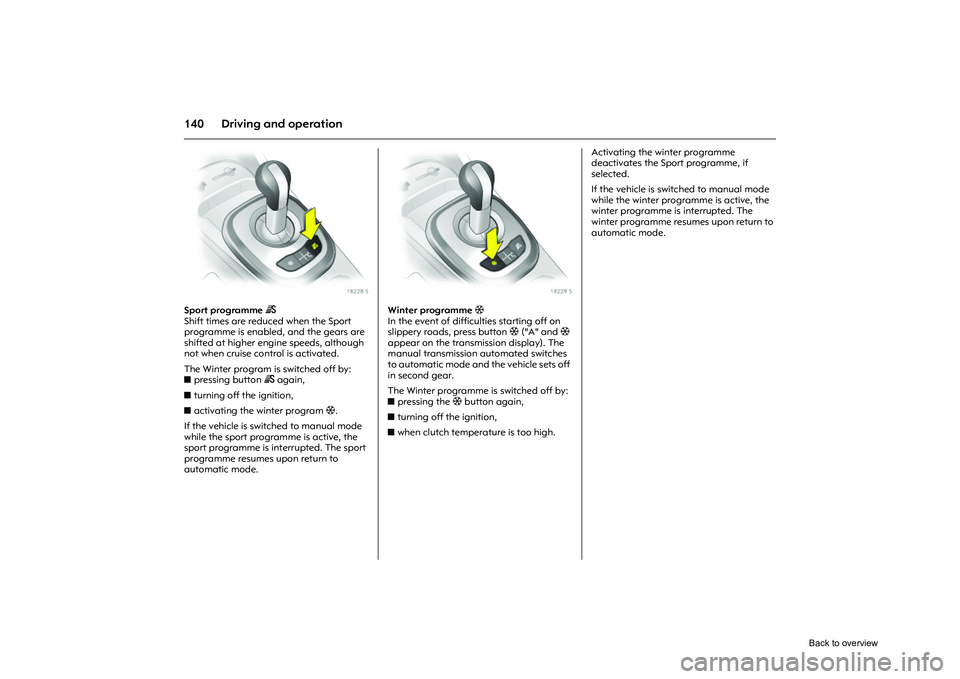
Sport programme =
Shift times are reduced when the Sport
programme is enabled, and the gears are
shifted at higher engine speeds, although
not when cruise control is activated.
The Winter program is switched off by:
z pressing button = again,
z turning off the ignition,
z activating the winter program T .
If the vehicle is switched to manual mode
while the sport programme is active, the
sport programme is in terrupted. The sport
programme resumes upon return to
automatic mode.
Picture no: 18229s.tif
Winter programme T
In the event of difficulties starting off on
slippery roads, press button T ("A" and T
appear on the transmission display). The
manual transmission automated switches
to automatic mode and the vehicle sets off
in second gear.
The Winter programme is switched off by:
z pressing the T button again,
z turning off the ignition,
z when clutch temperature is too high. Activating the winter programme
deactivates the Sport programme, if
selected.
If the vehicle is switched to manual mode
while the winter prog
ramme is active, the
winter programme is interrupted. The
winter programme resumes upon return to
automatic mode.
Back to overview
Page 148 of 284
142 Driving and operation
Picture no: 18230s.tif
Manoeuvring the vehicle
To manoeuvre the vehicle back and forth
during attempts to park or in garage
entrances the creeping movement can be
utilised by releasing the foot brake.
Never actuate accelerator and brake
pedals simultaneously.
To prevent damage, the manual
transmission automated deactivates the
"creep function" when the temperature of
the automatic clutch is extremely high. Vehicle storage
Apply the handbrake and remove the key
from the ignition. The most recently
engaged gear (indicator in transmission
display) remains engaged. With
N, no gear
is engaged.
When the ignition is switched off the
manual transmission automated no longer
responds to movement of the selector
lever.
Lock the vehicle. Otherwise the battery
may become discharged if the vehicle is
parked for long periods.
If the hand brake has not been applied, the
control indicator R flashes for a few
seconds after the ignition is switched off.
With the engine off and the hand brake not
applied, when the driver ’s door is opened a
warning buzzer sounds and the control
indicator R flashes; switch on ignition,
engage gear, switch off ignition and apply
hand brake.
Picture no: 18231s.tif
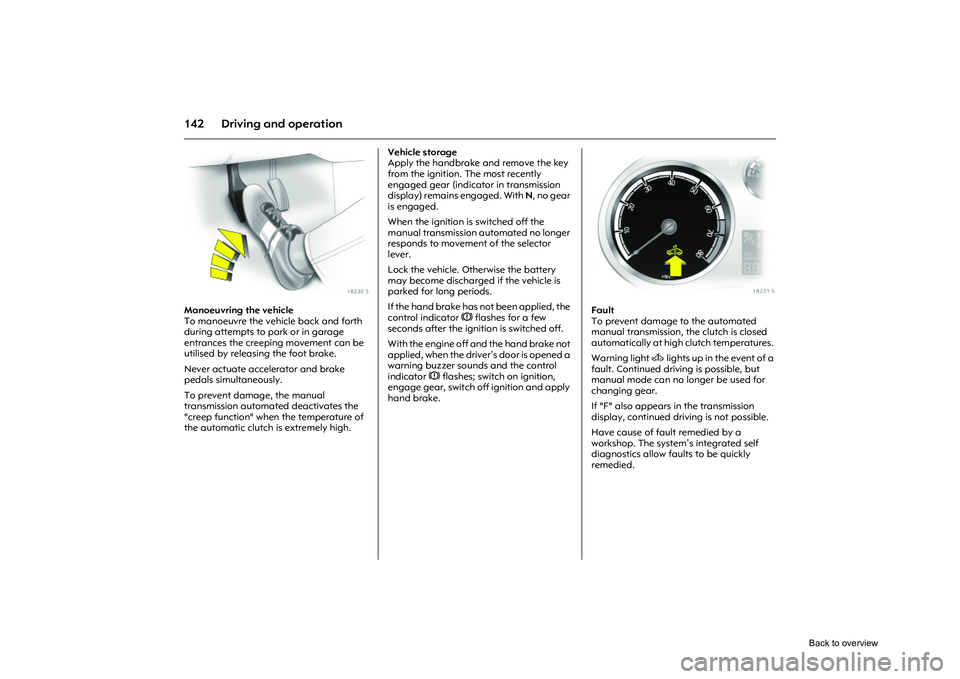
Fault
To prevent damage to the automated
manual transmission, the clutch is closed
automatically at high clutch temperatures.
Warning light A lights up in the event of a
fault. Continued driving is possible, but
manual mode can no longer be used for
changing gear.
If "F" also appears in the transmission
display, continued driving is not possible.
Have cause of fault remedied by a
workshop. The system’s integrated self
diagnostics allow faults to be quickly
remedied.
Back to overview
Page 149 of 284
143
Driving and operation
Picture no: 18308s.tif
Interruption of power supply
The clutch is not disengaged if there is an
interruption of the power supply when a
gear is engaged. The vehicle cannot move.
If the battery is flat, start the car using
jump leads 3191. If the cause of the power supply
interruption is not a flat battery, contact a
workshop for assistance. If the vehicle has
to be moved out of flowing traffic,
disengage clutch as follows:
1. Apply hand brake and switch off
ignition.
2. Open bonnet and engage support.
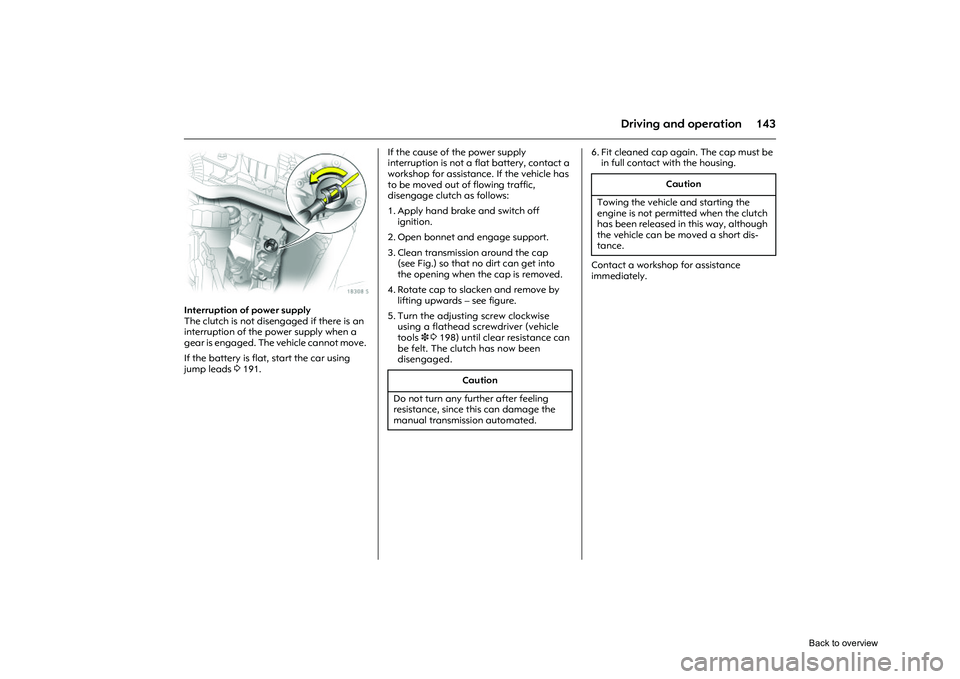
3. Clean transmission around the cap (see Fig.) so that no dirt can get into
the opening when the cap is removed.
4. Rotate cap to slacken and remove by lifting upwards – see figure.
5. Turn the adjusting screw clockwise using a flathead screwdriver (vehicle
tools 3 3198) until clear resistance can
be felt. The clutch has now been
disengaged. 6. Fit cleaned cap again. The cap must be
in full contact with the housing.
Contact a workshop for assistance
immediately.
Caution
Do not turn any further after feeling
resistance, since this can damage the
manual transmission automated.
Caution
Towing the vehicle and starting the
engine is not permitted when the clutch
has been released in this way, although
the vehicle can be moved a short dis-
tance.
Back to overview
Page 151 of 284
145
Driving and operation
Picture no: 18233s.tif
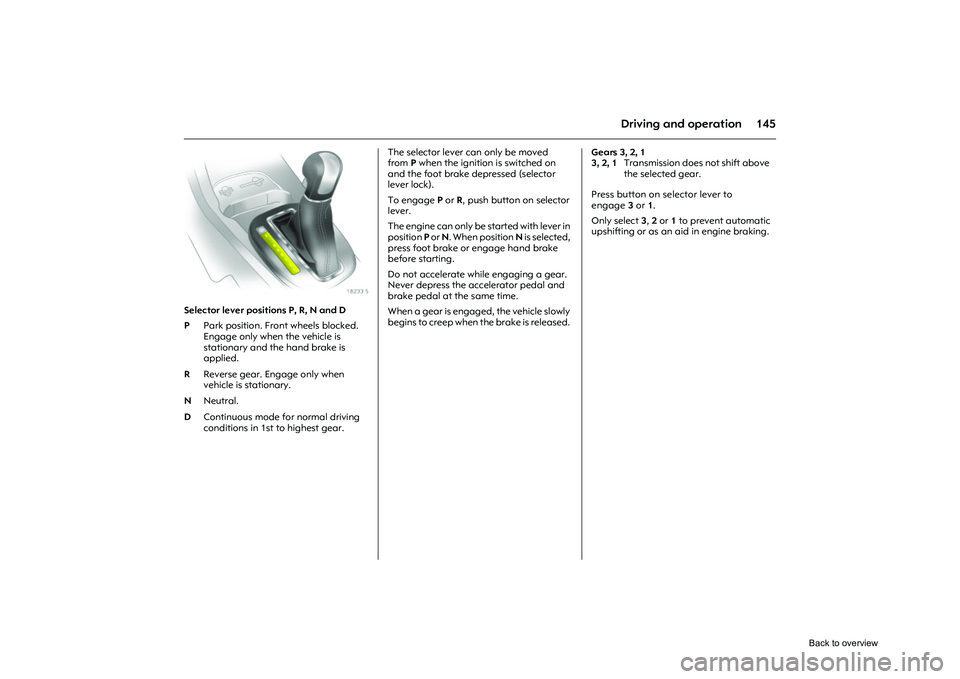
Selector lever positions P, R, N and D The selector lever can only be moved
from
P when the ignition is switched on
and the foot brake depressed (selector
lever lock).
To engage P or R, push button on selector
lever.
The engine can only be started with lever in
position P or N . When position N is selected,
press foot brake or engage hand brake
before starting.
Do not accelerate while engaging a gear.
Never depress the accelerator pedal and
brake pedal at the same time.
When a gear is engaged, the vehicle slowly
begins to creep when the brake is released. Gears 3, 2, 1
Press button on selector lever to
engage
3or 1.
Only select 3, 2 or 1 to prevent automatic
upshifting or as an aid in engine braking.
P Park position. Fron t wheels blocked.
Engage only when the vehicle is
stationary and the hand brake is
applied.
R Reverse gear. Engage only when
vehicle is stationary.
N Neutral.
D Continuous mode for normal driving
conditions in 1st to highest gear.
3, 2, 1 Transmission does not shift above
the selected gear.
Back to overview
Page 152 of 284

146 Driving and operationElectronically controlled driving
programmes
zThe automatic neutral shift function
automatically shifts to idling when the
vehicle is stopped with a forward gear
engaged (depending on transmission
fluid temperature).
z Following a cold start, the operating
temperature programme increases
engine speed to quickly bring the
catalytic converter to the required
temperature.
z The adaptive program automatically
adjusts the gear change to the driving
conditions, e.g. greater load or gradients.
Picture no: 18234s.tif
Winter programme T
Activate the Winter pr ogramme if you have
problems starting off on a slippery road
surface.
To activate Press the T button with P , R , N , D or 3
engaged. The vehicle starts off in 3rd gear.
To deactivate The Winter programme is switched off by:
z pressing the T button again,
z manually selecting 2 or 1 ,
z turning off the ignition,
z or if the transmission oil temperature is
too high.
Picture no: 18451s.tif
Kickdown
If the accelerator pedal is pressed past the
pressure point, the transmission shifts to a
lower gear depending on engine speed.
Back to overview
Page 153 of 284
147
Driving and operation
Engine braking
In order to utilise the engine braking
effect when driving downhill, select drive
range 3,2 or, if necessary, 1 in good time.
Gear 1 has the greatest braking effect. If
gear 1 is selected at too great a speed
the transmission remains in 2nd until the
shifting point for 1st gear is achieved by
braking, for example.
"Rocking the car"
If it becomes necessary to rock the vehicle
to free it from sand, mud, snow or a hole,
move the selector lever from D to R
repeatedly. Do not race the engine and
avoid sudden acceleration.
Picture no: 18230s.tif
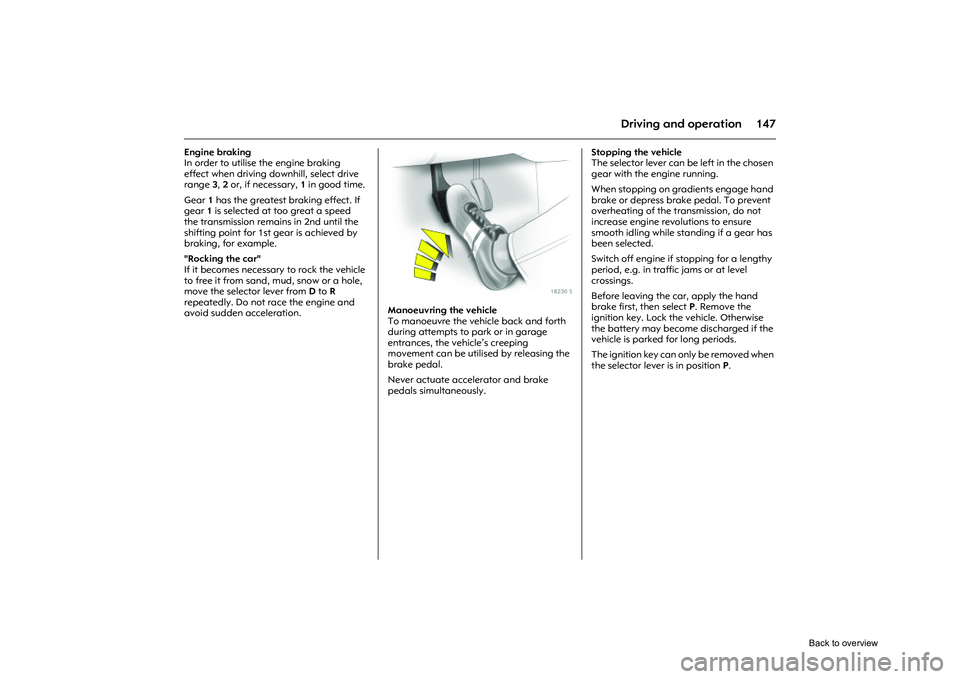
Manoeuvring the vehicle
To manoeuvre the vehicle back and forth
during attempts to park or in garage
entrances, the vehicle’s creeping
movement can be utilis ed by releasing the
brake pedal.
Never actuate accelerator and brake
pedals simultaneously. Stopping the vehicle
The selector lever can be left in the chosen
gear with the engine running.
When stopping on gr
adients engage hand
brake or depress brake pedal. To prevent
overheating of the transmission, do not
increase engine revolutions to ensure
smooth idling while standing if a gear has
been selected.
Switch off engine if stopping for a lengthy
period, e.g. in traffic jams or at level
crossings.
Before leaving the car, apply the hand
brake first, then select P. Remove the
ignition key. Lock the vehicle. Otherwise
the battery may become discharged if the
vehicle is parked for long periods.
The ignition key can only be removed when
the selector lever is in position P.
Back to overview
Page 160 of 284
154 Driving and operation
Picture no: 18310s.tif
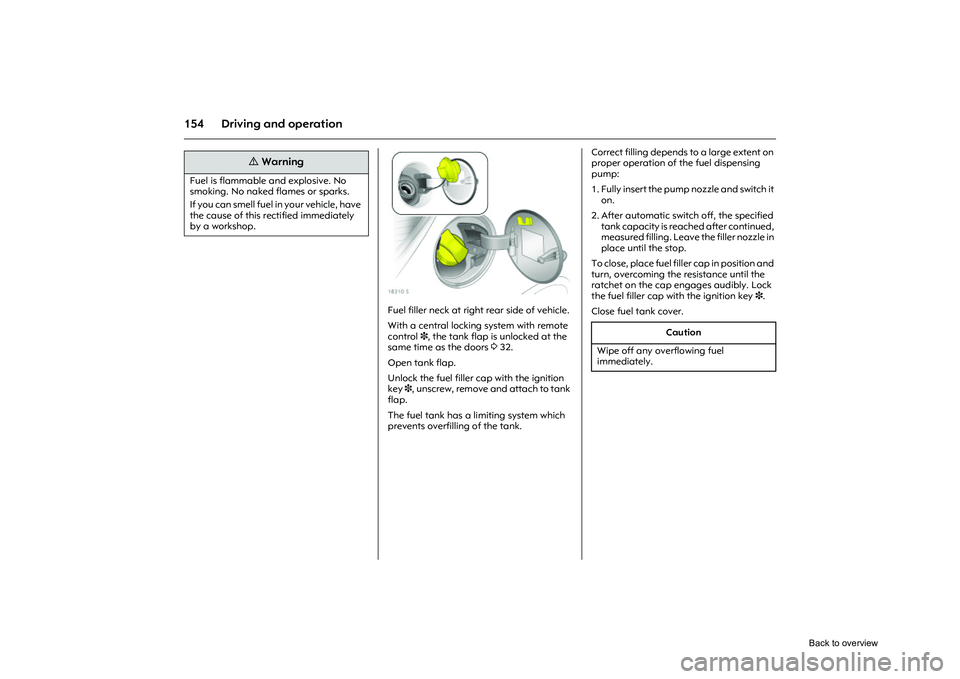
Fuel filler neck at right rear side of vehicle.
With a central locking system with remote
control 3, the tank flap is unlocked at the
same time as the doors 332.
Open tank flap.
Unlock the fuel filler cap with the ignition
key 3, unscrew, remove and attach to tank
flap.
The fuel tank has a limiting system which
prevents overfilling of the tank. Correct filling depends to a large extent on
proper operation of the fuel dispensing
pump:
1. Fully insert the pump nozzle and switch it
on.
2. After automatic switch off, the specified tank capacity is reached after continued,
measured filling. Leave the filler nozzle in
place until the stop.
To close, place fuel fill er cap in position and
turn, overcoming the resistance until the
ratchet on the cap engages audibly. Lock
the fuel filler cap with the ignition key 3.
Close fuel tank cover.
9
Warning
Fuel is flammable and explosive. No
smoking. No naked flames or sparks.
If you can smell fuel in your vehicle, have
the cause of this rectified immediately
by a workshop.
Caution
Wipe off any overflowing fuel
immediately.
Back to overview
Page 161 of 284
155
Driving and operation
Picture no: 17199t.tif
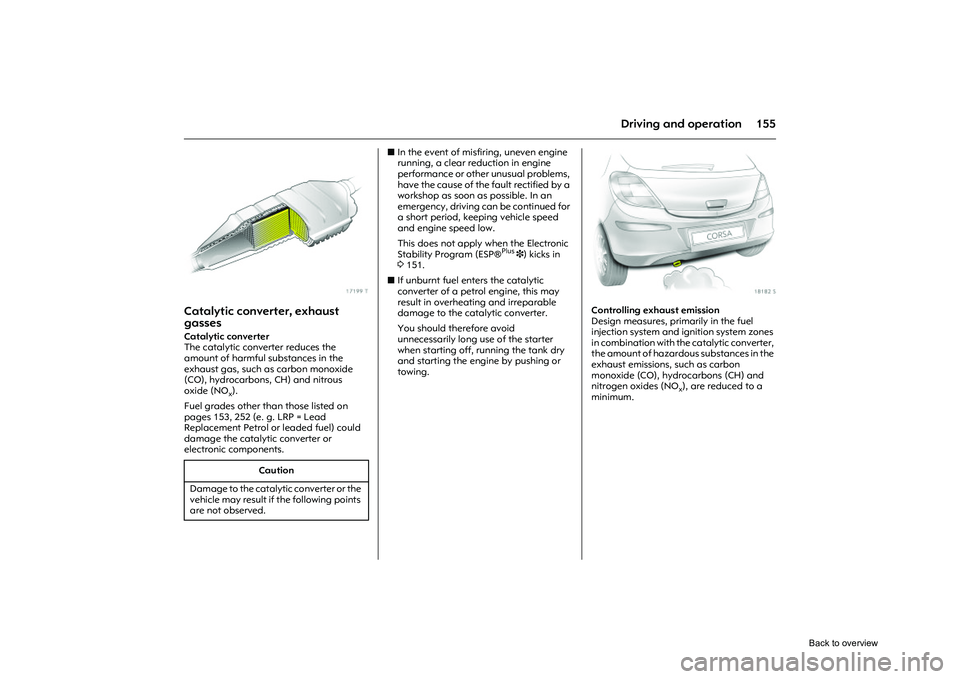
Catalytic converter, exhaust
gassesCatalytic converter
The catalytic converter reduces the
amount of harmful substances in the
exhaust gas, such as carbon monoxide
(CO), hydrocarbons, CH) and nitrous
oxide (NO
x).
Fuel grades other than those listed on
pages 153, 252 (e. g. LRP = Lead
Replacement Petrol or leaded fuel) could
damage the catalytic converter or
electronic components. z
In the event of misfiring, uneven engine
running, a clear reduction in engine
performance or other unusual problems,
have the cause of the fault rectified by a
workshop as soon as possible. In an
emergency, driving can be continued for
a short period, keeping vehicle speed
and engine speed low.
This does not apply when the Electronic
Stability Program (ESP®
Plus
3) kicks in
3 151.
z If unburnt fuel enters the catalytic
converter of a petrol engine, this may
result in overheating and irreparable
damage to the catalytic converter.
You should therefore avoid
unnecessarily long use of the starter
when starting off, running the tank dry
and starting the engine by pushing or
towing.
Picture no: 18182s.tif
Controlling exhaust emission
Design measures, primarily in the fuel
injection system and ignition system zones
in combination with the catalytic converter,
the amount of hazardous substances in the
exhaust emissions, such as carbon
monoxide (CO), hydrocarbons (CH) and
nitrogen oxides (NO
x), are reduced to a
minimum.
Caution
Damage to the catalytic converter or the
vehicle may result if the following points
are not observed.
Back to overview
Page 162 of 284

156 Driving and operation
Picture no: 18251s.tif
Control indicator
Z for exhaust
Illuminates when the ignition is switched on
and during the start attempt. Goes off
shortly after the engine starts running.
Illumination whilst the engine is running
indicates a fault in the emission control
system. The permissible emission limits
may be exceeded. Contact a workshop for
assistance immediately.
Illumination with the engine running
indicates a fault that can cause damage to
the catalytic converter. It is possible to
continue driving without causing damage
by slowing down until the flashing stops
and the control indicator illuminates.
Contact a workshop for assistance
immediately.
Picture no: 18231s.tif
Control indicator
A
for engine electronics
Illuminates for a few seconds after the
ignition is switched on.
If it illuminates when the engine is running,
there is a fault in engine or transmission
electronics. The electr onic system switches
to an emergency runni ng programme. Fuel
consumption may be increased and the
driveability of the vehicle may be impaired.
In some cases the fault can be remedied by
switching the engine off and starting it
again. If the control indicator continues to
illuminate whilst the en gine is running,
contact a workshop for assistance in
remedying the cause of the fault. If it illuminates briefly, but does not recur, it
is of no significance.
If
A lights up, this could mean that there
is water in the diesel fuel filter 3. A
message appears at the same time on the
service display 391. Have the fuel filter
checked for possible water contamination
by a workshop.
If it flashes after the ignition is switched on,
there is a fault in the immobiliser system.
The engine cannot be started 327.
Back to overview
Page 164 of 284

158 Driving and operation
Picture no: 18540t.tif
We recommend not stopping driving
during cleaning, and not switching off the
ignition. Cleaning is fa stest at high engine
revs and high loads.
Picture no: 18545s.tif
The control indicator
! goes off as soon as
the self-cleaning operation is complete. Maintenance
Have all maintenance work carried out at
the specified intervals. We recommend
that you entrust this work to your Opel
Partner, who has proper equipment and
trained personnel available. Electronic
testing systems permit rapid diagnosis and
remedy of faults. This way you can be
certain that all components of the vehicle’s
electrical, injection and ignition systems
operate correctly, that your vehicle has a
low level of pollutant emission and that the
catalytic converter system will have a long
service life.
You are thereby making an important
contribution towards keeping the air clean
and compliance with emissions legislation.
Checking and adjustment of the fuel-
injection and ignition systems is included in
the inspection. For this reason, you should
have all maintenance work carried out at
the intervals specified in your Service and
Warranty Booklet.
Back to overview