Electric OPEL CORSA E 2017.5 User Guide
[x] Cancel search | Manufacturer: OPEL, Model Year: 2017.5, Model line: CORSA E, Model: OPEL CORSA E 2017.5Pages: 269, PDF Size: 7.97 MB
Page 198 of 269

196Vehicle careBrakesIn the event of minimum thickness of
the brake lining, a squealing noise
sounds during braking.
Continued driving is possible but
have the brake lining replaced as
soon as possible.
Once new brake linings are installed,
do not brake unnecessarily hard for
the first few journeys.
Brake fluid9 Warning
Brake fluid is poisonous and
corrosive. Avoid contact with eyes, skin, fabrics and painted surfaces.
The brake fluid level must be betweenthe MIN and MAX marks.
If fluid level is below the MIN mark,
seek the assistance of a workshop.
Brake and clutch fluid 3 238.
Vehicle battery
The vehicle battery is maintenance-
free provided that the driving profile
allows sufficient charging of the
battery. Short-distance-driving and
frequent engine starts can discharge
the vehicle battery. Avoid the use of
unnecessary electrical consumers.
Batteries do not belong in household
waste. They must be disposed of at
an appropriate recycling collection
point.
Laying up the vehicle for more than
four weeks can lead to vehicle battery
discharge. Disconnect the clamp from
the negative terminal of the vehicle
battery.
Ensure the ignition is switched off
before connecting or disconnecting
the vehicle battery.
Battery discharge protection 3 122.
Disconnecting the battery If the vehicle's battery is to be
disconnected (e.g. for maintenance
work), the alarm siren must be
deactivated as follows: Switch the
ignition on then off, then disconnect
the vehicle's battery within
15 seconds.
Page 203 of 269
Vehicle care201Sidelight/daytime running light
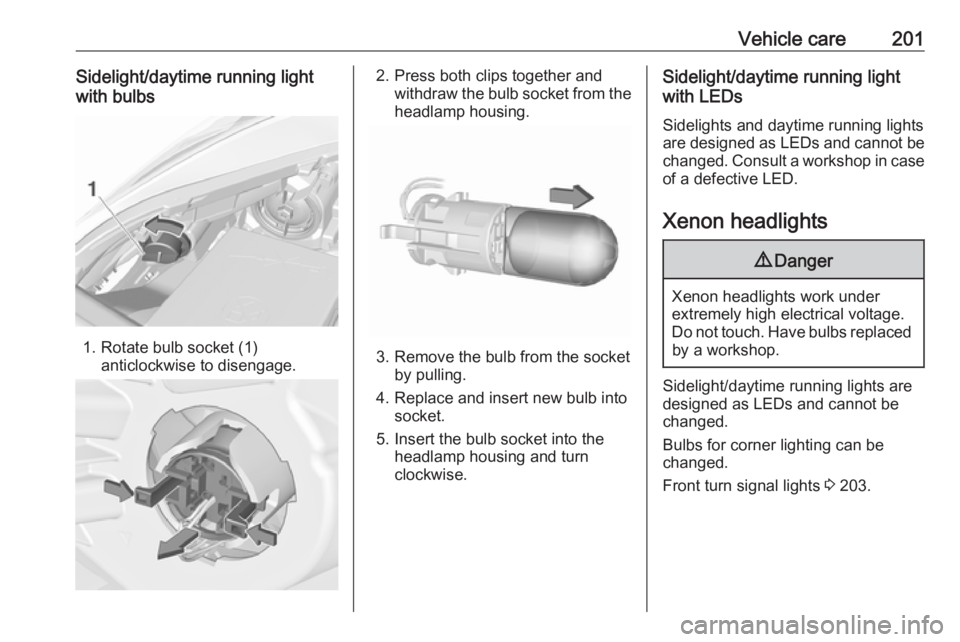
with bulbs
1. Rotate bulb socket (1) anticlockwise to disengage.
2. Press both clips together andwithdraw the bulb socket from theheadlamp housing.
3. Remove the bulb from the socket by pulling.
4. Replace and insert new bulb into socket.
5. Insert the bulb socket into the headlamp housing and turn
clockwise.
Sidelight/daytime running light
with LEDs
Sidelights and daytime running lights
are designed as LEDs and cannot be
changed. Consult a workshop in case
of a defective LED.
Xenon headlights9 Danger
Xenon headlights work under
extremely high electrical voltage.
Do not touch. Have bulbs replaced by a workshop.
Sidelight/daytime running lights are
designed as LEDs and cannot be
changed.
Bulbs for corner lighting can be
changed.
Front turn signal lights 3 203.
Page 209 of 269
Vehicle care207Electrical system
Fuses Data on the replacement fuse must
match the data on the defective fuse.
There are two fuse boxes in the
vehicle:
● in the front left of the engine compartment
● in left-hand drive vehicles, behind
the light switch, or, in right-hand
drive vehicles, behind the
glovebox
Before replacing a fuse, turn off the
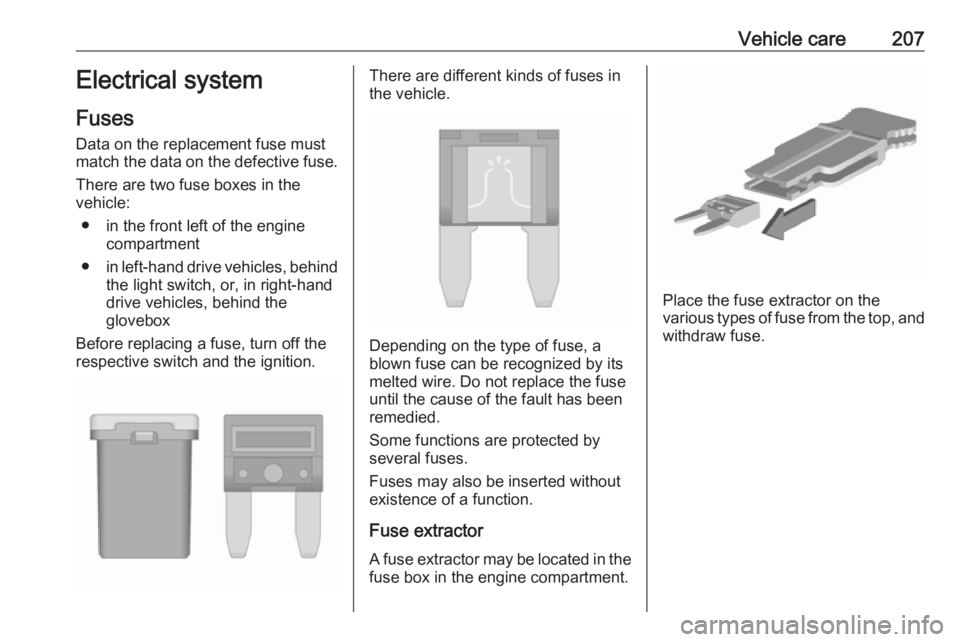
respective switch and the ignition.There are different kinds of fuses in
the vehicle.
Depending on the type of fuse, a
blown fuse can be recognized by its
melted wire. Do not replace the fuse until the cause of the fault has been
remedied.
Some functions are protected by
several fuses.
Fuses may also be inserted without existence of a function.
Fuse extractorA fuse extractor may be located in the
fuse box in the engine compartment.
Place the fuse extractor on the
various types of fuse from the top, and withdraw fuse.
Page 223 of 269

Vehicle care221If you have a flat tyre:
Apply the parking brake and engage first gear, reverse gear or P.
The tyre repair kit is stowed in the load
compartment.
Depending on the equipment, the tyre repair kit is in a compartment in the
right sidewall or in a compartment
under the floor cover.
Vehicles with tyre repair kit under
the floor cover
1. Take the tyre repair kit from the compartment.
2. Remove the compressor.
3. Remove the electrical connection cable and air hose from the
stowage compartments on the
underside of the compressor.
4. Screw the compressor air hose to
the connection on the sealant
bottle.
5. Fit the sealant bottle into the retainer on the compressor.
Set the compressor near the tyre
in such a way that the sealant
bottle is upright.
6. Unscrew valve cap from defective
tyre.
7. Screw the filler hose to the tyre valve.
8. The switch on the compressor must be set to J.
Page 232 of 269

230Vehicle careJump startingDo not start with a quick charger.
A vehicle with a discharged vehicle
battery can be started using jump
leads and the vehicle battery of
another vehicle.9 Warning
Be extremely careful when starting
with jump leads. Any deviation
from the following instructions can
lead to injuries or damage caused
by battery explosion or damage to the electrical systems of both
vehicles.
9 Warning
Avoid contact of the battery with
eyes, skin, fabrics and painted
surfaces. The fluid contains
sulphuric acid which can cause
injuries and damage in the event
of direct contact.
● Never expose the battery to naked flames or sparks.
● A discharged vehicle battery canalready freeze at a temperature
of 0 °C. Defrost the frozen battery
before connecting jump leads.
● Wear eye protection and protective clothing when
handling a battery.
● Use a booster battery with the same voltage (12 Volts). Its
capacity (Ah) must not be much less than that of the discharged
vehicle battery.
● Use jump leads with insulated terminals and a cross section of
at least 16 mm 2
(25 mm 2
for
diesel engines).
● Do not disconnect the discharged
vehicle battery from the vehicle.
● Switch off all unnecessary electrical consumers.
● Do not lean over the battery during jump starting.
● Do not allow the terminals of one
lead to touch those of the other
lead.
● The vehicles must not come into contact with each other during
the jump starting process.● Apply the parking brake, transmission in neutral,
automatic transmission in P.
● Open the positive terminal protection caps of both vehicle
batteries.
Lead connection order:
1. Connect the red lead to the positive terminal of the booster
vehicle battery.
2. Connect the other end of the red lead to the positive terminal of the
discharged vehicle battery.
Page 233 of 269
Vehicle care2313. Connect the black lead to thenegative terminal of the booster
vehicle battery.
4. Connect the other end of the black
lead to a vehicle grounding point,
such as the engine block or an
engine mounting bolt. Connect as far away from the discharged
vehicle battery as possible,
however at least 60 cm.
Route the leads so that they cannot
catch on rotating parts in the engine
compartment.
To start the engine: 1. Start the engine of the vehicle providing the jump.
2. After five minutes, start the other engine. Start attempts should be
made for no longer than
15 seconds at an interval of one
minute.
3. Allow both engines to idle for approx. three minutes with the
leads connected.4. Switch on electrical consumers (e.g. headlights, heated rear
window) of the vehicle receiving
the jump start.
5. Reverse above sequence exactly when removing leads.Towing
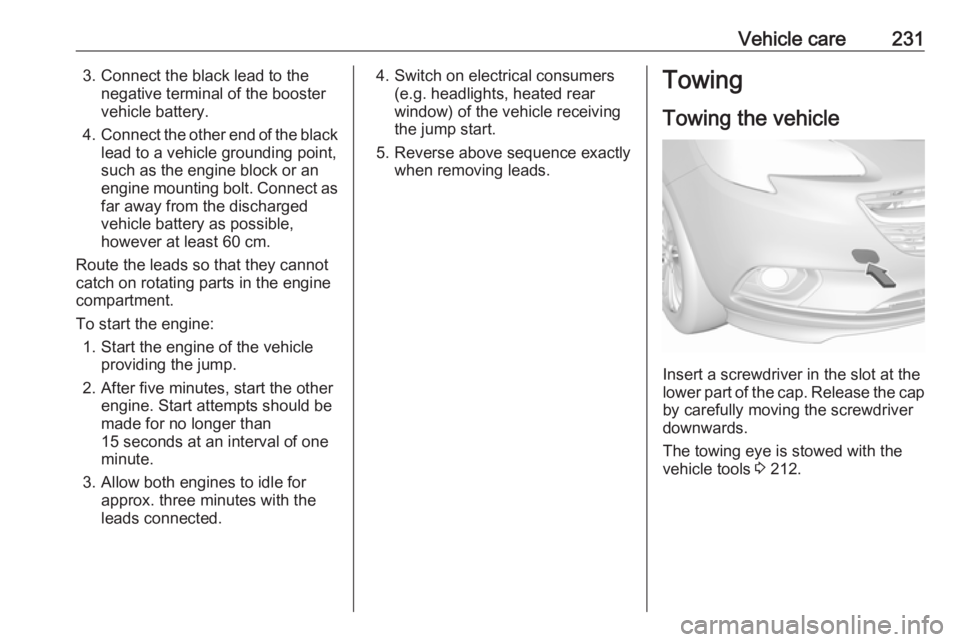
Towing the vehicle
Insert a screwdriver in the slot at the
lower part of the cap. Release the cap
by carefully moving the screwdriver
downwards.
The towing eye is stowed with the
vehicle tools 3 212.
Page 265 of 269
263Control indicators.......................... 88
Control of the vehicle .................134
Controls ........................................ 76
Convex shape .............................. 30
Coolant and antifreeze ...............238
Corner lighting ............................ 116
Cruise control ...................... 96, 154
Cupholders .................................. 57
Curtain airbag system .................. 49
D Danger, Warnings and Cautions ...4
Daytime running lights ...............116
Declaration of conformity ............255
Diesel fuel system bleeding .......198
Diesel particle filter ...............94, 140
Door open .................................... 96
Doors ............................................ 27
Driver assistance systems ..........154
Driver Information Centre .............97
Driving characteristics and towing tips .............................. 185
Driving hints ................................ 134
E Easy entry..................................... 39
Electric adjustment ......................30
Electrical system......................... 207
Electronic climate control system 126
Electronic driving programmes . ........................................ 143, 148Electronic Stability Control.......... 152
Electronic Stability Control and Traction Control system ............94
Electronic Stability Control off....... 94
End-of-life vehicle recovery .......192
Engine compartment fuse box ...208
Engine coolant ........................... 194
Engine coolant temperature gauge ....................................... 86
Engine data ............................... 245
Engine exhaust .......................... 140
Engine identification ...................241
Engine oil ................... 193, 238, 242
Engine oil pressure ......................95
Entry lighting .............................. 121
Event data recorders ..................259
Exit lighting ................................ 121
Exterior care .............................. 233
Exterior light ................................. 96
Exterior lighting ....................14, 113
Exterior mirrors ............................. 30
F
Fault ................................... 143, 148
First aid ......................................... 72
First aid kit ................................... 72
Fixed air vents ........................... 131
Flex-Fix system ............................ 59
Fog light ....................................... 96
Fog lights ................................... 202Folding mirrors ............................. 30
Following distance indication ......160
Forward collision alert................. 157
Front airbag system .....................47
Front fog lights ........................... 118
Front seats.................................... 37
Front storage ................................ 58
Front turn signal lights ...............203
Fuel............................................. 177
Fuel consumption - CO 2-
Emissions ............................... 184
Fuel for diesel engines ..............178
Fuel for liquid gas operation .......179
Fuel for petrol engines ...............177
Fuel gauge ................................... 85 Fuel selector ................................ 86
Fuses ......................................... 207
G Gauges ......................................... 83
Gear shifting ................................. 93
General information ...................185
Glovebox ..................................... 57
Graphic-Info-Display ...................102
H Halogen headlights ....................199
Hand brake ......................... 149, 150
Hazard warning flashers ............117
Headlight flash ........................... 115
Headlight range adjustment ......115