automatic transmission OPEL CORSA E 2018 Manual user
[x] Cancel search | Manufacturer: OPEL, Model Year: 2018, Model line: CORSA E, Model: OPEL CORSA E 2018Pages: 271, PDF Size: 7.99 MB
Page 159 of 271

Driving and operating157For safety reasons, the cruise control
cannot be activated until the brake
pedal has been operated once.
Activating in first gear is not possible.
Do not use the cruise control if it is not advisable to maintain a constant
speed.
On vehicles with automatic
transmission or manual transmission
automated cruise control can be
activated in automatic mode and
manual mode.
Control indicator m 3 97.
Switching on
Press m; control indicator m in
instrument cluster illuminates white.
Activation Accelerate to the desired speed and
turn thumb wheel to SET/-, the
current speed is stored and
maintained. Control indicator m in
instrument cluster illuminates green. Set speed is indicated on the display.
Accelerator pedal can be released.
Vehicle speed can be increased by
depressing the accelerator pedal. When the accelerator pedal is
released, the previously stored speed is resumed.
Cruise control remains activated
while gearshifting.
Increase speed
With cruise control active, hold thumb
wheel turned to RES/+ or briefly turn
to RES/+ repeatedly: speed
increases continuously or in small
increments.
Alternatively accelerate to the desired speed and store by turning to SET/-.
Reduce speed
With cruise control active, hold thumb
wheel turned to SET/- or briefly turn to
SET/- repeatedly: speed decreases
continuously or in small increments.
Page 219 of 271

Vehicle care217After inflating, some driving may be
required to update the tyre pressure
values in the Driver Information
Centre. During this time w may
illuminate.
If w illuminates at lower temperatures
and extinguishes after driving, this
could be an indicator for approaching
a low tyre pressure condition. Check
tyre pressure.
Vehicle messages 3 104.
If the tyre pressure must be reduced
or increased, switch off ignition.
Only mount wheels with pressure
sensors, otherwise the tyre pressure
will not be displayed and w
illuminates continuously.
A spare wheel or temporary spare
wheel is not equipped with pressure
sensors. The tyre pressure
monitoring system is not operational
for these tyres. Control indicator w
illuminates. For the further three
tyres, the system remains
operational.The use of commercially-available
liquid tyre repair kits can impair the
function of the system. Factory-
approved repair kits can be used.
Operating electronic devices or being close to facilities using similar wave
frequencies could disrupt the tyre
pressure monitoring system.
Each time the tyres are replaced, tyre pressure monitoring system sensors
must be dismounted and serviced.
For the screwed sensor; replace
valve core and sealing ring. For the
clipped sensor; replace complete
valve stem.
Vehicle loading status Adjust tyre pressure to load condition
according to the tyre information label or tyre pressure chart 3 255, and
select the appropriate setting in the menu Tyre Load in the Driver
Information Centre, Vehicle
Information Menu 3 98 . This setting is
the reference for the tyre pressure
warnings.The menu Tyre Load only appears
when the vehicle is at a standstill and the parking brake is applied. On
vehicles with automatic transmission,
the selector lever must be in P.
Midlevel display:
Select ● LO for comfort pressure up to
three people.
● ECO for Eco pressure up to
three people.
● Hi for full loading.
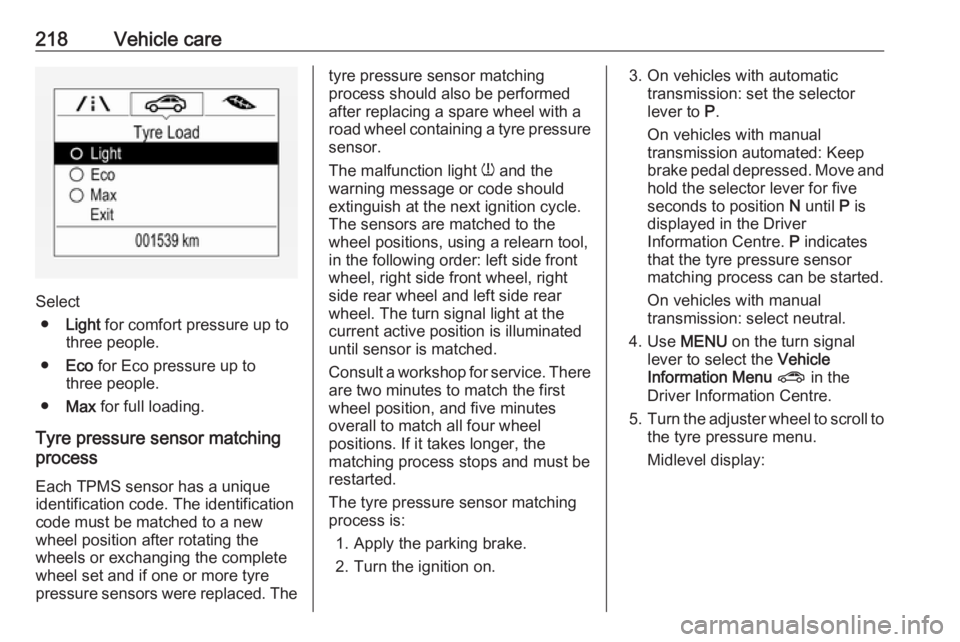
Uplevel display:
Page 220 of 271
218Vehicle care
Select● Light for comfort pressure up to
three people.
● Eco for Eco pressure up to
three people.
● Max for full loading.
Tyre pressure sensor matching
process
Each TPMS sensor has a unique
identification code. The identification
code must be matched to a new
wheel position after rotating the
wheels or exchanging the complete
wheel set and if one or more tyre
pressure sensors were replaced. The
tyre pressure sensor matching
process should also be performed
after replacing a spare wheel with a
road wheel containing a tyre pressure
sensor.
The malfunction light w and the
warning message or code should
extinguish at the next ignition cycle. The sensors are matched to the
wheel positions, using a relearn tool,
in the following order: left side front
wheel, right side front wheel, right
side rear wheel and left side rear
wheel. The turn signal light at the
current active position is illuminated
until sensor is matched.
Consult a workshop for service. There are two minutes to match the first
wheel position, and five minutes
overall to match all four wheel
positions. If it takes longer, the
matching process stops and must be
restarted.
The tyre pressure sensor matching
process is:
1. Apply the parking brake.
2. Turn the ignition on.3. On vehicles with automatic transmission: set the selector
lever to P.
On vehicles with manual
transmission automated: Keep
brake pedal depressed. Move and hold the selector lever for five
seconds to position N until P is
displayed in the Driver Information Centre. P indicates
that the tyre pressure sensor
matching process can be started.
On vehicles with manual
transmission: select neutral.
4. Use MENU on the turn signal
lever to select the Vehicle
Information Menu ? in the
Driver Information Centre.
5. Turn the adjuster wheel to scroll to
the tyre pressure menu.
Midlevel display:
Page 233 of 271

Vehicle care231● A discharged vehicle battery canalready freeze at a temperature
of 0 °C. Defrost the frozen battery before connecting jump leads.
● Wear eye protection and protective clothing when
handling a battery.
● Use a booster battery with the same voltage (12 Volts). Its
capacity (Ah) must not be much
less than that of the discharged
vehicle battery.
● Use jump leads with insulated terminals and a cross section of
at least 16 mm 2
(25 mm 2
for
diesel engines).
● Do not disconnect the discharged
vehicle battery from the vehicle.
● Switch off all unnecessary electrical consumers.
● Do not lean over the battery during jump starting.
● Do not allow the terminals of one
lead to touch those of the other
lead.
● The vehicles must not come into contact with each other during
the jump starting process.● Apply the parking brake, transmission in neutral,
automatic transmission in P.
● Open the positive terminal protection caps of both vehiclebatteries.
Lead connection order:
1. Connect the red lead to the positive terminal of the booster
vehicle battery.
2. Connect the other end of the red lead to the positive terminal of the
discharged vehicle battery.
3. Connect the black lead to the negative terminal of the booster
vehicle battery.
4. Connect the other end of the black
lead to a vehicle grounding point,
such as the engine block or an
engine mounting bolt. Connect as far away from the discharged
vehicle battery as possible,
however at least 60 cm.
Route the leads so that they cannot
catch on rotating parts in the engine
compartment.
To start the engine: 1. Start the engine of the vehicle providing the jump.
2. After five minutes, start the other engine. Start attempts should be
made for no longer than
15 seconds at an interval of one
minute.
3. Allow both engines to idle for approx. three minutes with the
leads connected.
Page 235 of 271

Vehicle care233Caution
Drive slowly. Do not drive jerkily.
Excessive tractive force can
damage the vehicle.
When the engine is not running,
considerably more force is needed to
brake and steer.
To prevent the entry of exhaust gases from the towing vehicle, switch on the
air recirculation and close the
windows.
Vehicles with automatic transmission: the vehicle must be towed facing
forwards, not faster than 80 km/h nor further than 100 km. In all other cases
and when the transmission is
defective, the front axle must be
raised off the ground.
Vehicles with manual transmission
automated: the vehicle must only be
towed facing forwards with the front axle raised off the ground.
Seek the assistance of a workshop. After towing, unscrew the towing eye.
Insert cap at the top and engage
downwards.
Towing another vehicle
Insert a screwdriver in the slot at the
lower bend of the cap. Release the
cap by carefully moving the
screwdriver downwards.
The towing eye is stowed with the
vehicle tools 3 212.
Screw in the towing eye as far as it will
go until it stops in a horizontal
position.
The lashing eye at the rear
underneath the vehicle must never be used as a towing eye.
Attach a tow rope – or even better a
tow bar – to the towing eye.
The towing eye must only be used for
towing and not for recovering a
vehicle.
Page 251 of 271
![OPEL CORSA E 2018 Manual user Technical data249Engine identifier codeB13DTCB13DTEB13DTEB13DTRSales designation1.31.31.31.3Engineering codeB13DTCB13DTEB13DTEB13DTRPiston displacement [cm3
]1248124812481248Engine power [kW]55557070a](/img/37/18828/w960_18828-250.png "OPEL CORSA E 2018 Manual user Technical data249Engine identifier codeB13DTCB13DTEB13DTEB13DTRSales designation1.31.31.31.3Engineering codeB13DTCB13DTEB13DTEB13DTRPiston displacement [cm3
]1248124812481248Engine power [kW]55557070a")
Technical data249Engine identifier codeB13DTCB13DTEB13DTEB13DTRSales designation1.31.31.31.3Engineering codeB13DTCB13DTEB13DTEB13DTRPiston displacement [cm3
]1248124812481248Engine power [kW]55557070at rpm3750375037503750Torque [Nm]190190190210at rpm1500 - 25001500 - 25001500 - 35001500 - 3000Fuel typeDieselDieselDieselDieselAdditional fuel type––––PerformanceEngineB10XFLB10XFTB12XELB14XEJB14XELB14NEJMaximum speed [km/h]Manual transmission180195162167175185Manual transmission automated––––175–Automatic transmission––––170–
Page 252 of 271
![OPEL CORSA E 2018 Manual user 250Technical dataEngineB14XEL LPGB14NEHB16LERMaximum speed [km/h]Manual transmission175207230Manual transmission automated–––Automatic transmission–––
Engine
B13DTCB13DTE
55kWB13DTE
70kWB1](/img/37/18828/w960_18828-251.png "OPEL CORSA E 2018 Manual user 250Technical dataEngineB14XEL LPGB14NEHB16LERMaximum speed [km/h]Manual transmission175207230Manual transmission automated–––Automatic transmission–––
Engine
B13DTCB13DTE
55kWB13DTE
70kWB1")
250Technical dataEngineB14XEL LPGB14NEHB16LERMaximum speed [km/h]Manual transmission175207230Manual transmission automated–––Automatic transmission–––
Engine
B13DTCB13DTE
55kWB13DTE
70kWB13DTRMaximum speed [km/h]Manual transmission164164182177Manual transmission automated––182–Automatic transmission––––
Page 253 of 271

Technical data251Vehicle weightKerb weight, 5-door vehicle, basic model without any optional equipmentEngineManual transmissionManual transmission automatedAutomatic transmissionwithout / with air conditioning
[kg]B10XFL1199 / 1249––B10XFT1199 / 1249––B12XEL1163 / 1210––B14XEJ1163 / 1211––B14XEL1163 / 12341163 / 12341199 / 1248B14XEL LPG1237 / 1252––B14NEJ1237 / 1290––B14NEH1259 / 1317––without / with air conditioning
[kg]B13DTC1237 / 1309––B13DTE1225 / 12971225 / 1294–B13DTR1259 / 1317––
Optional equipment and accessories increase the kerb weight.
Loading information 3 73.
Page 254 of 271

252Technical dataKerb weight, 3-door vehicle and van, basic model without any optional equipmentEngineManual transmissionManual transmissionautomatedAutomatic transmissionwithout / with air conditioning
[kg]B10XFL1163 / 1178––B10XFT1163 / 1178––B12XEL1120 / 1135––B14XEJ1141 / 1156––B14XEL1141 / 11561141 / 11561163 / 1178B14XEL LPG1199 / 1214––B14NEJ1199 / 1214––B14NEH1199 / 1214––B16LER1278 / 1293––without/with air conditioning
[kg]B13DTC1199 / 1214––B13DTE1199 / 12141199 / 1214–B13DTR1237 / 1252––
Optional equipment and accessories increase the kerb weight.
Loading information 3 73.
Page 266 of 271
264IndexAAccessories and vehicle modifications .......................... 192
Adjustable air vents ...................133
Airbag and belt tensioners ...........92
Airbag deactivation ................49, 93
Airbag label................................... 44 Airbag system .............................. 44
Air conditioning regular operation ................................ 134
Air conditioning system .............. 126
Air intake .................................... 133
Air vents...................................... 133
Antilock brake system ................ 151
Antilock brake system (ABS) .......94
Anti-theft alarm system ................28
Anti-theft locking system .............. 28
Appearance care ........................234
Ashtrays ....................................... 83
Automatic anti-dazzle ..................31
Automatic light control ...............116
Automatic locking ........................26
Automatic transmission .............143
Autostop ............................... 97, 138
B Battery discharge protection ......124
Battery voltage ........................... 106
Belts.............................................. 41
Bicycle rack .................................. 59Bonnet ....................................... 193
Brake and clutch fluid .................239
Brake and clutch system .............94
Brake assist ............................... 152
Brake fluid .................................. 197
Brakes ............................... 151, 197
Breakdown.................................. 232
Bulb replacement ....................... 199
C Capacities .................................. 254
Car Pass ...................................... 23
Catalytic converter .....................143
Central locking system ................24
Centre high-mounted brake light 206
Changing tyre and wheel size ...220
Charging system .......................... 93
Child locks ................................... 26
Child restraint installation locations ................................... 54
Child restraints.............................. 50
Child restraint systems ................50
Cigarette lighter ........................... 83
City mode ................................... 155
Climate control ............................. 17
Climate control systems .............125
Clock ............................................ 80
Code ........................................... 104
Collision damage repair ..............260
Colour-Info-Display .....................102