brake OPEL CORSA E 2019 Manual user
[x] Cancel search | Manufacturer: OPEL, Model Year: 2019, Model line: CORSA E, Model: OPEL CORSA E 2019Pages: 231, PDF Size: 6.87 MB
Page 158 of 231
156Vehicle careVehicle careGeneral Information...................156
Accessories and vehicle modifications .......................... 156
Vehicle storage ........................157
End-of-life vehicle recovery .....157
Vehicle checks ........................... 158
Performing work ......................158
Bonnet ..................................... 158
Engine oil ................................. 159
Engine coolant ......................... 160
Washer fluid ............................ 161
Brakes ..................................... 161
Brake fluid ............................... 161
Vehicle battery ......................... 162
Wiper blade replacement ........163
Bulb replacement .......................164
Halogen headlights ..................164
Xenon headlights .....................167
Front fog lights ......................... 168
Front turn lights .......................168
Tail lights ................................. 168
Side turn lights ......................... 170
Centre high-mounted brake light ......................................... 171Number plate light...................171
Interior lights ............................ 172
Electrical system ........................172
Fuses ....................................... 172
Engine compartment fuse box . 173
Instrument panel fuse box .......175
Vehicle tools .............................. 177
Tools ........................................ 177
Wheels and tyres .......................178
Winter tyres ............................. 178
Tyre designations ....................178
Tyre pressure .......................... 179
Tyre pressure monitoring
system .................................... 180
Tread depth ............................. 184
Changing tyre and wheel size . 184
Wheel covers ........................... 185
Tyre chains .............................. 185
Tyre repair kit .......................... 185
Wheel changing .......................191
Spare wheel ............................ 192
Jump starting ............................. 195
Towing ....................................... 196
Towing the vehicle ...................196
Towing another vehicle ...........197
Appearance care .......................198
Exterior care ............................ 198
Interior care ............................. 200General Information
Accessories and vehiclemodifications
We recommend the use of genuine
parts and accessories and factory
approved parts specific for your
vehicle type. We cannot assess or guarantee reliability of other products
- even if they have a regulatory or
otherwise granted approval.
Any modification, conversion or other
changes made to standard vehicle
specifications (including, without
limitation, software modifications,
modifications of the electronic control units) may invalidate the warranty
offered by Opel. Furthermore, such
changes may affect driver assistance
systems, fuel consumption, CO 2
emissions and other emissions of the
vehicle. They may also invalidate the
vehicle operating permit.
Page 159 of 231
Vehicle care157Caution
When transporting the vehicle on
a train or on a recovery vehicle, the
mud flaps may be damaged.
Vehicle storage
Storage for a long period of time
If the vehicle is to be stored for several months:
● Wash and wax the vehicle.
● Have the wax in the engine compartment and underbody
checked.
● Clean and preserve the rubber seals.
● Fill up fuel tank completely.
● Change the engine oil.
● Drain the washer fluid reservoir.
● Check the coolant antifreeze and
corrosion protection.
● Adjust tyre pressure to the value specified for full load.
● Park the vehicle in a dry, wellventilated place. Engage first or
reverse gear or set selector lever
to P. Prevent the vehicle from
rolling.
● Do not apply the parking brake.
● Open the bonnet, close all doors and lock the vehicle.
● Disconnect the clamp from the negative terminal of the vehicle
battery. Beware that all systems
are not functional, e.g. anti-theft
alarm system.
Putting back into operation
When the vehicle is to be put back into
operation:
● Connect the clamp to the negative terminal of the vehicle
battery. Activate the electronics
of the power windows.
● Check tyre pressure.
● Fill up the washer fluid reservoir.
● Check the engine oil level.
● Check the coolant level.
● Fit the number plate if necessary.End-of-life vehicle recovery
Information on end-of-life vehicle
recovery centres and the recycling of
end-of-life vehicles is available on our website. Only entrust this work to an
authorised recycling centre.
Gas vehicles must be recycled by a
service centre authorised for gas
vehicles.
Page 163 of 231
Vehicle care1619Warning
Allow the engine to cool before
opening the cap. Carefully open
the cap, relieving the pressure
slowly.
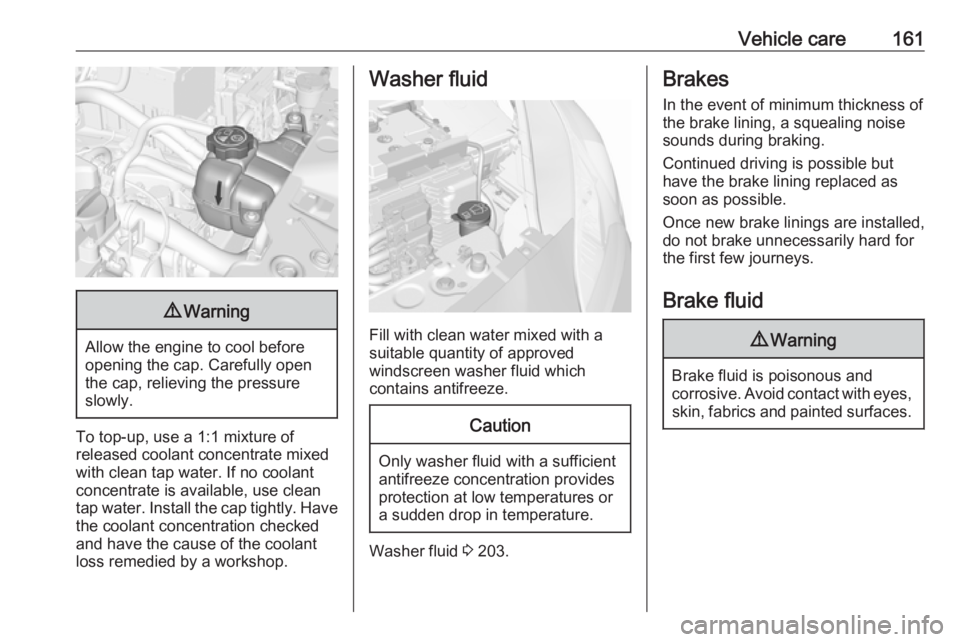
To top-up, use a 1:1 mixture of released coolant concentrate mixed
with clean tap water. If no coolant
concentrate is available, use clean
tap water. Install the cap tightly. Have the coolant concentration checked
and have the cause of the coolant
loss remedied by a workshop.
Washer fluid
Fill with clean water mixed with a
suitable quantity of approved
windscreen washer fluid which
contains antifreeze.
Caution
Only washer fluid with a sufficient
antifreeze concentration provides
protection at low temperatures or
a sudden drop in temperature.
Washer fluid 3 203.
Brakes
In the event of minimum thickness of
the brake lining, a squealing noise
sounds during braking.
Continued driving is possible but
have the brake lining replaced as
soon as possible.
Once new brake linings are installed,
do not brake unnecessarily hard for
the first few journeys.
Brake fluid9 Warning
Brake fluid is poisonous and
corrosive. Avoid contact with eyes, skin, fabrics and painted surfaces.
Page 164 of 231

162Vehicle care
The brake fluid level must be betweenthe MIN and MAX marks.
If fluid level is below the MIN mark,
seek the assistance of a workshop.
Brake and clutch fluid 3 203.
Vehicle battery
The vehicle battery is maintenance-
free provided that the driving profile
allows sufficient charging of the
battery. Short-distance-driving and
frequent engine starts can discharge
the vehicle battery. Avoid the use of
unnecessary electrical consumers.
Batteries do not belong in household
waste. They must be disposed of at
an appropriate recycling collection
point.
Laying up the vehicle for more than
four weeks can lead to vehicle battery
discharge. Disconnect the clamp from
the negative terminal of the vehicle
battery.
Ensure the ignition is switched off
before connecting or disconnecting
the vehicle battery.
Battery discharge protection 3 108.
Disconnecting the battery
If the vehicle's battery is to be
disconnected (e.g. for maintenance
work), the alarm siren must be
deactivated as follows: Switch the
ignition on then off, then disconnect
the vehicle's battery within
15 seconds.
Replacing the vehicle battery
Note
Any deviation from the instructions
given in this section may lead to
temporary deactivation or
disturbance of the stop-start system.
When the vehicle battery is being
replaced, please ensure that there
are no open ventilation holes in the
vicinity of the positive terminal. If a
ventilation hole is open in this area, it
must be closed off with a dummy cap,
and the ventilation in the vicinity of the negative terminal must be opened.
Ensure that the battery is always
replaced by the same type of battery.
We recommend the use of an original
Opel battery.
Note
Using an AGM vehicle battery
different from the original Opel
vehicle battery may result in a lower performance.
We recommend that you have the
vehicle battery replaced by a
workshop.
Page 171 of 231

Vehicle care169
2. Unscrew both plastic securingnuts from the inside by hand.
3. Carefully withdraw the lightassembly from the recesses and
remove.
4. Press the retaining lugs and remove the bulb carrier from the
light assembly.
5. Remove the bulb by pushing the bulb slightly into the socket and
rotating anticlockwise:
Tail light / brake light ( 1)
Turn light ( 2)
6. Insert bulb into bulb carrier and turn clockwise. Engage bulbcarrier into the light assembly. Fit
light assembly with the retaining
pins into the recesses of the
vehicle body and tighten the
plastic securing nuts from inside
the load compartment.
Close cover and engage.
Reversing light / rear fog light Left-hand drive models
Reversing light is located on the right
light assembly in the tailgate, and the rear fog light is located on the left light
assembly in the tailgate.
Right-hand drive models
Reversing light is located on the left
light assembly in the tailgate, and the rear fog light is located on the right
light assembly in the tailgate.
Page 173 of 231

Vehicle care171
2. Turn bulb holder anticlockwiseand remove from housing.
3. Pull bulb from bulb holder andreplace it.
4. Insert bulb holder and turnclockwise.
5. Insert left end of the lamp, slide to
the left and insert right end.
Centre high-mounted brake light
Have LEDs replaced by a workshop.
Number plate light
1. Insert screwdriver in recess of the
cover, press to the side and
release spring.
2. Remove lamp downwards, taking care not to pull on the cable.
3. Remove bulb holder from lamp housing by turning anticlockwise.
Page 176 of 231
174Vehicle careNo.Circuit1-2-3Battery sensor4Chassis control module, fuel
pump5ABS6Low beam and daytime running
light left, Xenon high beam7–8LPG control module9Body control module10Headlamp levelling11Rear wiper12Heated rear window13Low beam and daytime running
light right14Heated exterior mirror15–No.Circuit16Brake booster kit17Ignition signal, waterpump18Engine control module19Fuel pump20–21Engine solenoids, engine
sensors22–23Ignition coils, injectors24Washer system25–26Engine sensors27Engine management28Engine control module29Engine control module30Engine control module31High beam left, Xenon low
beam leftNo.Circuit32High beam right, Xenon low
beam right33Engine control module34Horn35Air condition compressor clutch36Front fog lights
Page 178 of 231
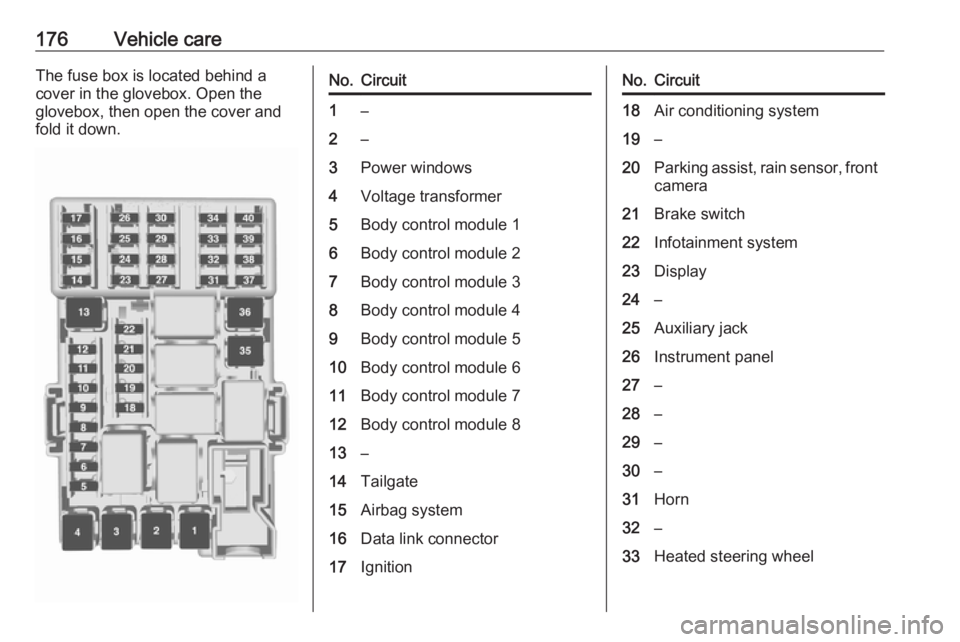
176Vehicle careThe fuse box is located behind a
cover in the glovebox. Open the
glovebox, then open the cover and
fold it down.No.Circuit1–2–3Power windows4Voltage transformer5Body control module 16Body control module 27Body control module 38Body control module 49Body control module 510Body control module 611Body control module 712Body control module 813–14Tailgate15Airbag system16Data link connector17IgnitionNo.Circuit18Air conditioning system19–20Parking assist, rain sensor, front camera21Brake switch22Infotainment system23Display24–25Auxiliary jack26Instrument panel27–28–29–30–31Horn32–33Heated steering wheel
Page 184 of 231
182Vehicle careThe use of commercially-availableliquid tyre repair kits can impair the
function of the system. Factory-
approved repair kits can be used.
Operating electronic devices or being close to facilities using similar wave
frequencies could disrupt the tyre
pressure monitoring system.
Each time the tyres are replaced, tyre
pressure monitoring system sensors
must be dismounted and serviced. For the screwed sensor; replace
valve core and sealing ring. For the
clipped sensor; replace complete
valve stem.
Vehicle loading status
Adjust tyre pressure to load condition according to the tyre information labelor tyre pressure chart 3 214, and
select the appropriate setting in the menu Tyre Load in the Driver
Information Centre, Vehicle
Information Menu 3 83 . This setting is
the reference for the tyre pressure
warnings.
The menu Tyre Load only appears
when the vehicle is at a standstill and
the parking brake is applied.On vehicles with automatic
transmission, the selector lever must
be in P.
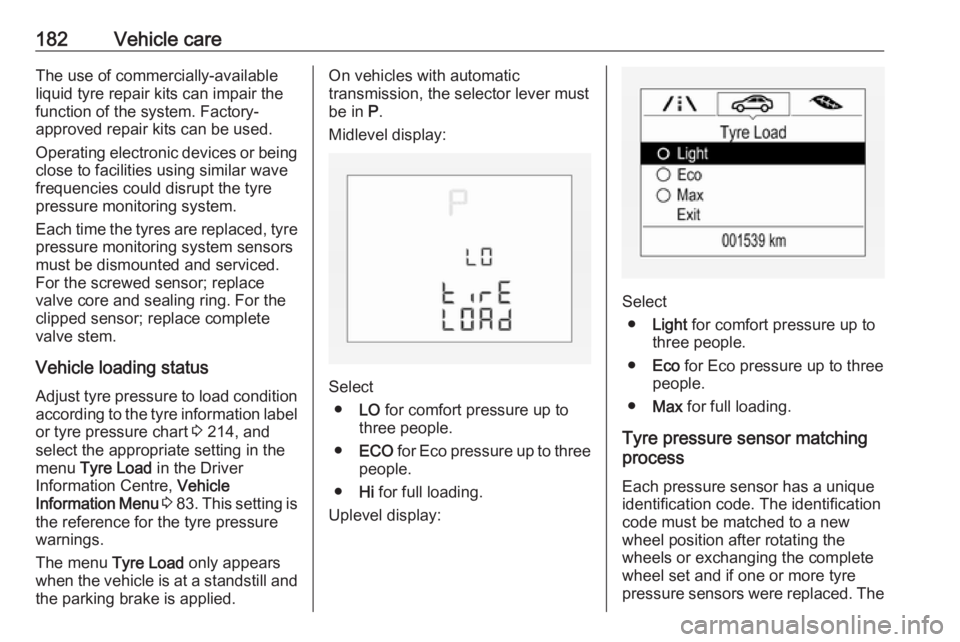
Midlevel display:
Select ● LO for comfort pressure up to
three people.
● ECO for Eco pressure up to three
people.
● Hi for full loading.
Uplevel display:
Select ● Light for comfort pressure up to
three people.
● Eco for Eco pressure up to three
people.
● Max for full loading.
Tyre pressure sensor matching
process
Each pressure sensor has a unique identification code. The identification
code must be matched to a new
wheel position after rotating the
wheels or exchanging the complete
wheel set and if one or more tyre
pressure sensors were replaced. The
Page 185 of 231
Vehicle care183tyre pressure sensor matching
process should also be performed
after replacing a spare wheel with a
road wheel containing a tyre pressure
sensor.
The malfunction light w and the
warning message or code should
extinguish at the next ignition cycle. The sensors are matched to the
wheel positions, using a relearn tool,
in the following order: left side front
wheel, right side front wheel, right
side rear wheel and left side rear
wheel. The turn light at the current
active position is illuminated until
sensor is matched.
Consult a workshop for service. There
are 2 minutes to match the first wheel position, and 5 minutes overall to
match all four wheel positions. If it
takes longer, the matching process
stops and must be restarted.
The tyre pressure sensor matching
process is:
1. Apply the parking brake.
2. Turn the ignition on.3. On vehicles with automatic transmission: set the selector
lever to P.
On vehicles with manual
transmission: select neutral.
4. Use MENU on the stalk to select
the Vehicle Information
Menu ? in the Driver
Information Centre.
5. Turn the adjuster wheel to scroll to
the tyre pressure menu.
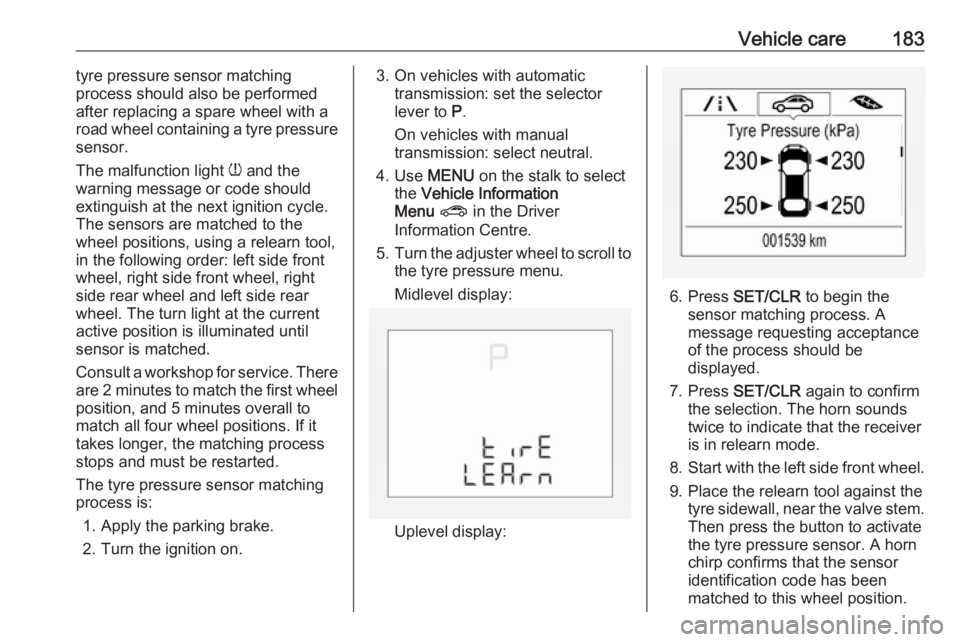
Midlevel display:
Uplevel display:
6. Press SET/CLR to begin the
sensor matching process. A
message requesting acceptance
of the process should be
displayed.
7. Press SET/CLR again to confirm
the selection. The horn sounds
twice to indicate that the receiver
is in relearn mode.
8. Start with the left side front wheel.
9. Place the relearn tool against the tyre sidewall, near the valve stem.Then press the button to activate
the tyre pressure sensor. A horn
chirp confirms that the sensor
identification code has been
matched to this wheel position.