belt OPEL GRANDLAND X 2019.75 Manual user
[x] Cancel search | Manufacturer: OPEL, Model Year: 2019.75, Model line: GRANDLAND X, Model: OPEL GRANDLAND X 2019.75Pages: 273, PDF Size: 7.85 MB
Page 61 of 273
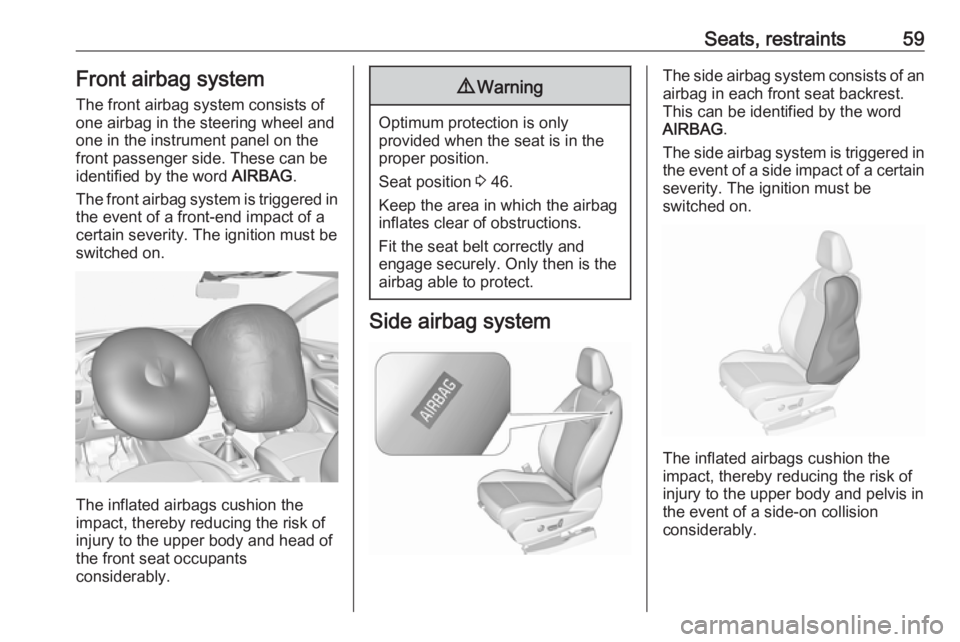
Seats, restraints59Front airbag systemThe front airbag system consists of
one airbag in the steering wheel and
one in the instrument panel on the
front passenger side. These can be
identified by the word AIRBAG.
The front airbag system is triggered in
the event of a front-end impact of a
certain severity. The ignition must be
switched on.
The inflated airbags cushion the
impact, thereby reducing the risk of
injury to the upper body and head of
the front seat occupants
considerably.
9 Warning
Optimum protection is only
provided when the seat is in the
proper position.
Seat position 3 46.
Keep the area in which the airbag
inflates clear of obstructions.
Fit the seat belt correctly and
engage securely. Only then is the
airbag able to protect.
Side airbag system
The side airbag system consists of an
airbag in each front seat backrest.
This can be identified by the word
AIRBAG .
The side airbag system is triggered in the event of a side impact of a certain
severity. The ignition must be
switched on.
The inflated airbags cushion the
impact, thereby reducing the risk of
injury to the upper body and pelvis in
the event of a side-on collision
considerably.
Page 62 of 273
60Seats, restraints9Warning
Keep the area in which the airbag
inflates clear of obstructions.
Note
Only use protective seat covers that have been approved for the vehicle.Be careful not to cover the airbags.
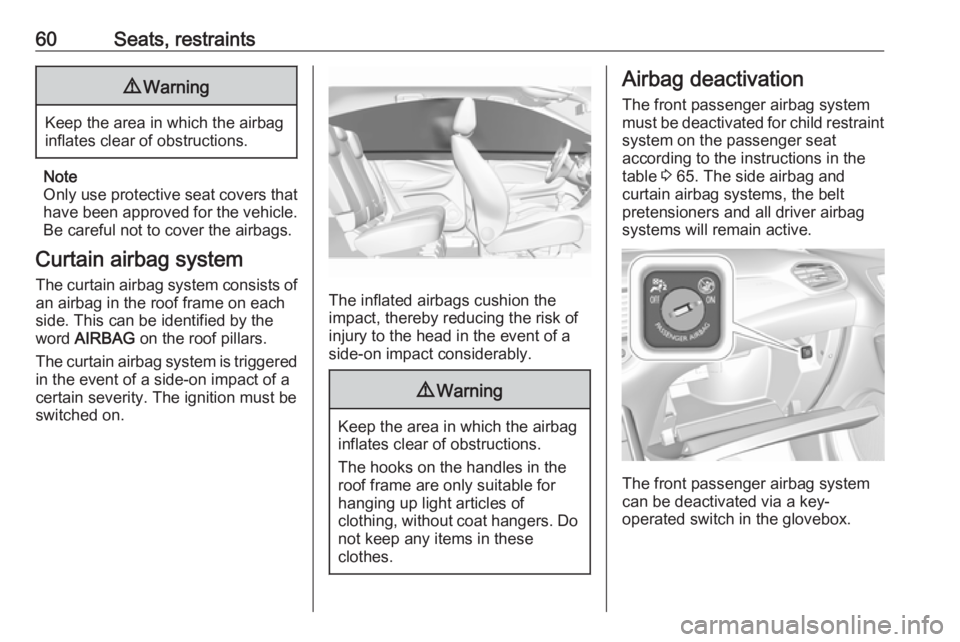
Curtain airbag system
The curtain airbag system consists of an airbag in the roof frame on each
side. This can be identified by the
word AIRBAG on the roof pillars.
The curtain airbag system is triggered
in the event of a side-on impact of a
certain severity. The ignition must be
switched on.
The inflated airbags cushion the
impact, thereby reducing the risk of
injury to the head in the event of a
side-on impact considerably.
9 Warning
Keep the area in which the airbag
inflates clear of obstructions.
The hooks on the handles in the
roof frame are only suitable for
hanging up light articles of
clothing, without coat hangers. Do not keep any items in these
clothes.
Airbag deactivation
The front passenger airbag system must be deactivated for child restraint
system on the passenger seat
according to the instructions in the
table 3 65. The side airbag and
curtain airbag systems, the belt
pretensioners and all driver airbag
systems will remain active.
The front passenger airbag system
can be deactivated via a key-
operated switch in the glovebox.
Page 64 of 273
62Seats, restraintsChild restraintsChild restraint systems9 Danger
If using a rear-facing child restraint
system on the front passenger
seat, the airbag system for the
front passenger seat must be
deactivated. This also applies to certain forward-facing child
restraint systems as indicated in
the tables 3 65.
Airbag deactivation 3 60.
Airbag label 3 55.
We recommend a child restraint system which is tailored specifically to the vehicle. For further information,
contact your workshop.
Before fastening a child seat adjust
the head restraint 3 45.
When a child restraint system is being
used, pay attention to the following
usage and installation instructions and also those supplied with the child restraint system.
Always comply with local or national
regulations. In some countries, the
use of child restraint systems is
forbidden on certain seats.
Child restraint systems can be
fastened with:
● Three-point seat belt
● ISOFIX brackets
● Top-tether
Three-point seat belt
Child restraint systems can be
fastened by using a three-point seat
belt. After fastening the child restraint system the seat belt has to be
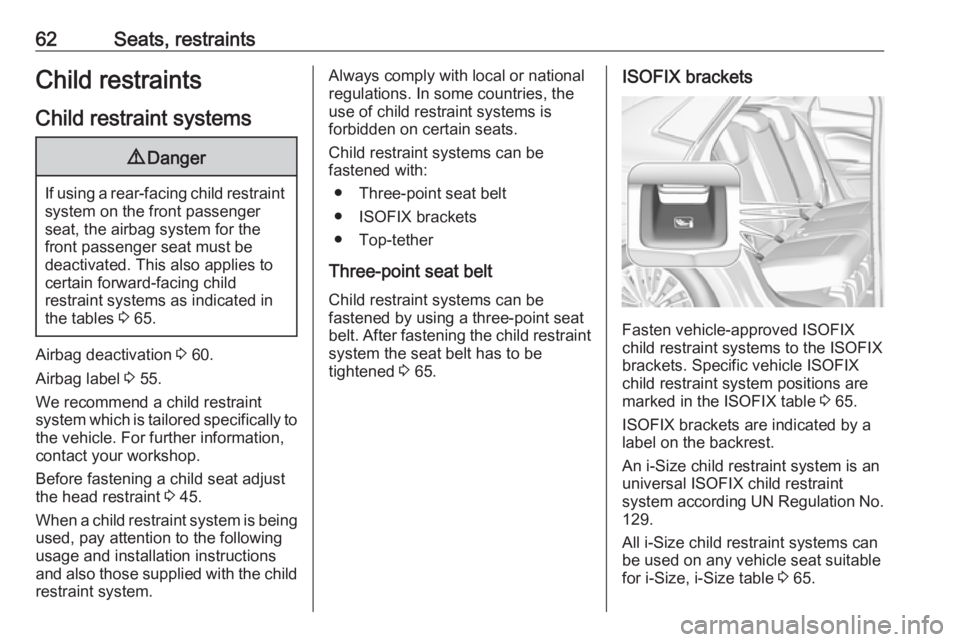
tightened 3 65.ISOFIX brackets
Fasten vehicle-approved ISOFIX
child restraint systems to the ISOFIX
brackets. Specific vehicle ISOFIX
child restraint system positions are
marked in the ISOFIX table 3 65.
ISOFIX brackets are indicated by a
label on the backrest.
An i-Size child restraint system is an
universal ISOFIX child restraint
system according UN Regulation No.
129.
All i-Size child restraint systems can be used on any vehicle seat suitable
for i-Size, i-Size table 3 65.
Page 65 of 273
Seats, restraints63Either a Top-tether strap or a support
leg must be used in addition to the
ISOFIX brackets.
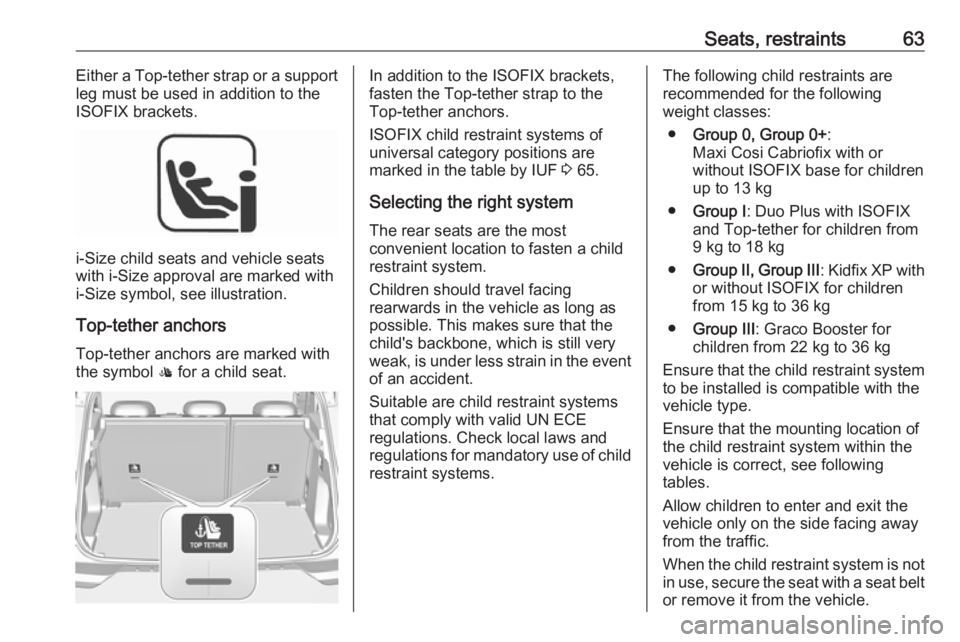
i-Size child seats and vehicle seats
with i-Size approval are marked with i-Size symbol, see illustration.
Top-tether anchors
Top-tether anchors are marked with
the symbol : for a child seat.
In addition to the ISOFIX brackets,
fasten the Top-tether strap to the
Top-tether anchors.
ISOFIX child restraint systems of
universal category positions are
marked in the table by IUF 3 65.
Selecting the right system The rear seats are the most
convenient location to fasten a child
restraint system.
Children should travel facing
rearwards in the vehicle as long as
possible. This makes sure that the child's backbone, which is still very
weak, is under less strain in the event of an accident.
Suitable are child restraint systems
that comply with valid UN ECE
regulations. Check local laws and
regulations for mandatory use of child
restraint systems.The following child restraints are recommended for the following
weight classes:
● Group 0, Group 0+ :
Maxi Cosi Cabriofix with or
without ISOFIX base for children
up to 13 kg
● Group I : Duo Plus with ISOFIX
and Top-tether for children from
9 kg to 18 kg
● Group II, Group III : Kidfix XP with
or without ISOFIX for children
from 15 kg to 36 kg
● Group III : Graco Booster for
children from 22 kg to 36 kg
Ensure that the child restraint system to be installed is compatible with the
vehicle type.
Ensure that the mounting location of
the child restraint system within the
vehicle is correct, see following
tables.
Allow children to enter and exit the vehicle only on the side facing away
from the traffic.
When the child restraint system is not in use, secure the seat with a seat beltor remove it from the vehicle.
Page 67 of 273
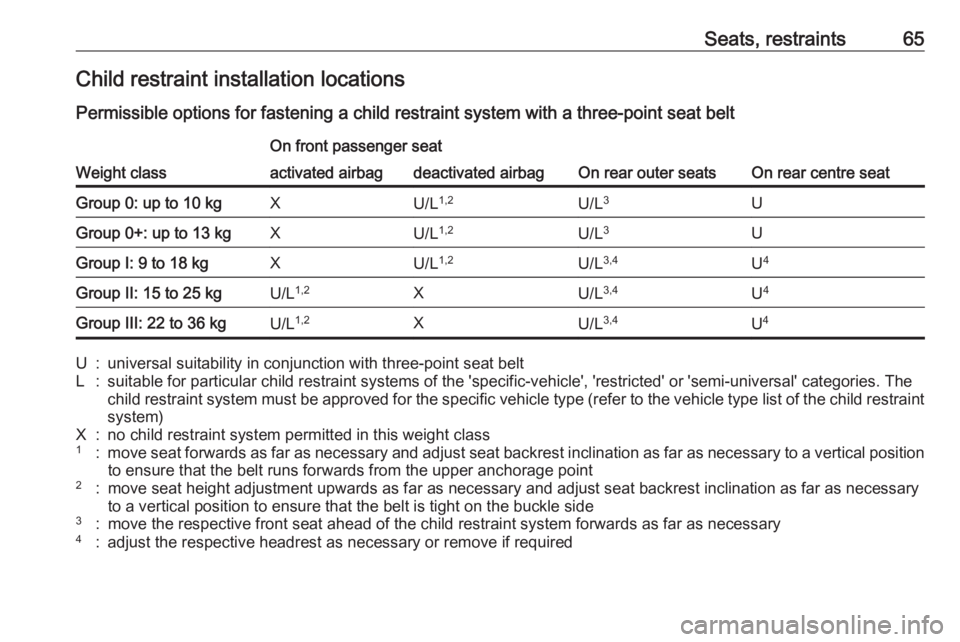
Seats, restraints65Child restraint installation locations
Permissible options for fastening a child restraint system with a three-point seat belt
Weight class
On front passenger seat
On rear outer seatsOn rear centre seat
activated airbagdeactivated airbagGroup 0: up to 10 kgXU/L 1,2U/L 3UGroup 0+: up to 13 kgXU/L1,2U/L3UGroup I: 9 to 18 kgXU/L 1,2U/L3,4U4Group II: 15 to 25 kgU/L 1,2XU/L3,4U4Group III: 22 to 36 kgU/L 1,2XU/L3,4U4U:universal suitability in conjunction with three-point seat beltL:suitable for particular child restraint systems of the 'specific-vehicle', 'restricted' or 'semi-universal' categories. The
child restraint system must be approved for the specific vehicle type (refer to the vehicle type list of the child restraint
system)X:no child restraint system permitted in this weight class1:move seat forwards as far as necessary and adjust seat backrest inclination as far as necessary to a vertical position to ensure that the belt runs forwards from the upper anchorage point2:move seat height adjustment upwards as far as necessary and adjust seat backrest inclination as far as necessaryto a vertical position to ensure that the belt is tight on the buckle side3:move the respective front seat ahead of the child restraint system forwards as far as necessary4:adjust the respective headrest as necessary or remove if required
Page 69 of 273
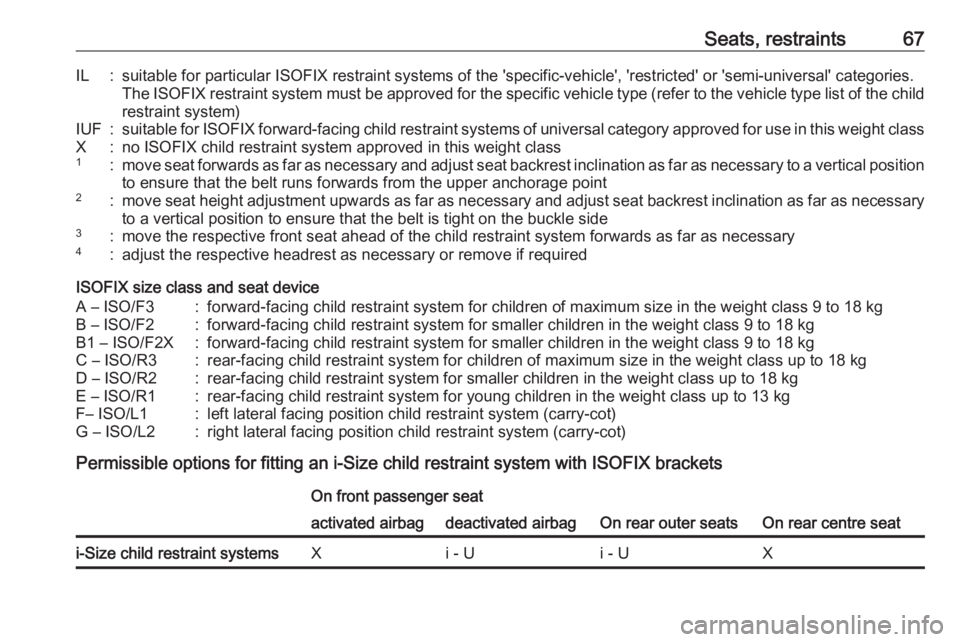
Seats, restraints67IL:suitable for particular ISOFIX restraint systems of the 'specific-vehicle', 'restricted' or 'semi-universal' categories.The ISOFIX restraint system must be approved for the specific vehicle type (refer to the vehicle type list of the child
restraint system)IUF:suitable for ISOFIX forward-facing child restraint systems of universal category approved for use in this weight classX:no ISOFIX child restraint system approved in this weight class1:move seat forwards as far as necessary and adjust seat backrest inclination as far as necessary to a vertical position to ensure that the belt runs forwards from the upper anchorage point2:move seat height adjustment upwards as far as necessary and adjust seat backrest inclination as far as necessary to a vertical position to ensure that the belt is tight on the buckle side3:move the respective front seat ahead of the child restraint system forwards as far as necessary4:adjust the respective headrest as necessary or remove if required
ISOFIX size class and seat device
A – ISO/F3:forward-facing child restraint system for children of maximum size in the weight class 9 to 18 kgB – ISO/F2:forward-facing child restraint system for smaller children in the weight class 9 to 18 kgB1 – ISO/F2X:forward-facing child restraint system for smaller children in the weight class 9 to 18 kgC – ISO/R3:rear-facing child restraint system for children of maximum size in the weight class up to 18 kgD – ISO/R2:rear-facing child restraint system for smaller children in the weight class up to 18 kgE – ISO/R1:rear-facing child restraint system for young children in the weight class up to 13 kgF– ISO/L1:left lateral facing position child restraint system (carry-cot)G – ISO/L2:right lateral facing position child restraint system (carry-cot)
Permissible options for fitting an i-Size child restraint system with ISOFIX brackets
On front passenger seat
On rear outer seatsOn rear centre seat
activated airbagdeactivated airbagi-Size child restraint systemsXi - Ui - UX
Page 72 of 273
70Storage
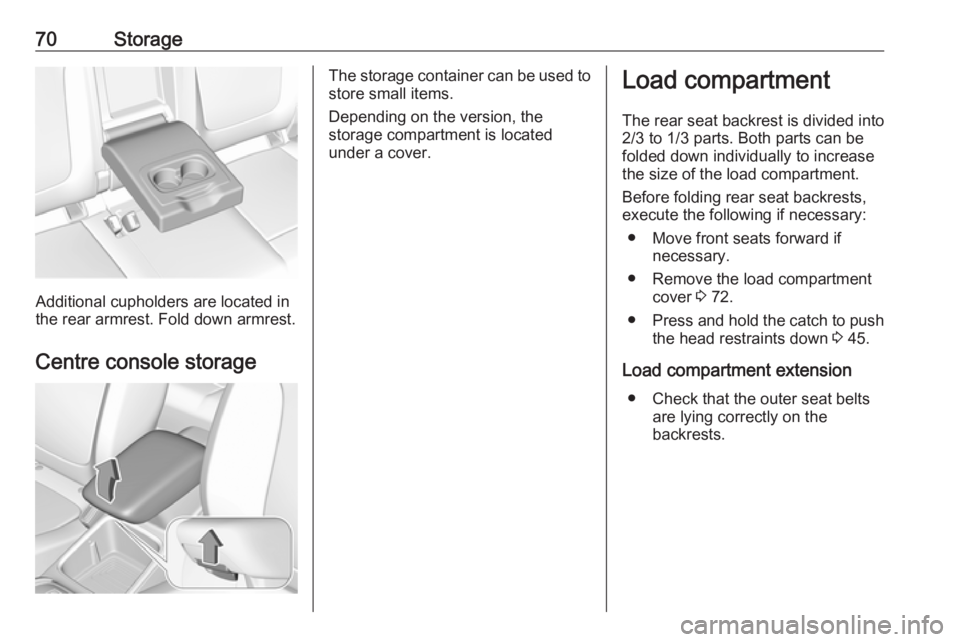
Additional cupholders are located in
the rear armrest. Fold down armrest.
Centre console storage
The storage container can be used to
store small items.
Depending on the version, the
storage compartment is located
under a cover.Load compartment
The rear seat backrest is divided into
2/3 to 1/3 parts. Both parts can be
folded down individually to increase
the size of the load compartment.
Before folding rear seat backrests,
execute the following if necessary:
● Move front seats forward if necessary.
● Remove the load compartment cover 3 72.
● Press and hold the catch to push
the head restraints down 3 45.
Load compartment extension ● Check that the outer seat belts are lying correctly on the
backrests.
Page 81 of 273
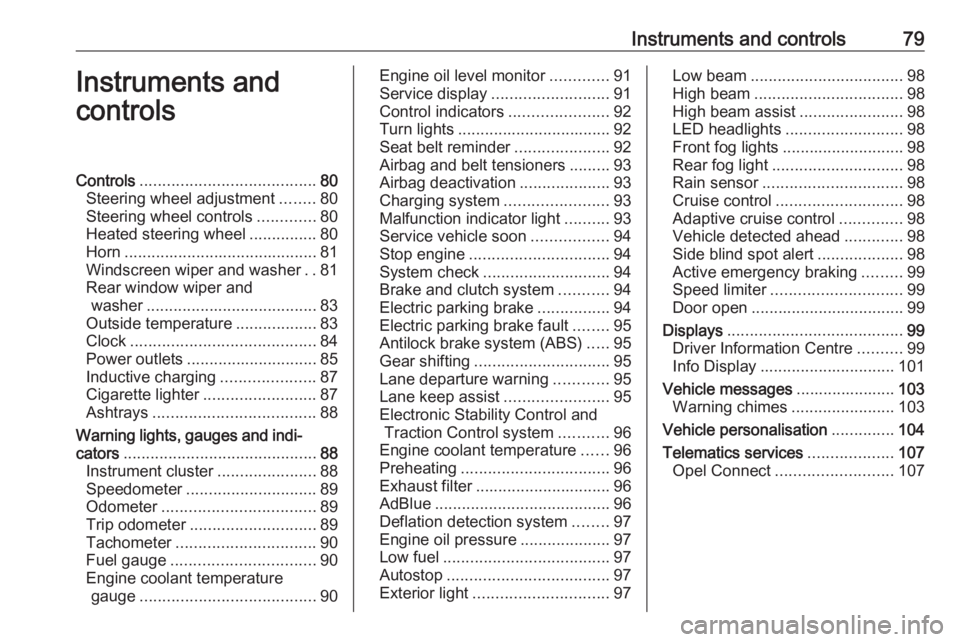
Instruments and controls79Instruments and
controlsControls ....................................... 80
Steering wheel adjustment ........80
Steering wheel controls .............80
Heated steering wheel ...............80
Horn ........................................... 81
Windscreen wiper and washer ..81
Rear window wiper and washer ...................................... 83
Outside temperature ..................83
Clock ......................................... 84
Power outlets ............................. 85
Inductive charging .....................87
Cigarette lighter ......................... 87
Ashtrays .................................... 88
Warning lights, gauges and indi‐ cators ........................................... 88
Instrument cluster ......................88
Speedometer ............................. 89
Odometer .................................. 89
Trip odometer ............................ 89
Tachometer ............................... 90
Fuel gauge ................................ 90
Engine coolant temperature gauge ....................................... 90Engine oil level monitor.............91
Service display .......................... 91
Control indicators ......................92
Turn lights .................................. 92
Seat belt reminder .....................92
Airbag and belt tensioners .........93
Airbag deactivation ....................93
Charging system .......................93
Malfunction indicator light ..........93
Service vehicle soon .................94
Stop engine ............................... 94
System check ............................ 94
Brake and clutch system ...........94
Electric parking brake ................94
Electric parking brake fault ........95
Antilock brake system (ABS) .....95
Gear shifting .............................. 95
Lane departure warning ............95
Lane keep assist .......................95
Electronic Stability Control and Traction Control system ...........96
Engine coolant temperature ......96
Preheating ................................. 96
Exhaust filter .............................. 96
AdBlue ....................................... 96
Deflation detection system ........97
Engine oil pressure ....................97
Low fuel ..................................... 97
Autostop .................................... 97
Exterior light .............................. 97Low beam.................................. 98
High beam ................................. 98
High beam assist .......................98
LED headlights .......................... 98
Front fog lights ........................... 98
Rear fog light ............................. 98
Rain sensor ............................... 98
Cruise control ............................ 98
Adaptive cruise control ..............98
Vehicle detected ahead .............98
Side blind spot alert ...................98
Active emergency braking .........99
Speed limiter ............................. 99
Door open .................................. 99
Displays ....................................... 99
Driver Information Centre ..........99
Info Display .............................. 101
Vehicle messages ......................103
Warning chimes .......................103
Vehicle personalisation ..............104
Telematics services ...................107
Opel Connect .......................... 107
Page 90 of 273
88Instruments and controlsPress in cigarette lighter. It switches
off automatically once the element is
glowing. Pull out cigarette lighter.
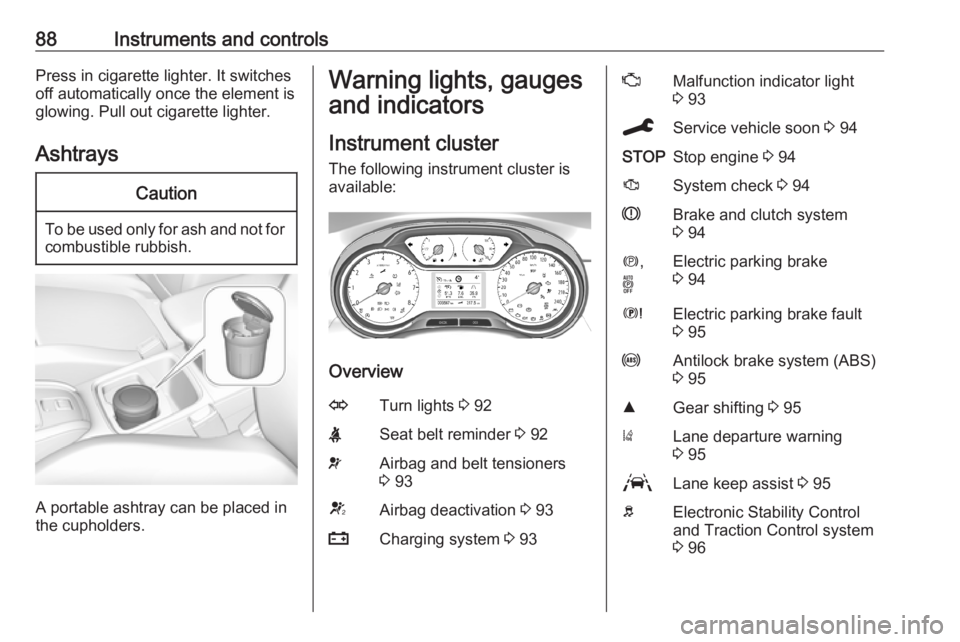
AshtraysCaution
To be used only for ash and not for combustible rubbish.
A portable ashtray can be placed in
the cupholders.
Warning lights, gauges
and indicators
Instrument cluster
The following instrument cluster is
available:
Overview
OTurn lights 3 92XSeat belt reminder 3 92vAirbag and belt tensioners
3 93VAirbag deactivation 3 93pCharging system 3 93ZMalfunction indicator light
3 93CService vehicle soon 3 94STOPStop engine 3 94JSystem check 3 94RBrake and clutch system
3 94m ,
oElectric parking brake
3 94EElectric parking brake fault
3 95uAntilock brake system (ABS)
3 95RGear shifting 3 95)Lane departure warning
3 95LLane keep assist 3 95bElectronic Stability Control
and Traction Control system
3 96
Page 94 of 273
92Instruments and controlsRetrieving service information
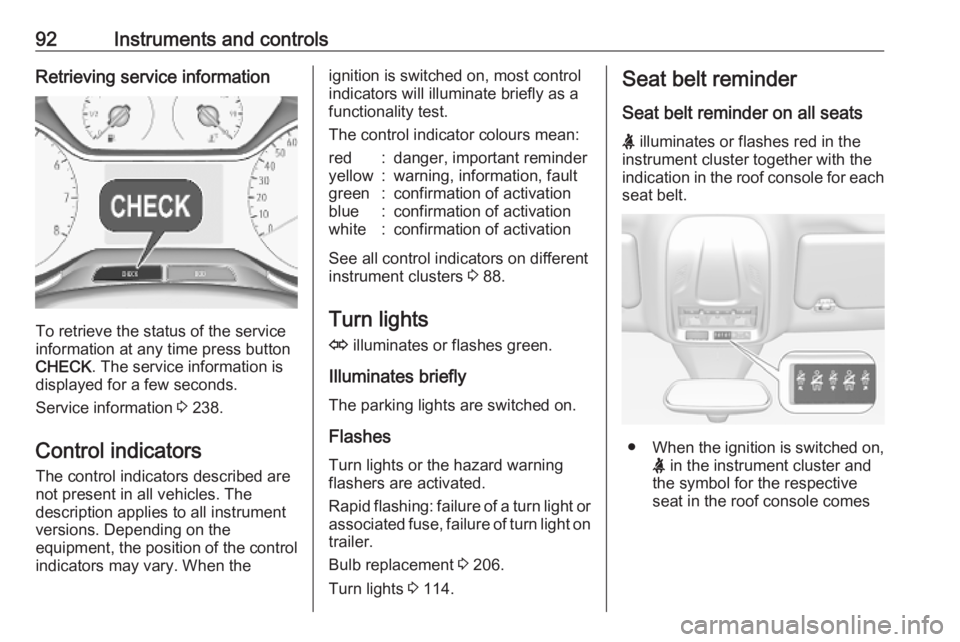
To retrieve the status of the service
information at any time press button
CHECK . The service information is
displayed for a few seconds.
Service information 3 238.
Control indicators The control indicators described are
not present in all vehicles. The
description applies to all instrument
versions. Depending on the
equipment, the position of the control indicators may vary. When the
ignition is switched on, most controlindicators will illuminate briefly as afunctionality test.
The control indicator colours mean:red:danger, important reminderyellow:warning, information, faultgreen:confirmation of activationblue:confirmation of activationwhite:confirmation of activation
See all control indicators on different
instrument clusters 3 88.
Turn lights
O illuminates or flashes green.
Illuminates briefly The parking lights are switched on.
Flashes
Turn lights or the hazard warning
flashers are activated.
Rapid flashing: failure of a turn light or associated fuse, failure of turn light on
trailer.
Bulb replacement 3 206.
Turn lights 3 114.
Seat belt reminder
Seat belt reminder on all seats
X illuminates or flashes red in the
instrument cluster together with the
indication in the roof console for each
seat belt.
● When the ignition is switched on,
X in the instrument cluster and
the symbol for the respective
seat in the roof console comes