battery OPEL GRANDLAND X 2020 Manual user
[x] Cancel search | Manufacturer: OPEL, Model Year: 2020, Model line: GRANDLAND X, Model: OPEL GRANDLAND X 2020Pages: 283, PDF Size: 22.19 MB
Page 143 of 283
Driving and operating141Restart of the engine by the driver
Vehicles with manual transmission
Depress the clutch pedal without depressing the brake pedal to restart
the engine.
Vehicles with automatic transmission The engine is restarted in the
following cases:
● brake pedal released while the selector lever in position D or M
● brake pedal released or selector lever in position N when selector
lever is moved to position D or
M
● selector lever moved to position R
Restart of the engine by the stop-
start system
The selector lever must be in neutralto enable an automatic restart.
If one of the following conditions
occurs during an Autostop, the
engine will be restarted automatically
by the stop-start system:● stop-start system manually deactivated
● driver's seat belt unfastened and driver's door opened
● engine temperature too low
● charging level of vehicle battery below a defined level
● brake vacuum not sufficient
● vehicle driven at least at walking speed
● climate control system requests engine start
● air conditioning manually switched on
If an electrical accessory, e.g. a
portable CD player, is connected to
the power outlet, a brief power drop
during the restart might be noticeable.Parking9 Warning
● Do not park the vehicle on an
easily ignitable surface. The
high temperature of the
exhaust system could ignite the
surface.
● Apply the parking brake.
● If the vehicle is on a level surface or uphill slope, engage
first gear or set the selector
lever to position P. On an uphill
slope, turn the front wheels
away from the kerb.
If the vehicle is on a downhill
slope, engage reverse gear or
set the selector lever to position
P . Turn the front wheels
towards the kerb.
● Close the windows.
● Switch off the engine.
● Remove the ignition key from the ignition switch or switch off
ignition on vehicles with power
Page 149 of 283

Driving and operating147Automatic transmission
electrified
This vehicle is a plug-in hybrid
vehicle. It has a combustion engine
and an automatic transmission with
integrated electrical engine which
enables electrical driving and
charging of the battery during the
deceleration and the braking of the
vehicle. Additionally, the battery can
be charged using a cable, e.g., at
domestic electric outlets or public
charging stations. The all-wheel drive version has a second electrical
engine for the rear axle.Gear selectionP:park position, front wheels are
locked, engage only when the
vehicle is stationary and the
parking brake is appliedR:reverse gear, engage only
when the vehicle is stationaryN/P:neutralD/B:automatic mode / automatic
mode with one-pedal driving
Do not accelerate while engaging a
gear. Never depress the accelerator
pedal and brake pedal at the same
time.
When a gear is engaged, the vehicle
slowly begins to creep when the
brake is released.Shifting in / out of P
To shift into P, press P on the selector
lever.
To shift out of P:
1. Depress brake pedal and press the release button.
2. To shift into R, push the selector
forwards beyond the point of
resistance.
To shift into D, push the selector
backwards beyond the point of
resistance.
To shift into N, push the selector
forwards or backwards without
passing the point of resistance.Shifting into R 1. Depress the brake pedal and press the release button.
2. Shift into R using the gear
selector.Shifting into / out of B
B can only be activated if D is
selected.
Page 150 of 283

148Driving and operatingTo shift into B:
1. Shift into D.
2. Push the selector backwards without passing the point of
resistance.
To shift from B to D, push the selector
backwards without passing the point
of resistance.
One-pedal driving With one-pedal driving, the
accelerator pedal can be used to
control the deceleration of the vehicle
down to a complete stop.
Quick releasing of the accelerator
pedal will result in aggressive
deceleration. Slow releasing of the
accelerator pedal will allow the
deceleration of the vehicle to be
adjusted as desired.
To use one-pedal driving, shift into B.
B is only selectable when the vehicle
is in D. Press the accelerator pedal to
achieve the desired speed. The
deceleration provided by one-pedal
driving provides full regenerative
braking by charging the high voltage
battery.Automatic transmission
The automatic transmission permits
automatic gearshifting (automatic
mode) or manual gearshifting
(manual mode).
Manual shifting is possible in manual
mode by tapping the selector lever to + or - 3 149.
Transmission display
The mode or selected gear is shown
in the Driver Information Centre.
In automatic mode, the driving
programme is indicated by D.
In manual mode, M and the number
of the selected gear is indicated.
R indicates reverse gear.
N indicates neutral position.
P indicates park position.
Gear selection
Move the selector lever in the shifting
gate as shown in the illustration
above.
Page 152 of 283
150Driving and operatingIn manual mode, no automatic
shifting to a higher gear takes place
at high engine revolutions.
Gear shift indication
The symbol R or S with a number
beside it is indicated when
gearshifting is recommended for fuel
saving reasons.
Shift indication appears only in
manual mode.
Electronic driving programmes
● Following a cold start, the operating temperature
programme increases engine
speed to quickly bring the
catalytic converter to the required
temperature.
● Special programmes automatically adapt the shifting
points when driving up inclines or
down hills.
● In snowy or icy conditions or on other slippery surfaces, the
electronic transmission controlenables the driver to select
manually first, second or third
gear for starting off.
Kickdown Pressing down the accelerator pedal
beyond the kickdown detent will lead
to maximum acceleration
independent of selected driving
mode. The transmission shifts to a
lower gear depending on engine
speed.
Fault
In the event of a fault a message is
displayed in the Driver Information
Centre.
Vehicle messages 3 107.
Electronic transmission control
enables only third gear. The
transmission no longer shifts
automatically.
Do not drive faster than 100 km/h.
Have the cause of the fault remedied by a workshop.Interruption of power supply
In the event of an interruption of
power supply, the selector lever
cannot be moved out of the P
position.
If the vehicle battery is discharged,
start the vehicle using jump leads
3 244.
If the vehicle battery is not the cause
of the fault, release the selector lever.
1. Apply the parking brake.
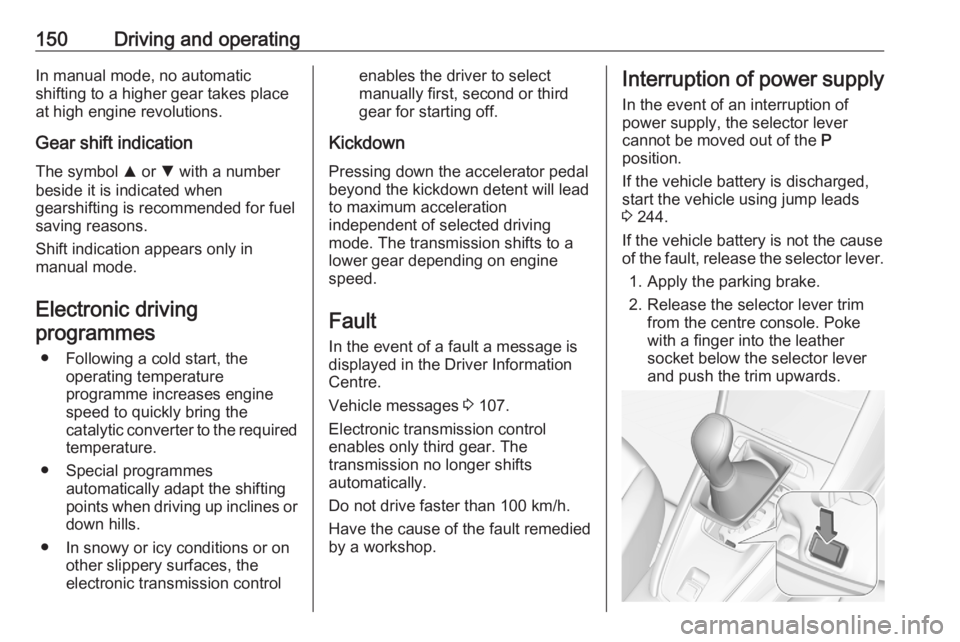
2. Release the selector lever trim from the centre console. Poke
with a finger into the leather socket below the selector lever
and push the trim upwards.
Page 154 of 283
152Driving and operatingDrive systems
Drive modes The plug-in hybrid vehicle providesseveral drive modes.
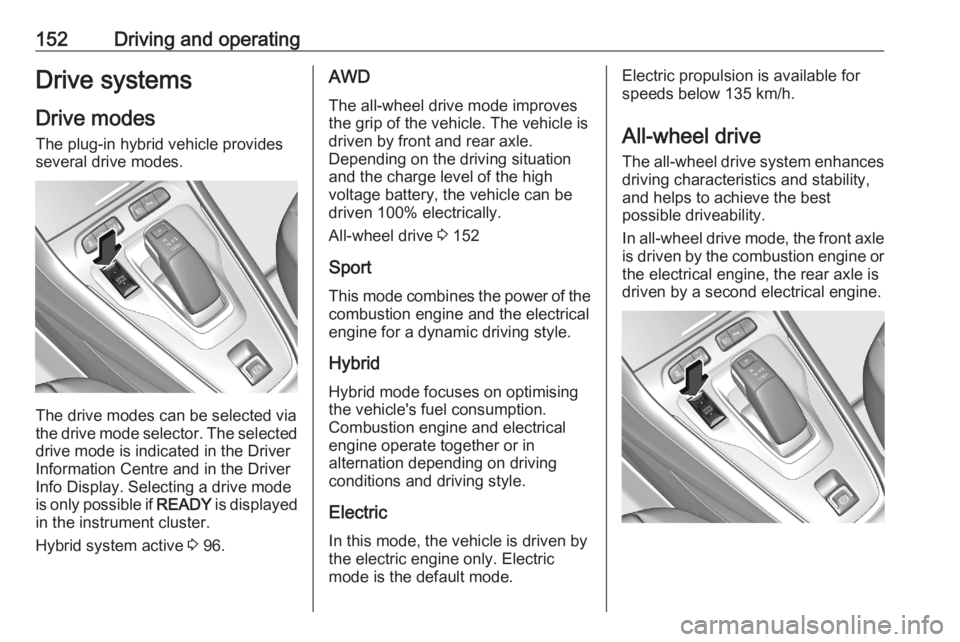
The drive modes can be selected via
the drive mode selector. The selected
drive mode is indicated in the Driver
Information Centre and in the Driver
Info Display. Selecting a drive mode
is only possible if READY is displayed
in the instrument cluster.
Hybrid system active 3 96.
AWD
The all-wheel drive mode improves
the grip of the vehicle. The vehicle is
driven by front and rear axle.
Depending on the driving situation
and the charge level of the high
voltage battery, the vehicle can be
driven 100% electrically.
All-wheel drive 3 152
Sport
This mode combines the power of the combustion engine and the electrical
engine for a dynamic driving style.
Hybrid
Hybrid mode focuses on optimising
the vehicle's fuel consumption.
Combustion engine and electrical
engine operate together or in
alternation depending on driving
conditions and driving style.
Electric
In this mode, the vehicle is driven by
the electric engine only. Electric
mode is the default mode.Electric propulsion is available for
speeds below 135 km/h.
All-wheel drive The all-wheel drive system enhances
driving characteristics and stability,
and helps to achieve the best
possible driveability.
In all-wheel drive mode, the front axle is driven by the combustion engine or
the electrical engine, the rear axle is
driven by a second electrical engine.
Page 156 of 283
154Driving and operatingFault9Warning
If there is a fault in the ABS, the
wheels may be liable to lock due
to braking that is heavier than
normal. The advantages of ABS are no longer available. During
hard braking, the vehicle can no longer be steered and may
swerve.
Have the cause of the fault remedied
by a workshop.
Parking brake
9 Warning
Before leaving the vehicle, check
parking brake status. Control
indicator j illuminate constantly
when electric parking brake is
applied.
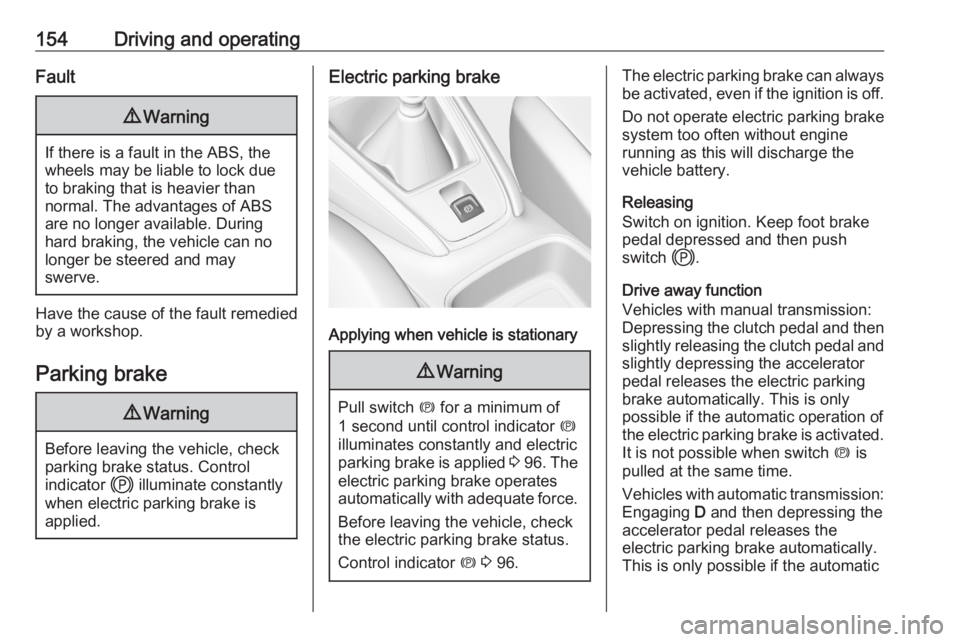
Electric parking brake
Applying when vehicle is stationary
9 Warning
Pull switch m for a minimum of
1 second until control indicator m
illuminates constantly and electric
parking brake is applied 3 96 . The
electric parking brake operates automatically with adequate force.
Before leaving the vehicle, check
the electric parking brake status.
Control indicator m 3 96.
The electric parking brake can always
be activated, even if the ignition is off.
Do not operate electric parking brake
system too often without engine
running as this will discharge the
vehicle battery.
Releasing
Switch on ignition. Keep foot brake
pedal depressed and then push
switch j.
Drive away function
Vehicles with manual transmission:
Depressing the clutch pedal and then slightly releasing the clutch pedal and
slightly depressing the accelerator
pedal releases the electric parking
brake automatically. This is only
possible if the automatic operation of
the electric parking brake is activated. It is not possible when switch m is
pulled at the same time.
Vehicles with automatic transmission: Engaging D and then depressing the
accelerator pedal releases the
electric parking brake automatically.
This is only possible if the automatic
Page 158 of 283

156Driving and operatingFunctionality check
When the vehicle is not moving, the
electric parking brake might be
applied automatically. This is done to
check the system.
Fault
Failure mode of electric parking brake
is indicated by a control indicator j
and by a vehicle message which is
displayed in the Driver Information
Centre.
Vehicle messages 3 107.
Control indicator j flashes: electric
parking brake is not fully applied or
released. When continuously
flashing, release electric parking
brake and retry applying.
Brake assist If brake pedal is depressed quickly
and forcefully, maximum brake force
is automatically applied.
Operation of brake assist might
become apparent by a pulse in the
brake pedal and a greater resistance
when depressing the brake pedal.Maintain steady pressure on the
brake pedal as long as full braking is
required. Maximum brake force is
automatically reduced when brake
pedal is released.
Hill start assist The system helps prevent unintendedmovement when driving away on
inclines.
When releasing the brake pedal after
stopping on an incline, brakes remain
on for further 2 seconds. The brakes
release automatically as soon as the
vehicle begins to accelerate.
Regenerative braking
Regenerative braking generates
electrical energy resulting from
braking to charge the high voltage
battery. Regenerative power may be
limited when the high voltage battery
is fully charged.
If the selector lever is in D, energy is
recuperated when the brake pedal is
depressed.If the selector lever is in B, energy is
recuperated when the accelerator
pedal is lifted.
Automatic transmission electrified
3 147
Page 197 of 283
Driving and operating195The counting of driving time alert is
reset when the ignition has been
switched off for a few minutes.
Driver drowsiness detection
The system monitors the driver's level
of vigilance. A camera at the top of the windscreen detects variations in
trajectory compared to the lane
markings. This system is particularly
suited to fast roads (speed higher
than 65 km/h).
If the trajectory of the vehicle
suggests a certain level of
drowsiness or inattention by the
driver, the system triggers the first
level of alert. The driver is notified by
a message and an audible signal is
given.
After three first level alerts, the
system triggers a new alert with a
message, accompanied by a more
pronounced audible signal.
In certain driving conditions (poor
road surface or strong winds), the
system may give alerts independent of the driver's level of vigilance.The driver drowsiness detection is
reinitialised when the ignition has
been switched off for a few minutes or
the speed remains below 65 km/h for a few minutes.
System limitations
In the following situations, the system
may not operate properly or even not operate at all:
● poor visibility caused by inadequate lighting of the
roadway, falling snow, heavy
rain, dense fog etc.
● dazzle caused by headlamps of an oncoming vehicles, low sun,
reflections on damp roads,
leaving a tunnel, alternating
shade and light etc.
● windscreen area in front of the camera covered by dirt, snow,
stickers etc.
● no lane markings detected or multiple lane markings due to
roadworks
● close vehicles ahead
● winding roads or narrow roadsCharging9 Warning
Persons with a pacemaker should
consult a doctor for possible
precautions.
This section explains the process of
charging the vehicle's high voltage
battery.
While the charge cord is plugged into
the vehicle, the vehicle cannot be
driven.
Page 198 of 283

196Driving and operatingCharging at domestic electrical
outlets
Start charging9 Warning
Only use a domestic electrical
outlet which is properly grounded and protected by a 30 mA
differential switch.
Only use a domestic electrical
outlet protected by a circuit
breaker adapted to the amperage
of the electrical circuit.
Have a qualified electrician check
the electrical installation to be
used. The installation has to be in
compliance with national
standards and compatible with the vehicle.
When using a dedicated domestic electrical outlet, have it installed
by a qualified electrician.
Make sure that the electrical
outlet, the plug and the cable do
not support the weight of the
control box.
9 Warning
Do not carry out any works in the
engine compartment during
charging.
The vehicle can be charged at
domestic electrical outlets. Charging
an empty high voltage battery at a
domestic electrical outlet takes
approx. 7 hours.
A portable charge cord used to charge the vehicle high voltage
battery is stored under the rear floor
storage cover in the load
compartment.
1. Shift into P and switch off the
vehicle.
2. Push the rearward edge of the charge port door in and release to
open the door.
Page 199 of 283
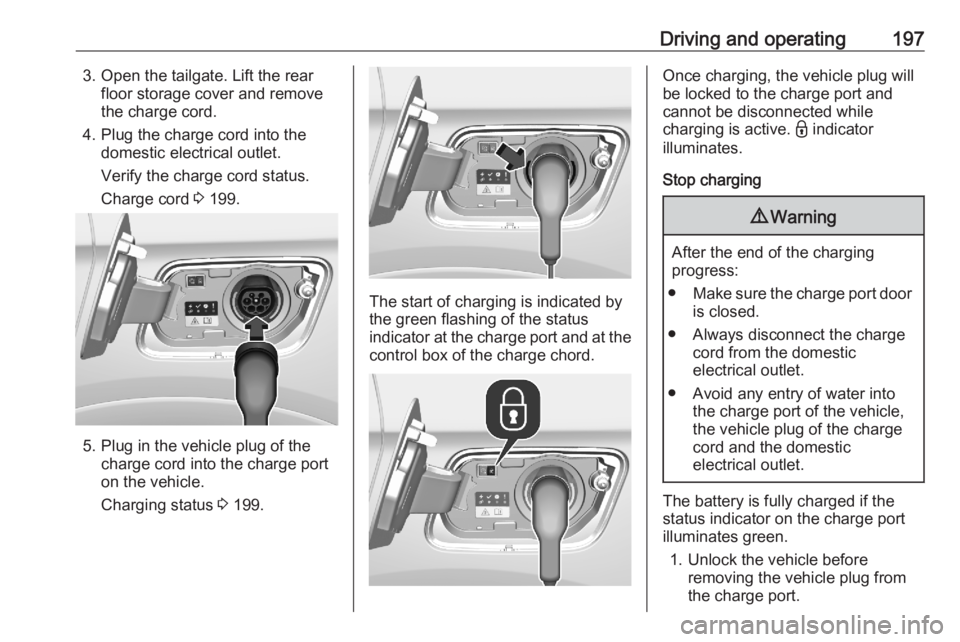
Driving and operating1973. Open the tailgate. Lift the rearfloor storage cover and remove
the charge cord.
4. Plug the charge cord into the domestic electrical outlet.
Verify the charge cord status.
Charge cord 3 199.
5. Plug in the vehicle plug of the
charge cord into the charge port
on the vehicle.
Charging status 3 199.
The start of charging is indicated by
the green flashing of the status
indicator at the charge port and at the
control box of the charge chord.
Once charging, the vehicle plug will
be locked to the charge port and cannot be disconnected while
charging is active. - indicator
illuminates.
Stop charging9 Warning
After the end of the charging
progress:
● Make sure the charge port door
is closed.
● Always disconnect the charge cord from the domestic
electrical outlet.
● Avoid any entry of water into the charge port of the vehicle,the vehicle plug of the charge
cord and the domestic
electrical outlet.
The battery is fully charged if the status indicator on the charge port
illuminates green.
1. Unlock the vehicle before removing the vehicle plug from
the charge port.