warning OPEL GT 2011 Owner's Guide
[x] Cancel search | Manufacturer: OPEL, Model Year: 2011, Model line: GT, Model: OPEL GT 2011Pages: 190, PDF Size: 2.46 MB
Page 124 of 190
1 2 4 D r iv in g an d o p e ra t io n
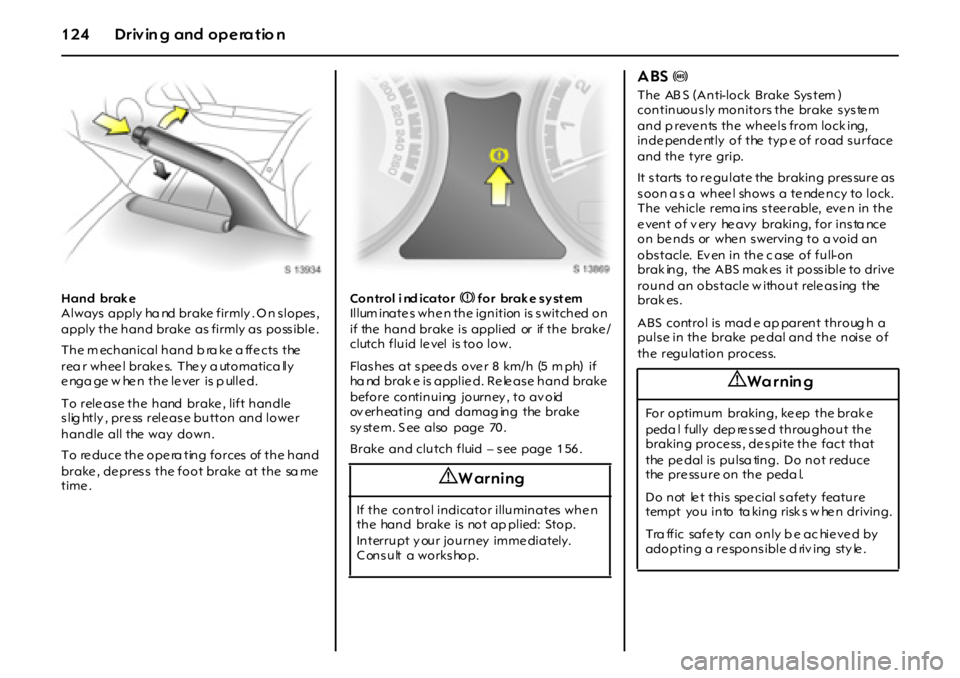
Hand brak e
Always apply ha nd brake firmly . O n s lopes ,
apply the hand brake as firmly as poss ible .
The m echanical hand b ra ke a ffe cts the
rea r wheel brakes. They a utomatica lly
enga ge w hen the lever is p ulled.
To release the hand brake, lift handle
s lig htly , pre ss rele as e button and lowe r
handle all the way down.
T o re du ce t h e o p e ra t in g f o r ces of t h e h a n d
brake , de pres s the foot brake at the sa me
time .Control i nd icator R f o r b r a k e s y st em
Illum inate s whe n the ignition is s witched on
if the hand brake is applied or if the brake/
clutch fluid le vel is too low.
Flas hes at s pee ds ove r 8 km/ h (5 m ph) if
ha nd brak e is applie d. Re le as e hand brake
b ef o r e c o nt i n u i ng j o ur n ey , t o a v o id
ov erheating and damag ing the brake
sy ste m. S ee also page 70 .
Brake and clutch fluid – s ee page 1 56 .
ABS u
T h e AB S ( A n ti-lo ck Brake Sys tem )
continuously monitors the brake system
a n d p r eve n ts t h e w h ee l s f r o m l o ck i ng ,
inde pende ntly of the typ e of road surface
and the tyre grip.
It s tarts to re gulate the braking pres sure as
soon a s a wheel shows a tendency to lock.
T h e veh i cl e r em a i ns s t ee r a bl e, eve n i n t h e
e vent of v ery he avy braking, for ins ta nce
on bends or when swerving to a void an
o bs t acl e. Ev en i n t h e c ase o f f u l l- o n
brak ing, the ABS mak es it poss ible to drive
round an obs tacle w ithout rele as ing the
brak es .
ABS control is mad e ap parent throug h a
puls e in the brake pe dal and the nois e of
the regulation process.
9 Warning
If the control indicator illuminates whe n
the hand brake is not ap plied: Stop.
Interrupt y our journey immediately.
C onsult a workshop.
9 Wa r nin g
For optimum braking, ke ep the brak e
peda l fully dep re s se d throughout the
braking proce ss , de s pite the fact that
the pe dal is pulsa ting. Do not reduce
the pre ssure on the peda l.
Do not le t this spe cial safety feature
tempt you into ta king risk s w he n driving.
Tra ffic safe ty can only b e ac hie ve d by
adopting a re spons ible d riv ing sty le .
Page 125 of 190
12 5Dr i vi ng and o pe r ati on
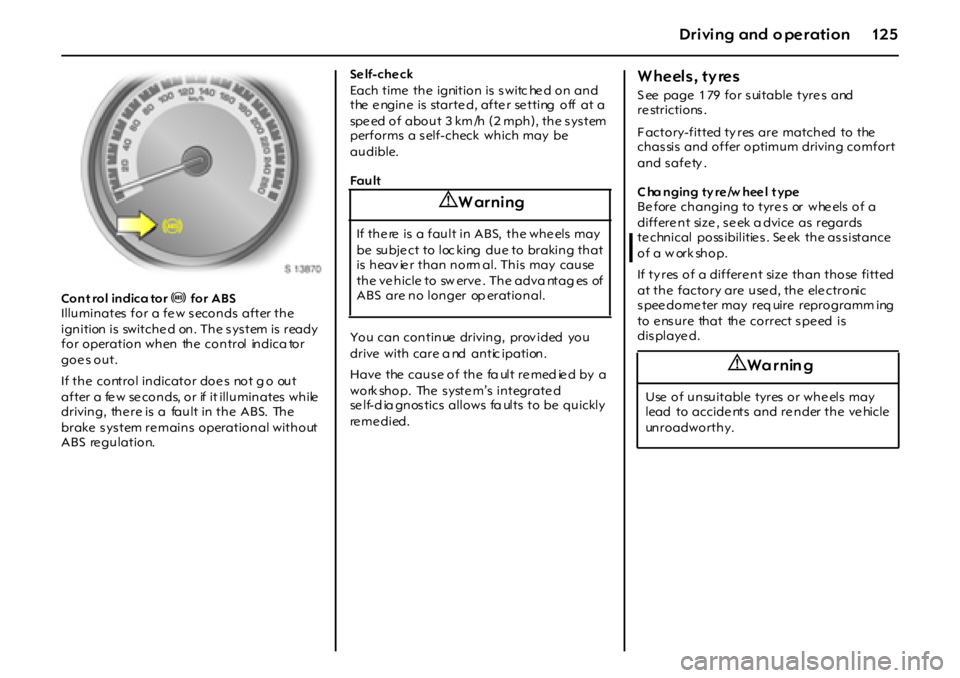
Con t rol in dica tor u for ABS
Illuminates for a few seconds after the
ignition is switche d on. The s ys tem is ready
for operation when the control indica tor
goe s out.
If the control indicator doe s not g o out
after a fe w se conds, or if it illuminates while
driving, there is a fault in the ABS. The
brake system remains operational without
ABS regulation.Se lf-che ck
Each time the ignition is switc he d on and
the e ngine is starte d, afte r se tting off at a
speed of about 3 km /h (2 mph), the system
performs a s elf-check which may be
audible.
Fa u lt
You can continue driving, prov ided you
drive with care a nd antic ipation.
Have the cause of the fa ult re med ie d by a
workshop. The system’s integrated
se lf-d ia gnos tics allows fa ults to be quickly
re m e d i e d .
Wheels, tyres
S ee page 1 79 for s uitable tyre s and
re strictions.
F actory-fitted ty res are matched to the
chas sis and offer optimum driving comfort
and s afe ty .
C ha nging ty re/w heel t ype
Be fore changing to tyre s or whe els of a
differe nt size , s e ek a dvice as regards
te chnical poss ibilitie s . Se ek the as s istance
of a w ork shop.
If ty res of a differe nt size than those fitted
at the factory are used, the electronic
spee dome ter may req uire reprogramm ing
to ensure that the correct speed is
dis playe d.
9 Warning
If the re is a fault in ABS, the whe els may
be subje ct to loc king due to braking that
is heav ie r than norm al. This may cause
t h e ve h i cl e t o sw er ve . T h e a dva nt a g es of
A B S a r e n o l o n g er op er a t i o n a l .
9 Wa r nin g
Use of unsuitable tyres or wheels may
lead to accide nts and re nder the ve hicle
unroadworthy.
Page 126 of 190
1 2 6 D r iv in g an d o p e ra t io n
F itting ne w tyre s
Please fit tyre s in pairs. Se ts would be eve n
be tte r. Re place tyre s w ith:
zth e s a m e si z e ,
zthe same design,
zthe s ame make ,
zthe same tre ad pattern on one ax le.
F it direc tional tyres such that the y roll in the
direc tion of trave l. The rolling d ire ction is
indicated by a s ymbol (e .g. a n arrow) on
the s ide wall.
Tyre s fitte d opposing the rolling direction
(e. g. whe n a tyre is chang ed) s hould be
refitted a s s oon as poss ible. This is the only
way to obtain full bene fit from the de sign
properties of the tyre.
O bse rve legal re quireme nts w he n
disposing of ty res.Some brands of tyres have a b eade d
edge for alloy whe els to protect against
damage . If a whee l trim is use d on s tee l
whee ls with be ade d-edg e ty re s, the
following proce dure mus t be followe d:
zW hee l trims and ty res that are a pproved
for the re spe ctive ve hicle and c om ply
with all of the rele vant whee l and tyre
combination re quireme nts mus t b e use d.
zIf the whe el trims and ty re s use d are not
approve d, the tyre s must not have a
be ade d ed ge.
Ty re pre ssure
Ch eck t yr e p r es su r e s w he n co l d, a t l ea s t
eve ry 1 4 days and prior to any long
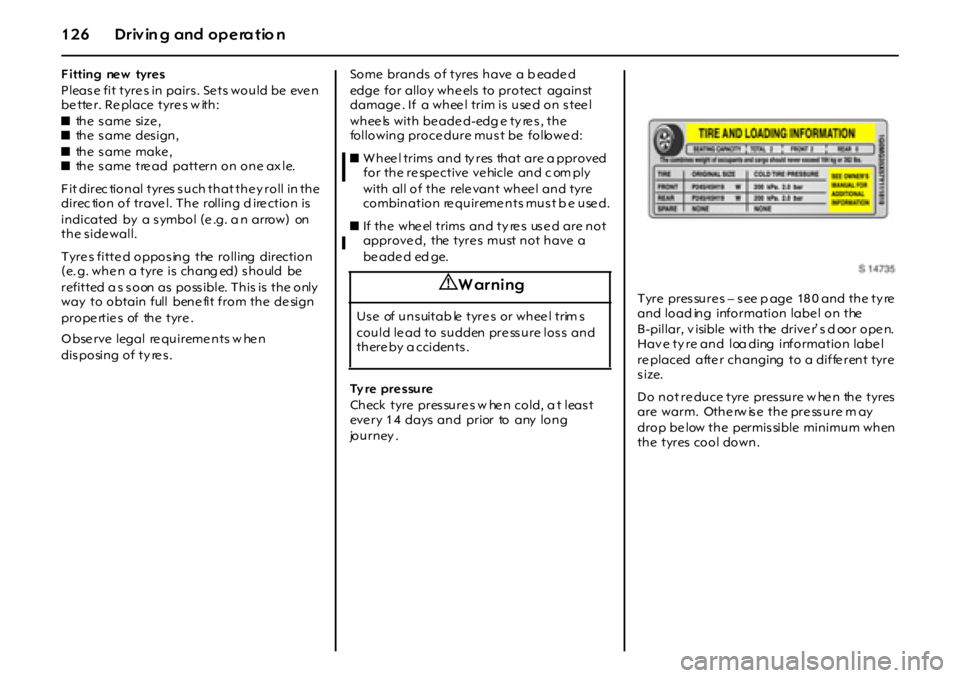
journey .Tyre pres sure s – s ee p age 18 0 and the ty re
and load ing information labe l on the
B-pillar, v isible with the drive r’ s d oor ope n.
Hav e ty re and loa ding information labe l
re placed afte r changing to a diffe rent tyre
size.
Do not re duce tyre pressure w he n the tyres
are warm. Otherw ise the pressure m ay
drop be low the permis sible minimum when
the tyres cool down.
9 Warning
Use of unsuitab le tyre s or whee l trim s
could le ad to s udden pre ss ure los s and
there by a ccidents .
Page 127 of 190
12 7Dr i vi ng and o pe r ati on
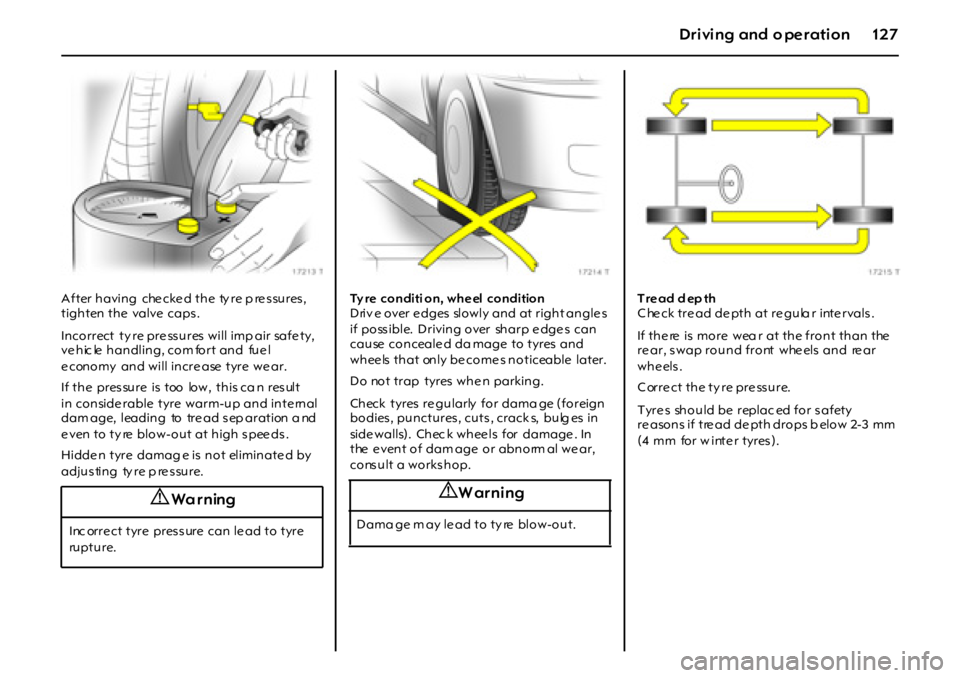
After having che cke d the ty re p re ssures,
tighten the valve caps.
Incorrect ty re pre ssures will imp air safe ty,
vehic le handling, com fort and fuel
e conomy and will incre ase tyre we ar.
If the pressure is too low, this ca n result
in conside rable tyre warm-up and inte rnal
dam age, leading to tre ad s ep aration a nd
e ven to ty re blo w-o u t at h igh s pee ds .
Hidde n tyre damag e is not eliminate d by
adjus ting ty re p re s sure.Ty re conditi on, wheel condition
Driv e over e dges slowly and at right angle s
if poss ible. Driving over sharp e dge s can
cause conceale d da mage to tyres and
whee ls that only be come s noticeable later.
Do not trap tyres whe n parking.
Check tyres re gularly for dama ge (foreign
bo dies , pu n ctu res , cu ts , crack s, bu lg es in
side walls). Chec k whee ls for damage . In
the e vent of dam age or abnorm al we ar,
cons ult a works hop.Tread depth
C he ck tre ad de pth at re gula r inte rvals .
If the re is more wea r at the front than the
re ar, s wap round front whe els and re ar
whe els.
C orre ct the ty re pre ssure.
Tyre s should be replac ed for safety
re asons if tre ad de pth drops b elow 2-3 mm
(4 mm for w inte r tyres).
9 Wa r ning
Inc orre ct tyre pressure can le ad to tyre
ru p t u r e .
9 Warning
Dama ge m ay le ad to ty re blow-out.
Page 130 of 190
130 Self-help, vehicle care
Self-help, vehicle care
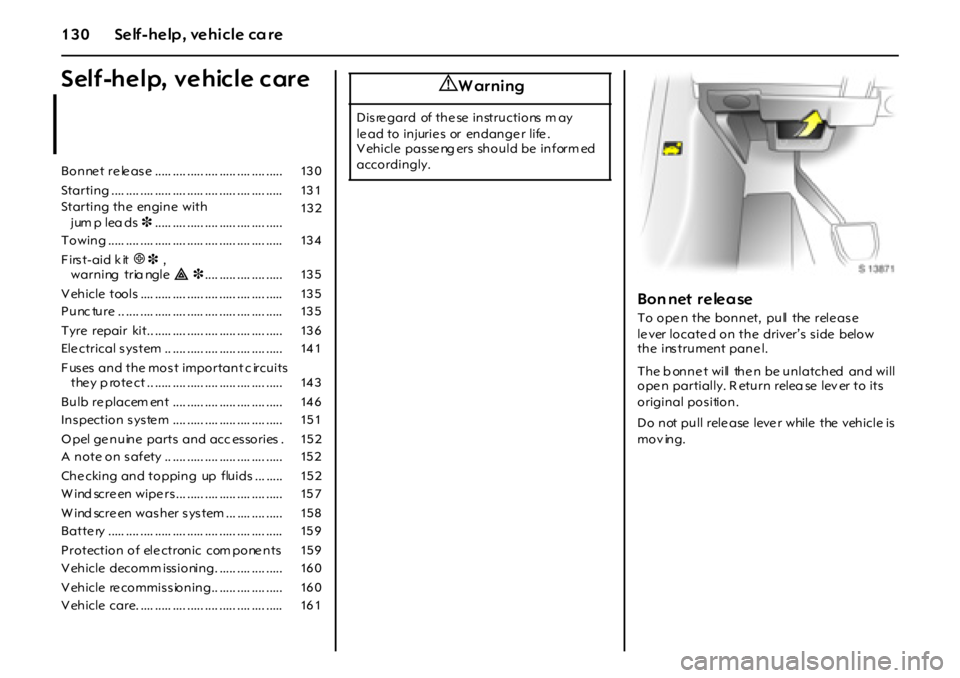
Bon net relea se
To ope n the bonnet, pull the rele ase
le ver locate d on the driver’s s ide below
the instrument pane l.
The b onnet will then be unlatched and will
ope n partially. R eturn relea se lev er to its
original pos ition.
Do not pull rele ase leve r while the vehicle is
mov ing. Bo n ne t re le as e ..... .... ..... .... ..... .... .... ..... 13 0
Startin g .... .... .... ..... .... ..... .... ..... .... .... ..... 13 1
Starting the engine with
jum p lea ds3..... .... ..... .... ..... .... .... ..... 13 2
T o win g ..... .... .... ..... .... ..... .... ..... .... .... ..... 13 4
First-aid kit+3,
warning tria ngle¨3.... ..... .... .... ..... 13 5
V eh icle too ls .... ..... .... ..... .... ..... .... .... ..... 13 5
P u nc tu re .. .... .... ..... .... ..... .... ..... .... .... ..... 13 5
T yre repair kit.. ..... .... ..... .... ..... .... .... ..... 13 6
Ele ctrical s ys tem .. .... ..... .... ..... .... .... ..... 14 1
Fuses and the most important c ircuits
the y p ro te ct .. ..... .... ..... .... ..... .... .... ..... 14 3
Bu lb re placem en t .... ..... .... ..... .... .... ..... 14 6
In s pectio n s ys te m .... ..... .... ..... .... .... ..... 15 1
O pel ge nuine parts and acc es sories . 15 2
A n o te o n s af ety .. .... ..... .... ..... .... .... ..... 15 2
Ch e ckin g an d to ppin g up f lu ids ... ..... 15 2
W ind scre en wipe rs ... ..... .... ..... .... .... ..... 15 7
W ind scre en was h er s ys tem ... .... .... ..... 15 8
Batte ry ..... .... .... ..... .... ..... .... ..... .... .... ..... 15 9
Protection of electronic com ponents 159
V eh icle deco mm iss io nin g. ..... .... .... ..... 16 0
V eh icle re co mmis s io n in g.. ..... .... .... ..... 16 0
V eh icle care. .... ..... .... ..... .... ..... .... .... ..... 16 1
9 Warning
Disregard of these instructions m ay
le ad to injurie s or endange r life .
V eh i c l e p a s se ng er s sh o u l d b e i n f or m ed
accordingly.
Page 131 of 190
13 1Self-help, vehicle care
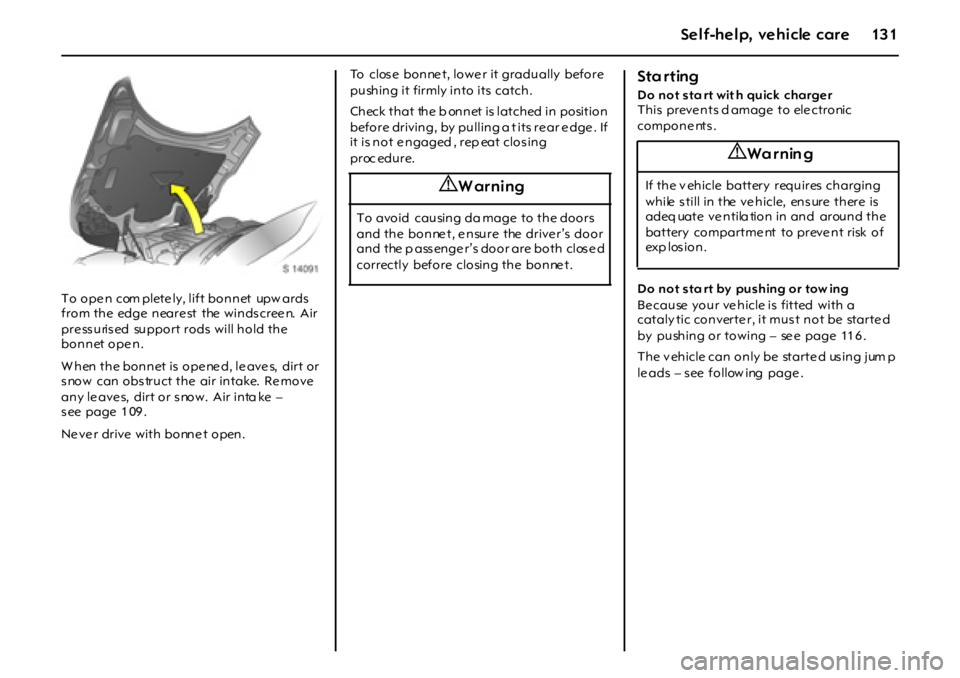
To ope n com plete ly, lift bonnet upw ards
from the edge neare st the windscree n. Air
pre ss uris ed support rods will hold the
bonnet open.
When the bonnet is opened, leaves, dirt or
snow can obstruct the air intake. Remove
any le ave s, dirt or s now. Air inta ke –
s ee page 1 09 .
Ne ve r drive with bonne t open.To clos e bonne t, lowe r it gradually before
pushing it firmly into its catch.
Check that the b onnet is latched in position
before driving, by pulling a t its re ar e dge . If
it is not e ngaged , rep eat clos ing
p r oc edu r e.
Sta rting
D o not s ta rt wit h quick charge r
This preve nts d amage to ele ctronic
compone nts .
D o not s ta rt by pus hing or tow ing
Be cause your ve hicle is fitted with a
cataly tic converte r, it must not be starte d
by pushing or towing – se e page 11 6 .
T h e v eh i cl e ca n o n l y be st a r t e d us i n g j um p
le ads – s ee follow ing page .
9 Warning
To avoid causing da mage to the doors
and the bonnet, ensure the driver’s door
and the p ass enge r’s door are both clos e d
correctly before closing the bonne t.
9 Wa r nin g
If t h e v eh i cl e ba t t er y r equ i r es ch a r g i n g
while s till in the ve hicle, ens ure there is
adeq uate ventila tion in and around the
battery compartme nt to preve nt risk of
exp l os i o n .
Page 134 of 190
134 Self-help, vehicle care
zDo not c onnec t leads to negative
te rminal of discharged battery!
zRoute the le ads so that the y ca nnot
catch on rotating p arts in the engine
com partment.
zStart the e ngine of the ve hicle p rov id ing
th e j u m p s t a r t .
zAfte r 5 minute s, sta rt the other e ngine .
Start attem pts should be made for no
longe r than 15 s econds at an interva l of
1 m i nu t e .
zAfte r the start, allow b oth engines to idle
for 3 minutes with the leads connected.
zIn ord er to av oid ex ces s voltage in the
el ec tr i ca l sy st e m , be f o r e r e m o vi n g a
le ad, switch on an e lectrical cons umer
(e .g. lamps , h ea te d re ar win do w) in th e
vehicle rece iving the jump start.
zReverse above sequence exactly when
re m o v i n g l e a d s .
Towing
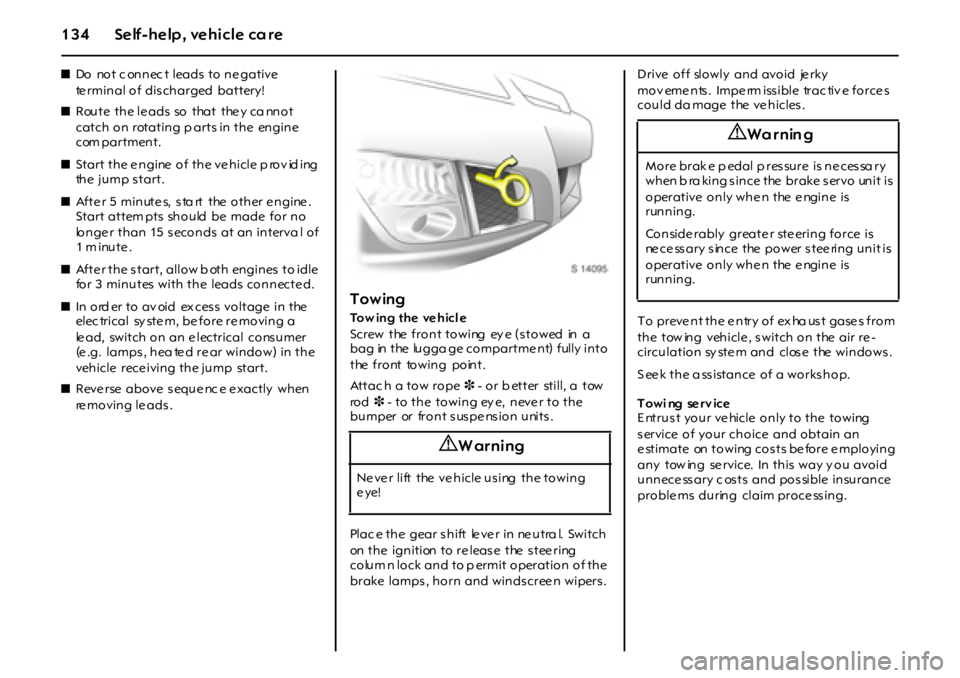
Tow ing the vehicl e
Screw the front towing ey e (stowed in a
bag in the lugga ge compartme nt) fully into
the front towing point.
Attac h a tow rope 3 - or b etter still, a tow
ro d 3 - to the towing ey e, neve r to the
bumper or front suspension units.
Plac e the gear s hift le ve r in ne utra l. Switch
on the ignition to re lease the stee ring
colum n lock and to p ermit operation of the
brake lamps , horn and winds cree n wipers . Drive off slowly and avoid jerky
mov eme nts . Impe rm iss ible trac tiv e force s
could da mage the ve hicles .
To prevent the entry of exha ust gases from
the tow ing vehicle , switch on the air re -
circulation sy stem and close the windows.
S ee k the a ss istance of a works hop.
Towi ng serv ice
E ntrust your ve hicle only to the towing
service of your choice and obtain an
e stimate on towing costs be fore e mploying
any tow ing se rvice. In this way y ou avoid
unnecessary c osts and possible insurance
proble ms during claim proce ss ing.
9 Warning
Ne ve r lift the ve hicle using the towing
eye!
9 Wa r nin g
More brake pedal pressure is necessary
w h en b ra ki n g s i n ce t he br a ke s er vo un i t i s
operative only when the engine is
running.
Conside rably greate r ste ering force is
necessary since the power steering unit is
operative only when the engine is
running.
Page 135 of 190

13 5Self-help, vehicle care
First-aid kit+3,
warning triangle¨3
Your first-aid kit and w arning triangle can
be accomm od ated in the luggage
compartme nt.
Vehicle tools
T h e f r o n t t o w i ng ey e s h o ul d be k ep t i n t h e
bag provided when not in use and s towed
in the lugga ge com partment.
Puncture
I n o r d er t o m i ni m i s e v eh i c l e w e i g ht , y o u r
vehicle is not fitte d with a jack or a spare
whee l.
It is recomm ended that whee l changing
and jacking of the vehicle are only carried
ou t b y a w or k sh o p .H o w e ve r, i f t h e v eh i cl e n e eds t o b e l i f t ed i n
an e me rg ency, suitable jacking points are
locate d on the v ehicle unde rbody.
9 Wa r nin g
When raising the vehicle on a workshop
hois t, prope r lift pads mus t be us e d to
avoid caus ing dama ge to the ve hicle .
Contact a w ork shop.
Page 136 of 190
136 Self-help, vehicle care
Tyre rep air k it
Minor damag e to the tyre tread, e.g . from
foreign bodie s, can be tem porarily
rep aire d using the ty re re pair kit.
Do not rem ov e foreign bodies from the
tyre s. Damage d are as bigger than 4 m m
and da mage at the ty re rim cannot be
rep aire d using the ty re re pair kit.
The tyre re pair k it can be use d to seal small
puncture s with a liquid seala nt. Use of the
sealant doe s not c onstitute a pe rmane nt
rep air but is des igned as an eme rgency
measure, to allow the vehicle to be driven
while awaiting tyre replace me nt.
The ty re re pair kit ca n also be used to
infla te the tyres to the c orre ct ty re pressure
(se e page 18 0 ) without us ing the s ea lant.For important information – s ee page 1 40 .
If you have a flat ty re:
zPark on a leve l, firm a nd non-s lippery
surface.
zSw itch on haz ard warning lamps , a pply
hand brak e, engage rev ers e ge ar and
switch off engine.
zC orre ctly s et up the warning triangle3.
W arning tria ngle – se e page 13 5 .
Nev er use the liquid sealant on more than
one tyre at a tim e.
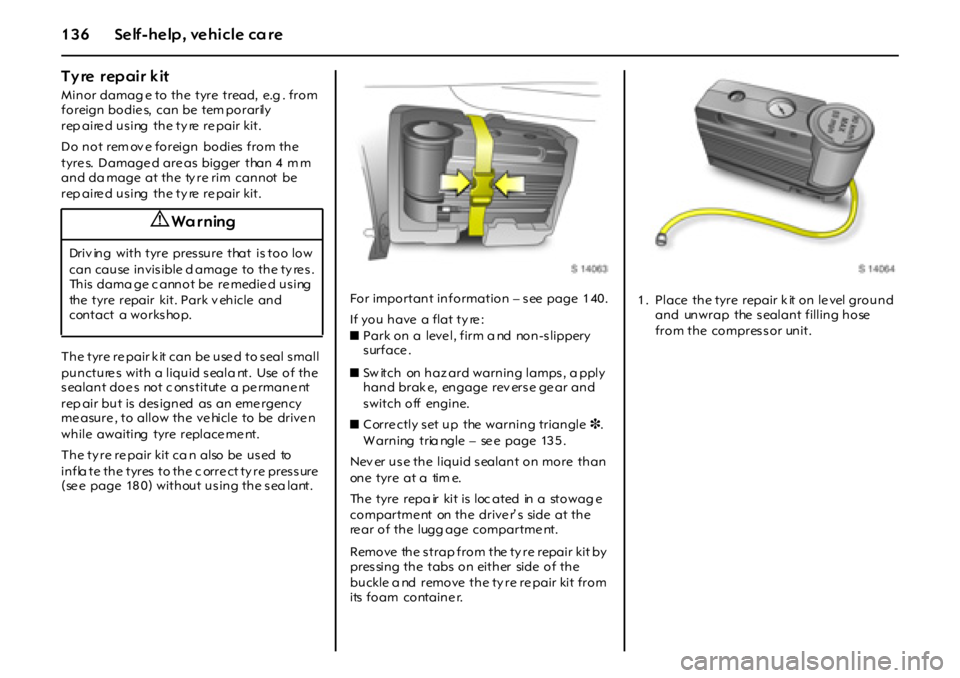
The tyre repa ir kit is loc ated in a stowag e
compartme nt on the drive r’ s side at the
re ar of the lugg age compartme nt.
Remove the strap from the ty re repair kit by
pressing the tabs on either side of the
buckle a nd remove the ty re re pair kit from
its foam containe r.
9 Wa r ning
Driv ing with tyre pressure that is too low
can cause invisible d amage to the ty re s.
This dama ge c annot be re medie d us ing
the tyre repair kit. Park v ehicle and
contact a works hop.
1 . Place the tyre repair k it on le vel ground
and unwrap the s ealant filling hose
from the compressor unit.
Page 139 of 190
13 9Self-help, vehicle care
14. Place the ty re re pair kit in its foam
container and wrap the strap a round
it. S nap the buc kle into place and
tighten the strap as ne ce ss ary.
1 5. Re move any e xce ss s ealant us ing a
cloth. S tow tyre re pair kit in lugga ge
compa rtm ent in its orig inal loca tion.
1 6. C ollap se warning triangle3 and s tow
in luggage compartm ent –
s ee page 1 35 .
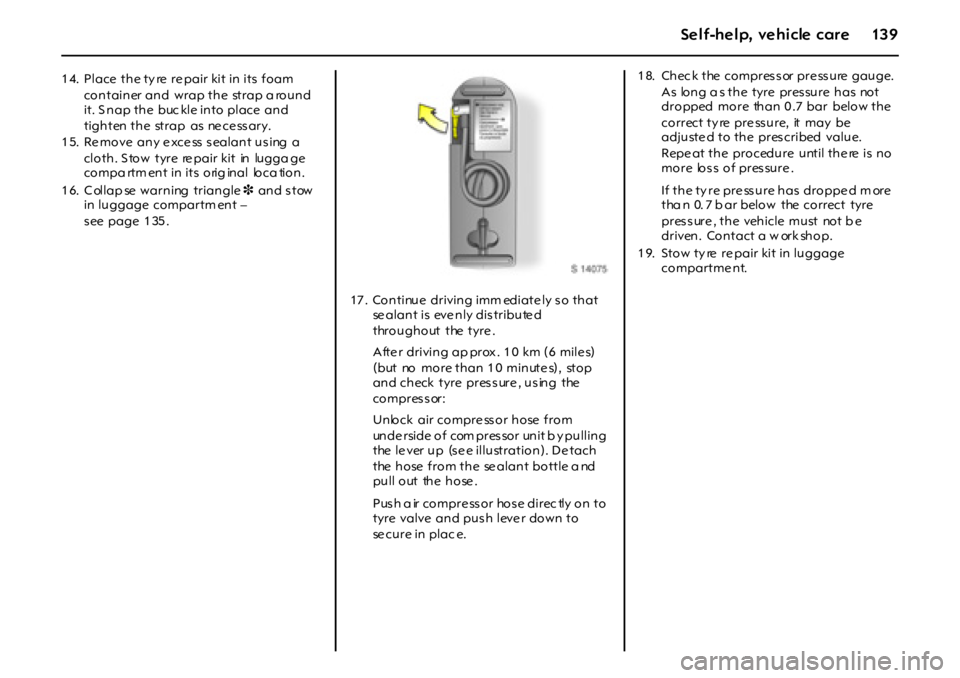
17 . Continue driving imm ediate ly s o that
se alant is eve nly dis tribute d
throughout the tyre .
Afte r driving ap prox . 1 0 km (6 mile s)
( b ut no m o r e t h a n 1 0 m i n ut e s) , st o p
and check tyre pres s ure , us ing the
compressor:
Unlock air compre ss or hose from
unde rside of com pres sor unit b y pulling
the le ver up (s e e illustration). De tach
the hose from the se alant bottle a nd
pull out the hose .
Push a ir compre ssor hose direc tly on to
tyre valve and pus h leve r down to
se cure in plac e.1 8. Chec k the compres s or pre ss ure gauge.
As long a s the tyre pressure has not
dropped more than 0 .7 bar below the
correct ty re pre ssure, it may be
a dj u st e d t o t h e p r es cr i bed va l u e.
Repe at the procedure until the re is no
more loss of pressure .
If the ty re pre ssure has droppe d m ore
tha n 0. 7 b ar below the correct tyre
pressure , the vehicle must not b e
driven . Co n tact a w ork sh o p.
1 9. Stow ty re re pair kit in luggage
compartme nt.