brake fluid OPEL GT-R 1973 User Guide
[x] Cancel search | Manufacturer: OPEL, Model Year: 1973, Model line: GT-R, Model: OPEL GT-R 1973Pages: 625, PDF Size: 17.22 MB
Page 267 of 625
5A- 81973 OPEL SERVICE MANUAL
4. If required, adjust mechanically actuated stop
light switch. Pedal travel of 5/S” to 1” should actu-
ate switch. Add or subtract washers between bracket
and switch to obtain proper adjustment.
5. Road test car for proper brake performance.
MASTER CYLINDER OVERHAUL. OPEL 1900
AND MANTA
Ramoval of Master Cylinder1. Remove master cylinder from brake booster by
disconnecting brake pipes and removing two
self-tightening nuts that secure master cylinder to brake;ia;;ter. Be careful not to loosen the front housing
Disassembly1. Prior-to brake master cylinder disassembly, pour
brake fluid out of brake fluid reservoir.
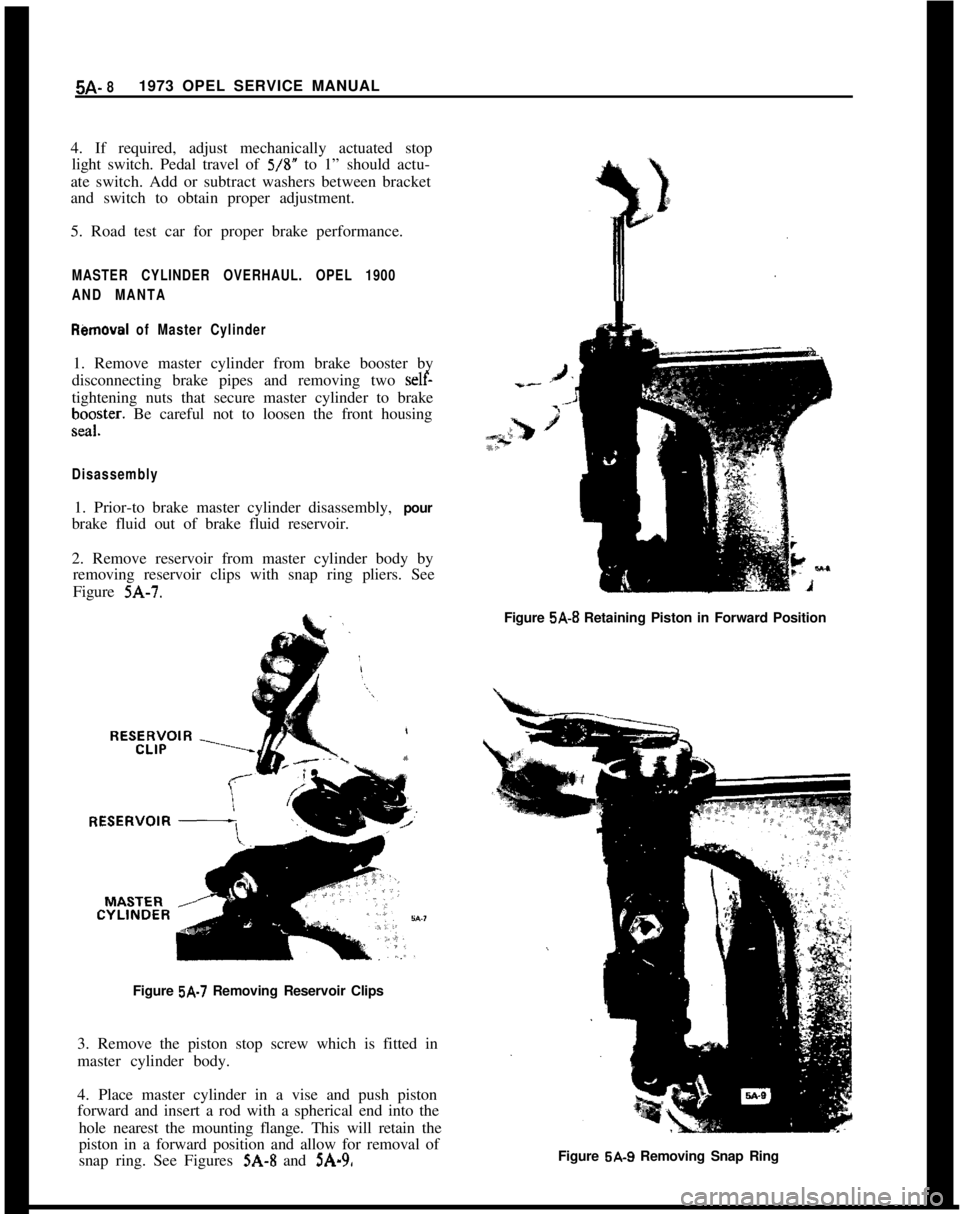
2. Remove reservoir from master cylinder body by
removing reservoir clips with snap ring pliers. See
Figure 5A-7.
Figure
5A-7 Removing Reservoir Clips
3. Remove the piston stop screw which is fitted in
master cylinder body.
4. Place master cylinder in a vise and push piston
forward and insert a rod with a spherical end into the
hole nearest the mounting flange. This will retain the
piston in a forward position and allow for removal of
snap ring. See Figures
SA-8 and 5A-9,Figure 5A.8 Retaining Piston in Forward Position
Figure 6A-9 Removing Snap Ring
Page 268 of 625
POWER BRAKE BOOSTER AND MASTER CYLINDER5A- 9NOTE: Snap ring should not be reused.5. Remove primary and secondary pistons from cyl-
inder.
6. Remove check valve by unscrewing check valve
connection.
Cleaning and Checking
1. Clean parts with genuine brake fluid, Delco Su-
preme No. 11, or equivalent. Do not use any other
cleaning solvents. Dry with compressed air. Free up
compensating and feed parts.
2. Inspect cylinder bore for pits, scoring, cracks,
nicks or other defects.
NOTE: Whenever the master cylinder is overhauled,
a new repair kit must be used.
Assembly
NOTE:
Before reassembly double check that there
is no foreign particles in the master
cyIinder bore
or on any parts that are to be assembled into it.1. Coat master cylinder bore with clean brake fluid
and install secondary and primary pistons.
2. Install new snap ring while holding primary piston
in a forward position.
3. Install check valve spring, check valve and check
valve connector and torque to 26
Ib.ft.4. Install stop screw.
5. Lubricate reservoir seals and remount on master
cylinder body.
6. Install reservoir clips into reservoir and mount
reservoir onto master cylinder without distorting
seals. Do not force reservoir onto master cylinder.
7. Position reservoir cover onto reservoir.
Installation
1. Mount master cylinder to brake booster, using a
new front housing seal if old one is damaged or dis-
torted. Torque nuts to 12
lb.ft.2. Install brake pipes to master cylinder and bleed
brakes.
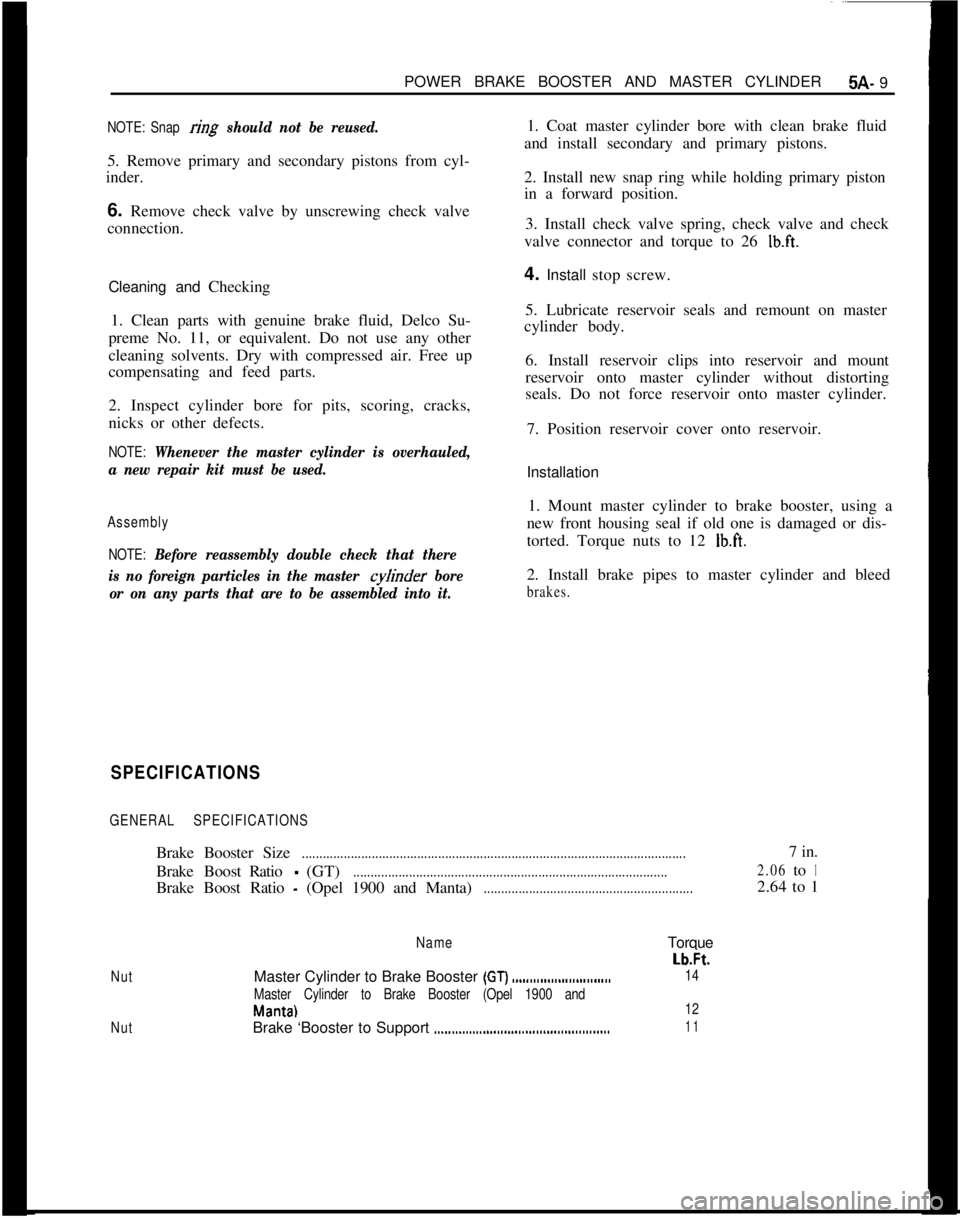
SPECIFICATIONS
GENERAL SPECIFICATIONSBrake Booster Size
..............................................................................................................7 in.
BrakeBoostRatio
-(GT)..........................................................................................2.06to1Brake Boost Ratio
- (Opel 1900 and Manta)............................................................2.64 to 1
NameTorque
Nut
Nut
Lb.Ft.Master Cylinder to Brake Booster
(GT) .__......._.._...._.........
Master Cylinder to Brake Booster (Opel 1900 and
Manta)14
12Brake ‘Booster to Support
.._...._..........................................11
Page 269 of 625

5B- 10 1973 OPEL SERVICE MANUAL
DISC BRAKES
CONTENTS
Subject
DESCRIPTION AND OPERATION:
Description. . . . . . . . . . . . . . . . . . . . . . . . . . . . . . . . . . . . . . . . . . . . . . . . . . . . . . . . . . . . . . . . . . . . . . . . . . . .Operation
. . . . . . . . . . . . . . . . . . . . . . . . . . . . . . . . . . . . . . . . . . . . . . . . . . . . . . . . . . . * . . . . . . . . . . . . . . . . . .DIAGNOSIS:
DiscBrakeTroubleDiagnosis. . . . . . . . . . . . . . . . . . . . . . . . . . . . . . . . . . . . . . . .MAINTENANCE AND ADJUSTMENTS:
Disc Brake Maintenance
. . . . . . . . . . . . . . . . . . . . . . . . . . . . . . . . . . . . . . . . . . . . . . . .Checking Disc Brake Friction Pads for Wear
. . . . . . . . . .Replacing Friction Pads
Checking Brake Disc for Lateral
Runout. . . . . . . . . . . . . . . . . .MAJOR REPAIR:
RemovingandInstallingBrakeCaliper. . . . . . . . . . . . . . . . . . . . . .Removing and Installing Brake Disc
. . . . . . . , . . . . . . . . . . . . . . . . . .
RemovingandInstallingBrakeDiscShield. . . . . . . . . . . . . .Disassembly and Assembly of Brake Caliper
. . . . . . . . . .SPECIFICATIONS:
Disc Brake Specifications
. . . . . . . . . . . . . . . . . . . . . . . . . . . . . . . . . . . . . . . . . . . . . .Page No.
58-1058-l
1
58-12
58-15
SB-15
5&17
56-17
58-17
58-195519
58-21
DESCRIPTION AND OPERATION
DESCRIPTIONThe front wheel disc brake consists of two major
parts: The brake disc and the brake caliper with the
two friction pads. See Figure
5B-20.The brake disc is attached to the inside of the wheel
hub flange by four bolts and centered on a shoulder
of the hub. The brake caliper consists of two halves:
the mounting half, arranged on the inside of the
brake disc, and the rim half. The two halves are
firmly attached to each other by four bolts. Two
flanges on the mounting half serve as attachment of
the brake caliper to the steering knuckle. The brake
caliper is positioned behind the front suspension
cross member at steering knuckle spindle level. It is
attached to the steering knuckle by two bolts. Both
caliper halves act as brake cylinders and each houses
a piston and a fluid seal. The fluid seal, of square
cross section, is positioned in an annular groove of
the caliper bore, preventing fluid leakage past the
piston and entry of water and dirt. The pistons and
caliper half bores are protected against entry of waterFigure 58.20 Left Front Disc Brake Assembly
and dirt in brake disc direction by a rubber seal, held
on the caliper half collar by a clamp ring and against
Page 270 of 625

DISC BRAKES5B- 11
rLF 5.2. RUBBER FLUID SEALS6.3. HOLLOW PISTONS7.
AL5
3Figure 58.21 Left Front Disc Brake
- Emloded View
the piston circumference by its inherent tension. See
Figure
5B-21. Both pistons are hollow. The open end
of each piston faces the brake disc.
A sheet metal spacer plate with two impressions for
preventing the piston from rotating is installed be-
tween each piston and friction pad and secured by
the friction pad dowel pins. The two friction pads are
positioned on the right and left of the brake disc
recesses in the caliper halves. Each friction pad con-
sists of a backing plate with friction material, which
is abrasive-coated, bonded to it. The friction pad
assemblies are held in position in the brake caliper by
two dowel pins, secured by slit dowel pin retainers,
and by a cross-shaped retaining spring which is pre-
loaded and positioned under the dowel pins, thus
pressing the friction pads and spacer plates firmly
against the pistons. The front brake line leading from
the brake master cylinder attaches to a distribution
tee from which a brake line leads to each front wheel
caliper. The caliper bores are interconnected by fluid
ducts within the caliper halves.
The front wheel disc brakes have self-adjusting pis-
tons. See Figure
5B-22.The adjustment of the pads is effected by the pistons
which push the friction pads ahead towards the
brake disc for a distance equivalent to the amount of
friction pad wear. This means that the greater the
wear the closer the pistons move towards the brake
disc. A running clearance exists between friction
pads and brake disc when the brakes are in “off”
position. This running clearance is provided by the
rubber fluid seals which are positioned in the caliper
half bores and which tightly grip and exert their
pre-load pressure on the pistons. The rubber fluid
seals also prevent the pistons from being pushed into
the caliper half bores more than the distance equiva-
lent to the running clearance. As the friction pads are
adjusted by the pistons, there must be no static pres-
sure in the front brake circuit when the brakes are in“OR position. Non-existence of a static pressure in
the front brake circuit is achieved by eliminating the
check valve in the brake master cylinder on the front
brake circuit. During brake application the pressure
from the brake master cylinder is transferred to the
pistons in the brake caliper. The pistons move ahead
and press the friction pads against both friction
SW-faces of the rotating brake disc. The force exerted on
the brake pedal determines the pressure of the fric-
tion pads against the brake disc. On releasing the
brake pedal, the brake lines of the front brake circuit,
including the caliper half bores, are relieved of
hy-OPERATION
Page 271 of 625

5B- 121973 OPEL SERVICE MANUAL
A = BRAKE ON
THE RUBBER FLUID SEAL TIGHTLY GRIPPING PISTON
IS DEFLECTED IN DIRECTION OF PISTON TRAVELAFRICTION PAD
BRAKE DISCRUBBER FLUID SEALBRAKE
IICALIPER
IPISTON
I
CE BETWEEN RUNNING CLEARAN
FRICTION PAD AND BRAKE DISC
B = BRAKE OFFBTHE PISTON IS RETRACTED BY THE AMOUNT OF
RUBBER FLUID SEAL DEFLECTION. THIS AMOUNT
IS EQUAL TO RUNNING CLEARANCE.SBZZ
Figure 58-22 Rubber Fluid Seal -Automatic Piston Retractiondraulic pressure, and the friction pads and pistonsmove away from the brake disc, leaving a small run-
ning clearance. The brake disc can now rotate freely.
The amount of brake travel is dependent upon the
amount of running clearance. For this reason therunout of the brake disc should be checked, besides
bleeding of the brake system and adjusting the rear
brake shoes, when the pedal free travel is too great.during braking, the rubber seals in the annular
grooves of the brake caliper bores deflect laterally in
the direction of piston movement. See Figure
5B-22,View (A). The seal remains deflected for the duration
of the braking operation. After braking, the caliper
bores are relieved of hydraulic pressure and the rub-
ber seals resume their normal position, thus pulling
or retracting the pistons. The distance traveled by
the pistons is equal to that of the running clearance
between brake disc and friction pads.
The running clearance between brake disc and
fric-tion pads is attained as follows: When the pistons in
the caliper halves are moved towards the brake discThe shifting of the pistons in the direction of the
brake disc due to friction pad wear has no effect on
the running clearance. The running clearance re-mains the same in all piston positions.
DIAGNOSIS
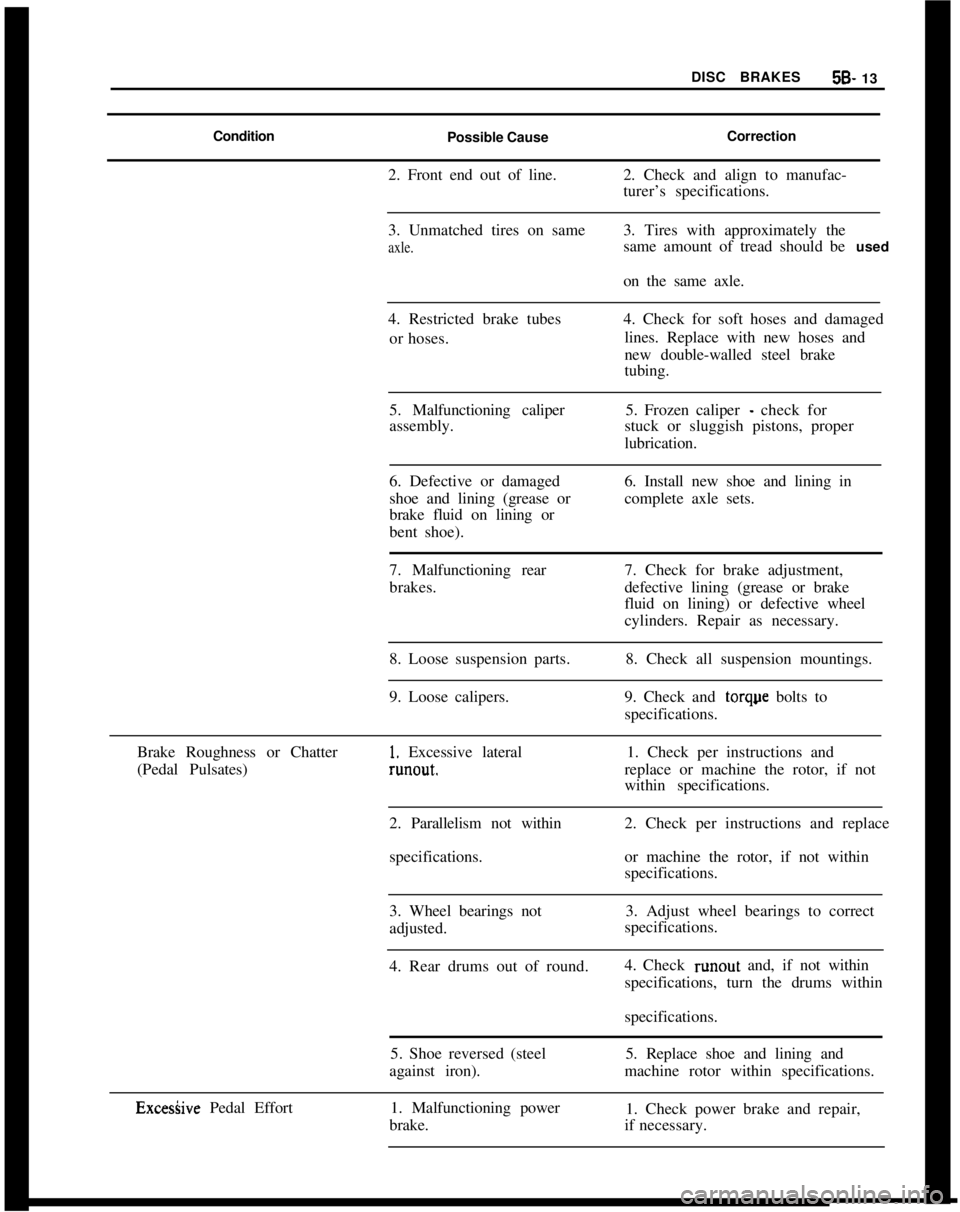
DISC BRAKE TROUBLE DIAGNOSIS
ConditionPulls
Possible Cause
I. Incorrect tire
pressures.Correction1. Inflate evenly on both sides to
the recommended pressures (see
Owner’s Manual).
Page 272 of 625
DISC BRAKES5B- 13
Condition
Possible CauseCorrection
2. Front end out of line.2. Check and align to manufac-
turer’s specifications.
3. Unmatched tires on sameaxle.3. Tires with approximately the
same amount of tread should be used
on the same axle.
4. Restricted brake tubes
or hoses.4. Check for soft hoses and damaged
lines. Replace with new hoses and
new double-walled steel brake
tubing.
5. Malfunctioning caliper
assembly.5. Frozen caliper
- check for
stuck or sluggish pistons, proper
lubrication.
6. Defective or damaged
shoe and lining (grease or
brake fluid on lining or
bent shoe).6. Install new shoe and lining in
complete axle sets.
7. Malfunctioning rear
brakes.7. Check for brake adjustment,
defective lining (grease or brake
fluid on lining) or defective wheel
cylinders. Repair as necessary.
8. Loose suspension parts.
9. Loose calipers.8. Check all suspension mountings.
9. Check and torque bolts to
specifications.
Brake Roughness or Chatter
(Pedal Pulsates)
1. Excessive lateralrunout.1. Check per instructions and
replace or machine the rotor, if not
within specifications.
2. Parallelism not within
specifications.2. Check per instructions and replace
or machine the rotor, if not within
specifications.
3. Wheel bearings not
adjusted.3. Adjust wheel bearings to correct
specifications.
4. Rear drums out of round.4. Check runout and, if not within
specifications, turn the drums within
specifications.
5. Shoe reversed (steel
against iron).5. Replace shoe and lining and
machine rotor within specifications.
ExcesGve Pedal Effort1. Malfunctioning power
brake.1. Check power brake and repair,
if necessary.
Page 273 of 625

5B- 141973 OPEL SERVICE MANUALConditionPossible CauseCorrection2. Partial system failure.2. Check front and rear brake system
and repair, if necessary. Also, check
brake warning light, if a failed
system is found and light did not
function.
3. Excessively worn shoe
and lining.3. Check and replace in axle sets.
4. Piston in caliper stuck
or sluggish.4. Remove caliper and rebuild.
5. Fading brakes due to
incorrect lining.
6. Vacuum leak.5. Remove and replace with original
equipment lining.
6. Check for ruptured hose or loose
attachment.
Excessive Pedal Travel1. Partial brake system
failure.1. Check both front and rear system
for a failure and repair. Also, check
warning light
- it should have indi-
cated a failure.
2. Insufficient fluid in
master cylinder.
3. Poor rear brake
adjustment.2. Fill reservoirs with approved
brake fluid. Check for leaks.
3. Adjust rear brake per
specifications.
4. Air trapped in system.4. Bleed system.
5. Bent shoe and lining.5. Replace axle set of shoe and
lining.
Dragging Brakes (A very
light drag is present in
all disc brakes
immediately after pedal
is released.)1. Master cylinder pistons
not returning correctly.1. With reservoir cover off, check
for fluid spurt at bypass holes as
pedal is depressed. Adjust push rod,
if necessary, or rebuild master
cylinder.
2. Restricted brake tubes2. Check for soft hoses or damaged
or hoses.tubes and replace with new hoses and
new double-walled steel brake tubing.
3. Incorrect parking brake
adjustment on rear brakes.3. Check and readjust to correct
specifications.
Grabbing or Uneven Braking
Action (All conditions
listed under “Pulls”
.)4. Check valve installed in
outlet to front disc brakes.
1. Malfunction of power
brake unit.4. Check master cylinder outlet and
remove check valve if present.
1. Check operation and repair, if
necessary.
Page 274 of 625

DISC BRAKES5B- 15
ConditionPossible Cause
2. Binding brake pedal
mechanism.Correction
2. Check and lubricate, ifnecessary.3. Corroded caliper
assembly.3. Clean and lubricate.
MAINTENANCE AND ADJUSTMENTSDISC BRAKE MAINTENANCE
Checking Brake Fluid Level
The brake fluid level in the brake fluid container
must be checked during predelivery inspection, then
every 3,000 miles during inspection and preventive
maintenance servicing.
The brake fluid level must not be higher than the
inscription “MAX” and must be at least up to
“MIN”. Replenish brake fluid, if necessary.
Because of the relatively large brake caliper bore
cross section and the self-adjustment of the disc
brakes, resulting in a greater piston travel to compen-
sate for friction pad wear, the brake fluid level drops
faster than in fluid containers for drum brakes with
their smaller wheel brake cylinders. For this reason
pay special attention to the fluid level in the brake
fluid container.
Drop of brake fluid level can be due to friction pad
wear and may not be due to leakage in the braking
system.On loss of brake fluid due to leakage, the brake sys-
tem must be checked thoroughly.
Friction Pad Adjustment
Friction pad adjustment is not necessary on the front
wheel disc brakes as this is done automatically by the
pistons in the brake calipers.
Lubricating Front Wheel Bearings
When removing one or both brake discs, check lu-
brication of front wheel bearings and the cavity of
the wheel hub and replenish if necessary (see operat-
ion
“Removing and Reinstalling Brake Disc”).
When carrying out other work on disc brakes which
does not necessitate the removal and installation of
the brake disc, lubricating wheel bearings is not
necessary.Checking Disc Brake Friction Pads for Wear
Whenever a disc brake equipped car is in for periodic
service, while the car is raised, the friction pads in
both brake calipers should be checked for wear by
making a simple measurement. Worn or oily friction
pads must be replaced.
Measure friction pad wear as follows:
1. Remove friction pads.
2. Using a one-inch micrometer, measure the thick-
ness of the pad and friction plate. See Figure
5B-23.Figure 58-23 Checking Brake Friction Pad Thickness
3. If any one of the four measurements is less than
-.280, replace all four friction pads. (Partial replace-
ment of friction pads would cause unequal braking.)
Removal and Installation of Friction Pads
1. Raise car and remove front wheels.
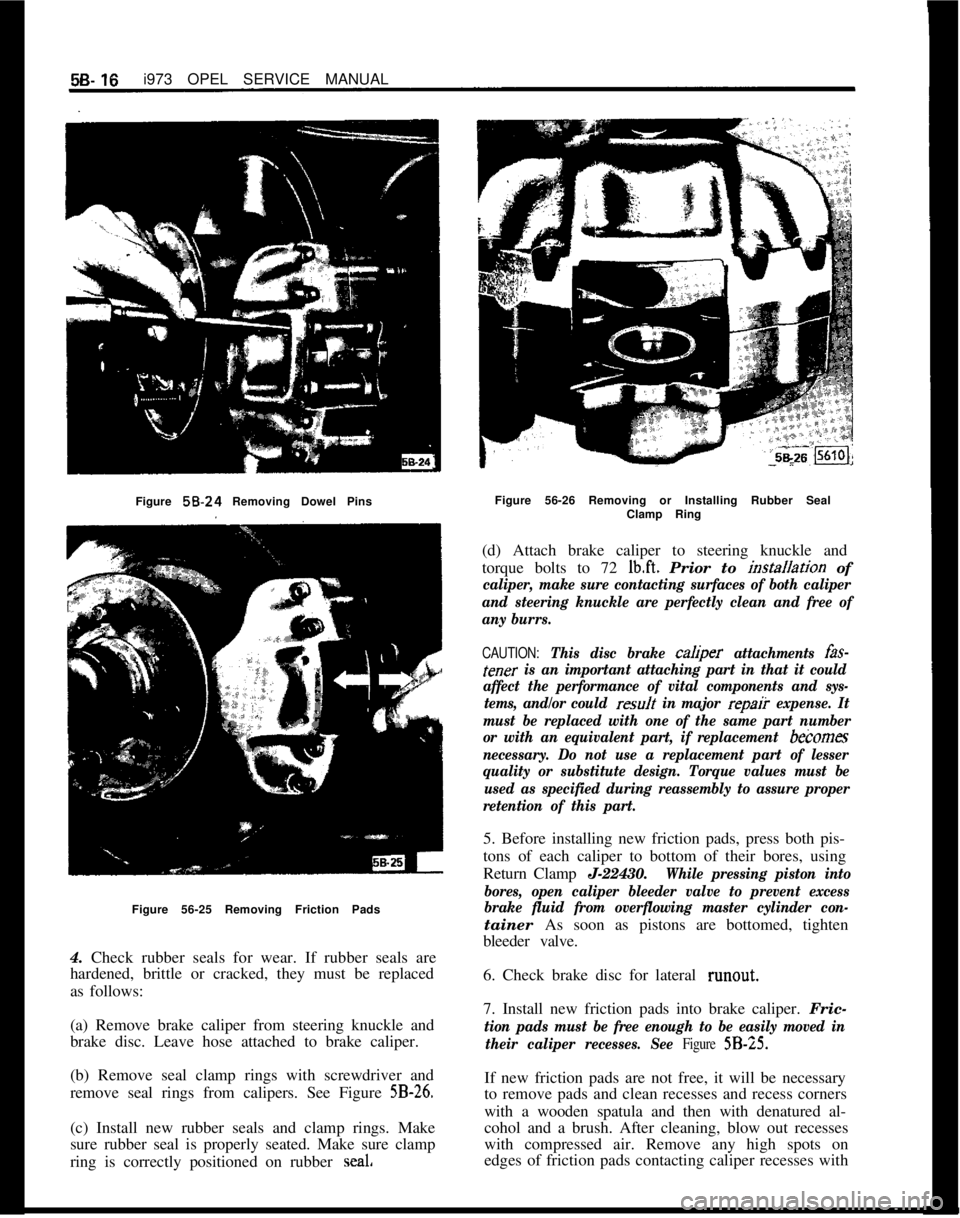
2. Drive dowel pins out of brake calipers toward
center of car. See Figure
5B-24. Dowel pins must be
driven inward because they are secured by enlarge
fluted inner ends.
3. Remove friction pads from brake calipers. See
Figure
5B-25.
Page 275 of 625
5B- 19i973 OPEL SERVICE MANUAL
Figure
56-24 Removing Dowel Pins
Figure 56-25 Removing Friction Pads
4. Check rubber seals for wear. If rubber seals are
hardened, brittle or cracked, they must be replaced
as follows:
(a) Remove brake caliper from steering knuckle and
brake disc. Leave hose attached to brake caliper.
(b) Remove seal clamp rings with screwdriver and
remove seal rings from calipers. See Figure
5B-26.(c) Install new rubber seals and clamp rings. Make
sure rubber seal is properly seated. Make sure clamp
ring is correctly positioned on rubber seal,Figure 56-26 Removing or Installing Rubber Seal
Clamp Ring
(d) Attach brake caliper to steering knuckle and
torque bolts to 72
Ib.ft. Prior to installation of
caliper, make sure contacting surfaces of both caliper
and steering knuckle are perfectly clean and free of
any burrs.
CAUTION: This disc brake caliper attachments fas-
tener is an important attaching part in that it could
affect the performance of vital components and sys-
tems, and/or could
result in major repair expense. It
must be replaced with one of the same part number
or with an equivalent part, if replacement
becomes
necessary. Do not use a replacement part of lesser
quality or substitute design. Torque values must be
used as specified during reassembly to assure proper
retention of this part.5. Before installing new friction pads, press both pis-
tons of each caliper to bottom of their bores, using
Return Clamp J-22430.
While pressing piston into
bores, open caliper bleeder valve to prevent excess
brake fluid from overflowing master cylinder con-tainer As soon as pistons are bottomed, tighten
bleeder valve.
6. Check brake disc for lateral runout.
7. Install new friction pads into brake caliper. Fric-
tion pads must be free enough to be easily moved in
their caliper recesses. See
Figure X3-25.If new friction pads are not free, it will be necessary
to remove pads and clean recesses and recess corners
with a wooden spatula and then with denatured al-
cohol and a brush. After cleaning, blow out recesses
with compressed air. Remove any high spots on
edges of friction pads contacting caliper recesses with
Page 276 of 625
DISC BRAKES58.17a tine cut file.Do not use any solvent except dena-
tured alcohol. Do not use a
metaIJic scraper too/.8. With a punch, drive one dowel pin from inboard
side through caliper and friction pads to stop. Install
new cross-shaped retaining spring under installed
dowel pin, then install second dowel pin. Loose tit-
ting dowel pins must be replaced.
9. Before operating vehicle, depress brake pedal sev-
eral times to adjust friction pads to brake discs.
Check brake fluid level and add fluid as necessary to
bring level up to “MAX” on reservoir.
Car owners must be informed that a break-in period
exists for new friction pads, and that they must avoid
unnecessary, forceful braking during the first 125
miles after installation of new friction pads.
Checking Brake Disc for Lateral Runout1. Remove front wheel assembly.
2. Remove front wheel bearing hub cap and spindle
nut cotter pin. Tighten spindle nut until all free play
is removed from wheel bearings.
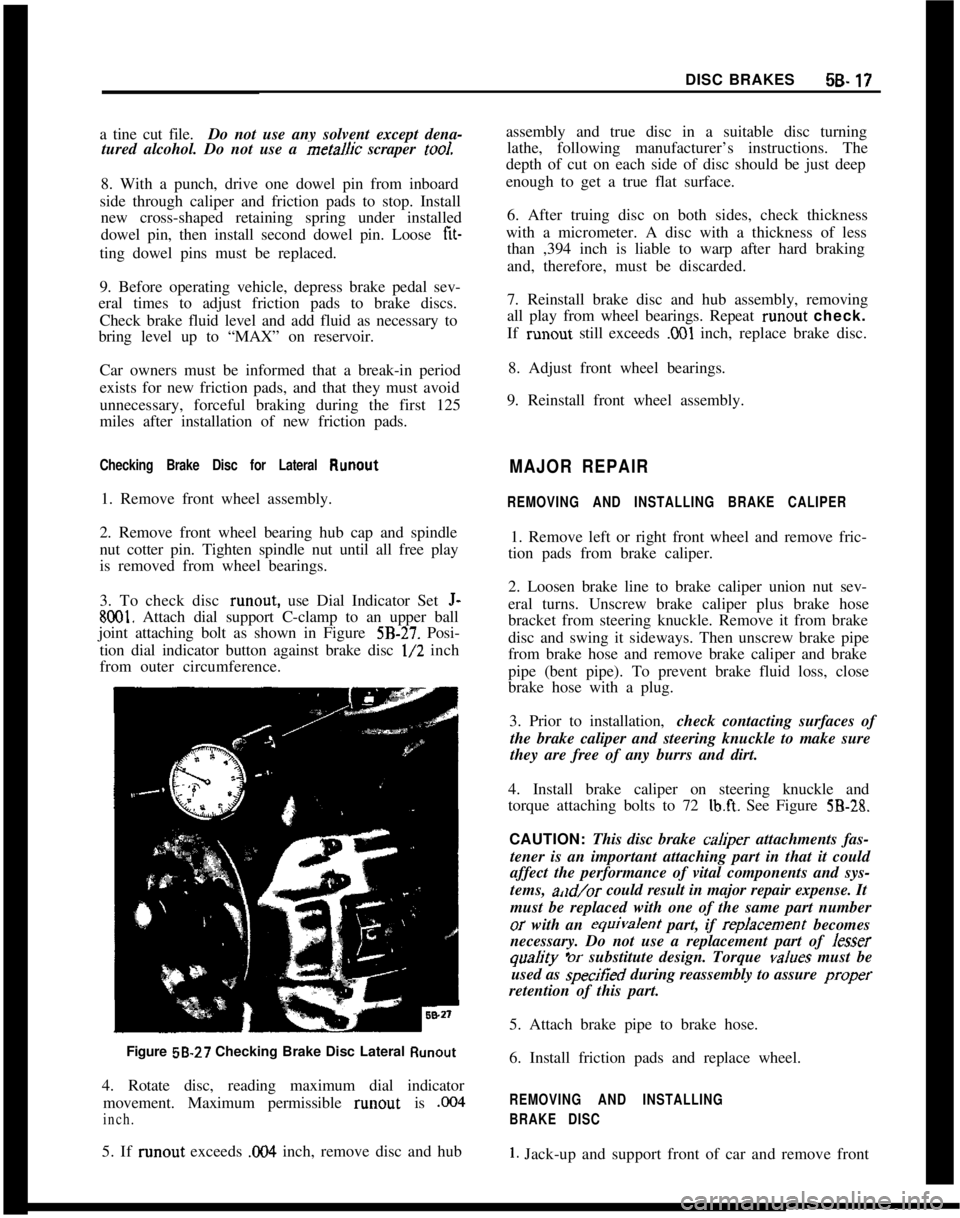
3. To check disc runout, use Dial Indicator Set
J-
8001. Attach dial support C-clamp to an upper ball
joint attaching bolt as shown in Figure
5B-27. Posi-
tion dial indicator button against brake disc
l/2 inch
from outer circumference.
Figure 58-27 Checking Brake Disc Lateral
Runout4. Rotate disc, reading maximum dial indicator
movement. Maximum permissible runout is
,004
inch.5. If runout exceeds
0% inch, remove disc and hubassembly and true disc in a suitable disc turning
lathe, following manufacturer’s instructions. The
depth of cut on each side of disc should be just deep
enough to get a true flat surface.
6. After truing disc on both sides, check thickness
with a micrometer. A disc with a thickness of less
than ,394 inch is liable to warp after hard braking
and, therefore, must be discarded.
7. Reinstall brake disc and hub assembly, removing
all play from wheel bearings. Repeat runout check.
If runout still exceeds
,001 inch, replace brake disc.
8. Adjust front wheel bearings.
9. Reinstall front wheel assembly.
MAJOR REPAIR
REMOVING AND INSTALLING BRAKE CALIPER1. Remove left or right front wheel and remove fric-
tion pads from brake caliper.
2. Loosen brake line to brake caliper union nut sev-
eral turns. Unscrew brake caliper plus brake hose
bracket from steering knuckle. Remove it from brake
disc and swing it sideways. Then unscrew brake pipe
from brake hose and remove brake caliper and brake
pipe (bent pipe). To prevent brake fluid loss, close
brake hose with a plug.
3. Prior to installation,check contacting surfaces of
the brake caliper and steering knuckle to make sure
they are free of any burrs and dirt.
4. Install brake caliper on steering knuckle and
torque attaching bolts to 72
lb.ft. See Figure 5B-28.CAUTION: This disc brake
cah@er attachments fas-
tener is an important attaching part in that it could
affect the performance of vital components and sys-
tems, a,ld/or could result in major repair expense. It
must be replaced with one of the same part numberor with an equivafent part, if repfacement becomes
necessary. Do not use a replacement part of Jesser
quaJity ‘or substitute design. Torque vafues must be
used as specitied during reassembly to assure proper
retention of this part.
5. Attach brake pipe to brake hose.
6. Install friction pads and replace wheel.
REMOVING AND INSTALLING
BRAKE DISC
1. Jack-up and support front of car and remove front