air condition OPEL INSIGNIA 2014 User Guide
[x] Cancel search | Manufacturer: OPEL, Model Year: 2014, Model line: INSIGNIA, Model: OPEL INSIGNIA 2014Pages: 321, PDF Size: 8.95 MB
Page 146 of 321
144Climate control
Cooling A/C
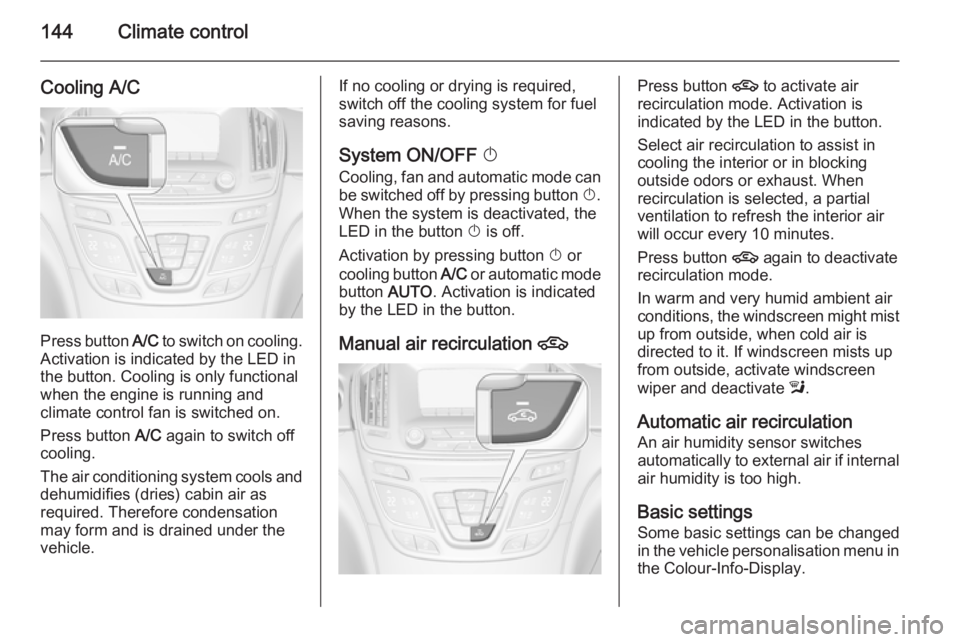
Press button A/C to switch on cooling.
Activation is indicated by the LED in
the button. Cooling is only functional
when the engine is running and
climate control fan is switched on.
Press button A/C again to switch off
cooling.
The air conditioning system cools and
dehumidifies (dries) cabin air as
required. Therefore condensation
may form and is drained under the
vehicle.
If no cooling or drying is required,
switch off the cooling system for fuel
saving reasons.
System ON/OFF X
Cooling, fan and automatic mode can
be switched off by pressing button X.
When the system is deactivated, the
LED in the button X is off.
Activation by pressing button X or
cooling button A/C or automatic mode
button AUTO. Activation is indicated
by the LED in the button.
Manual air recirculation 4Press button 4 to activate air
recirculation mode. Activation is
indicated by the LED in the button.
Select air recirculation to assist in cooling the interior or in blocking
outside odors or exhaust. When
recirculation is selected, a partial
ventilation to refresh the interior air
will occur every 10 minutes.
Press button 4 again to deactivate
recirculation mode.
In warm and very humid ambient air
conditions, the windscreen might mist up from outside, when cold air is
directed to it. If windscreen mists up
from outside, activate windscreen
wiper and deactivate l.
Automatic air recirculation An air humidity sensor switches
automatically to external air if internal air humidity is too high.
Basic settingsSome basic settings can be changed
in the vehicle personalisation menu in
the Colour-Info-Display.
Page 149 of 321
Climate control147
Active carbon filterIn addition to the particle filter, theactive carbon filter reduces odours.
Filter replacement must be carried out
during a regular service.
Air conditioning regular
operation In order to ensure continuously
efficient performance, it is
recommended that air coditioning
should be operated for a few minutes once a month, irrespective of the
weather and time of year.
Service
For optimal cooling performance, it is recommended to annually check the
climate control system, starting
three years after initial vehicle
registration, including:
■ Functionality and pressure test■ Heating functionality
■ Leakage check
■ Check of drive belts■ Cleaning of condenser and evaporator drainage
■ Performance check
Page 157 of 321
Driving and operating155
■ The stop-start system is manuallydeactivated
■ the bonnet is opened
■ the driver's seat belt is unfastened and the driver's door is opened
■ the engine temperature is too low
■ the charging level of the vehicle battery is below a defined level
■ the brake vacuum is not sufficient
■ the vehicle is driven at least at walking speed
■ the climate control system requests
an engine start
■ the air conditioning is manually switched on
If the bonnet is not fully closed, a
warning message is displayed in the
Driver Information Centre.
If an electrical accessory, e.g. a
portable CD player, is connected to
the power outlet, a brief power drop during the restart might be noticeable.Parking
■ Do not park the vehicle on an easily
ignitable surface. The high
temperature of the exhaust system
could ignite the surface.
■ Always apply parking brake. Pull electric parking brake switch
m for approx. one second.
Apply manual parking brake
without pressing release button.
Apply as firmly as possible on
downhill or uphill slopes. Depress the foot brake at the same time to
reduce operating force.
■ Switch off the engine and ignition. Turn the steering wheel until the
steering wheel lock engages.
■ If the vehicle is on a level surface or
uphill slope, engage first gear or set
the selector lever to P before
switching off the ignition. On an
uphill slope, turn the front wheels
away from the kerb.
If the vehicle is on a downhill slope, engage reverse gear or set theselector lever to P before switchingoff the ignition. Turn the front
wheels towards the kerb.
■ Lock the vehicle and activate the anti-theft alarm system.
Note
In the event of an accident with
airbag deployment, the engine is
turned off automatically if the vehicle comes to a standstill within a certain
time.
Page 237 of 321
Vehicle care235
No.Circuit16Vacuum pump, mass air flow
meter, water in fuel sensor, DC
transformer17–18Adaptive forward lighting19Adaptive forward lighting20Fuel pump21Rear power windows22ABS23Variable effort steering24Front power windows25Power outlets26ABS27Electric parking brake28Heated rear window29Left power seat30Right power seatNo.Circuit31Air conditioning system32Body control module33Heated front seats34Sunroof35Infotainment system36–37Right high beam38Left high beam39–40–41Vacuum pump42Radiator fan43Vehicle battery, DC transformer (only on vehicles with stop-start
system)44Headlamp washer system45Radiator fanNo.Circuit46Terminal 87, main relay47Lambda probe48Fog lights49Right low beam50Left low beam51Horn52Ignition53Ignition, ventilated front seats54Ignition55Power windows, mirror folding56Windscreen washer57–58–59Diesel fuel heating, emission
control system60Mirror heating61Mirror heating
Page 239 of 321
Vehicle care237
No.Circuit1Infotainment system, Info
display2Body control unit3Body control unit4Infotainment system, Info
display5Infotainment system, Info
display6Cigarette lighter7Power outlet8Body control unit9Body control unit10Body control unit11Interior fan12–13–14Diagnostic connector15AirbagNo.Circuit16Central locking system, tailgate17Air conditioning system18Transportation fuse19Memory20–21Instrument22Ignition23Body control unit24Body control unit25–26Power outlet load compartment
Power seats, No's. 12 and 13, have
an overload protection. The circuit will
be closed again after cooling down.
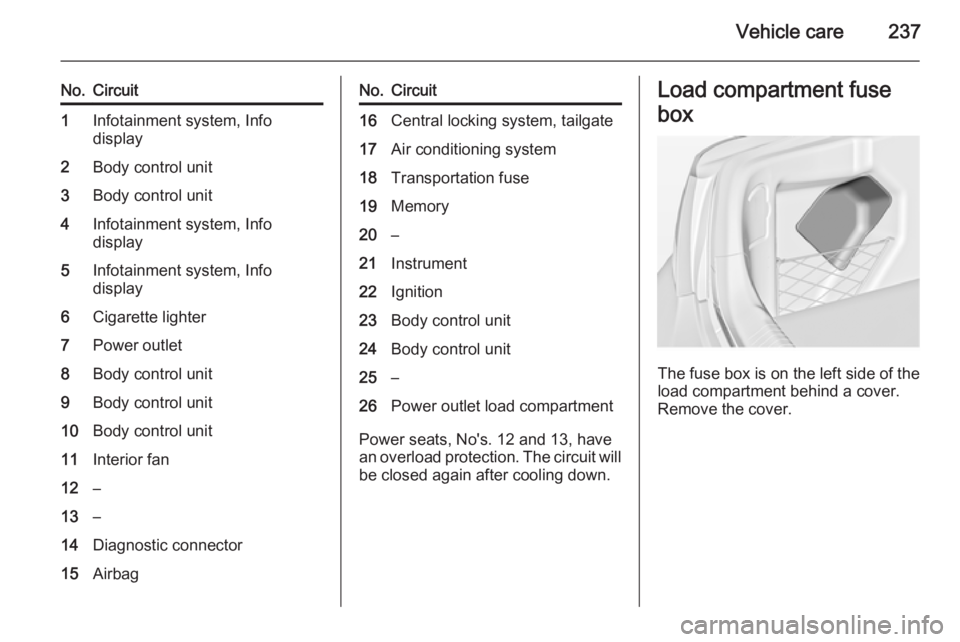
Load compartment fuse
box
The fuse box is on the left side of the
load compartment behind a cover.
Remove the cover.
Page 240 of 321
238Vehicle care
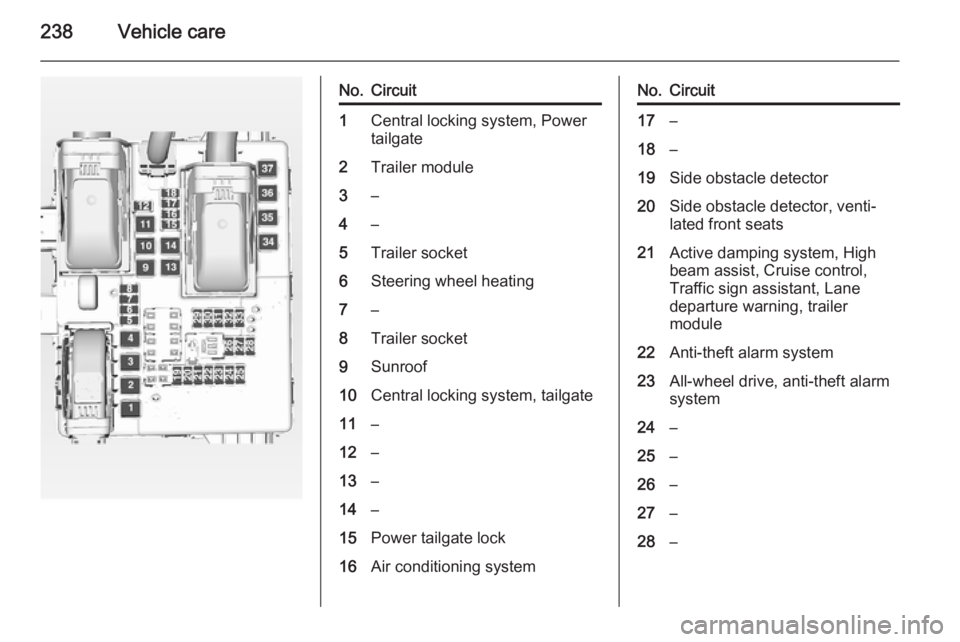
No.Circuit1Central locking system, Power
tailgate2Trailer module3–4–5Trailer socket6Steering wheel heating7–8Trailer socket9Sunroof10Central locking system, tailgate11–12–13–14–15Power tailgate lock16Air conditioning systemNo.Circuit17–18–19Side obstacle detector20Side obstacle detector, venti‐
lated front seats21Active damping system, High beam assist, Cruise control,
Traffic sign assistant, Lane
departure warning, trailer
module22Anti-theft alarm system23All-wheel drive, anti-theft alarm
system24–25–26–27–28–
Page 243 of 321
Vehicle care241
Incorrect tyre pressures will impair
safety, vehicle handling, comfort and
fuel economy and will increase tyre
wear.
Tyre pressures differ depending on
various options. For the correct tyre
pressure value, follow the procedure
below:
1. Identify drive axle and body style.
2. Identify the engine identifier code.
Engine data 3 269.
3. Identify the respective tyre.
The tyre pressure tables show all
possible tyre combinations 3 289.
For the tyres approved for your
vehicle, refer to the EEC Certificate of Conformity provided with your vehicle
or other national registration
documents.
The driver is responsible for correct
adjustment of tyre pressure.9 Warning
If the pressure is too low, this can
result in considerable tyre warm-
up and internal damage, leading to tread separation and even to tyre
blow-out at high speeds.
If the tyre pressure shall be reduced
or increased on a vehicle with tyre
pressure monitoring system, switch
off ignition. After adjusting tyre
pressure switch on ignition and select the according setting on the page
Tyre load in the Driver Information
Centre, 3 107.
Tyre pressure monitoring
system
The tyre pressure monitoring system
checks the pressure of all four wheels once a minute when vehicle speed
exceeds a certain limit.
Caution
Tyre pressure monitoring system
warns just about low tyre pressure condition and does not replace
regular tyre maintenance by the
driver.
All wheels must be equipped with
pressure sensors and the tyres must
have the prescribed pressure.
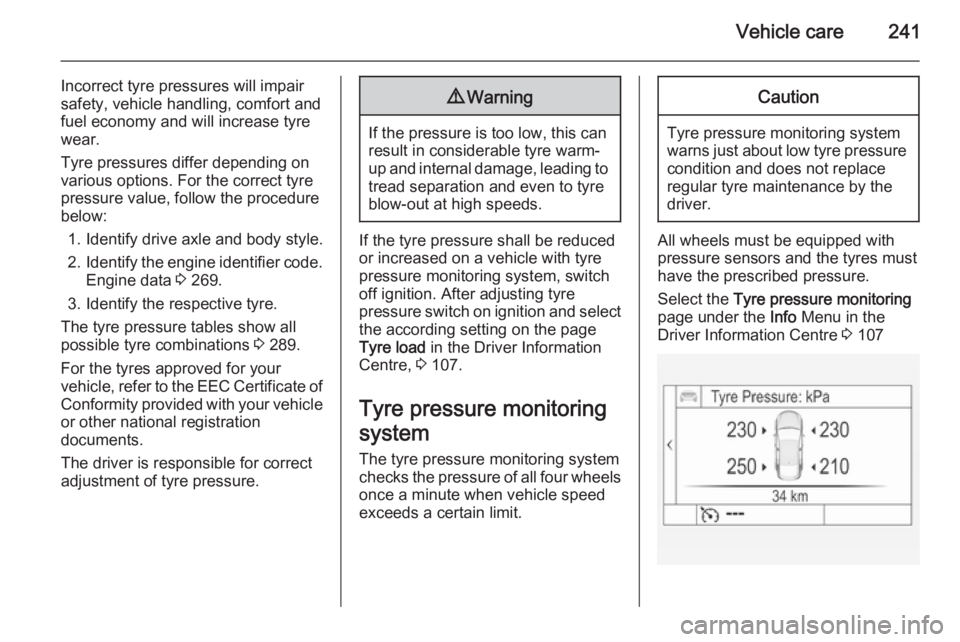
Select the Tyre pressure monitoring
page under the Info Menu in the
Driver Information Centre 3 107
Page 244 of 321
242Vehicle care
System status and pressure warningsare displayed by a message with the
corresponding tyre flashing in the
Driver Information Centre.
A detected low tyre pressure
condition is indicated by the control
indicator w 3 104.
If w lights up, stop as soon as
possible and inflate the tyres as
recommended 3 289.
After inflating driving may be required
to update the tyre pressure values in
the Driver Information Centre. During
this time w may light up.
If w lights up at lower temperatures
and extinguishes after some driving,
this could be an indicator for getting
low pressure. Check tyre pressure.
Vehicle messages 3 116.
If the tyre pressure must be reduced
or increased, switch off ignition.
Only mount wheels with pressure
sensors, otherwise the tyre pressure
will not be displayed and w
illuminates continuously.
A spare wheel or temporary spare
wheel is not equipped with pressure
sensors. The tyre pressure
monitoring system is not operational
for these wheels. Control indicator w
illuminates. For the further three
wheels the system remains
operational.
The use of commercially available
liquid tyre repair kits can impair the
function of the system. Factory
approved repair kits can be used.
External high-power radio equipment
could disrupt the tyre pressure
monitoring system.
Each time the tyres are replaced tyre
pressure monitoring system sensors
must be dismounted and serviced.
For the screwed sensor replace valve
core and sealing ring, for clipped
sensor replace complete valve stem.Vehicle loading status
Adjust tyre pressure to load condition according tyre information label or
tyre pressure chart 3 289, and select
the according setting in the Tyre
loading page under the Settings
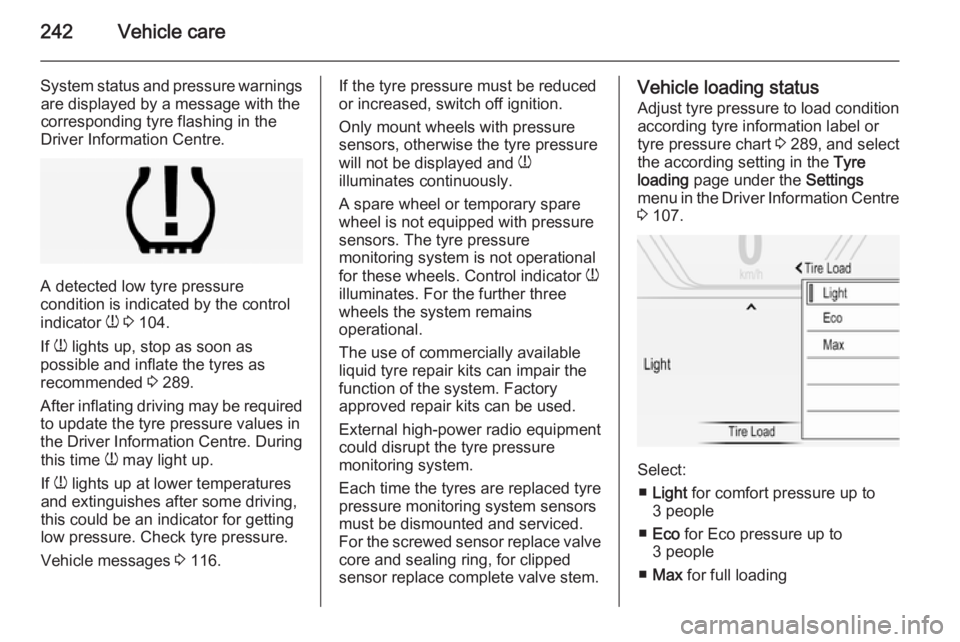
menu in the Driver Information Centre 3 107.
Select:
■ Light for comfort pressure up to
3 people
■ Eco for Eco pressure up to
3 people
■ Max for full loading
Page 315 of 321
Customer information313
■ Vehicle reactions in particulardriving situations (e.g. inflation of
an airbag, activation of the stability
regulation system)
■ Environmental conditions (e.g. temperature)
These data are exclusively technical
and help identifying and correcting
errors as well as optimizing vehicle
functions.
Motion profiles indicating travelled
routes cannot be created with these
data.
If services are used (e.g. repair
works, service processes, warranty cases, quality assurance),
employees of the service network
(manufacturer included) are able to
read out this technical information
from the event and error data storage
modules applying special diagnostic
devices. If required, you will receive
further information at these
workshops. After an error has been
corrected, the data are deleted from
the error storage module or they are
constantly overwritten.When using the vehicle, situations
may occur in which these technical
data related to other information
(accident report, damages on the
vehicle, witness statements etc.) may be associated with a specific person -
possibly, with the assistance of an
expert.
Additional functions contractually
agreed upon with the client (e.g.
vehicle location in emergency cases)
allow the transmission of particular vehicle data from the vehicle.Radio Frequency
Identification (RFID) RFID technology is used in somevehicles for functions such as tyre
pressure monitoring and ignition
system security. It is also used in
connection with conveniences such
as radio remote controls for door
locking/unlocking and starting, and in-
vehicle transmitters for garage door
openers. RFID technology in Opel
vehicles does not use or record
personal information or link with any
other Opel system containing
personal information.
Page 316 of 321
314IndexAAccessories and vehicle modifications .......................... 213
Active Emergency Braking .........185
Active head restraints ...................46
Adaptive cruise control .......106, 173
Adaptive forward lighting ...106, 125
Adjustable air vents ...................145
Airbag and belt tensioners .........101
Airbag deactivation ..............60, 101
Airbag system .............................. 58
Air conditioning regular operation ................................ 147
Air conditioning system .............. 134
Air intake .................................... 146
Air vents...................................... 145
All-wheel drive ........................... 163
Antilock brake system ................ 163
Antilock brake system (ABS) .....103
Anti-theft alarm system ................34
Anti-theft locking system .............. 33
Appearance care ........................257
Apply footbrake .......................... 105
Armrest ................................... 53, 54
Armrest storage ........................... 68
Ashtrays ....................................... 90 Automatic anti-dazzle ..................39
Automatic climate control system .................................... 136Automatic dimming ......................38
Automatic light control ...............123
Automatic locking ........................27
Automatic transmission .............157
Autostop ..................................... 105
Auxiliary heater ........................... 145
B Battery discharge protection ......132
Battery voltage ........................... 118
Belts.............................................. 54
Bonnet ....................................... 215
Brake and clutch fluid .................262
Brake and clutch system ...........102
Brake assist ............................... 165
Brake fluid .................................. 218
Brakes ............................... 163, 218
Breakdown.................................. 254
Bulb replacement ....................... 222
C Capacities .................................. 288
Cargo management system ........73
Car Pass ...................................... 20
Catalytic converter .....................157
Central locking system ................23
Centre console lighting ..............131
Changing tyre and wheel size ...243
Charging system ........................ 101
Child locks ................................... 28