transmission OPEL INSIGNIA BREAK 2017.75 Manual user
[x] Cancel search | Manufacturer: OPEL, Model Year: 2017.75, Model line: INSIGNIA BREAK, Model: OPEL INSIGNIA BREAK 2017.75Pages: 323, PDF Size: 9.18 MB
Page 221 of 323

Driving and operating219The screen in the Info Display is
divided into two parts: on the left there
is a view from above the vehicle, and
on the right there is the view from front or the rear displayed, according to the
gear engaged. The parking sensors
complete the information on the view.
Activation
Panoramic view system is activated: ● engaging reverse gear
● touching the camera icon ë in
the Info Display
● approaching too close to an object ahead
Functionality
Rear view
Rear view displays an image of the
area behind the vehicle on the right
part of the screen when reverse gear
is engaged.
A warning triangle 9 may be
displayed on the screen when
obstacles are detected by the rear
sensors of the parking assist. Thistriangle changes from yellow to red
and increases in size the closer the
object gets.
The previous content of the Info
Display appears when the vehicle is
shifted out of reverse gear after a
short delay. To return to the previous
display content sooner, press the
camera icon in the Info Display.
Driving faster than 11 km/h in a
forward gear will deactivate the
panoramic system also.
Surround view
Surround view displays an image of the area surrounding the vehicle from
above, along with the front or rear
camera views in the Info Display.
Front view
Front view displays an image of the area in front of the vehicle on the right
part of the screen. The view displays
after shifting from reverse gear to a
forward gear, or by touching the
camera icon in the Info Display. Front
view also displays objects
automatically detected within 30 cm.
The front view is only displayed up to a speed of 11 km/h in a forward gear.Deactivation
Panoramic view system is
deactivated:
● driving faster than 11 km/h
● touching the camera icon ë in
the Info Display
● shifting into neutral or P with automatic transmission.
General information9 Warning
The panoramic view system does
not replace driver vision. It will not display children, pedestrians,
cyclists, crossing traffic, animals,
or any other objects outside of the camera view areas, e. g. below the
bumper, or underneath the
vehicle.
Do not drive or park the vehicle
using only the panoramic view
system.
Always check the surrounding of
the vehicle before driving.
Page 261 of 323

Vehicle care259No.Circuit18Sunblind19Power seat, driver20–21Sunroof22Rear wiper/Airbag23Adaptive forward lighting24–25–26Transmission control module27Ignition/Instrument panel28–29Rear view camera/Air vent30Malfunction indicator light/
Trailer31–32Camera33Seat heat front34Seat heat rearNo.Circuit35Damping/All-wheel drive36Fuel system37–38–39–40Steering wheel lock41–42–43Heated steering wheel44Headlight range adjustment45–46Engine control module47–48DC/DC converter/Air vent/E-
Boost49Rear door control module50–51–No.Circuit52–53–54–55–56Starter57–58–59Left headlight (LED)60Cooling fan61–62–63–64–65Climate control66–67–68–
Page 262 of 323
260Vehicle careNo.Circuit69Right high beam (Halogen)/
Right headlight (LED)70Left high beam (Halogen)71–72Starter73–74Transmission control module75Engine control module76Exhaust reduction system77–78Horn79Washer system80–81Engine control module82–83Ignition coil84Ignition coil85PowertrainNo.Circuit86–87Diesel fuel heating88Air shutter89–90–91–92After boil pump93Electronic key system94–95Coolant pump96Diesel fuel heating97–98–99Coolant pump
After having changed defective fuses,
close the fuse box cover and press
until it engages.
If the fuse box cover is not closed
correctly, malfunction may occur.
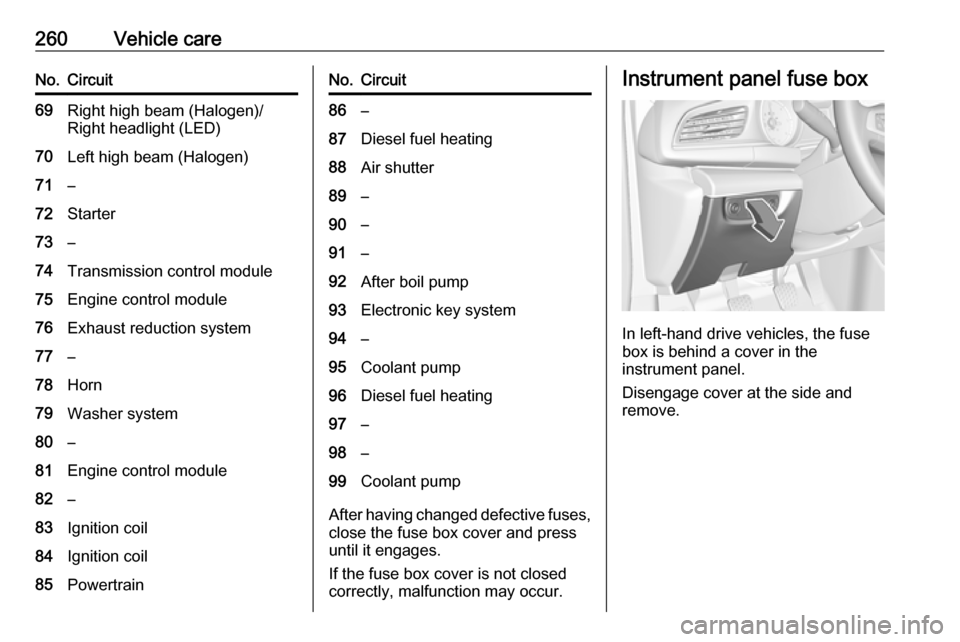
Instrument panel fuse box
In left-hand drive vehicles, the fuse
box is behind a cover in the
instrument panel.
Disengage cover at the side and
remove.
Page 263 of 323
Vehicle care261
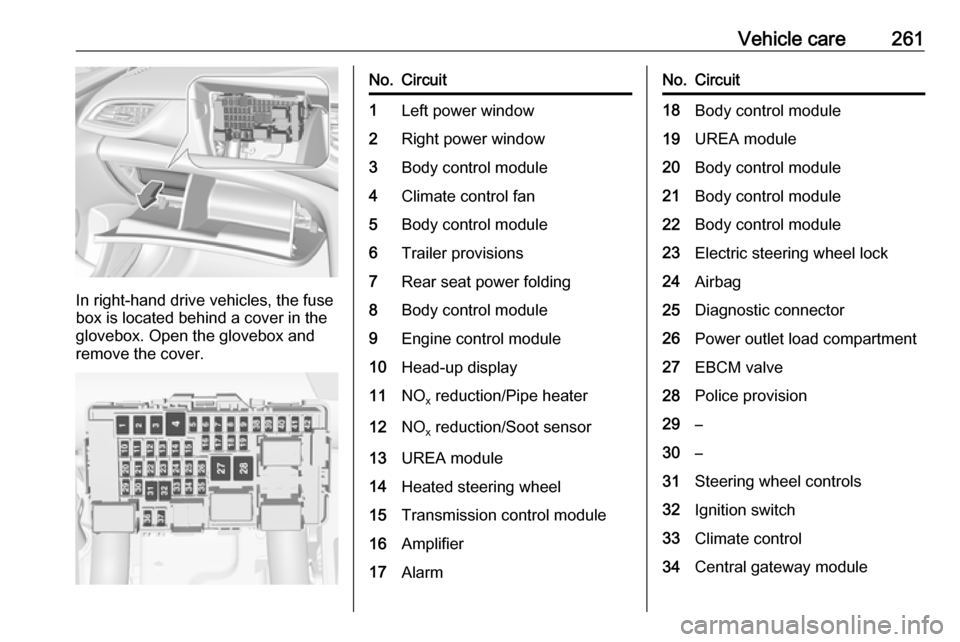
In right-hand drive vehicles, the fuse
box is located behind a cover in the
glovebox. Open the glovebox and
remove the cover.
No.Circuit1Left power window2Right power window3Body control module4Climate control fan5Body control module6Trailer provisions7Rear seat power folding8Body control module9Engine control module10Head-up display11NO x reduction/Pipe heater12NO
x reduction/Soot sensor13UREA module14Heated steering wheel15Transmission control module16Amplifier17AlarmNo.Circuit18Body control module19UREA module20Body control module21Body control module22Body control module23Electric steering wheel lock24Airbag25Diagnostic connector26Power outlet load compartment27EBCM valve28Police provision29–30–31Steering wheel controls32Ignition switch33Climate control34Central gateway module
Page 268 of 323

266Vehicle careA detected low tyre pressure
condition is indicated by the control
indicator w 3 110.
If w illuminates, stop as soon as
possible and inflate the tyres as
recommended 3 301.
Ensure that vehicle loading status
matches selected tyre pressure.
Vehicle loading status, see below in
this chapter.
After inflating, some driving may be
required to update the tyre pressure
values in the Driver Information
Centre. During this time w may
continue to illuminate.
If w illuminates at lower temperatures
and extinguishes after some driving,
this could be an indicator for
approaching a low tyre pressure
condition. Check tyre pressure.
Vehicle messages 3 124.
Only mount wheels with pressure
sensors, otherwise the tyre pressure
will not be displayed and w
illuminates continuously.
A spare wheel or temporary spare
wheel is not equipped with pressure
sensors. The tyre pressuremonitoring system is not operational
for these wheels. Control indicator w
illuminates. For the further three
wheels the system remains
operational.
The use of commercially available
liquid tyre repair kits can impair the
function of the system. Factory-
approved repair kits can be used.
Operating electronic devices or being
close to facilities using similar wave
frequencies could disrupt the tyre
pressure monitoring system.
Each time the tyres are replaced tyre
pressure monitoring system sensors
must be dismounted and serviced.
For the screwed sensor replace valve core and sealing ring, for clipped
sensor replace complete valve stem.
Use only original plastic valve caps to
protect valve on any damage.Caution
Do not use metal valve caps as
they lead to valve oxidation and
damage.
Vehicle loading status
Adjust tyre pressure to load condition
according tyre information label or
tyre pressure chart 3 301, and select
the appropriate setting in the Tyre
loading page under the Settings
menu in the Driver Information Centre 3 113. This setting determines the
reference pressures for the tyre
pressure warnings.
Depending on the display, the menu
Tyre loading only appears if the
vehicle is at a standstill and the
parking brake is applied. On vehicles
with automatic transmission the
selector lever must be in P.
Page 280 of 323
278Vehicle care● The vehicles must not come intocontact with each other during
the jump starting process.
● Apply the parking brake, transmission in neutral,
automatic transmission in P.
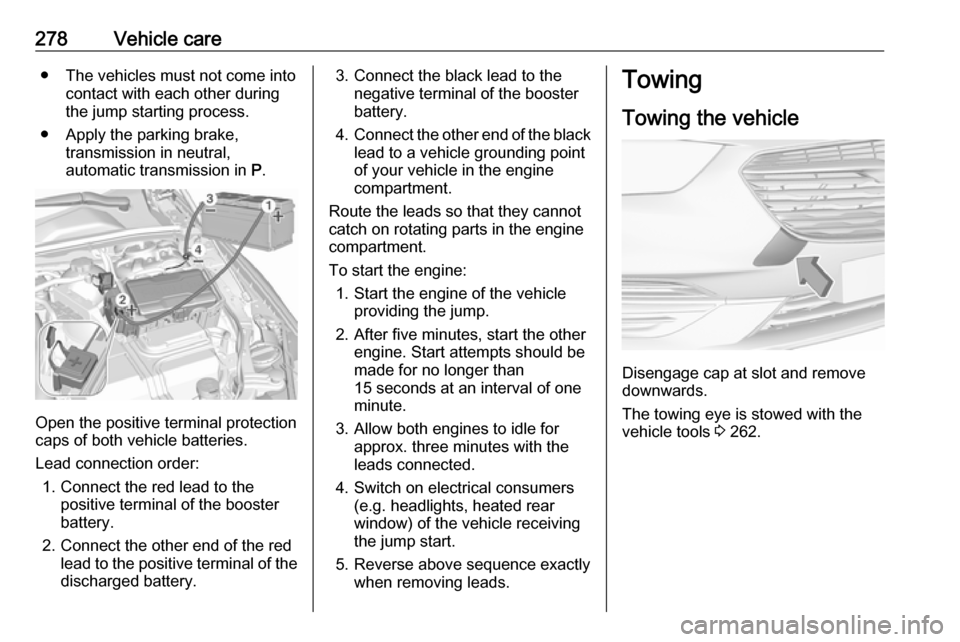
Open the positive terminal protection
caps of both vehicle batteries.
Lead connection order: 1. Connect the red lead to the positive terminal of the booster
battery.
2. Connect the other end of the red lead to the positive terminal of the
discharged battery.
3. Connect the black lead to the negative terminal of the boosterbattery.
4. Connect the other end of the black
lead to a vehicle grounding point
of your vehicle in the engine
compartment.
Route the leads so that they cannot
catch on rotating parts in the engine
compartment.
To start the engine: 1. Start the engine of the vehicle providing the jump.
2. After five minutes, start the other engine. Start attempts should be
made for no longer than
15 seconds at an interval of one
minute.
3. Allow both engines to idle for approx. three minutes with the
leads connected.
4. Switch on electrical consumers (e.g. headlights, heated rear
window) of the vehicle receiving
the jump start.
5. Reverse above sequence exactly when removing leads.Towing
Towing the vehicle
Disengage cap at slot and remove
downwards.
The towing eye is stowed with the
vehicle tools 3 262.
Page 281 of 323
Vehicle care279
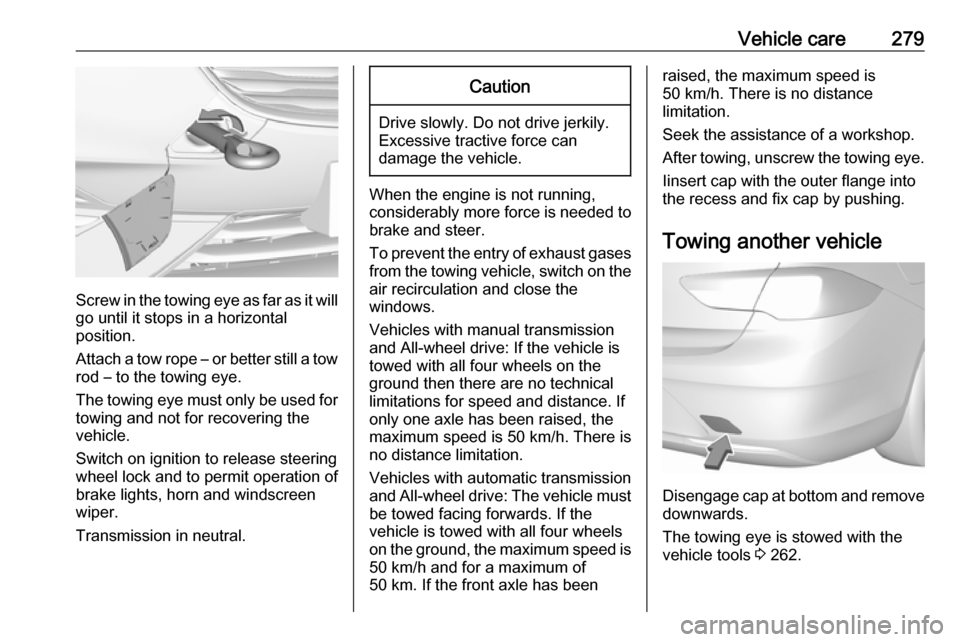
Screw in the towing eye as far as it will
go until it stops in a horizontal
position.
Attach a tow rope – or better still a tow
rod – to the towing eye.
The towing eye must only be used for towing and not for recovering the
vehicle.
Switch on ignition to release steering
wheel lock and to permit operation of
brake lights, horn and windscreen
wiper.
Transmission in neutral.
Caution
Drive slowly. Do not drive jerkily.
Excessive tractive force can
damage the vehicle.
When the engine is not running,
considerably more force is needed to
brake and steer.
To prevent the entry of exhaust gases from the towing vehicle, switch on the
air recirculation and close the
windows.
Vehicles with manual transmission
and All-wheel drive: If the vehicle is
towed with all four wheels on the
ground then there are no technical
limitations for speed and distance. If
only one axle has been raised, the
maximum speed is 50 km/h. There is
no distance limitation.
Vehicles with automatic transmission and All-wheel drive: The vehicle must
be towed facing forwards. If the
vehicle is towed with all four wheels
on the ground, the maximum speed is 50 km/h and for a maximum of
50 km. If the front axle has been
raised, the maximum speed is
50 km/h. There is no distance
limitation.
Seek the assistance of a workshop.
After towing, unscrew the towing eye.
Iinsert cap with the outer flange into
the recess and fix cap by pushing.
Towing another vehicle
Disengage cap at bottom and remove downwards.
The towing eye is stowed with the
vehicle tools 3 262.
Page 297 of 323
![OPEL INSIGNIA BREAK 2017.75 Manual user Technical data295Performance
Grand SportEngineB15XHLB15XHTB20NFTMaximum speed [km/h]Manual transmission210/213 3)222/2253)–Automatic transmission–2182503)
ECOEngineB16DTEB16DTHB20DTH
B20DTH
AWD 4)](/img/37/18864/w960_18864-296.png "OPEL INSIGNIA BREAK 2017.75 Manual user Technical data295Performance
Grand SportEngineB15XHLB15XHTB20NFTMaximum speed [km/h]Manual transmission210/213 3)222/2253)–Automatic transmission–2182503)
ECOEngineB16DTEB16DTHB20DTH
B20DTH
AWD 4)")
Technical data295Performance
Grand SportEngineB15XHLB15XHTB20NFTMaximum speed [km/h]Manual transmission210/213 3)222/2253)–Automatic transmission–2182503)
ECOEngineB16DTEB16DTHB20DTH
B20DTH
AWD 4)Maximum speed [km/h]Manual transmission2055)211226223Automatic transmission–203––4)
All wheel drive
5) ECO
Page 298 of 323
![OPEL INSIGNIA BREAK 2017.75 Manual user 296Technical dataSports TourerEngineB15XHLB15XHTB20NFTB20DTHMaximum speed [km/h]Manual transmission207/2106)218/2216)–223Automatic transmission–214245–6)
ECO](/img/37/18864/w960_18864-297.png "OPEL INSIGNIA BREAK 2017.75 Manual user 296Technical dataSports TourerEngineB15XHLB15XHTB20NFTB20DTHMaximum speed [km/h]Manual transmission207/2106)218/2216)–223Automatic transmission–214245–6)
ECO")
296Technical dataSports TourerEngineB15XHLB15XHTB20NFTB20DTHMaximum speed [km/h]Manual transmission207/2106)218/2216)–223Automatic transmission–214245–6)
ECO
Page 299 of 323
![OPEL INSIGNIA BREAK 2017.75 Manual user Technical data297Vehicle weightKerb weight, basic model without any optional equipmentGrand SportEngineManual transmissionAutomatic transmission[kg]B15XHL1440/1456 3)–B15XHT1441/1472 3)1472B20NFT–](/img/37/18864/w960_18864-298.png "OPEL INSIGNIA BREAK 2017.75 Manual user Technical data297Vehicle weightKerb weight, basic model without any optional equipmentGrand SportEngineManual transmissionAutomatic transmission[kg]B15XHL1440/1456 3)–B15XHT1441/1472 3)1472B20NFT–")
Technical data297Vehicle weightKerb weight, basic model without any optional equipmentGrand SportEngineManual transmissionAutomatic transmission[kg]B15XHL1440/1456 3)–B15XHT1441/1472 3)1472B20NFT–1649[kg]B16DTE1503–B16DTH15031522B20DTH1582–B20DTH
AWD1683–3) ECO
Optional equipment and accessories increase the kerb weight.
Loading information 3 85.