wheel OPEL INSIGNIA BREAK 2018.5 Manual user
[x] Cancel search | Manufacturer: OPEL, Model Year: 2018.5, Model line: INSIGNIA BREAK, Model: OPEL INSIGNIA BREAK 2018.5Pages: 329, PDF Size: 9.32 MB
Page 280 of 329

278Vehicle careSpare wheel with directional tyre
Fit directional tyres such that they roll in the direction of travel. The rolling
direction is indicated by a symbol
(e.g. an arrow) on the sidewall.
The following applies to tyres fitted
opposing the rolling direction:
● Driveability may be affected. Have the defective tyre renewed
or repaired as soon as possible
and fit it instead of the spare
wheel.
● Drive particularly carefully on wet
and snow-covered road
surfaces.Jump starting
Do not start with quick charger.
A vehicle with a discharged vehicle
battery can be started using jump
leads and the vehicle battery of
another vehicle.9 Warning
Be extremely careful when starting
with jump leads. Any deviation
from the following instructions can
lead to injuries or damage caused
by battery explosion or damage to the electrical systems of both
vehicles.
9 Warning
Avoid contact of the battery with
eyes, skin, fabrics and painted
surfaces. The fluid contains
sulphuric acid which can cause
injuries and damage in the event
of direct contact.
● Never expose the vehicle battery
to naked flames or sparks.
● A discharged vehicle battery can already freeze at a temperature
of 0 °C. Defrost the frozen battery before connecting jump leads.
● Wear eye protection and protective clothing when
handling a battery.
● Use a booster battery with the same voltage (12 Volts). Its
capacity (Ah) must not be much less than that of the discharged
vehicle battery.
● Use jump leads with insulated terminals and a cross section of
at least 16 mm 2
(25 mm 2
for
diesel engines).
● Do not disconnect the discharged
vehicle battery from the vehicle.
● Switch off all unnecessary electrical consumers.
● Do not lean over the vehicle battery during jump starting.
● Do not allow the terminals of one
lead to touch those of the other
lead.
Page 282 of 329
280Vehicle care
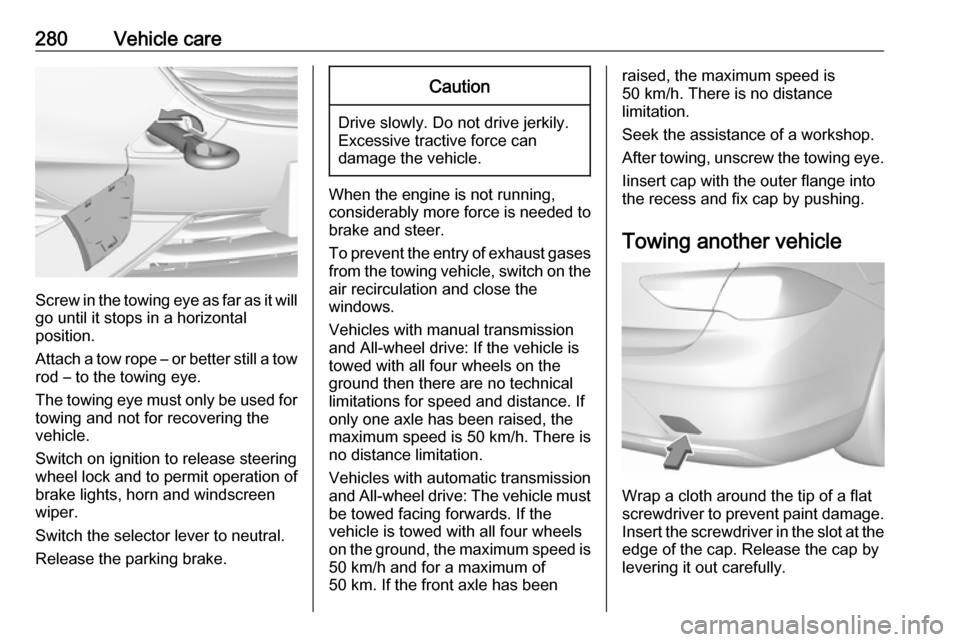
Screw in the towing eye as far as it will
go until it stops in a horizontal
position.
Attach a tow rope – or better still a tow
rod – to the towing eye.
The towing eye must only be used for towing and not for recovering the
vehicle.
Switch on ignition to release steering
wheel lock and to permit operation of
brake lights, horn and windscreen
wiper.
Switch the selector lever to neutral.
Release the parking brake.
Caution
Drive slowly. Do not drive jerkily.
Excessive tractive force can
damage the vehicle.
When the engine is not running,
considerably more force is needed to
brake and steer.
To prevent the entry of exhaust gases from the towing vehicle, switch on the
air recirculation and close the
windows.
Vehicles with manual transmission
and All-wheel drive: If the vehicle is
towed with all four wheels on the
ground then there are no technical
limitations for speed and distance. If
only one axle has been raised, the
maximum speed is 50 km/h. There is
no distance limitation.
Vehicles with automatic transmission and All-wheel drive: The vehicle must
be towed facing forwards. If the
vehicle is towed with all four wheels
on the ground, the maximum speed is 50 km/h and for a maximum of
50 km. If the front axle has been
raised, the maximum speed is
50 km/h. There is no distance
limitation.
Seek the assistance of a workshop.
After towing, unscrew the towing eye.
Iinsert cap with the outer flange into
the recess and fix cap by pushing.
Towing another vehicle
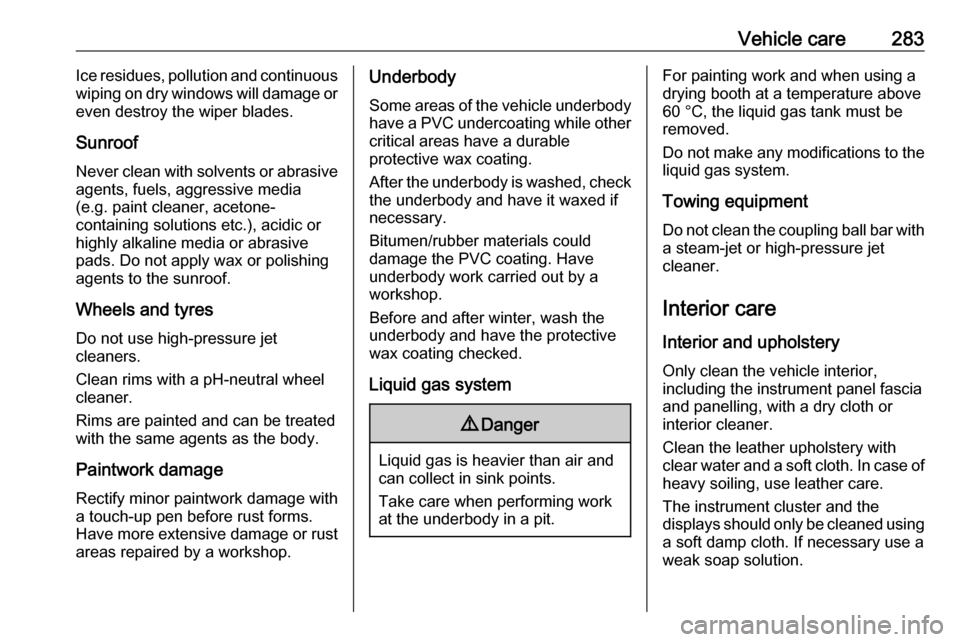
Wrap a cloth around the tip of a flat
screwdriver to prevent paint damage.
Insert the screwdriver in the slot at the
edge of the cap. Release the cap by
levering it out carefully.
Page 284 of 329

282Vehicle careIf using a vehicle wash, comply with
the vehicle wash manufacturer's
instructions. The windscreen wiper and rear window wiper must be
switched off. Remove antenna and
external accessories such as roof
racks etc.
If you wash your vehicle by hand,
make sure that the insides of the
wheel housings are also thoroughly
rinsed out.
Wax painted parts of the vehicle
regularly.
Clean edges and folds on opened
doors and the bonnet as well as the
areas they cover.
Clean bright metal mouldings with a
cleaning solution approved for
aluminium to avoid damages.Caution
Always use a cleaning agent with
a pH value of four to nine.
Do not use cleaning agents on hot surfaces.
Do not clean the engine compartmentwith a steam-jet or high-pressure jet
cleaner.
Thoroughly rinse and leather-off the vehicle. Rinse leather frequently. Use
separate leathers for painted and
glass surfaces: remnants of wax on
the windows will impair vision.
Have the door hinges of all doors
greased by a workshop.
Do not use hard objects to remove
spots of tar. Use tar removal spray on
painted surfaces.
Exterior lights
Headlight and other light covers are
made of plastic. Do not use any
abrasive or caustic agents, do not use an ice scraper, and do not clean them
dry.
Polishing and waxing
Wax the vehicle regularly (at the
latest when water no longer beads).
Otherwise, the paintwork will dry out.
Polishing is necessary only if the paint
has become dull or if solid deposits
have become attached to it.Paintwork polish with silicone forms a
protective film, making waxing
unnecessary.
Plastic body parts must not be treated with wax or polishing agents.
Windows and windscreen wiper
blades
Use a soft lint-free cloth or chamois
leather together with window cleaner and insect remover.
When cleaning the rear window from
inside, always wipe in parallel to the
heating element to prevent damage.
For mechanical removal of ice, use a
sharp-edged ice scraper. Press the
scraper firmly against the glass so
that no dirt can get under it and
scratch the glass.
Clean smearing wiper blades with a
soft cloth and window cleaner.
Remove dirt residues from smearing
wiper blades by using a soft cloth and window cleaner. Also make sure to
remove any residues such as wax,
insect residues and similar from the
window.
Page 285 of 329
Vehicle care283Ice residues, pollution and continuous
wiping on dry windows will damage or
even destroy the wiper blades.
Sunroof Never clean with solvents or abrasive
agents, fuels, aggressive media
(e.g. paint cleaner, acetone-
containing solutions etc.), acidic or
highly alkaline media or abrasive
pads. Do not apply wax or polishing
agents to the sunroof.
Wheels and tyres
Do not use high-pressure jet
cleaners.
Clean rims with a pH-neutral wheel
cleaner.
Rims are painted and can be treated
with the same agents as the body.
Paintwork damageRectify minor paintwork damage with
a touch-up pen before rust forms.
Have more extensive damage or rust
areas repaired by a workshop.Underbody
Some areas of the vehicle underbody
have a PVC undercoating while other
critical areas have a durable
protective wax coating.
After the underbody is washed, check
the underbody and have it waxed if
necessary.
Bitumen/rubber materials could
damage the PVC coating. Have
underbody work carried out by a
workshop.
Before and after winter, wash the
underbody and have the protective
wax coating checked.
Liquid gas system9 Danger
Liquid gas is heavier than air and
can collect in sink points.
Take care when performing work
at the underbody in a pit.
For painting work and when using a
drying booth at a temperature above
60 °C, the liquid gas tank must be
removed.
Do not make any modifications to the
liquid gas system.
Towing equipment
Do not clean the coupling ball bar with a steam-jet or high-pressure jet
cleaner.
Interior care
Interior and upholstery
Only clean the vehicle interior,
including the instrument panel fascia
and panelling, with a dry cloth or
interior cleaner.
Clean the leather upholstery with
clear water and a soft cloth. In case of heavy soiling, use leather care.
The instrument cluster and the
displays should only be cleaned using
a soft damp cloth. If necessary use a
weak soap solution.
Page 298 of 329
![OPEL INSIGNIA BREAK 2018.5 Manual user 296Technical dataPerformance
Grand SportEngineB15XHLB15XHTB20NFTMaximum speed [km/h]Manual transmission210/213 3)222/225 3)–Automatic transmission–2182503)
ECOEngineB16DTEB16DTH
B20DTH
FWD 4)B20](/img/37/18868/w960_18868-297.png "OPEL INSIGNIA BREAK 2018.5 Manual user 296Technical dataPerformance
Grand SportEngineB15XHLB15XHTB20NFTMaximum speed [km/h]Manual transmission210/213 3)222/225 3)–Automatic transmission–2182503)
ECOEngineB16DTEB16DTH
B20DTH
FWD 4)B20")
296Technical dataPerformance
Grand SportEngineB15XHLB15XHTB20NFTMaximum speed [km/h]Manual transmission210/213 3)222/225 3)–Automatic transmission–2182503)
ECOEngineB16DTEB16DTH
B20DTH
FWD 4)B20DTH
AWD 5)
D20DTR
Maximum speed [km/h]Manual transmission201/205 3)211226223–Automatic transmission–203223–2333)
ECO
4) Front wheel drive
5) All wheel drive
Page 299 of 329
![OPEL INSIGNIA BREAK 2018.5 Manual user Technical data297Sports TourerEngineB15XHLB15XHTB20NFTMaximum speed [km/h]Manual transmission207/210 3)218/221 3)–Automatic transmission–2142453)
ECOEngineB16DTEB16DTH
B20DTH
FWD 4)B20DTH
AWD 5)](/img/37/18868/w960_18868-298.png "OPEL INSIGNIA BREAK 2018.5 Manual user Technical data297Sports TourerEngineB15XHLB15XHTB20NFTMaximum speed [km/h]Manual transmission207/210 3)218/221 3)–Automatic transmission–2142453)
ECOEngineB16DTEB16DTH
B20DTH
FWD 4)B20DTH
AWD 5)")
Technical data297Sports TourerEngineB15XHLB15XHTB20NFTMaximum speed [km/h]Manual transmission207/210 3)218/221 3)–Automatic transmission–2142453)
ECOEngineB16DTEB16DTH
B20DTH
FWD 4)B20DTH
AWD 5)
D20DTR
Maximum speed [km/h]Manual transmission201212223220–Automatic transmission–204220–2314)
Front wheel drive
5) All wheel drive
Page 300 of 329
![OPEL INSIGNIA BREAK 2018.5 Manual user 298Technical dataCountry TourerEngineB15XHLB15XHTB20NFTMaximum speed [km/h]Manual transmission203213–Automatic transmission–210242EngineB20DTH
FWD 4)B20DTH
AWD 5)
D20DTR
Maximum speed [km/h]Manu](/img/37/18868/w960_18868-299.png "OPEL INSIGNIA BREAK 2018.5 Manual user 298Technical dataCountry TourerEngineB15XHLB15XHTB20NFTMaximum speed [km/h]Manual transmission203213–Automatic transmission–210242EngineB20DTH
FWD 4)B20DTH
AWD 5)
D20DTR
Maximum speed [km/h]Manu")
298Technical dataCountry TourerEngineB15XHLB15XHTB20NFTMaximum speed [km/h]Manual transmission203213–Automatic transmission–210242EngineB20DTH
FWD 4)B20DTH
AWD 5)
D20DTR
Maximum speed [km/h]Manual transmission220218–Automatic transmission218–2284)
Front wheel drive
5) All wheel drive
Page 301 of 329
![OPEL INSIGNIA BREAK 2018.5 Manual user Technical data299Vehicle weightKerb weight, basic model without any optional equipmentGrand SportEngineManual transmissionAutomatic transmission[kg]B15XHL1440/1456 6)–B15XHT1441/1472 6)1472B20NFT–](/img/37/18868/w960_18868-300.png "OPEL INSIGNIA BREAK 2018.5 Manual user Technical data299Vehicle weightKerb weight, basic model without any optional equipmentGrand SportEngineManual transmissionAutomatic transmission[kg]B15XHL1440/1456 6)–B15XHT1441/1472 6)1472B20NFT–")
Technical data299Vehicle weightKerb weight, basic model without any optional equipmentGrand SportEngineManual transmissionAutomatic transmission[kg]B15XHL1440/1456 6)–B15XHT1441/1472 6)1472B20NFT–1649/1683 7)[kg]B16DTE1487/1503 6)–B16DTH15031522B20DTH15821613B20DTH
AWD 8)1683–D20DTR–1733/1772 7)6)
ECO
7) GSi
8) All wheel drive
Optional equipment and accessories increase the kerb weight.
Loading information 3 86.
Page 302 of 329
![OPEL INSIGNIA BREAK 2018.5 Manual user 300Technical dataKerb weight, basic model without any optional equipmentSports TourerEngineManual transmissionAutomatic transmission[kg]B15XHL1487–B15XHT1487/15036)1522B20NFT–1683/1716 7)[kg]B16D](/img/37/18868/w960_18868-301.png "OPEL INSIGNIA BREAK 2018.5 Manual user 300Technical dataKerb weight, basic model without any optional equipmentSports TourerEngineManual transmissionAutomatic transmission[kg]B15XHL1487–B15XHT1487/15036)1522B20NFT–1683/1716 7)[kg]B16D")
300Technical dataKerb weight, basic model without any optional equipmentSports TourerEngineManual transmissionAutomatic transmission[kg]B15XHL1487–B15XHT1487/15036)1522B20NFT–1683/1716 7)[kg]B16DTE1522–B16DTH15371567B20DTH16331666B20DTH
AWD 8)1716–D20DTR–1772/1807 7)6)
ECO
7) GSi
8) All wheel drive
Optional equipment and accessories increase the kerb weight.
Loading information 3 86.
Page 303 of 329
![OPEL INSIGNIA BREAK 2018.5 Manual user Technical data301Kerb weight, basic model without any optional equipmentCountry TourerEngineManual transmissionAutomatic transmission[kg]B15XHL1522–B15XHT15221552B20NFT–1699[kg]B20DTH16661666B20DT](/img/37/18868/w960_18868-302.png "OPEL INSIGNIA BREAK 2018.5 Manual user Technical data301Kerb weight, basic model without any optional equipmentCountry TourerEngineManual transmissionAutomatic transmission[kg]B15XHL1522–B15XHT15221552B20NFT–1699[kg]B20DTH16661666B20DT")
Technical data301Kerb weight, basic model without any optional equipmentCountry TourerEngineManual transmissionAutomatic transmission[kg]B15XHL1522–B15XHT15221552B20NFT–1699[kg]B20DTH16661666B20DTH
AWD 8)1716–D20DTR–18078)
All wheel drive
Optional equipment and accessories increase the kerb weight.
Loading information 3 86.