box OPEL INSIGNIA BREAK 2020 User Guide
[x] Cancel search | Manufacturer: OPEL, Model Year: 2020, Model line: INSIGNIA BREAK, Model: OPEL INSIGNIA BREAK 2020Pages: 315, PDF Size: 9.45 MB
Page 251 of 315
Vehicle care249
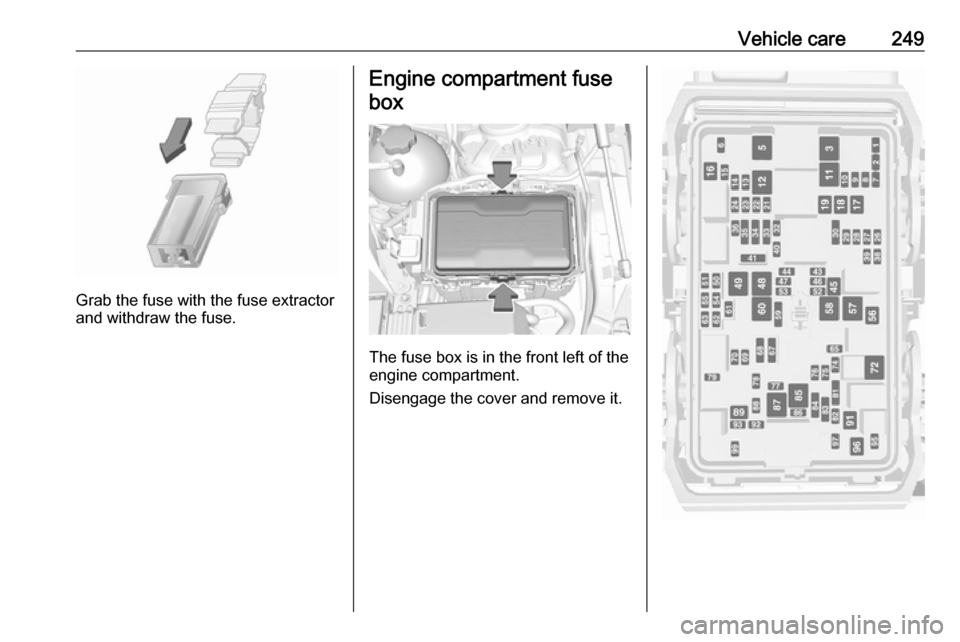
Grab the fuse with the fuse extractor
and withdraw the fuse.
Engine compartment fuse
box
The fuse box is in the front left of the
engine compartment.
Disengage the cover and remove it.
Page 253 of 315

Vehicle care251No.Circuit52–53–54–55–56Starter57–58–59Left headlight (LED)60Cooling fan61–62–63–64–65Climate control66–67–68–No.Circuit69Right high beam (Halogen) /
Right headlight (LED)70Left high beam (Halogen)71–72Starter73–74Transmission control module75Engine control module76Exhaust reduction system77–78Horn79Washer system80–81Engine control module82–83Ignition coil84Ignition coil85PowertrainNo.Circuit86–87Diesel fuel heating88Air shutter89–90–91–92After boil pump93Electronic key system94–95Coolant pump96Diesel fuel heating97–98–99Coolant pump
After having changed defective fuses,
close the fuse box cover and press
until it engages.
If the fuse box cover is not closed
correctly, malfunction may occur.
Page 254 of 315
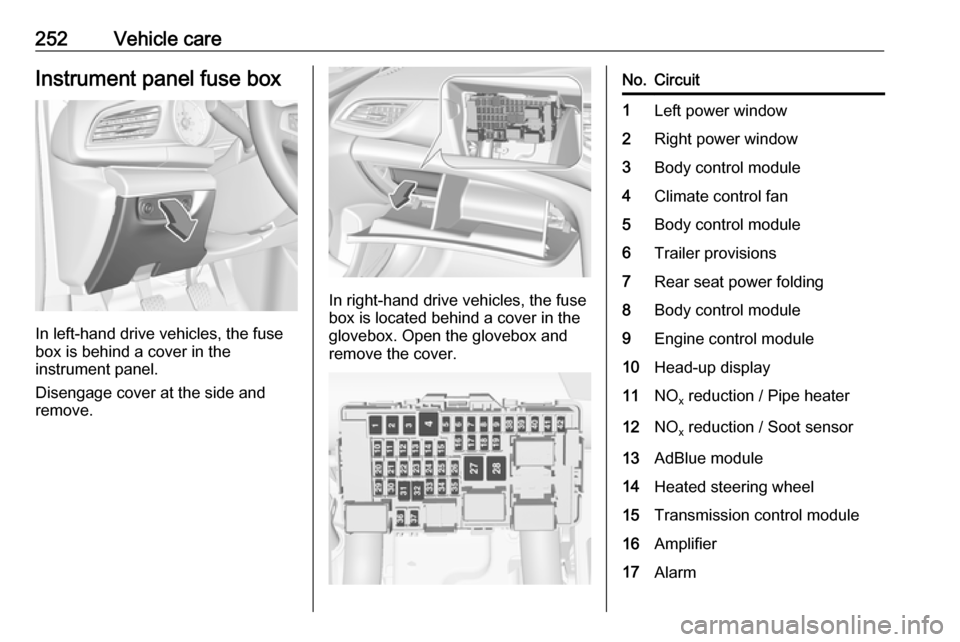
252Vehicle careInstrument panel fuse box
In left-hand drive vehicles, the fuse
box is behind a cover in the
instrument panel.
Disengage cover at the side and
remove.
In right-hand drive vehicles, the fuse
box is located behind a cover in the
glovebox. Open the glovebox and
remove the cover.
No.Circuit1Left power window2Right power window3Body control module4Climate control fan5Body control module6Trailer provisions7Rear seat power folding8Body control module9Engine control module10Head-up display11NO x reduction / Pipe heater12NO
x reduction / Soot sensor13AdBlue module14Heated steering wheel15Transmission control module16Amplifier17Alarm
Page 255 of 315

Vehicle care253No.Circuit18Body control module19AdBlue module20Body control module21Body control module22Body control module23Electric steering wheel lock24Airbag25Diagnostic connector26Power outlet load compartment27EBCM valve28Police provision29–30–31Steering wheel controls32Ignition switch33Climate control34Central gateway moduleNo.Circuit35AUX / USB connector36Wireless charger37Rear wiper38Emergency call39Display40Parking assist41Overhead console42Infotainment SystemVehicle tools
Tools
Vehicles with spare wheel
The jack with wheel wrench, the tools,
an extension bolt for securing a
damaged wheel and the towing eye
are placed in the tool box below the
spare wheel in the load compartment.
Spare wheel 3 265.
Page 256 of 315
254Vehicle careVehicles without spare wheel
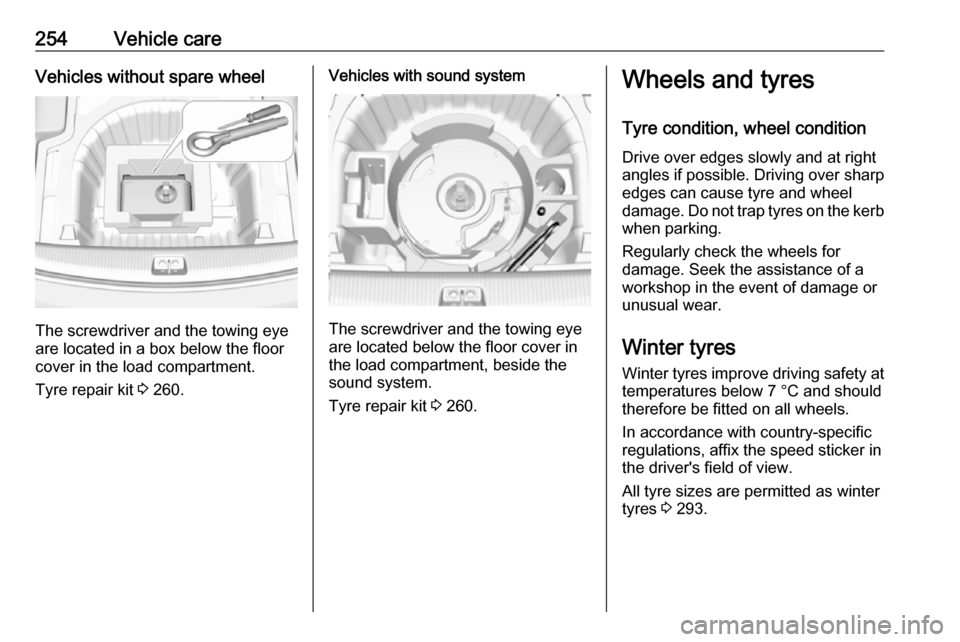
The screwdriver and the towing eye
are located in a box below the floor
cover in the load compartment.
Tyre repair kit 3 260.
Vehicles with sound system
The screwdriver and the towing eye
are located below the floor cover in
the load compartment, beside the
sound system.
Tyre repair kit 3 260.
Wheels and tyres
Tyre condition, wheel condition Drive over edges slowly and at right
angles if possible. Driving over sharp
edges can cause tyre and wheel
damage. Do not trap tyres on the kerb when parking.
Regularly check the wheels for
damage. Seek the assistance of a
workshop in the event of damage or
unusual wear.
Winter tyres
Winter tyres improve driving safety at temperatures below 7 °C and shouldtherefore be fitted on all wheels.
In accordance with country-specific
regulations, affix the speed sticker in
the driver's field of view.
All tyre sizes are permitted as winter
tyres 3 293.
Page 263 of 315

Vehicle care261●Type 2 indicated by the on/off
switch at the side of the
compressor.
If vehicle has a flat tyre:
Apply the parking brake and engage first gear, reverse gear or P.
On vehicles with audio speaker
system, the tyre repair kit is stowed together with the tools.
On other versions, the tyre repair kit
is stored in a bag.
Loosen the screw and remove the
bag.
Take the sealant bottle and the
compressor out of the box.
1. Remove the electrical connection cable and air hose from the
stowage compartments on the
underside of the compressor.
Page 266 of 315

264Vehicle carerelease valve (turn anticlockwise)
at the air filler hose.
12. Detach the tyre repair kit. Type 1: push catch on bracket to
remove sealant bottle from
bracket. Screw tyre inflation hose
to the free connection of sealant
bottle. This prevents sealant from
escaping.
Type 2: Sealant bottle can not be
removed from the compressor.
Have the sealant bottle replaced
by your workshop.
13. Stow tyre repair kit in the load compartment.
14. Remove any excess sealant using a cloth.
15. Take the label indicating maximum permitted speed from
the sealant bottle and affix in the
driver's field of view.
16. Continue driving immediately so that sealant is evenly distributed
in the tyre. After driving approx.
10 km (but no more than
10 minutes), stop and check tyre
pressure. Screw compressor air
hose directly onto tyre valve.
If tyre pressure is more than
1.3 bar , set it to the correct value.
Repeat the procedure until there
is no more loss of pressure.
If the tyre pressure has fallen
below 1.3 bar, the vehicle must
not be used. Seek the assistance
of a workshop.
17. Stow away tyre repair kit in the box.
18. Fix the box with the screw.
Note
The driving characteristics of the repaired tyre are severely affected,
therefore have this tyre replaced.
If unusual noise is heard or the
compressor becomes hot, turn
compressor off for at least 30 min.
The built-in safety valve opens at a
pressure of 7 bar.
Note the expiry date of the kit. After
this date its sealing capability is no
longer guaranteed. Pay attention to
storage information on sealant
bottle.
Replace the used sealant bottle. Dispose of the bottle as prescribed
by applicable laws.
The compressor and sealant can be used from approx. -30 °C.
The adapters possibly supplied can
be used to pump up other items e.g. footballs, air mattresses, inflatable
dinghies etc. They can be located on the underside of the compressor. To
remove, screw on compressor air
hose and withdraw adapter.
Page 268 of 315

266Vehicle careOnly mount one temporary spare
wheel. Do not drive faster than
80 km/h. Take curves slowly. Do not
use for a long period of time.Caution
The use of a spare wheel that is smaller than the other wheels or in
combination with winter tyres
could affect driveability. Have the defective tyre replaced as soon as
possible.
Caution
If driving with a temporary spare
wheel, active emergency braking
has to deactivated.
The spare wheel is located in the load
compartment beneath the floor
covering.
To remove: 1. Open the floor cover.
2. The spare wheel is secured with a
wing nut. Unscrew the wing nut
and take out the spare wheel.
Under the spare wheel there is the
box with vehicle tools.
3. When, after a wheel change, no wheel is placed in the spare wheel
well, secure the tool box by
tightening the wing nut as far as it will go and close floor cover.
4. After wheel change back to full size wheel, place the spare wheel
outside up in the well and secure
with the wing nut.
Only mount one temporary spare
wheel. The permissible maximum
speed on the label on the temporary
spare wheel is only valid for the
factory-fitted tyre size.
Fitting the spare wheel Make the following preparations and
observe the following information:
● Park the vehicle on a level, firm and non-skid surface. The front
wheels must be in the straight-
ahead position.
● Apply the parking brake and engage first gear, reverse gear or
P .
● Remove the spare wheel.
● Never change more than one wheel at once.
Page 269 of 315
Vehicle care267● Use the jack only to changewheels in case of puncture, not
for seasonal winter or summer
tyre change.
● The jack is maintenance-free.
● If the ground on which the vehicle
is standing is soft, a solid board
(max. 1 cm thick) should be
placed under the jack.
● Take heavy objects out of the vehicle before jacking up.
● No people or animals may be in the vehicle when it is jacked-up.
● Never crawl under a jacked-up vehicle.
● Do not start the vehicle when it is
raised on the jack.
● Clean wheel nuts and thread with
a clean cloth before mounting the wheel.9 Warning
Do not grease wheel bolt, wheel
nut and wheel nut cone.
1. Steel wheels with cover: Pull off the wheel cover.
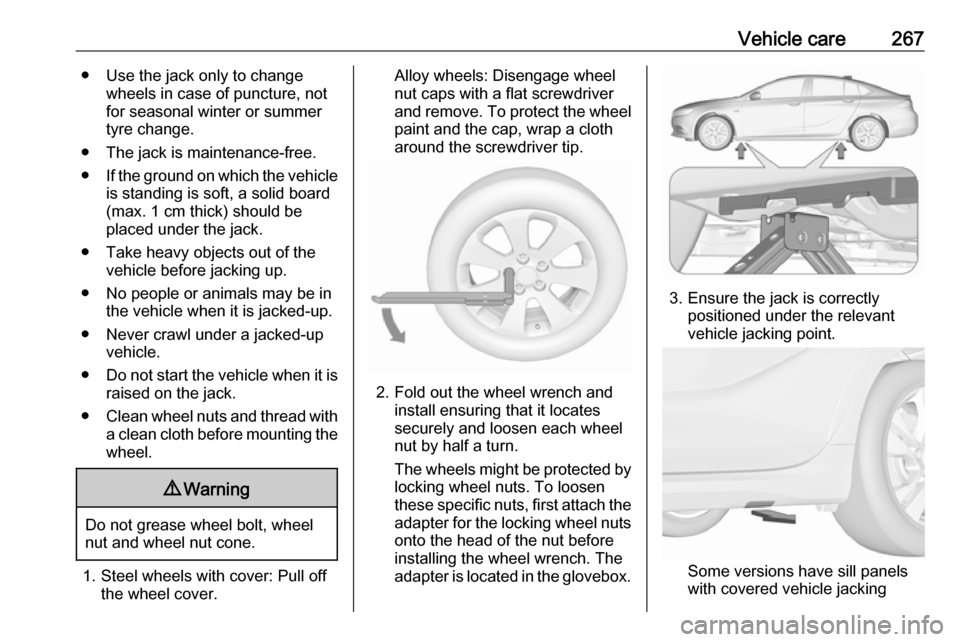
Alloy wheels: Disengage wheel
nut caps with a flat screwdriver
and remove. To protect the wheel paint and the cap, wrap a cloth
around the screwdriver tip.
2. Fold out the wheel wrench and install ensuring that it locates
securely and loosen each wheel
nut by half a turn.
The wheels might be protected by
locking wheel nuts. To loosen
these specific nuts, first attach the adapter for the locking wheel nuts
onto the head of the nut before
installing the wheel wrench. The
adapter is located in the glovebox.
3. Ensure the jack is correctly positioned under the relevant
vehicle jacking point.
Some versions have sill panels
with covered vehicle jacking
Page 311 of 315

309Child restraint systems ................65
Climate control ............................. 16
Clock............................................. 93
Collision damage repair ..............301
Control indicators........................ 105
Control of the vehicle .................152
Controls ........................................ 89
Convex shape .............................. 38
Coolant and antifreeze ...............279
Cruise control ....................110, 178
Cupholders .................................. 74
Curtain airbag system .................. 63
Curve lighting.............................. 133
D Danger, Warnings and Cautions ...4
Daytime running lights ...............133
Declaration of conformity ............297
DEF ............................................ 162
Diesel exhaust fluid ....................162
Diesel fuel system bleeding .......237
Door open .................................. 111
Doors ............................................ 30
Driver assistance systems ..........178
Driver Information Centre ...........111
Driving characteristics and towing tips .............................. 225
Driving hints ................................ 152E
Electric adjustment ......................38
Electrical system......................... 248
Electric parking brake .........107, 171
Electric parking brake fault .........107
Electronic climate control system 143
Electronic driving programmes ..167
Electronic key system ...................23
Electronic Stability Control.......... 175
Electronic Stability Control and Traction Control system ..........108
Electronic Stability Control off..... 108
Emergency call ........................... 127
End-of-life vehicle recovery .......230
Engine compartment fuse box ...249
Engine coolant ........................... 233
Engine coolant temperature ......108
Engine coolant temperature gauge ..................................... 103
Engine data ............................... 286
Engine exhaust .......................... 160
Engine identification ...................282
Engine oil ................... 232, 279, 283
Engine oil pressure ....................109
Entry lighting .............................. 138
Event data recorders ..................304
Exhaust filter ............................... 160
Exit lighting ................................ 138
Exterior care .............................. 273
Exterior light ............................... 110Exterior lighting ....................13, 129
Exterior mirrors ............................. 38
F
Fault ........................................... 168
First aid kit ................................... 85
Fixed air vents ........................... 150
Floor mats................................... 276
Folding mirrors ............................. 39
Following distance ......................108
Following distance indication ......193
Forward collision alert................. 190
Front airbag system .....................62
Front fog lights ...........110, 135, 240
Front pedestrian protection ........197
Front seats.................................... 48
Front storage ................................ 75
Fuel............................................. 221
Fuel for diesel engines ..............222
Fuel for petrol engines ...............221
Fuel gauge ................................. 103
Funnel......................................... 223
Fuses ......................................... 248
G Gauges ....................................... 101
Gear selection ........................... 165
Gear shifting ............................... 108
General information ...................225
Glovebox ..................................... 74