steering wheel OPEL KARL 2019 Manual user
[x] Cancel search | Manufacturer: OPEL, Model Year: 2019, Model line: KARL, Model: OPEL KARL 2019Pages: 191, PDF Size: 5.51 MB
Page 108 of 191
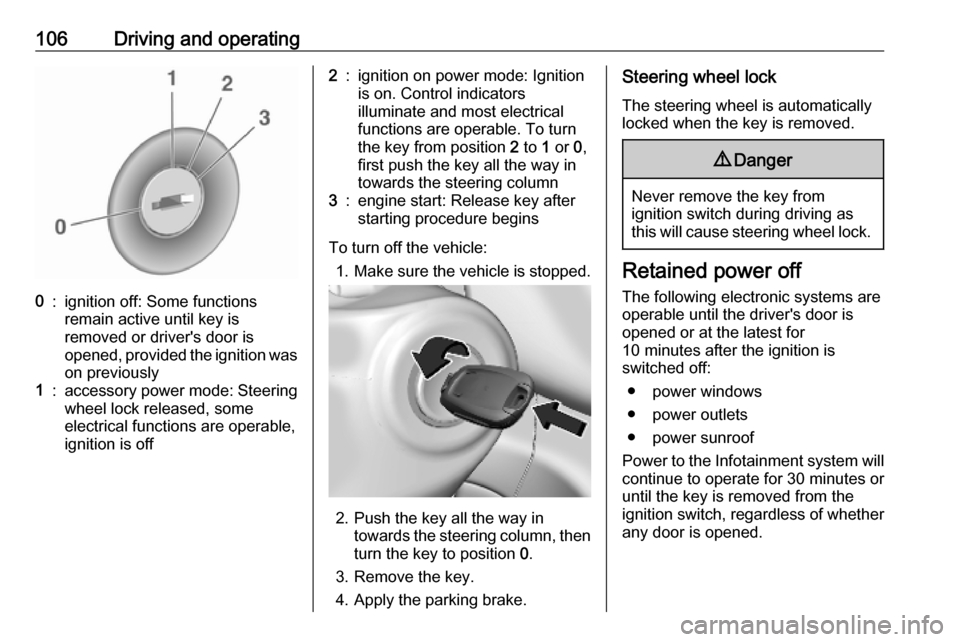
106Driving and operating0:ignition off: Some functions
remain active until key is
removed or driver's door is
opened, provided the ignition was
on previously1:accessory power mode: Steering wheel lock released, some
electrical functions are operable,
ignition is off2:ignition on power mode: Ignition
is on. Control indicators
illuminate and most electrical
functions are operable. To turn
the key from position 2 to 1 or 0,
first push the key all the way in
towards the steering column3:engine start: Release key after
starting procedure begins
To turn off the vehicle:
1. Make sure the vehicle is stopped.
2. Push the key all the way in
towards the steering column, then
turn the key to position 0.
3. Remove the key.
4. Apply the parking brake.
Steering wheel lock
The steering wheel is automatically
locked when the key is removed.9 Danger
Never remove the key from
ignition switch during driving as
this will cause steering wheel lock.
Retained power off
The following electronic systems are
operable until the driver's door is
opened or at the latest for
10 minutes after the ignition is
switched off:
● power windows
● power outlets
● power sunroof
Power to the Infotainment system will continue to operate for 30 minutes oruntil the key is removed from theignition switch, regardless of whether
any door is opened.
Page 109 of 191

Driving and operating107Starting the engine
Turn key to position 1 to release the
steering wheel lock.
Operate clutch and brake pedal. Do not operate the accelerator pedal. Turn key briefly to position 3 and
release: an automatic procedure
operates the starter after a brief
delay, until the engine is running. See
"Automatic Starter Control".
Before restarting or to switch off the
engine, turn the key back to position
0 .
During an Autostop, the engine can
be started by depressing the clutch
pedal.
Starting the vehicle at low
temperatures
The start of the engine without
additional heaters is possible down to -30 °C.
Required is an engine oil with the
correct viscosity, the correct fuel,
performed services and a sufficiently
charged vehicle battery.
Automatic starter control This function controls the engine
starting procedure. The driver does
not need to hold the key in position 3.
Once applied, the system will go on
starting automatically until the engine
is running. Because of the checking
procedure, the engine starts running after a short delay.
Possible reasons for a non-starting engine:
● clutch pedal not operated
● timeout occurredTurbo engine warm-up
Upon start-up, engine available
torque may be limited for a short time, especially when the engine
temperature is cold. The limitation is
to allow the lubrication system to fully
protect the engine.
Overrun cut-off
The fuel supply is automatically cut off
during overrun, i.e. when the vehicle
is driven with a gear engaged but
accelerator is released.
Depending on driving conditions, the
overrun cut-off may be deactivated.
Stop-start system The stop-start system helps to save
fuel and to reduce the exhaust
emissions. When conditions allow, it
switches off the engine as soon as the
vehicle is at a low speed or at a
standstill, e.g. at a traffic light or in a
traffic jam.
The engine is started automatically as soon as the clutch is depressed.
Page 112 of 191

110Driving and operating● Always apply the parkingbrake. Activate the manual
parking brake without pressing
the release button. Apply as
firmly as possible on a downhill
slope or uphill slope. Depress brake pedal at the same time to reduce operating force.
● Switch off the engine.
● If the vehicle is on a level surface or uphill slope, engage
first gear before removing the ignition key. On an uphill slope,
turn the front wheels away from
the kerb.
If the vehicle is on a downhill
slope, engage reverse gear
before removing the ignition
key. Turn the front wheels
towards the kerb.
● Close the windows and the sunroof.
● Remove the ignition key from the ignition switch. Turn the
steering wheel until the
steering wheel lock is felt to
engage.● Lock the vehicle.
● Activate the anti-theft alarm system.
● The engine cooling fans may run
after the engine has been
switched off 3 128.Caution
After running at high engine
speeds or with high engine loads,
operate the engine briefly at a low load or run in neutral for
approx. 30 seconds before
switching off, in order to protect
the turbocharger.
Note
In the event of an accident with
airbag deployment, the engine is
switched off automatically if the
vehicle comes to a standstill within a
certain time.
Engine exhaust9 Danger
Engine exhaust gases contain
poisonous carbon monoxide,
which is colourless and odourless and could be fatal if inhaled.
If exhaust gases enter the interior
of the vehicle, open the windows.
Have the cause of the fault
rectified by a workshop.
Avoid driving with an open load
compartment, otherwise exhaust
gases could enter the vehicle.
Catalytic converter
The catalytic converter reduces the
amount of harmful substances in the
exhaust gases.
Page 117 of 191

Driving and operating115Electronic Stability Control
Electronic Stability Control (ESC)
improves driving stability when
necessary, regardless of the type of
road surface or tyre grip.
As soon as the vehicle starts to
swerve (understeer / oversteer),
engine output is reduced and the wheels are braked individually.
ESC operates in combination with the Traction Control system (TC). It
prevents the drive wheels from
spinning.
ESC is operational after each engine
start as soon as the control indicator
b extinguishes.
When ESC operates b flashes.
9 Warning
Do not let this special safety
feature tempt you into taking risks
when driving.
Adapt speed to the road
conditions.
Control indicator b 3 72.
Deactivation
For very high-performance driving
ESC can be deactivated:
Press and hold t for a minimum of
5 seconds. Control indicator t
illuminates.
ESC is reactivated by pressing t
again. If the TC system was
previously disabled, both TC and
ESC are reactivated. k and t
extinguish when TC and ESC are reactivated.
ESC is also reactivated the next time
the ignition is switched on.
Fault
If there is a fault in the system, the
control indicator b illuminates
continuously and a warning code appears in the Driver Information
Centre. The system is not
operational.
Have the cause of the fault remedied
by a workshop.
City mode City mode is a feature which enables
increased steering assistance during
lower speed conditions, e.g. city
traffic or parking. Steering assistance
is increased for greater convenience.
Page 146 of 191

144Vehicle careNo.Circuit17–18Instrument cluster19–20Headlight range adjustment21Power windows, front22Power windows, rear23–24–25Auxiliary power outlet26Sunroof27Central gateway module28Body control module 829Body control module 730Body control module 631Body control module 532Body control module 433Body control module 3No.Circuit34Body control module 235Body control module 136–37Steering wheel control LED38–39Logistic/DC transformer40Power window, driver41Blower42Seat heating, front43Air conditioning module44Heated steering wheel45–Vehicle tools
Tools
Vehicles without spare
The vehicle tools are in the
compartment under the floor cover in
the load compartment.
Page 153 of 191
Vehicle care151Wheel covers must not impair brake
cooling.9 Warning
Use of unsuitable tyres or wheel
covers could lead to sudden
pressure loss and thereby
accidents.
Tyre chains
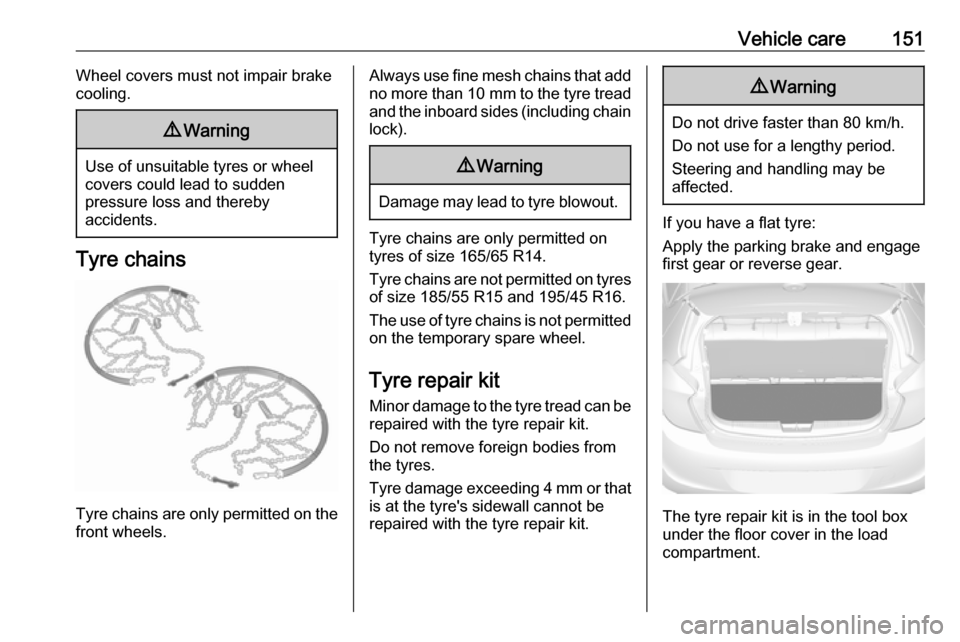
Tyre chains are only permitted on the
front wheels.
Always use fine mesh chains that add no more than 10 mm to the tyre tread
and the inboard sides (including chain lock).9 Warning
Damage may lead to tyre blowout.
Tyre chains are only permitted on
tyres of size 165/65 R14.
Tyre chains are not permitted on tyres of size 185/55 R15 and 195/45 R16.
The use of tyre chains is not permitted on the temporary spare wheel.
Tyre repair kit Minor damage to the tyre tread can be
repaired with the tyre repair kit.
Do not remove foreign bodies from
the tyres.
Tyre damage exceeding 4 mm or that is at the tyre's sidewall cannot be
repaired with the tyre repair kit.
9 Warning
Do not drive faster than 80 km/h.
Do not use for a lengthy period.
Steering and handling may be
affected.
If you have a flat tyre:
Apply the parking brake and engage
first gear or reverse gear.
The tyre repair kit is in the tool box
under the floor cover in the load
compartment.
Page 163 of 191

Vehicle care161
2. Screw in the towing eye as far asit will go until it stops in a
horizontal position.
3. Attach a tow rope – or better still a
tow rod – to the towing eye.
General
The towing eye must only be used for
towing and not for recovering the
vehicle.
Switch on ignition to release steering
wheel lock and to permit operation of
brake lights, horn and windscreen
wiper.
Switch the selector lever to neutral.
Release the parking brake.Caution
Drive slowly. Do not drive jerkily.
Excessive tractive force can
damage the vehicle.
When the engine is not running,
considerably more force is needed to
brake and steer.
To prevent the entry of exhaust gases from the towing vehicle, switch on the
air recirculation and close the
windows.
The vehicle must be towed facing
forward, not faster than 88 km/h. In all
other cases and when the
transmission is defective, the front
axle must be raised off the ground.
Seek the assistance of a workshop.
After towing, unscrew the towing eye.
Insert cap and engage in the front
bumper.
Appearance care
Exterior care
Locks The locks are lubricated at the factoryusing a high quality lock cylinder
grease. Use a de-icing agent only
when absolutely necessary, as this
has a degreasing effect and impairs
lock function. After using a de-icing
agent, have the locks regreased by a workshop.
Washing The paintwork of your vehicle is
exposed to environmental influences.
Wash and wax your vehicle regularly. When using automatic vehicle
washes, select a programme that
includes waxing.
Bird droppings, dead insects, resin,
pollen and the like should be cleaned
off immediately, as they contain
aggressive constituents which can
cause paint damage.
Page 183 of 191

Customer information181Depending on technical equipment
level, the data stored is as follows:
● system component operating states (e.g. fill level, tyre
pressure, battery status)
● faults and defects in important system components (e.g. lights,
brakes)
● system reactions in special driving situations (e.g. triggeringof an airbag, actuation of the
stability control systems)
● information on events damaging the vehicle
● for electric vehicles the amount of
charge in the high-voltage
battery, estimated range
In special cases (e.g. if the vehicle
has detected a malfunction), it may be
necessary to save data that would
otherwise just be volatile.
When you use services (e.g. repairs,
maintenance), the operating data
saved can be read together with the
vehicle identification number and
used when necessary. Staff working
for the service network ( e.g. garages,
manufacturers) or third parties (e.g.breakdown services) can read the
data from the vehicle. The same
applies to warranty work and quality
assurance measures.
Data is generally read via the OBD
(On-Board Diagnostics) port
prescribed by law in the vehicle. The operating data which is read out,
documents the technical condition of
the vehicle or individual components
and assists with fault diagnosis,
compliance with warranty obligations
and quality improvement. This data,
in particular information on
component stress, technical events,
operator errors and other faults, is
transmitted to the manufacturer
where appropriate, together with the
vehicle identification number. The
manufacturer is also subject to
product liability. The manufacturer
potentially also uses operating data
from vehicles for product recalls. This
data can also be used to check
customer warranty and guarantee
claims.
Fault memories in the vehicle can be
reset by a service company when
carrying out servicing or repairs or at
your request.Comfort and infotainment
functions
Comfort settings and custom settings can be stored in the vehicle and
changed or reset at any time.
Depending on the equipment level in
question, these include
● seat and steering wheel position settings
● chassis and air conditioning settings
● custom settings such as interior lighting
You can input your own data in the
infotainment functions for your
vehicle as part of the selected
features.
Depending on the equipment level in
question, these include
● multimedia data such as music, videos or photos for playback in
an integrated multimedia system
● address book data for use with an
integrated hands-free system or an integrated navigation system
Page 187 of 191

185DDanger, Warnings and Cautions ...4
Daytime running lights .................91
Declaration of conformity ............175
Door open .................................... 75
Doors ............................................ 25
Driver assistance systems ..........117
Driver Information Centre .............75
Driving hints ................................ 104
E Electric adjustment ......................28
Electrical system......................... 140
Electronic climate control system 99
Electronic Stability Control.......... 115
Electronic Stability Control and Traction Control system ............72
Electronic Stability Control off....... 72
End-of-life vehicle recovery .......127
Engine compartment fuse box ...141
Engine coolant ........................... 130
Engine coolant temperature ........73
Engine coolant temperature gauge ....................................... 66
Engine data ............................... 171
Engine exhaust .......................... 110
Engine identification ...................168
Engine oil ................... 129, 165, 169
Engine oil pressure ......................73
Event data recorders ..................180Exit lighting .................................. 94
Exterior care .............................. 161
Exterior light ................................. 74
Exterior lighting ......................14, 90
Exterior mirrors ............................. 28
F
First aid ......................................... 57
First aid kit ................................... 57
Fixed air vents ........................... 103
Folding mirrors ............................. 28
Front airbag system .....................43
Front doors ................................... 25
Front fog lights ...............74, 92, 136
Front seats.................................... 35
Front turn lights .......................... 136
Fuel............................................. 122
Fuel for petrol engines ...............122
Fuel gauge ................................... 65
Fuses ......................................... 140
G Gauges ......................................... 64
Gear shifting ................................. 72
Glovebox ..................................... 52
H Halogen headlights ....................134
Hand brake ......................... 112, 113
Hazard warning flashers ..............91
Headlight flash ............................. 90Headlight range adjustment ........91
Headlights..................................... 90
Headlights when driving abroad ..91
Head restraint adjustment .............8
Head restraints ............................ 34
Heated mirrors ............................. 29
Heated rear window ..................... 32
Heated steering wheel .................60
Heating ........................................ 37
Heating and ventilation system ...96
High beam ............................. 74, 90
Hill start assist ........................... 113
Horn ....................................... 15, 61
I
Identification plate .....................168
Ignition switch positions .............105
Immobiliser ............................ 27, 74
Indicators ...................................... 64
Info Display ................................... 80
Information displays...................... 75
Instrument cluster ........................64
Instrument panel fuse box .........143
Instrument panel illumination .....139
Instrument panel illumination control ...................................... 93
Instrument panel overview ........... 10
Interior care ............................... 163
Interior lighting .............................. 93
Interior lights ........................ 94, 139
Page 189 of 191

187Software acknowledgement.......178
Spare wheel ............................... 155
Speed limiter......................... 74, 118
Speedometer ............................... 64
Starting and operating ................105
Starting off ................................... 18
Starting the engine ....................107
Steering ...................................... 105
Steering wheel adjustment ......9, 60
Steering wheel controls ...............60
Stop-start system........................ 107
Storage ......................................... 52
Storage compartments .................52
Sunroof ........................................ 32
Sun visors .................................... 32
Symbols ......................................... 4
T
Tachometer ................................. 65
Tail lights ................................... 137
Three-point seat belt .................... 39
Tools .......................................... 144
Towing ........................................ 160
Towing the vehicle .....................160
Traction Control system ............. 114
Traction Control system off........... 73
Transmission ............................... 17
Tread depth ............................... 150
Trip odometer .............................. 65
Turn lights .............................. 69, 92Tyre chains ................................ 151
Tyre designations ......................145
Tyre pressure ............................ 146
Tyre pressure monitoring system ............................... 73, 147
Tyre pressures ........................... 174
Tyre repair kit ............................. 151
U
Upholstery .................................. 163
Using this manual ..........................3
V Valet mode ................................... 80
Vehicle battery ........................... 131
Vehicle checks............................ 128
Vehicle data ........................ 169, 172
Vehicle data recording and privacy ..................................... 180
Vehicle dimensions .................... 173
Vehicle Identification Number ....167
Vehicle jack ................................ 144
Vehicle messages .......................81
Vehicle personalisation ...............83
Vehicle specific data ......................3
Vehicle storage ........................... 127
Vehicle tools ............................... 144
Vehicle unlocking ........................... 6
Ventilation ..................................... 96W
Warning chimes ........................... 83
Warning lights ............................... 64
Warning triangle .......................... 56
Washer and wiper systems .........15
Washer fluid ............................... 131
Wheel changing .........................154
Wheel covers ............................. 150
Wheels and tyres .......................145
Windows ....................................... 30
Windscreen................................... 30
Windscreen wiper and washer ....61
Winter tyres ............................... 145
Wiper blade replacement ..........133