water OPEL MANTA 1973 User Guide
[x] Cancel search | Manufacturer: OPEL, Model Year: 1973, Model line: MANTA, Model: OPEL MANTA 1973Pages: 625, PDF Size: 17.22 MB
Page 125 of 625
I2A- 21973 OPEL SERVICE MANUAL
GENERAL INFORlVlATION
CONTENTS
SubjectPage No.
DESCRIPTION AND OPERATION: (Not Applicable)
DIAGNOSIS: (Not Applicable)
MAINTENANCE AND ADJUSTMENTS:
PaintMaintenance. . . . . . . . . . . . . . . . . . . . . . . . . . . . . . . . . . . . . . . . . . . . . . . . . . . . . . . . . . . .2A-2
ChromeMaintenance
. . . . . . . . . . . . . . . . . . . . . . . . . . . . . . . . . . . . . . . . . . . . . . . . . . . . . .2A-2
StainRemoval
. . . . . . . . . . . . . . . . . . . . . . . . . . . . . . . . . . . . . . . . . . . . . . . . . . . . . . . . . . . . . . . . . . . .2A-2
MAJOR REPAIR: (Not Applicable)
SPECIFICATIONS:
Bolt
TorqueSpecifications. . . . . . . . . . . . . . . . . . . . . . . . . . . . . . . . . . . . . . . . . . . . . .2A-4
Special Body Tools
. . . . , . . . . . . . . . . . . . . . . . . . . . . . . . . . . . . . . . . . . . . . . . . . . . . . . . . . . . . .2A-5
MAINTENANCE AND ADJUSTMENTSPAINT MAINTENANCE
To remove heavy concentrations of road dirt and
grime, it is recommended that the car be washed
using an automotive shampoo or mild soap, and cold
to lukewarm water. Use of harsh soaps or detergents
is not advised. In areas where salt is used on the
roads during the winter months, more frequentwashing is recommended.
Use of cleaners and polishes are required if no high
luster is obtainable by waxing. To protect the paint
finish, sparingly apply several coats of wax. Each
coat should be thoroughly rubbed to remove any
surplus wax.
Once the car is properly waxed, road dirt may easily
be removed by use of cold to lukewarm water and a
sponge. Dry by use of a chamois.
CHROME MAINTENANCE
Chrome parts should be washed with water and a
mild detergent. If rust or salt corrosion should ap-
pear, they may be removed with Buick Rust Eraser
or equivalent. Do not use scouring powders or stiff
brushes.STAIN REMOVAL
Before attempting to remove spots or stains from
upholstery fabrics, determine as accurately as possi-
ble: (1) Nature and age of the spot or stain. (2) The
affect of stain removing agents on the color, struc-
ture and general appearance of the fabric.
For best results, stains should be removed from
upholstery as soon as possible after they have been
made. If they are allowed to stand for some time,
they often become set, and removal becomes more
diffxult and frequently impossible.
There are three basic types of acceptable’ cleaners
available to car owners: (1) Volatile cleaners, (2) Syn-
thetic detergents, (3) Neutral soap (non-alkaline).
The volatile cleaners are recommended since they
have great solvent powers for grease, oils and general
road grime. Synthetic detergents generally loosen
stains satisfactorily, however, the use of improper
type detergents (containing bleach) involves risk of
damage to the color or finish of fabrics.
Precautions For Cleaning FabricsDo not use laundry soap or detergents containing
bleaches. The use of these agents tends to weaken
fabric and to change its color. Do
not use too much
cleaning fluid. Some interior trim assemblies are pad-
Page 126 of 625
GENERAL INFORMATIONZA- 3
ded with rubber, and volatile cleaners are generally
solvents for rubber. The application of too much
cleaner may destroy these rubber pads. Do not use
volatile cleaners on vinyl coated fabrics.
Procedure For Cleaning
Vinyl Fabrics With Synthetic Detergents
1. Make a solution of the synthetic detergent in luke-
warm water, working up a thick, frothy suds.
2. With a clean cloth or sponge, dampened with
lukewarm water, apply suds only to the surface of the
upholstery using light to medium pressure, repeating
several times, applying more suds with a clean por-
tion of the cloth or sponge.
3. With a second clean cloth, dampened with luke-
warm water, rub over the area with medium pressure
to remove excess detergent and loose material.
4. With a clean dry cloth, wipe off all excess mois-
ture. A vacuum cleaner may also be used.
5. Allow the upholstery to dry partially; then repeat
the above treatment if necessary to remove stain.
6. When the upholstery is satisfactorily cleaned, al-
low to dry completely before using.
Instructions for the Removal of
Specific Stains From Automotive
Upholstery Materials
Some types of stains and soilage, including blood,
ink, chewing gum, etc., require special consideration
for satisfactory results. For thkse, and other stains,
specific instructions are outlined in succeeding para-
graphs. It must be expected, particularly where wa-
ter treatment is specified, that discoloration and
finish disturbance may occur. In some cases fabric
disturbance may be considered preferable to the stain
itself. By following the procedures outlined below,
reasonably satisfactory results can be expected.
1. Bafrery Acids. Apply ordinary household am-
monia water with a brush or cloth to the affected
‘area, saturating it thoroughly. Permit the ammonia
water to remain on the spot about a minute, so that
it will have ample time to neutralize the acid. Then
rinse the spot by rubbing with a clean cloth saturated
with cold water.
This treatment will suffice for both old and new
stains. However, no type of treatment will repairdamage.to fibers resulting from the actidn of the
acids on the fibers particularly after the spot has
dried.
2.
Blood. Do not use hot water or soap and wateron blood stains since they will set the stain, thereby
making its removal practically impossible.
Rub the stain with a clean cloth saturated with cold
water until no more of the stain will come out. Care
must be taken so that clean portions ofcloth are used
for rubbing the stain.
This treatment should remove all of the stain. If it
does not, apply a small amount of household am-
monia water to the stain with a cloth or brush. After
a lapse of about one minute, continue to rub the stain
with a clean cloth dipped in clear cold water.
If the stain remains after the use of water and am-
monia, a thick paste of corn starch and cold water
may be applied to the stained area. Allow the paste
to remain until it has dried and absorbed the stain.
Then pick off the dry starch. Brush the surface to
remove starch particles that remain. For heavy
stains, several applications of starch paste may be
necessary.3. Candy. Candy stains, other than candy contain-
ing chocolate, can be removed by rubbing the af-
fected area with a cloth soaked with very hot water.
If the stain is not completely removed, rub area
lightly (after drying) with a cloth wet with a volatile
cleaner. This will usually remove the stain.
Candy stains resulting from cream and fruit-filled
chocolates can be removed more easily by rubbing
with a cloth soaked in lukewarm soap-suds (mild
neutral soap) and scraping, while wet, with a dull
knife. This treatment is followed with a rinsing by
rubbing the spot with a cloth dipped in cold water.
Stains resulting from chocolate or milk chocolate can
be removed by rubbing the stain with a cloth wet
with lukewarm water. After the spot is dry, rub it
lightly with a cloth dipped in a volatile cleaner.
4. Chewing Gum. Harden the gum with an ice cube,
and scrape off particles with a dull knife. If gum
cannot be removed completely by this method, mois-
ten it with a volatile cleaner and work it from the
fabric with a dull knife, while gum is still moist.
5. Fruit, Fruit Stains, Liquor and Wine. Practicallyall fruit stains can be removed by treatment with very
hot water. Wet the stain well by applying hot water
to the spot with a clean cloth. Scrape all excess pulp,
if present, off the fabric with a dull knife; then rub
vigorously with a cloth wet with very hot water. If
the stain is very old or deep, it may be necessary to
pour very hot water directly on the spot, following
this treatment with the scraping and rubbing. Direct
application of hot water to fabrics is not recom-
mended for general use since discoloration usually
results.
If the above treatments do not remove stain, allow
Page 127 of 625
fabric to dry thoroughly; then rub lightly with a
clean cloth dipped in a volatile cleaner. This is the
only further treatment recommended.
Soap and water are not recommended since they will
probably set the stain and cause a permanent dis-
coloration. Drying the fabric by means of heat (such
as the use of an iron) is not recommended.
6. Grease and 02 If grease has been spilled on the
material, as much as possible should be remove by
scraping with a dull knife or spatula before further
treatment is attempted.
Grease and oil stains may be removed by rubbing
lightly with a clean cloth saturated with a volatile
cleaner. Be sure all motions are toward the center of
the stained area to decrease the possibility of spread-
ing the stain.
7. Ice Cream. The same procedure is recommended
for the removal of ice cream stains as that used in
removing fruit stains.
If the stain is persistent, rubbing the spot with a cloth
wet with soap suds (mild neutral soap) may be used
to some advantage after the initial treatment with hot
water. This soap treatment should be followed with
a rinsing, by rubbing with a clean cloth wet with cold
water. After this dries, rubbing lightly with a cloth
wet with volatile cleaner will clear up the last of the
stain, by removing fatty or oily matter.
8.Vomit. Sponge with a clean cloth, dipped in clear
cold water. After most of the stain has been removed
in this way wash lightly with soap (mild neutral),
using a clean cloth and lukewarm water. Then rub
with another clean cloth dipped in cold water. If any
of the stain remains after this treatment, gently rub
clean with a cloth moistened with a volatile cleaner.
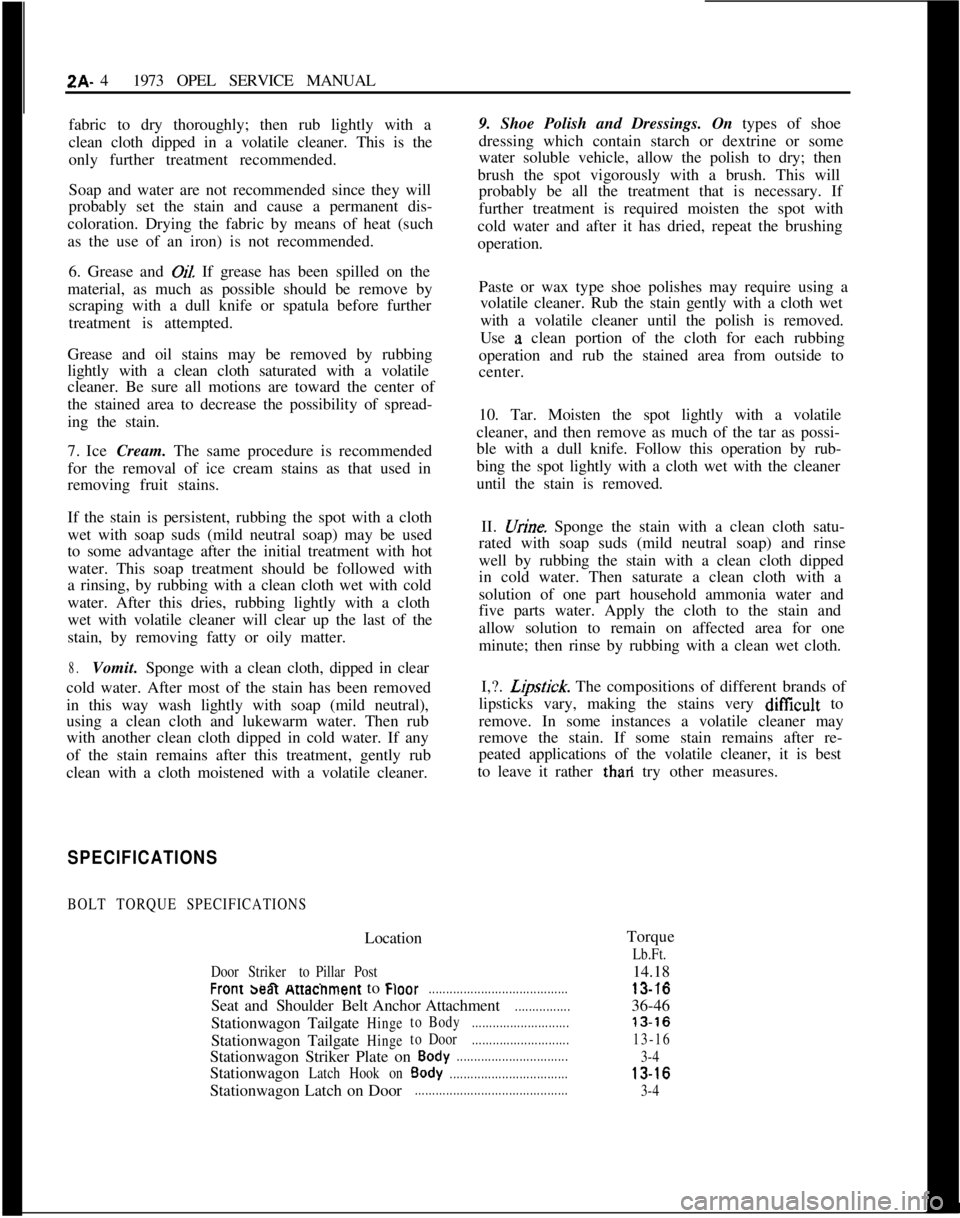
SPECIFICATIONS
BOLT TORQUE SPECIFICATIONSLocation
DoorStriker toPillarPostr .^ ...r.ZA- 41973 OPEL SERVICE MANUAL
9. Shoe Polish and Dressings. On types of shoe
dressing which contain starch or dextrine or some
water soluble vehicle, allow the polish to dry; then
brush the spot vigorously with a brush. This will
probably be all the treatment that is necessary. If
further treatment is required moisten the spot with
cold water and after it has dried, repeat the brushing
operation.
Paste or wax type shoe polishes may require using a
volatile cleaner. Rub the stain gently with a cloth wet
with a volatile cleaner until the polish is removed.
Use
;a clean portion of the cloth for each rubbing
operation and rub the stained area from outside to
center.
10. Tar. Moisten the spot lightly with a volatile
cleaner, and then remove as much of the tar as possi-
ble with a dull knife. Follow this operation by rub-
bing the spot lightly with a cloth wet with the cleaner
until the stain is removed.
II. .X&e. Sponge the stain with a clean cloth satu-
rated with soap suds (mild neutral soap) and rinse
well by rubbing the stain with a clean cloth dipped
in cold water. Then saturate a clean cloth with a
solution of one part household ammonia water and
five parts water. Apply the cloth to the stain and
allow solution to remain on affected area for one
minute; then rinse by rubbing with a clean wet cloth.
I,?.
L,ipslick. The compositions of different brands of
lipsticks vary, making the stains very
diff%cult to
remove. In some instances a volatile cleaner may
remove the stain. If some stain remains after re-
peated applications of the volatile cleaner, it is best
to leave it rather thari try other measures.
Torque
Lb.Ft.
wont saar twacnment to war........................................Seat andShoulderBelt Anchor Attachment
................StationwagonTailgate
HingetoBody............................StationwagonTailgate
HingetoDoor............................Stationwagon Striker Plate on
Body................................Stationwagon
LatchHookonBody..................................Stationwagon Latch on Door
............................................14.18
_^ _^13-1036-46
13-16
13-16
3-4
13-16
3-4
Page 132 of 625
WINDOWS AND WINDOW MOLDINGS2c-9WINDOWS AND WINDOW MOLDINGS
CONTENTS
Subject
DESCRIPTION AND OPERATION: (Not Applicable)
DIAGNOSIS: (Not Applicable)
MAINTENANCE AND ADJUSTMENTS: (Not
Applicable)
MAJOR REPAIR:
Removal and Installation
Windshield
RevealMolding. . . . . . . . . . . . . . . . . . . . . . . . . . . . . . . . . . . . . . . .Windshield
andBackWindow. . . . . . . . . . . . . . . . . . . . . . . . . . . . . . . . . .
DoorWindow. . . . . . . . . . . . . . . . . . . . . . . . . . . . . . . . . . . . . . . . . . . . . . . . . . . . . . . . . . . . . . . . . .Rear Quarter Window Molding
. . . . . . . . . . . . . . . . . . . . . . . . . . . . . . . .Rear Quarter Window
-1900 -Manta. . . . . . . . . . . . . . . . . .RearQuarterWindow
-GT. . . . . . . . . . . . . . . . . . . . . . . . . . . . . . . . . . . . . . . .
RearQuarterWindowLock. . . . . . . . . . . . . . . . . . . . . . . . . . . . . . . . . . . . . . . .SPECIFICATIONS: (Not Applicable)Page No.
2c- 9
2c-10
2c-11
2c-11
2c-12
2c-12
2c-12
MAJOR REPAIR
REMOVAL AND INSTALLATION OF WINDSHIELD3. With Tools J-2 1828 and J-2 1549, insert new reveal
REVEAL MOLDINGmolding and install escutcheon.
1. Remove reveal molding escutcheon. Starting at
one end, pull molding out of rubber channel. See
Figure
2C-2.Figure ZC-2 Removing Reveal Molding
Figure ZC-3 Pushing Windshield Out 2. Prior to installation, place molding in water and
heat up to approximately 113
- 122 degrees F.
Page 138 of 625
dOORS2D-15
3. Unhook con&cting rod out of old support and
hook into new support and door lock.
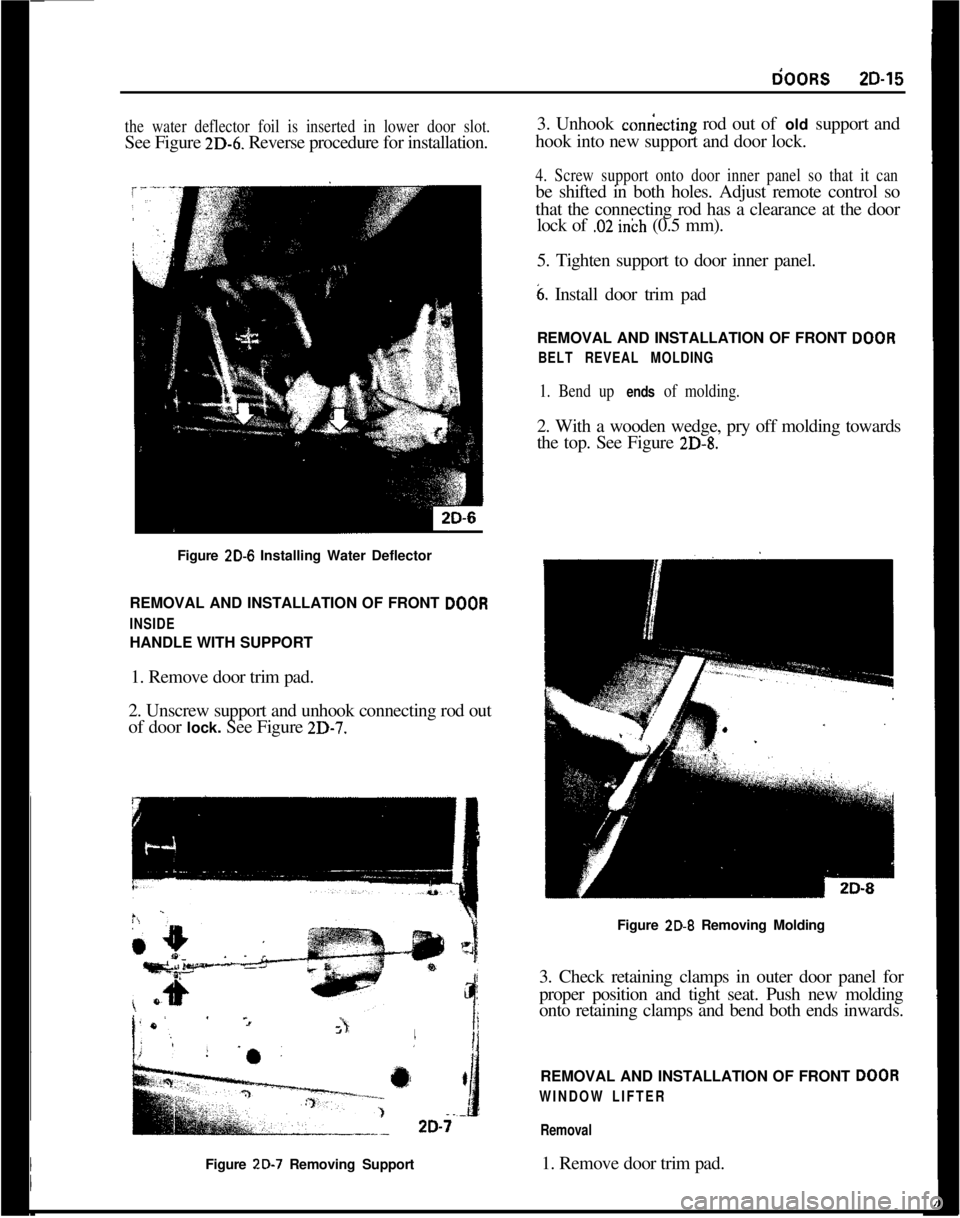
the water deflector foil is inserted in lower door slot.See Figure
2D-6. Reverse procedure for installation.2D-i-
Figure
2D-7 Removing Support
4. Screw support onto door inner panel so that it canbe shifted in both holes. Adjust remote control so
that the connecting rod has a clearance at the door
lock of
.02 inch (0.5 mm).
5. Tighten support to door inner panel.
b. Install door trim pad
REMOVAL AND INSTALLATION OF FRONT
DOOR
BELT REVEAL MOLDING
1. Bend up ends of molding.2. With a wooden wedge, pry off molding towards
the top. See Figure
2D-8.Figure
2D-6 Installing Water Deflector
REMOVAL AND INSTALLATION OF FRONT
DOOR
INSIDEHANDLE WITH SUPPORT
1. Remove door trim pad.
2. Unscrew support and unhook connecting rod out
of door lock. See Figure
2D-7.Figure
2D-6 Removing Molding
3. Check retaining clamps in outer door panel for
proper position and tight seat. Push new molding
onto retaining clamps and bend both ends inwards.
REMOVAL AND INSTALLATION OF FRONT
DOOR
WINDOW LIFTER
Removal1. Remove door trim pad.
Page 147 of 625
2F-241973 OPEL SERVICE MANUAL
ROOF AND SUN ROOF
CONTENTS
,.,Subject
DESC,RIF?TION AND OPERATION: (Not Applicable)
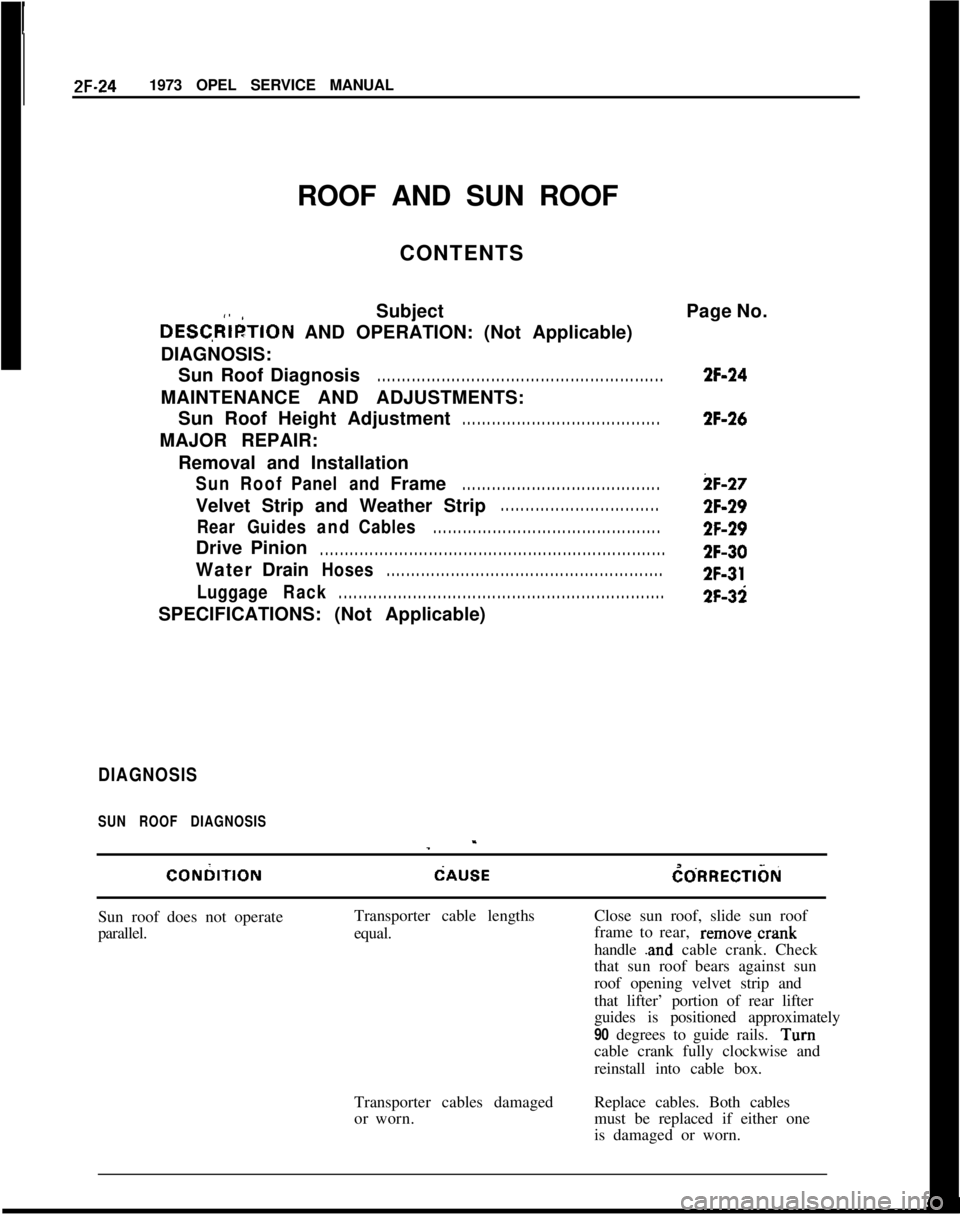
DIAGNOSIS: Sun Roof Diagnosis
. . . . . . . . . . . . . . . . . . . . . . . . . . . . . . . . . . . . \
. . . . . . . . . . . . . . . . . . . . . .
MAINTENANCE AND ADJUSTMENTS:Sun Roof Height Adjustment
. . . . . . . . . . . . . . . . . . . . . . . . . . . . . . . . . . . . \
. . . .
MAJOR REPAIR:
Removal and Installation
Sun Roof Panel andFrame. . . . . . . . . . . . . . . . . . . . . . . . . . . . . . . . . . . . \
. . . .
Velvet Strip and Weather Strip. . . . . . . . . . . . . . . . . . . . . . . . . . . . . . . .
RearGuides andCables. . . . . . . . . . . . . . . . . . . . . . . . . . . . . . . . . . . . \
. . . . . . . . . .
Drive Pinion. . . . . . . . . . . . . . . . . . . . . . . . . . . . . . . . . . . . \
. . . . . . . . . . . . . . . . . . . . . . . . . . . . . . . . . .
Water DrainHoses. . . . . . . . . . . . . . . . . . . . . . . . . . . . . . . . . . . . \
. . . . . . . . . . . . . . . . . . . .
Luggage Rack. . . . . . . . . . . . . . . . . . . . . . . . . . . . . . . . . . . . \
. . . . . . . . . . . . . . . . . . . . . . . . . . . . . .
SPECIFICATIONS: (Not Applicable) Page No.
2F-24
2F-26
iF-27
2F-29
2F-29
2F-30
2F-31
2F-3i
DIAGNOSIS
SUN ROOF DIAGNOSIS
_ -
CONhTlONPAUSEI~C~RRECTI~X~
Sun roof does not operate
Transporter cable lengths
parallel. equal.Close sun roof, slide sun roof
frame to rear, remove.crank
handle
and cable crank. Check
that sun roof bears against sun
roof opening velvet strip and
that lifter’ portion of rear lifter
guides is positioned approximately
90 degrees to guide rails.
Turn
cable crank fully clockwise and
reinstall into cable box.
Transporter cables damaged
or worn. Replace cables. Both cables
must be replaced if either one
is damaged or worn.
Page 148 of 625
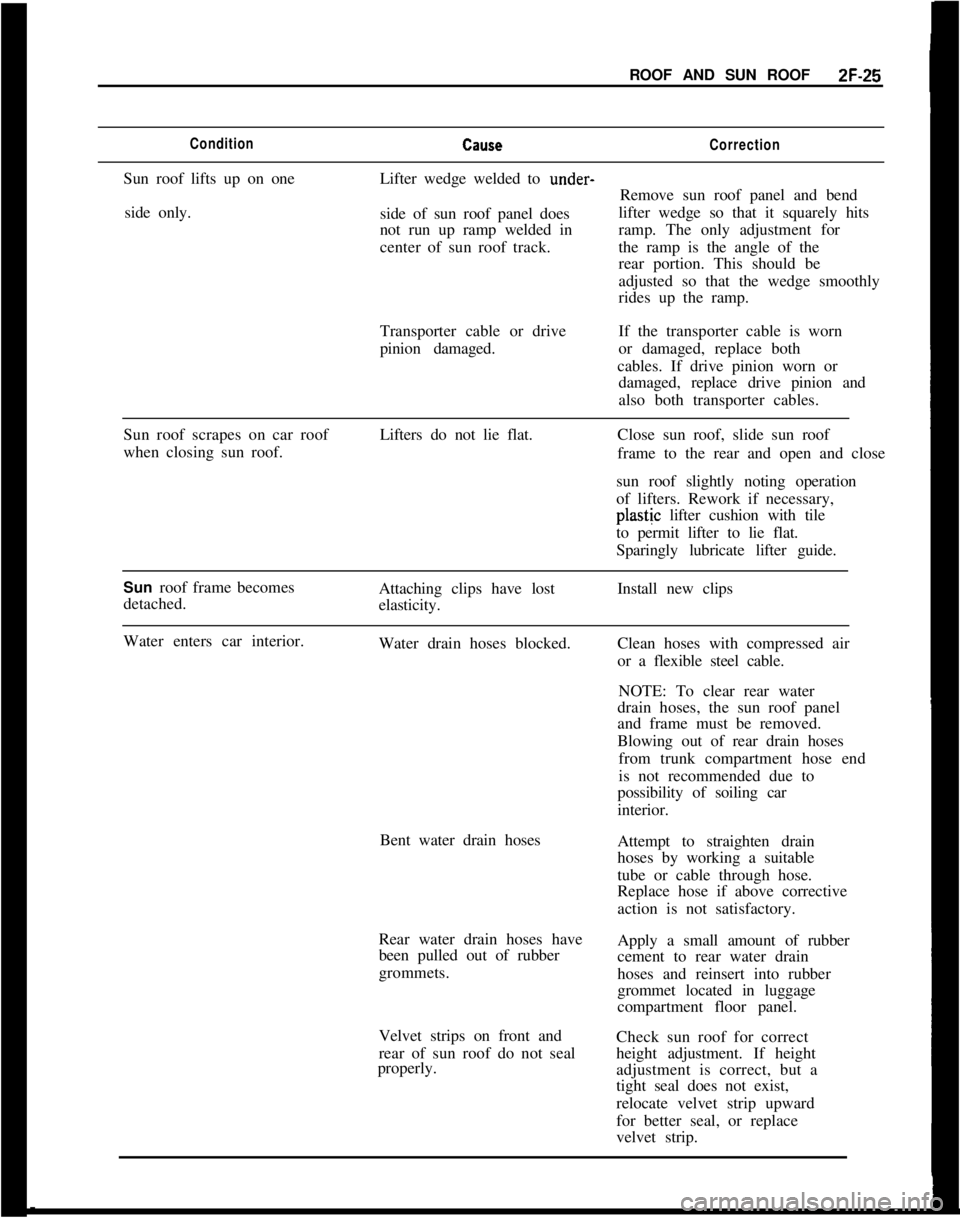
ROOF AND SUN ROOFZF-25ConditionCallseCorrectionSun roof lifts up on one
side only.Lifter wedge welded to under-
Remove sun roof panel and bend
side of sun roof panel doeslifter wedge so that it squarely hits
not run up ramp welded inramp. The only adjustment for
center of sun roof track.the ramp is the angle of the
rear portion. This should be
adjusted so that the wedge smoothly
rides up the ramp.
Transporter cable or drive
pinion damaged.If the transporter cable is worn
or damaged, replace both
cables. If drive pinion worn or
damaged, replace drive pinion and
also both transporter cables.
Sun roof scrapes on car roof
when closing sun roof.Lifters do not lie flat.Close sun roof, slide sun roof
frame to the rear and open and close
sun roof slightly noting operation
of lifters. Rework if necessary,plastjc lifter cushion with tile
to permit lifter to lie flat.
Sparingly lubricate lifter guide.
Sun roof frame becomes
detached.Attaching clips have lost
elasticity.Install new clips
Water enters car interior.
Water drain hoses blocked.
Bent water drain hoses
Rear water drain hoses have
been pulled out of rubber
grommets.
Velvet strips on front and
rear of sun roof do not seal
properly.Clean hoses with compressed air
or a flexible steel cable.
NOTE: To clear rear water
drain hoses, the sun roof panel
and frame must be removed.
Blowing out of rear drain hoses
from trunk compartment hose end
is not recommended due to
possibility of soiling car
interior.
Attempt to straighten drain
hoses by working a suitable
tube or cable through hose.
Replace hose if above corrective
action is not satisfactory.
Apply a small amount of rubber
cement to rear water drain
hoses and reinsert into rubber
grommet located in luggage
compartment floor panel.
Check sun roof for correct
height adjustment. If height
adjustment is correct, but a
tight seal does not exist,
relocate velvet strip upward
for better seal, or replace
velvet strip.
Page 154 of 625
2. Press off snap ring holding drive pinion in place
and remove drive pinion (see Figure 2F-10).
Installation1. Install drive pinion reverse of removal.
NOTE: If drive pinion is to be replaced, also replace
both cables to insure smooth operation of sun roof.
2. Rotate cable crank to its limit in a clockwise direc-
tion and install reverse of removal procedure.ROOF AND SUN ROOF2F-31
REMOVAL AND INSTALLATION OF FRONT AND
REAR WATER DRAINAGE HOSES
Removal of Front Water Drainage Hose
1, Remove sun visor from side of car which will have
drainage pipe taken out.
2. Partially detach pinchweld finishing strip from
door opening involved.
II2F-12L
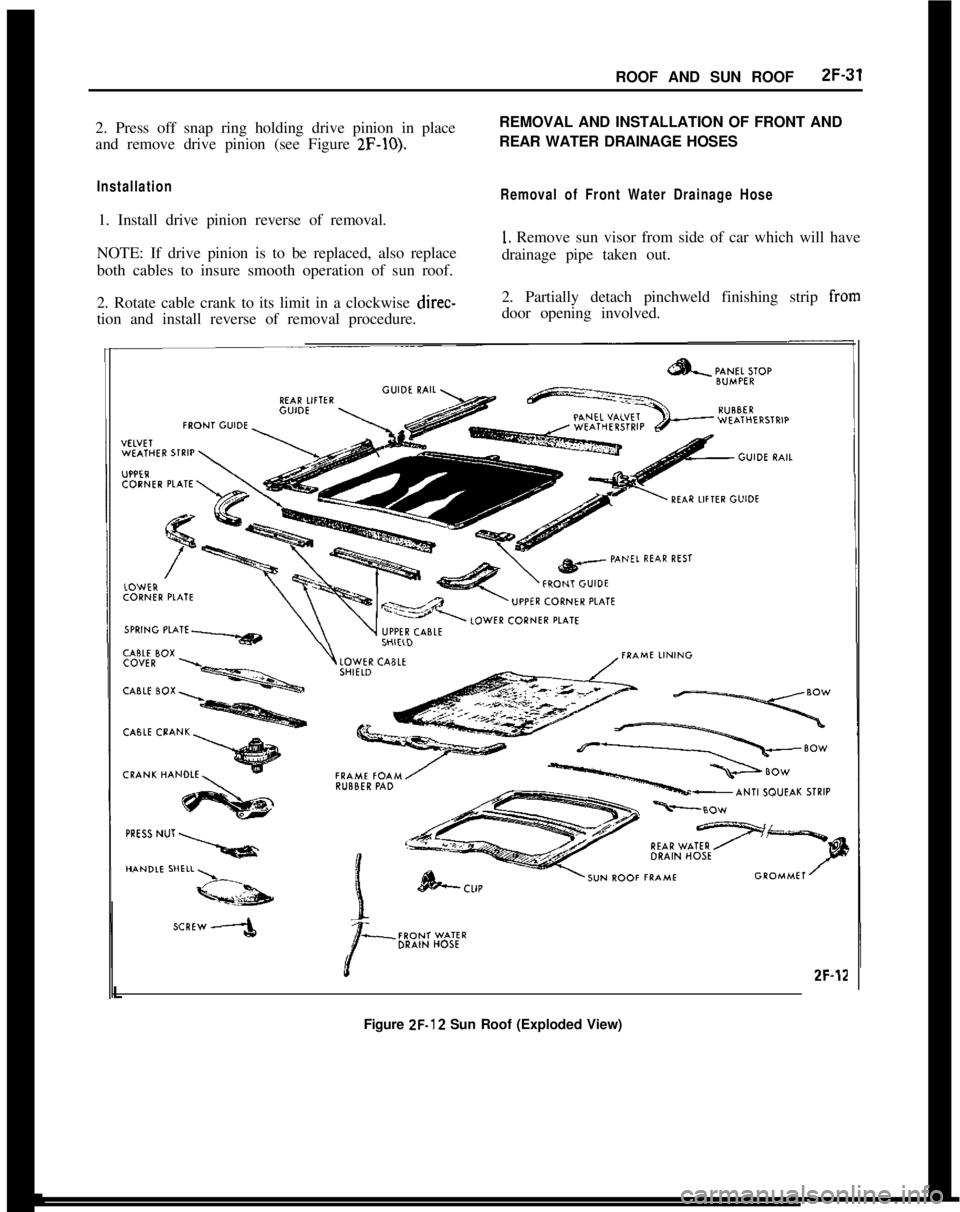
Figure 2F-12 Sun Roof (Exploded View)
Page 155 of 625
2F-321973 OPEL SERVICE MANUAL
3. Carefully detach a portion of headlining around
window corner post involved.
4. Detach water drain hose from sun roof hose iit-
ting.
5. Remove cowl side kickpads.
6. Pull out from upper end front water drain hose.
Installation of Front Water Drain Hose
1. Insert from above water drain hose (wider end
upward) into door hinge pillar.
NOTE: Do not mistake front and rear water hoses.
The front hose is thinner than the rear hose and is
wider at the end which connects to hose fitting on
sun roof. The rear hose is uniform over its entire
length.
2. Work water drain hose downward through lower
half of door hinge pillar and be sure hose terminates
behind door sill flange at bottom of frbnt fender.
3. Cement upper portion of water drain hose to sun
roof hose fitting.
4. Cement detached portions of headlining into place
by use of rubber cement or nitrile vinyl trim adhesive
(3M Vinyl Trim Adhesive, Permalastic Vinyl Trim
Adhesive or equivalent).
5. Complete installation reverse of removal proce-
dures.
Removal of Rear Water Drain Hose1. Remove rear seat and rear seat back.2. Pry out plastic fasteners securing cardboard parcel
shelf in position and remove shelf.
3. Remove rear quarter trim pad.
4. Detach headlining only as required from area
around rear window pillar.
5. Pull out rear water drain hose.
Installation of Rear Water Drain Hose1. Install rear water drain hose in original position.
Insert hose from above and work downward. Ce-
ment both ends of hose in place.
2. Secure water drain hose in place along wheel-
house.3. Complete installation reverse of removal proce-
dures.
REMOVAL AND INSTALLATION
OF LUGGAGE
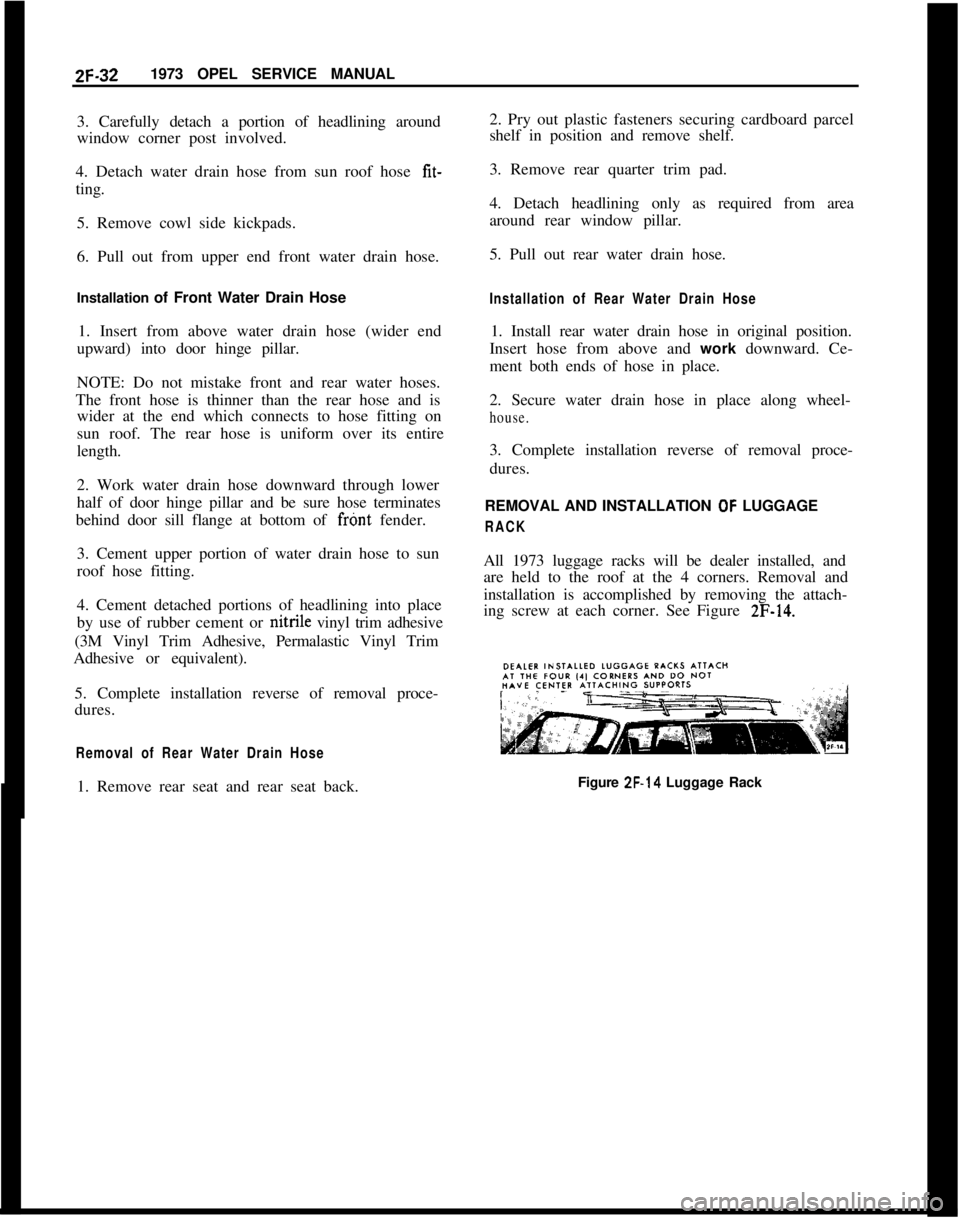
RACKAll 1973 luggage racks will be dealer installed, and
are held to the roof at the 4 corners. Removal and
installation is accomplished by removing the attach-
ing screw at each corner. See Figure
2F-14.Figure ZF-14 Luggage Rack
Page 236 of 625
PROPELLER SHAFT AND CENTRAL JOINT4A- 5
1. Check condition of support cushions. If new cush-
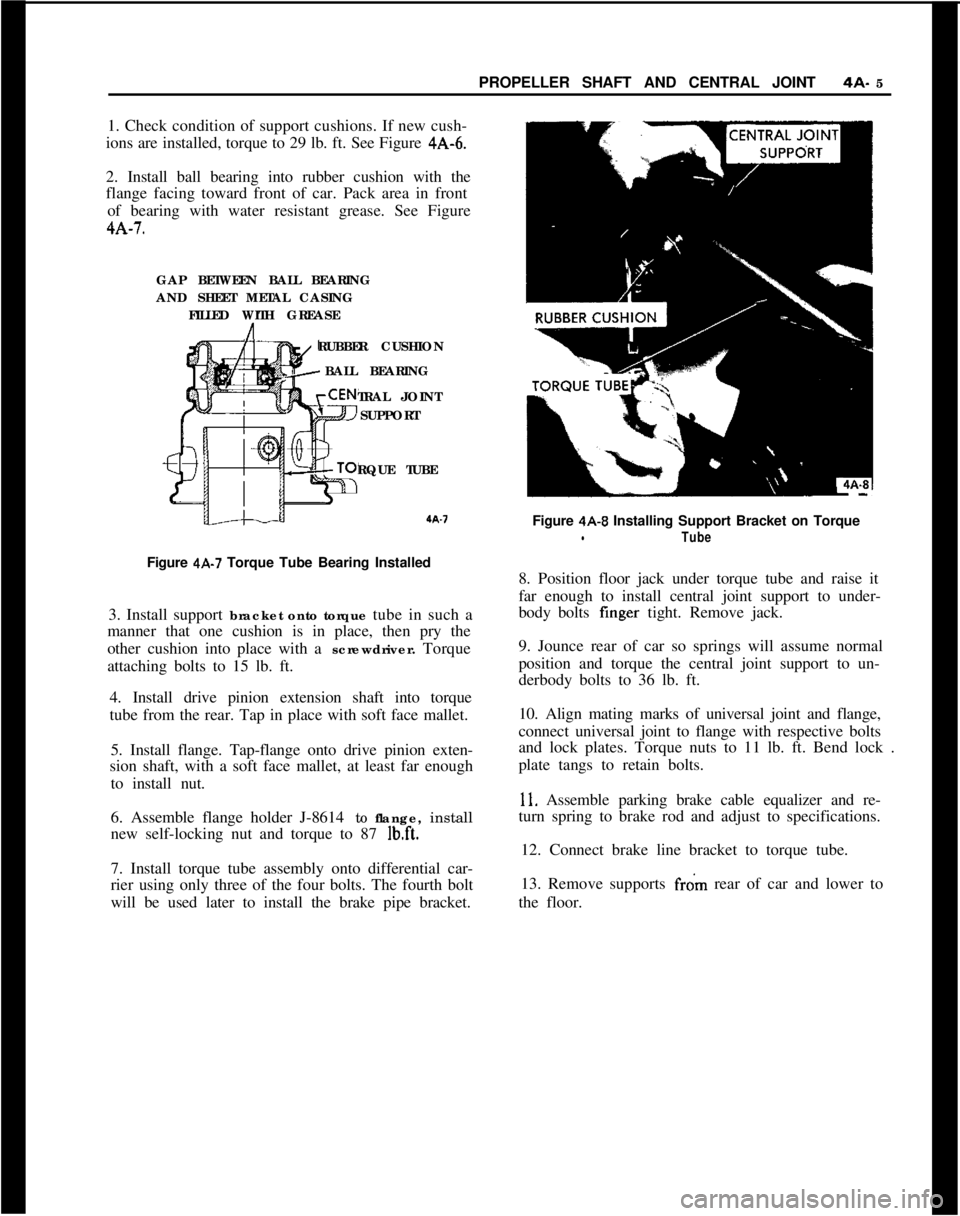
ions are installed, torque to 29 lb. ft. See Figure 4A-6.
2. Install ball bearing into rubber cushion with the
flange facing toward front of car. Pack area in front
of bearing with water resistant grease. See Figure4A-7.
GAP BETWEEN BALL BEARING
AND SHEET METAL CASING
FILLED WITH GREASE
RUBBER CUSHION
BALL BEARING
TRAL JOINT
SUPPORT
RQUE TUBEa.7
Figure 4A-7 Torque Tube Bearing Installed
3. Install support bracket onto torque tube in such a
manner that one cushion is in place, then pry the
other cushion into place with a screwdriver. Torque
attaching bolts to 15 lb. ft.
4. Install drive pinion extension shaft into torque
tube from the rear. Tap in place with soft face mallet.
5. Install flange. Tap-flange onto drive pinion exten-
sion shaft, with a soft face mallet, at least far enough
to install nut.
6. Assemble flange holder J-8614 to flange, install
new self-locking nut and torque to 87
lb.ft.7. Install torque tube assembly onto differential car-
rier using only three of the four bolts. The fourth bolt
will be used later to install the brake pipe bracket.Figure
4A-8 Installing Support Bracket on TorquelTube8. Position floor jack under torque tube and raise it
far enough to install central joint support to under-
body bolts finger tight. Remove jack.
9. Jounce rear of car so springs will assume normal
position and torque the central joint support to un-
derbody bolts to 36 lb. ft.
10. Align mating marks of universal joint and flange,
connect universal joint to flange with respective bolts
and lock plates. Torque nuts to 11 lb. ft. Bend lock .
plate tangs to retain bolts.
11. Assemble parking brake cable equalizer and re-
turn spring to brake rod and adjust to specifications.
12. Connect brake line bracket to torque tube.
13. Remove supports
f&n rear of car and lower to
the floor.