carburetor OPEL MANTA 1973 Owner's Manual
[x] Cancel search | Manufacturer: OPEL, Model Year: 1973, Model line: MANTA, Model: OPEL MANTA 1973Pages: 625, PDF Size: 17.22 MB
Page 347 of 625
6E- 561973 OPEL SERVICE MANUAL
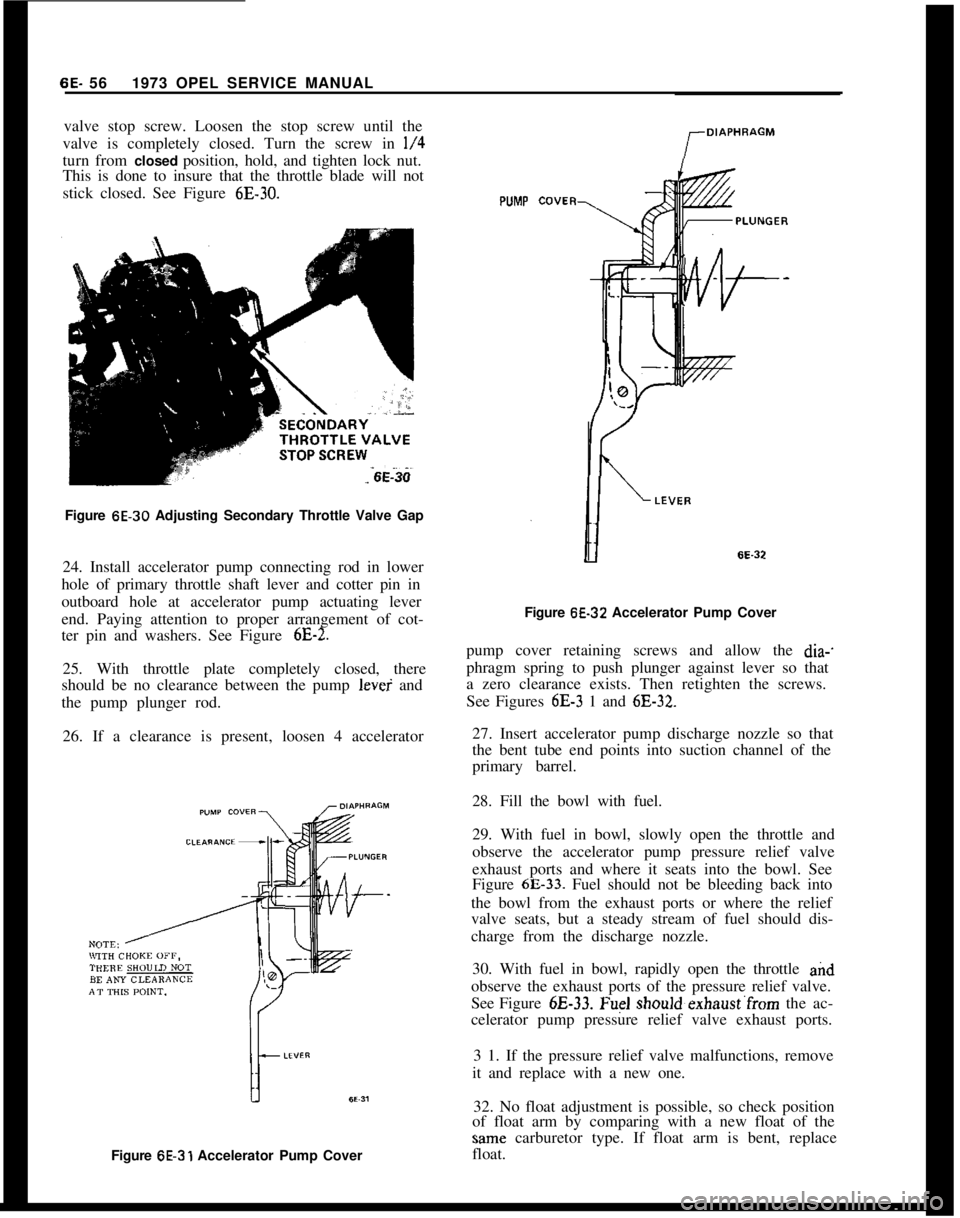
valve stop screw. Loosen the stop screw until the
valve is completely closed. Turn the screw in l/4turn from closed position, hold, and tighten lock nut.
This is done to insure that the throttle blade will not
stick closed. See Figure
6E-30.PUMPFigure 6E-30 Adjusting Secondary Throttle Valve Gap
24. Install accelerator pump connecting rod in lower
hole of primary throttle shaft lever and cotter pin in
outboard hole at accelerator pump actuating lever
end. Paying attention to proper arrangement of cot-
ter pin and washers. See Figure
6E-2.25. With throttle plate completely closed, there
should be no clearance between the pump levei and
the pump plunger rod.
26. If a clearance is present, loosen 4 accelerator
Figure
6E-31 Accelerator Pump CoverFigure 6C32 Accelerator Pump Cover
pump cover retaining screws and allow the
dia-’phragm spring to push plunger against lever so that
a zero clearance exists. Then retighten the screws.
See Figures
6E-3 1 and 6E-32.27. Insert accelerator pump discharge nozzle so that
the bent tube end points into suction channel of the
primary barrel.
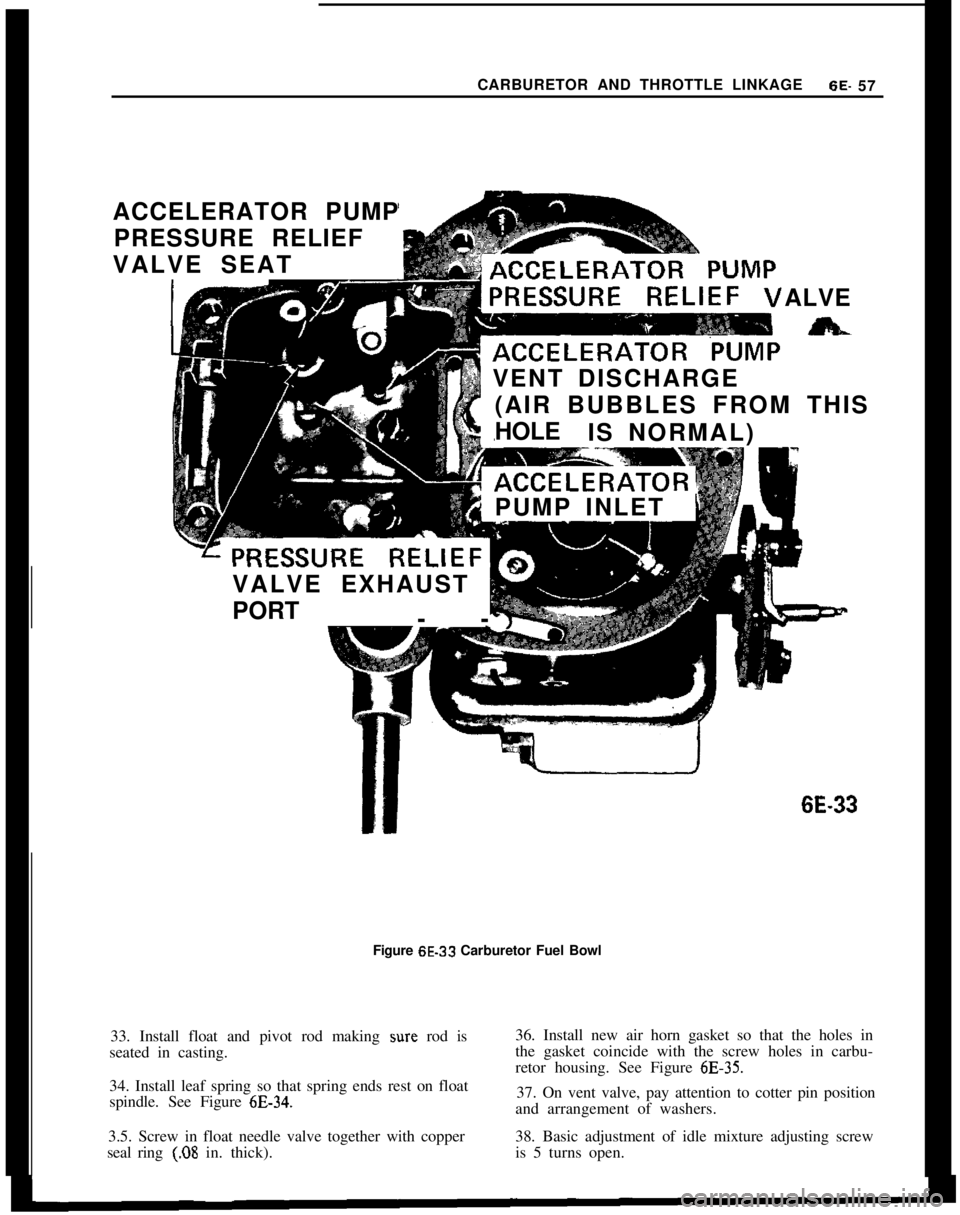
28. Fill the bowl with fuel.
29. With fuel in bowl, slowly open the throttle and
observe the accelerator pump pressure relief valve
exhaust ports and where it seats into the bowl. See
Figure
6E-33. Fuel should not be bleeding back into
the bowl from the exhaust ports or where the relief
valve seats, but a steady stream of fuel should dis-
charge from the discharge nozzle.
30. With fuel in bowl, rapidly open the throttle atid
observe the exhaust ports of the pressure relief valve.
See Figure
6E-33. Fuel should~exhaust’from the ac-
celerator pump pressure relief valve exhaust ports.
3 1. If the pressure relief valve malfunctions, remove
it and replace with a new one.
32. No float adjustment is possible, so check position
of float arm by comparing with a new float of thesame carburetor type. If float arm is bent, replace
float.
Page 348 of 625
CARBURETOR AND THROTTLE LINKAGE6E- 57
ACCELERATOR PUMP
PRESSURE RELIEF
VALVE SEAT
ALVE
VENT DISCHARGE
(AIR BUBBLES FROM THIS
HOLE
IS NORMAL)
PUMP INLET
VALVE EXHAUST
PORT
--6E-33
Figure 6E-33 Carburetor Fuel Bowl
33. Install float and pivot rod making sure rod is
seated in casting.36. Install new air horn gasket so that the holes in
the gasket coincide with the screw holes in carbu-
retor housing. See Figure
6E-35.34. Install leaf spring so that spring ends rest on float
spindle. See Figure
6E-34.37. On vent valve, pay attention to cotter pin position
and arrangement of washers.
3.5. Screw in float needle valve together with copper38. Basic adjustment of idle mixture adjusting screw
seal ring
(.08 in. thick).is 5 turns open.
Page 349 of 625

6E- 581973 OPEL SERVICE MANUAL
Figure 6E-34 Leaf Spring Installed
1 6E-36
Figure 6E-36 Checking Vent Valve Adjustment
39. Check compression of vent valve lower spring. It
should be compressed
l/4 inch with throttle valve
completely closed. See Figure
6E-36.40. Correct by bending valve lever.
Figure
6E-35 Installing Cover Gasket
SPECIFICATIONS
GENERAL SPECIFICATIONSCompression Ratio
........................................................................................................7.6 to 1
Fuel Required
................................(...........................................................................Low Lead
Fuel Tank Capacity (Gallons)
Opel1900andManta..
....................................................................................................11.9
GT...................................................................................................................................13.2Fuel Gauge Type
........................................................................................................Electrical
FuelPumpType
......................................................................................................Mechanical
FuelPumpDrive
..................................................................................EccentriconCamshaft
Fuel Pump Pressure at 1950 RPM
......................................................................3.1 to 3.7 psi
FuelFilter
............................................................................................................In-LineFilter
CarburetorMakeandType................................................I-Solex2BBLAutomaticChoke
AirCleanerElementType
..........................................................................FiberMesh-Paper
Page 350 of 625
CARBURETOR AND THROTTLE LINKAGE6E- 59
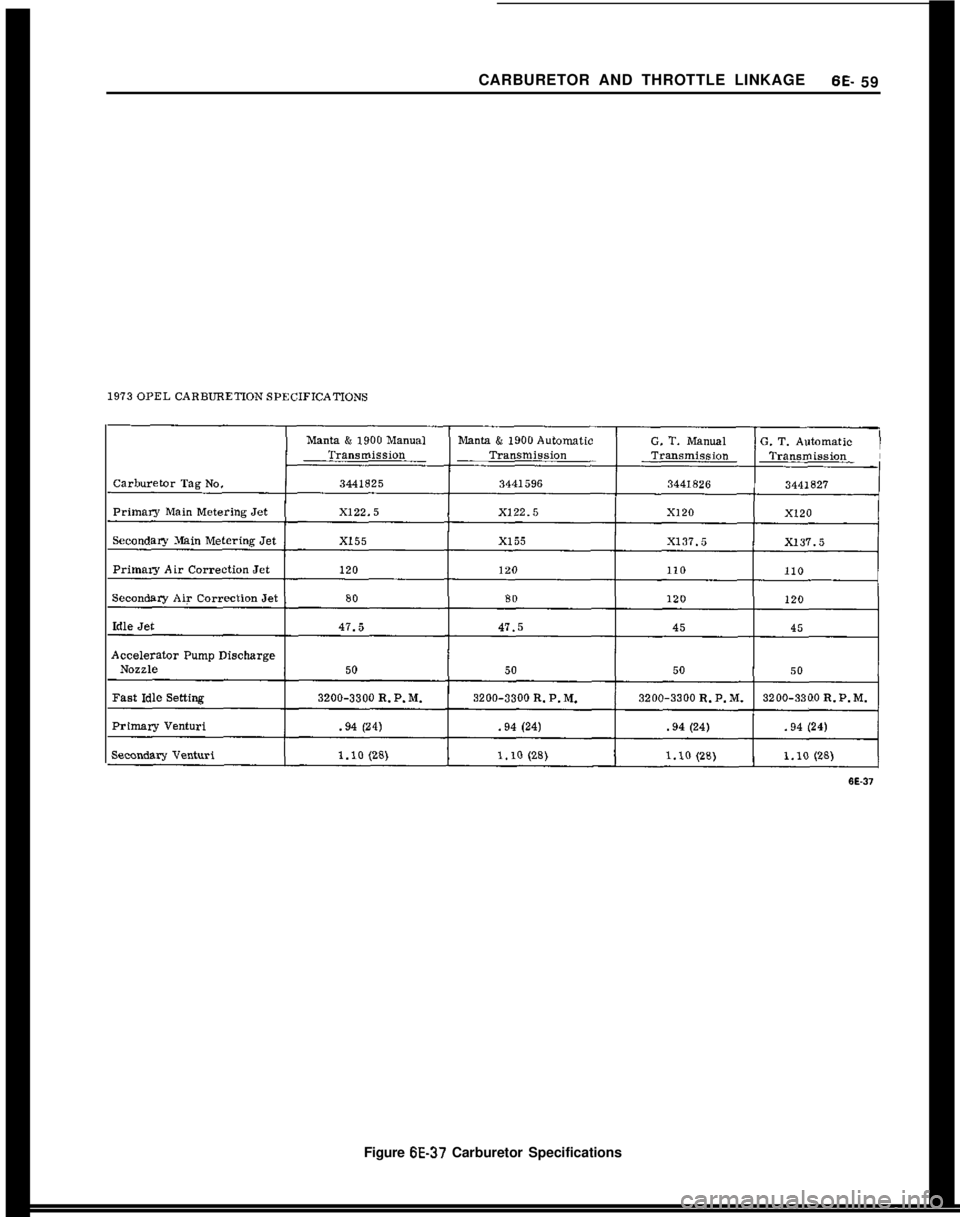
Figure 6E-37 Carburetor Specifications
Page 351 of 625
6F- 601973 OPEL SERVICE MANUAL
EMISSION CONTROL SYSTEMS
ALL MODELS
CONTENTS
Subject
DESCRIPTION AND OPERATION:
DescriptionandOperationofO.E.C.S.. . . . . . . . . . . . . . . . . . . . . . . .Exhaust
GasRecirculationSystem. . . . . . . . . . . . . . . . . . . . . . . . . . . . . .DIAGNOSIS:
Testing Therm0 Air Cleaner Operation
. . . . . . . . . . . . . . . . . . . . . .Exhaust
GasRecirculationSystem. . . . . . . . . . . . . . . . . . . . . . . . . . . . . .MAINTENANCE AND ADJUSTMENTS:
Exhaust GAS Recirculation System
. . . . . . . . . . . . . . . . . . . . . . . . . . . .MAJOR REPAIR:
Removal and Replacement of O.E.C.S. Units
. . . . . . . . . .SPECIFICATIONS:
Opel Emission Control System Specifications
. . . . . . . .Page No.
6F-60
6F-62
6F-62
6F-636F-636F-636F-64
DESCRIPTION AND OPERATION
OPEL EMISSION CONTROL SYSTEM (O.E.C.S.)All 1973 cars must be capable of passing certain tests
which measure the quantity of unburned impurities
in the exhaust system. Federal law places a limit on
the hydrocarbon and carbon monoxide emissions
from the exhaust system. The purpose of this law is
to keep the atmosphere cleaner, particularly in popu-
lous areas where these impurities add to the smog
problem. Basically, excessive exhaust emissions are
caused by incomplete combustion of the air-fuel mix-
ture in the cylinders.
The basic components of the OECS on the 1.9 liter
engines are (1) leaned out carburetion, (2) heated air
(except GT), and (3) tuned spark timing.
(1) The carburetor idle system is leaned out and
special features are incorporated into the carburetors
to make possible additional idle mixture adjustments
over and above those manufactured into the carbu-
retors.
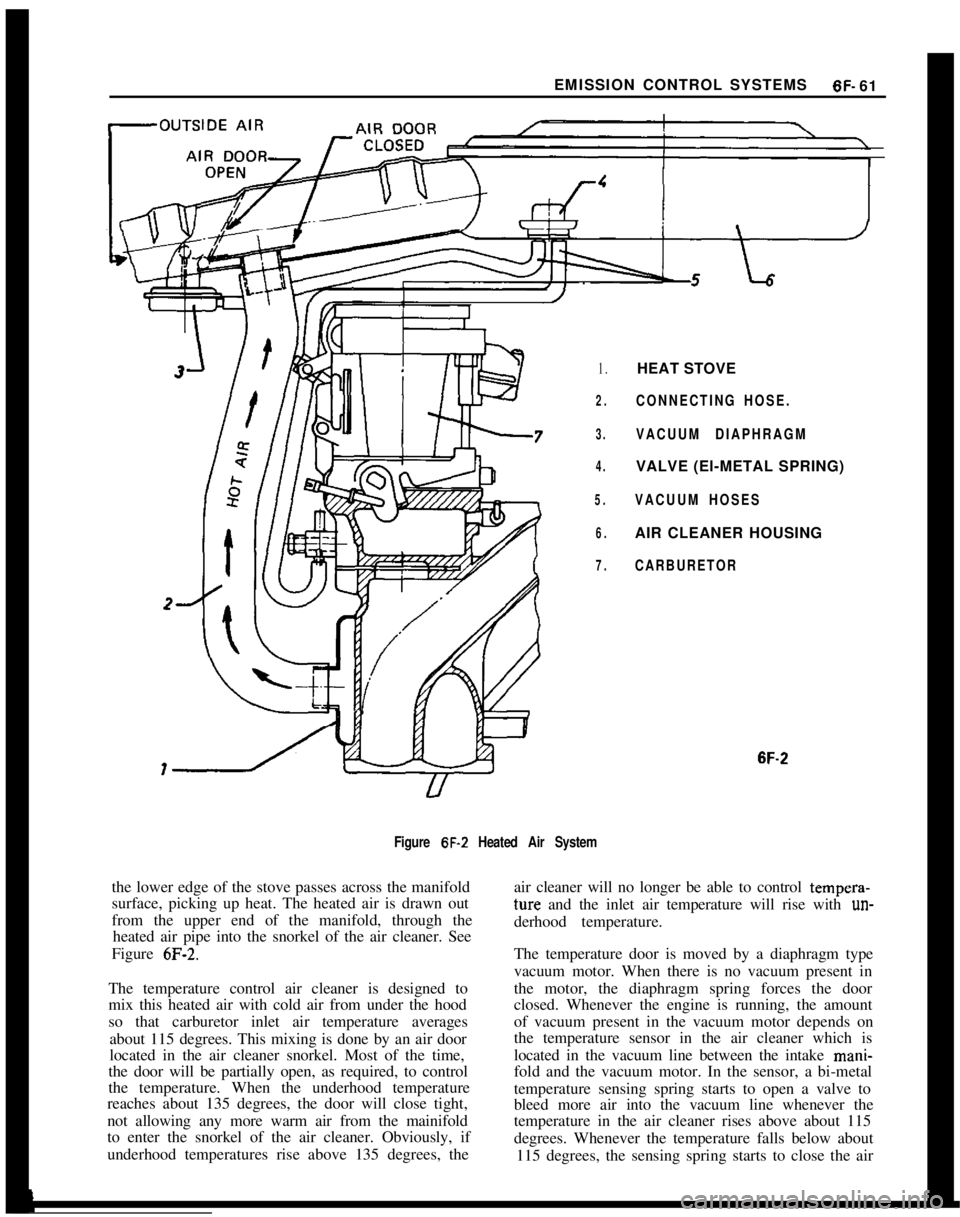
(2) The heated air package consists of a heat stove,
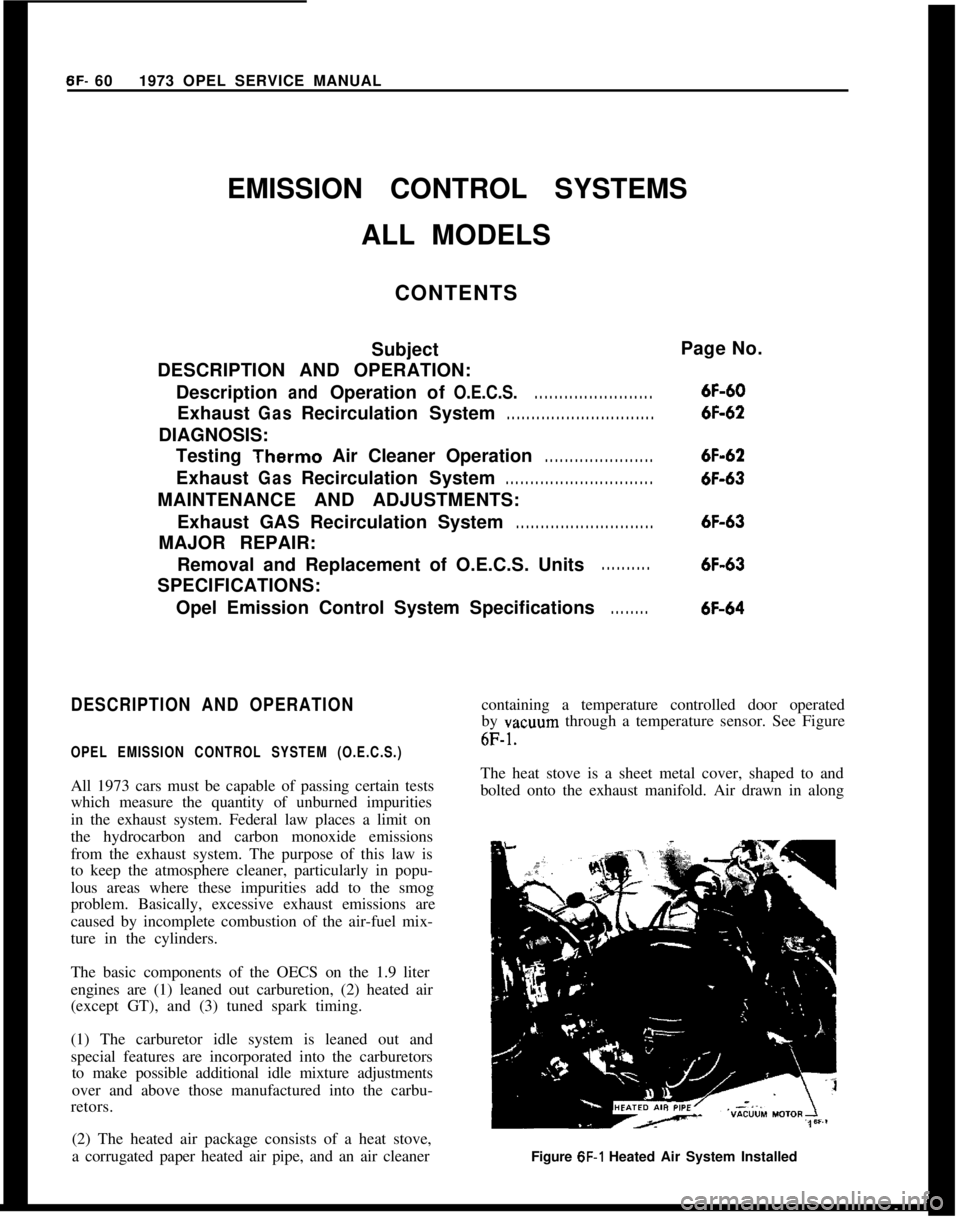
a corrugated paper heated air pipe, and an air cleanercontaining a temperature controlled door operated
by vacuum through a temperature sensor. See Figure6F-1.The heat stove is a sheet metal cover, shaped to and
bolted onto the exhaust manifold. Air drawn in along
Figure
6F-1 Heated Air System Installed
Page 352 of 625
EMISSION CONTROL SYSTEMS6F- 61I
1.HEAT STOVE
2.CONNECTING HOSE.
3.VACUUM DIAPHRAGM
4.VALVE (El-METAL SPRING)
5.VACUUM HOSES
6.AIR CLEANER HOUSING
7.CARBURETOR
BF-2
Figure 6F-2 Heated Air Systemthe lower edge of the stove passes across the manifold
surface, picking up heat. The heated air is drawn out
from the upper end of the manifold, through the
heated air pipe into the snorkel of the air cleaner. See
Figure
6F-2.The temperature control air cleaner is designed to
mix this heated air with cold air from under the hood
so that carburetor inlet air temperature averages
about 115 degrees. This mixing is done by an air door
located in the air cleaner snorkel. Most of the time,
the door will be partially open, as required, to control
the temperature. When the underhood temperature
reaches about 135 degrees, the door will close tight,
not allowing any more warm air from the mainifold
to enter the snorkel of the air cleaner. Obviously, if
underhood temperatures rise above 135 degrees, theair cleaner will no longer be able to control tempera-ture and the inlet air temperature will rise with
un-derhood temperature.
The temperature door is moved by a diaphragm type
vacuum motor. When there is no vacuum present in
the motor, the diaphragm spring forces the door
closed. Whenever the engine is running, the amount
of vacuum present in the vacuum motor depends on
the temperature sensor in the air cleaner which is
located in the vacuum line between the intake mani-
fold and the vacuum motor. In the sensor, a bi-metal
temperature sensing spring starts to open a valve to
bleed more air into the vacuum line whenever the
temperature in the air cleaner rises above about 115
degrees. Whenever the temperature falls below about
115 degrees, the sensing spring starts to close the air
Page 353 of 625
6F. 62 1973 OPEL SERVICE MANUAL
bleed into the vacuum line, allowing more manifold
vacuum to reach the vacuum motor. Whenever there
is nine inches or more of vacuum in the vacuum
motor, the diaphragm spring is compressed, the door
is opened.
When the engine is not running, the diaphragm
spring will always hold the door closed. However,
when the engine is running, the position of the door
depends on the air temperature in the air cleaner.
When starting a cold engine (air cleaner temperature
under 85 degrees), the air door will open immedi-
ately. This is because the air bleed valve in the sensor
is closed so that full manifold vacuum, is applied in
the vacuum motor. As soon as the air cleaner starts
receiving hot air from the heat stove, the sensor will
cause the air door to close partially, mixing cold air
with the hot air as necessary to regulate air cleaner
temperature within 20 degrees of the ideal 115 de-
grees air inlet temperature.
If underhood air temperature rises to 135 degrees,
the air bleed valve in the sensor will be wide open so
that vacuum to the vacuum motor approaches zero.
The diaphragm spring in the vacuum motor will hold
the air door closed tightly. If underhood temperature
rises above 135 degrees, carburetor inlet air tempera-
ture will also rise above 135 degrees.
While air cleaner temperature is being regulated, ac-
celerating the engine hard will cause the vacuum
level in the intake manifold and in the vacuum motor
to drop. Whenever vacuum drops below 5 inches, the
diaphragm spring will close the air
door in order to
get the
maxumum outside air flow required for max-
imum acceleration.
The carburetor is set by the manufacturer for
800-
850 RPM (automatic transmission) or 850-900 RPM
(manual transmission) and 1.5 to 2.5 percent CO.
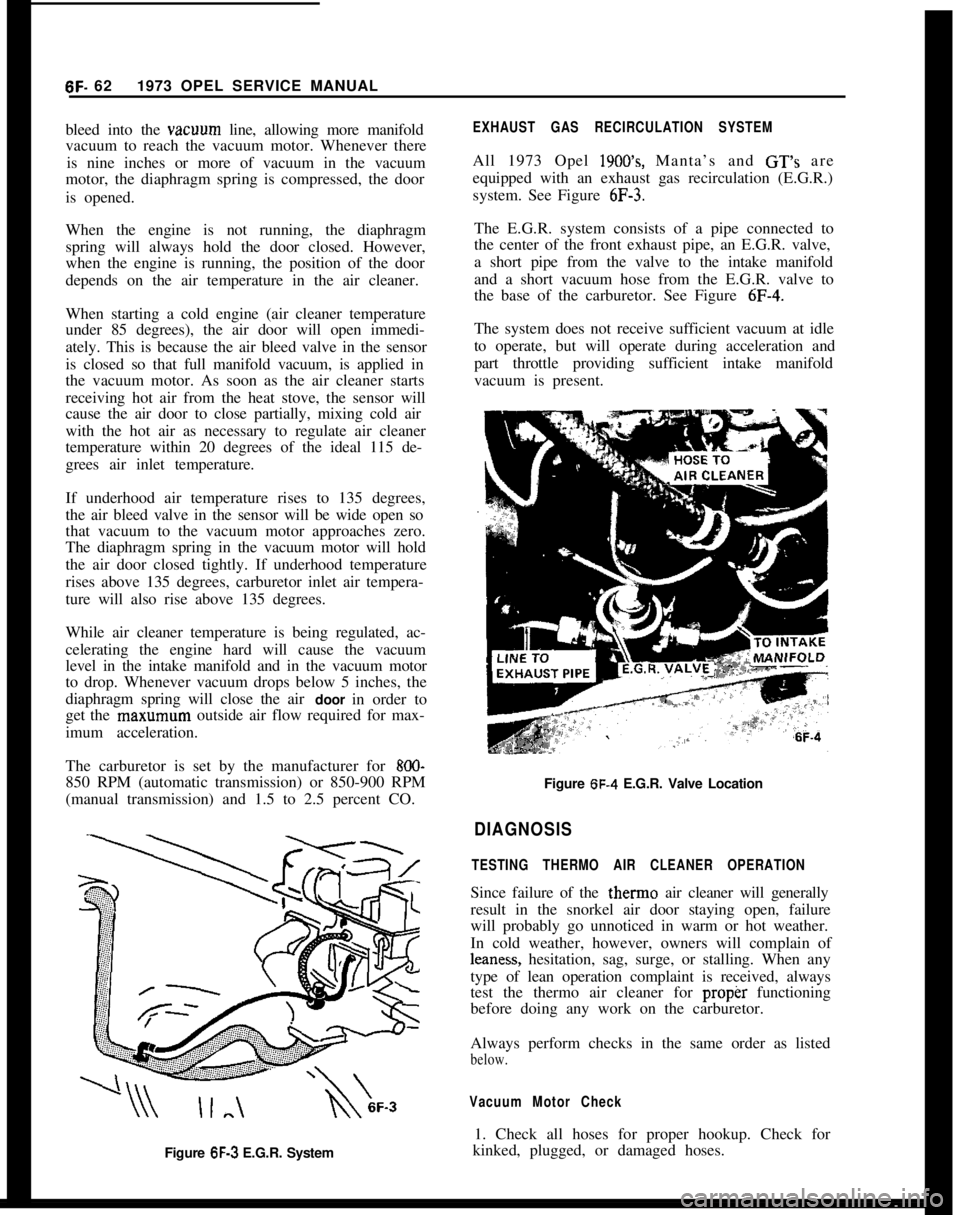
Figure 6F-3 E.G.R. System
EXHAUST GAS RECIRCULATION SYSTEM
All 1973 Opel 1900’s, Manta’s and GT’s are
equipped with an exhaust gas recirculation (E.G.R.)
system. See Figure
6F-3.
The E.G.R. system consists of a pipe connected to
the center of the front exhaust pipe, an E.G.R. valve,
a short pipe from the valve to the intake manifold
and a short vacuum hose from the E.G.R. valve to
the base of the carburetor. See Figure
6F-4.
The system does not receive sufficient vacuum at idle
to operate, but will operate during acceleration and
part throttle providing sufficient intake manifold
vacuum is present.
Figure 6F-4 E.G.R. Valve Location
DIAGNOSIS
TESTING THERMO AIR CLEANER OPERATION
Since failure of the therm0 air cleaner will generally
result in the snorkel air door staying open, failure
will probably go unnoticed in warm or hot weather.
In cold weather, however, owners will complain of
leaness, hesitation, sag, surge, or stalling. When any
type of lean operation complaint is received, always
test the thermo air cleaner for
proper functioning
before doing any work on the carburetor.
Always perform checks in the same order as listed
below.
Vacuum Motor Check
1. Check all hoses for proper hookup. Check for
kinked, plugged, or damaged hoses.
Page 355 of 625
6F. 641973 OPEL SERVICE MANUAL
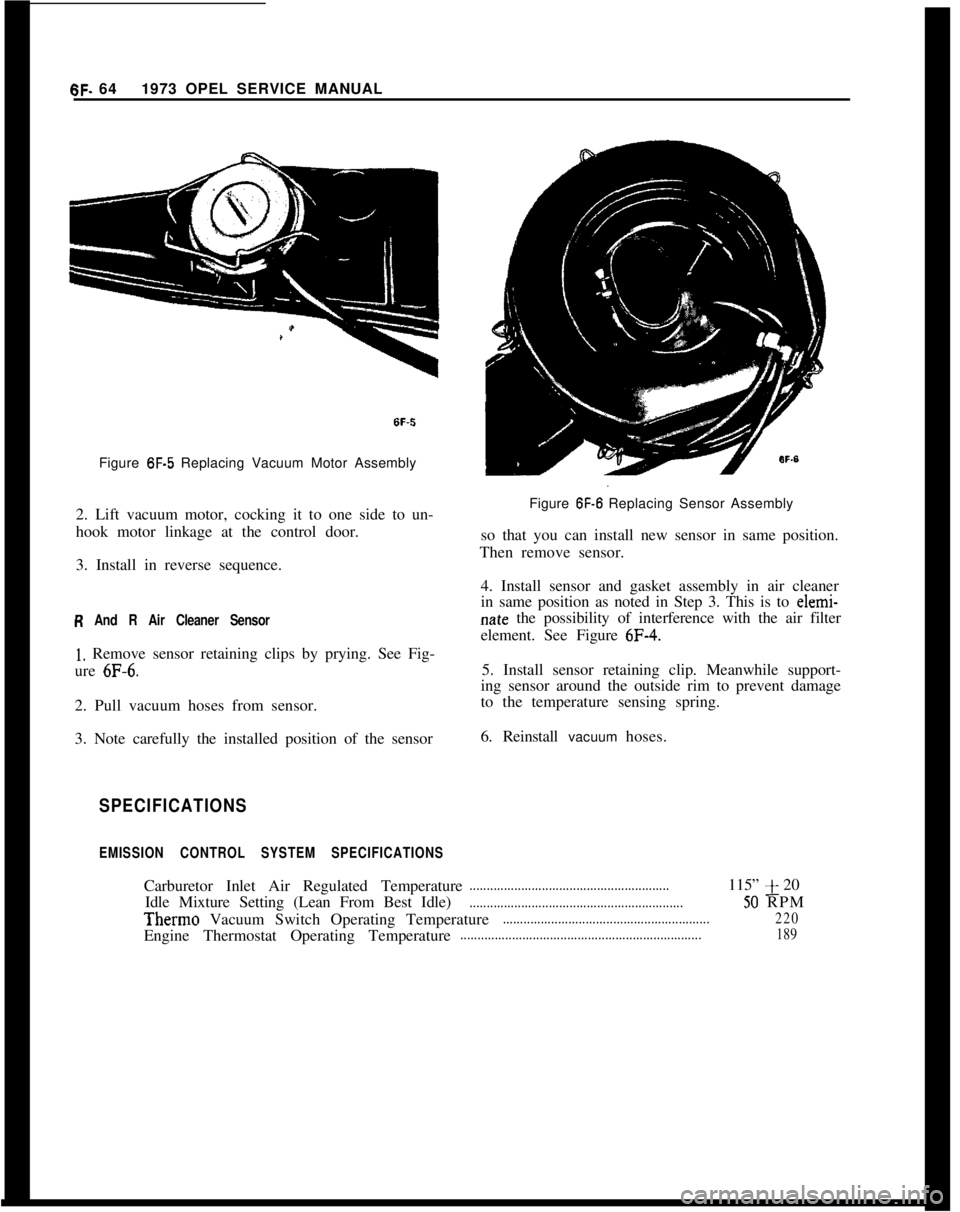
Figure 6F-5 Replacing Vacuum Motor Assembly
2. Lift vacuum motor, cocking it to one side to un-
hook motor linkage at the control door.
3. Install in reverse sequence.
R And R Air Cleaner Sensor
1. Remove sensor retaining clips by prying. See Fig-
ure
6F-6.2. Pull vacuum hoses from sensor.
3. Note carefully the installed position of the sensor
SPECIFICATIONS
EMISSION CONTROL SYSTEM SPECIFICATIONSFigure
6F-6 Replacing Sensor Assembly
so that you can install new sensor in same position.
Then remove sensor.
4. Install sensor and gasket assembly in air cleaner
in same position as noted in Step 3. This is to elemi-“ate the possibility of interference with the air filter
element. See Figure
6F-4.5. Install sensor retaining clip. Meanwhile support-
ing sensor around the outside rim to prevent damage
to the temperature sensing spring.
6. Reinstall vacuum hoses.
Carburetor Inlet Air Regulated Temperature
..........................................................115” k 20
Idle Mixture Setting (Lean From Best Idle)
..............................................................50 RPMTherm0 Vacuum Switch Operating Temperature
............................................................220Engine Thermostat Operating Temperature
......................................................................189
Page 358 of 625
2. If inspection of contact points indicates excessive
burning, pitting or wear, check condenser and re-
place if necessary.
3. Inspect all connections and wires in the primary
ignition circuit. Correct any abnormal conditions
found.Carburetor1. Clean fuel strainer in fuel pump. To prevent fuel
leakage in pump, disconnect “IN” line from pump
and raise end above fuel level. The in-line fuel filter
should be replaced every 12,000 miles or every 12
months.
2. Check for freedom of choke valve operation and
clean shaft if necessary, with suitable solvent.
3. Inspect throttle cable or linkage bracket and re-
turn spring for wear. With helper depressing acceler-
ator pedal to floor, check for wide open throttle.
Adjust accelerator pedal height so wide open throttle
is obtained when pedal is within
l/2 inch from floor.
Lubricate linkage pivot points with engine oil.
Air CleanerCheck paper element every 6,000 miles and replace
every
24,ooO miles. If a vehicle is operated in dusty
territory, check condition of air cleaner element
more frequently and replace if necessary.
Fan Belt1. Inspect belt for wear, cracks or frayed points.
Replace and/or adjust as necessary. Specified ten-
sion for belt using Gauge J-23600 is 45 lbs.
Cooling System1. Inspect the radiator, water pump, cylinder head
areas and all radiator and heater hose connections
for evidence of engine coolant leaks.
2. Inspect all hoses for deterioration from gas and oil
contact. Correct as required.
Inspection should be made with engine operating at
normal temperature, cooling system completely
filled, temperature control lever fully open and nor-
mal pressure in the system. Normal pressure should
be 13.2 to 15.2 psi.
Engine Lubrication SystemInspect engine for evidence of oil leakage. Correctany abnormal condition with sealastic or new seals
and gaskets.
Battery
1. Inspect battery, battery mount and cables and
check electrolyte level. Proper level should be just
above the cell plates.
CAUTION:Do not over fill.
2. Determine the serviceability of the battery by ap-
plying the 421 Battery Test.
Positive Crankcase VentilationClean crankcase ventilator metered orifice in the in-
take manifold fitting every 6,000 miles. Also all hoses
and fittings should be inspected, cleaned and re-
placed, if necessary.
To clean, remove rubber hose from metered orifice
and apply air pressure to orifice to remove any for-
eign particles that may be trapped.
Valve Lifter AdjustmentRefer to Engine Mechanical and Mounts section for
valve lifter adjustment procedure.
Engine Tune-Up Instrument ChecksThe following instrument checks and adjustments
serve as a final check on engine condition. These
checks may discover some new problems that may
not have been obvious before. The engine is also
given its final adjustments that will assure maximum
performance, reliability, and proper emission con-
trol.
Refer to Electrical Group for checking procedures of
the following:
Cranking Voltage Check
Ignition Timing
Distributor Advance
Ignition Output
Secondary Resistance
Current Output and Voltage Setting
Idle Speed and Mixture AdjustmentsRefer to carburetor section.
Page 383 of 625
78.221973 OPEL SERVICE MANUAL
3. Install new bellows. Adhere to distance A
- 8.07”.
See Figure 7B-I 1.
4. Heat up new gearshift lever knob in boiling water
to 176 degrees F. and push it onto gearshift lever
tube. Adhere to distance A .3”, see Figure
7B-15.The gearshift lever tube end is provided with trans-
verse grooves for which reason the old button cannot
be reused. Install gearshift lever.
REPLACING RUBBER DAMPENING PARTS IN
GEARSHIFT LEVER1. Remove gearshift lever.
2. Knock off gearshift lever button and loosen
threaded pin for Bowden control wire attachment.
3. Remove lower snap ring from gearshift lever tube
and pull tube off shift finger.
4. Take off and replace rubber dampening parts.
5. After installation of tube, tighten Bowden control
wire with threaded pin. Prior to tightening, pull ring
must rest on gearshift lever tube and clamping block
on pull ring. See Figure
7B-15.6. Heat up new gearshift lever knob in boiling water
to 176 degrees F. and push it onto gearshift lever
tube. Adhere to distance A
- .3”, see Figure 7B-15.The gearshift lever tube end is provided with trans-
verse grooves for which reason the old button cannot
be reused.
7. Install gearshift lever.
MAJOR REPAIR
TRANSMISSION REMOVAL1. Remove air cleaner. Remove throttle rod from
carburetor and rear support and disconnect battery.
2. Remove screws from fan shroud.
3. Remove gearshift lever (refer to paragraph on ser-
vicing gearshift lever).
4. Support car with frame or wheel stands in the
front or frame stands in the rear.
5. Loosen front exhaust pipe to manifold flange.
6. Remove clutch cable from fork by pushing fork to
disengage the clutch and unsnap cable from slot.
7. Disconnect both wires from backup lamp switch.8. Disconnect speedometer cable from transmission
case extension housing.
9. Unhook parking brake cable return spring and
remove cable adjusting nut, equalizer, and spacer.
See Figure
7B-16.PARKING BRAKE CABLE
PARKING BRAKE
Figure 78-16 Parking Brake Equalizer and Return
Spring
9. Disconnect drive shaft at central joint and remove
as follows: See Figure
7B-16.a. Disconnect parking brake cable equalizer from
rod.b. Mark the mating parts of U-Joint and the drive
pinion extension shaft flange.
c. Loosen bolt locks and remove bolts or nuts.
d. Work propeller shaft slightly forward, lower rear
end of shaft and slide assembly rearward. Remove
thrust spring.
e. Install a plug in the rear of the transmission to
prevent loss of lubricant.
10. Remove rear engine mount bolts and lower trans-
mission as far as possible.
11. Remove transmission case to clutch housing at-
taching bolts and remove transmission.
INSTALLATION OF TRANSMISSION WITH
ENGINE IN CAR1. Make certain main drive gear splines are clean and
dry. Also, make certain the transmission is in Neu-
tral so that the main drive gear splines may be in-
dexed when making the installation.
2. Install transmission and support weight while in-
stalling transmission case to clutch housing bolts.
3. Install rear engine mount.
4. Install propeller shaft, align, and tighten U-Joint
to pinion flange U-Bolt nuts and torque to 11 lb. ft.