instrument panel OPEL MANTA 1973 Owner's Manual
[x] Cancel search | Manufacturer: OPEL, Model Year: 1973, Model line: MANTA, Model: OPEL MANTA 1973Pages: 625, PDF Size: 17.22 MB
Page 115 of 625
1 J- 94 1973 OPEL SERVICE MANUALi
I
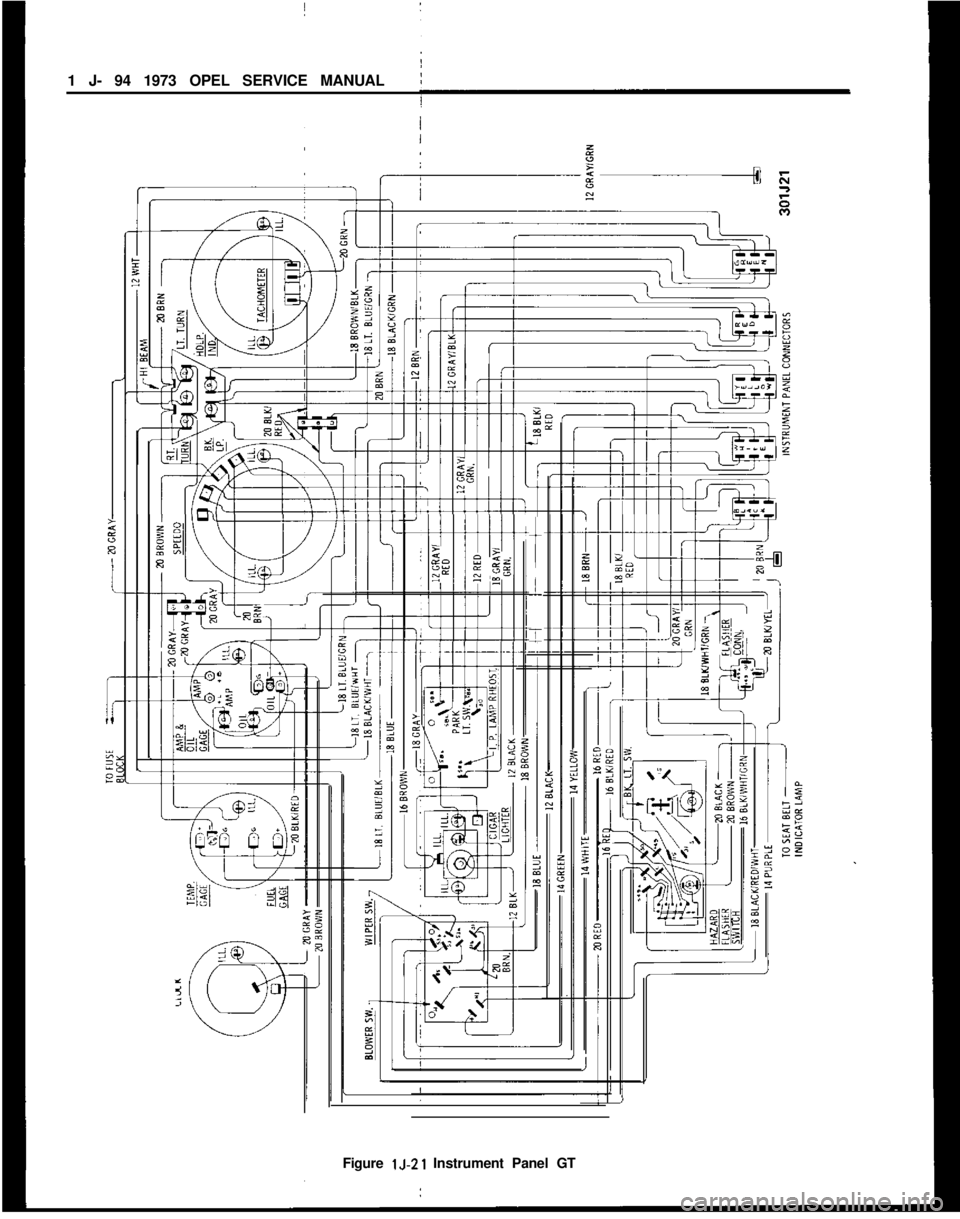
IFigure lJ-21 Instrument Panel GT
Page 157 of 625
26-341973 OPEL SERVICE MANUAL
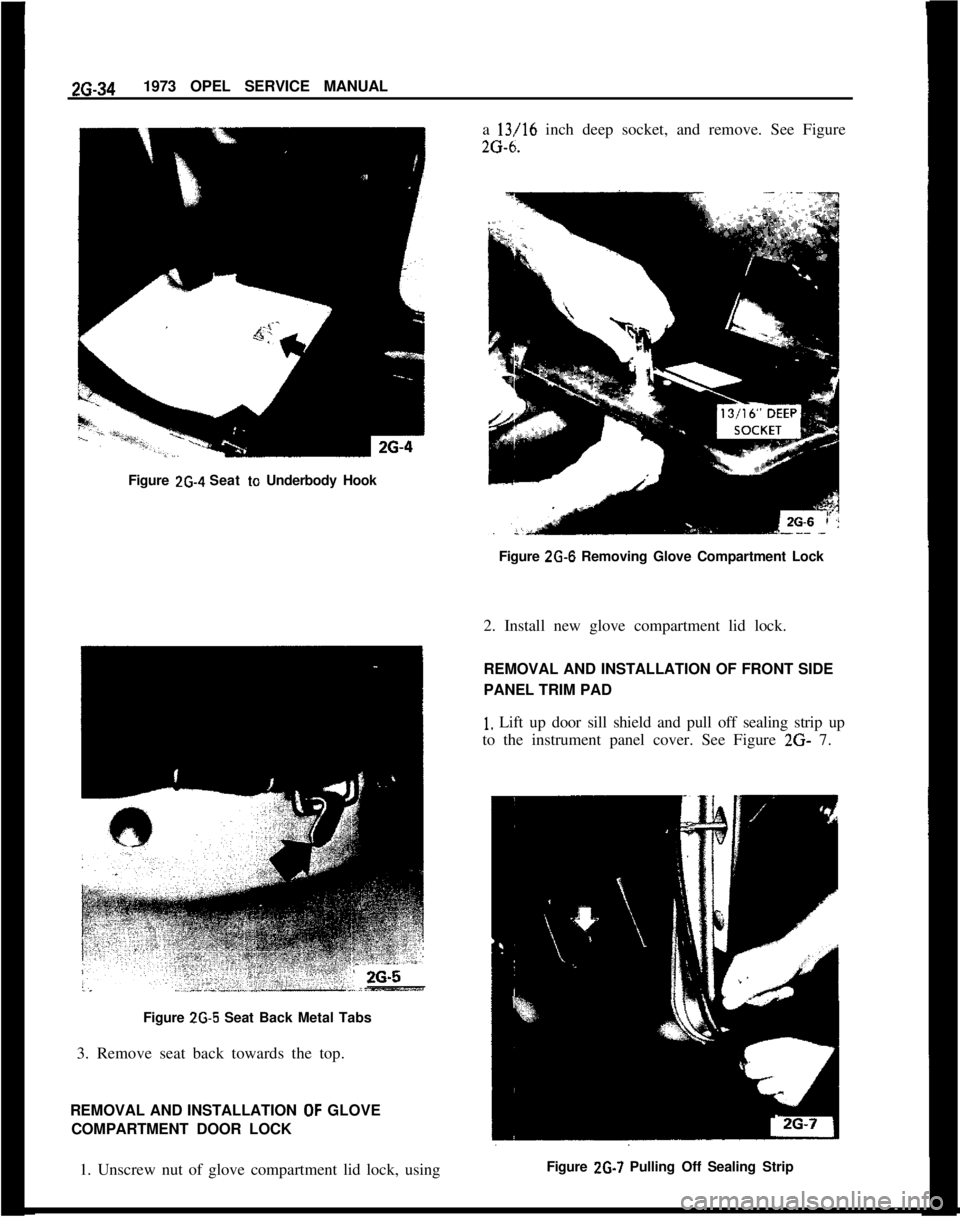
a 13/16 inch deep socket, and remove. See Figure2G-6.Figure
ZG-4 Seat to Underbody Hook
Figure
ZG-5 Seat Back Metal Tabs
3. Remove seat back towards the top.
REMOVAL AND INSTALLATION
OF GLOVE
COMPARTMENT DOOR LOCK
1. Unscrew nut of glove compartment lid lock, usingFigure ZG-6 Removing Glove Compartment Lock
2. Install new glove compartment lid lock.
REMOVAL AND INSTALLATION OF FRONT SIDE
PANEL TRIM PAD
1, Lift up door sill shield and pull off sealing strip up
to the instrument panel cover. See Figure 2G- 7.
Figure
ZG-7 Pulling Off Sealing Strip
Page 202 of 625
OPEL 1900 AND MANTA STEERING COLUMN ASSEMBLY 3E.35
II
OPEL 1900 AND MANTA STEERING COLUMN
ASSEMBLY
CONTENTS
SubjectPage No.
DESCRIPTION AND OPERATION:
Description and Operation of Directional Signal
Lever. . . . . . . . . . . . . . . . . . . . . . . . . . . . . . . . . . . . . . . . . . . . . . . . . . . . . . . . . . . . . . . . . . . . . . . . . . . . . . . . . .Description
andOperationofHorn. . . . . . . . . . . . . . . . . . . . . . . . . . . . . .Description of Steering Column Assembly
. . . . . . . . . . . . . .DIAGNOSIS: (Not Applicable)
MAINTENANCE AND ADJUSTMENTS: (Not
Applicable)
MAJOR REPAIR:
3E-353E-363E-36
Removal and Installation of Steering Column
Assembly
. . . . . . . . . . . . . . . . . . . . . . . . . . . . . . . . . . . . . . . . . . . . . . . . . . . . . . . . . . . . . . . . . . . . . . . . . .
RemovalandInstallationofSteeringWheel. . . . . . . . . . . .Disassembly and Reassembly of Direction Signal
Switch
. . . . . . . . . . . . . . . . . . . . . . . . . . . . . . . . . . . . . . . . . . . . . . . . . . . . . . . . . . . . . . . . . . . . . . . . . . . . . . . .Disassembly and Reassembly of Steering and
Ignition Lock Cylinder, and Electrical Switch
from Mast Jacket Assembly
. . . . . . . . . . . . . . . . . . . . . . . . . . . . . . . . . . . . .SPECIFICATIONS:
Steering
ColumnSpecifications. . . . . . . . . . . . . . . . . . . . . . . . . . . . . . . . . . . .3E-363E-383E-393E-403E-41
DESCRIPTION AND OPERATIONDESCRIPTION AND OPERATION OF
DIRECTIONAL SIGNAL LEVERhigh to low beam or vice versa. On all
19M) Rallye
cars, when switching from low to high beam posi-
tion, with the fog lamp instrument panel switch ON
The direction signal switch lever is a multi- purpose
lever controlling direction signals, passing signal and
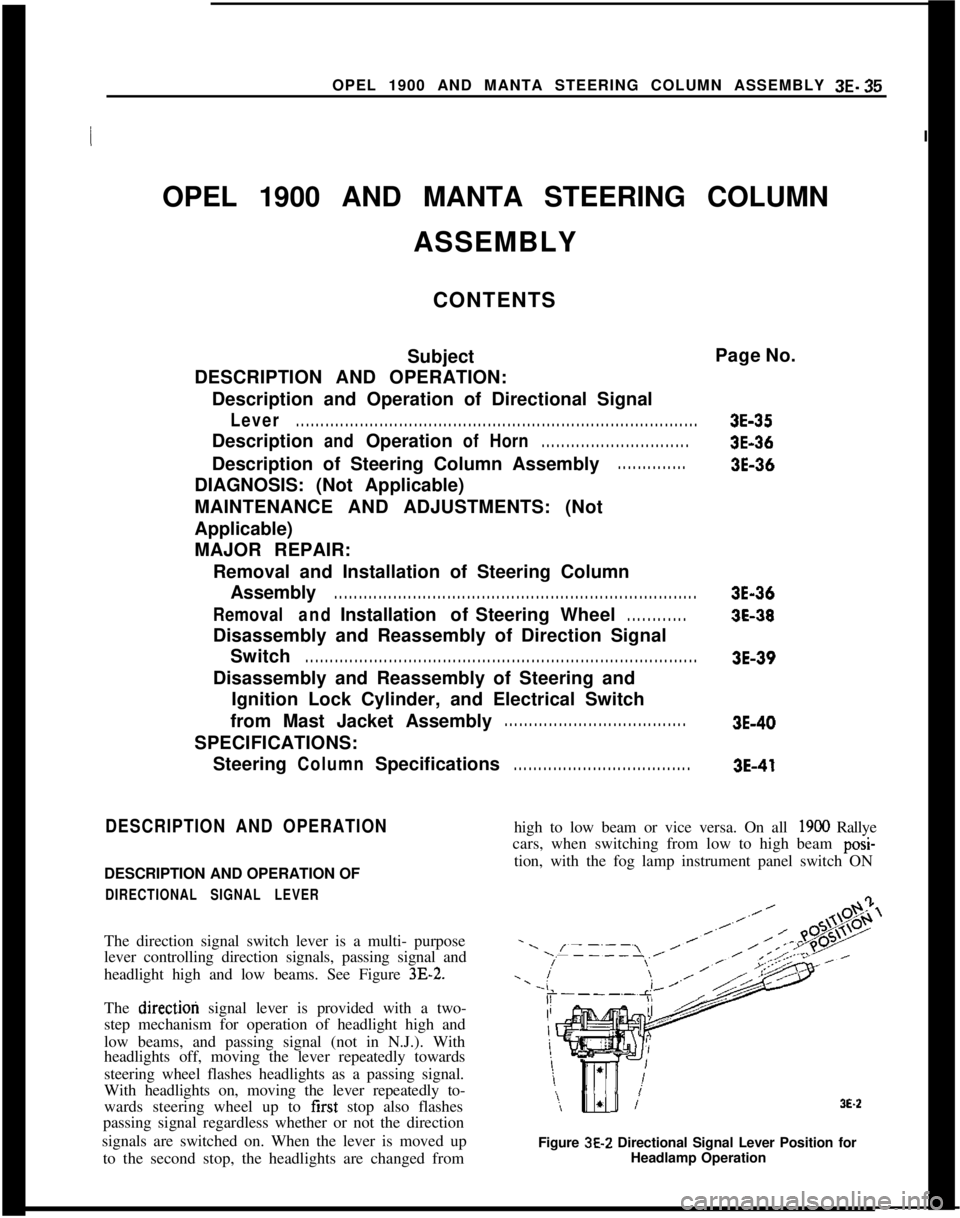
headlight high and low beams. See Figure
3E-2.The dire&M signal lever is provided with a two-
step mechanism for operation of headlight high and
low beams, and passing signal (not in N.J.). With
headlights off, moving the lever repeatedly towards
steering wheel flashes headlights as a passing signal.
With headlights on, moving the lever repeatedly to-
wards steering wheel up to first stop also flashes
passing signal regardless whether or not the direction
signals are switched on. When the lever is moved up
to the second stop, the headlights are changed from
SE.2Figure
3E-2 Directional Signal Lever Position for
Headlamp Operation
Page 205 of 625
3E- 38 ,1973 OPEL SERVICE MANUAL
ponents and systems, and/or could result in major
repair expense. They must be replaced with one or
the same part number or with
an equivalent part if
replacement becomes necessary. Do not use a
re-
placement part of lesser quality or substitute design.
Torque
values must be used as specified during reas-
sembly to assure proper retention of these parts.On installation, make sure steering wheel spokes
point downwards and steering gear is in high point.
1. Carefully insert steering mast into universal joint
flange.
2. Loosely attach slide-off base attaching nuts at un-
derside of instrument panel.
3. Attach steering mast jacket at front of dash, using
a notched hex nut.
4. Torque nuts at slide-off base to II
lb.ft.5. Tighten screw at steering mast clamp to 22
lb.ft.6. Reconnect wires to directional signal switch and
ignition switch.
7. Reconnect battery.
REMOVAL AND INSTALLATION OF
STEERING WHEELThis procedure may be performed with the steering
column assembly either removed or installed in the
car.
Removal
1. Disconnect battery.
2. Pry off horn cap and remove wires from cap. See
Figure
3E-3.3. Bend lockplate tabs down and take off steering
shaft nut and lockplate.
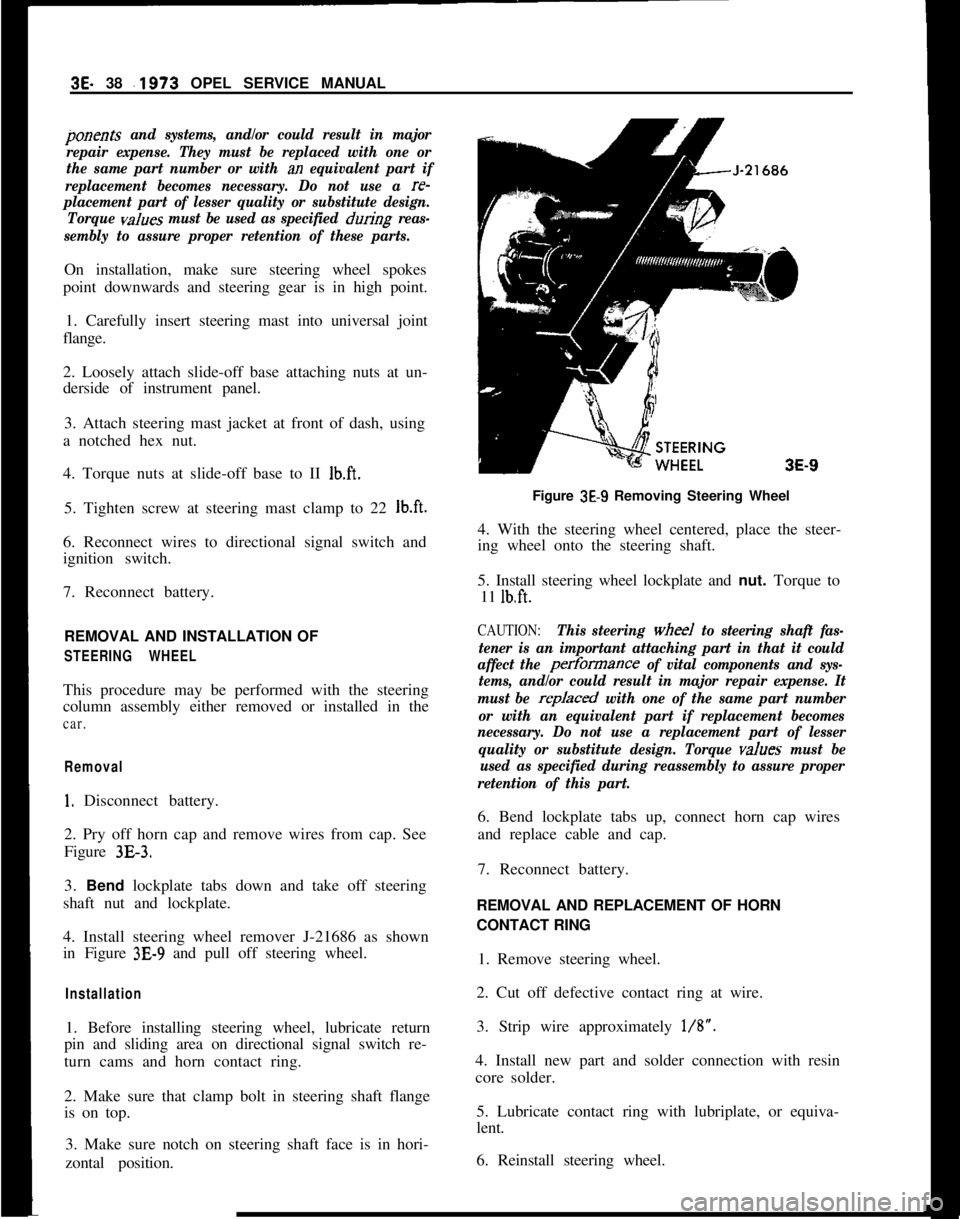
4. Install steering wheel remover J-21686 as shown
in Figure
3E-9 and pull off steering wheel.
Installation1. Before installing steering wheel, lubricate return
pin and sliding area on directional signal switch re-
turn cams and horn contact ring.
2. Make sure that clamp bolt in steering shaft flange
is on top.
3. Make sure notch on steering shaft face is in hori-
zontal position.Figure
3E-9 Removing Steering Wheel
4. With the steering wheel centered, place the steer-
ing wheel onto the steering shaft.
5. Install steering wheel lockplate and nut. Torque to
11
lb.ft.
CAUTION:
This steering wheeI to steering shaft fas-
tener is an important attaching part in that it could
affect the
performance of vital components and sys-
tems, and/or could result in major repair expense. It
must be repked
with one of the same part number
or with an equivalent part if replacement becomes
necessary. Do not use a replacement part of lesser
quality or substitute design. Torque
values must be
used as specified during reassembly to assure proper
retention of this part.6. Bend lockplate tabs up, connect horn cap wires
and replace cable and cap.
7. Reconnect battery.
REMOVAL AND REPLACEMENT OF HORN
CONTACT RING
1. Remove steering wheel.
2. Cut off defective contact ring at wire.
3. Strip wire approximately
l/8”.4. Install new part and solder connection with resin
core solder.
5. Lubricate contact ring with lubriplate, or equiva-
lent.
6. Reinstall steering wheel.
Page 206 of 625
OPEL 1900 AND MANTA STEERING COLUMN ASSEMBLY3E- 39~~~A~SEMBLY AND ~EASBEMBL~ 0~
DIRECTIONAL SIGNAL SWITCHThis procedure may be performed with the steering
column assembly removed or installed in the car.
Disassembly (Opel 1900. Manta)
1. Remove steering wheel (see paragraph above).
2. Pull off signal switch and steering and ignition
lock wire set.
3. Pull directional signal lever out of seat. Lever is
held in place by a lock ball.
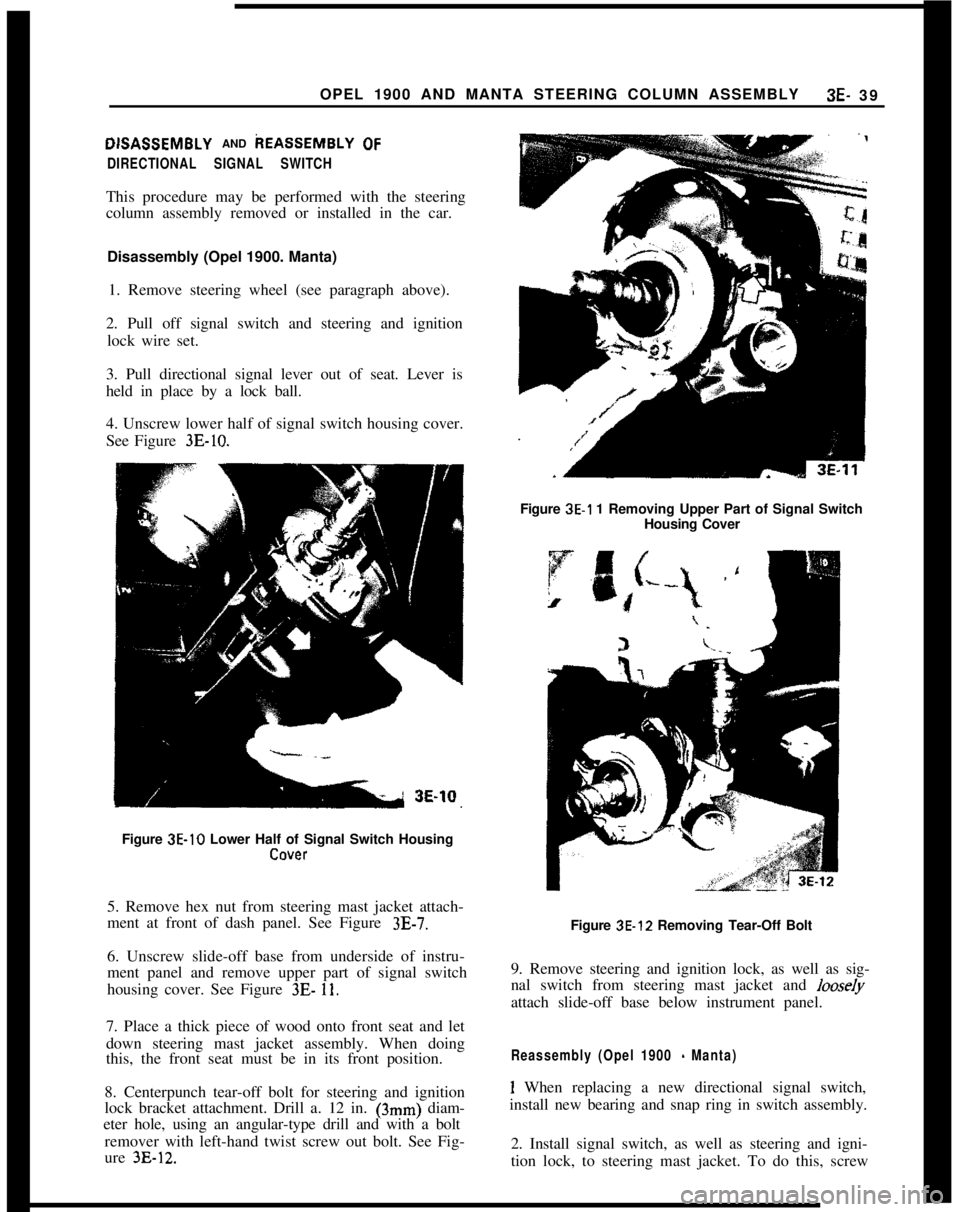
4. Unscrew lower half of signal switch housing cover.
See Figure
3E-10.Figure
3E-1 1 Removing Upper Part of Signal Switch
Housing Cover
Figure 3E-10 Lower Half of Signal Switch Housing
COVSr5. Remove hex nut from steering mast jacket attach-
ment at front of dash panel. See Figure
3E-7.6. Unscrew slide-off base from underside of instru-
ment panel and remove upper part of signal switch
housing cover. See Figure 3E-
11,7. Place a thick piece of wood onto front seat and let
down steering mast jacket assembly. When doing
this, the front seat must be in its front position.
8. Centerpunch tear-off bolt for steering and ignition
lock bracket attachment. Drill a. 12 in. (3mm) diam-
eter hole, using an angular-type drill and with a bolt
remover with left-hand twist screw out bolt. See Fig-
ure
3E-12.Figure
3E-12 Removing Tear-Off Bolt
9. Remove steering and ignition lock, as well as sig-
nal switch from steering mast jacket and
foosefyattach slide-off base below instrument panel.
Reassembly (Opel 1900 - Manta)
1 When replacing a new directional signal switch,
install new bearing and snap ring in switch assembly.
2. Install signal switch, as well as steering and igni-
tion lock, to steering mast jacket. To do this, screw
Page 211 of 625
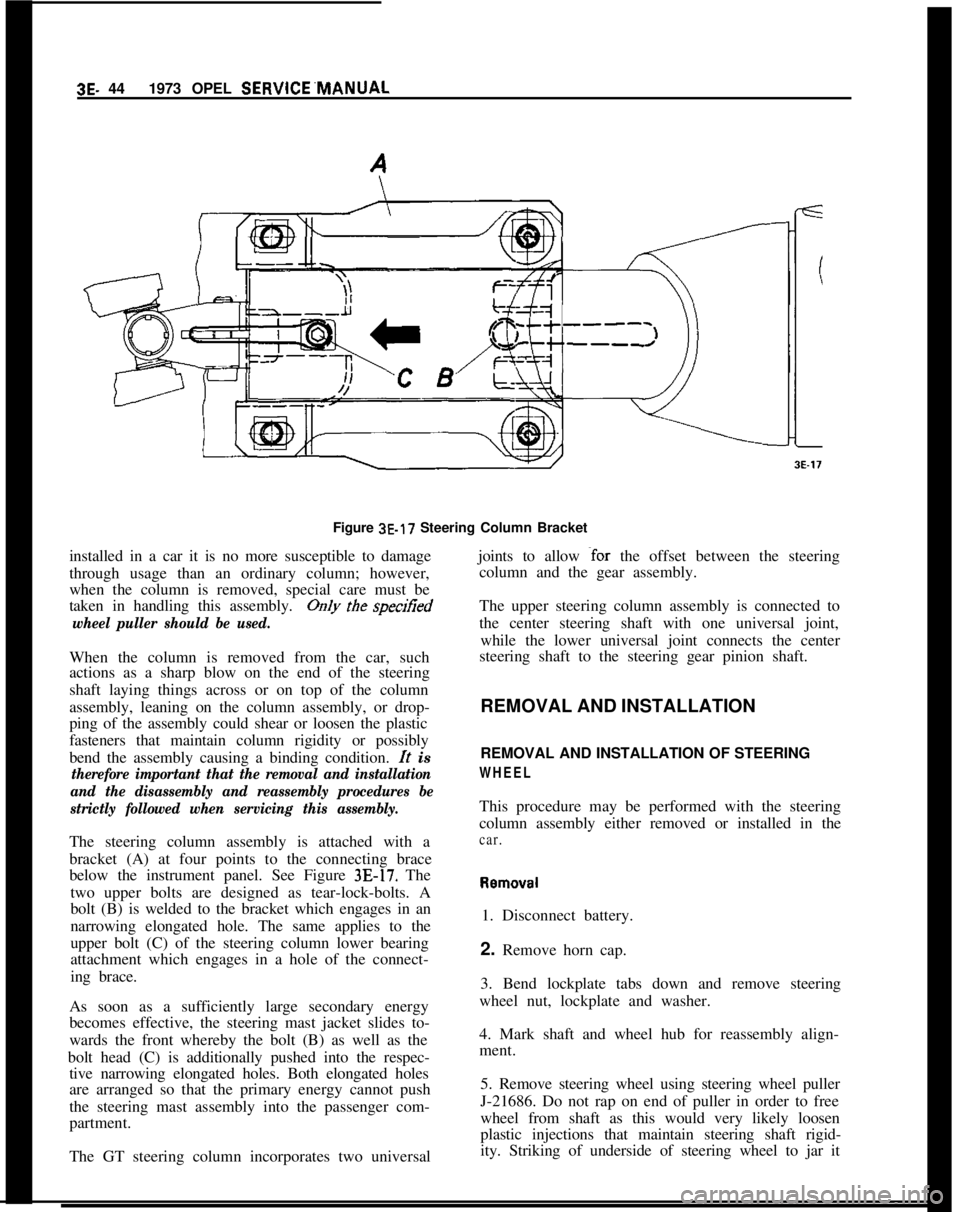
3E. 441973 OPEL SERVICE’MANUAL
Figure 3E-17 Steering Column Bracket
installed in a car it is no more susceptible to damage
through usage than an ordinary column; however,
when the column is removed, special care must be
taken in handling this assembly.Only the speufied
wheel puller should be used.When the column is removed from the car, such
actions as a sharp blow on the end of the steering
shaft laying things across or on top of the column
assembly, leaning on the column assembly, or drop-
ping of the assembly could shear or loosen the plastic
fasteners that maintain column rigidity or possibly
bend the assembly causing a binding condition.
It is
therefore important that the removal and installation
and the disassembly and reassembly procedures be
strictly followed when servicing this assembly.The steering column assembly is attached with a
bracket (A) at four points to the connecting brace
below the instrument panel. See Figure
3E-17. The
two upper bolts are designed as tear-lock-bolts. A
bolt (B) is welded to the bracket which engages in an
narrowing elongated hole. The same applies to the
upper bolt (C) of the steering column lower bearing
attachment which engages in a hole of the connect-
ing brace.
As soon as a sufficiently large secondary energy
becomes effective, the steering mast jacket slides to-
wards the front whereby the bolt (B) as well as the
bolt head (C) is additionally pushed into the respec-
tive narrowing elongated holes. Both elongated holes
are arranged so that the primary energy cannot push
the steering mast assembly into the passenger com-
partment.
The GT steering column incorporates two universaljoints to allow
~for the offset between the steering
column and the gear assembly.
The upper steering column assembly is connected to
the center steering shaft with one universal joint,
while the lower universal joint connects the center
steering shaft to the steering gear pinion shaft.
REMOVAL AND INSTALLATION
REMOVAL AND INSTALLATION OF STEERING
WHEELThis procedure may be performed with the steering
column assembly either removed or installed in the
car.Removal
1. Disconnect battery.
2. Remove horn cap.
3. Bend lockplate tabs down and remove steering
wheel nut, lockplate and washer.
4. Mark shaft and wheel hub for reassembly align-
ment.
5. Remove steering wheel using steering wheel puller
J-21686. Do not rap on end of puller in order to free
wheel from shaft as this would very likely loosen
plastic injections that maintain steering shaft rigid-
ity. Striking of underside of steering wheel to jar it
Page 362 of 625
CLUTCH7A. 1
CLUTCH
CONTENTS
Subject
DESCRIPTION AND OPERATION: Clutch andClutch
PedalMechanisms
. . . . . . . . . . . . . . . . . . . . . .
DIAGNOSIS:
Clutch
. . . . . . . . . . . . . . . . . . . . . . . . . . . . . . . . . . . . \
. . . . . . . . . . . . . . . . . . . . . . . . . . . . . . . . . . . . \
. . . . . . .
MAINTENANCE AND ADJUSTMENTS: Clutch LashAdjustment (GTOnly)
. . . . . . . . . . . . . . . . . . . . . . . . . . . . . .
Clutch Adjustment (All 1.9 Engines Except GT). . . .
Control CableAdjustment. . . . . . . . . . . . . . . . . . . . . . . . . . . . . . . . . . . . \
. . . . . . . . . .
MAJOR REPAIR:
Clutch Removal and Installation
. . . . . . . . . . . . . . . . . . . . . . . . . . . . . . . . .
Clutch Control Cable. . . . . . . . . . . . . . . . . . . . . . . . . . . . . . . . . . . . \
. . . . . . . . . . . . . . . . . . . .
SPECIFICATIONS:
Specifications
. . . . . . . . . . . . . . . . . . . . . . . . . . . . . . . . . . . . . . . . \
. . . . . . . . . . . . . . . . . . . . . . . . . . . . .
Page No.
7A-
1
7A-2
7A-4
7A-4
7A-4
IA-5
7A- 7
7A-7
DESCRIPTION AND OPERATION
CLUTCH PEDAL MECHANISM GT Only
The pedal lever pivots on a tubular steel shaft and
operates the clutch release yoke thru a sheathed ca-
ble attached directly to the upper end of the pedallever. Pedal return is accomplished thru the cable by
the clutch yoke return spring at the transmission.
The pedal return stop
is a nonadjustable rubber
bumper inserted through the upper end of the pedal leverjust below the cable attaching point. The clutch
cable is sheathed in woven steel and weather pro-
tected by a plastic and fabric covering. An eyelet is
wedged on the upper end and fits over a formed
hook on the upper end of the pedal. The lower end
is provided with a
wedged ball stud arrangement
that slips into a slot in the clutch release lever. See
Figure
7A-6.
Opel 1900 and Manta
The pedal lever pivots on a tubular steel shaft and
operates the clutch release yoke through a sheathed
cable attached directly to the upper end of the pedal
lever. Pedal return is accomplished through a spring
attached to the pedal below the pivot shaft and to the
pedal assembly mounting bracket at the bulkhead. Clutch actuation works without pedal-free travel and
a warning device is provided which actuates an in-
dicator lamp in the instrument panel indicating
necessity of clutch adjustment. The clutch cable is
sheathed in
woven steel and weather protected by a
plastic fabric covering. An eyelet is wedged on the
upper end and fits over a formed hook on the upper
end of the pedal. The lower end is provided with a
wedged ball stud arrangement that slips into a slot in the clutch release lever. See Figure
7A-7.
Clutch Mechanism
The clutch assembly is enclosed in the bell housing.
The clutch release bearing and release fork are of
conventional design, with the fork pivoting on a ball
stud located opposite the control cable attaching
point. The bearing flange tits over two vertical pins
which are riveted to and extend into the eye of the
yoke.
The clutch pressure plate is similar in design to the
Buick Century pressure plate. A radially slotted dia-
phragm pivoting on two steel wire rings is retained
to the clutch cover by eight rivets. The clutch driven
member is a
6-3/4 inches diameter single plate dry
disc with torsional damper springs and spring leaves
between facings to cushion application. Dampener
springs in clutch disc assembly are
preloaded.
Page 365 of 625
7A- 41973 dPEL SERVICE MANUALConditionPossible CauseCorrectionHeat-blued driven plate
and pressure plate
assembly.
1. Improper pedal1. Replace only driven plate, and
adjustment.adjust clutch pedal and cable.
Grab and chatter with
oil present on clutch
assembly.1. Oil leak.1. Correct oil leakage, clean
pressure plate in solvent, replace
driven plate and adjust pedal lash.
MAINTENANCE AND ADJUSTMENTS
CLUTCH LASH ADJUSTMENT
GTPedal lash, free pedal travel must be adjusted occa-
sionally to compensate for normal wear of the clutch
facings. As the driven plate wears thinner, pedal lash
decreases. Adjust clutch pedal free travel only with
ball stud located on right side of clutch housing if
cable length is not to be changed. To adjust pedal
lash proceed as follows:
1. Loosen lock nut on ball stud end located to the
right of the transmission on the clutch housing. Posi-
tion ball stud so that the outer end protrudes 3/4
inches out of housing and finger tighten lock nut. See
Figures
7A-1 and 7A-6.
2. Adjust ball stud, pivoting clutch release fork, to
obtain 3/4 to
l-1/4 inches pedal lash, free pedal. See
Figure 7A-6.
Opel 1900 and MantaThe clutch actuation works without clutch pedal free
travel. A readjustment of the clutch is only required
if the indicator lamp at the instrument panel lights
up.In synchronism with the gradual wear of the clutch
linings the clutch pedal travels from its basic adjust-
ment position upwards,
ie., towards driver. If the
clutch lining wear has reached such an extent that
the clutch pedal rests against switch, the indicator
lamp at the instrument panel lights up.
This is an indication that the clutch pedal position
has to be corrected to ensure proper clutch operat-
ion.
To
&~sure proper clutch operation, observe the fol-
lowing adjustment instructions.. For all adjustment
dimensions, refer to Figure 7A-7.
1. If the parking brake is provided with an indicator
lamp, the parking brake has to be disengaged, other-wise the same indicator lamp as for the clutch lights
UP.2. Carry out adjustment only with ball stud on clutch
housing whereby the distance (Item 20, Figure 7A-7)
between clutch housing contacting surface and
clutch release lever has to be adjusted in the rear to
4
l/4 inches.
Clutch Control Cable Adjustment(Only on
Installation of a New Clutch Disc or
Bowden
Control Wire)
GT1. Adjust ball stud so that outer end protrudes ap-
proximately 3/4 inches out of clutch housing.
2. Adjust distance between release lever and clutch
housing face at eye for control cable to approxi-
mately 4
l/4 inches. See Figure 7A-6. Hold cable in
this position and place E-ring two grooves ahead of
washer on rubber grommet. Clutch pedal free travel
is now between 3/4 and 1
l/4 inches and clutch
release bearing has proper clearance from pressure
plate.
Opel 1900 and Manta1. Adjust ball stud on clutch housing to basic dimen-
sion of approximately 3/4 inch. With lower end ofbowden control wire unhooked, push clutch release
lever towards the front so that the clutch release
bearing rests against clutch spring. Now, adjust ball
stud so that the dimension (Item 20, Figure
7A-7)between clutch housing contacting surface and
clutch release lever amounts in the rear to 4
l/4
inches.2. Pull reattached bowden control wire out of dash
panel so that clutch pedal rests against switch (in-
dicator lamp lights up).
3. In this position, install lockwasher at upper con-
trol wire attachment three grooves towards the front,
thereby completing control wire adjustment.
Page 503 of 625
8A-2 1973 OPEL SERVICE MANUAL
HOOD, FENDERS, AND GRILLE
CONTENTS
Subject
DESCRIPTION AND OPERATION:
GTHeadlampOperation. . . . . . . . . . . . . . . . . . . . . . . . . . . . . . . . . . . . . . . . . . . . . . . . . .DIAGNOSIS: (Not Applicable)
MAINTENANCE AND ADJUSTMENTS
GTHeadlampMechanism
. . . . . . . . . . . . . . . . . . . . . . . . . . . . . . . . . . . . . . . . . . . . . .MAJOR REPAIR:
Removal and Installation
Hood (1900
- Manta). . . . . . . . . . . . . . . . . . . . . . . . . . . . . . . . . . . . . . . . . . . . . . . . .
Fender(1900-Manta). . . . . . . . . . . . . . . . . . . . . . . . . . . . . . . . . . . . . . . . . . . . . . . . . .Headlamp Covering (1900
- Manta). . . . . . . . . . . . . . . . . . . . . . . .Headlamp Assembly
(GT). . . . . . . . . . . . . . . . . . . . . . . . . . . . . . . . . . . . . . . . . .Headlamp
CableAssembly(GT). . . . . . . . . . . . . . . . . . . . . . . . . . . . . . . .Grille
. . . . . . . . . . . . . . . . . . . . . . . . . . . . . . . . . . . . . . . . . . . . . . . . . . . . . . . . . . . . . . . . . . . . . . . . . . . . . . .SPECIFICATIONS: (Not Applicable)
DESCRIPTION AND OPERATION
DESCRIPTION AND OPERATION OF GT
HEADLAMP MECHANISMThe concealed headlamps are moved mechanically.
Pushing actuating lever on left side of console opens
headlamps, pulling lever closes headlamps. Two
meshing gear segments convert the movement of the
lever to a rotation of 180 degrees. The pivots of the
headlamps lie below the centerline so that with head-
lamps in closed position the headlamp housing is
flush with front sheet metal.
A white indicator lamp in the instrument panel lights
if the headlamps are not completely opened and
locked. The switches of the headlamp electrical sys-
tem are located behind the left headlamp operating
mechanism.
MAINTENANCE AND ADJUSTMENTS
ADJUSTMENT OF HEADLAMP MECHANISMBoth headlamp assemblies must operate in unison in
order to lock in either the open or closed position.
Page No.
8A-2
8A-2
8A-3
8A-3
8A-4
8A-4
8A-6
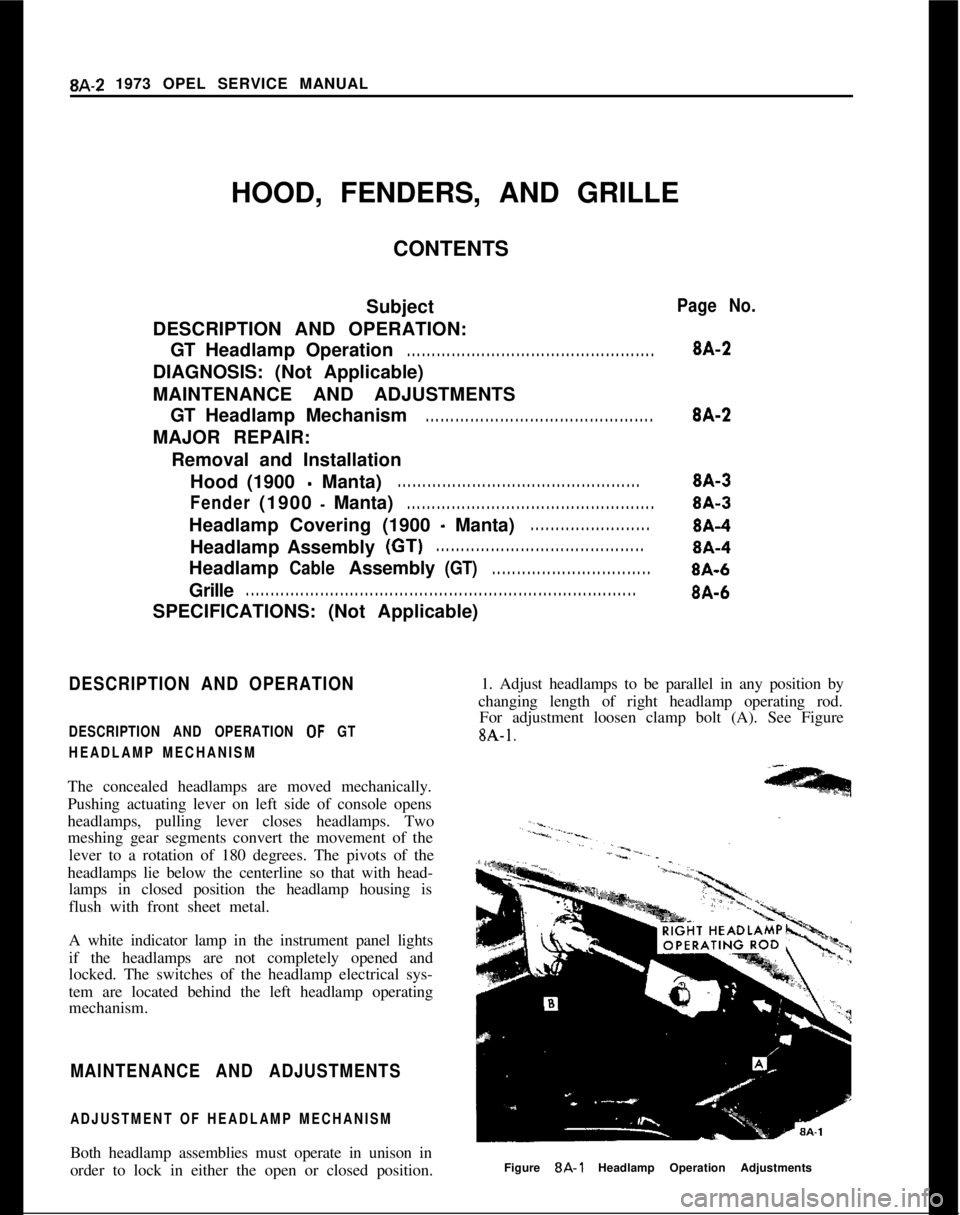
8A-61. Adjust headlamps to be parallel in any position by
changing length of right headlamp operating rod.
For adjustment loosen clamp bolt (A). See Figure
8A-1.Figure
8A-l Headlamp Operation Adjustments
Page 511 of 625
9A-2 1973 OPEL SERVICE MANUALHEATER SYSTEM
- GT
CONTENTS
Subject
DESCRIPTION AND OPERATION:
Flow-ThroughVentilationSystem................................
Heater System Description............................................
HeaterSystemOperation................................................
DIAGNOSIS:
Heater and Defroster........................................................
MAINTENANCE AND ADJUSTMENTS:
Control
CableAdjustment..............................................
MAJOR REPAIR:
Removal
81 Installation Instrument Panel
FreshAirOutlet..............................................................
Removal
& Installation Kick Panel Fresh
AirOutlet..........................................................................
Removal&InstallationBlowerSwitch......................
Removal&InstallationHeater......................................
Removal&InstallationDefrosterOutlet..................
Removal
81InstallationHeaterValve........................
SPECIFICATIONS:
Specifications......................................................................Page No.9A-29A-29A-49A-49A-49A-59A-59A-59A-59A-09A-99A-9
DESCRIPTION AND OPERATION
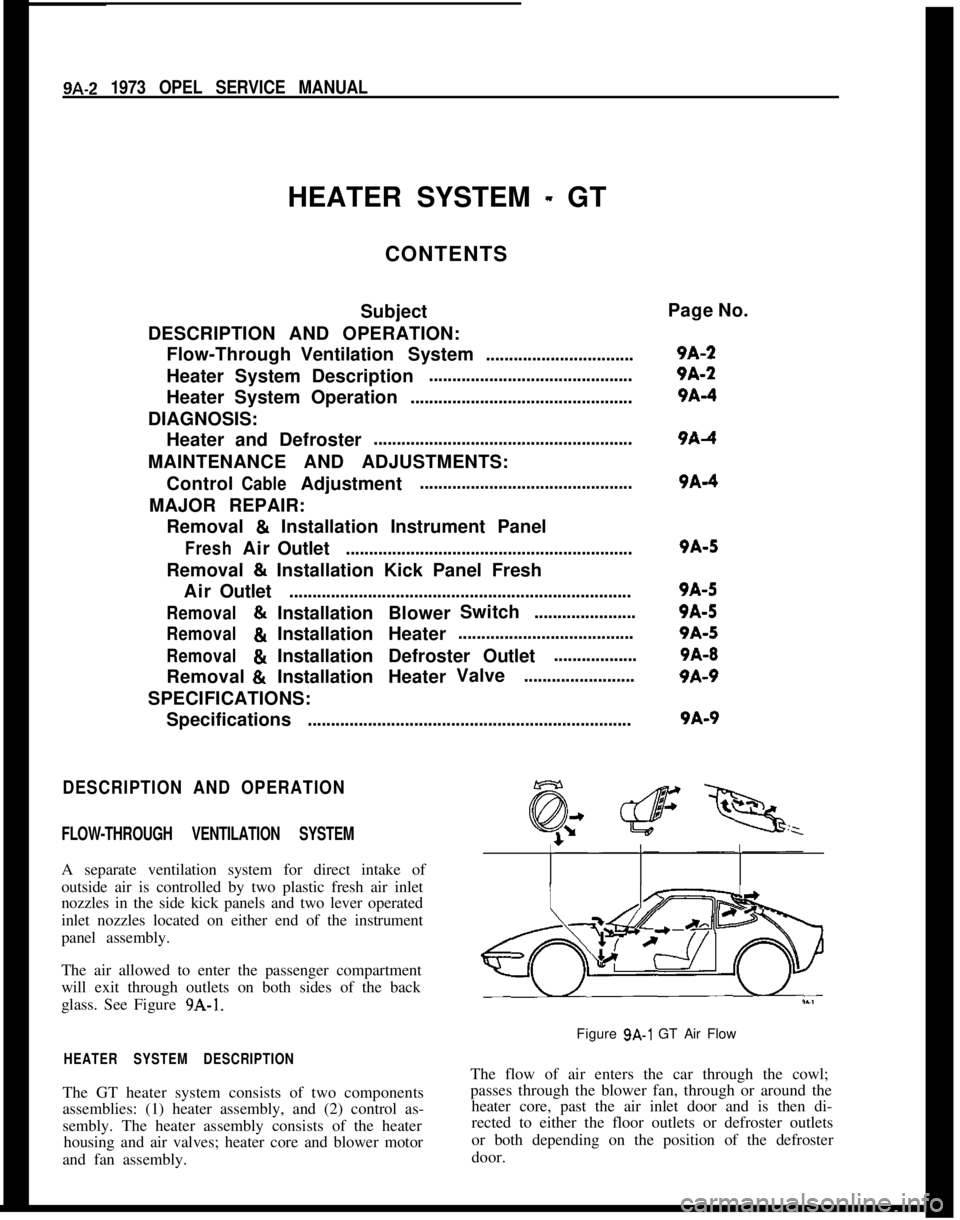
FLOW-THROUGH VENTILATION SYSTEMA separate ventilation system for direct intake of
outside air is controlled by two plastic fresh air inlet
nozzles in the side kick panels and two lever operated
inlet nozzles located on either end of the instrument
panel assembly.
The air allowed to enter the passenger compartment
will exit through outlets on both sides of the back
glass. See Figure 9A-1.
HEATER SYSTEM DESCRIPTIONThe GT heater system consists of two components
assemblies: (1) heater assembly, and (2) control as-
sembly. The heater assembly consists of the heater
housing and air valves; heater core and blower motor
and fan assembly.Figure
9A-1 GT Air Flow
The flow of air enters the car through the cowl;
passes through the blower fan, through or around the
heater core, past the air inlet door and is then di-
rected to either the floor outlets or defroster outlets
or both depending on the position of the defroster
door.