oil pressure OPEL MANTA 1973 Workshop Manual
[x] Cancel search | Manufacturer: OPEL, Model Year: 1973, Model line: MANTA, Model: OPEL MANTA 1973Pages: 625, PDF Size: 17.22 MB
Page 446 of 625

AlITOMATIC TRANSMISSION 7C- 85
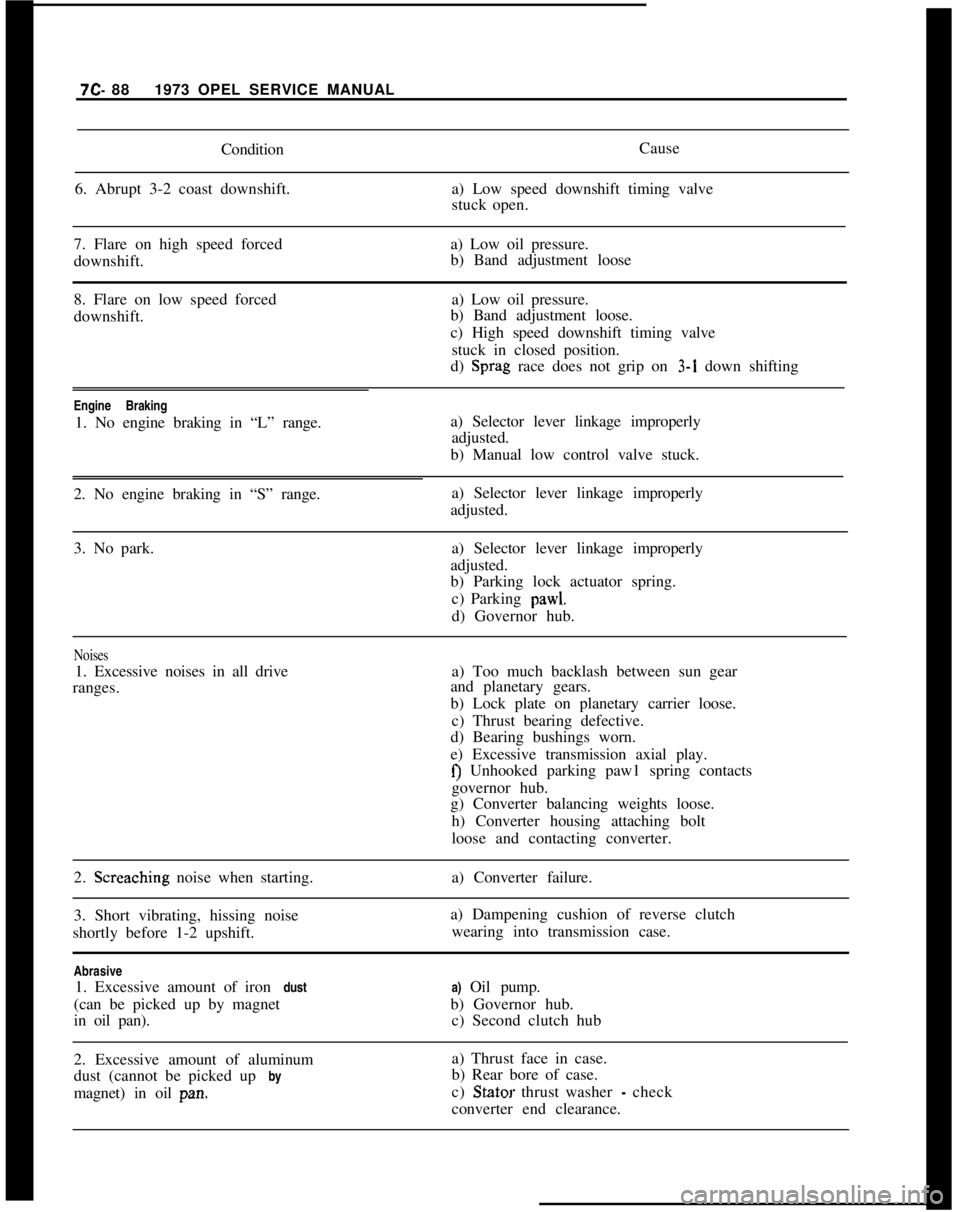
ConditionCtSlSl?8. After full throttle upshifting
transmission shifts immediately
into lower gear upon easing off
accelerator pedal.a) Detent valve stuck in open position,
b) Detent cable stuck.
c) Modulator vacuum line interrupted.
9. At higher speeds, transmission
shifts into lower gear.a) Retaining pin of selector lever shaft
in transmission dropped out.
b) Loose connection of selector lever
linkage to manual valve.
c) Pressure loss at governor.
10. Hard disengagement of selector
lever from “P” position.a) Steel guide bushing of parking
paw1actuating rod missing.
b) Manual selector lever stuck.
Shifts1. Slipping l-2 upshifts (engine
flares).a) Low oil pressure.
b) Sealing ball in valve body dropped out.
c) Second clutch piston seals leaking.
d) Second clutch piston centrifugal ball
stuck open.
e) Second clutch piston cracked or broken.
f) Second clutch plates worn.
g) Seal rings of oil pump hub leaky.
2. Slipping 2-3 upshifts (engine
flares).a) Low oil pressure.
b) Band adjustment loose.
c) Third clutch piston seals leaking.
d) Third clutch piston centrifugal ball
stuck open.
e) Third clutch piston cracked or broken.
f) Wear of input shaft bushing.
g) Sealing ball in valve body dropped out
3. Abrupt l-2 upshift.a) High oil pressure.
b) l-2 accumulator valve stuck.
c) Spring cushion of second clutch broken,
d) Second gear ball valve missing.
4. Abrupt 2-3 upshift.
a) High oil pressure
b) Incorrect band adjustment.
5. Abrupt 3-2 detent downshift at
high speed.a) High speed downshift valve stuck open.
b) Band adjustment.
Page 447 of 625
7C- 881973 OPEL SERVICE MANUAL
Condition
6. Abrupt 3-2 coast downshift.Cause
a) Low speed downshift timing valve
stuck open.
7. Flare on high speed forceda) Low oil pressure.
downshift.b) Band adjustment loose
8. Flare on low speed forced
downshift.a) Low oil pressure.
b) Band adjustment loose.
c) High speed downshift timing valve
stuck in closed position.
d) Sprag race does not grip on 3-1 down shifting
Engine Braking
1. No engine braking in “L” range.a) Selector lever linkage improperly
adjusted.
b) Manual low control valve stuck.
2. No engine braking in “S” range.a) Selector lever linkage improperly
adjusted.
3. No park.a) Selector lever linkage improperly
adjusted.
b) Parking lock actuator spring.
c) Parking pawl.
d) Governor hub.
Noises1. Excessive noises in all drive
ranges.a) Too much backlash between sun gear
and planetary gears.
b) Lock plate on planetary carrier loose.
c) Thrust bearing defective.
d) Bearing bushings worn.
e) Excessive transmission axial play.
f) Unhooked parking paw1 spring contacts
governor hub.
g) Converter balancing weights loose.
h) Converter housing attaching bolt
loose and contacting converter.
2. Screaching noise when starting.
3. Short vibrating, hissing noise
shortly before 1-2 upshift.a) Converter failure.
a) Dampening cushion of reverse clutch
wearing into transmission case.
Abrasive
1. Excessive amount of iron dust
(can be picked up by magnet
in oil pan).a) Oil pump.
b) Governor hub.
c) Second clutch hub
2. Excessive amount of aluminum
dust (cannot be picked up by
magnet) in oil pan.a) Thrust face in case.
b) Rear bore of case.
c) Stator thrust washer
- check
converter end clearance.
Page 469 of 625
712.1081973 OPEL SERVICE MANUALCHSJ
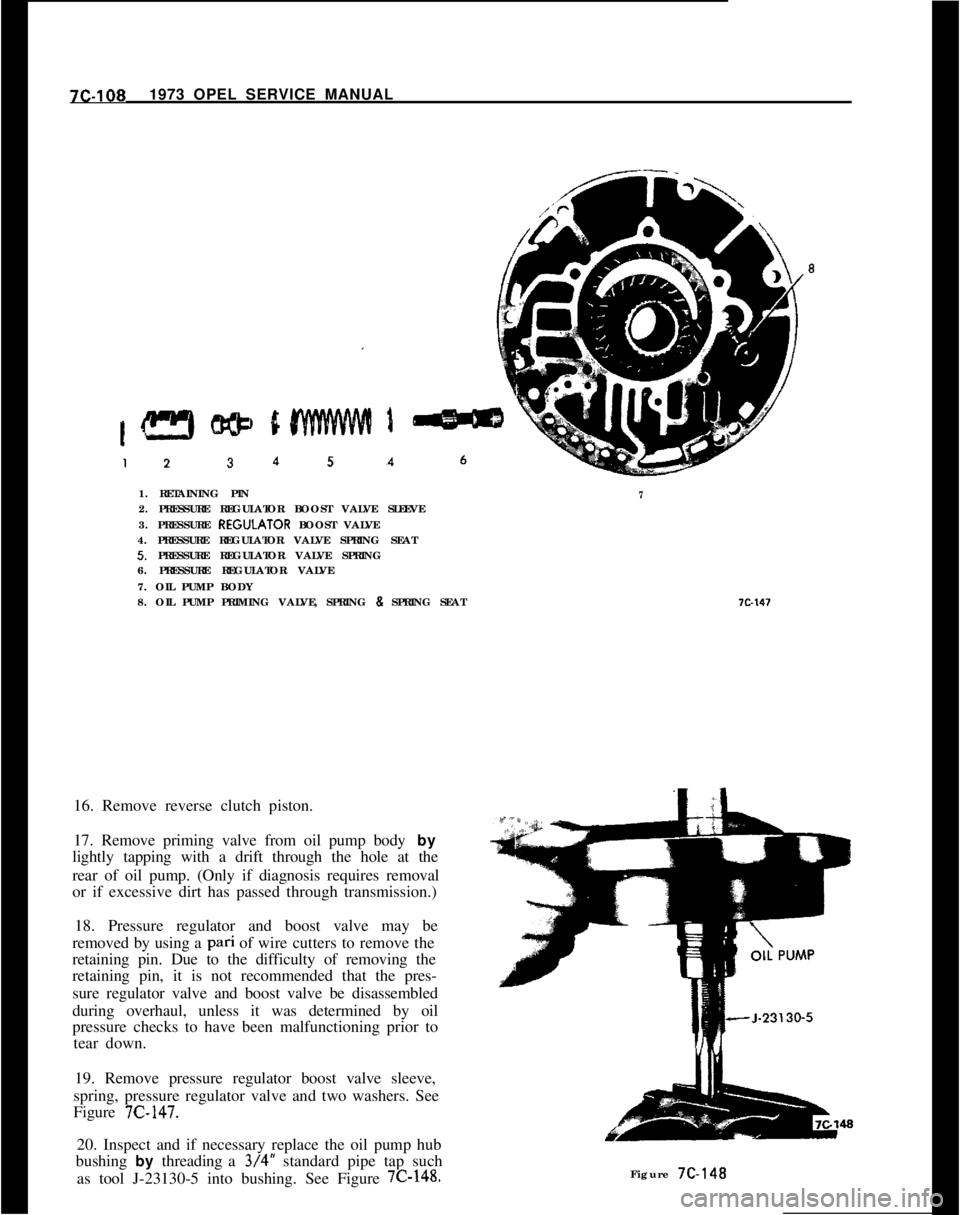
351. RETAINING PIN
72. PRESSURE REGULATOR BOOST VALVE SLEEVE
3. PRESSURE REGVLATOR BOOST VALVE
4. PRESSURE REGULATOR VALVE SPRING SEAT
5. PRESSURE REGULATOR VALVE SPRING
6. PRESSURE REGULATOR VALVE
7. OIL PUMP BODY
8. OIL PUMP PRIMING VALVE, SPRING 8 SPRING SEAT
16. Remove reverse clutch piston.
17. Remove priming valve from oil pump body by
lightly tapping with a drift through the hole at the
rear of oil pump. (Only if diagnosis requires removal
or if excessive dirt has passed through transmission.)
18. Pressure regulator and boost valve may be
removed by using a pari of wire cutters to remove the
retaining pin. Due to the difficulty of removing the
retaining pin, it is not recommended that the pres-
sure regulator valve and boost valve be disassembled
during overhaul, unless it was determined by oil
pressure checks to have been malfunctioning prior to
tear down.
19. Remove pressure regulator boost valve sleeve,
spring, pressure regulator valve and two washers. See
Figure
7C-147.20. Inspect and if necessary replace the oil pump hub
bushing by threading a 3/4” standard pipe tap such
as tool J-23130-5 into bushing. See Figure
7C-148.Figure 7C-148
Page 470 of 625
AUTOMATIC TRANSMISSION 7C-109
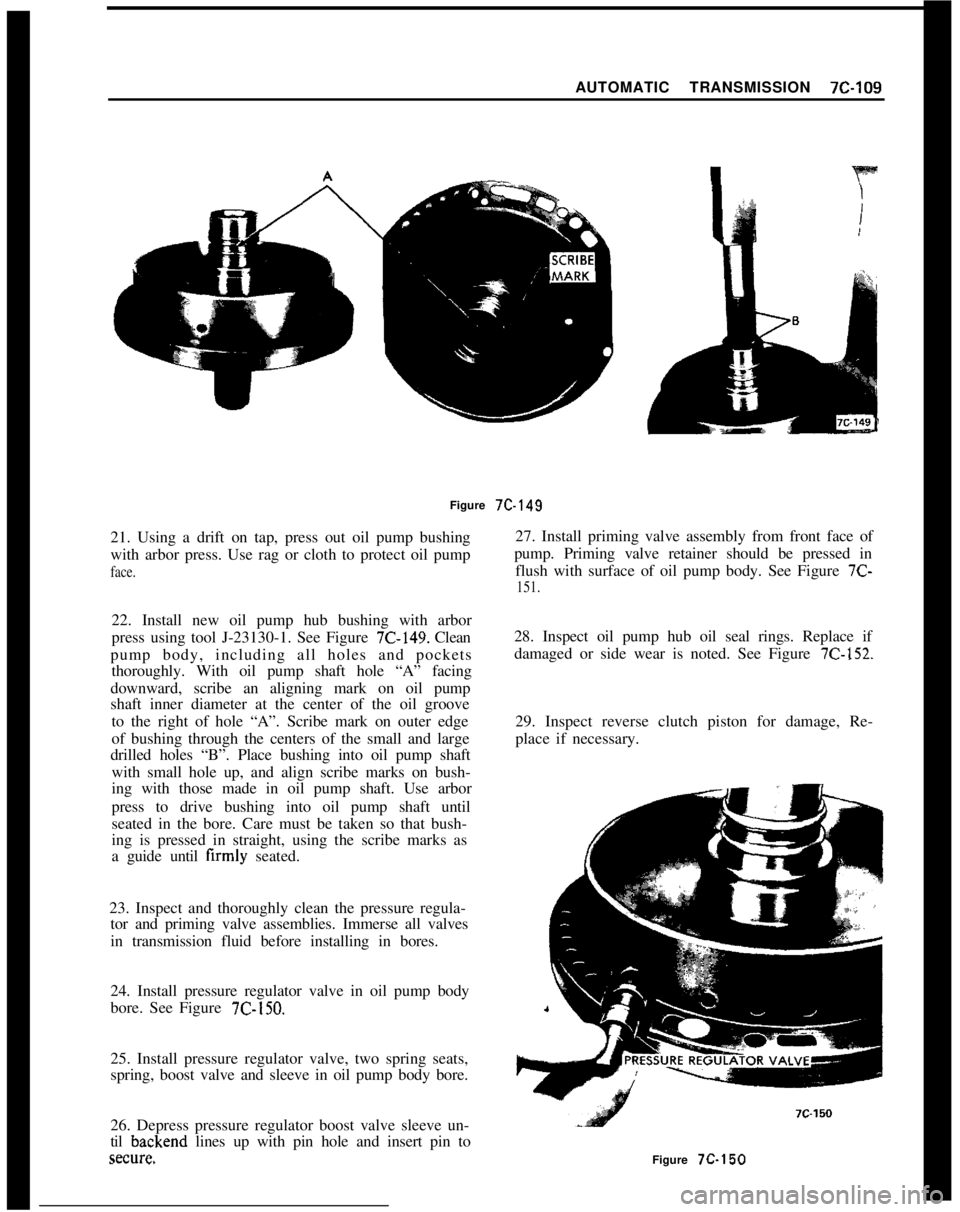
Figure 7C-149
21. Using a drift on tap, press out oil pump bushing
with arbor press. Use rag or cloth to protect oil pumpface.22. Install new oil pump hub bushing with arbor
press using tool J-23130-1. See Figure
7C-149. Clean
pump body, including all holes and pockets
thoroughly. With oil pump shaft hole “A” facing
downward, scribe an aligning mark on oil pump
shaft inner diameter at the center of the oil groove
to the right of hole “A”. Scribe mark on outer edge
of bushing through the centers of the small and large
drilled holes “B”. Place bushing into oil pump shaft
with small hole up, and align scribe marks on bush-
ing with those made in oil pump shaft. Use arbor
press to drive bushing into oil pump shaft until
seated in the bore. Care must be taken so that bush-
ing is pressed in straight, using the scribe marks as
a guide until firmly seated.
23. Inspect and thoroughly clean the pressure regula-
tor and priming valve assemblies. Immerse all valves
in transmission fluid before installing in bores.
24. Install pressure regulator valve in oil pump body
bore. See Figure
7C-150.25. Install pressure regulator valve, two spring seats,
spring, boost valve and sleeve in oil pump body bore.
26. Depress pressure regulator boost valve sleeve un-
til backend lines up with pin hole and insert pin to
XWP$.27. Install priming valve assembly from front face of
pump. Priming valve retainer should be pressed in
flush with surface of oil pump body. See Figure 7C-
151.28. Inspect oil pump hub oil seal rings. Replace if
damaged or side wear is noted. See Figure
7C-152.29. Inspect reverse clutch piston for damage, Re-
place if necessary.
Figure
7C-150
Page 484 of 625
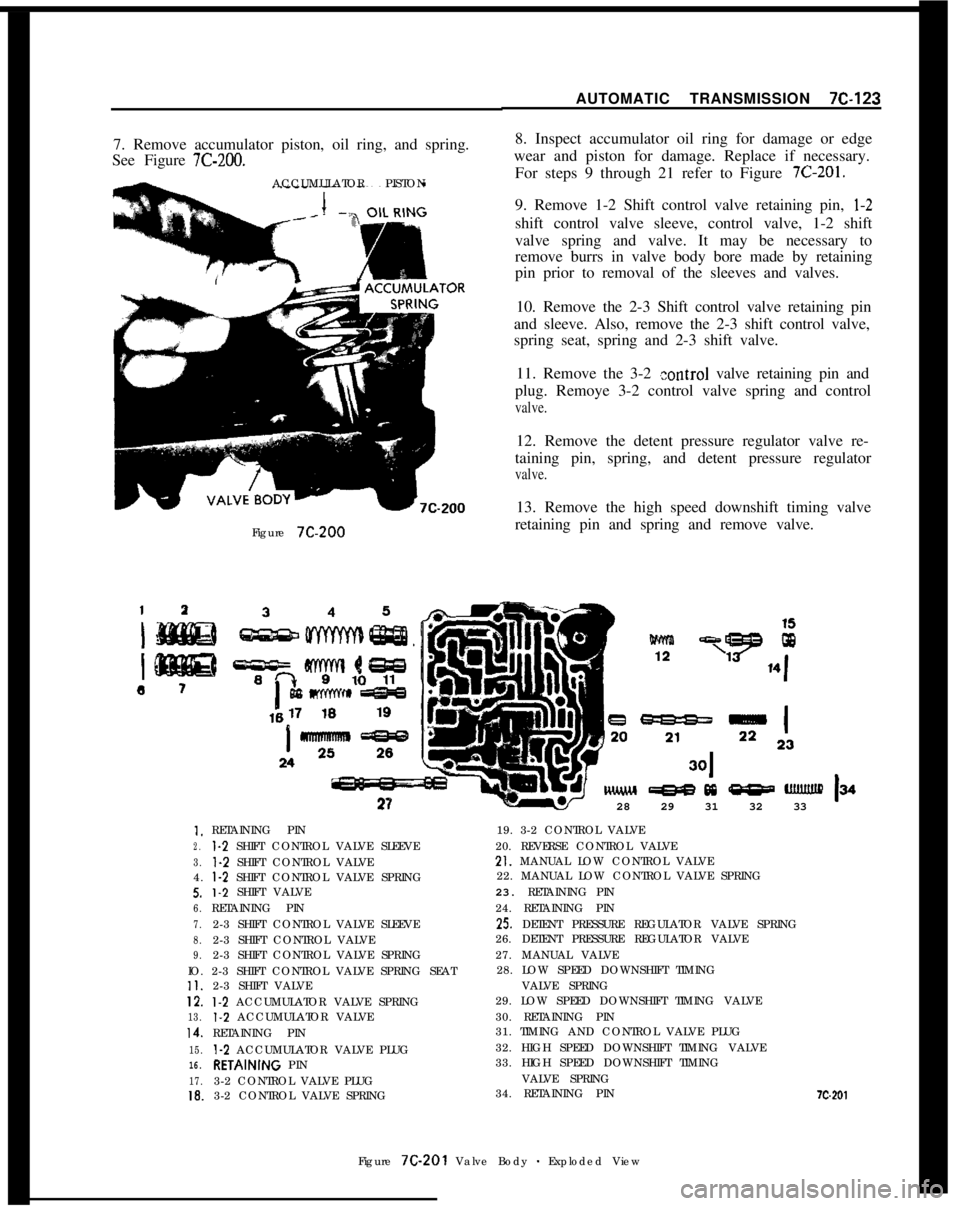
7. Remove accumulator piston, oil ring, and spring.
See Figure 7C-200.ACCUMULATOR PISTON
Figure 7C-200AUTOMATIC TRANSMISSION 7C-123
8. Inspect accumulator oil ring for damage or edge
wear and piston for damage. Replace if necessary.
For steps 9 through 21 refer to Figure 7C-201.9. Remove 1-2 Shift control valve retaining pin, l-2
shift control valve sleeve, control valve, 1-2 shift
valve spring and valve. It may be necessary to
remove burrs in valve body bore made by retaining
pin prior to removal of the sleeves and valves.
10. Remove the 2-3 Shift control valve retaining pin
and sleeve. Also, remove the 2-3 shift control valve,
spring seat, spring and 2-3 shift valve.
11. Remove the 3-2
,control valve retaining pin and
plug. Remoye 3-2 control valve spring and control
valve.12. Remove the detent pressure regulator valve re-
taining pin, spring, and detent pressure regulator
valve.13. Remove the high speed downshift timing valve
retaining pin and spring and remove valve.
1.RETAINING PIN
2.1-2 SHIFT CONTROL VALVE SLEEVE
3.1-2 SHIFT CONTROL VALVE
4. l-2 SHIFT CONTROL VALVE SPRING5.1-2 SHIFT VALVE
6.RETAINING PIN
7.2-3 SHIFT CONTROL VALVE SLEEVE
8.2-3 SHIFT CONTROL VALVE9.2-3 SHIFT CONTROL VALVE SPRING
IO. 2-3 SHIFT CONTROL VALVE SPRING SEAT
11.2-3 SHIFT VALVE
12.1-2 ACCUMULATOR VALVE SPRING13.1-2 ACCUMULATOR VALVE
14.RETAINING PIN
15.1-2 ACCUMULATOR VALVE PLUG16.RETAlNlNG PIN
17.3-2 CONTROL VALVE PLUG18.3-2 CONTROL VALVE SPRING
d 28 29 31 32 33uu44ucBBt?a~~19. 3-2 CONTROL VALVE
20. REVERSE CONTROL VALVE
21. MANUAL LOW CONTROL VALVE
22. MANUAL LOW CONTROL VALVE SPRING
23. RETAINING PIN
24. RETAINING PIN
25. DETENT PRESSURE REGULATOR VALVE SPRING
26. DETENT PRESSURE REGULATOR VALVE
27. MANUAL VALVE
28. LOW SPEED DOWNSHIFT TIMING
VALVE SPRING
29. LOW SPEED DOWNSHIFT TIMING VALVE
30. RETAINING PIN
31. TIMING AND CONTROL VALVE PLUG
32. HIGH SPEED DOWNSHIFT TIMING VALVE
33. HIGH SPEED DOWNSHIFT TIMING
VALVE SPRING
34. RETAINING PIN
7c-201Figure 7C-201 Valve Body
- Exploded View
Page 485 of 625

7C.1241973 OPEL SERVICE MANUAL
14. Remove the downshift timing valve plug retain-
ing pin and remove downshift timing valve plug.
Remove the low speed downshift timing valve and
spring.
15. Remove the manual low and r&erse control
valve retaining pin. Remove the spring and the
manual low control valve and the reverse control
valve.
16. Remove the l-2 accumulator valve retaining pin
and remove the l-2 accumulator valve plug, l-2 ac-
cumulator valve and spring.
17. A clean work area which is free of dirt and dust
should be used to inspect, clean and install the valves
in the valve body. Handle valve components with
clean hands and tools. Since most valve failures are
caused initially by dirt or other foreign matter pre-
venting a valve from functioning properly, a
thorough cleaning of all the components with a
cleaning solvent is essential. Do not use paraffin toclean out the valve body passages and valve bore.
Compressed air may be used to blow out the pas-
sages.18. Inspect each valve for free movement in its re-
spective bore in
t.he valve body. If necessary, use
crocus cloth to remove small burrs on a valve. Do
not remove the sharp edges of the valves as these
edges perform a cleaning action within the bore.
19. Inspect the valve springs for distortion or col-
lapsed coils. Replace the entire valve body assembly
if any parts are damaged.
20. Inspect the transfer plate for dents or distortion.
Replace transfer plate if necessary.
21. Reassemble the valves, springs, plugs and retain-
ing pins in their proper location and order into the
valve body using a liberal amount of transmission
fluid. See the spring data chart which includes the
spring identification sizes in the event springs have
been disarranged.
LocationApplication
PumpPressureRegulator Valve....................................................
PumpPrimingValve
...........................................................
.............Valve Body1.2ShiftValve......................................................................
Valve Body2-3ShiftValve......................................................................
Valve BodyDetentPressureRegulatorValve......................................
Valve BodyHigh-Speed Timing Valve....................................................
Valve BodyLow-Speed
TimingValve....................................................
Valve BodyReverse and Low Control Valve
........................................
CSSDetentValve..........................................................................
Valve Body1-2 Accumulator Valve........................................................
Valve Body3-2Control
Valve..................................................................
Gov. BodySecondary
Governor Valve................................................
Valve BodyAccumulator Piston
..............................................................
CaseServo Return..........................................................................SHVOServoCushion
........................................................................
Clutch PackClutchReturn(All)................................................................ SPRING IDENTIFICATION CHART
FreeOuter
HeightDiameter
2.756
,7601.043
,3202.467
,7201.769
,7001.625,474
1.349
,4061.380,406
1.343
,4062.569
,6751.072
,5201.853
.4061.317
,4061.9171.224
2.2401.850
1.0391.267
1.050
,42422. Install spring and accumulator piston in valve
body.
23. Compress accumulator piston with C-clamp and
install retaining ring.
24. Install new valve body gasket.2. Inspect and clean oil passages with cleaning sol-
vent and air.
3. Check for good retention of band anchor pins.
25. Bolt the transfer plate and gasket to the valve
body. Torque to 6-8 lbs. ft.
Disassembly, Inspection and Reassembly of Case
1. Inspect case for damage. See Figure
7C-202.4. Inspect all threaded holes for thread damage.
5. Inspect detent valve and modulator valve bores for
scratches or scoring.
6. Inspect case bushing inside of case at rear. If
da-maged, remove bushing with remover and installer
tool J-23 130-3 and driver handle J-8092. See Figure
7C-203.
Page 486 of 625
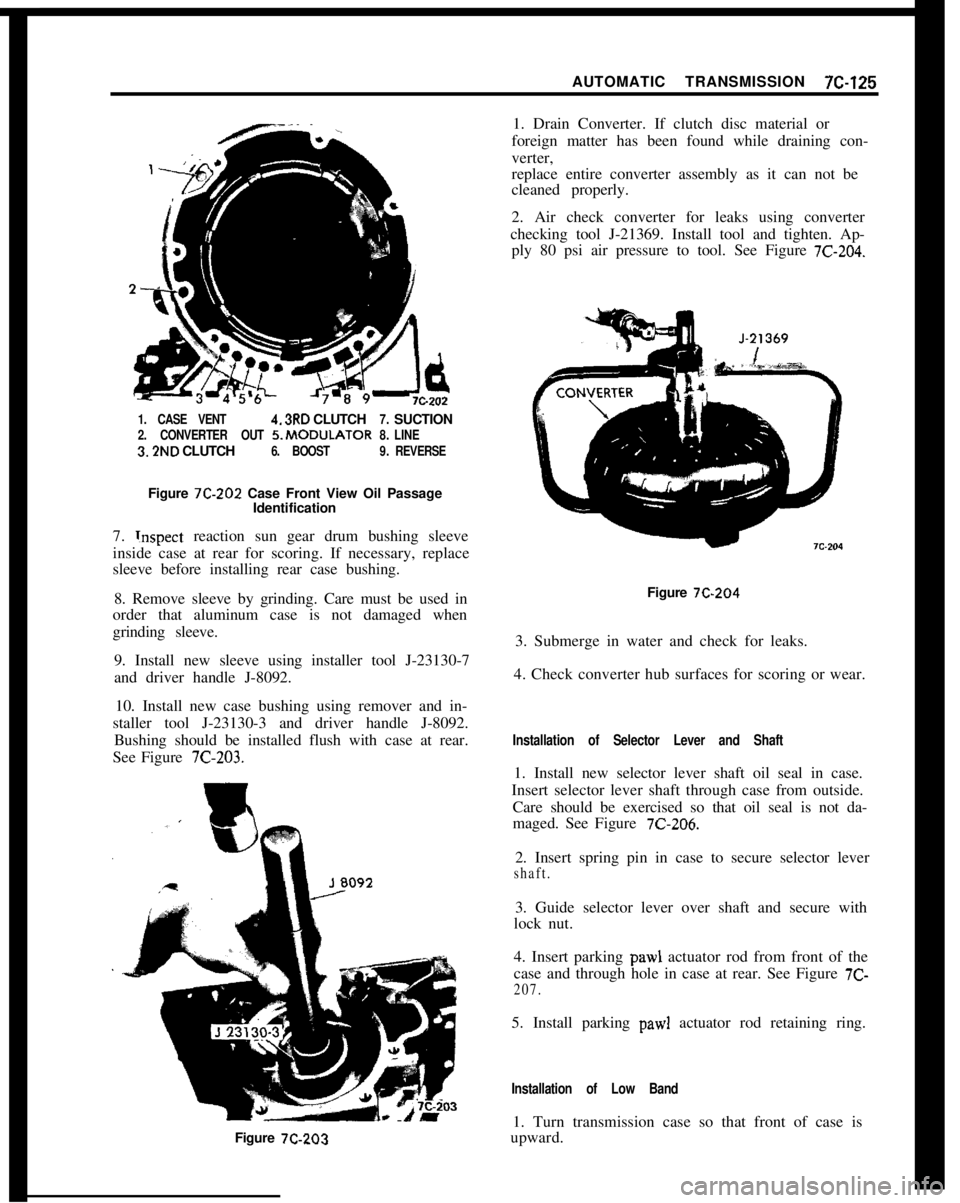
AUTOMATIC TRANSMISSION 7C-1251. CASE VENT4.3RD CLUTCH7.SUCTION
2. CONVERTER OUT5MODULATOR8.LINE/3.2ND CLUTCH
6. BOOST9.REVERSEFigure 7C-202 Case Front View Oil Passage
Identification
7.
!nspect reaction sun gear drum bushing sleeve
inside case at rear for scoring. If necessary, replace
sleeve before installing rear case bushing.
8. Remove sleeve by grinding. Care must be used in
order that aluminum case is not damaged when
grinding sleeve.
9. Install new sleeve using installer tool J-23130-7
and driver handle J-8092.
10. Install new case bushing using remover and in-
staller tool J-23130-3 and driver handle J-8092.
Bushing should be installed flush with case at rear.
See Figure
7C-203.Figure 7C-2031. Drain Converter. If clutch disc material or
foreign matter has been found while draining con-
verter,
replace entire converter assembly as it can not be
cleaned properly.
2. Air check converter for leaks using converter
checking tool J-21369. Install tool and tighten. Ap-
ply 80 psi air pressure to tool. See Figure
7C-204.Figure 7C-204
3. Submerge in water and check for leaks.
4. Check converter hub surfaces for scoring or wear.
Installation of Selector Lever and Shaft1. Install new selector lever shaft oil seal in case.
Insert selector lever shaft through case from outside.
Care should be exercised so that oil seal is not da-
maged. See Figure
7C-206.2. Insert spring pin in case to secure selector lever
shaft.3. Guide selector lever over shaft and secure with
lock nut.
4. Insert parking
paw1 actuator rod from front of the
case and through hole in case at rear. See Figure 7C-
207.5. Install parking
paw1 actuator rod retaining ring.
Installation of Low Band1. Turn transmission case so that front of case is
upward.
Page 497 of 625
7C-1361973 OPEL SERVICE MANUALshould be secured to keep the front wheels in a
straight-ahead position.sand,. mud, or snow, move the selector lever from
“D” to “R” in a repeat pattern while simultaneously
applying moderate pressure to the accelerator. DoRocking Carnot race engine. Avoid spinning wheels when trying
If it becomes necessary to rock the car to free it fromto free the car.
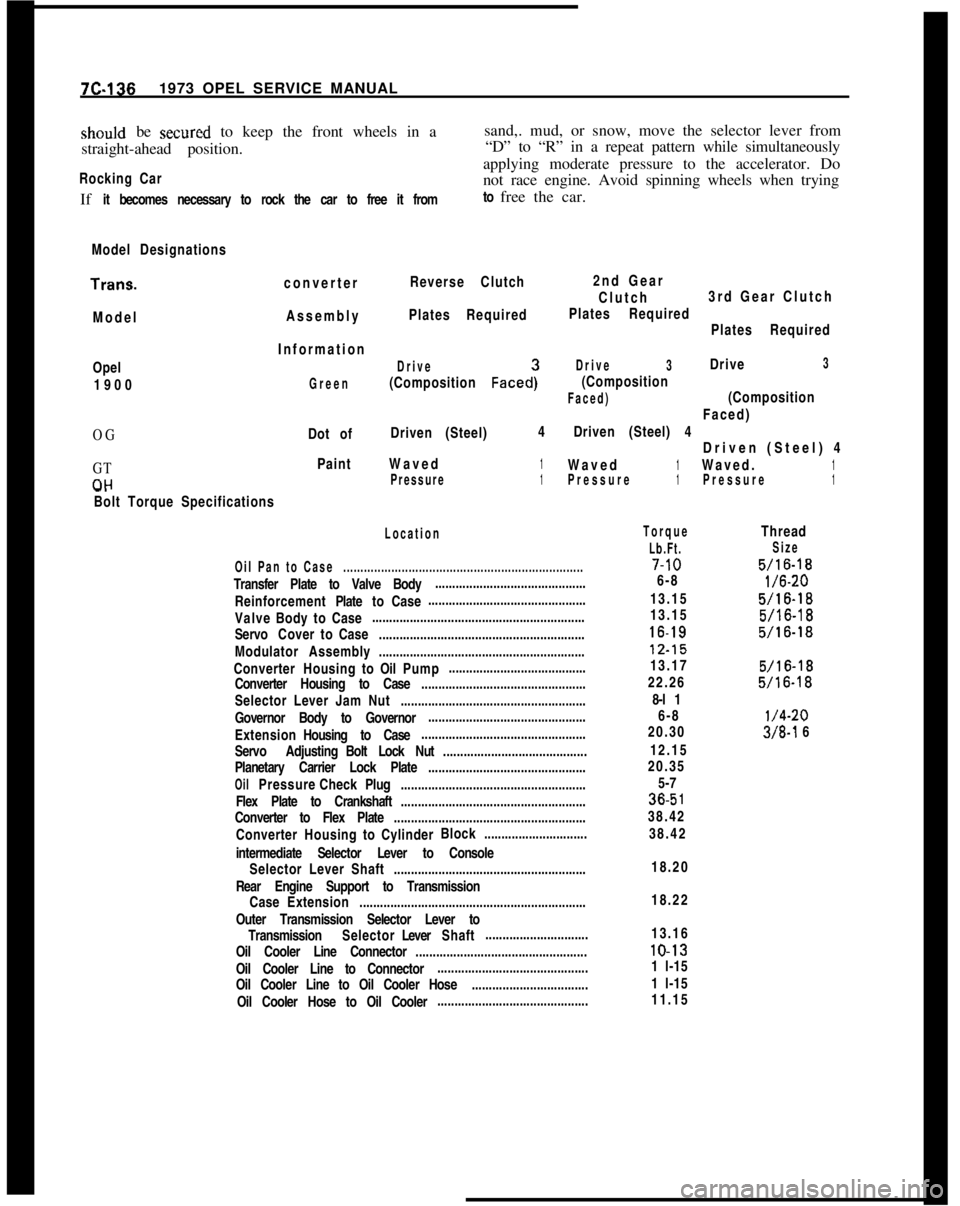
Model DesignationsTrans.
converterReverse Clutch
ModelAssemblyPlates Required2nd Gear
Clutch3rd Gear Clutch
Plates Required
Plates RequiredOpel
1900
OG
GT
CIHInformation
Drive
(Composition Faced:
Drive3Drive3
Green
(Composition
Faced)(CompositionFaced)
Dot ofDriven (Steel)4Driven (Steel) 4
Driven (Steel) 4
PaintWaved1Waved1Waved.1Pressure1Pressure1Pressure1-.
Bolt Torque Specifications
Location
Oil Pan to Case......................................................................Transfer Plate to Valve Body............................................
ReinforcementPlatetoCase..............................................
ValveBodytoCase..............................................................
ServoCovertoCase............................................................
Modulator Assembly............................................................
ConverterHousingtoOilPump........................................
Converter Housing to Case................................................
Selector Lever Jam Nut......................................................
Governor Body to Governor..............................................
ExtensionHousing to Case................................................
Servo AdjustingBolt Lock Nut..........................................
Planetary Carrier Lock Plate..............................................
OilPressureCheckPlug......................................................
Flex Plate to Crankshaft......................................................
Converter to Flex Plate........................................................
ConverterHousingtoCylinderBlock..............................
intermediate Selector Lever to Console
Selector Lever Shaft........................................................
Rear Engine Support to Transmission
CaseExtension..................................................................
Outer Transmission Selector Lever to
TransmissionSelectorLeverShaft..............................
Oil Cooler Line Connector..................................................
Oil Cooler Line to Connector............................................
Oil Cooler Line to Oil Cooler Hose..................................
Oil Cooler Hose to Oil Cooler............................................
Torque
Lb.Ft.7-10
6-8
13.15
13.1516-1812.15
13.17
22.26
8-l 1
6-8
20.30
12.15
20.35
5-736.5
138.42
38.42
Thread
Size
5/16-18
l/6-20
5/16-18
5/16-18
5/16-18
5/16-18
5/16-18
l/4-20
3/8-l 6
18.20
18.22
13.1610-13
1 l-15
1 l-15
11.15
Page 531 of 625
9B-22 1973 OPEL SERVICE MANUAL
We can change a vapor back into a liquid by chilling
it, or do the same thing with pressure. When we
condense a vapor we will find that the heat removed
just exactly equals the amount of heat that was neces-
sary to make the substance vaporize in the first place.
At last the lost is found! The latent heat of vaporiza-
tion the heat that apparently disappeared when
a liquid boiled into a vapor again reappears on
the scene when that same vapor reverts back into a
liquid. It is just like putting air into a balloon to
expand it and then letting the same amount of air out
again to return the balloon to its original condition.
We know that any substance will condense at the
same temperature at which it boiled. This tempera-
ture point is a clear-cut division like a fence. On one
side, a substance is a liquid. Immediately on the
other side it is a vapor. Whichever way a substance
would go, from hot to cold or cold to hot, it will
change its character the moment it crosses over thefence.But pressure moves the fence! Water will boil at 212
degrees under normal conditions. Naturally, we ex-
pect steam to condense at the same temperature. But
whenever we put pressure on steam, it doesn’t! It will
condense at some temperature higher than 212 de-
grees. The greater the pressure, the higher the boiling
point and the temperature at which a vapor will
condense. This is the reason why pressure cookers
cook food faster, since the pressure on the water
permits it to boil out at a higher temperature. We
know that R-12 boils at 21.7 degrees below zero. A
thermometer will show us that the rising vapors,
even though they have soaked up lots of heat, are
only slightly warmer. But the vapors must be made
warmer than the room air if we expect heat to flow
out of them. Also, the condensing point temperature
must be above that of room air or else the vapors
won’t condense.This is where pressure comes to the rescue. With
pressure, we can compress the vapor, thereby con-
centrating the heat it contains. When we concentrate
heat in a vapor that way, we increase the intensity of
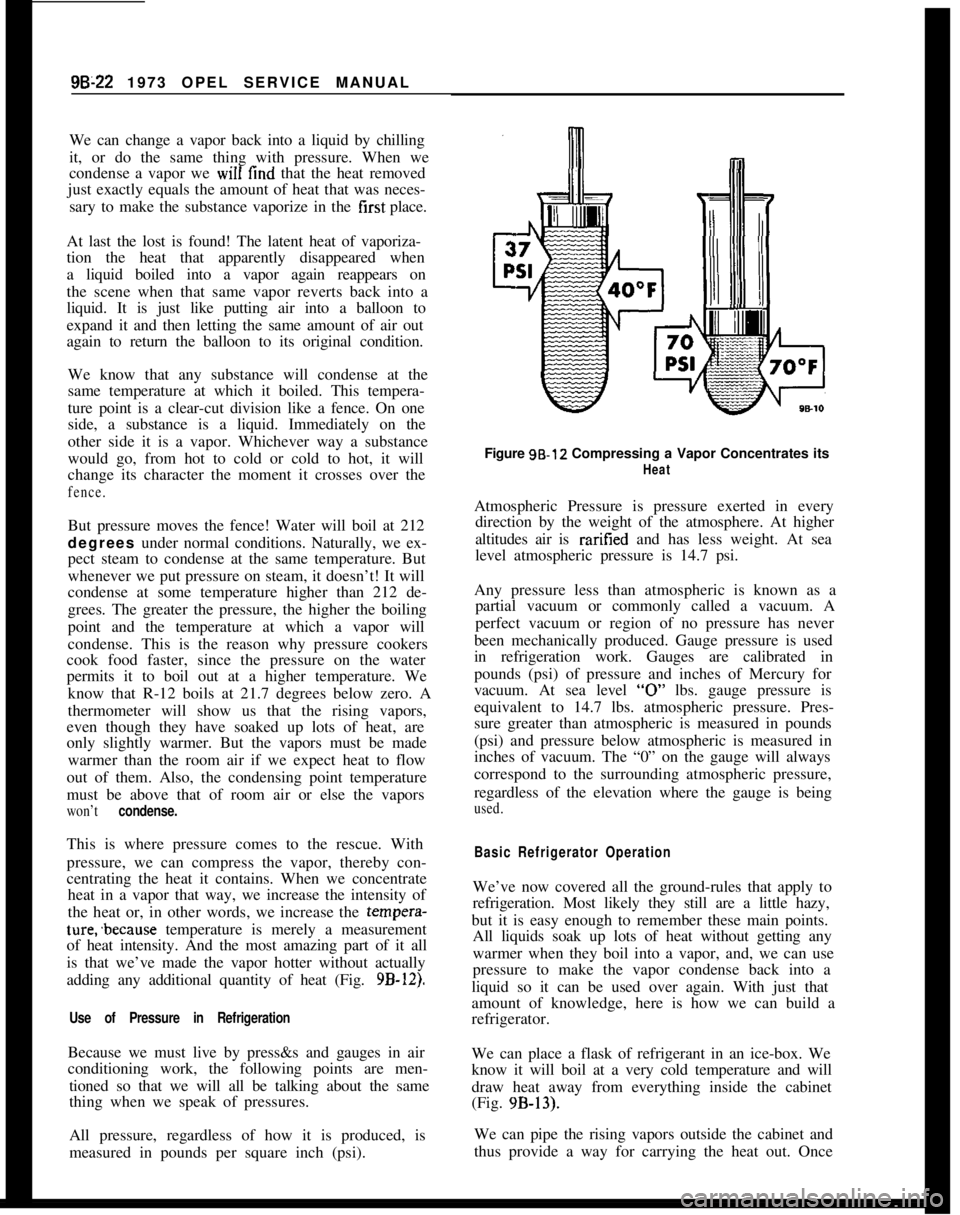
the heat or, in other words, we increase the tempera-ture;because temperature is merely a measurement
of heat intensity. And the most amazing part of it all
is that we’ve made the vapor hotter without actually
adding any additional quantity of heat (Fig.
9B-12).
Use of Pressure in RefrigerationBecause we must live by press&s and gauges in air
conditioning work, the following points are men-
tioned so that we will all be talking about the same
thing when we speak of pressures.
All pressure, regardless of how it is produced, is
measured in pounds per square inch (psi).Figure 98.12 Compressing a Vapor Concentrates its
HeatAtmospheric Pressure is pressure exerted in every
direction by the weight of the atmosphere. At higher
altitudes air is raritied and has less weight. At sea
level atmospheric pressure is 14.7 psi.
Any pressure less than atmospheric is known as a
partial vacuum or commonly called a vacuum. A
perfect vacuum or region of no pressure has never
been mechanically produced. Gauge pressure is used
in refrigeration work. Gauges are calibrated in
pounds (psi) of pressure and inches of Mercury for
vacuum. At sea level
“0” lbs. gauge pressure is
equivalent to 14.7 lbs. atmospheric pressure. Pres-
sure greater than atmospheric is measured in pounds
(psi) and pressure below atmospheric is measured in
inches of vacuum. The “0” on the gauge will always
correspond to the surrounding atmospheric pressure,
regardless of the elevation where the gauge is being
used.
Basic Refrigerator OperationWe’ve now covered all the ground-rules that apply to
refrigeration. Most likely they still are a little hazy,
but it is easy enough to remember these main points.
All liquids soak up lots of heat without getting any
warmer when they boil into a vapor, and, we can use
pressure to make the vapor condense back into a
liquid so it can be used over again. With just that
amount of knowledge, here is how we can build a
refrigerator.
We can place a flask of refrigerant in an ice-box. We
know it will boil at a very cold temperature and will
draw heat away from everything inside the cabinet
(Fig. 9B-13).
We can pipe the rising vapors outside the cabinet and
thus provide a way for carrying the heat out. Once
Page 532 of 625
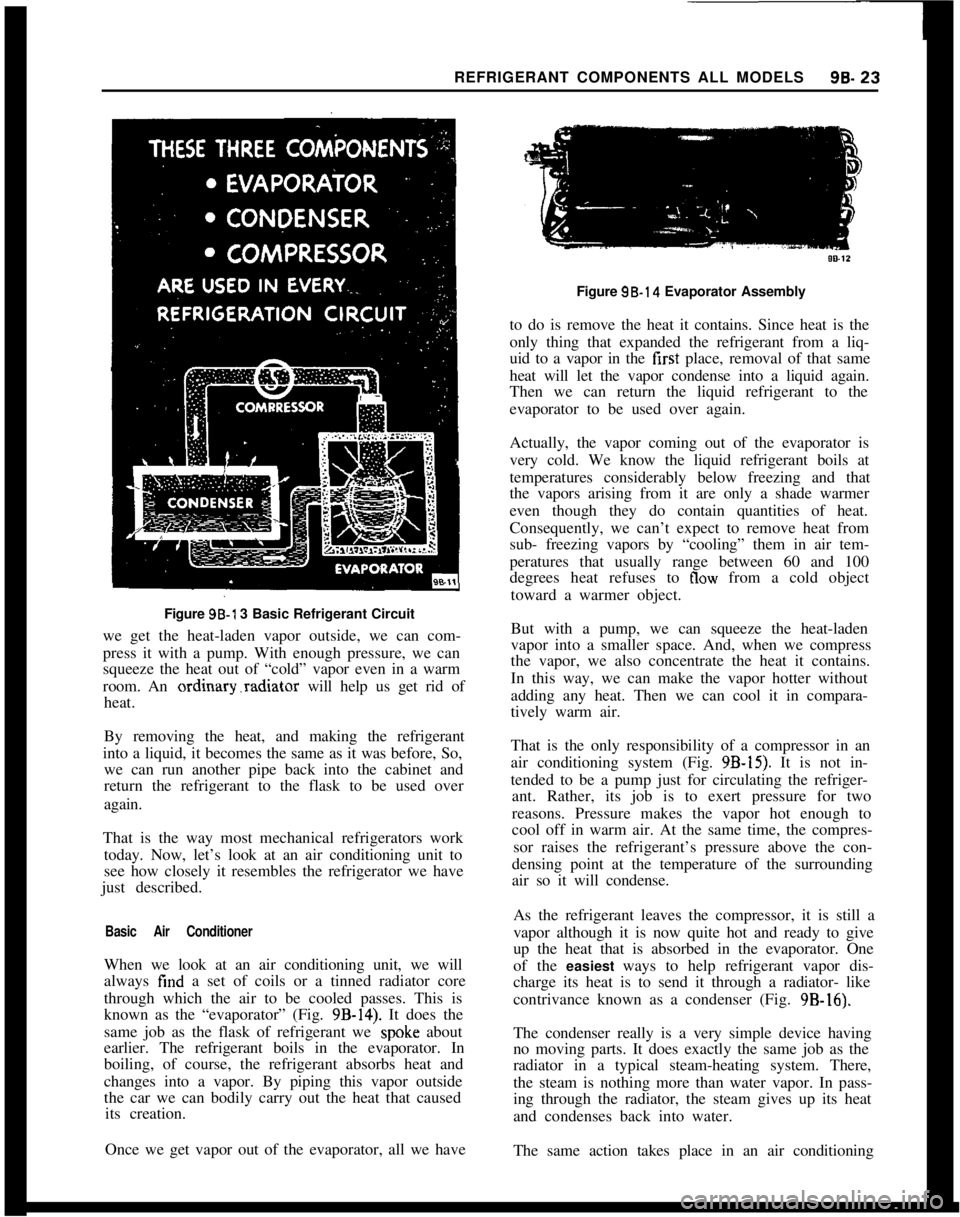
REFRIGERANT COMPONENTS ALL MODELS96.23Figure 96-l 3 Basic Refrigerant Circuit
we get the heat-laden vapor outside, we can com-
press it with a pump. With enough pressure, we can
squeeze the heat out of “cold” vapor even in a warm
room. An ordinary.radiator will help us get rid of
heat.
By removing the heat, and making the refrigerant
into a liquid, it becomes the same as it was before, So,
we can run another pipe back into the cabinet and
return the refrigerant to the flask to be used over
again.
That is the way most mechanical refrigerators work
today. Now, let’s look at an air conditioning unit to
see how closely it resembles the refrigerator we have
just described.
Basic Air ConditionerWhen we look at an air conditioning unit, we will
always find a set of coils or a tinned radiator core
through which the air to be cooled passes. This is
known as the “evaporator” (Fig.
9B-14). It does the
same job as the flask of refrigerant we
spok.e about
earlier. The refrigerant boils in the evaporator. In
boiling, of course, the refrigerant absorbs heat and
changes into a vapor. By piping this vapor outside
the car we can bodily carry out the heat that caused
its creation.
Once we get vapor out of the evaporator, all we haveFigure 98.14 Evaporator Assembly
to do is remove the heat it contains. Since heat is the
only thing that expanded the refrigerant from a liq-
uid to a vapor in the first place, removal of that same
heat will let the vapor condense into a liquid again.
Then we can return the liquid refrigerant to the
evaporator to be used over again.
Actually, the vapor coming out of the evaporator is
very cold. We know the liquid refrigerant boils at
temperatures considerably below freezing and that
the vapors arising from it are only a shade warmer
even though they do contain quantities of heat.
Consequently, we can’t expect to remove heat from
sub- freezing vapors by “cooling” them in air tem-
peratures that usually range between 60 and 100
degrees heat refuses to
flow from a cold object
toward a warmer object.
But with a pump, we can squeeze the heat-laden
vapor into a smaller space. And, when we compress
the vapor, we also concentrate the heat it contains.
In this way, we can make the vapor hotter without
adding any heat. Then we can cool it in compara-
tively warm air.
That is the only responsibility of a compressor in an
air conditioning system (Fig.
9B-15). It is not in-
tended to be a pump just for circulating the refriger-
ant. Rather, its job is to exert pressure for two
reasons. Pressure makes the vapor hot enough to
cool off in warm air. At the same time, the compres-
sor raises the refrigerant’s pressure above the con-
densing point at the temperature of the surrounding
air so it will condense.
As the refrigerant leaves the compressor, it is still a
vapor although it is now quite hot and ready to give
up the heat that is absorbed in the evaporator. One
of the easiest ways to help refrigerant vapor dis-
charge its heat is to send it through a radiator- like
contrivance known as a condenser (Fig. 9B-16).
The condenser really is a very simple device having
no moving parts. It does exactly the same job as the
radiator in a typical steam-heating system. There,
the steam is nothing more than water vapor. In pass-
ing through the radiator, the steam gives up its heat
and condenses back into water.
The same action takes place in an air conditioning