automatic transmission OPEL MERIVA 2009 User Guide
[x] Cancel search | Manufacturer: OPEL, Model Year: 2009, Model line: MERIVA, Model: OPEL MERIVA 2009Pages: 248, PDF Size: 4.46 MB
Page 139 of 248
133
Driving and operation
Picture no: 14083j.tif
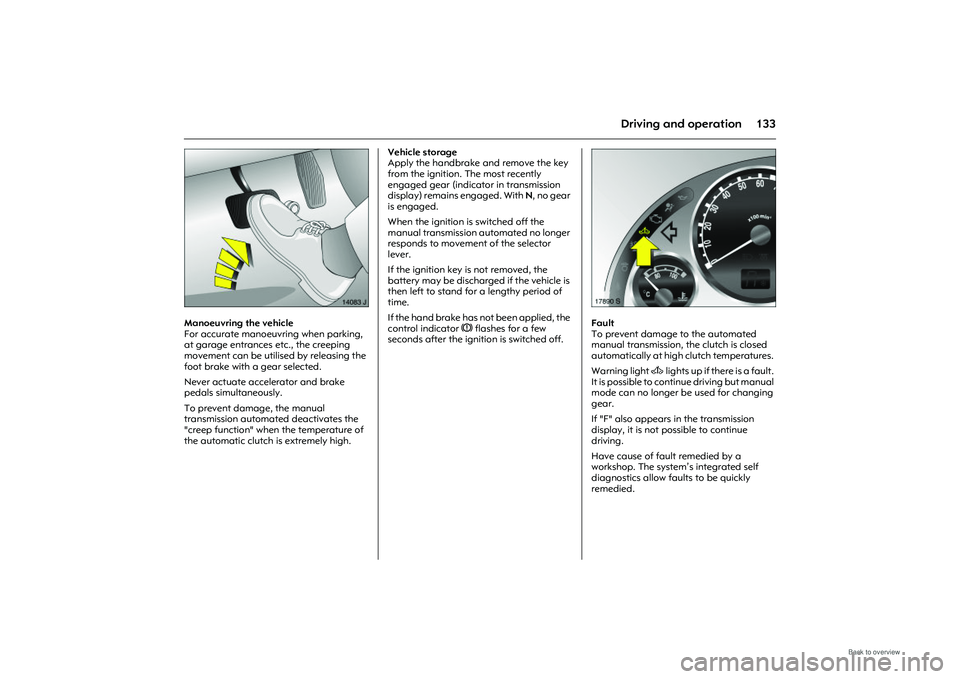
Manoeuvring the vehicle
For accurate manoeuvring when parking,
at garage entrances etc., the creeping
movement can be utilised by releasing the
foot brake with a gear selected.
Never actuate accelerator and brake
pedals simultaneously.
To prevent damage, the manual
transmission automated deactivates the
"creep function" when the temperature of
the automatic clutch is extremely high. Vehicle storage
Apply the handbrake and remove the key
from the ignition. The most recently
engaged gear (indicator in transmission
display) remains engaged. With
N, no gear
is engaged.
When the ignition is switched off the
manual transmission automated no longer
responds to movement of the selector
lever.
If the ignition key is not removed, the
battery may be discharg ed if the vehicle is
then left to stand for a lengthy period of
time.
If the hand brake has not been applied, the
control indicator R flashes for a few
seconds after the ignition is switched off.
Picture no: 17890s.tif
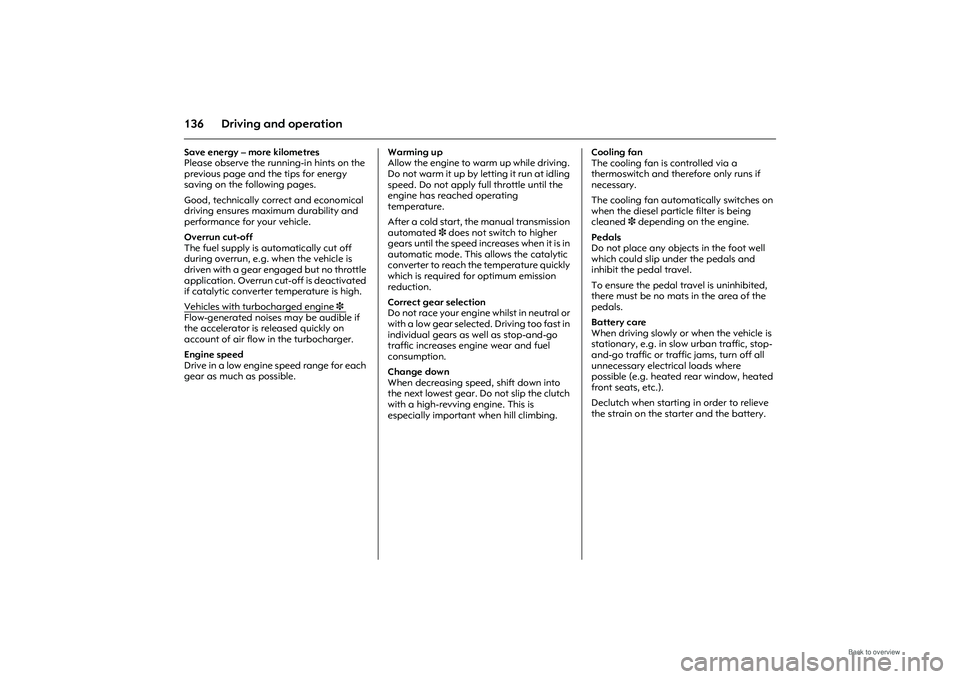
Fault
To prevent damage to the automated
manual transmission, the clutch is closed
automatically at high clutch temperatures.
Warning light A lights up if there is a fault.
It is possible to continue driving but manual
mode can no longer be used for changing
gear.
If "F" also appears in the transmission
display, it is not possible to continue
driving.
Have cause of fault remedied by a
workshop. The system’s integrated self
diagnostics allow faults to be quickly
remedied.
Page 142 of 248
136 Driving and operationSave energy – more kilometres
Please observe the running-in hints on the
previous page and the tips for energy
saving on the following pages.
Good, technically correct and economical
driving ensures maximum durability and
performance for your vehicle.
Overrun cut-off
The fuel supply is automatically cut off
during overrun, e.g. when the vehicle is
driven with a gear engaged but no throttle
application. Overrun cut-off is deactivated
if catalytic converter temperature is high.
Vehicles with turbocharged engine
3
Flow-generated noises may be audible if
the accelerator is released quickly on
account of air flow in the turbocharger.
Engine speed
Drive in a low engine speed range for each
gear as much as possible. Warming up
Allow the engine to wa
rm up while driving.
Do not warm it up by letting it ru n at idling
speed. Do not apply full throttle until the
engine has reached operating
temperature.
After a cold start, the manual transmission
automated 3 does not switch to higher
gears until the speed increases when it is in
automatic mode. This allows the catalytic
converter to reach th e temperature quickly
which is required for optimum emission
reduction.
Correct gear selection
Do not race your engine whilst in neutral or
with a low gear selected. Driving too fast in
individual gears as well as stop-and-go
traffic increases engine wear and fuel
consumption.
Change down
When decreasing speed, shift down into
the next lowest gear. Do not slip the clutch
with a high-revving engine. This is
especially important when hill climbing. Cooling fan
The cooling fan is controlled via a
thermoswitch and therefore only runs if
necessary.
The cooling fan automatically switches on
when the diesel particle filter is being
cleaned
3 depending on the engine.
Pedals
Do not place any objects in the foot well
which could slip under the pedals and
inhibit the pedal travel.
To ensure the pedal travel is uninhibited,
there must be no mats in the area of the
pedals.
Battery care
When driving slowly or when the vehicle is
stationary, e.g. in slow urban traffic, stop-
and-go traffic or traffic jams, turn off all
unnecessary electrical loads where
possible (e.g. heated rear window, heated
front seats, etc.).
Declutch when starting in order to relieve
the strain on the starter and the battery.
Page 154 of 248
148 Driving and operationCruise control 3
Cruise control can store and maintain
speeds of approx. 30 to 200 km/h.
Deviation from the stored speed is possible
on uphill or downhill inclines.
For safety reasons the cruise control
cannot be activated until the foot brake
has been operated once.
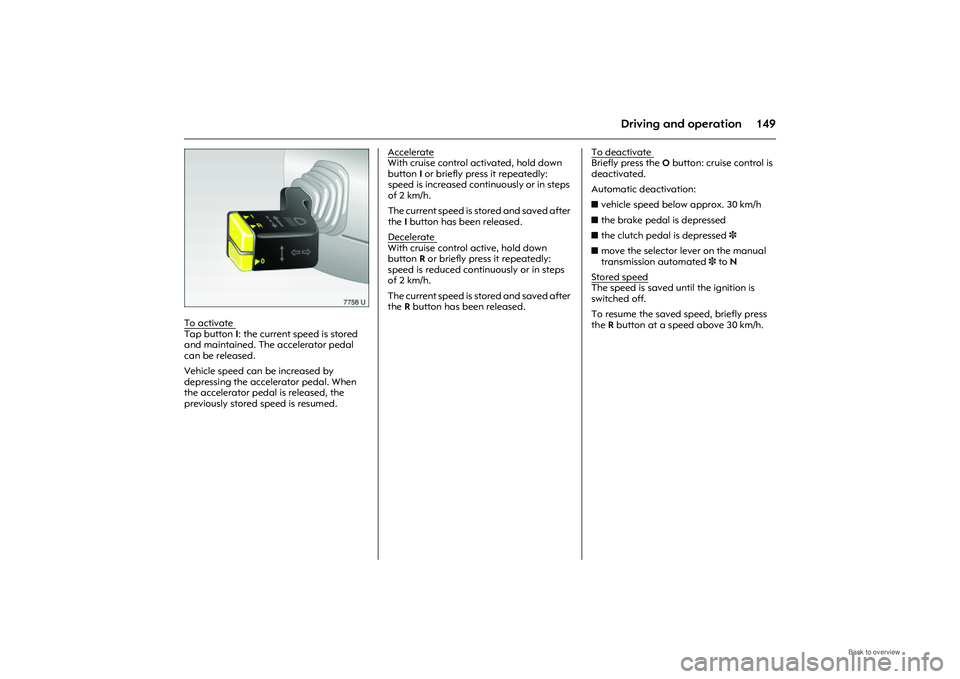
The cruise control is operated with the
buttons I, R and O on the turn signal lever.
Do not use the cruise control if it is not
advisable to maintain a constant speed
(e.g. in situations presenting a danger to
yourself and other road users, in heavy
traffic or on winding, slippery or greasy
roads). For manual transmission automated
3,
engage cruise control in automatic mode
only.
Picture no: 17893s.tif
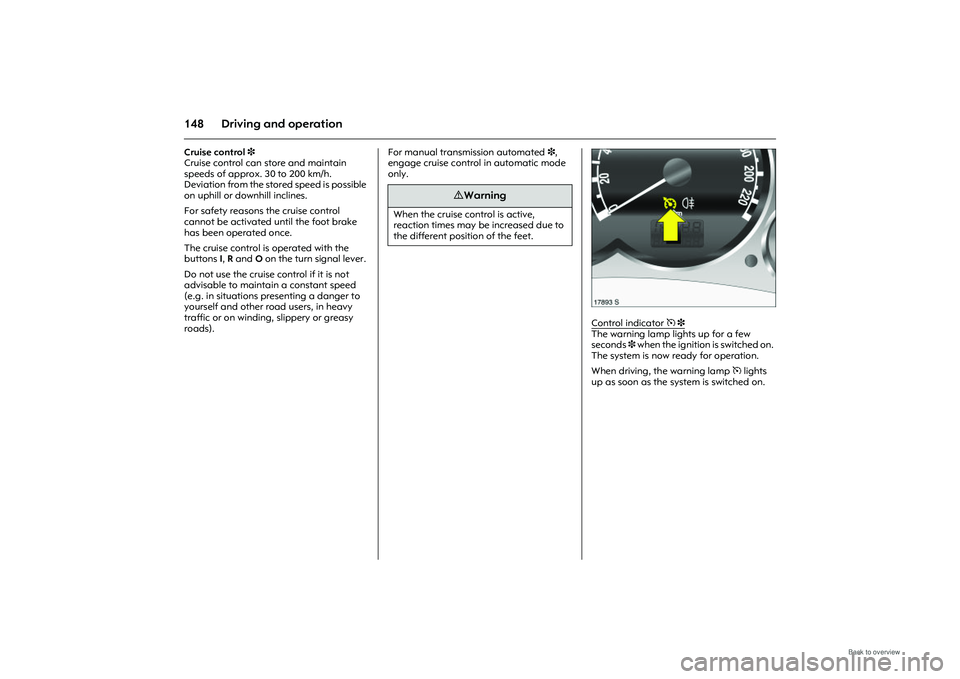
Control indicator
m 3
The warning lamp lights up for a few
seconds 3 when the ignition is switched on.
The system is now ready for operation.
When driving, th e warning lamp m lights
up as soon as the sy stem is switched on.
9 Warning
When the cruise control is active,
reaction times may be increased due to
the different position of the feet.
Page 155 of 248
149
Driving and operation
Picture no: 7758u.tif
To activate Tap button I: the current speed is stored
and maintained. The accelerator pedal
can be released.
Vehicle speed can be increased by
depressing the accelerator pedal. When
the accelerator pedal is released, the
previously stored speed is resumed. Accelerate
With cruise control activated, hold down
button I or briefly press it repeatedly:
speed is increased continuously or in steps
of 2 km/h.
The current speed is stored and saved after
the I button has been released.
Decelerate
With cruise control active, hold down
button R or briefly press it repeatedly:
speed is reduced continuously or in steps
of 2 km/h.
The current speed is stored and saved after
the R button has been released. To deactivate
Briefly press the
O button: cruise control is
deactivated.
Automatic deactivation:
z vehicle speed below approx. 30 km/h
z the brake pedal is depressed
z the clutch pedal is depressed 3
z move the selector lever on the manual
transmission automated 3 to N
Stored speed
The speed is saved until the ignition is
switched off.
To resume the saved speed, briefly press
the R button at a speed above 30 km/h.
Page 170 of 248
164 Driving and operationIf the trailer/caravan starts to sway, drive
more slowly, do not attempt to correct the
steering and brake sharply if necessary.
If it is necessary to apply the brakes fully,
depress the brake pedal as hard as
possible.
Remember that the braking distance for
vehicles towing carava ns/trailers with and
without brake is always greater than that
for vehicles not towing a caravan/trailer.
When driving downhill , drive in the same
gear as if driving uphill and drive at a
similar speed.
Adjust tyre pressure to the value specified
for full load 3228. Starting on inclines
For vehicles with ma
nual transmission,
the most favourable engine speed
when starting off on an incline is
between 2500 and 3000 rpm for petrol
engines and between 2000 and 2500 rpm
for diesel engines. Hold engine speed
constant, engage clutch gradually (let slip)
– release hand brake – and open throttle. If
possible, the engine speed should not drop
during this procedure.
For vehicles with ma nual transmission
automated 3 in Automatic mode simply
apply full gas. Before starting off under extreme
operating conditions, switch off
unnecessary consumers.
Page 176 of 248
170 Self-help, vehicle careIf the automatic clutch has been manually
disengaged in vehicles with manual
automated transmission 3 towing is not
permitted 3134. In this case, contact a
workshop for assistance immediately.
After towing, unscrew towing eye by
rotating clockwise and insert and close the
cap.
Picture no: 14199s.tif
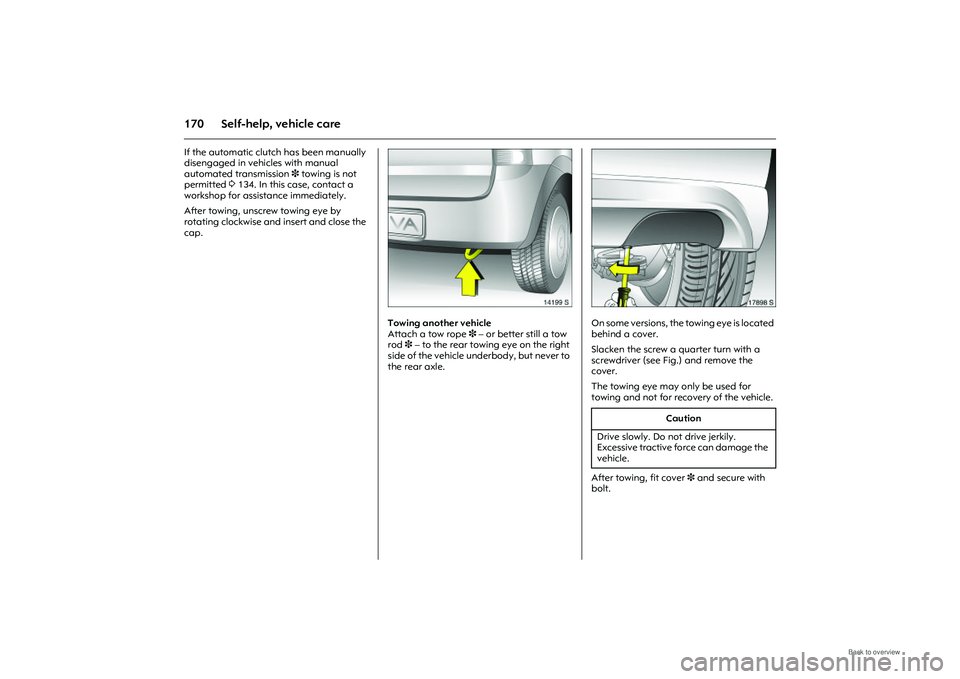
Towing another vehicle
Attach a tow rope 3 – or better still a tow
rod 3 – to the rear towing eye on the right
side of the vehicle underbody, but never to
the rear axle.
Picture no: 17898s.tif
On some versions, the towing eye is located
behind a cover.
Slacken the screw a quarter turn with a
screwdriver (see Fig.) and remove the
cover.
The towing eye may only be used for
towing and not for recovery of the vehicle.
After towing, fit cover 3 and secure with
bolt.
Caution
Drive slowly. Do not drive jerkily.
Excessive tractive force can damage the
vehicle.