brake OPEL MERIVA 2009 User Guide
[x] Cancel search | Manufacturer: OPEL, Model Year: 2009, Model line: MERIVA, Model: OPEL MERIVA 2009Pages: 248, PDF Size: 4.46 MB
Page 118 of 248
112 Infotainment system
Picture no: 14035s.tif
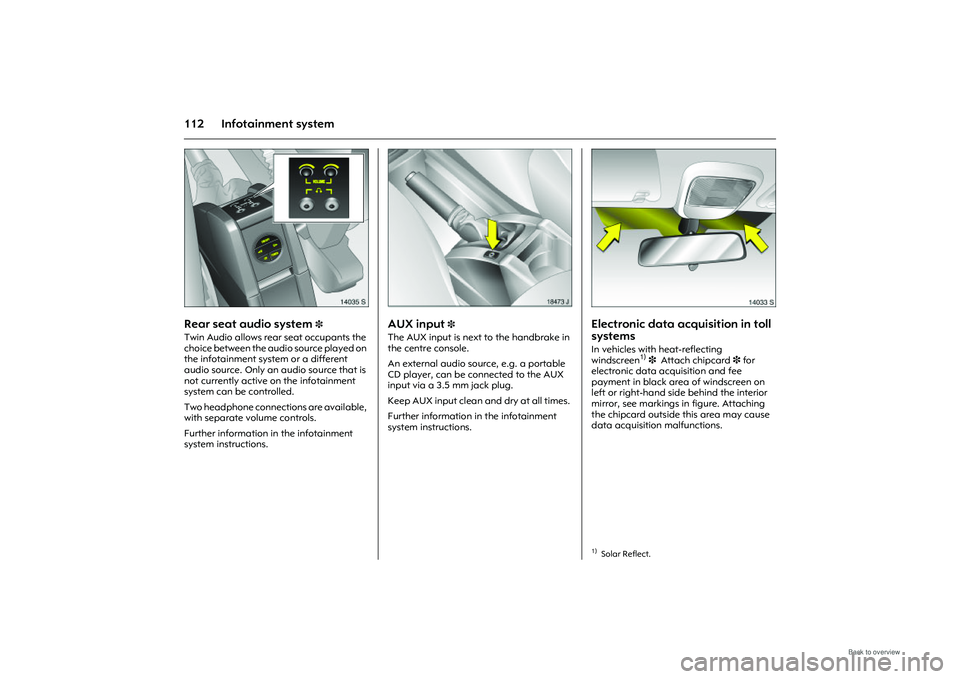
Rear seat audio system
3
Twin Audio allows rear seat occupants the
choice between the audio source played on
the infotainment system or a different
audio source. Only an audio source that is
not currently active on the infotainment
system can be controlled.
Two headphone connections are available,
with separate volume controls.
Further information in the infotainment
system instructions.
Picture no: 18473s.tif
AUX input
3
The AUX input is next to the handbrake in
the centre console.
An external audio source, e.g. a portable
CD player, can be connected to the AUX
input via a 3.5 mm jack plug.
Keep AUX input clean and dry at all times.
Further information in the infotainment
system instructions.
Picture no: 14033s.tif
Electronic data acquisition in toll
systems In vehicles with heat-reflecting
windscreen
1) 3 Attach chipcard 3 for
electronic data acquisition and fee
payment in black area of windscreen on
left or right-hand side behind the interior
mirror, see markings in figure. Attaching
the chipcard outside this area may cause
data acquisition malfunctions.
1)Solar Reflect.
Page 135 of 248
129
Driving and operation
Driving and operation
Manual transmission
automated
3
The manual transmission automated
transmission 3 permits manual ( manual
mode ) or automatic gear shifting
(automatic mode ), both with automatic
clutch control.
Picture no: 17878s.tif
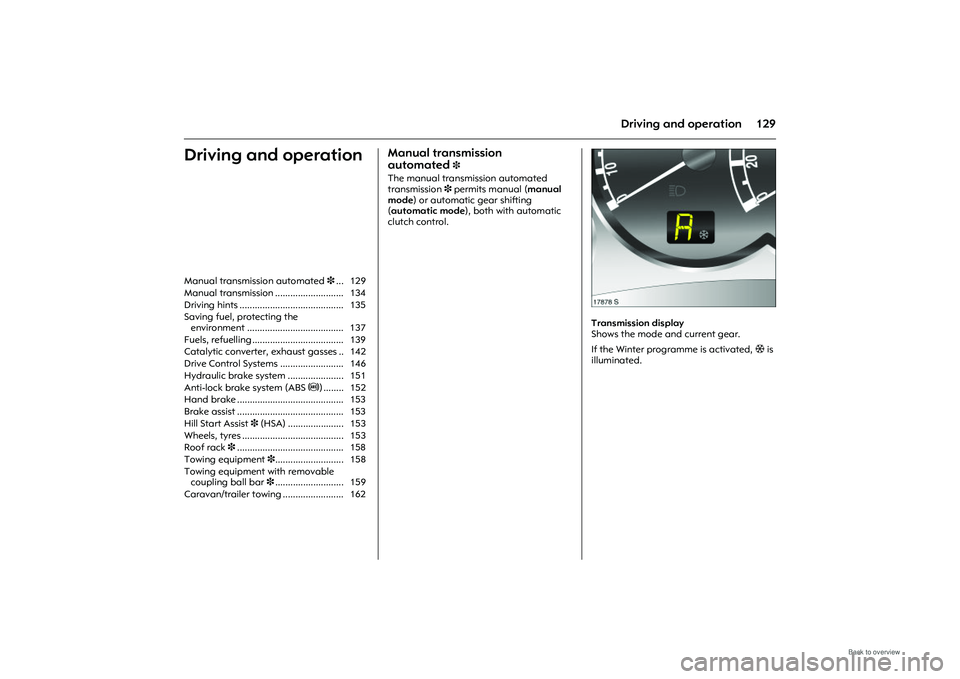
Transmission display
Shows the mode and current gear.
If the Winter programme is activated, T is
illuminated.
Manual transmission automated
3... 129
Manual transmission ........................... 134
Driving hints ......................................... 135
Saving fuel, protecting the environment ...................................... 137
Fuels, refuelling .................................... 139
Catalytic converter, exhaust gasses .. 142
Drive Control Systems ......................... 146
Hydraulic brake system ...................... 151
Anti-lock brake system (ABS u ) ........ 152
Hand brake .......................................... 153
Brake assist .......................................... 153
Hill Start Assist 3 (HSA) ...................... 153
Wheels, tyres ........................................ 153
Roof rack 3.......................................... 158
Towing equipment 3........................... 158
Towing equipment with removable coupling ball bar 3........................... 159
Caravan/trailer towing ........................ 162
Page 136 of 248
130 Driving and operation
Picture no: 18386s.tif
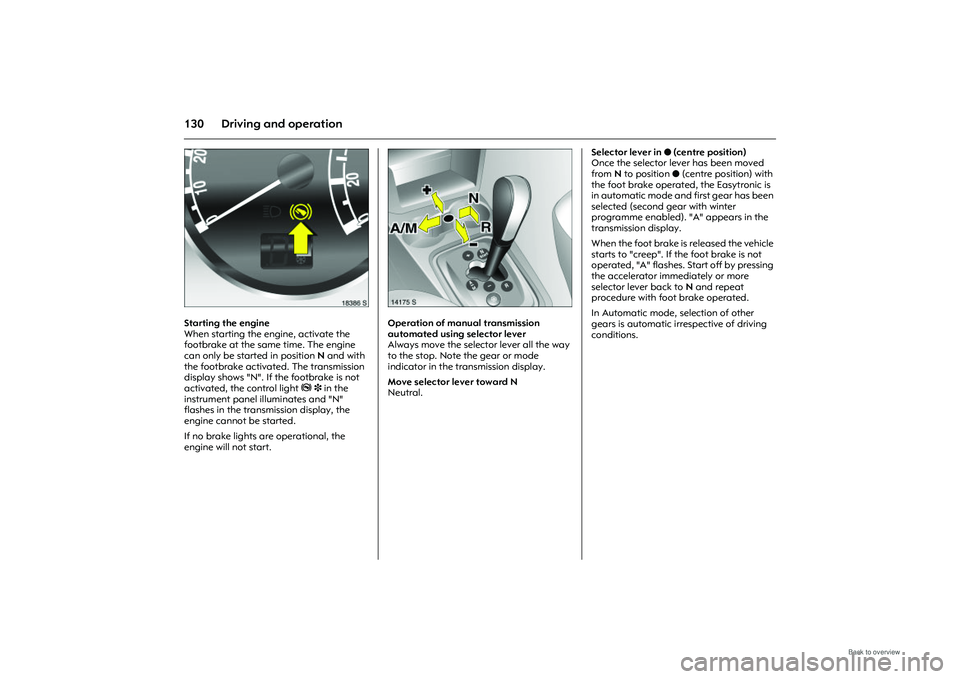
Starting the engine
When starting the engine, activate the
footbrake at the same time. The engine
can only be started in position N and with
the footbrake activated. The transmission
display shows "N". If the footbrake is not
activated, the control light j 3 in the
instrument panel illuminates and "N"
flashes in the transmission display, the
engine cannot be started.
If no brake lights are operational, the
engine will not start.
Picture no: 14175s.tif
Operation of manual transmission
automated using selector lever
Always move the selector lever all the way
to the stop. Note the gear or mode
indicator in the transmission display.
Move selector lever toward N
Neutral. Selector lever in
o (centre position)
Once the selector lever has been moved
from N to position o (centre position) with
the foot brake operated, the Easytronic is
in automatic mode and first gear has been
selected (second gear with winter
programme enabled). "A" appears in the
transmission display.
When the foot brake is released the vehicle
starts to "creep". If the foot brake is not
operated, "A" flashes. Start off by pressing
the accelerator immediately or more
selector lever back to N and repeat
procedure with foot brake operated.
In Automatic mode, selection of other
gears is automatic irrespective of driving
conditions.
Page 137 of 248
131
Driving and operation
Picture no: 14175s.tif
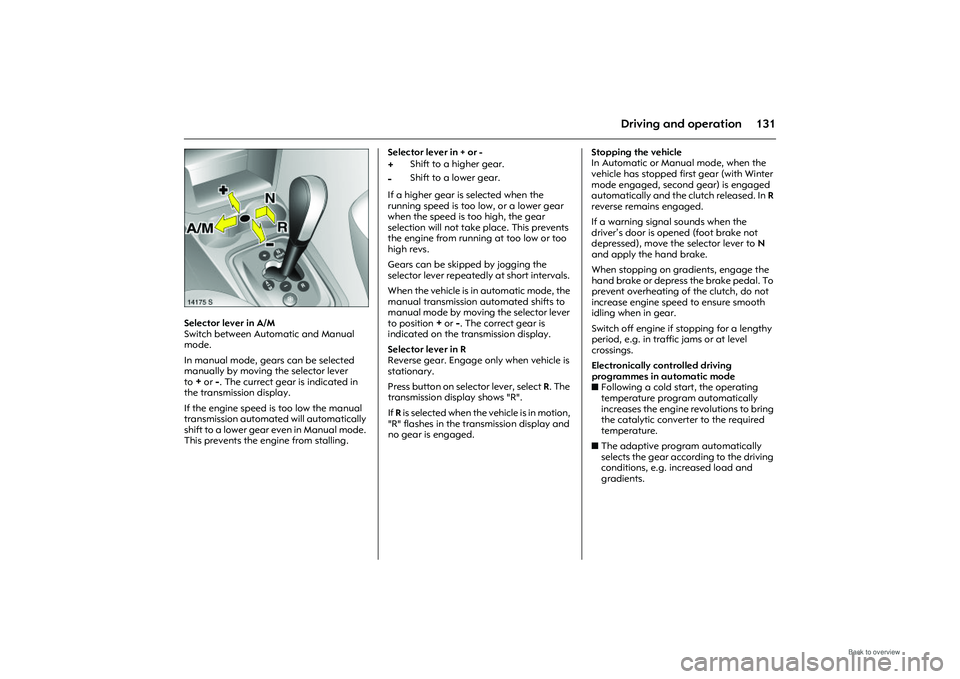
Selector lever in A/M
Switch between Automatic and Manual
mode.
In manual mode, gears can be selected
manually by moving the selector lever
to
+or
-. The currect gear is indicated in
the transmission display.
If the engine speed is too low the manual
transmission automated will automatically
shift to a lower gear even in Manual mode.
This prevents the engine from stalling. Selector lever in + or -
If a higher gear is selected when the
running speed is too low, or a lower gear
when the speed is too high, the gear
selection will not take place. This prevents
the engine from running at too low or too
high revs.
Gears can be skipped by jogging the
selector lever repeatedly
at short intervals.
When the vehicle is in automatic mode, the
manual transmission automated shifts to
manual mode by moving the selector lever
to position
+ or
-. The correct gear is
indicated on the transmission display.
Selector lever in R
Reverse gear. Engage only when vehicle is
stationary.
Press button on selector lever, select R. The
transmission display shows "R".
If R is selected when the vehicle is in motion,
"R" flashes in the transmission display and
no gear is engaged. Stopping the vehicle
In Automatic or Manual mode, when the
vehicle has stopped first gear (with Winter
mode engaged, second gear) is engaged
automatically and the
clutch released. In R
reverse remains engaged.
If a warning signal sounds when the
driver’s door is opened (foot brake not
depressed), move the selector lever to N
and apply the hand brake.
When stopping on gradients, engage the
hand brake or depress the brake pedal. To
prevent overheating of the clutch, do not
increase engine speed to ensure smooth
idling when in gear.
Switch off engine if stopping for a lengthy
period, e.g. in traffic jams or at level
crossings.
Electronically controlled driving
programmes in automatic mode
z Following a cold start, the operating
temperature program automatically
increases the engine revolutions to bring
the catalytic converter to the required
temperature.
z The adaptive program automatically
selects the gear according to the driving
conditions, e.g. increased load and
gradients.
+
Shift to a higher gear.
-
Shift to a lower gear.
Page 139 of 248
133
Driving and operation
Picture no: 14083j.tif
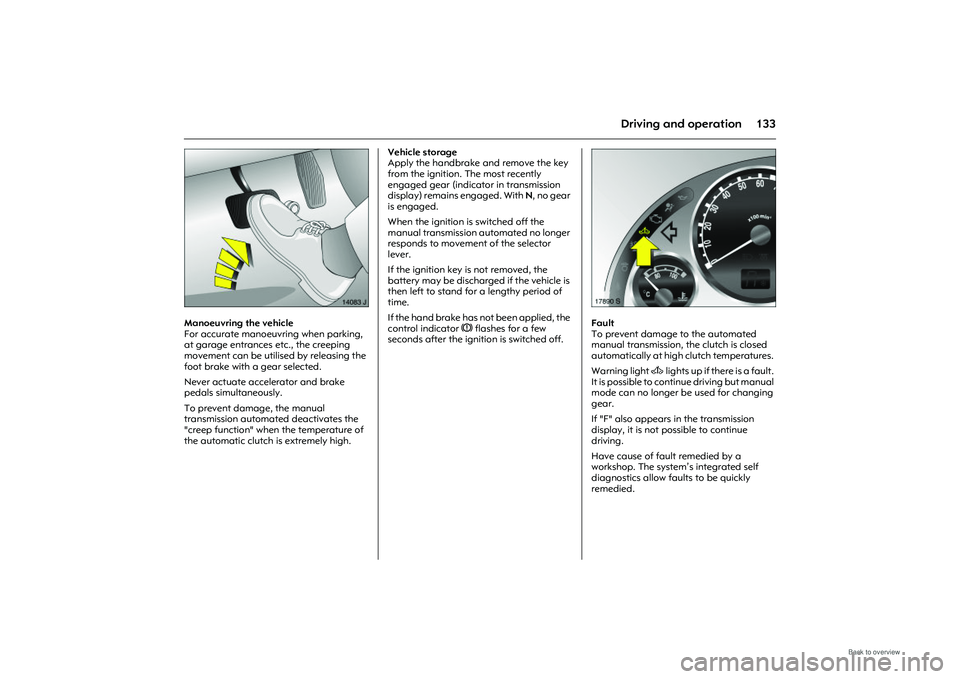
Manoeuvring the vehicle
For accurate manoeuvring when parking,
at garage entrances etc., the creeping
movement can be utilised by releasing the
foot brake with a gear selected.
Never actuate accelerator and brake
pedals simultaneously.
To prevent damage, the manual
transmission automated deactivates the
"creep function" when the temperature of
the automatic clutch is extremely high. Vehicle storage
Apply the handbrake and remove the key
from the ignition. The most recently
engaged gear (indicator in transmission
display) remains engaged. With
N, no gear
is engaged.
When the ignition is switched off the
manual transmission automated no longer
responds to movement of the selector
lever.
If the ignition key is not removed, the
battery may be discharg ed if the vehicle is
then left to stand for a lengthy period of
time.
If the hand brake has not been applied, the
control indicator R flashes for a few
seconds after the ignition is switched off.
Picture no: 17890s.tif
Fault
To prevent damage to the automated
manual transmission, the clutch is closed
automatically at high clutch temperatures.
Warning light A lights up if there is a fault.
It is possible to continue driving but manual
mode can no longer be used for changing
gear.
If "F" also appears in the transmission
display, it is not possible to continue
driving.
Have cause of fault remedied by a
workshop. The system’s integrated self
diagnostics allow faults to be quickly
remedied.
Page 140 of 248
134 Driving and operation
Picture no: 14721s.tif
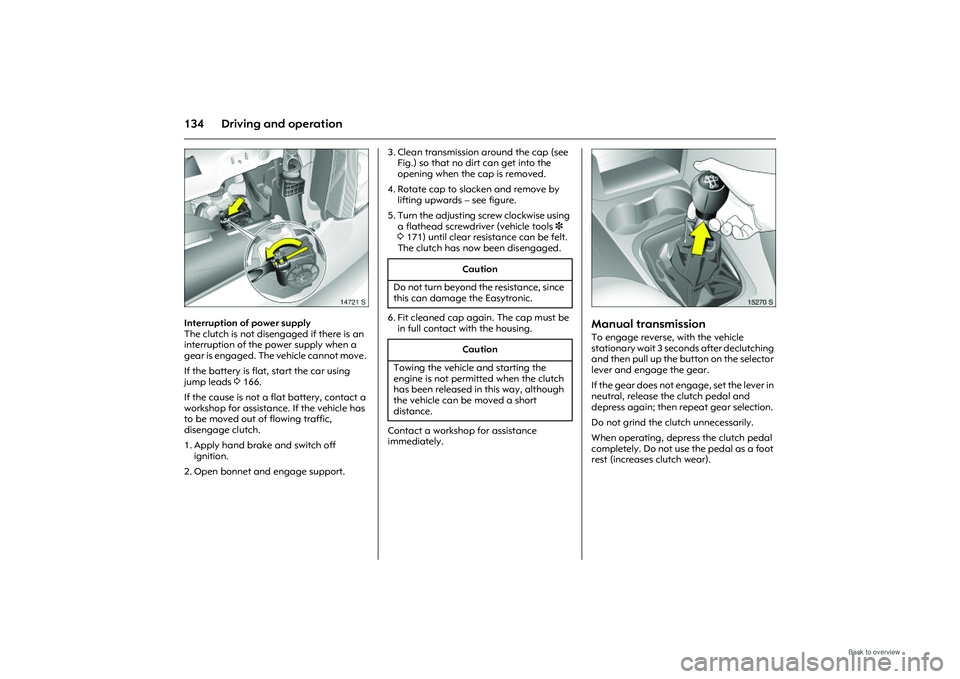
Interruption of power supply
The clutch is not disengaged if there is an
interruption of the power supply when a
gear is engaged. The vehicle cannot move.
If the battery is flat, start the car using
jump leads 3166.
If the cause is not a flat battery, contact a
workshop for assistance. If the vehicle has
to be moved out of flowing traffic,
disengage clutch.
1. Apply hand brake and switch off ignition.
2. Open bonnet and engage support. 3. Clean transmission around the cap (see
Fig.) so that no dirt can get into the
opening when the cap is removed.
4. Rotate cap to slacken and remove by lifting upwards – see figure.
5. Turn the adjusting screw clockwise using a flathead screwdriver (vehicle tools 3
3 171) until clear resistance can be felt.
The clutch has now been disengaged.
6. Fit cleaned cap again. The cap must be in full contact with the housing.
Contact a workshop for assistance
immediately.
Picture no: 15270s.tif
Manual transmissionTo engage reverse, with the vehicle
stationary wait 3 seconds after declutching
and then pull up the bu tton on the selector
lever and engage the gear.
If the gear does not engage, set the lever in
neutral, release the clutch pedal and
depress again; then re peat gear selection.
Do not grind the clutch unnecessarily.
When operating, depress the clutch pedal
completely. Do not use the pedal as a foot
rest (increases clutch wear).
Caution
Do not turn beyond the resistance, since
this can damage the Easytronic.
Caution
Towing the vehicle and starting the
engine is not permitted when the clutch
has been released in this way, although
the vehicle can be moved a short
distance.
Page 141 of 248
135
Driving and operation
Driving hintsThe first 1000 km
Drive your vehicle at various speeds. Do
not use full throttle. Never allow the engine
to labour at low revs.
Drive moderately. In all gears, only depress
the accelerator pedal around
3/4 of the way
down.
Do not drive faster than three quarters of
maximum speed.
Do not brake unnecessarily hard for the
first 200 km.
During the first drive smoke may develop
because of wax and oil evaporating on the
exhaust system. Park the vehicle in the
open for a while after the first drive and
avoid inhaling the fumes.
Fuel and engine oil consumption is higher
than normal during the running-in period.
Never coast with engine not running
Many units will not function in this situation
(e.g. brake servo unit, power steering 3).
Driving in this manner is a danger to
yourself and others. Brake servo unit
When the engine is not running, the brake
servo unit is no longer effective once the
brake pedal has been depressed once or
twice. Braking effect is not reduced, but
significantly greater force is required for
braking.
Electric power steering
3
If the power assisted steering fails when
being towed with the engine switched off,
the vehicle can still be steered, but
considerably more force is required.
Driving in mountainous terrain or with a
trailer/caravan
The cooling fan is elec trically operated. Its
cooling power is therefore independent of
the engine speed.
Since a considerable amount of heat is
generated at high engine speeds and less
at slower speeds, do not shift down when
climbing hills whilst the vehicle is still coping
with the gradient in the higher gear. Driving with a roof load
Do not exceed the permissible roof load
3
226. For reasons of safety, distribute the
load evenly and secure it properly with
retaining straps. Adjust tyre pressure to
load conditions. Do not drive faster
than 120 km/h. Check and retighten the
straps frequently. Observe country-specific
regulations.
Switching off the engine
When you switch off, fans in the engine
compartment may continue running for a
time to cool the engine.
If the engine temperature is very high, e.g.
after driving in mountainous terrain: allow
the engine to idle for approximately two
minutes in order to prevent heat
accumulation.
Vehicles with turbocharged engine
3
After running at high engine speeds or high
engine loads, operate the engine briefly
at a low load or run in neutral for
approx. 30 seconds before switching off in
order to protect the turbocharger.
Page 143 of 248
137
Driving and operation
Saving fuel, protecting the
environmentTrend-setting technology
Environmentally friendly and mainly
recyclable materials were used when your
vehicle was being developed and
manufactured. The production methods
used to make your vehicle are also
environmentally-compatible.
Recycling of production wastes keeps the
circulation of material closed. Reduction of
energy and water requirements also helps
to conserve natural resources.
A highly advanced design means that your
vehicle can be easily disassembled at the
end of its working life, and the individual
materials separated for subsequent re-use.
Materials such as asbestos and cadmium
are not used. The refrigerant in the air
conditioning system 3 is CFC-free.
New painting techniques employ water as
a solvent. End-of-life vehicle recovery
Information on end-of-life vehicle recovery
centres and the recycling of end-of-life
vehicles is availabl
e at www.opel.com.
Energy and environment-conscious
driving
z High noise levels and exhaust emissions
are often a result of driving without due
attention to saving energy and
protecting the environment.
z You should therefore drive with energy in
mind: "more miles – less fuel".
Reduce the noise level and exhaust
emissions by adopting an environment-
conscious driving style. This is extremely
worthwhile and improves the quality of
life.
Fuel consumption depends to a great
extent on your own personal driving
style. The following hints are intended to
help you consume fuel at a rate that is as
close as possible to the specified levels
3224.
Check your vehicle’s fuel consumption
every time you refuel. This facilitates
early detection of any irregularities
causing increased fuel consumption. Warming up
z
Full throttle and warming up at idle
speed increase wear, fuel consumption,
exhaust emission, the amount of
pollutant in the exhaust and the amount
of noise.
z Drive off immediately after starting.
Warm up the engine by running it at
moderate engine speeds.
Uniform speed
z Hectic driving significantly increases fuel
consumption, the exhaust emissions, the
proportion of pollutant in the exhaust
gas and the noise level.
z Do not accelerate and brake
unnecessarily. Drive at uniform speed,
watching the road.
Avoid frequent starting off and stopping
e.g. at traffic lights, in short distance
traffic and in queues of traffic by means
of clever planning. Select roads with
good traffic flow.
Idling
z The engine also consumes fuel when
idling.
z If you have to wait for more than one
minute, it is worthwhile switching off the
engine. Five minutes of idling
corresponds to approximately one
kilometre of driving.
Page 152 of 248
146 Driving and operationDrive Control SystemsElectronic Stability Program (ESP®
Plus
) 3
ESP®
Plus
improves driving stability when
necessary in any driving situation
regardless of the type of road surface or
tyre grip. It also prevents the drive wheels
from spinning. As soon as the vehicle starts to swerve
(understeer/oversteer), engine output is
reduced and the wheels are braked
individually. This considerably improves
the driving stability of the vehicle on
slippery road surfaces.
ESP®
Plus
is ready for operation as soon as
the ignition is switched on and control
indicator v goes out.
When ESP®
Plus
comes into action, v
flashes. The vehicle is now in a critical situation;
ESP®
Plus
allows you to keep control of the
vehicle and reminds you to match your
speed to the road conditions.
9 Warning
Do not let this special safety feature
tempt you into taking risks when driving.
ESP®
Plus
does not negate the laws of
physics.
Adapt speed to the road conditions.
Page 153 of 248
147
Driving and operation
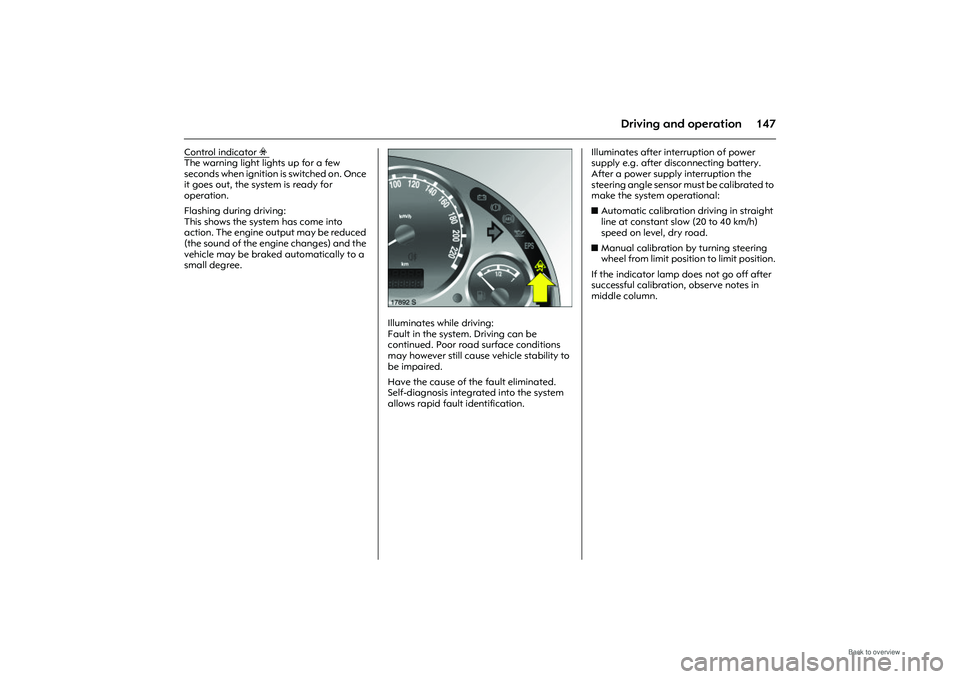
Control indicator
v
The warning light lights up for a few
seconds when ignition is switched on. Once
it goes out, the system is ready for
operation.
Flashing during driving:
This shows the system has come into
action. The engine output may be reduced
(the sound of the engine changes) and the
vehicle may be braked automatically to a
small degree.
Picture no: 17892s.tif
Illuminates while driving:
Fault in the system. Driving can be
continued. Poor road surface conditions
may however still cause vehicle stability to
be impaired.
Have the cause of the fault eliminated.
Self-diagnosis integrated into the system
allows rapid fault identification. Illuminates after interruption of power
supply e.g. after disconnecting battery.
After a power supply interruption the
steering angle sensor must be calibrated to
make the system operational:
z
Automatic calibration driving in straight
line at constant slow (20 to 40 km/h)
speed on level, dry road.
z Manual calibration by turning steering
wheel from limit position to limit position.
If the indicator lamp does not go off after
successful calibration , observe notes in
middle column.