fuel OPEL MERIVA 2009 Owner's Manual
[x] Cancel search | Manufacturer: OPEL, Model Year: 2009, Model line: MERIVA, Model: OPEL MERIVA 2009Pages: 248, PDF Size: 4.46 MB
Page 146 of 248
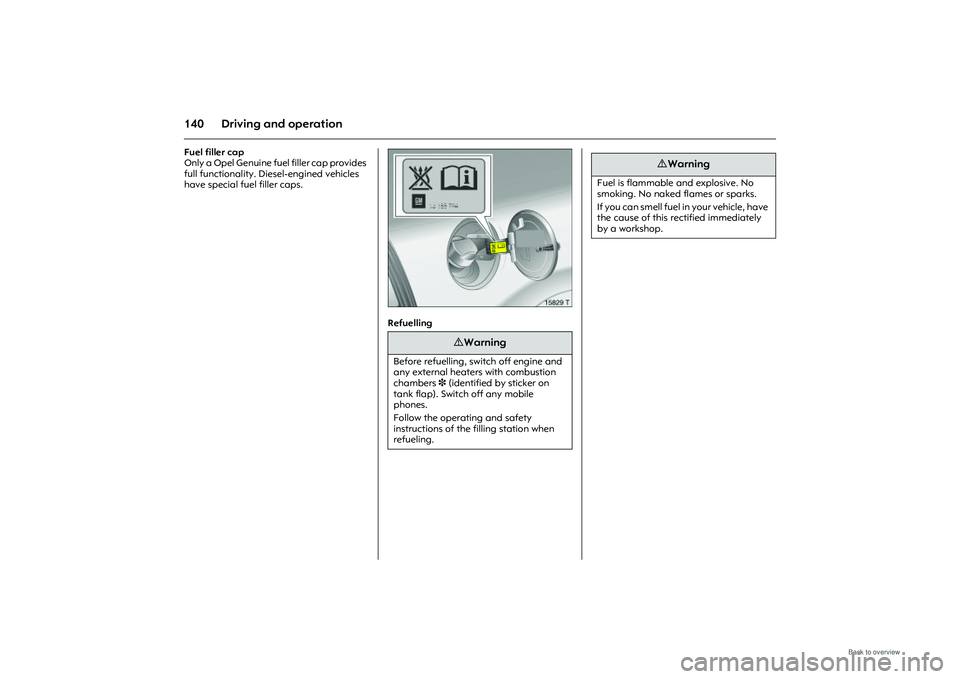
140 Driving and operationFuel filler cap
Only a Opel Genuine fuel filler cap provides
full functionality. Diesel-engined vehicles
have special fuel filler caps.
Picture no: 15829t.tif
Refuelling
9 Warning
Before refuelling, switch off engine and
any external heaters with combustion
chambers 3 (identified by sticker on
tank flap). Switch off any mobile
phones.
Follow the operating and safety
instructions of the filling station when
refueling.
9 Warning
Fuel is flammable and explosive. No
smoking. No naked flames or sparks.
If you can smell fuel in your vehicle, have
the cause of this rectified immediately
by a workshop.
Page 147 of 248
141
Driving and operation
Picture no: 14191s.tif
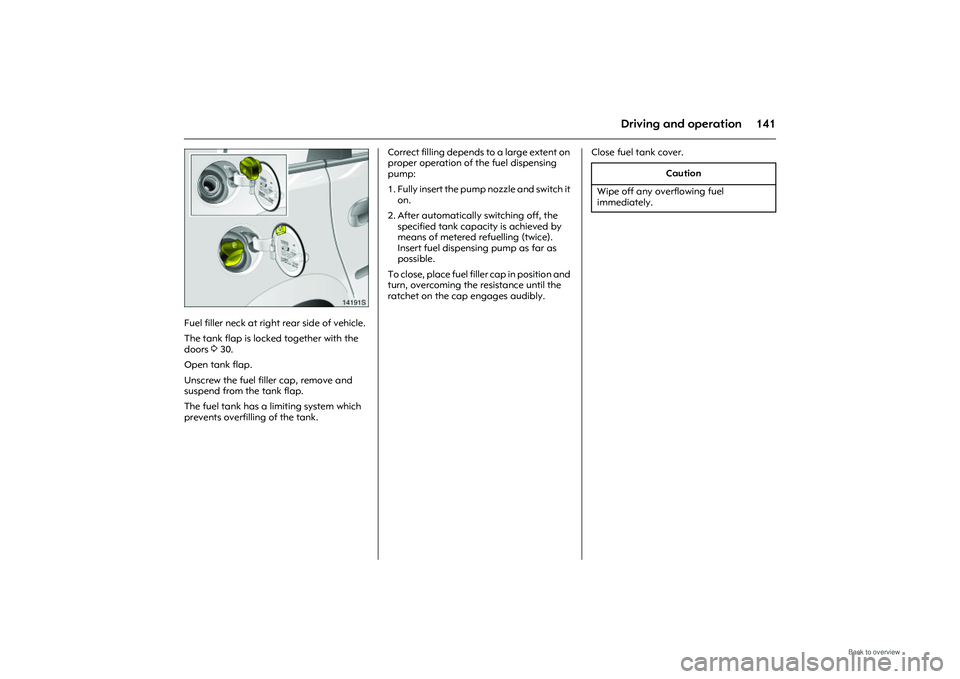
Fuel filler neck at right rear side of vehicle.
The tank flap is locked together with the
doors 330.
Open tank flap.
Unscrew the fuel filler cap, remove and
suspend from the tank flap.
The fuel tank has a limiting system which
prevents overfilling of the tank. Correct filling depends to a large extent on
proper operation of
the fuel dispensing
pump:
1. Fully insert the pump nozzle and switch it on.
2. After automatically switching off, the specified tank capacity is achieved by
means of metered re fuelling (twice).
Insert fuel dispensing pump as far as
possible.
To close, place fuel filler cap in position and
turn, overcoming the resistance until the
ratchet on the cap engages audibly. Close fuel tank cover.
Caution
Wipe off any overflowing fuel
immediately.
Page 148 of 248
142 Driving and operation
Picture no: 6448u.tif
Catalytic converter, exhaust
gassesCatalytic converter
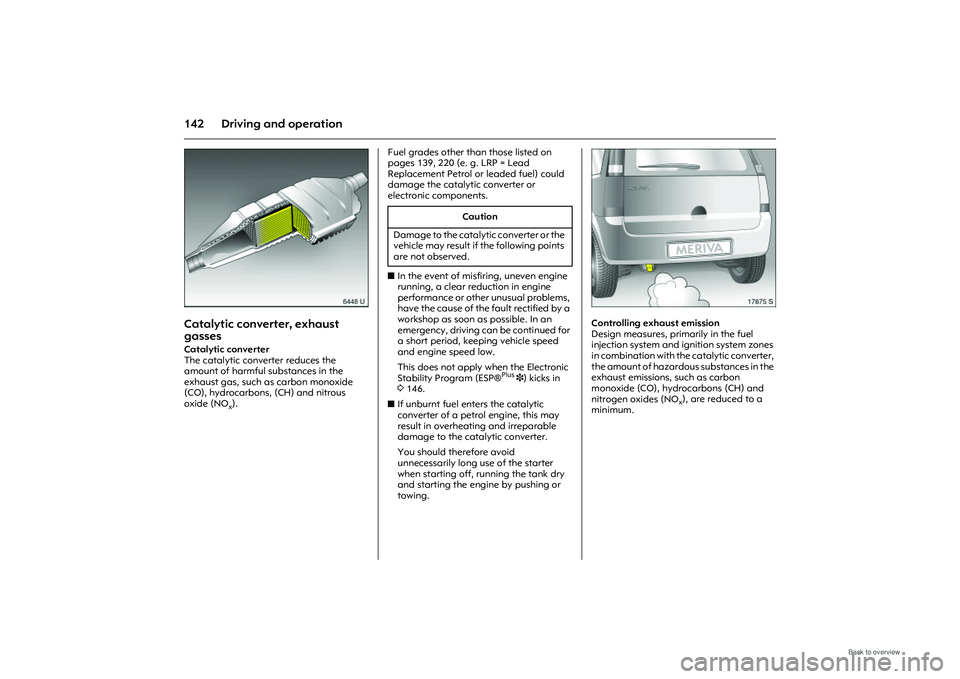
The catalytic converter reduces the
amount of harmful substances in the
exhaust gas, such as carbon monoxide
(CO), hydrocarbons, (CH) and nitrous
oxide (NO
x). Fuel grades other than those listed on
pages 139, 220 (e. g. LRP = Lead
Replacement Petrol or leaded fuel) could
damage the catalytic converter or
electronic components.
z
In the event of misfiring, uneven engine
running, a clear reduction in engine
performance or other unusual problems,
have the cause of the fault rectified by a
workshop as soon as possible. In an
emergency, driving can be continued for
a short period, keeping vehicle speed
and engine speed low.
This does not apply when the Electronic
Stability Program (ESP®
Plus
3) kicks in
3 146.
z If unburnt fuel enters the catalytic
converter of a petrol engine, this may
result in overheating and irreparable
damage to the catalytic converter.
You should therefore avoid
unnecessarily long use of the starter
when starting off, running the tank dry
and starting the engine by pushing or
towing.
Picture no: 17875s.tif
Controlling exhaust emission
Design measures, primarily in the fuel
injection system and ignition system zones
in combination with the catalytic converter,
the amount of hazardous substances in the
exhaust emissions, such as carbon
monoxide (CO), hydrocarbons (CH) and
nitrogen oxides (NO
x), are reduced to a
minimum.
Caution
Damage to the catalytic converter or the
vehicle may result if the following points
are not observed.
Page 149 of 248
143
Driving and operation
Picture no: 17891s.tif
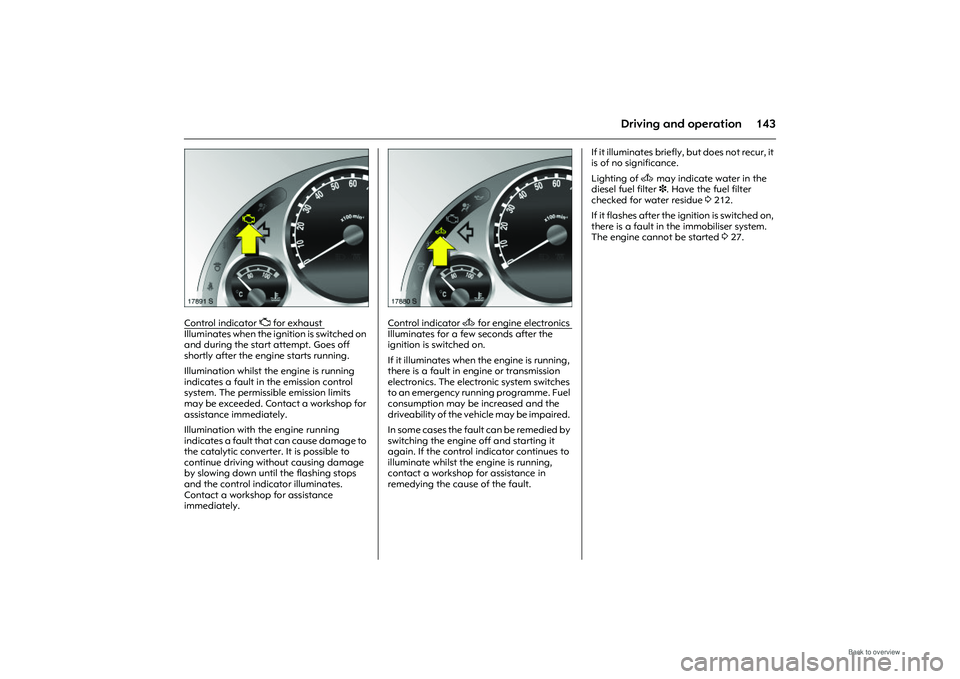
Control indicator
Z for exhaust
Illuminates when the ignition is switched on
and during the start attempt. Goes off
shortly after the engine starts running.
Illumination whilst the engine is running
indicates a fault in the emission control
system. The permissible emission limits
may be exceeded. Contact a workshop for
assistance immediately.
Illumination with the engine running
indicates a fault that can cause damage to
the catalytic converter. It is possible to
continue driving without causing damage
by slowing down until the flashing stops
and the control indicator illuminates.
Contact a workshop for assistance
immediately.
Picture no: 17880s.tif
Control indicator
A
for engine electronics
Illuminates for a few seconds after the
ignition is switched on.
If it illuminates when the engine is running,
there is a fault in engine or transmission
electronics. The electr onic system switches
to an emergency runni ng programme. Fuel
consumption may be increased and the
driveability of the vehicle may be impaired.
In some cases the fault can be remedied by
switching the engine off and starting it
again. If the control indicator continues to
illuminate whilst the en gine is running,
contact a workshop for assistance in
remedying the cause of the fault. If it illuminates briefly, but does not recur, it
is of no significance.
Lighting of
A may indicate water in the
diesel fuel filter 3. Have the fuel filter
checked for water residue 3212.
If it flashes after the ignition is switched on,
there is a fault in the immobiliser system.
The engine cannot be started 327.
Page 150 of 248
144 Driving and operationEngine exhaust
Picture no: 18600S.tif
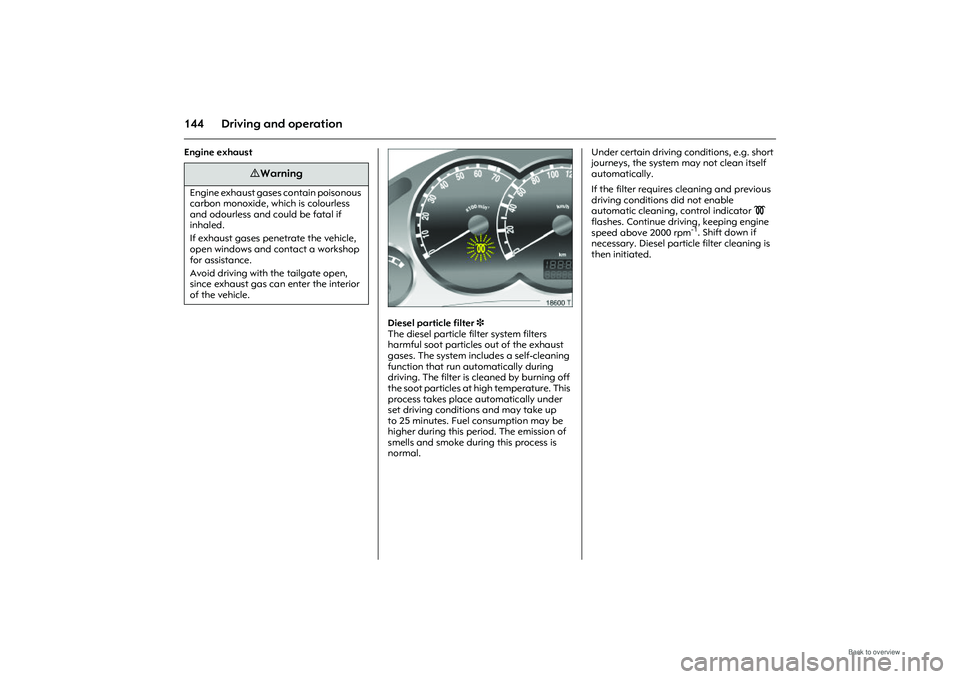
Diesel particle filter 3
The diesel particle filter system filters
harmful soot particles out of the exhaust
gases. The system includes a self-cleaning
function that run automatically during
driving. The filter is cleaned by burning off
the soot particles at hi gh temperature. This
process takes place automatically under
set driving conditions and may take up
to 25 minutes. Fuel consumption may be
higher during this period. The emission of
smells and smoke during this process is
normal. Under certain driving conditions, e.g. short
journeys, the system may not clean itself
automatically.
If the filter requires cleaning and previous
driving conditions did not enable
automatic cleaning, control indicator
!
flashes. Continue driving, keeping engine
speed above 2000 rpm
-1. Shift down if
necessary. Diesel partic le filter cleaning is
then initiated.
9 Warning
Engine exhaust gases contain poisonous
carbon monoxide, which is colourless
and odourless and could be fatal if
inhaled.
If exhaust gases penetrate the vehicle,
open windows and contact a workshop
for assistance.
Avoid driving with the tailgate open,
since exhaust gas can enter the interior
of the vehicle.
Page 151 of 248
145
Driving and operation
Picture no: 18535s.tif
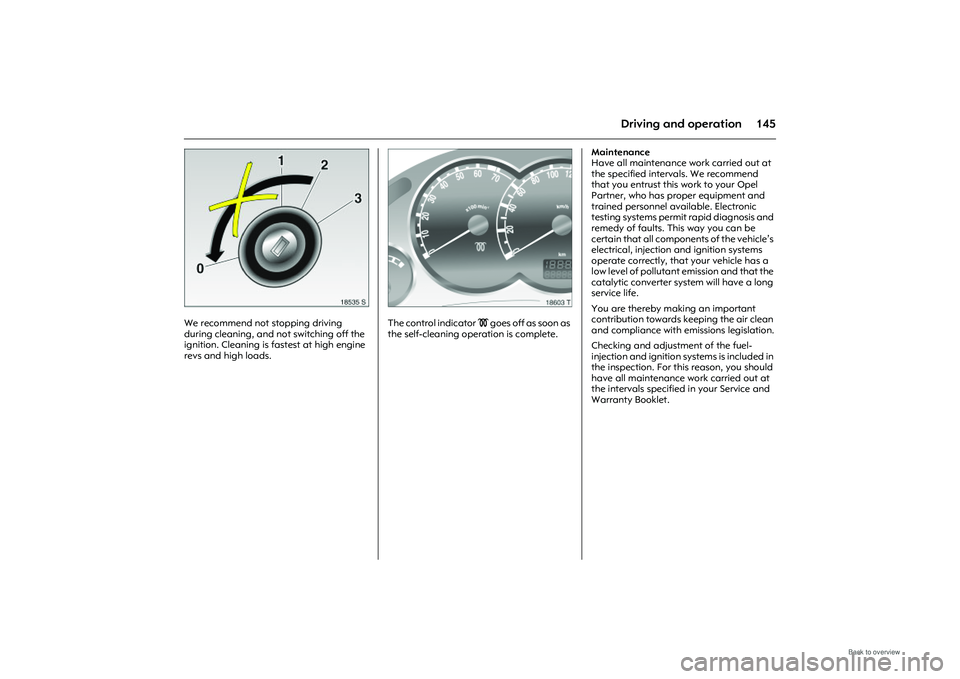
We recommend not stopping driving
during cleaning, and not switching off the
ignition. Cleaning is fa stest at high engine
revs and high loads.
Picture no: 18603s.tif
The control indicator
! goes off as soon as
the self-cleaning operation is complete. Maintenance
Have all maintenance work carried out at
the specified intervals. We recommend
that you entrust this work to your Opel
Partner, who has proper equipment and
trained personnel available. Electronic
testing systems permit rapid diagnosis and
remedy of faults. This way you can be
certain that all components of the vehicle’s
electrical, injection and ignition systems
operate correctly, that your vehicle has a
low level of pollutant emission and that the
catalytic converter system will have a long
service life.
You are thereby making an important
contribution towards keeping the air clean
and compliance with emissions legislation.
Checking and adjustment of the fuel-
injection and ignition systems is included in
the inspection. For this reason, you should
have all maintenance work carried out at
the intervals specified in your Service and
Warranty Booklet.
Page 160 of 248
154 Driving and operationFitting new tyres
Fit tyres in pairs or in sets, which is even
better. Ensure that tyres on one axle are
zthe same size
z the same design
z the same make
z and have the same tread pattern
Fit directional tyres such that they roll in the
direction of travel. The rolling direction is
indicated by a symbol (e.g. an arrow) on
the sidewall.
Tyres fitted opposing the rolling direction
(such as when changing a tyre) should be
refitted as soon as possible. This is the only
way to benefit fully from the design
properties of the tyre.
Pay attention to legal requirements when
disposing of tyres.
Picture no: 14194s.tif
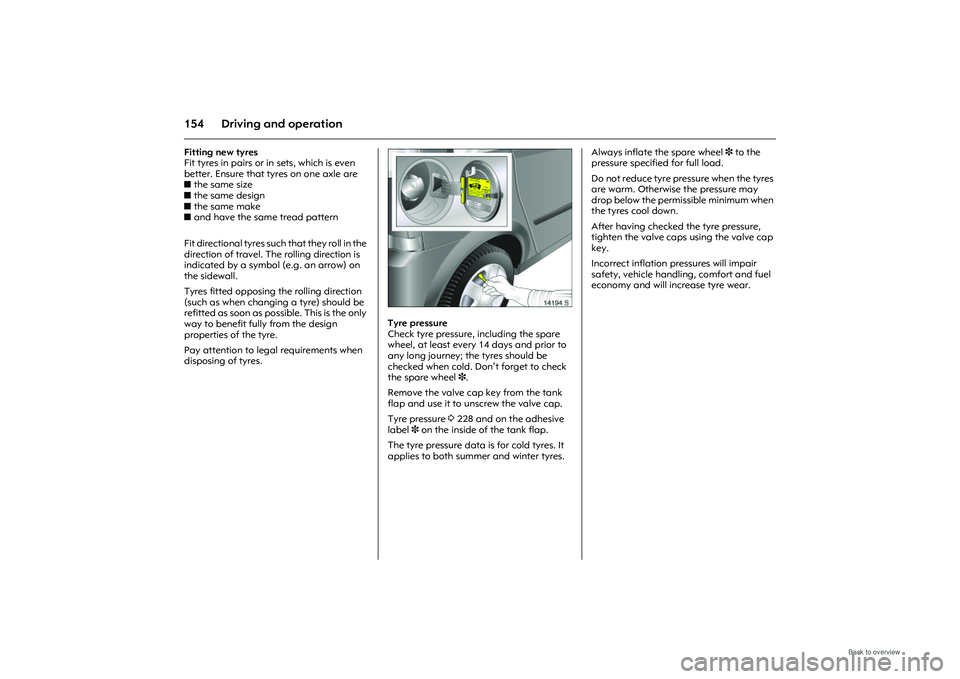
Tyre pressure
Check tyre pressure, including the spare
wheel, at least every 14 days and prior to
any long journey; the tyres should be
checked when cold. Do n’t forget to check
the spare wheel 3.
Remove the valve cap key from the tank
flap and use it to unscrew the valve cap.
Tyre pressure 3228 and on the adhesive
label 3 on the inside of the tank flap.
The tyre pressure data is for cold tyres. It
applies to both summer and winter tyres. Always inflate the spare wheel
3 to the
pressure specified for full load.
Do not reduce tyre pressure when the tyres
are warm. Otherwise the pressure may
drop below the permissible minimum when
the tyres cool down.
After having checked the tyre pressure,
tighten the valve caps using the valve cap
key.
Incorrect inflation pressures will impair
safety, vehicle handling, comfort and fuel
economy and will increase tyre wear.
Page 171 of 248
165
Self-help, vehicle care
Self-help, vehicle care
Diesel fuel system, bleeding If the tank is allowed to run dry, the diesel
fuel system must be bled. Turn over the
ignition three times for 15 seconds at a
time. Then start the engine for a maximum
of 40 seconds
1). Repeat this process after
no less than 5 seconds. If the engine fails to
start, seek the assistance of a workshop.
Picture no: 16109s.tif
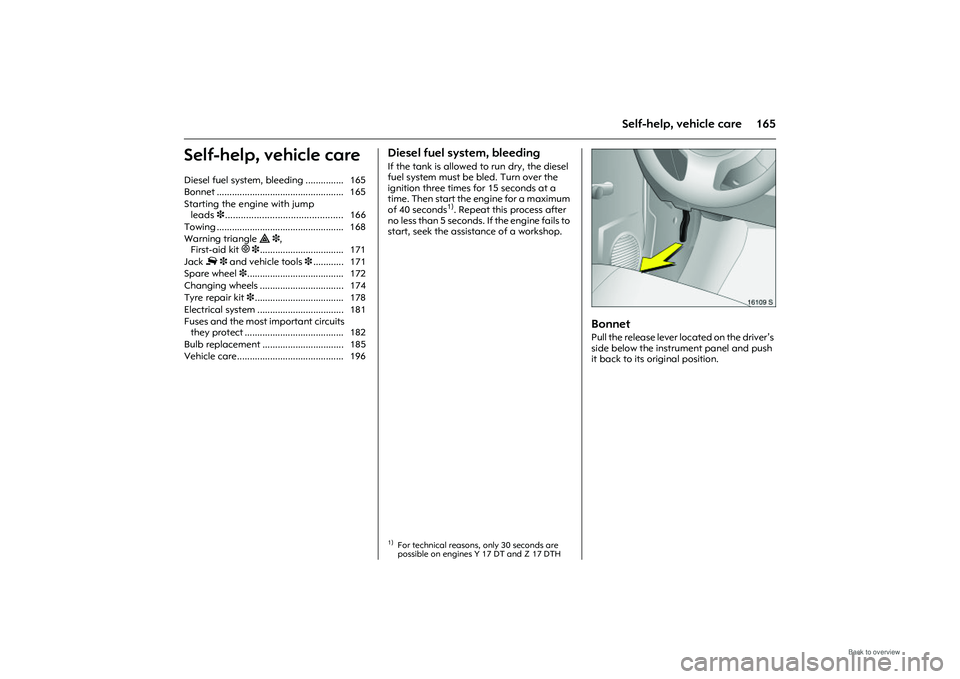
Bonnet Pull the release lever lo cated on the driver’s
side below the instru ment panel and push
it back to its original position.
Diesel fuel system, bleeding ............... 165
Bonnet .................................................. 165
Starting the engine with jump
leads 3............................................. 166
Towing .................................................. 168
Warning triangle ¨ 3,
First-aid kit +3................................. 171
Jack £ 3 and vehicle tools 3............ 171
Spare wheel 3...................................... 172
Changing wheels ................................. 174
Tyre repair kit 3................................... 178
Electrical system .................................. 181
Fuses and the most important circuits they protect ....................................... 182
Bulb replacement ................................ 185
Vehicle care.......................................... 196
1)For technical reasons, only 30 seconds are
possible on engines Y 17 DT and Z 17 DTH
Page 189 of 248
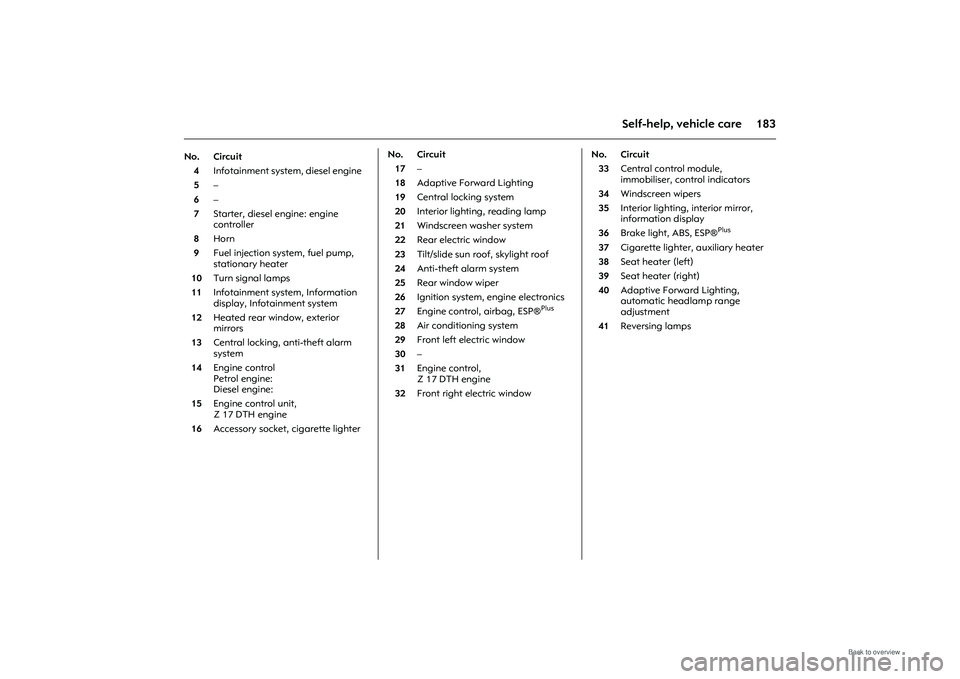
183
Self-help, vehicle care
No. Circuit4 Infotainment system, diesel engine
5 –
6 –
7 Starter, diesel engine: engine
controller
8 Horn
9 Fuel injection system, fuel pump,
stationary heater
10 Turn signal lamps
11 Infotainment system, Information
display, Infotainment system
12 Heated rear window, exterior
mirrors
13 Central locking, anti-theft alarm
system
14 Engine control
Petrol engine:
Diesel engine:
15 Engine control unit,
Z 17 DTH engine
16 Accessory socket, cigarette lighter No. Circuit
17 –
18 Adaptive Forward Lighting
19 Central locking system
20 Interior lighting, reading lamp
21 Windscreen washer system
22 Rear electric window
23 Tilt/slide sun roof, skylight roof
24 Anti-theft alarm system
25 Rear window wiper
26 Ignition system, engine electronics
27 Engine control, airbag, ESP®
Plus
28 Air conditioning system
29 Front left electric window
30 –
31 Engine control,
Z 17 DTH engine
32 Front right electric window No. Circuit
33 Central control module,
immobiliser, control indicators
34 Windscreen wipers
35 Interior lighting, interior mirror,
information display
36 Brake light, ABS, ESP®
Plus
37Cigarette lighter, auxiliary heater
38 Seat heater (left)
39 Seat heater (right)
40 Adaptive Forward Lighting,
automatic headlamp range
adjustment
41 Reversing lamps
Page 205 of 248
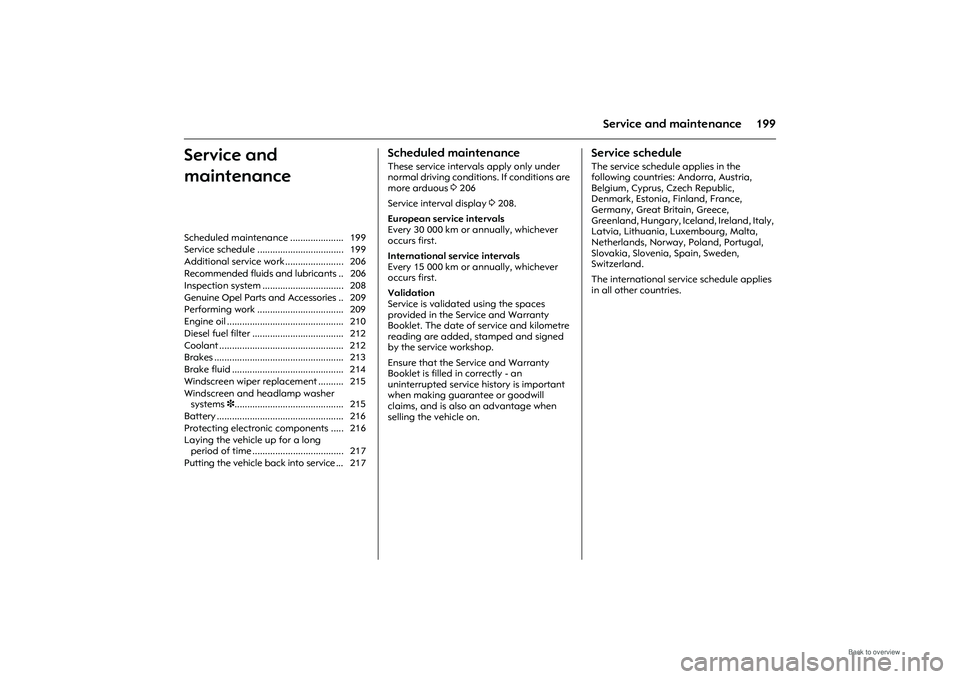
199
Service and maintenance
Service and
maintenance
Scheduled maintenanceThese service intervals apply only under
normal driving conditions. If conditions are
more arduous 3206
Service interval display 3208.
European service intervals
Every 30 000 km or annually, whichever
occurs first.
International service intervals
Every 15 000 km or annually, whichever
occurs first.
Validation
Service is validated using the spaces
provided in the Service and Warranty
Booklet. The date of service and kilometre
reading are added, stamped and signed
by the service workshop.
Ensure that the Service and Warranty
Booklet is filled in correctly - an
uninterrupted service history is important
when making guarantee or goodwill
claims, and is also an advantage when
selling the vehicle on.
Service scheduleThe service schedule applies in the
following countries: Andorra, Austria,
Belgium, Cyprus, Czech Republic,
Denmark, Estonia, Finland, France,
Germany, Great Br itain, Greece,
Greenland, Hungary, Iceland, Ireland, Italy,
Latvia, Lithuania, Luxembourg, Malta,
Netherlands, Norway, Poland, Portugal,
Slovakia, Slovenia , Spain, Sweden,
Switzerland.
The international serv ice schedule applies
in all other countries.
Scheduled maintenance ..................... 199
Service schedule .................................. 199
Additional service work ....................... 206
Recommended fluids and lubricants .. 206
Inspection system ................................ 208
Genuine Opel Parts and Accessories .. 209
Performing work .................................. 209
Engine oil .............................................. 210
Diesel fuel filter .................................... 212
Coolant ................................................. 212
Brakes ................................................... 213
Brake fluid ............................................ 214
Windscreen wiper replacement .......... 215
Windscreen and headlamp washer
systems 3........................................... 215
Battery .................................................. 216
Protecting electronic components ..... 216
Laying the vehicle up for a long period of time .................................... 217
Putting the vehicle back into service ... 217