fuel OPEL MERIVA 2009 User Guide
[x] Cancel search | Manufacturer: OPEL, Model Year: 2009, Model line: MERIVA, Model: OPEL MERIVA 2009Pages: 248, PDF Size: 4.46 MB
Page 104 of 248
98 Instruments, ControlsDistance travelled
Display of distance travelled. The
measurement can be reset at any time.
Average speed
Display of average speed. The
measurement can be reset at any time.
Stoppages in the journey with the ignition
off are not included in the calculations.
Effective consumption
Display of fuel consumed. The
measurement can be reset at any time.
Average consumption
Display of average consumption. The
measurement can be reset at any time.
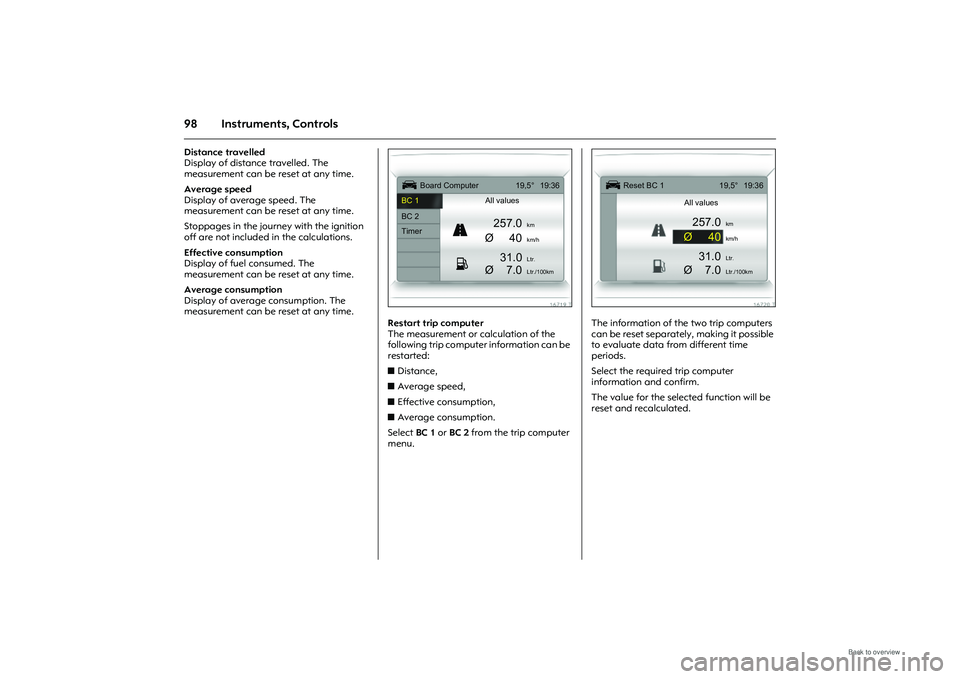
Picture no: 16719t.tif
Restart trip computer
The measurement or calculation of the
following trip computer information can be
restarted:
zDistance,
z Average speed,
z Effective consumption,
z Average consumption.
Select BC 1 or BC 2 from the trip computer
menu.
Picture no: 16720t.tif
The information of the two trip computers
can be reset separately, making it possible
to evaluate data from different time
periods.
Select the required trip computer
information and confirm.
The value for the selected function will be
reset and recalculated.
Ü
Board Computer 19,5° 19:36
BC 1 All values
BC 2
257.0
km
Timer
Ø40
km/h
31.0
Ltr.
Ø
7.0
Ltr./100km
1
8
Ü
Reset BC 1 19,5° 19:36
All values
257.0
km
Ø40
km/h
31.0
Ltr.
Ø
7.0
Ltr./100km
Page 125 of 248
119
Climate control
Air conditioning system
3
As a supplement to the heating and
ventilation system, the air conditioning
system cools and dehumidifies (dries)
inflowing air.
If cooling or dehumidification is not
desired, switch off cooling in order to save
fuel.
Cooling switches off automatically at low
outside temperatures.
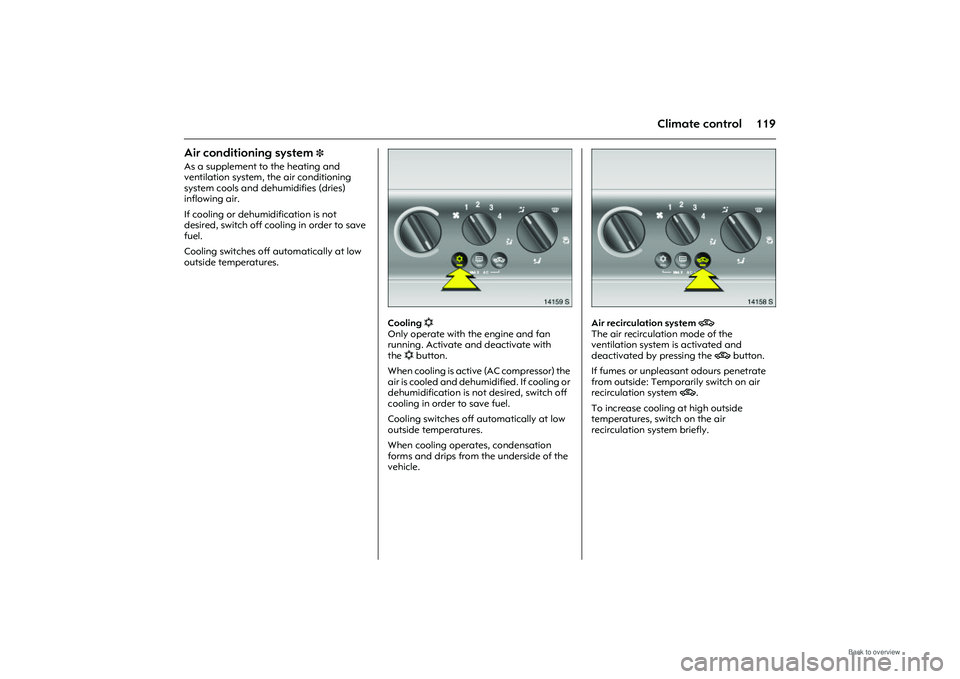
Picture no: 14159s.tif
Cooling n
Only operate with the engine and fan
running. Activate and deactivate with
the nbutton.
When cooling is active (AC compressor) the
air is cooled and dehumid ified. If cooling or
dehumidification is not desired, switch off
cooling in order to save fuel.
Cooling switches off automatically at low
outside temperatures.
When cooling operates, condensation
forms and drips from the underside of the
vehicle.
Picture no: 14158s.tif
Air recirculation system 4
The air recirculation mode of the
ventilation system is activated and
deactivated by pressing the 4 button.
If fumes or unpleasant odours penetrate
from outside: Temporarily switch on air
recirculation system 4.
To increase cooling at high outside
temperatures, switch on the air
recirculation system briefly.
Page 131 of 248
125
Climate control
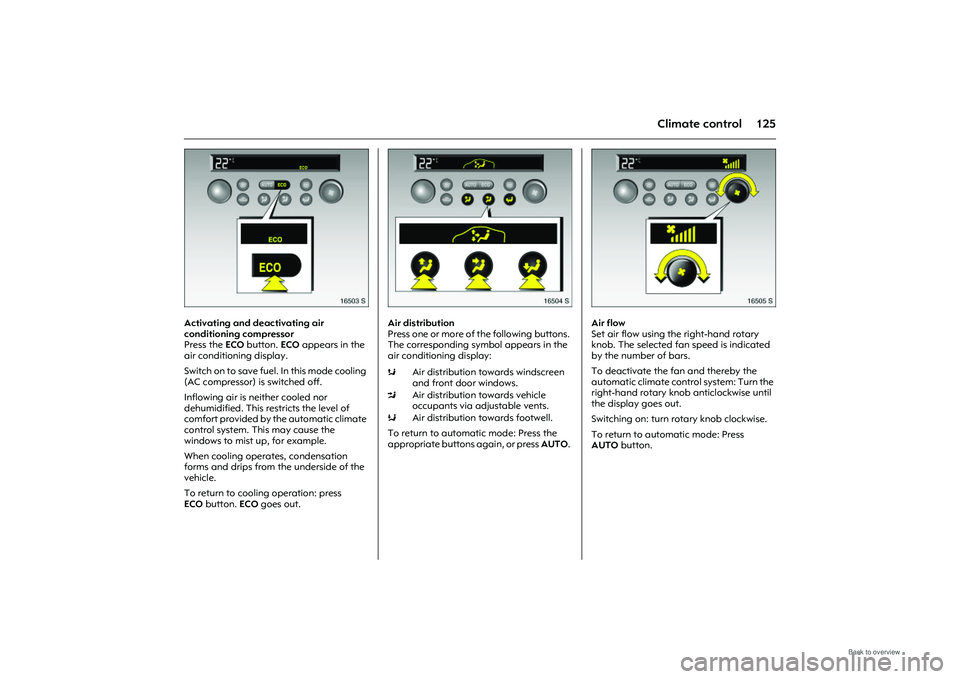
Picture no: 16503s.tif
Activating and deactivating air
conditioning compressor
Press the ECO button. ECO appears in the
air conditioning display.
Switch on to sa ve fuel. In this m ode cooling
(AC compressor) is switched off.
Inflowing air is neither cooled nor
dehumidified. This restricts the level of
comfort provided by the automatic climate
control system. This may cause the
windows to mist up, for example.
When cooling operates, condensation
forms and drips from the underside of the
vehicle.
To return to cooling operation: press
ECO button. ECO goes out.
Picture no: 16504s.tif
Air distribution
Press one or more of the following buttons.
The corresponding symbol appears in the
air conditioning display:
To return to automatic mode: Press the
appropriate buttons again, or press AUTO.
Picture no: 16505s.tif
Air flow
Set air flow using the right-hand rotary
knob. The selected fan speed is indicated
by the number of bars.
To deactivate the fan and thereby the
automatic climate control system: Turn the
right-hand rotary knob anticlockwise until
the display goes out.
Switching on: turn rota ry knob clockwise.
To return to automatic mode: Press
AUTO button.
sAir distribution towards windscreen
and front door windows.
M Air distribution towards vehicle
occupants via adjustable vents.
K Air distribution towards footwell.
Page 133 of 248
127
Climate control
Auxiliary heater Depending on outside temperature and
engine temperature, the passenger
compartment of vehicles with Quickheat 3
electric auxiliary heating is warmed up
more quickly.
Diesel-engined vehicles have a fuel-
powered auxiliary heater 3.
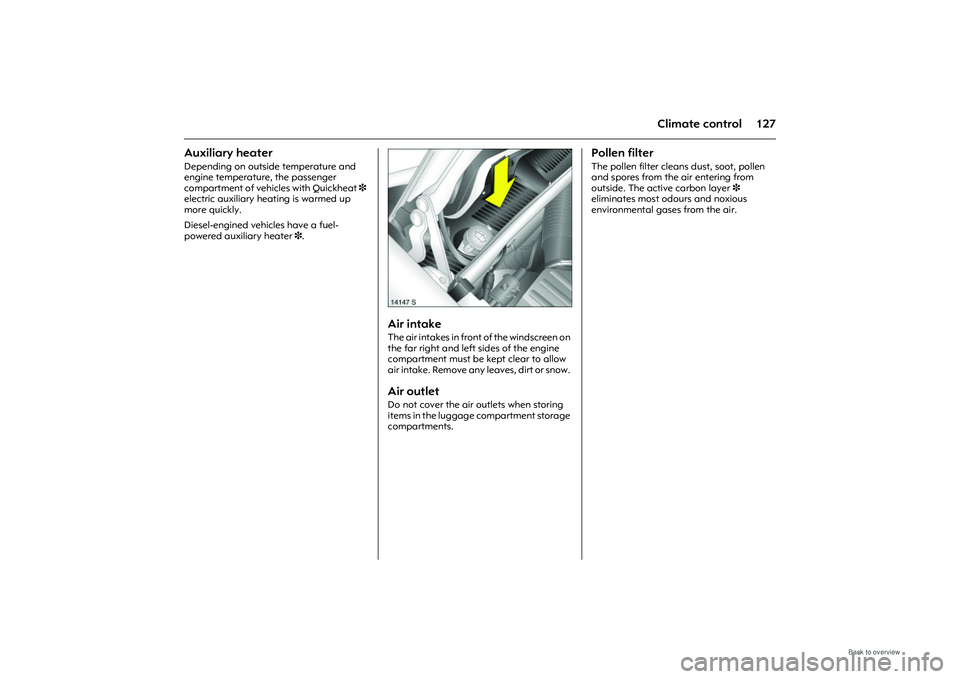
Picture no: 14147s.tif
Air intake The air intakes in front of the windscreen on
the far right and left sides of the engine
compartment must be kept clear to allow
air intake. Remove any leaves, dirt or snow. Air outletDo not cover the air outlets when storing
items in the luggage compartment storage
compartments.
Pollen filter The pollen filter cleans dust, soot, pollen
and spores from the air entering from
outside. The active carbon layer 3
eliminates most odours and noxious
environmental gases from the air.
Page 135 of 248
129
Driving and operation
Driving and operation
Manual transmission
automated
3
The manual transmission automated
transmission 3 permits manual ( manual
mode ) or automatic gear shifting
(automatic mode ), both with automatic
clutch control.
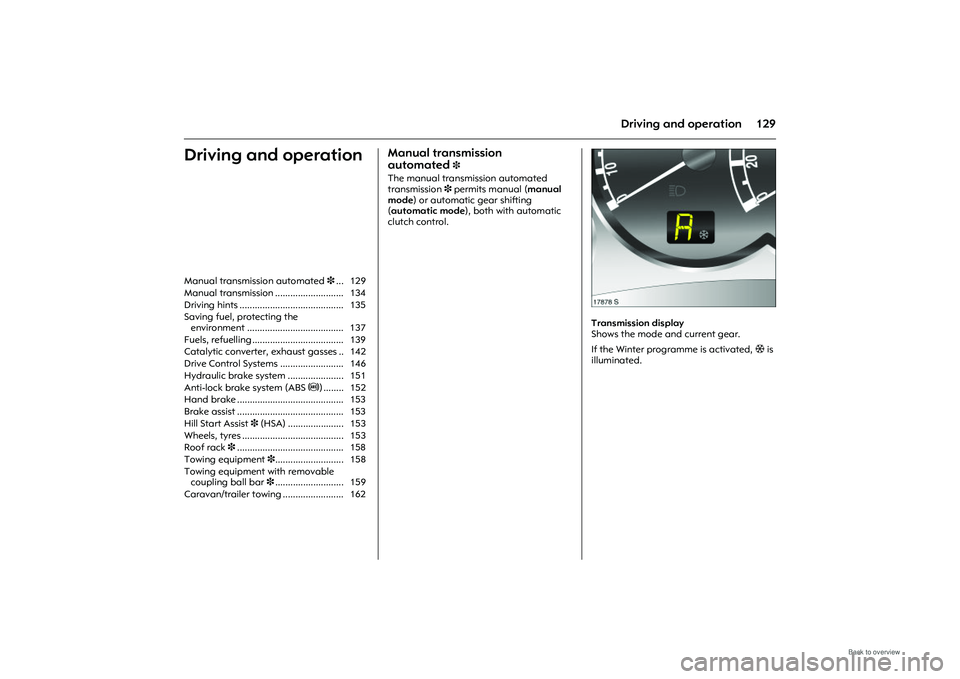
Picture no: 17878s.tif
Transmission display
Shows the mode and current gear.
If the Winter programme is activated, T is
illuminated.
Manual transmission automated
3... 129
Manual transmission ........................... 134
Driving hints ......................................... 135
Saving fuel, protecting the environment ...................................... 137
Fuels, refuelling .................................... 139
Catalytic converter, exhaust gasses .. 142
Drive Control Systems ......................... 146
Hydraulic brake system ...................... 151
Anti-lock brake system (ABS u ) ........ 152
Hand brake .......................................... 153
Brake assist .......................................... 153
Hill Start Assist 3 (HSA) ...................... 153
Wheels, tyres ........................................ 153
Roof rack 3.......................................... 158
Towing equipment 3........................... 158
Towing equipment with removable coupling ball bar 3........................... 159
Caravan/trailer towing ........................ 162
Page 141 of 248
135
Driving and operation
Driving hintsThe first 1000 km
Drive your vehicle at various speeds. Do
not use full throttle. Never allow the engine
to labour at low revs.
Drive moderately. In all gears, only depress
the accelerator pedal around
3/4 of the way
down.
Do not drive faster than three quarters of
maximum speed.
Do not brake unnecessarily hard for the
first 200 km.
During the first drive smoke may develop
because of wax and oil evaporating on the
exhaust system. Park the vehicle in the
open for a while after the first drive and
avoid inhaling the fumes.
Fuel and engine oil consumption is higher
than normal during the running-in period.
Never coast with engine not running
Many units will not function in this situation
(e.g. brake servo unit, power steering 3).
Driving in this manner is a danger to
yourself and others. Brake servo unit
When the engine is not running, the brake
servo unit is no longer effective once the
brake pedal has been depressed once or
twice. Braking effect is not reduced, but
significantly greater force is required for
braking.
Electric power steering
3
If the power assisted steering fails when
being towed with the engine switched off,
the vehicle can still be steered, but
considerably more force is required.
Driving in mountainous terrain or with a
trailer/caravan
The cooling fan is elec trically operated. Its
cooling power is therefore independent of
the engine speed.
Since a considerable amount of heat is
generated at high engine speeds and less
at slower speeds, do not shift down when
climbing hills whilst the vehicle is still coping
with the gradient in the higher gear. Driving with a roof load
Do not exceed the permissible roof load
3
226. For reasons of safety, distribute the
load evenly and secure it properly with
retaining straps. Adjust tyre pressure to
load conditions. Do not drive faster
than 120 km/h. Check and retighten the
straps frequently. Observe country-specific
regulations.
Switching off the engine
When you switch off, fans in the engine
compartment may continue running for a
time to cool the engine.
If the engine temperature is very high, e.g.
after driving in mountainous terrain: allow
the engine to idle for approximately two
minutes in order to prevent heat
accumulation.
Vehicles with turbocharged engine
3
After running at high engine speeds or high
engine loads, operate the engine briefly
at a low load or run in neutral for
approx. 30 seconds before switching off in
order to protect the turbocharger.
Page 142 of 248
136 Driving and operationSave energy – more kilometres
Please observe the running-in hints on the
previous page and the tips for energy
saving on the following pages.
Good, technically correct and economical
driving ensures maximum durability and
performance for your vehicle.
Overrun cut-off
The fuel supply is automatically cut off
during overrun, e.g. when the vehicle is
driven with a gear engaged but no throttle
application. Overrun cut-off is deactivated
if catalytic converter temperature is high.
Vehicles with turbocharged engine
3
Flow-generated noises may be audible if
the accelerator is released quickly on
account of air flow in the turbocharger.
Engine speed
Drive in a low engine speed range for each
gear as much as possible. Warming up
Allow the engine to wa
rm up while driving.
Do not warm it up by letting it ru n at idling
speed. Do not apply full throttle until the
engine has reached operating
temperature.
After a cold start, the manual transmission
automated 3 does not switch to higher
gears until the speed increases when it is in
automatic mode. This allows the catalytic
converter to reach th e temperature quickly
which is required for optimum emission
reduction.
Correct gear selection
Do not race your engine whilst in neutral or
with a low gear selected. Driving too fast in
individual gears as well as stop-and-go
traffic increases engine wear and fuel
consumption.
Change down
When decreasing speed, shift down into
the next lowest gear. Do not slip the clutch
with a high-revving engine. This is
especially important when hill climbing. Cooling fan
The cooling fan is controlled via a
thermoswitch and therefore only runs if
necessary.
The cooling fan automatically switches on
when the diesel particle filter is being
cleaned
3 depending on the engine.
Pedals
Do not place any objects in the foot well
which could slip under the pedals and
inhibit the pedal travel.
To ensure the pedal travel is uninhibited,
there must be no mats in the area of the
pedals.
Battery care
When driving slowly or when the vehicle is
stationary, e.g. in slow urban traffic, stop-
and-go traffic or traffic jams, turn off all
unnecessary electrical loads where
possible (e.g. heated rear window, heated
front seats, etc.).
Declutch when starting in order to relieve
the strain on the starter and the battery.
Page 143 of 248
137
Driving and operation
Saving fuel, protecting the
environmentTrend-setting technology
Environmentally friendly and mainly
recyclable materials were used when your
vehicle was being developed and
manufactured. The production methods
used to make your vehicle are also
environmentally-compatible.
Recycling of production wastes keeps the
circulation of material closed. Reduction of
energy and water requirements also helps
to conserve natural resources.
A highly advanced design means that your
vehicle can be easily disassembled at the
end of its working life, and the individual
materials separated for subsequent re-use.
Materials such as asbestos and cadmium
are not used. The refrigerant in the air
conditioning system 3 is CFC-free.
New painting techniques employ water as
a solvent. End-of-life vehicle recovery
Information on end-of-life vehicle recovery
centres and the recycling of end-of-life
vehicles is availabl
e at www.opel.com.
Energy and environment-conscious
driving
z High noise levels and exhaust emissions
are often a result of driving without due
attention to saving energy and
protecting the environment.
z You should therefore drive with energy in
mind: "more miles – less fuel".
Reduce the noise level and exhaust
emissions by adopting an environment-
conscious driving style. This is extremely
worthwhile and improves the quality of
life.
Fuel consumption depends to a great
extent on your own personal driving
style. The following hints are intended to
help you consume fuel at a rate that is as
close as possible to the specified levels
3224.
Check your vehicle’s fuel consumption
every time you refuel. This facilitates
early detection of any irregularities
causing increased fuel consumption. Warming up
z
Full throttle and warming up at idle
speed increase wear, fuel consumption,
exhaust emission, the amount of
pollutant in the exhaust and the amount
of noise.
z Drive off immediately after starting.
Warm up the engine by running it at
moderate engine speeds.
Uniform speed
z Hectic driving significantly increases fuel
consumption, the exhaust emissions, the
proportion of pollutant in the exhaust
gas and the noise level.
z Do not accelerate and brake
unnecessarily. Drive at uniform speed,
watching the road.
Avoid frequent starting off and stopping
e.g. at traffic lights, in short distance
traffic and in queues of traffic by means
of clever planning. Select roads with
good traffic flow.
Idling
z The engine also consumes fuel when
idling.
z If you have to wait for more than one
minute, it is worthwhile switching off the
engine. Five minutes of idling
corresponds to approximately one
kilometre of driving.
Page 144 of 248
138 Driving and operationOverrun
zThe fuel supply is shut off automatically
on overrun, e.g. when descending steep
hills or when braking 3136.
z To enable the overrun cut-off to come
into action and save fuel, do not
accelerate or declutch during overrun.
Correct gear selection
z High revs increase engine wear and fuel
consumption.
z Do not race your engine. Avoid driving at
high engine speeds.
Making use of the tachometer helps to
save fuel. Drive in a low engine speed
range for each gear as much as possible
with uniform engine speeds. Drive as
often as possible in top gear, select the
next higher gear as soon as possible,
and only change down when the engine
is no longer running perfectly smoothly.
High speed
z The higher the speed, the higher the
consumption and the noise level. At top
speed, you consume a great deal of fuel
and produce excessive noise and
exhaust emissions. z
Slightly releasing th e accelerator pedal
results in distinct fu el savings with no
major loss of speed.
Drive at no more than around three
quarters of maximum speed and you will
use up to 50 % less fuel, without losing a
great deal of time.
Tyre pressure
z Inadequate tyre pressure, leading to
higher road resistance, costs money in
two ways: for more fuel and increased
tyre wear.
z Regular checks (every 14 days) pay off.
Electrical loads
z The power consumption of electrical
equipment increases fuel consumption.
z Switch off all auxiliary electrical loads
(e.g. air conditioning 3, heated rear
window) when not needed.
Roof racks, ski-holders
z Due to air resistance, a roof load can
increase fuel consumption by
approx. 1l/100 km.
z Remove them if they are not being used. Repair and maintenance
z
Improper repairs or adjustment and
maintenance work can increase fuel
consumption. Do not carry out work on
the engine yourself.
You may out of ignorance infringe
environmental laws by not disposing of
materials properly.
Appropriate parts might not be recycled.
Contact with some of the materials
involved may pose a health hazard.
z We recommend that repair and
maintenance be entrusted to your Opel
Partner.
Extreme driving conditions
z Going up steep slopes, cornering, driving
on poor roads and winter driving all
increase fuel consumption.
Fuel consumption increases dramatically
in urban traffic and at winter
temperatures, especially on short trips
when the engine operating temperature
is not reached.
z Follow the hints given above to keep
consumption to a minimum under such
conditions.
Page 145 of 248
139
Driving and operation
Fuels, refuellingFuel consumption
The fuel consumption is determined under
specified driving conditions 3224.
Special equipment increases the weight of
the vehicle. As a result, they can increase
fuel consumption and reduce the specified
maximum speed.
For the first few thousand kilometres,
friction between the engine and
transmission components is higher. This
increases fuel consumption. Fuel for petrol engines
Only use unleaded fuel that complies
with DIN EN 228.
Fuels with ethanol content greater than 5 %
may only be used if the vehicle has been
specifically developed and approved for
these fuels.
Use fuel with the recommended octane
rating (value in bold
3220). Use of fuel
with too low an octane rating can reduce
engine power and torque and will slightly
increase fuel consumption. Fuel for diesel engines
Only use diesel fuel that complies
with DIN EN 590. The fuel must have low
sulphur content (maximum 50 ppm).
Do not use marine diesel oils, heating oils
or entirely or partially plant-based diesel
fuels, such as rape seed oil or bio diesel,
Aquazole and similar diesel-water
emulsions. Diesel fuels must not be diluted
with fuels for petrol engines.
The flow and filterability of diesel fuel are
temperature-dependent. When
temperatures are low, re
fuel with diesel fuel
with guaranteed winter properties.
Caution
Use of fuel with too low an octane rating
could lead to uncontrolled combustion
and engine damage.