warning light OPEL MERIVA 2009 Owner's Manual
[x] Cancel search | Manufacturer: OPEL, Model Year: 2009, Model line: MERIVA, Model: OPEL MERIVA 2009Pages: 248, PDF Size: 4.46 MB
Page 153 of 248
147
Driving and operation
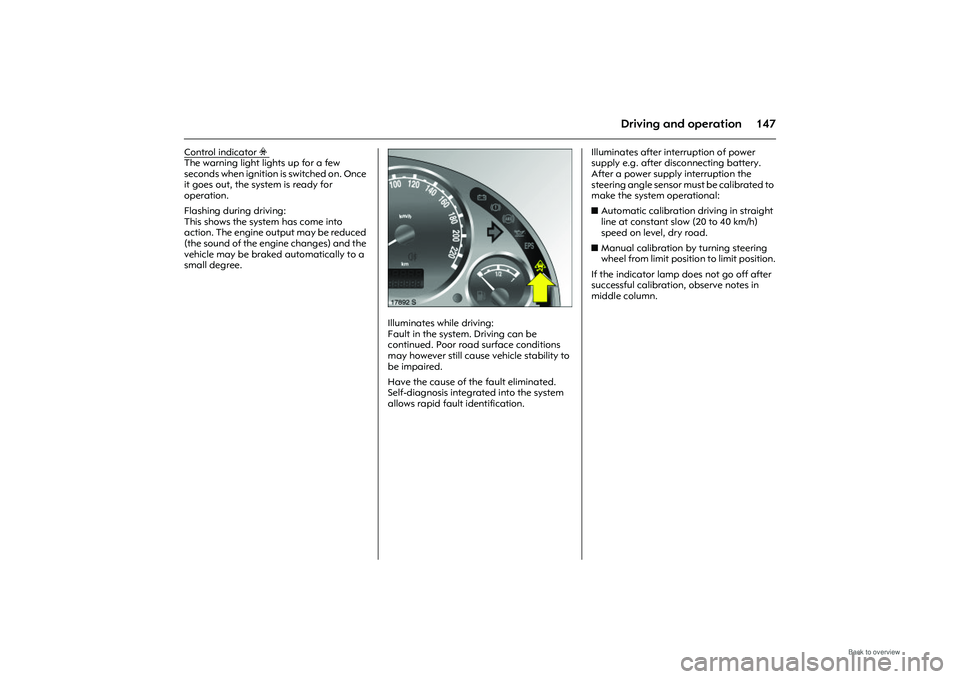
Control indicator
v
The warning light lights up for a few
seconds when ignition is switched on. Once
it goes out, the system is ready for
operation.
Flashing during driving:
This shows the system has come into
action. The engine output may be reduced
(the sound of the engine changes) and the
vehicle may be braked automatically to a
small degree.
Picture no: 17892s.tif
Illuminates while driving:
Fault in the system. Driving can be
continued. Poor road surface conditions
may however still cause vehicle stability to
be impaired.
Have the cause of the fault eliminated.
Self-diagnosis integrated into the system
allows rapid fault identification. Illuminates after interruption of power
supply e.g. after disconnecting battery.
After a power supply interruption the
steering angle sensor must be calibrated to
make the system operational:
z
Automatic calibration driving in straight
line at constant slow (20 to 40 km/h)
speed on level, dry road.
z Manual calibration by turning steering
wheel from limit position to limit position.
If the indicator lamp does not go off after
successful calibration , observe notes in
middle column.
Page 154 of 248
148 Driving and operationCruise control 3
Cruise control can store and maintain
speeds of approx. 30 to 200 km/h.
Deviation from the stored speed is possible
on uphill or downhill inclines.
For safety reasons the cruise control
cannot be activated until the foot brake
has been operated once.
The cruise control is operated with the
buttons I, R and O on the turn signal lever.
Do not use the cruise control if it is not
advisable to maintain a constant speed
(e.g. in situations presenting a danger to
yourself and other road users, in heavy
traffic or on winding, slippery or greasy
roads). For manual transmission automated
3,
engage cruise control in automatic mode
only.
Picture no: 17893s.tif
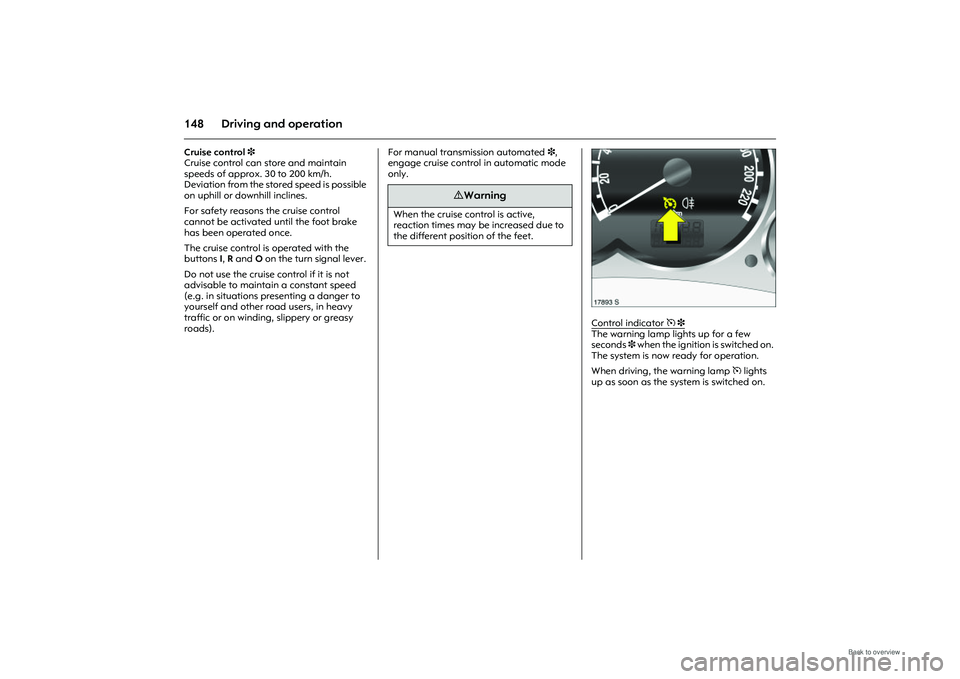
Control indicator
m 3
The warning lamp lights up for a few
seconds 3 when the ignition is switched on.
The system is now ready for operation.
When driving, th e warning lamp m lights
up as soon as the sy stem is switched on.
9 Warning
When the cruise control is active,
reaction times may be increased due to
the different position of the feet.
Page 159 of 248
153
Driving and operation
Picture no: 14723s.tif
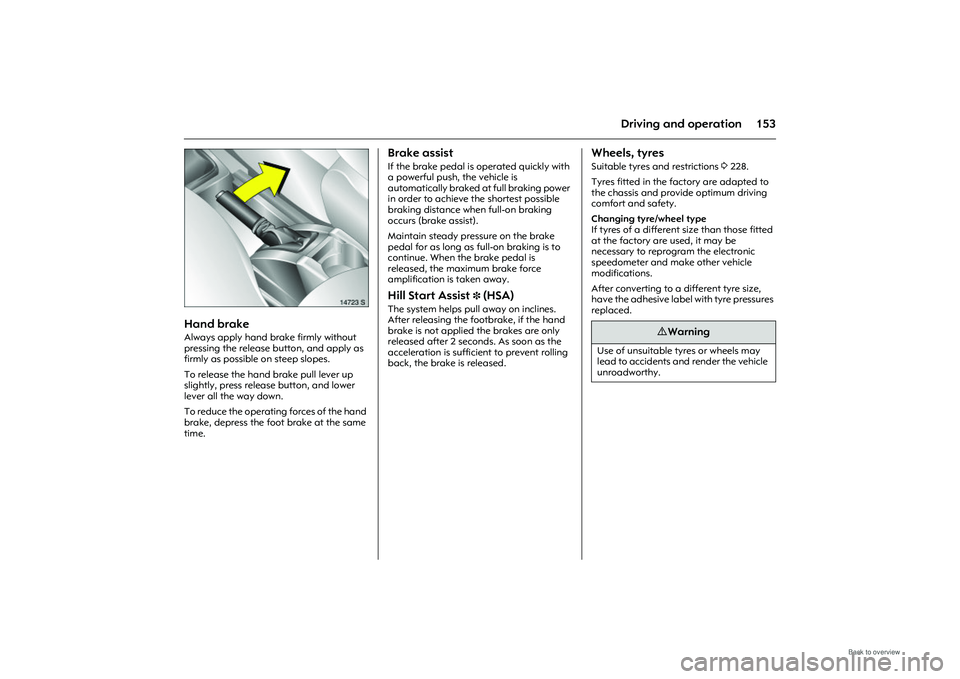
Hand brake Always apply hand brake firmly without
pressing the release button, and apply as
firmly as possible on steep slopes.
To release the hand brake pull lever up
slightly, press release button, and lower
lever all the way down.
To reduce the operating forces of the hand
brake, depress the foot brake at the same
time.
Brake assist If the brake pedal is operated quickly with
a powerful push, the vehicle is
automatically braked at full braking power
in order to achieve the shortest possible
braking distance when full-on braking
occurs (brake assist).
Maintain steady pressure on the brake
pedal for as long as full-on braking is to
continue. When the brake pedal is
released, the maximum brake force
amplification is taken away. Hill Start Assist
3 (HSA)
The system helps pull away on inclines.
After releasing the footbrake, if the hand
brake is not applied the brakes are only
released after 2 seconds. As soon as the
acceleration is sufficient to prevent rolling
back, the brake is released.
Wheels, tyresSuitable tyres and restrictions 3 228.
Tyres fitted in the factory are adapted to
the chassis and provide optimum driving
comfort and safety.
Changing tyre/wheel type
If tyres of a different size than those fitted
at the factory are used, it may be
necessary to reprogram the electronic
speedometer and make other vehicle
modifications.
After converting to a different tyre size,
have the adhesive label with tyre pressures
replaced.
9 Warning
Use of unsuitable tyres or wheels may
lead to accidents and render the vehicle
unroadworthy.
Page 180 of 248
174 Self-help, vehicle careChanging wheels There may be a tyre repair kit instead of a
spare wheel 3178.
Make the following preparations and
observe the following information:
z Park the vehicle on a level, firm and non-
skid surface. The front wheels must be in
the straight-ahead position.
z Switch on the hazard warning flashers,
apply the hand brake, engage first gear
or reverse.
z Erect warning triangle as specified.
Warning triangle 3171.
z Remove the spare wheel 3 172.
z Never change more than one wheel at
once.
z Use the jack 3 only to change wheels. z
If the ground on which the vehicle is
standing is soft, a solid board (max. 1 cm
thick) should be placed under the jack 3.
z Block the wheel diagonally opposite the
wheel to be changed by placing wedge
blocks or equivalent in front and behind
the wheel. z
No people or animals may be in the
vehicle when it is jacked up.
z Never crawl under a jacked-up vehicle.
z Do not start the vehicle when it is raised
on the jack.
z Before screwing in the wheel bolts, clean
them and lightly coat the taper of each
wheel bolt with comm ercially available
grease.
Page 183 of 248
177
Self-help, vehicle care
Picture no: 14763s.tif
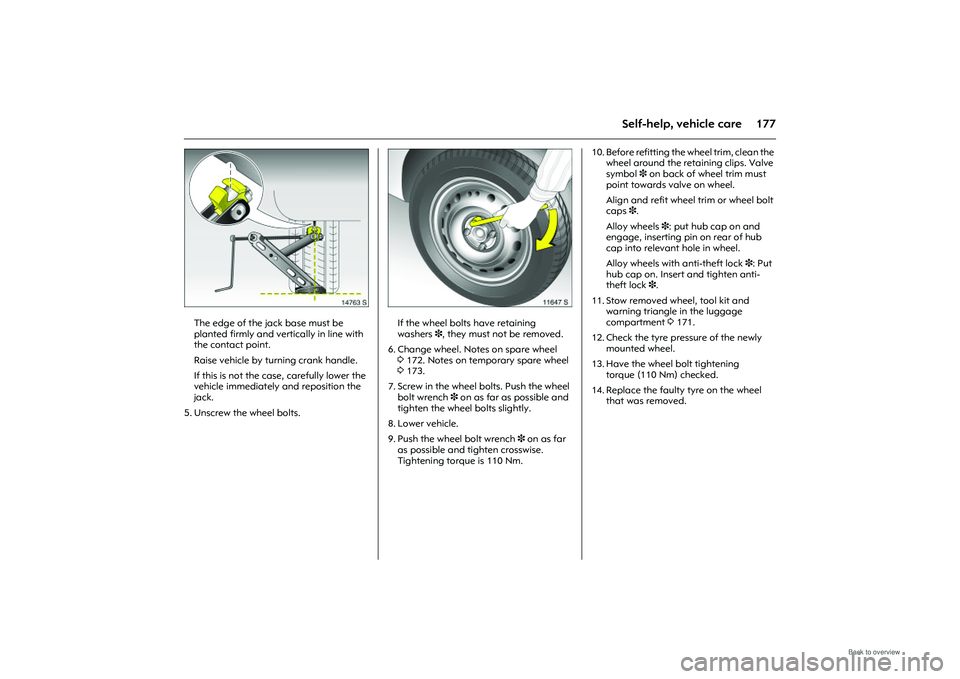
The edge of the jack base must be
planted firmly and vertically in line with
the contact point.
Raise vehicle by turning crank handle.
If this is not the case, carefully lower the
vehicle immediately and reposition the
jack.
5. Unscrew the wheel bolts.
Picture no: 11647s.tif
If the wheel bolt s have retaining
washers 3, they must not be removed.
6. Change wheel. Notes on spare wheel 3172. Notes on temporary spare wheel
3 173.
7. Screw in the wheel bolts. Push the wheel bolt wrench 3 on as far as possible and
tighten the wheel bolts slightly.
8. Lower vehicle.
9. Push the wheel bolt wrench 3 on as far
as possible and tighten crosswise.
Tightening torque is 110 Nm. 10. Before refitting the wheel trim, clean the
wheel around the retaining clips. Valve
symbol 3 on back of wheel trim must
point towards valve on wheel.
Align and refit wheel trim or wheel bolt
caps 3.
Alloy wheels 3: put hub cap on and
engage, inserting pin on rear of hub
cap into relevant hole in wheel.
Alloy wheels with anti-theft lock 3: Put
hub cap on. Insert and tighten anti-
theft lock 3.
11. Stow removed wheel, tool kit and warning triangle in the luggage
compartment 3171.
12. Check the tyre pressure of the newly mounted wheel.
13. Have the wheel bolt tightening torque (110 Nm) checked.
14. Replace the faulty tyre on the wheel that was removed.
Page 188 of 248
182 Self-help, vehicle care
Picture no: 14725s.tif
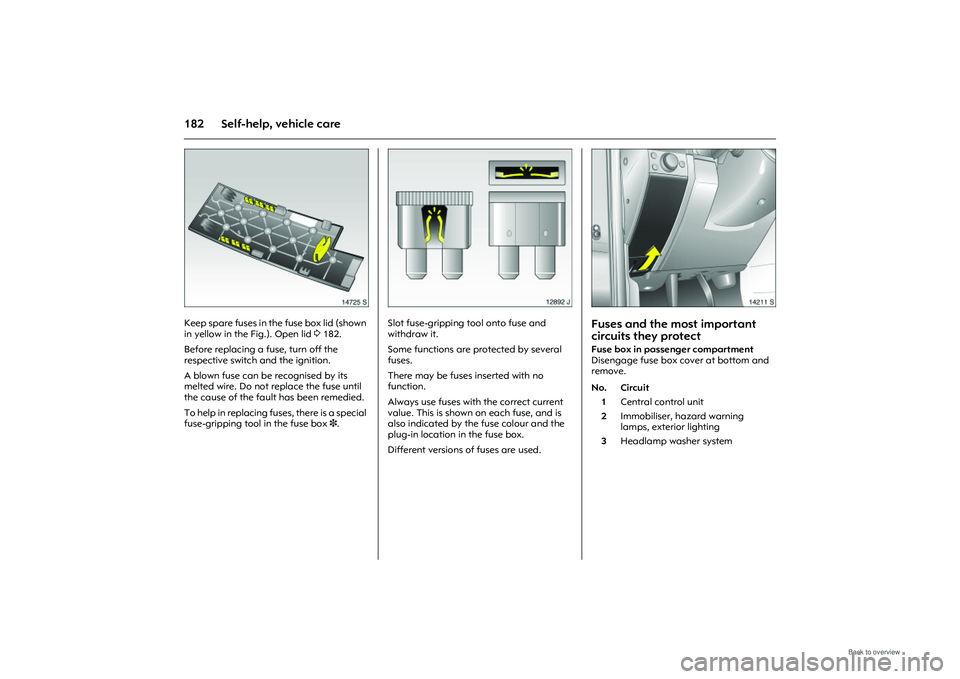
Keep spare fuses in the fuse box lid (shown
in yellow in the Fig.). Open lid 3182.
Before replacing a fuse, turn off the
respective switch and the ignition.
A blown fuse can be recognised by its
melted wire. Do not replace the fuse until
the cause of the fault has been remedied.
To help in replacing fuses, there is a special
fuse-gripping tool in the fuse box 3.
Picture no: 12892j.tif
Slot fuse-gripping tool onto fuse and
withdraw it.
Some functions are protected by several
fuses.
There may be fuses inserted with no
function.
Always use fuses with the correct current
value. This is shown on each fuse, and is
also indicated by the fuse colour and the
plug-in location in the fuse box.
Different versions of fuses are used.
Picture no: 14211s.tif
Fuses and the most important
circuits they protect Fuse box in passenger compartment
Disengage fuse box cover at bottom and
remove. No. Circuit
1 Central control unit
2 Immobiliser, hazard warning
lamps, exterior lighting
3 Headlamp washer system
Page 190 of 248
184 Self-help, vehicle care
Picture no: 14436s.tif Picture no:
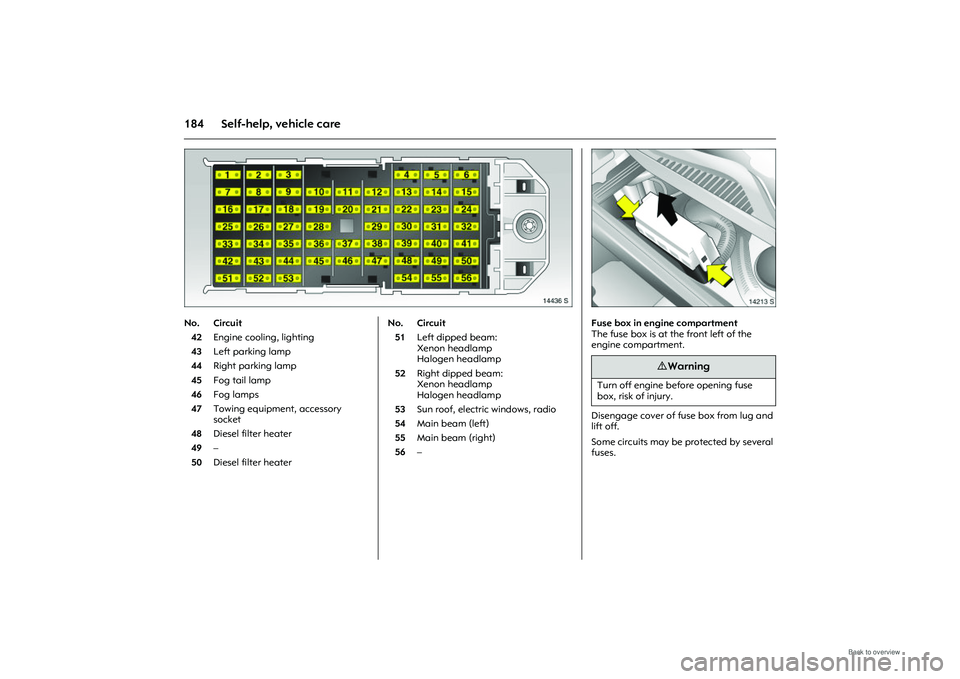
No. Circuit
42 Engine cooling, lighting
43 Left parking lamp
44 Right parking lamp
45 Fog tail lamp
46 Fog lamps
47 Towing equipment, accessory
socket
48 Diesel filter heater
49 –
50 Diesel filter heater
No. Circuit
51 Left dipped beam:
Xenon headlamp
Halogen headlamp
52 Right dipped beam:
Xenon headlamp
Halogen headlamp
53 Sun roof, electric windows, radio
54 Main beam (left)
55 Main beam (right)
56 –
Picture no: 14213s.tif
Fuse box in engine compartment
The fuse box is at the front left of the
engine compartment.
Disengage cover of fuse box from lug and
lift off.
Some circuits may be protected by several
fuses.
9 Warning
Turn off engine before opening fuse
box, risk of injury.
Page 194 of 248
188 Self-help, vehicle careHalogen headlamp system
3,
Adaptive Forward Lighting (AFL)
Halogen headlamp system for dipped and
main beam in comb ination with curve
lighting and cornering light.
Picture no: 14222s.tif
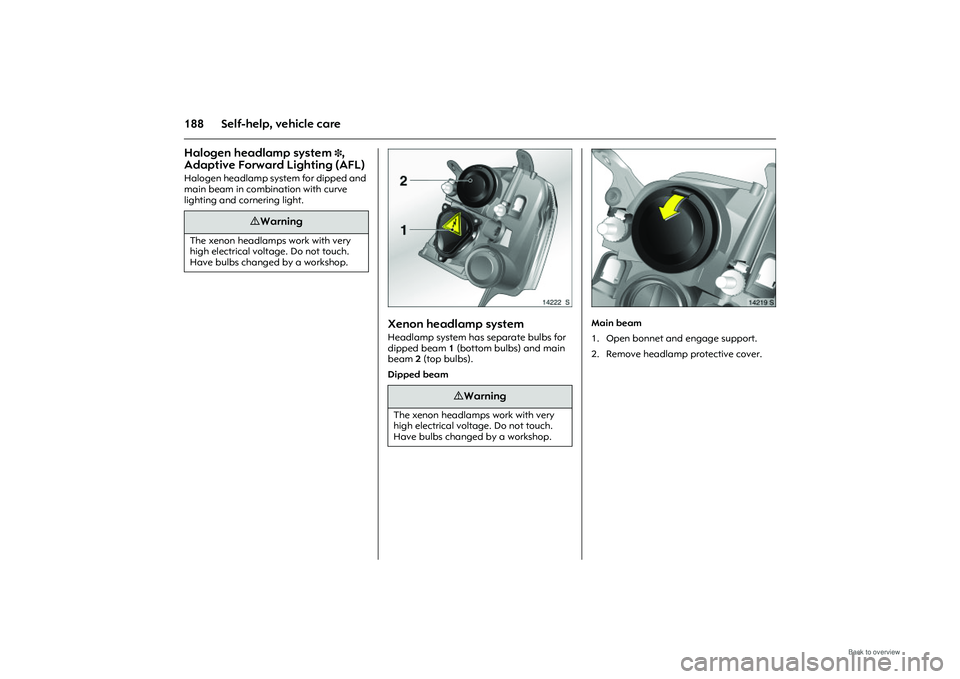
Xenon headlamp systemHeadlamp system has separate bulbs for
dipped beam 1 (bottom bulbs) and main
beam 2 (top bulbs).
Dipped beam
Picture no: 14219s.tif
Main beam
1. Open bonnet and engage support.
2. Remove headlamp protective cover.
9 Warning
The xenon headlamps work with very
high electrical voltage. Do not touch.
Have bulbs changed by a workshop.
9 Warning
The xenon headlamps work with very
high electrical volt age. Do not touch.
Have bulbs changed by a workshop.
Page 206 of 248
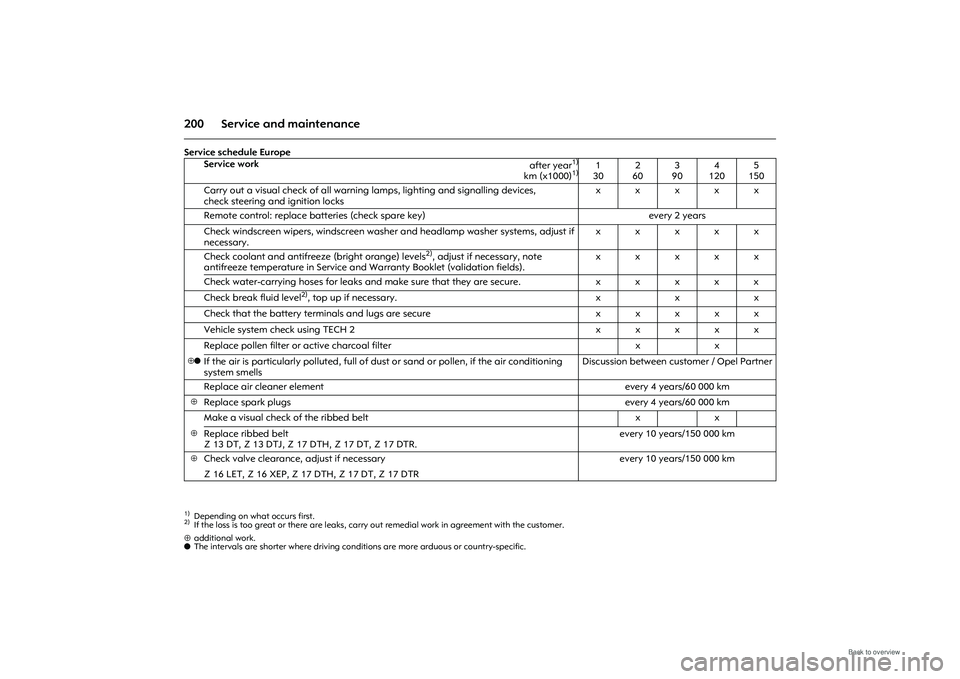
200 Service and maintenanceService schedule Europe⊕additional work.
o The intervals are shorter where driving conditions are more arduous or country-specific.
Service work
after year
1)
km (x1000)
1)
1)Depending on what occurs first.
1
30 2
60 3
90 4
120 5
150
Carry out a visual check of all warning lamps, lighting and signalling devices,
check steering and ignition locks xxxxx
Remote control: replace batteries (check spare key) every 2 years
Check windscreen wipers, windscreen washer and headlamp washer systems, adjust if
necessary. xxxxx
Check coolant and antifreeze (bright orange) levels
2), adjust if necessary, note
antifreeze temperature in Service and Warranty Booklet (validation fields).
2)If the loss is too great or there are leaks, carry out remedial work in agr eement with the customer.
xxxxx
Check water-carrying hoses for leaks and make sure that they are secure. xxxxx
Check break fluid level
2), top up if necessary. xxx
Check that the battery terminals and lugs are secure xxxxx
Vehicle system check using TECH 2 xxxxx
Replace pollen filter or active charcoal filter xx
⊕o
If the air is particularly polluted, full of du st or sand or pollen, if the air conditioning
system smells Discussion between customer / Opel Partner
Replace air cleaner element every 4 years/60 000 km
⊕
Replace spark plugsevery 4 years/60 000 km
Make a visual check of the ribbed belt xx
⊕
Replace ribbed belt
Z 13 DT, Z 13 DTJ, Z 17 DTH, Z 17 DT, Z 17 DTR. every 10 years/150 000 km
⊕
Check valve clearance,
adjust if necessary
Z 16 LET, Z 16 XEP, Z 17 DTH, Z 17 DT, Z 17 DTR every 10 years/150 000 km
Page 209 of 248
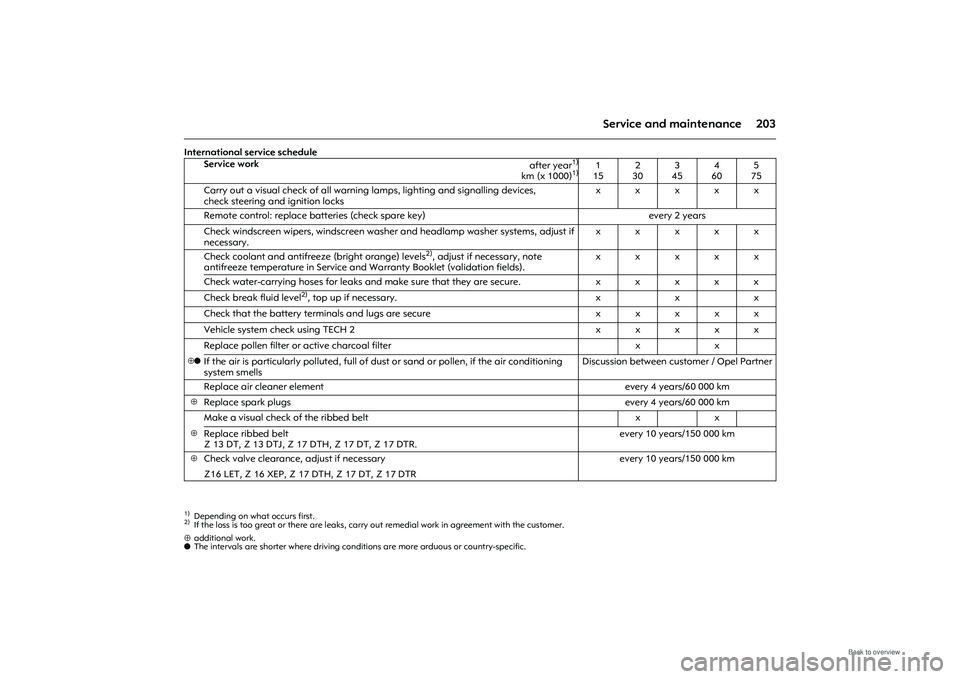
203
Service and maintenance
International service schedule⊕ additional work.
o The intervals are shorter where driving conditions are more arduous or country-specific.
Service work
after year
1)
km (x 1000)
1)
1)Depending on what occurs first.
1
15 2
30 3
45 4
60 5
75
Carry out a visual check of all warning lamps, lighting and signalling devices,
check steering and ignition locks xxxxx
Remote control: replace batteries (check spare key) every 2 years
Check windscreen wipers, windscreen washer and headlamp washer systems, adjust if
necessary. xxxxx
Check coolant and antifreeze (bright orange) levels
2), adjust if necessary, note
antifreeze temperature in Service and Warranty Booklet (validation fields).
2)If the loss is too great or there are leaks, carry out remedial work in agr eement with the customer.
xxxxx
Check water-carrying hoses for leaks and make sure that they are secure. xxxxx
Check break fluid level
2), top up if necessary. xxx
Check that the battery terminals and lugs are secure xxxxx
Vehicle system check using TECH 2 xxxxx
Replace pollen filter or active charcoal filter xx
⊕o
If the air is particularly polluted, full of du st or sand or pollen, if the air conditioning
system smells Discussion between customer / Opel Partner
Replace air cleaner element every 4 years/60 000 km
⊕
Replace spark plugsevery 4 years/60 000 km
Make a visual check of the ribbed belt xx
⊕
Replace ribbed belt
Z 13 DT, Z 13 DTJ, Z 17 DTH, Z 17 DT, Z 17 DTR. every 10 years/150 000 km
⊕
Check valve clearance,
adjust if necessary
Z16 LET, Z 16 XEP, Z 17 DTH, Z 17 DT, Z 17 DTR every 10 years/150 000 km