door lock OPEL MERIVA 2017 Owner's Manual
[x] Cancel search | Manufacturer: OPEL, Model Year: 2017, Model line: MERIVA, Model: OPEL MERIVA 2017Pages: 251, PDF Size: 8.14 MB
Page 146 of 251
144Driving and operating● The stop-start system ismanually deactivated.
● The bonnet is opened.
● The driver's seat belt is unfastened and the driver's door
is opened.
● The engine temperature is too low.
● The charging level of the vehicle battery is below a defined level.
● The brake vacuum is not sufficient.
● The vehicle is driven at least at walking speed.
● The climate control system requests an engine start.
● The air conditioning is manually switched on.
If the bonnet is not fully closed, a
warning message is displayed in the
Driver Information Centre.
If an electrical accessory, e.g. a
portable CD player, is connected to
the power outlet, a brief power drop
during the restart might be noticeable.Parking9 Warning
● Do not park the vehicle on an
easily ignitable surface. The
high temperature of the
exhaust system could ignite the
surface.
● Always apply parking brake. Pull switch m for approx.
one second.
The electric parking brake is
applied when control indicator
m illuminates 3 96.
● Switch off the engine. ● If the vehicle is on a level surface or uphill slope, engage
first gear or set the selector
lever to position P before
removing the ignition key. On
an uphill slope, turn the front
wheels away from the kerb.
If the vehicle is on a downhill
slope, engage reverse gear or
set the selector lever to position P before removing the ignition
key. Turn the front wheels
towards the kerb.
● Close the windows.
● Remove the ignition key from the ignition switch. Turn the
steering wheel until the
steering wheel lock is felt to
engage.
For vehicles with automatic
transmission, the key can only
be removed when the selector
lever is in position P.
Lock the vehicle and activate the anti-
theft alarm system.
Note
In the event of an accident with
airbag deployment, the engine is
turned off automatically if the vehicle comes to a standstill within a certain
time.
Page 174 of 251
172Vehicle careGeneral Information
Accessories and vehicle modifications
We recommend the use of genuine
parts and accessories and factory
approved parts specific for your
vehicle type. We cannot assess or guarantee reliability of other products
- even if they have a regulatory or
otherwise granted approval.
Do not make any modifications to the electrical system, e.g. changes of
electronic control units (chip tuning).Caution
When transporting the vehicle on
a train or on a recovery vehicle, the
mud flaps might be damaged.
Vehicle storage
Storage for a long period of time
If the vehicle is to be stored for several months:
● Wash and wax the vehicle.
● Have the wax in the engine compartment and underbody
checked.
● Clean and preserve the rubber seals.
● Fill up fuel tank completely.
● Change the engine oil.
● Drain the washer fluid reservoir.
● Check the coolant antifreeze and
corrosion protection.
● Adjust tyre pressure to the value specified for full load.
● Park the vehicle in a dry, well ventilated place. Engage first or
reverse gear or set selector lever
to P. Prevent the vehicle from
rolling.
● Do not apply the parking brake.● Open the bonnet, close all doors and lock the vehicle.
● Disconnect the clamp from the negative terminal of the vehicle
battery. Beware that all systems
are not functional, e.g. anti-theft
alarm system.
Putting back into operation
When the vehicle is to be put back into
operation:
● Connect the clamp to the negative terminal of the vehicle
battery. Activate the electronics
of the power windows.
● Check tyre pressure.
● Fill up the washer fluid reservoir.
● Check the engine oil level.
● Check the coolant level.
● Fit the number plate if necessary.
End-of-life vehicle recovery
Information on end-of-life vehicle
recovery centres and the recycling of
end-of-life vehicles is available on our website. Only entrust this work to an
authorised recycling centre.
Page 182 of 251
180Vehicle careBulb replacement
Switch off the ignition and switch off
the relevant switch or close the doors.
Only hold a new bulb at the base. Do not touch the bulb glass with bare
hands.
Use only the same bulb type for
replacement.
Replace headlight bulbs from within
the engine compartment.
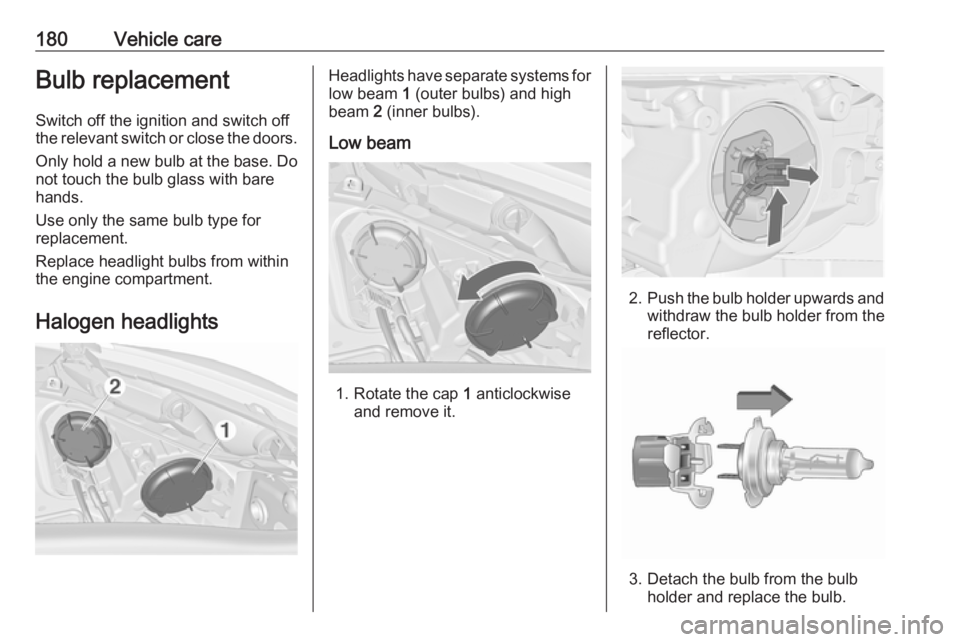
Halogen headlightsHeadlights have separate systems for low beam 1 (outer bulbs) and high
beam 2 (inner bulbs).
Low beam
1. Rotate the cap 1 anticlockwise
and remove it.
2. Push the bulb holder upwards and
withdraw the bulb holder from the
reflector.
3. Detach the bulb from the bulb holder and replace the bulb.
Page 195 of 251
Vehicle care193Instrument panel fuse box
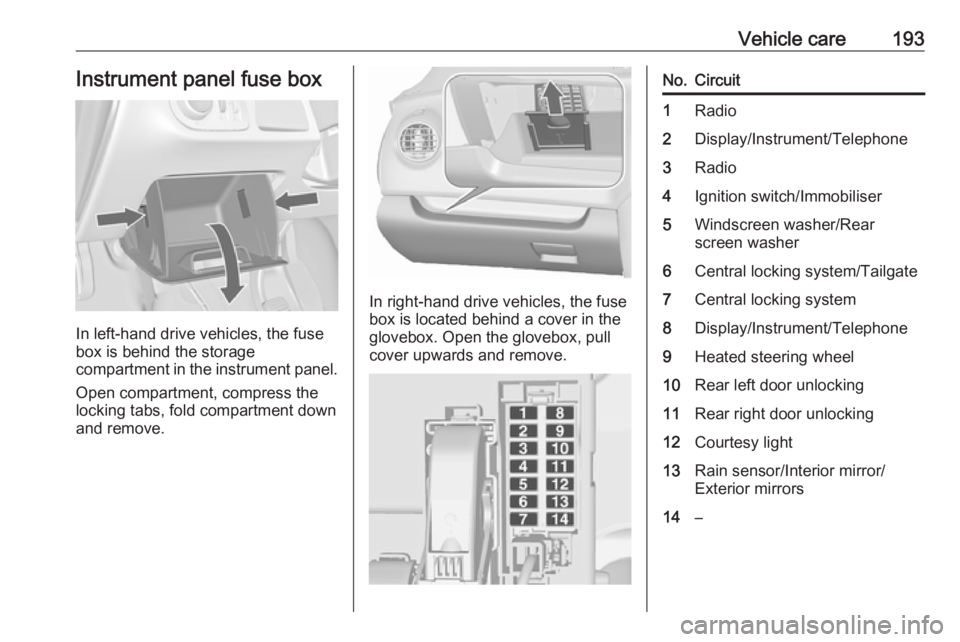
In left-hand drive vehicles, the fuse
box is behind the storage
compartment in the instrument panel.
Open compartment, compress the
locking tabs, fold compartment down and remove.
In right-hand drive vehicles, the fuse
box is located behind a cover in the
glovebox. Open the glovebox, pull
cover upwards and remove.
No.Circuit1Radio2Display/Instrument/Telephone3Radio4Ignition switch/Immobiliser5Windscreen washer/Rear
screen washer6Central locking system/Tailgate7Central locking system8Display/Instrument/Telephone9Heated steering wheel10Rear left door unlocking11Rear right door unlocking12Courtesy light13Rain sensor/Interior mirror/
Exterior mirrors14–
Page 217 of 251
Vehicle care215
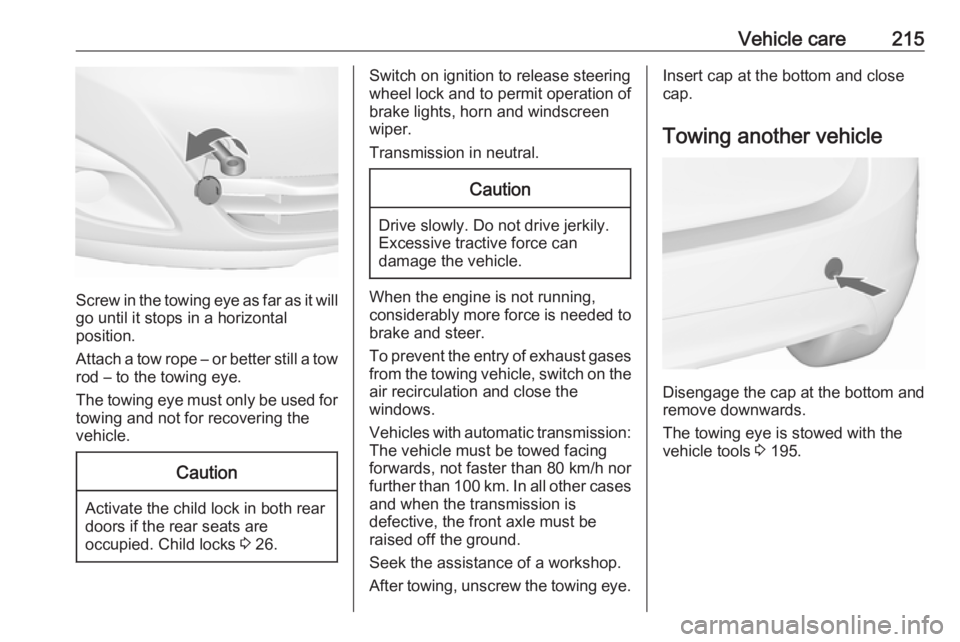
Screw in the towing eye as far as it will
go until it stops in a horizontal
position.
Attach a tow rope – or better still a tow
rod – to the towing eye.
The towing eye must only be used for towing and not for recovering the
vehicle.
Caution
Activate the child lock in both rear
doors if the rear seats are
occupied. Child locks 3 26.
Switch on ignition to release steering
wheel lock and to permit operation of
brake lights, horn and windscreen
wiper.
Transmission in neutral.Caution
Drive slowly. Do not drive jerkily.
Excessive tractive force can
damage the vehicle.
When the engine is not running,
considerably more force is needed to
brake and steer.
To prevent the entry of exhaust gases from the towing vehicle, switch on the
air recirculation and close the
windows.
Vehicles with automatic transmission: The vehicle must be towed facing
forwards, not faster than 80 km/h nor further than 100 km. In all other cases
and when the transmission is
defective, the front axle must be
raised off the ground.
Seek the assistance of a workshop.
After towing, unscrew the towing eye.
Insert cap at the bottom and close
cap.
Towing another vehicle
Disengage the cap at the bottom and
remove downwards.
The towing eye is stowed with the
vehicle tools 3 195.
Page 245 of 251
Customer information243When using the vehicle, situations
may occur in which these technical
data related to other information
(accident report, damages on the
vehicle, witness statements etc.) may
be associated with a specific person - possibly, with the assistance of an
expert.
Additional functions contractually
agreed upon with the client (e.g.
vehicle location in emergency cases)
allow the transmission of particular vehicle data from the vehicle.
Radio Frequency Identification (RFID)
RFID technology is used in some
vehicles for functions such as tyre
deflation detection and ignition
system security. It is also used in
connection with conveniences such
as radio remote controls for door
locking/unlocking and starting, and in-
vehicle transmitters for garage door
openers. RFID technology in Opel
vehicles does not use or record
personal information or link with any
other Opel system containing
personal information.
Page 247 of 251
245Cigarette lighter ........................... 88
Climate control ............................. 16
Climate control, service ..............137
Climate control systems .............129
Clock............................................. 86
Code ........................................... 106
Collision damage repair ..............240
Control indicators.......................... 92
Control of the vehicle .................139
Controls ........................................ 82
Controls in steering wheel ............82
Convex shape .............................. 29
Coolant ....................................... 175
Coolant and antifreeze ...............221
Coolant temperature gauge ..........90
Coupling ball bar ........................168
Cruise control ....................100, 154
Cupholders .................................. 61
Curtain airbag system .................. 53
Curve lighting.............................. 123
D
Danger, Warnings and Cautions ...4
Dashboard .................................... 10
Daytime running light ..................121
Daytime running lights ...............123
Declaration of conformity ............238
Diesel fuel system bleeding .......179
Diesel particle filter ...............98, 145
Door open .................................. 100Doors............................................ 26
Driver assistance systems ..........154
Driver Information Centre ...........101
Driving characteristics and towing tips .............................. 167
Driving hints ................................ 139
E Electric adjustment ......................29
Electrical system......................... 189
Electric parking brake ...........97, 151
Electric parking brake fault ...........97
Electronic climate control system 132
Electronic driving programmes ..148
Electronic Stability Control.......... 153
Electronic Stability Control and Traction Control system ............98
Electronic Stability Control off....... 98
End-of-life vehicle recovery .......172
Engine compartment fuse box ...191
Engine coolant ........................... 175
Engine coolant temperature gauge ....................................... 90
Engine data ............................... 228
Engine exhaust .......................... 145
Engine identification ...................224
Engine oil ................... 174, 221, 225
Engine oil pressure ......................99
Entry lighting .............................. 127
Event data recorders ..................242Exhaust gases ............................ 145
Exit lighting ................................ 127
Exterior care .............................. 216
Exterior light ................................. 99
Exterior lighting ....................13, 120
Exterior mirrors ............................. 29
F
Fault ........................................... 148
First aid ......................................... 78
First aid kit ................................... 78
Fixed air vents ........................... 137
Flex-Fix system ............................ 64
Fog light ..................................... 100
Fog lights .................... 124, 125, 184
Folding mirrors ............................. 30
Folding tray .................................. 78
Front airbag system .....................52
Front fog lights ........................... 124
Front seats.................................... 37
Front storage ................................ 63
Front turn signal light ..................180
Front turn signal lights ...............184
Fuel............................................. 160
Fuel consumption - CO 2-
Emissions ............................... 165
Fuel for diesel engines ..............160
Fuel for liquid gas operation .......160
Fuel for petrol engines ...............160
Fuel gauge ................................... 90