warning OPEL MERIVA 2017 Owner's Manual
[x] Cancel search | Manufacturer: OPEL, Model Year: 2017, Model line: MERIVA, Model: OPEL MERIVA 2017Pages: 251, PDF Size: 8.14 MB
Page 54 of 251
52Seats, restraintsThe airbag label is located on both
sides of the front passenger sun visor.
Airbag deactivation 3 53.
Front airbag system
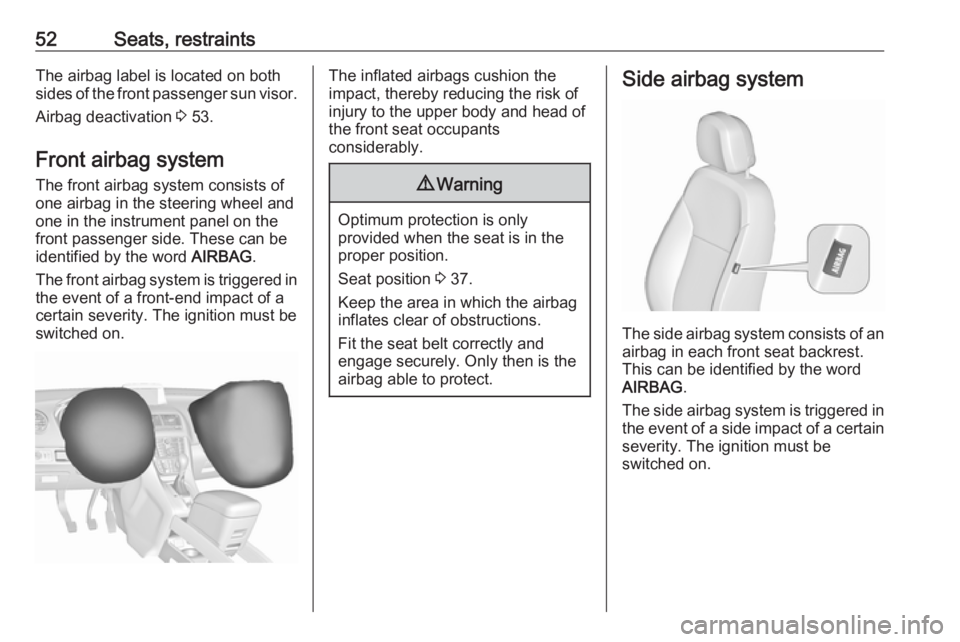
The front airbag system consists of
one airbag in the steering wheel and
one in the instrument panel on the
front passenger side. These can be
identified by the word AIRBAG.
The front airbag system is triggered in
the event of a front-end impact of a
certain severity. The ignition must be
switched on.The inflated airbags cushion the
impact, thereby reducing the risk of
injury to the upper body and head of
the front seat occupants
considerably.9 Warning
Optimum protection is only
provided when the seat is in the
proper position.
Seat position 3 37.
Keep the area in which the airbag
inflates clear of obstructions.
Fit the seat belt correctly and
engage securely. Only then is the
airbag able to protect.
Side airbag system
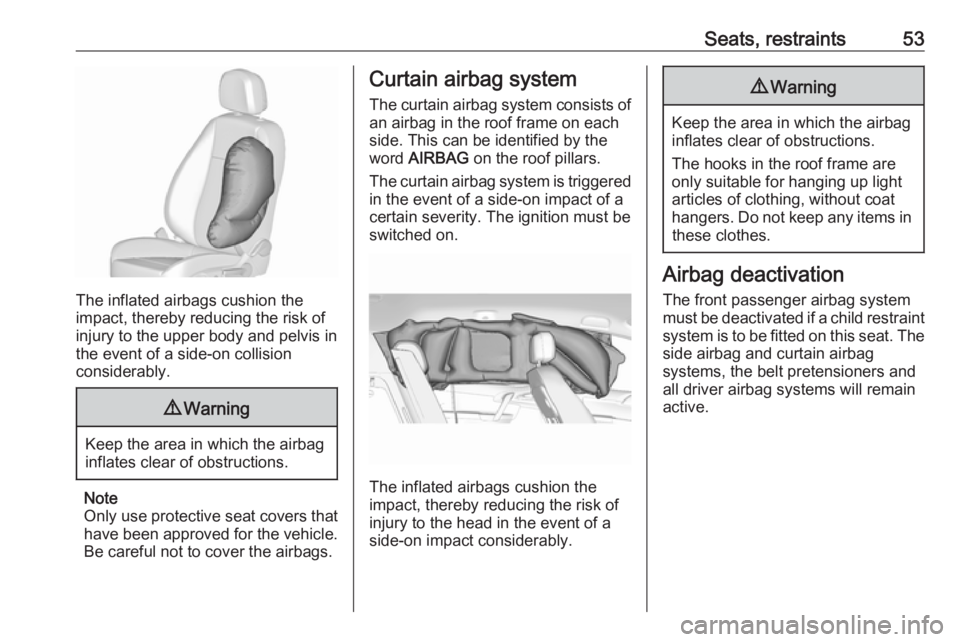
The side airbag system consists of an
airbag in each front seat backrest.
This can be identified by the word
AIRBAG .
The side airbag system is triggered in the event of a side impact of a certain
severity. The ignition must be
switched on.
Page 55 of 251
Seats, restraints53
The inflated airbags cushion the
impact, thereby reducing the risk of
injury to the upper body and pelvis in
the event of a side-on collision
considerably.
9 Warning
Keep the area in which the airbag
inflates clear of obstructions.
Note
Only use protective seat covers that
have been approved for the vehicle.Be careful not to cover the airbags.
Curtain airbag system
The curtain airbag system consists of an airbag in the roof frame on each
side. This can be identified by the
word AIRBAG on the roof pillars.
The curtain airbag system is triggered
in the event of a side-on impact of a
certain severity. The ignition must be
switched on.
The inflated airbags cushion the
impact, thereby reducing the risk of
injury to the head in the event of a
side-on impact considerably.
9 Warning
Keep the area in which the airbag
inflates clear of obstructions.
The hooks in the roof frame are
only suitable for hanging up light
articles of clothing, without coat
hangers. Do not keep any items in these clothes.
Airbag deactivation
The front passenger airbag system
must be deactivated if a child restraint
system is to be fitted on this seat. The side airbag and curtain airbag
systems, the belt pretensioners and
all driver airbag systems will remain
active.
Page 58 of 251
56Seats, restraintsWhen a child restraint system is beingused, pay attention to the following
usage and installation instructions and also those supplied with the child
restraint system.
Always comply with local or national
regulations. In some countries, the
use of child restraint systems is
forbidden on certain seats.9 Warning
If using a child restraint system on
the front passenger seat, the
airbag system for the front
passenger seat must be
deactivated; if not, the triggering of the front airbag poses a risk of fatal
injury to the child.
This is especially the case if
rearfacing child restraint systems are used on the front passenger
seat.
Airbag deactivation 3 53,
Airbag label 3 49.
Selecting the right system
The rear seats are the most
convenient location to fasten a child
restraint system.
Children should travel facing
rearwards in the vehicle as long as
possible. This makes sure that the child's backbone, which is still very
weak, is under less strain in the event of an accident.
Suitable are restraint systems that
comply with valid UN ECE
regulations. Check local laws and
regulations for mandatory use of child restraint systems.
Ensure that the child restraint system
to be installed is compatible with the
vehicle type.
Ensure that the mounting location of
the child restraint system within the
vehicle is correct, see following
tables.
Allow children to enter and exit the
vehicle only on the side facing away
from the traffic.
When the child restraint system is not in use, secure the seat with a seat beltor remove it from the vehicle.Note
Do not stick anything on the child
restraint systems and do not cover
them with any other materials.
A child restraint system which has
been subjected to stress in an
accident must be replaced.
Page 63 of 251
Storage61StorageStorage compartments................61
Glovebox ................................... 61
Cupholders ................................ 61
Front storage ............................. 63
Underseat storage .....................63
Armrest storage .........................63
Rear carrier system ...................64
Load compartment .......................73
Rear storage .............................. 74
Load compartment cover ...........74
Rear floor storage cover ............75
Lashing eyes ............................. 76
Safety net .................................. 76
Folding tray ................................ 78
Warning triangle ........................78
First aid kit ................................. 78
Roof rack system .........................79
Roof rack ................................... 79
Loading information .....................79Storage compartments9Warning
Do not store heavy or sharp
objects in the storage
compartments. Otherwise, the
storage compartment lid could
open and vehicle occupants could be injured by objects being thrown
around in the event of hard
braking, a sudden change in
direction or an accident.
Glovebox
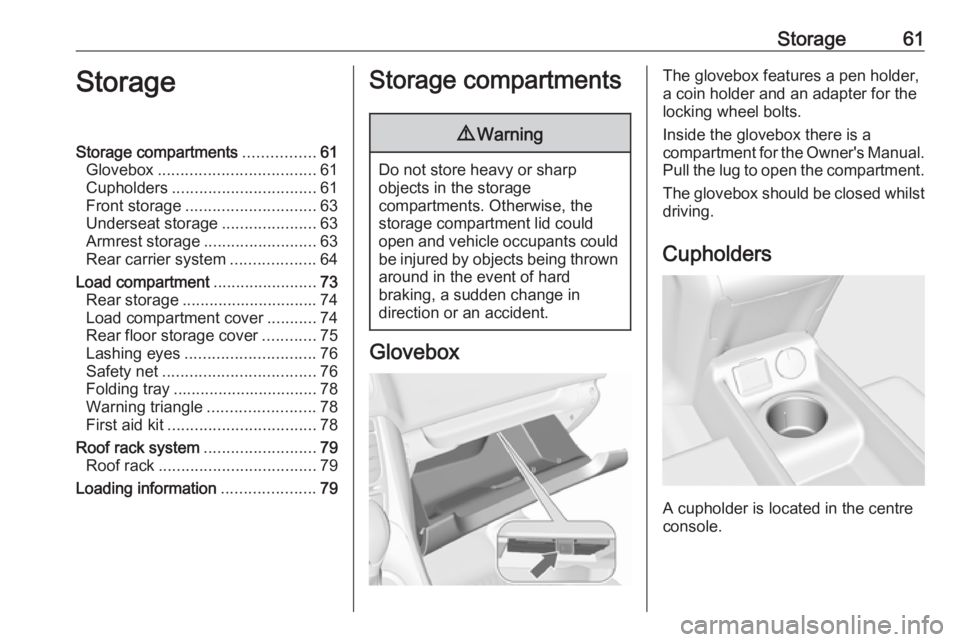
The glovebox features a pen holder,
a coin holder and an adapter for the
locking wheel bolts.
Inside the glovebox there is a
compartment for the Owner's Manual. Pull the lug to open the compartment.
The glovebox should be closed whilst driving.
Cupholders
A cupholder is located in the centre
console.
Page 66 of 251
64StorageRear carrier system
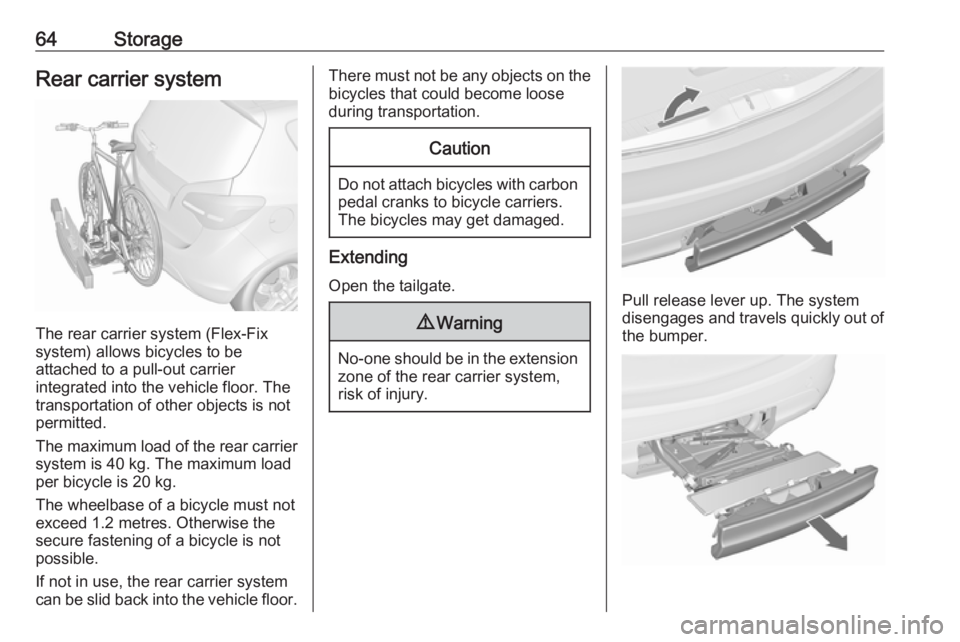
The rear carrier system (Flex-Fix
system) allows bicycles to be
attached to a pull-out carrier
integrated into the vehicle floor. The
transportation of other objects is not
permitted.
The maximum load of the rear carrier
system is 40 kg. The maximum load
per bicycle is 20 kg.
The wheelbase of a bicycle must not
exceed 1.2 metres. Otherwise the
secure fastening of a bicycle is not possible.
If not in use, the rear carrier system
can be slid back into the vehicle floor.
There must not be any objects on the bicycles that could become loose
during transportation.Caution
Do not attach bicycles with carbon pedal cranks to bicycle carriers.
The bicycles may get damaged.
Extending
Open the tailgate.
9 Warning
No-one should be in the extension
zone of the rear carrier system,
risk of injury.
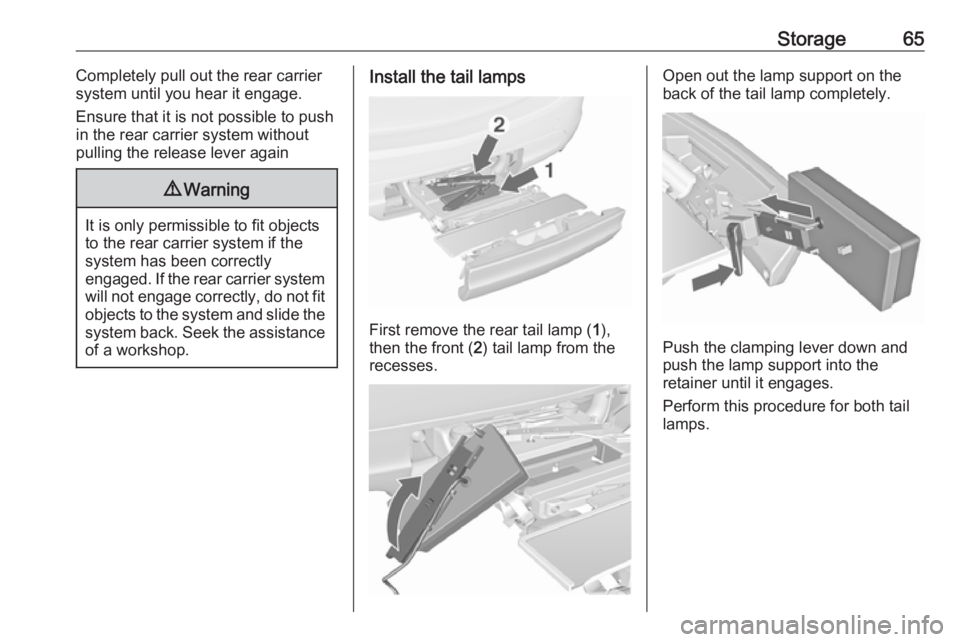
Pull release lever up. The system
disengages and travels quickly out of
the bumper.
Page 67 of 251
Storage65Completely pull out the rear carrier
system until you hear it engage.
Ensure that it is not possible to push in the rear carrier system without
pulling the release lever again9 Warning
It is only permissible to fit objects
to the rear carrier system if the
system has been correctly
engaged. If the rear carrier system
will not engage correctly, do not fit
objects to the system and slide the system back. Seek the assistance
of a workshop.
Install the tail lamps
First remove the rear tail lamp ( 1),
then the front ( 2) tail lamp from the
recesses.
Open out the lamp support on the
back of the tail lamp completely.
Push the clamping lever down and
push the lamp support into the
retainer until it engages.
Perform this procedure for both tail
lamps.
Page 72 of 251
70Storage
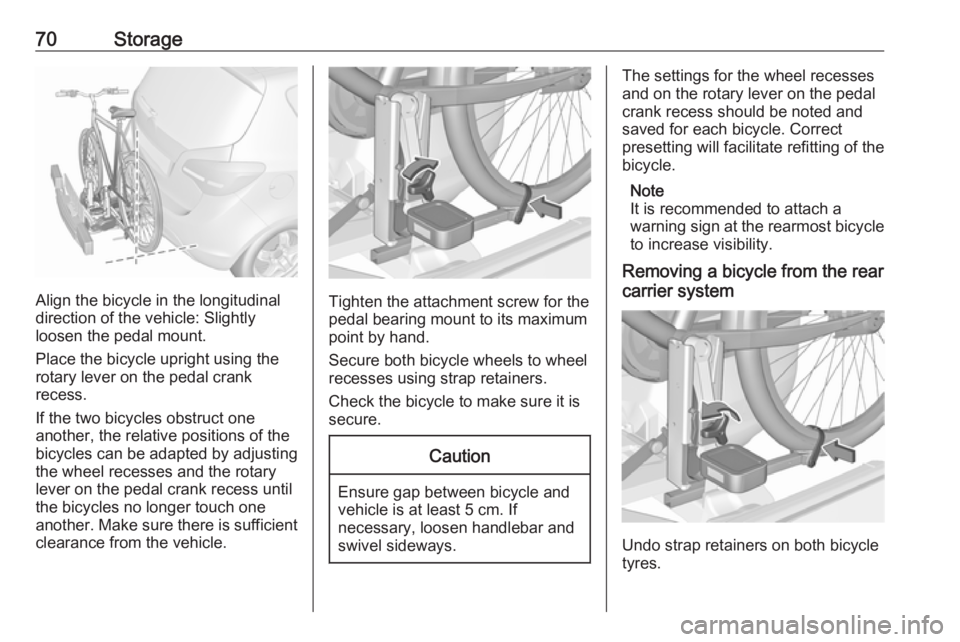
Align the bicycle in the longitudinal
direction of the vehicle: Slightly
loosen the pedal mount.
Place the bicycle upright using the
rotary lever on the pedal crank
recess.
If the two bicycles obstruct one
another, the relative positions of the
bicycles can be adapted by adjusting
the wheel recesses and the rotary
lever on the pedal crank recess until
the bicycles no longer touch one
another. Make sure there is sufficient
clearance from the vehicle.Tighten the attachment screw for the
pedal bearing mount to its maximum
point by hand.
Secure both bicycle wheels to wheel
recesses using strap retainers.
Check the bicycle to make sure it is
secure.
Caution
Ensure gap between bicycle and
vehicle is at least 5 cm. If
necessary, loosen handlebar and swivel sideways.
The settings for the wheel recesses
and on the rotary lever on the pedal
crank recess should be noted and saved for each bicycle. Correct
presetting will facilitate refitting of the
bicycle.
Note
It is recommended to attach a
warning sign at the rearmost bicycle to increase visibility.
Removing a bicycle from the rear
carrier system
Undo strap retainers on both bicycle
tyres.
Page 73 of 251
Storage71Hold on to the bicycle, loosen the
attachment screw for the pedal
bearing mount, then lift the pedal bearing mount to remove it.
Retracting the rear carrier system
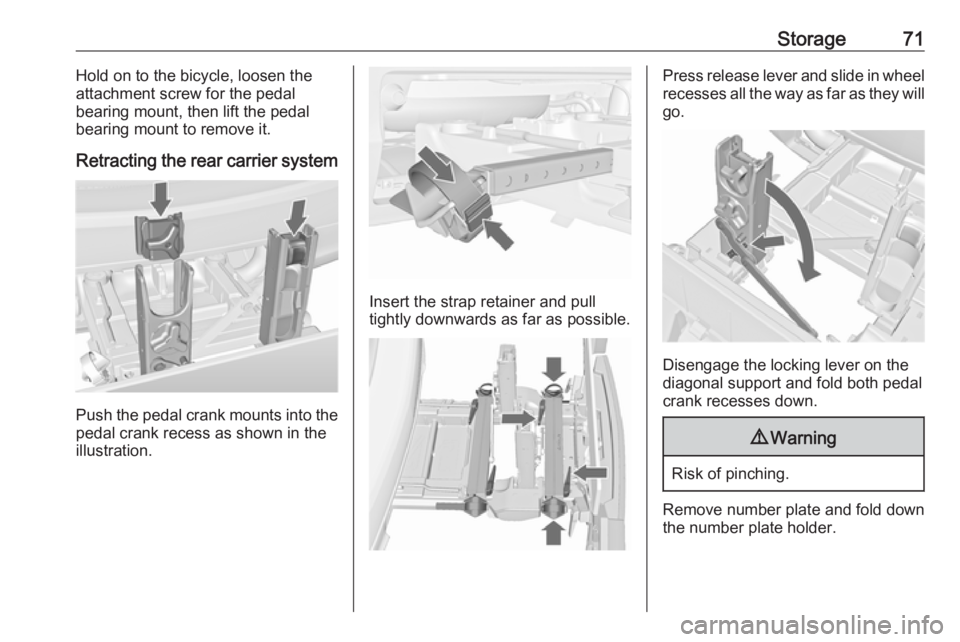
Push the pedal crank mounts into the
pedal crank recess as shown in the
illustration.
Insert the strap retainer and pull
tightly downwards as far as possible.
Press release lever and slide in wheel recesses all the way as far as they will
go.
Disengage the locking lever on the
diagonal support and fold both pedal crank recesses down.
9 Warning
Risk of pinching.
Remove number plate and fold down
the number plate holder.
Page 74 of 251
72Storage
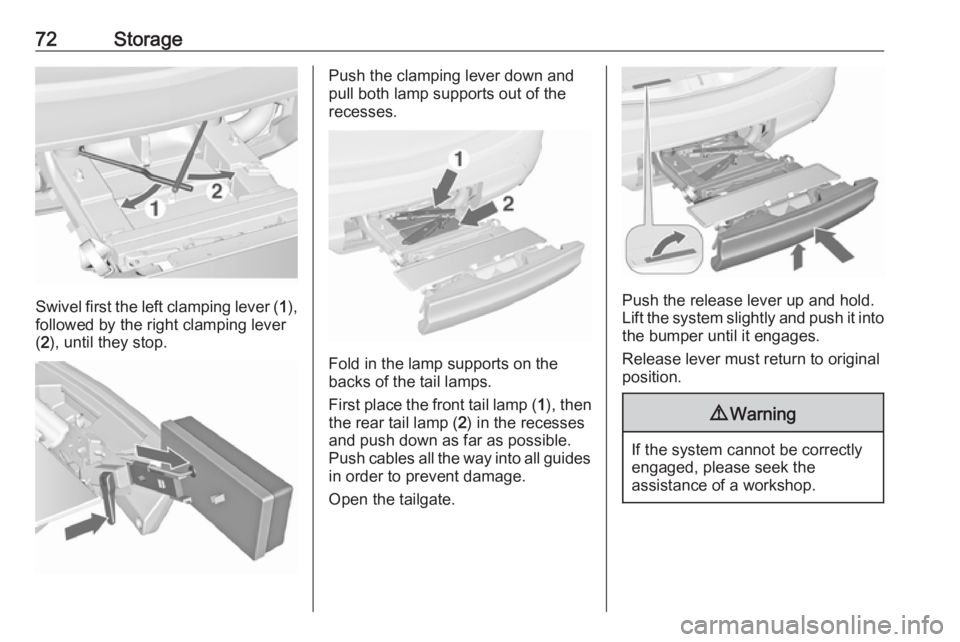
Swivel first the left clamping lever (1),
followed by the right clamping lever
( 2 ), until they stop.
Push the clamping lever down and
pull both lamp supports out of the recesses.
Fold in the lamp supports on the
backs of the tail lamps.
First place the front tail lamp ( 1), then
the rear tail lamp ( 2) in the recesses
and push down as far as possible. Push cables all the way into all guides
in order to prevent damage.
Open the tailgate.
Push the release lever up and hold.
Lift the system slightly and push it into the bumper until it engages.
Release lever must return to original
position.
9 Warning
If the system cannot be correctly
engaged, please seek the
assistance of a workshop.
Page 75 of 251
Storage73Load compartment
Folding down rear seat backrests
The rear seat backrest is divided into
three parts. All parts can be folded
down individually to increase the size of the load compartment.9 Warning
Do not stow objects under or
behind the seats. The objects
might be damaged and prevent
the guide rails from locking
properly.
A completely flat load bay is created if first the centre seat and then the
outer rear seat backrests are folded
down.
Caution
Do not fold the outer seat
backrests while the seats are in the inner position. The seats could be damaged.
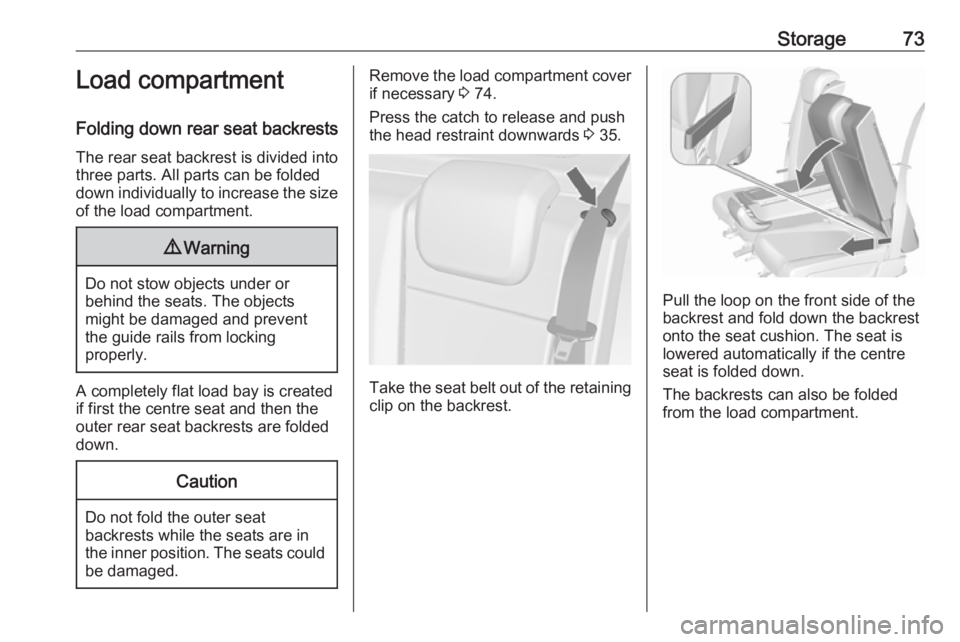
Remove the load compartment coverif necessary 3 74.
Press the catch to release and push
the head restraint downwards 3 35.
Take the seat belt out of the retaining
clip on the backrest.
Pull the loop on the front side of the
backrest and fold down the backrest
onto the seat cushion. The seat is
lowered automatically if the centre
seat is folded down.
The backrests can also be folded
from the load compartment.