fuel OPEL MOKKA 2014 Manual user
[x] Cancel search | Manufacturer: OPEL, Model Year: 2014, Model line: MOKKA, Model: OPEL MOKKA 2014Pages: 217, PDF Size: 6 MB
Page 152 of 217
150Driving and operating9Danger
Before refuelling, switch off engine
and any external heaters with
combustion chambers. Switch off
any mobile phones.
Follow the operating and safety
instructions of the filling station
when refuelling.
9 Danger
Fuel is flammable and explosive.
No smoking. No naked flames or
sparks.
If you can smell fuel in your
vehicle, have the cause of this
remedied immediately by a
workshop.
Caution
In case of misfuelling, do not
switch on ignition.
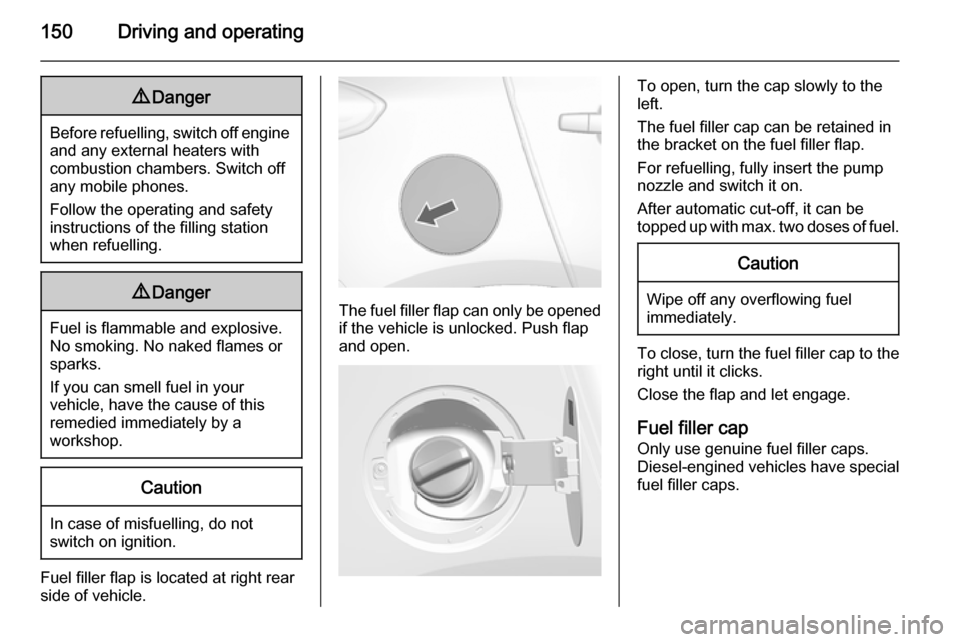
Fuel filler flap is located at right rear
side of vehicle.
The fuel filler flap can only be opened
if the vehicle is unlocked. Push flap
and open.
To open, turn the cap slowly to the
left.
The fuel filler cap can be retained in
the bracket on the fuel filler flap.
For refuelling, fully insert the pump
nozzle and switch it on.
After automatic cut-off, it can be
topped up with max. two doses of fuel.Caution
Wipe off any overflowing fuel
immediately.
To close, turn the fuel filler cap to the right until it clicks.
Close the flap and let engage.
Fuel filler cap
Only use genuine fuel filler caps. Diesel-engined vehicles have special
fuel filler caps.
Page 153 of 217

Driving and operating151Fuel consumption - CO2-
Emissions
The values for fuel consumption
(combined) of the model Opel Mokka is within a range of 7.9 to
4.5 l/100 km.
The values for CO 2 emission
(combined) is within a range of 189 to 120 g/km.
For the values specific to your
vehicle, refer to the EEC Certificate of
Conformity provided with your vehicle or other national registration
documents.
General information The official fuel consumption and
specific CO 2 emission figures quoted
relate to the EU base model with standard equipment.
Fuel consumption data and CO 2
emission data are determined
according to regulation
R (EC) No. 715/2007 (in the latest
applicable version), taking intoconsideration the vehicle weight in
running order, as specified by the regulation.
The figures are provided only for the
purpose of comparison between
different vehicle variants and must not be taken as a guarantee for the
actual fuel consumption of a
particular vehicle. Additional
equipment may result in slightly
higher results than the stated
consumption and CO 2 figures.
Furthermore, fuel consumption is
dependent on personal driving style
as well as road and traffic conditions.Trailer hitch
General information Only use towing equipment that has
been approved for your vehicle.
Entrust retrofitting of towing
equipment to a workshop. It may be
necessary to make changes that
affect the cooling system, heat
shields or other equipment.
Fitting of towing equipment could
cover the opening of the towing eye.
If this is the case, use the coupling ball
bar for towing. Always keep the
coupling ball bar in the vehicle.
Driving characteristics and
towing tips Before attaching a trailer, lubricate
the coupling ball. However, do not do so if a stabiliser, which acts on thecoupling ball, is being used to reduce
snaking movements.
For trailers with low driving stability
and caravan trailers with a permitted
gross vehicle weight of more than
Page 155 of 217

Vehicle care153Vehicle careGeneral Information...................153
Vehicle checks ........................... 154
Bulb replacement .......................161
Electrical system ........................167
Vehicle tools .............................. 172
Wheels and tyres .......................173
Jump starting ............................. 186
Towing ....................................... 187
Appearance care .......................190General Information
Accessories and vehicle
modifications
We recommend the use of genuine parts and accessories and factory
approved parts specific for your
vehicle type. We cannot assess or
guarantee reliability of other products
- even if they have a regulatory or
otherwise granted approval.
Do not make any modifications to the electrical system, e.g. changes of
electronic control units (chip tuning).Caution
When transporting the vehicle on
a train or on a recovery vehicle, the
mud flaps might be damaged.
Vehicle storage
Storage for a long period of time
If the vehicle is to be stored for several months:
■ Wash and wax the vehicle.
■ Have the wax in the engine compartment and underbody
checked.
■ Clean and preserve the rubber seals.
■ Fill up fuel tank completely.
■ Change the engine oil.
■ Drain the washer fluid reservoir.
■ Check the coolant antifreeze and corrosion protection.
■ Adjust tyre pressure to the value specified for full load.
■ Park the vehicle in a dry, well ventilated place. Engage first orreverse gear or set selector lever to P . Prevent the vehicle from rolling.
■ Do not apply the parking brake.
Page 162 of 217

160Vehicle care
Warning label
Meaning of symbols:■ No sparks, naked flames or smoking.
■ Always shield eyes. Explosive gases can cause blindness or
injury.
■ Keep the vehicle battery out of reach of children.
■ The vehicle battery contains sulphuric acid which could cause
blindness or serious burn injuries.
■ See the Owner's Manual for further
information.
■ Explosive gas may be present in the vicinity of the vehicle battery.
Diesel fuel system
bleeding
If the tank has been run dry, the diesel
fuel system must be bled. Switch on
the ignition three times for
15 seconds at a time. Then crank the
engine for a maximum of
40 seconds. Repeat this process after
no less than 5 seconds. If the engine fails to start, seek the assistance of a
workshop.Wiper blade replacement
Lift the wiper arm, press button to
disengage the wiper blade and
remove.
Attach the wiper blade slightly angled
to the wiper arm and push until it
engages.
Lower wiper arm carefully.
Page 171 of 217

Vehicle care169
No.Circuit18Engine control module19Fuel pump20–21Cooling fan22–23Ignition coil, Engine control
module24Washer pump25Headlamp actuator (right hand)26Engine control module27–28Engine control module29Engine control module30Exhaust system31Left-hand high beam32Right-hand high beam33Engine control moduleNo.Circuit34Horn35Climate control, air conditioning
system36Front fog lamp
J-cases Fuses
No.Circuit1Electrical brake control module2Front wiper3Engine control module4Engine control module5–6Fuel heater7–8Cooling fan9Cooling fanNo.Circuit10Engine control module, Glow
plug11Starter
Instrument panel fuse box
Interior fuse block is located on the
underside of the driver's side
instrument panel.
To access the fuses, remove the
storage.
To remove the storage, open and pull it.
Page 174 of 217

172Vehicle care
No.Circuit1Seat, lumbar support, driver2Seat, lumbar support,
passenger3Amplifier4Trailer socket5All-wheel drive6Display7Spare8Trailer9Spare10Spare11Trailer12Navigation13Heated steering wheel14Trailer socket15Steering wheel16Water in fuel sensorNo.Circuit17Interior mirror18Spare
S/B Fuses
No.Circuit01Power seat driver02Power seat passenger03Trailer04Voltage converter05Battery06Headlight washer07Spare08Spare09SpareVehicle tools
Tools
Vehicles with tyre repair kit
The tools and tyre repair kit are in the
right side of the load compartment.
3 178.
Vehicles with spare wheel A label on the jack indicates the
vehicles for which the jack can be
used.
Page 176 of 217

174Vehicle care
Tyre pressure 3 206 and on the label
on the driver's door frame.
The tyre pressure data refers to cold
tyres. It applies to summer and winter tyres.
Always inflate the spare tyre to the
pressure specified for full load.
The ECO tyre pressure serves to
achieve the smallest amount of fuel
consumption possible.
Incorrect tyre pressures will impair
safety, vehicle handling, comfort and
fuel economy and will increase tyre
wear.
Tyre pressures differ depending on
various options. For the correct tyre
pressure value, follow the procedure
below:
1. Identify the engine identifier code.
Engine data 3 201.
2. Identify the respective tyre.
The tyre pressure tables show all
possible tyre combinations 3 206.
For the tyres approved for your
vehicle, refer to the EEC Certificate of Conformity provided with your vehicle
or other national registration
documents.
The driver is responsible for correct
adjustment of tyre pressure.9 Warning
If the pressure is too low, this can
result in considerable tyre warm-
up and internal damage, leading to tread separation and even to tyre
blow-out at high speeds.
Tyre pressure monitoring
system
The Tyre Pressure Monitoring
System (TPMS) uses radio and
sensor technology to check tyre
pressure levels.
All wheels must be equipped with
pressure sensors and the tyres must
have the prescribed pressure.
The TPMS sensors monitor the air
pressure in the tyres and transmit tyre pressure readings to a receiver
located in the vehicle.
Each tyre, including the spare, should be checked monthly when cold and
inflated to the inflation pressure
recommended on the tyre pressure
label.
Control indicator w illuminates when
one or more tyres are significantly
under-inflated.
Check the tyre pressure as soon as
possible, and inflate them to the
proper pressure.
Page 196 of 217

194Service and maintenance
Make sure that the Service and
Warranty Booklet is completed
correctly as continuous proof of
service and to assist with warranty
claims. It is also a benefit when selling
the vehicle.
Service interval with remainingengine oil life duration The service interval is based on
several parameters depending on
usage.
The service display lets you know
when to change the engine oil.
Service display 3 81.Recommended fluids,
lubricants and parts
Recommended fluids and
lubricants Only use products that meet the
recommended specifications.
Damage resulting from the use of
products not in line with these
specifiations will not be covered by
the warranty.9 Warning
Operating materials are
hazardous and could be
poisonous. Handle with care. Pay
attention to information given on
the containers.
Engine oil
Engine oil is identified by its quality
and its viscosity. Quality is more
important than viscosity when
selecting which engine oil to use. The oil quality ensures e.g. engine
cleanliness, wear protection and oil
aging control, whereas viscosity
grade gives information on the oil's
thickness over a temperature range.
Dexos is the newest engine oil quality
that provides optimum protection for
gasoline and diesel engines. If it is unavailable, engine oils of other listed qualities have to be used.
Recommendations for gasoline
engines are also valid for
Compressed Natural Gas (CNG),
Liquified Petroleum Gas (LPG) and
Ethanol (E85) fuelled engines.
Select the appropriate engine oil
based on its quality and on the
minimum ambient temperature
3 198.
Topping up engine oil
Engine oils of different manufacturers
and brands can be mixed as long as
they comply with the required engine
oil quality and viscosity.
Use of engine oil with only
ACEA A1/B1 or only A5/B5 quality is
prohibited, since it can cause long-
term engine damage under certain
operating conditions.
Page 203 of 217
![OPEL MOKKA 2014 Manual user Technical data201Engine dataSales designation1.41.61.81.7Engine identifier codeA14NETA16XERA18XERA17DTSNumber of cylinders4444Piston displacement [cm3
]1364159817961686Engine power [kW]1038510396at rp](/img/37/18890/w960_18890-202.png "OPEL MOKKA 2014 Manual user Technical data201Engine dataSales designation1.41.61.81.7Engine identifier codeA14NETA16XERA18XERA17DTSNumber of cylinders4444Piston displacement [cm3
]1364159817961686Engine power [kW]1038510396at rp")
Technical data201Engine dataSales designation1.41.61.81.7Engine identifier codeA14NETA16XERA18XERA17DTSNumber of cylinders4444Piston displacement [cm3
]1364159817961686Engine power [kW]1038510396at rpm4900-6000600062004000Torque [Nm]200155178300at rpm1850-4900400038002000-2500Fuel typePetrolPetrolPetrolDieselOctane rating RONrecommended959595possible989898Oil consumption [l/1000 km]0.60.60.60.6
Page 207 of 217
![OPEL MOKKA 2014 Manual user Technical data205CapacitiesEngine oilEngineA14NETA16XERA18XERA17DTSincluding Filter [l]4.55.14.55.4between MIN and MAX [l]1.01.01.01.0
Fuel tank
EngineA14NETA16XERA18XERA17DTSPetrol/diesel, refilling](/img/37/18890/w960_18890-206.png "OPEL MOKKA 2014 Manual user Technical data205CapacitiesEngine oilEngineA14NETA16XERA18XERA17DTSincluding Filter [l]4.55.14.55.4between MIN and MAX [l]1.01.01.01.0
Fuel tank
EngineA14NETA16XERA18XERA17DTSPetrol/diesel, refilling")
Technical data205CapacitiesEngine oilEngineA14NETA16XERA18XERA17DTSincluding Filter [l]4.55.14.55.4between MIN and MAX [l]1.01.01.01.0
Fuel tank
EngineA14NETA16XERA18XERA17DTSPetrol/diesel, refilling quantity [l]52525352