towing OPEL MOKKA 2017 Owners Manual
[x] Cancel search | Manufacturer: OPEL, Model Year: 2017, Model line: MOKKA, Model: OPEL MOKKA 2017Pages: 233, PDF Size: 6.69 MB
Page 126 of 233
124Driving and operatingDriving and
operatingDriving hints ............................... 125
Control of the vehicle ...............125
Steering ................................... 125
Starting and operating ...............125
New vehicle running-in ............125
Ignition switch positions ...........126
Starting the engine ..................126
Overrun cut-off ........................ 127
Stop-start system ....................127
Parking .................................... 129
Engine exhaust .......................... 130
Diesel particle filter ..................130
Catalytic converter ...................131
Automatic transmission ..............131
Transmission display ...............131
Selector lever .......................... 132
Manual mode ........................... 133
Electronic driving programmes 133
Fault ........................................ 133
Interruption of power supply ....133
Manual transmission ..................134
Drive systems ............................ 135
All-wheel drive ......................... 135Brakes........................................ 136
Antilock brake system .............136
Parking brake .......................... 136
Brake assist ............................. 137
Hill start assist ......................... 137
Ride control systems .................137
Traction Control system ..........137
Electronic Stability Control ......138
Descent control system ...........139
Driver assistance systems .........140
Cruise control .......................... 140
Speed limiter ........................... 141
Forward collision alert .............142
Parking assist .......................... 144
Rear view camera ...................146
Traffic sign assistant ................148
Lane departure warning ..........151
Fuel ............................................ 152
Fuel for petrol engines .............152
Fuel for diesel engines ............152
Fuel for liquid gas operation ....153
Refuelling ................................ 155
Fuel consumption - CO 2-
Emissions ............................... 158
Trailer hitch ................................ 159
General information .................159
Driving characteristics and towing tips .............................. 159Trailer towing........................... 159
Towing equipment ...................160
Page 133 of 233

Driving and operating131% flashes when diesel particle filter
has reached the maximum filling level. Start cleaning process
immediately to avoid damage to the
engine.
Cleaning process
To activate cleaning process,
continue driving, keep engine speed
above 2000 revolutions per minute.
Shift down if necessary. Diesel
particle filter cleaning is then started.
If control indicator g also
illuminates, cleaning is not possible:
seek the assistance of a workshop.Caution
If the cleaning process is
interrupted, there is a risk of
provoking severe engine damage.
Cleaning takes place quickest at high engine speeds and loads.
The control indicator % extinguishes
as soon as the self-cleaning
operation is complete.
Catalytic converter
The catalytic converter reduces the
amount of harmful substances in the
exhaust gases.Caution
Fuel grades other than those listed on pages 3 152, 3 213 could
damage the catalytic converter or
electronic components.
Unburnt petrol will overheat and
damage the catalytic converter.
Therefore avoid excessive use of the starter, running the fuel tank
dry and starting the engine by
pushing or towing.
In the event of misfiring, uneven
engine running, a reduction in engine performance or other unusual
problems, have the cause of the fault
rectified by a workshop as soon as
possible. In an emergency, driving
can be continued for a short period,
keeping vehicle speed and engine
speed low.
Automatic transmission
The automatic transmission permits
automatic gearshifting (automatic
mode) or manual gearshifting
(manual mode).
Transmission display
The mode or selected gear is shown
in the transmission display.
Page 137 of 233
Driving and operating135Caution
It is not advisable to drive with thehand resting on the selector lever.
Stop-start system 3 127.
Drive systems
All-wheel drive
The All-Wheel Drive (AWD) system
enhances driving characteristics and
stability, and helps to achieve the best
possible driveability regardless of
ground surface. The system is always
active and cannot be deactivated.
The torque is distributed steplessly
between the wheels of the front and rear axle, depending on the driving
conditions. Additionally the torque
between the rear wheels is distributed depending on the surface.
For optimum system performance,
the vehicle's tyres should not have
varying degrees of wear.
When using a temporary spare
wheel, the AWD system is
automatically disabled.
The AWD system will also be
temporarily disabled to protect the
system from overheating if there is
excessive wheel spin. When the
system cools down, AWD will be
restored.The deactivation of the AWD system
will be indicated by a message on the
Driver Information Centre.
If a service message or warning
code S73 is displayed on the Driver
Information Centre, there is a
malfunction in the AWD system. Seek
the assistance of a workshop.
Vehicle messages 3 94, Towing the
vehicle 3 200.
Page 148 of 233
146Driving and operatingSpecial conditions apply if there
are taller vehicles in the vicinity
(e.g. off-road vehicles, mini vans,
vans). Object identification and correct distance indication in the
upper part of these vehicles
cannot be guaranteed.
Objects with a very small reflection
cross-section, e.g. objects of
narrow size or soft materials, may
not be detected by the system.
Parking assist systems do not
detect objects outside the
detection range.
Note
The parking assist system
automatically detects factory-fitted
towing equipment. It is deactivated
when the connector is plugged in.
The sensor may detect a non-
existent object (echo disturbance)
caused by external acoustic or
mechanical disturbances.
Note
The parking assist is deactivated
when the rear carrier system is
extended.
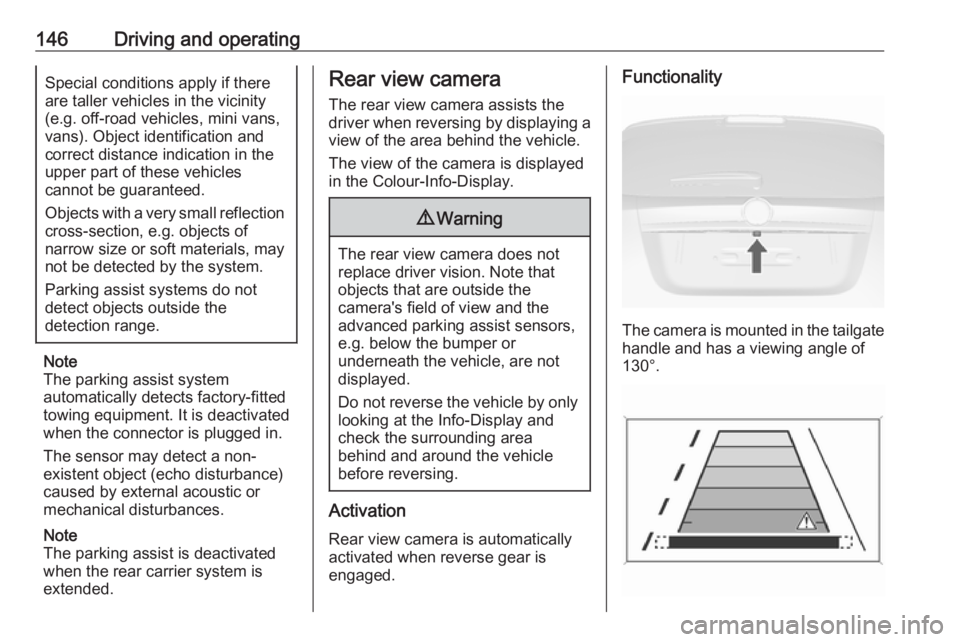
Rear view camera
The rear view camera assists the
driver when reversing by displaying a view of the area behind the vehicle.
The view of the camera is displayed
in the Colour-Info-Display.9 Warning
The rear view camera does not
replace driver vision. Note that
objects that are outside the
camera's field of view and the
advanced parking assist sensors,
e.g. below the bumper or
underneath the vehicle, are not
displayed.
Do not reverse the vehicle by only looking at the Info-Display and
check the surrounding area
behind and around the vehicle
before reversing.
Activation
Rear view camera is automatically
activated when reverse gear is
engaged.
Functionality
The camera is mounted in the tailgate handle and has a viewing angle of
130°.
Page 150 of 233

148Driving and operatingTraffic sign assistant
Functionality The traffic sign assistant system
detects designated traffic signs via a
front camera and displays them in the
Driver Information Centre.
Traffic signs which will be detected
are:
Limit and no passing signs ● speed limit
● no passing
● end of speed limit
● end of no passingRoad signs
Beginning and end of:
● motorways
● A-roads
● play streetsAdd-on signs ● additional hints to traffic signs
● restriction of trailer towing
● wet warning
● ice warning
● direction arrows
Speed limit signs are displayed in the
Driver Information Centre until the
next speed limit sign or end of speed
limit is detected or up to a defined sign timeout.
Combinations of more signs in the
display are possible.
Page 161 of 233

Driving and operating159Trailer hitch
General information
Only use towing equipment that has
been approved for your vehicle.
Entrust retrofitting of towing
equipment to a workshop. It may be
necessary to make changes that
affect the cooling system, heat
shields or other equipment.
The bulb outage detection function for trailer brake light cannot detect a
partial bulb outage, e.g. in case of four
times five watt bulbs, the function only detects lamp outage when only a
single five Watt lamp remains or none remain.
Fitting of towing equipment could
cover the opening of the towing eye.
If this is the case, use the coupling ball
bar for towing. Always keep the
coupling ball bar in the vehicle when
not in use.Driving characteristics and
towing tips
Before attaching a trailer, lubricate
the coupling ball. However, do not do
so if a stabiliser, which acts on the coupling ball, is being used to reduce
snaking movements.
For trailers with low driving stability
and caravan trailers with a permitted
gross vehicle weight of more than
1000 kg a speed of 80 km/h must not
be exceeded; the use of a stabiliser is
recommended.
If the trailer starts snaking, drive more
slowly, do not attempt to correct the
steering and brake sharply if
necessary.
When driving downhill, drive in the
same gear as if driving uphill and
drive at a similar speed.
Adjust tyre pressure to the value
specified for full load 3 218.Trailer towing
Trailer loadsThe permissible trailer loads are
vehicle and engine-dependent
maximum values which must not be
exceeded. The actual trailer load is
the difference between the actual
gross weight of the trailer and the
actual coupling socket load with the trailer coupled.
The permissible trailer loads are
specified in the vehicle documents. In general, they are valid for gradients
up to max. 12%.
The permitted trailer loads apply up to
the specified incline and up to an
altitude of 1000 metres above sea
level. Since engine power decreases
as altitude increases due to the air
becoming thinner, therefore reducing
climbing ability, the permissible gross train weight also decreases by 10%
for every 1000 metres of additional
altitude. The gross train weight does
not have to be reduced when driving
on roads with slight inclines (less than
8%, e.g. motorways).
Page 162 of 233

160Driving and operatingThe permissible gross train weight
must not be exceeded. This weight is
specified on the identification plate
3 208.
Vertical coupling load The vertical coupling load is the load
exerted by the trailer on the coupling
ball. It can be varied by changing the
weight distribution when loading the
trailer.
The maximum permissible vertical
coupling load (75 kg) is specified on
the towing equipment identification
plate and in the vehicle documents.
Always aim for the maximum load,
especially in the case of heavy
trailers. The vertical coupling load
should never fall below 25 kg.
Rear axle load The permissible axle loads (see
identification plate or vehicle
documents) must not be exceeded.Towing equipmentCaution
When operating without a trailer,
remove the coupling ball bar.
Stowage of coupling ball bar
The bag with the coupling ball bar is
stowed in the rear stowage
compartment on the floor.
Place the strap through the lashing
eye, wrap around twice and tighten
the strap to secure the bag.
Fitting the coupling ball bar
Disengage and fold down the socket. Remove the sealing plug from the
opening for the coupling ball bar and
stow it.
Page 164 of 233

162Driving and operatingAttach breakaway stopping cable to
eye.
Check that the coupling ball bar is correctly installed
● Green marking on rotary knob must point towards green
marking on coupling ball bar.
● There must be no gap between the rotary handle and the
coupling ball bar.
● The coupling ball bar must be firmly engaged in the opening.
● The coupling ball bar must be locked and the key removed.9Warning
Towing a trailer is permitted only
when a coupling ball bar is fitted correctly. If the coupling ball bardoes not engage correctly, seekthe assistance of a workshop.
Dismounting the coupling ball bar
Open the protective flap and turn the
key to position c to unlock the
coupling ball bar.
Pull out rotary handle and turn
clockwise as far as it will go. Pull out coupling ball bar downwards.
Insert sealing plug in opening. Fold away socket.
Page 165 of 233

Vehicle care163Vehicle careGeneral Information...................164
Accessories and vehicle modifications .......................... 164
Vehicle storage ........................164
End-of-life vehicle recovery .....164
Vehicle checks ........................... 165
Performing work ......................165
Bonnet ..................................... 165
Engine oil ................................. 166
Engine coolant ......................... 167
Power steering fluid .................168
Washer fluid ............................ 168
Brakes ..................................... 169
Brake fluid ............................... 169
Vehicle battery ......................... 169
Diesel fuel system bleeding .....171
Wiper blade replacement ........171
Bulb replacement .......................172
Halogen headlights ..................172
Xenon headlights .....................174
Fog lights ................................. 175
Front turn signal lights .............175
Tail lights ................................. 176
Side turn signal lights ..............177Centre high-mounted brake
light ......................................... 177
Number plate light ...................178
Interior lights ............................ 178
Electrical system ........................179
Fuses ....................................... 179
Engine compartment fuse box . 179
Instrument panel fuse box .......181
Load compartment fuse box ....182
Vehicle tools .............................. 184
Tools ........................................ 184
Wheels and tyres .......................184
Winter tyres ............................. 184
Tyre designations ....................185
Tyre pressure .......................... 185
Tyre pressure monitoring system .................................... 186
Tread depth ............................. 189
Changing tyre and wheel size . 190 Wheel covers ........................... 190
Tyre chains .............................. 190
Tyre repair kit .......................... 191
Wheel changing .......................194
Spare wheel ............................ 196
Jump starting ............................. 198
Towing ....................................... 200
Towing the vehicle ...................200
Towing another vehicle ...........201Appearance care .......................202
Exterior care ............................ 202
Interior care ............................. 204
Page 198 of 233

196Vehicle careJacking position for lifting platform
Rear arm position of the lifting
platform centrically under the recess
of the sill.
Front arm position of the lifting
platform at the underbody.
Spare wheel Some vehicles are equipped with a
tyre repair kit instead of a spare wheel
3 191.
If mounting a spare wheel, which is
different from the other wheels, this
wheel might be classified as a
temporary spare wheel and the
corresponding speed limits apply,
even though no label indicates this.
Seek the assistance of a workshop to
check the applicable speed limit.
The spare wheel has a steel rim.Caution
The use of a spare wheel that is smaller than the other wheels or in combination with winter tyres
could affect driveability. Have the defective tyre replaced as soon as
possible.
The spare wheel is located in the load
compartment beneath the floor
covering. It is secured with a wing nut.
Stowing a damaged full size
wheel in the load compartment
The spare wheel well is not designed for other tyre sizes than the spare
wheel.