service OPEL MOVANO_B 2017 Manual user
[x] Cancel search | Manufacturer: OPEL, Model Year: 2017, Model line: MOVANO_B, Model: OPEL MOVANO_B 2017Pages: 255, PDF Size: 6.12 MB
Page 128 of 255
126Climate controlBus
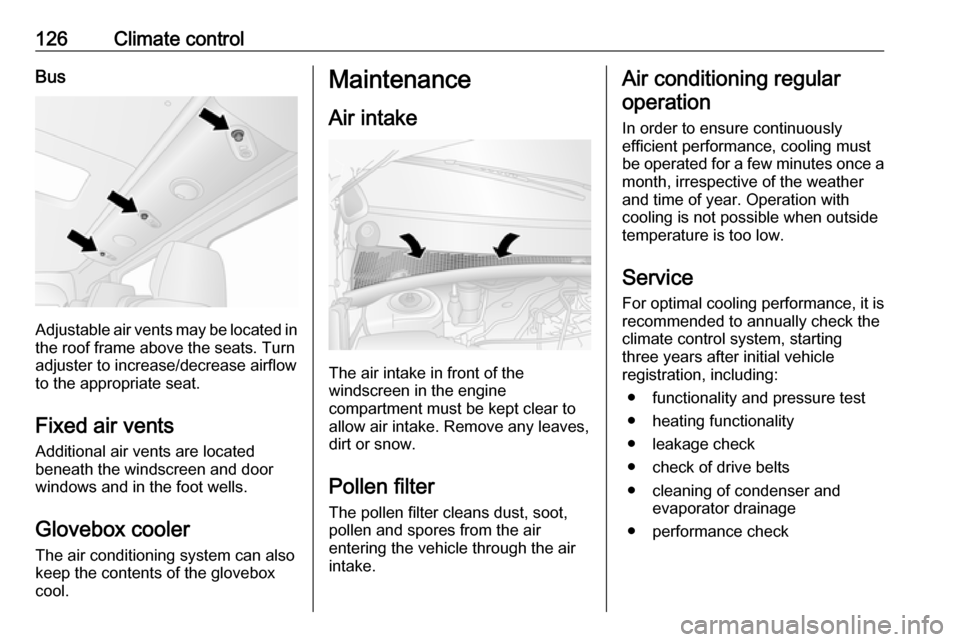
Adjustable air vents may be located inthe roof frame above the seats. Turn
adjuster to increase/decrease airflow
to the appropriate seat.
Fixed air vents Additional air vents are located
beneath the windscreen and door
windows and in the foot wells.
Glovebox cooler
The air conditioning system can also
keep the contents of the glovebox
cool.
Maintenance
Air intake
The air intake in front of the
windscreen in the engine
compartment must be kept clear to
allow air intake. Remove any leaves,
dirt or snow.
Pollen filter The pollen filter cleans dust, soot,
pollen and spores from the air
entering the vehicle through the air
intake.
Air conditioning regular
operation
In order to ensure continuously
efficient performance, cooling must
be operated for a few minutes once a
month, irrespective of the weather
and time of year. Operation with
cooling is not possible when outside
temperature is too low.
ServiceFor optimal cooling performance, it is
recommended to annually check the
climate control system, starting
three years after initial vehicle
registration, including:
● functionality and pressure test
● heating functionality
● leakage check
● check of drive belts
● cleaning of condenser and evaporator drainage
● performance check
Page 137 of 255
Driving and operating135● Close the windows.
● Turn the ignition key to position
0 and remove it. Turn the
steering wheel until the
steering wheel lock is felt to
engage.
Lock the vehicle 3 23 and activate the
anti-theft locking system 3 33 and
anti-theft alarm system 3 33.
Air suspension
Operates automatically when the
vehicle is driven. The air suspension
system constantly adjusts the ride
height according to the vehicle load.
Caution
To ensure safe operation of the air
suspension system, do not exceed the maximum permissible gross
vehicle weight rating. Refer to
identification plate 3 218 or the
vehicle documents.
For further information on the air
suspension system, refer to the
operating instructions supplied.
Master switchCaution
The air suspension system must
be switched off when the vehicle is being towed, jump‐started, raised
off the ground or transported.
Do not switch off the air
suspension system when driving.
Jump starting 3 206, Towing the
vehicle 3 208.
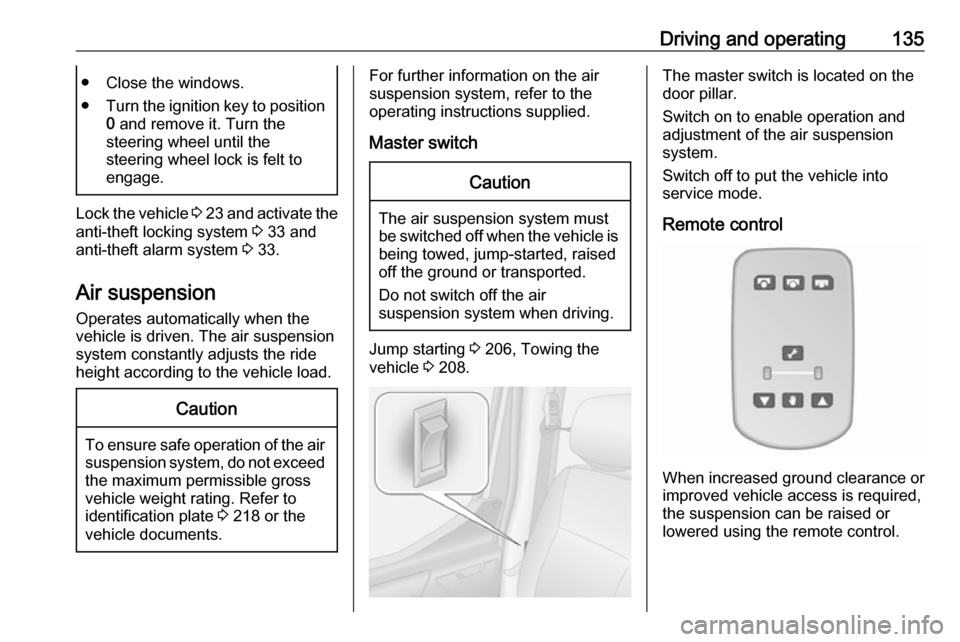
The master switch is located on the
door pillar.
Switch on to enable operation and
adjustment of the air suspension
system.
Switch off to put the vehicle into
service mode.
Remote control
When increased ground clearance or improved vehicle access is required,the suspension can be raised or
lowered using the remote control.
Page 138 of 255
136Driving and operatingCaution
Ensure there is adequate
clearance and that there are no
obstructions when adjusting the
suspension height.
The remote control unit is magnetic
and may be fixed to any metal part of the vehicle or stored in its holder.
With the engine running, press the appropriate button for two seconds to
adjust the suspension height.
Indicator light will flash intermittently
while height adjustment is in progress
and illuminates when complete.
If the ignition is switched on with
engine not running, the suspension
height can only be lowered.
Note
Handle with care, protect from
moisture and high temperatures and
avoid unnecessary operation.
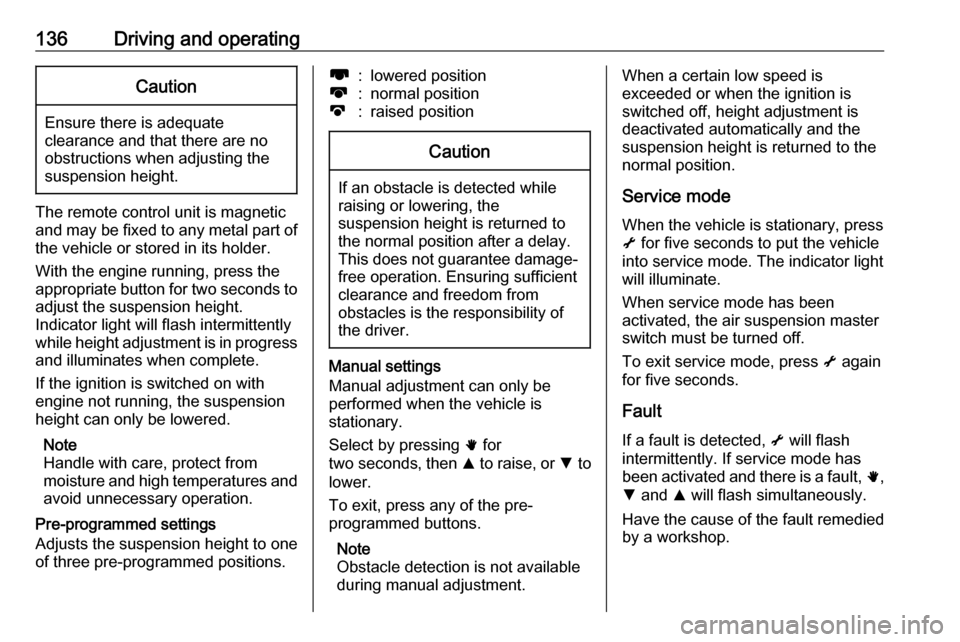
Pre-programmed settings
Adjusts the suspension height to one
of three pre-programmed positions.
l:lowered positionk:normal positionj:raised positionCaution
If an obstacle is detected while
raising or lowering, the
suspension height is returned to the normal position after a delay.
This does not guarantee damage- free operation. Ensuring sufficient
clearance and freedom from
obstacles is the responsibility of the driver.
Manual settings
Manual adjustment can only be
performed when the vehicle is
stationary.
Select by pressing h for
two seconds , then R to raise, or S to
lower.
To exit, press any of the pre-
programmed buttons.
Note
Obstacle detection is not available
during manual adjustment.
When a certain low speed is
exceeded or when the ignition is
switched off, height adjustment is deactivated automatically and the
suspension height is returned to the
normal position.
Service modeWhen the vehicle is stationary, press
i for five seconds to put the vehicle
into service mode. The indicator light
will illuminate.
When service mode has been
activated, the air suspension master
switch must be turned off.
To exit service mode, press i again
for five seconds.
Fault
If a fault is detected, i will flash
intermittently. If service mode has been activated and there is a fault, h,
S and R will flash simultaneously.
Have the cause of the fault remedied
by a workshop.
Page 198 of 255
196Vehicle careRelearn function
After a puncture has been repaired
and the driver has inflated the tyres to
the correct tyre pressure, the tyre
pressure monitoring system needs to recalculate.
Tyre pressure 3 239, Tyre repair kit
3 198.
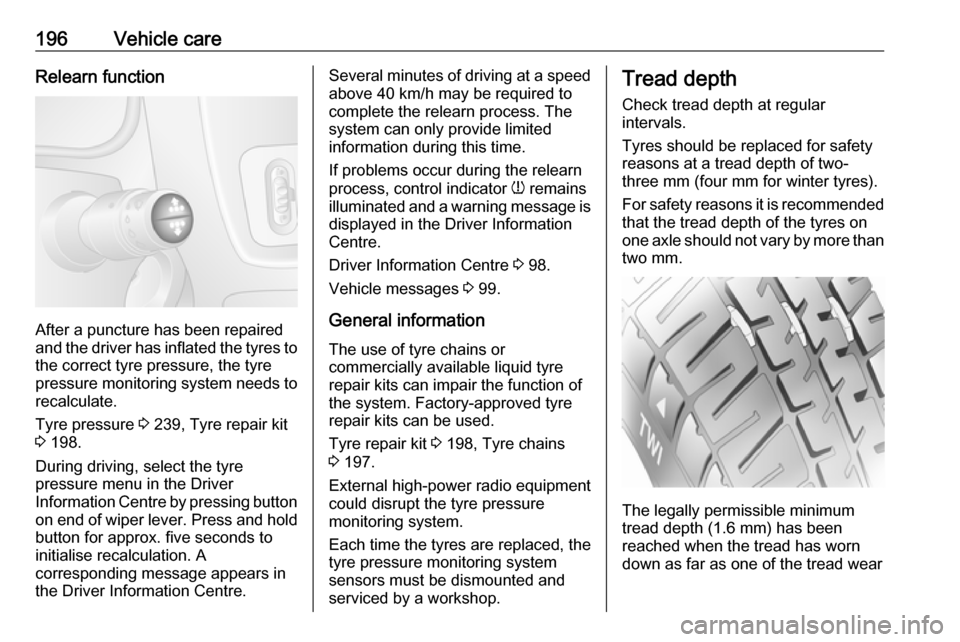
During driving, select the tyre
pressure menu in the Driver
Information Centre by pressing button
on end of wiper lever. Press and hold button for approx. five seconds to
initialise recalculation. A
corresponding message appears in
the Driver Information Centre.
Several minutes of driving at a speed above 40 km/h may be required to
complete the relearn process. The system can only provide limited
information during this time.
If problems occur during the relearn
process, control indicator w remains
illuminated and a warning message is displayed in the Driver Information
Centre.
Driver Information Centre 3 98.
Vehicle messages 3 99.
General information
The use of tyre chains or
commercially available liquid tyre
repair kits can impair the function of
the system. Factory-approved tyre
repair kits can be used.
Tyre repair kit 3 198, Tyre chains
3 197.
External high-power radio equipment
could disrupt the tyre pressure
monitoring system.
Each time the tyres are replaced, the
tyre pressure monitoring system
sensors must be dismounted and
serviced by a workshop.Tread depth
Check tread depth at regular
intervals.
Tyres should be replaced for safety
reasons at a tread depth of two-
three mm (four mm for winter tyres).
For safety reasons it is recommended
that the tread depth of the tyres on
one axle should not vary by more than two mm.
The legally permissible minimum
tread depth (1.6 mm) has been
reached when the tread has worn
down as far as one of the tread wear
Page 215 of 255

Service and maintenance213Service and
maintenanceGeneral information ...................213
Service information ..................213
Recommended fluids, lubricants and parts .................................... 215
Recommended fluids and lubricants ................................ 215General information
Service information In order to ensure economical and
safe vehicle operation and to
maintain the value of your vehicle, it
is of vital importance that all
maintenance work is carried out at the proper intervals as specified.
The detailed, up-to-date service
schedule for the vehicle is available at
the workshop.
Service display 3 88.
Engine identification 3 218.
European service intervals -
except Bus
Maintenance of your vehicle is
required every 40,000 km or after
two years, whichever occurs first, unless otherwise indicated by the
service display.
A shorter service interval can be valid for severe driving behaviour, e.g. for
taxis and police vehicles.European service intervals - Bus
only
Maintenance of your vehicle is
required every 30,000 km or after
one year, whichever occurs first, unless otherwise indicated by the
service display.
The European service intervals are
valid for the following countries:
Andorra, Austria, Belgium, Croatia,
Czech Republic, Denmark, Estonia,
Finland, France, Germany, Greece,
Hungary, Iceland, Ireland, Italy,
Latvia, Liechtenstein, Lithuania,
Luxembourg, Netherlands, Norway,
Poland, Portugal, Slovakia, Slovenia,
Spain, Sweden, Switzerland, United
Kingdom.
Service display 3 88.
International service intervals Israel:
Maintenance of your vehicle is
required every 40,000 km or after
one year, whichever occurs first,
unless otherwise indicated by the
service display.
Page 216 of 255

214Service and maintenanceAlbania, Bosnia-Herzegovina,
Kosovo, Macedonia, Montenegro,
Serbia:
Maintenance of your vehicle is
required every 30,000 km or after
two years, whichever occurs first,
unless otherwise indicated by the
service display.
Romania, Bulgaria, Moldova, Cyprus:
Maintenance of your vehicle is
required every 30,000 km or after
two years, whichever occurs first,
unless otherwise indicated by the
service display.
Australia, New Zealand:
Maintenance of your vehicle is
required every 30,000 km or after
two years, whichever occurs first,
unless otherwise indicated by the
service display.
Turkey:
Maintenance of your vehicle is
required every 20,000 km or after
one year, whichever occurs first, unless otherwise indicated by the
service display.Morocco:
Maintenance of your vehicle is
required every 20,000 km or after
one year, whichever occurs first,
unless otherwise indicated by the
service display.
South Africa:
Maintenance of your vehicle is
required every 15,000 km or after
one year, whichever occurs first,
unless otherwise indicated by the
service display.
Russia, Ukraine, Belarus,
Kazakhstan:
Maintenance of your vehicle is
required every 15,000 km or after
one year, whichever occurs first,
unless otherwise indicated by the
service display.
Algeria, Tunisia:
Maintenance of your vehicle is required every 10,000 km or after
one year, whichever occurs first,
unless otherwise indicated by the service display.International:
Maintenance of your vehicle is
required every 15,000 km or after
one year, whichever occurs first,
unless otherwise indicated by the
service display.
International countries include:
Malta, Singapore.
International +:
Maintenance of your vehicle is
required every 10,000 km or after
one year, whichever occurs first,
unless otherwise indicated by the
service display.
International + countries include: To
be defined.
International ++:
Maintenance of your vehicle is
required every 8,000 km or after one year, whichever occurs first,unless otherwise indicated by the
service display.
International ++ countries include:
Hong Kong.
Severe operating conditions exist if
one or more of the following
circumstances occur frequently: Cold
Page 217 of 255

Service and maintenance215starting, stop and go operation, trailer
operation, mountain driving, driving
on poor and sandy road surfaces,
increased air pollution, presence of
airborne sand and high dust content,
driving at high altitude and large
variations of temperature. Under
these severe operating conditions,
certain service work may be required more frequently than the regular
service interval.
Service display 3 88.
Confirmations Confirmation of service is recorded inthe Service and warranty booklet.
The date and mileage is completed
with the stamp and signature of the
servicing workshop.
Make sure that the Service and
warranty booklet is completed
correctly as continuous proof of
service is essential if any warranty or goodwill claims are to be met, and is
also a benefit when selling the
vehicle.Service display
The service interval is based on
several parameters depending on
usage.
The service display, located in the
Driver Information Centre, indicates
when the next service is due. Seek
the assistance of a workshop.
Service display 3 88.
Engine oil lever monitor 3 87.Recommended fluids,
lubricants and parts
Recommended fluids andlubricants
Only use products that meet the
recommended specifications.9 Warning
Operating materials are
hazardous and could be
poisonous. Handle with care. Pay
attention to information given on
the containers.
Engine oil
Engine oil is identified by its quality
and its viscosity. Quality is more
important than viscosity when
selecting which engine oil to use. The oil quality ensures e.g. engine
cleanliness, wear protection and oil
aging control, whereas viscosity
grade gives information on the oil's
thickness over a temperature range.
Page 218 of 255

216Service and maintenanceDexos is the newest engine oil quality
that provides optimum protection for
diesel engines. If it is unavailable,
engine oils of other listed qualities
must be used.
Select the appropriate engine oil
based on its quality and on the
minimum ambient temperature
3 219.
Topping up engine oil
Engine oils of different manufacturers and brands can be mixed as long as
they comply with the required engine
oil quality and viscosity.
Use of engine oil with only
ACEA A1/B1 or only A5/B5 quality is
prohibited, since it can cause long-
term engine damage under certain
operating conditions.
Select the appropriate engine oil
based on its quality and on the
minimum ambient temperature
3 219.
Additional engine oil additives
The use of additional engine oil
additives could cause damage and
invalidate the warranty.Engine oil viscosity grades
The SAE viscosity grade gives
information of the thickness of the oil.
Multigrade oil is indicated by two
figures, e.g. SAE 5W-30. The first
figure, followed by a W, indicates the
low temperature viscosity and the
second figure the high temperature viscosity.
Select the appropriate viscosity grade depending on the minimum ambient
temperature 3 219.
All of the recommended viscosity
grades are suitable for high ambient
temperatures.
Coolant and antifreeze
Use only silicate-free long life coolant (LLC) antifreeze approved for thevehicle. Consult a workshop.
The system is factory filled with
coolant designed for excellent
corrosion protection and frost
protection down to approx. -28 °C.
This concentration should be
maintained all year round. The use of additional coolant additives that
intend to give additional corrosionprotection or seal against minor leaks
can cause function problems. Liability
for consequences resulting from the
use of additional coolant additives will be rejected.
Washer fluid Use only washer fluid approved for
the vehicle to prevent damage of
wiper blades, paintwork, plastic and
rubber parts. Consult a workshop.
Brake fluid
Over time, brake fluid absorbs
moisture which will reduce braking
effectiveness. The brake fluid should
therefore be replaced at the specified interval.
AdBlue Only use AdBlue to reduce the
nitrogen oxides in the exhaust
emission 3 138.
Page 221 of 255

Technical data219Vehicle data
Recommended fluids and lubricants
Required engine oil qualityEngine oil quality: Europedexos 2✔
For countries with International
service interval 3 213, you may use
the oil qualities listed below:
Engine oil quality: Internationaldexos 2✔GM-LL-A/B-025✔ACEA C3
diesel engines with DPF✔ACEA A3/B4
diesel engines without DPF✔Engine oil viscosity gradesAmbient temperaturedown to -25 °CSAE 5W-30 or
SAE 5W-40below -25 °CSAE 0W-30 or
SAE 0W-40
Page 246 of 255

244Customer information● Vehicle reactions in particulardriving situations (e.g. inflation of
an airbag, activation of the
stability regulation system).
● Environmental conditions (e.g. temperature).
These data are exclusively technical and help identifying and correcting
errors as well as optimizing vehicle
functions.
Motion profiles indicating travelled
routes cannot be created with these
data.
If services are used (e.g. repair
works, service processes, warranty cases, quality assurance),
employees of the service network
(manufacturer included) are able to
read out this technical information
from the event and error data storage
modules applying special diagnostic
devices. If required, you will receive
further information at these
workshops. After an error has been
corrected, the data are deleted from
the error storage module or they are
constantly overwritten.When using the vehicle, situations
may occur in which these technical
data related to other information
(accident report, damages on the
vehicle, witness statements etc.) may be associated with a specific person -possibly, with the assistance of an
expert.
Additional functions contractually
agreed upon with the client (e.g.
vehicle location in emergency cases)
allow the transmission of particular
vehicle data from the vehicle.
Radio Frequency
Identification (RFID)
RFID technology is used in some
vehicles for functions such as tyre
pressure monitoring and ignition
system security. It is also used in
connection with conveniences such
as radio remote controls for door
locking/unlocking and starting, and in-
vehicle transmitters for garage door
openers. RFID technology in Opel
vehicles does not use or record
personal information or link with any
other Opel system containing
personal information.