tyre pressure OPEL MOVANO_B 2018 Manual user
[x] Cancel search | Manufacturer: OPEL, Model Year: 2018, Model line: MOVANO_B, Model: OPEL MOVANO_B 2018Pages: 265, PDF Size: 6.39 MB
Page 20 of 265
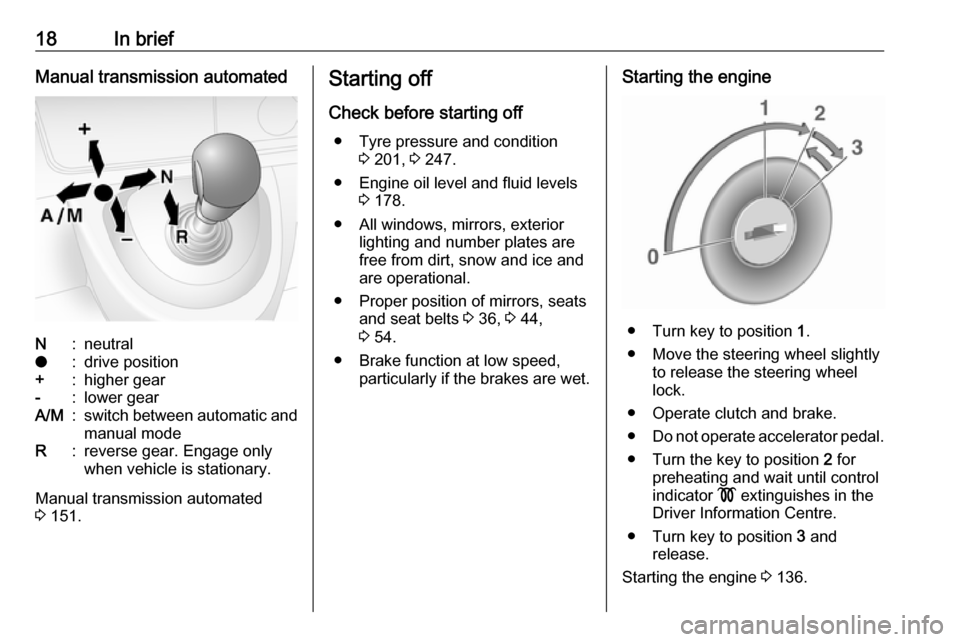
18In briefManual transmission automatedN:neutralo:drive position+:higher gear-:lower gearA/M:switch between automatic and
manual modeR:reverse gear. Engage only
when vehicle is stationary.
Manual transmission automated
3 151.
Starting off
Check before starting off ● Tyre pressure and condition 3 201, 3 247.
● Engine oil level and fluid levels 3 178.
● All windows, mirrors, exterior lighting and number plates are
free from dirt, snow and ice and
are operational.
● Proper position of mirrors, seats and seat belts 3 36, 3 44,
3 54.
● Brake function at low speed, particularly if the brakes are wet.Starting the engine
● Turn key to position 1.
● Move the steering wheel slightly to release the steering wheel
lock.
● Operate clutch and brake.
● Do not operate accelerator pedal.
● Turn the key to position 2 for
preheating and wait until control
indicator ! extinguishes in the
Driver Information Centre.
● Turn key to position 3 and
release.
Starting the engine 3 136.
Page 85 of 265

Storage83Optional equipment and
accessories increase the kerb
weight.
● Driving with a roof load increases
the sensitivity of the vehicle to
cross-winds and has a
detrimental effect on vehicle
handling due to the vehicle's
higher centre of gravity.
Distribute the load evenly and secure it properly with retaining
straps. Adjust the tyre pressure
and vehicle speed according to
the load conditions. Check and
retighten the straps frequently.
Do not drive faster than
120 km/h.
● The permissible roof load (which includes the weight of the roof
rack) is 200 kg for standard roof
variants. The roof load is the combined weight of the roof rack
and the load.
Page 86 of 265

84Instruments and controlsInstruments and
controlsControls ....................................... 85
Steering wheel adjustment ........85
Steering wheel controls .............85
Horn ........................................... 85
Steering column controls ...........85
Windscreen wiper/washer .........86
Outside temperature ..................87
Clock ......................................... 88
Power outlets ............................. 88
Cigarette lighter ......................... 90
Ashtrays .................................... 90
Warning lights, gauges and indi‐ cators ........................................... 90
Instrument cluster ......................90
Speedometer ............................. 90
Odometer .................................. 91
Trip odometer ............................ 91
Tachometer ............................... 91
Fuel gauge ................................ 92
AdBlue gauge ............................ 92
Engine coolant temperature gauge ....................................... 92
Engine oil level monitor .............93
Service display .......................... 93Transmission display .................94
Control indicators ......................94
Turn signal ................................. 97
Seat belt reminder .....................97
Airbag and belt tensioners .........97
Airbag deactivation ....................97
Charging system .......................98
Malfunction indicator light ..........98
Service vehicle soon .................98
Stop engine ............................... 99
Brake system ............................. 99
Antilock brake system (ABS) .....99
Upshift ....................................... 99
Lane departure warning ............99
Electronic Stability Program ....100
Electronic Stability Program off ........................................... 100
Engine coolant temperature ....100
Preheating ............................... 100
AdBlue ..................................... 100
Tyre pressure monitoring system .................................... 100
Engine oil pressure ..................101
Low fuel ................................... 101
Stop-start system ....................101
Exterior light ............................ 102
High beam ............................... 102
High beam assist .....................102
Fog light ................................... 102
Rear fog light ........................... 102Cruise control.......................... 102
Tachograph ............................. 102
Door open ................................ 102
Information displays ...................103
Driver Information Centre ........103
Info display .............................. 103
Vehicle messages ......................104
Warning chimes .......................104
Trip computer ............................. 105
Tachograph ................................ 107
Page 98 of 265
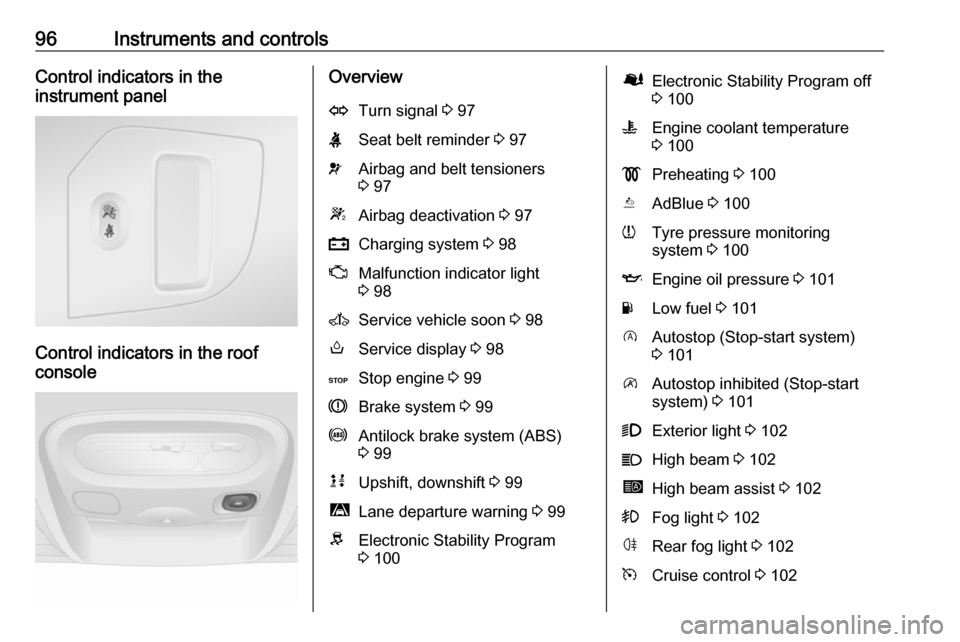
96Instruments and controlsControl indicators in the
instrument panel
Control indicators in the roof
console
OverviewOTurn signal 3 97XSeat belt reminder 3 97vAirbag and belt tensioners
3 97WAirbag deactivation 3 97pCharging system 3 98ZMalfunction indicator light
3 98AService vehicle soon 3 98oService display 3 98CStop engine 3 99RBrake system 3 99uAntilock brake system (ABS)
3 99kjUpshift, downshift 3 99ìLane departure warning 3 99RElectronic Stability Program
3 100ØElectronic Stability Program off
3 100WEngine coolant temperature
3 100!Preheating 3 100YAdBlue 3 100wTyre pressure monitoring
system 3 100IEngine oil pressure 3 101YLow fuel 3 101DAutostop (Stop-start system)
3 101\Autostop inhibited (Stop-start
system) 3 1019Exterior light 3 102CHigh beam 3 102íHigh beam assist 3 102>Fog light 3 102øRear fog light 3 102mCruise control 3 102
Page 102 of 265
100Instruments and controlsLane departure warning 3 168.
Electronic Stability Program b flashes or illuminates yellow.
Illuminates briefly when the ignition is
switched on.
Flashing during driving
The system is actively engaged.
Engine output may be reduced and
the vehicle may be braked
automatically to a small degree
3 158.
Illuminates during driving
The system is unavailable.
May illuminate together with control indicator A 3 98. A corresponding
message also appears in the Driver
Information Centre 3 103.
ESP® Plus
3 158, Traction Control
system 3 157.
Electronic Stability Program off
Ø illuminates green.If ESP ®Plus
has been deactivated with
Ø on the instrument panel, control
indicator Ø illuminates and a
corresponding message appears in
the Driver Information Centre 3 103.
ESP® Plus
3 158, Traction Control
system 3 157.
Engine coolant temperature
W illuminates red.
Illuminates briefly when the ignition is
switched on.
Illuminates when the engine is
running
If W illuminates (possibly in
combination with control indicator
C ), stop vehicle and switch off
engine.Caution
Coolant temperature too high.
Check coolant level 3 179.
If there is sufficient coolant, consult a workshop.
Preheating
! illuminates yellow.
Preheating is activated. Only
activates when outside temperature
is low.
AdBlue Õ illuminates yellow.
AdBlue level is low. Refill AdBlue as
soon as possible, to avoid prevention
of engine starts.
Illuminates together with control
indicator A to indicate a system
failure or as a warning that engine starting may not be possible after a
certain distance. Seek the assistance
of a workshop immediately.
A corresponding message appears in the Driver Information Centre 3 103.
AdBlue 3 144.
Tyre pressure monitoring system
w illuminates or flashes yellow.
Illuminates briefly when the ignition is switched on.
Page 103 of 265
Instruments and controls101Illuminates
Tyre pressure loss. Stop immediately and check tyre pressure.
Control indicator w illuminates
together with C 3 99 and a
corresponding message appears in
the Driver Information Centre when a
puncture or severely under-inflated
tyre is detected.
Flashes
Fault in system. After a delay the
control indicator illuminates
continuously. Consult a workshop.
Control indicator w illuminates
together with A 3 98 and a
corresponding message appears in
the Driver Information Centre when a tyre without a pressure sensor is
mounted (e.g. spare wheel).
Tyre pressure monitoring system
3 202.
Engine oil pressure
I illuminates red.
Illuminates briefly when the ignition is
switched on.Illuminates when the engine is
runningCaution
Engine lubrication may be
interrupted. This may result in
damage to the engine and/or
locking of the drive wheels.
1. Depress clutch.
2. Select neutral gear, set selector lever to N.
3. Move out of the flow of traffic as quickly as possible without
impeding other vehicles.
4. Switch off ignition.
9 Warning
When the engine is off,
considerably more force is needed
to brake and steer. During an
Autostop the brake servo unit will still be operational.
Do not remove key until vehicle is
stationary, otherwise the steeringwheel lock could engage
unexpectedly.
Check oil level before seeking
assistance of a workshop 3 178.
Low fuel
Y illuminates yellow.
Illuminates when the ignition is
switched on and extinguishes shortly
after the engine starts.
Illuminates when the engine is
running
Fuel level in the tank is too low. Refuel
immediately.
Never run the tank dry.
Refuelling 3 170.
Catalytic converter 3 143.
Bleeding the diesel fuel system
3 184.
Stop-start system
\
Page 106 of 265

104Instruments and controlsVehicle messagesMessages appear in the Driver
Information Centre, in combination
with control indicator A or C.
Information messagesInformation messagesBATTERY MODE: ECONOMYESP OFFAUTO LIGHTS DEACTIVATEDOIL LEVEL CORRECT
Fault messages Displayed in combination with control
indicator A. Drive with caution and
seek the assistance of a workshop.
To remove fault message, press
button on end of wiper lever. After a
few seconds the message may
disappear automatically and A
remains illuminated. The fault will
then be stored in the on board
system.
Fault messagesCHECK ESPCHECK FUEL FILTERCHECK GEARBOXCHECK AUTO LIGHTS
Warning messages
These may appear with control
indicator C or in combination with
other warning messages, control
indicators or an audible warning. Stop engine immediately and seek the
assistance of a workshop.
Warning messagesINJECTION FAULTENGINE OVERHEATINGGEARBOX OVERHEATING
Tyre pressure monitoring system
3 202.
Warning chimes
When starting the engine or whilst
driving
Only one warning chime will sound at a time.
The warning chime regarding
unfastened seat belts has priority
over any other warning chime.
● If seat belt is not fastened 3 54.
● If a certain speed is exceeded with the parking brake applied
3 156.
● If the parking assist detects an object or a fault is present
3 164.
● If the vehicle has manual transmission automated and the
clutch temperature is too high
3 151.
● If the vehicle speed briefly exceeds a set limit 3 90.
● During closing of the power sliding door 3 28.
● If the sliding door is open and the
parking brake is released 3 28.
Page 159 of 265
Driving and operating157Brake assistIf the brake pedal is depressed
quickly and forcefully, maximum
brake force is automatically applied
(full braking).
Maintain steady pressure on the
brake pedal for as long as full braking
is required. Maximum brake force is
automatically reduced when the
brake pedal is released.
Brake assist is not available during an
Autostop. Stop-start system 3 137.
Hill start assist The system helps prevent unintendedmovement when driving away on
inclines.
When releasing the brake pedal after
stopping on an incline (with the
selector lever in a forward gear or
reverse gear), the brakes remain on
for a further two seconds. The brakes release automatically as soon as the
vehicle begins to accelerate.Caution
The Hill start assist cannot
completely prevent vehicle
movement in all situations
(extremely steep gradients, etc.).
If necessary, depress the brake
pedal to prevent the vehicle from
rolling backwards.
The Hill start assist is not active
during an Autostop. Stop-start system 3 137.
Ride control systems
Traction Control system The Traction Control system (TC) is a
component part of the Electronic
Stability Program (ESP® Plus
) which
improves driving stability when
necessary, regardless of the type of
road surface or tyre grip, by
preventing the drive wheels from
spinning.
As soon as the drive wheels starts to spin, engine output is reduced and
the wheel spinning the most is braked
individually. This considerably
improves the driving stability of the
vehicle on slippery road surfaces.
TC is operational as soon as the
ignition is switched on and control
indicator b extinguishes in the
instrument cluster. A corresponding message also appears in the Driver
Information Centre 3 103.
When TC is active b flashes.
Page 174 of 265

172Driving and operatingTrailer hitch
General information
Only use towing equipment that has
been approved for your vehicle.
Entrust fitting of towing equipment at
a later date to a workshop. It may be
necessary to make changes that
affect the cooling system, heat
shields or other equipment.
Driving characteristics and towing tips
In the case of trailers with brakes,
attach the breakaway stopping cable.
Before attaching a trailer, lubricate
the coupling ball. However, do not do so if a stabiliser, which acts on thecoupling ball, is being used to reduce
snaking movements. For trailers with
low driving stability the use of a
stabiliser is recommended.
A maximum speed of 80 km/h must
not be exceeded, even in countries
where higher speeds are permitted.If the trailer starts snaking, drive more slowly, do not attempt to correct the
steering and brake sharply if
necessary.
When driving downhill, drive in the
same gear as if driving uphill and
drive at a similar speed.
Adjust tyre pressure to the value
specified for full load 3 247.
Trailer towing
Trailer loads The permissible trailer loads are
vehicle-dependent and engine-
dependent maximum values which
must not be exceeded. The actual
trailer load is the difference between
the actual gross weight of the trailer
and the actual coupling socket load
with the trailer coupled.
The permissible trailer loads are
specified in the vehicle documents. In
general, they are valid for gradients
up to max. 12%.
The permitted trailer load applies up to the specified incline and up to an
altitude of 1000 metres above sealevel. Since engine power decreases
as altitude increases due to the air
becoming thinner, therefore reducing
climbing ability, the permissible gross
train weight also decreases by 10%
for every 1000 metres of additional
altitude. The gross train weight does
not have to be reduced when driving
on roads with slight inclines (less than 8%, e.g. motorways).
The permissible gross train weight
must not be exceeded. This weight is
specified on the identification plate
3 226.
Vertical coupling load
The vertical coupling load is the load
exerted by the trailer on the coupling
ball. It can be varied by changing the
weight distribution when loading the
trailer.
The maximum permissible vertical
coupling load is specified on the
towing equipment identification plate
and in the vehicle documents. Always aim for the maximum load, especially in the case of heavy trailers. The
vertical coupling load should never
fall below 25 kg.
Page 177 of 265

Vehicle care175Vehicle careGeneral Information...................176
Accessories and vehicle modifications .......................... 176
Vehicle storage ........................176
End-of-life vehicle recovery .....177
Vehicle checks ........................... 177
Performing work ......................177
Bonnet ..................................... 177
Engine oil ................................. 178
Engine coolant ......................... 179
Power steering fluid .................180
Washer fluid ............................ 181
Brakes ..................................... 181
Brake fluid ............................... 181
Vehicle battery ......................... 182
Diesel fuel filter ........................184
Diesel fuel system bleeding .....184
Wiper blade replacement ........185
Bulb replacement .......................185
Headlights ............................... 186
Adaptive forward lighting .........188
Fog lights ................................. 188
Front turn signal lights .............189
Tail lights ................................. 189
Side turn signal lights ..............191Centre high-mounted brake
light ......................................... 192
Number plate light ...................192
Interior lights ............................ 193
Instrument panel illumination ...194
Electrical system ........................194
Fuses ....................................... 194
Engine compartment fuse box . 196
Instrument panel fuse box .......196
Load compartment fuse box ....197
Vehicle tools .............................. 199
Tools ........................................ 199
Wheels and tyres .......................200
Tyres ....................................... 200
Winter tyres ............................. 200
Tyre designations ....................200
Tyre pressure .......................... 201
Tyre pressure monitoring system .................................... 202
Tread depth ............................. 204
Changing tyre and wheel size . 204 Wheel covers ........................... 204
Tyre chains .............................. 205
Tyre repair kit .......................... 205
Wheel changing .......................208
Spare wheel ............................ 210
Jump starting ............................. 213Towing....................................... 216
Towing the vehicle ...................216
Towing another vehicle ...........217
Appearance care .......................217
Exterior care ............................ 217
Interior care ............................. 219