ignition OPEL MOVANO_B 2020 Manual user
[x] Cancel search | Manufacturer: OPEL, Model Year: 2020, Model line: MOVANO_B, Model: OPEL MOVANO_B 2020Pages: 353, PDF Size: 9.4 MB
Page 239 of 353
Driving and operating237Illumination of control indicators ú
and j may be accompanied by a
warning chime.
Warning chimes 3 107.
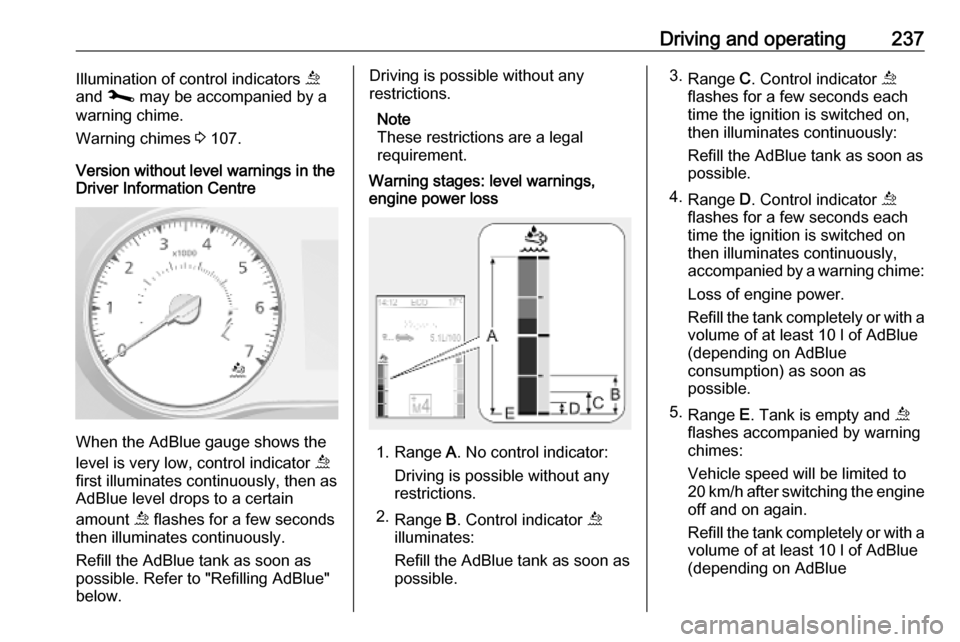
Version without level warnings in the Driver Information Centre
When the AdBlue gauge shows the
level is very low, control indicator ú
first illuminates continuously, then as
AdBlue level drops to a certain
amount ú flashes for a few seconds
then illuminates continuously.
Refill the AdBlue tank as soon as
possible. Refer to "Refilling AdBlue"
below.
Driving is possible without any
restrictions.
Note
These restrictions are a legal
requirement.Warning stages: level warnings,
engine power loss
1. Range A. No control indicator:
Driving is possible without any
restrictions.
2. Range B. Control indicator ú
illuminates:
Refill the AdBlue tank as soon as
possible.
3. Range C. Control indicator ú
flashes for a few seconds each
time the ignition is switched on,
then illuminates continuously:
Refill the AdBlue tank as soon as
possible.
4. Range D. Control indicator ú
flashes for a few seconds each
time the ignition is switched on
then illuminates continuously,
accompanied by a warning chime:
Loss of engine power.
Refill the tank completely or with a
volume of at least 10 l of AdBlue
(depending on AdBlue
consumption) as soon as
possible.
5. Range E. Tank is empty and ú
flashes accompanied by warning
chimes:
Vehicle speed will be limited to
20 km/h after switching the engine
off and on again.
Refill the tank completely or with a
volume of at least 10 l of AdBlue (depending on AdBlue
Page 241 of 353
Driving and operating239volume of at least 10 l of AdBlue
(depending on AdBlue
consumption).
Avoid minor top-ups (e.g. less than
10 l), otherwise the system may not
detect a refill.
Note
When unscrewing the protective cap
from the filler neck, ammonia fumes
may emerge. Do not inhale as the
fumes have a pungent smell. The
fumes are not harmful by inhalation.
The vehicle must be parked on a level surface.
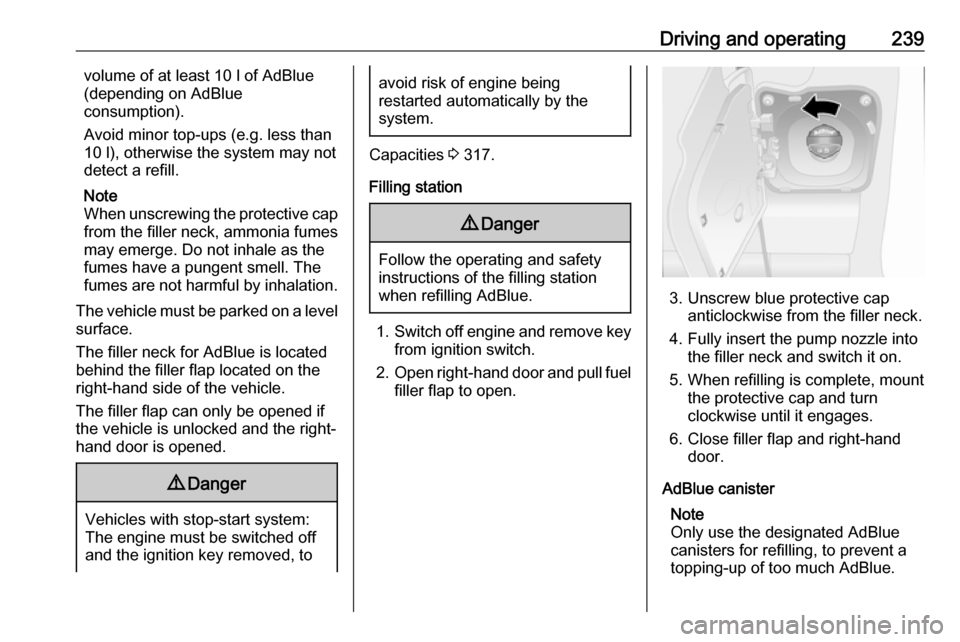
The filler neck for AdBlue is located
behind the filler flap located on the
right-hand side of the vehicle.
The filler flap can only be opened if
the vehicle is unlocked and the right- hand door is opened.9 Danger
Vehicles with stop-start system:
The engine must be switched off
and the ignition key removed, to
avoid risk of engine being
restarted automatically by the
system.
Capacities 3 317.
Filling station
9 Danger
Follow the operating and safety
instructions of the filling station
when refilling AdBlue.
1. Switch off engine and remove key
from ignition switch.
2. Open right-hand door and pull fuel
filler flap to open.
3. Unscrew blue protective cap anticlockwise from the filler neck.
4. Fully insert the pump nozzle into the filler neck and switch it on.
5. When refilling is complete, mount the protective cap and turn
clockwise until it engages.
6. Close filler flap and right-hand door.
AdBlue canister Note
Only use the designated AdBlue canisters for refilling, to prevent a
topping-up of too much AdBlue.
Page 242 of 353
240Driving and operatingAdditionally, the fumes in the tank
are captured in the canister and do
not emerge.
Note
Since AdBlue has a limited
durability, check the date of expiry
before refilling.
1. Switch off engine and remove key
from ignition switch.
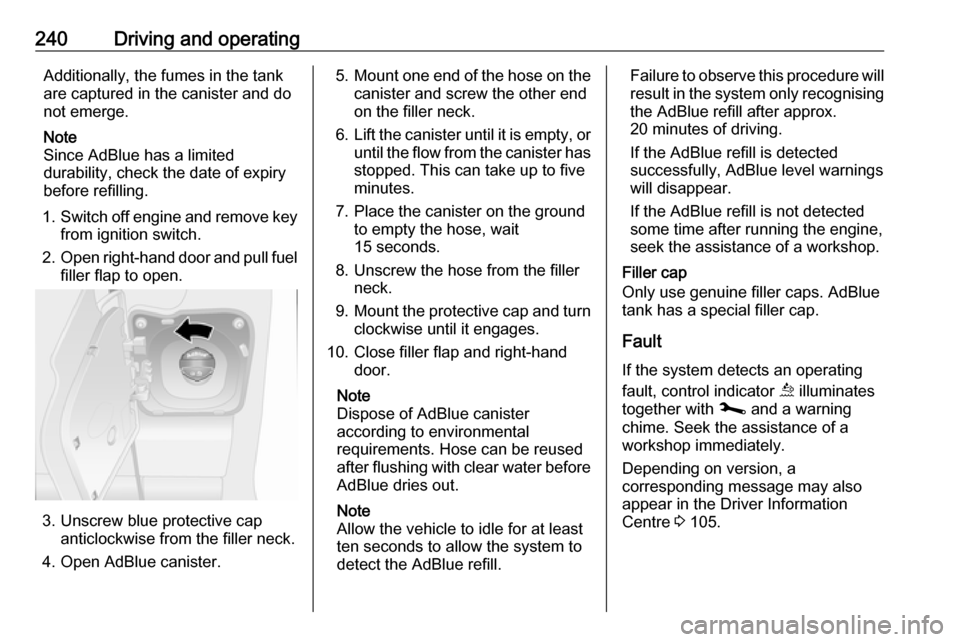
2. Open right-hand door and pull fuel
filler flap to open.
3. Unscrew blue protective cap anticlockwise from the filler neck.
4. Open AdBlue canister.
5. Mount one end of the hose on the
canister and screw the other end
on the filler neck.
6. Lift the canister until it is empty, or
until the flow from the canister has stopped. This can take up to five
minutes.
7. Place the canister on the ground to empty the hose, wait
15 seconds.
8. Unscrew the hose from the filler neck.
9. Mount the protective cap and turn
clockwise until it engages.
10. Close filler flap and right-hand door.
Note
Dispose of AdBlue canister
according to environmental
requirements. Hose can be reused
after flushing with clear water before
AdBlue dries out.
Note
Allow the vehicle to idle for at least
ten seconds to allow the system to
detect the AdBlue refill.Failure to observe this procedure will
result in the system only recognising the AdBlue refill after approx.
20 minutes of driving.
If the AdBlue refill is detected
successfully, AdBlue level warnings
will disappear.
If the AdBlue refill is not detected
some time after running the engine,
seek the assistance of a workshop.
Filler cap
Only use genuine filler caps. AdBlue tank has a special filler cap.
Fault
If the system detects an operating
fault, control indicator ú illuminates
together with j and a warning
chime. Seek the assistance of a
workshop immediately.
Depending on version, a
corresponding message may also
appear in the Driver Information
Centre 3 105.
Page 245 of 353
Driving and operating243warning may sound as a signal to
depress the brake pedal or apply the
parking brake.
Switch off engine if stopping for a lengthy period, e.g. in traffic jams.
When the vehicle is parked and the
driver's door is opened, a warning
chime will sound if neutral is not
selected or the brake pedal has not
been depressed.
Engine braking
Automatic mode
When driving downhill, the manual transmission automated does not shift into higher gears until a fairly
high engine speed has been reached. It shifts down in good time when
braking.
Manual mode
To utilise the engine braking effect, select a lower gear in good time when driving downhill.Rocking the vehicle
Rocking the vehicle is only
permissible if the vehicle is stuck in
sand, mud, snow or a hole. Move the
selector lever between R and D/M (or
between + and -) in a repeat pattern,
while applying light pressure to the
accelerator pedal. Do not race the
engine and avoid sudden
acceleration.
Parking
Apply the parking brake. The most recently engaged gear (see
transmission display) remains
engaged. With N, no gear is engaged.
When the ignition is switched off, the transmission no longer responds to
movement of the selector lever.
If the ignition is not switched off, or the parking brake has not been applied, a
warning chime will sound upon
opening the driver's door.
Manual mode If a higher gear is selected when the
engine speed is too low, or a lower
gear when the speed is too high, theshift is not executed. This prevents
the engine from running at too low or
too high an engine speed.
If engine speed is too low, the
transmission automatically shifts to a
lower gear.
If engine speed is too high, the
transmission only switches to a higher gear via kickdown.
Electronic driving programmes
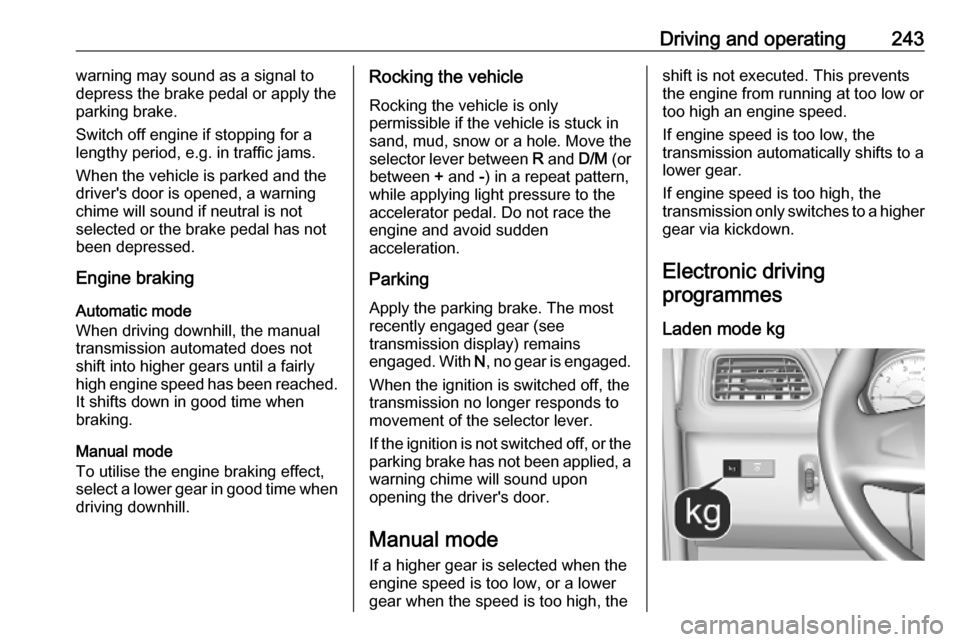
Laden mode kg
Page 246 of 353

244Driving and operatingIt is possible to use the Laden mode
in both manual and automatic modes. In both cases, the gearshifting
patterns are adapted automatically
for carrying an increased payload.
Activation
Press kg. Control indicator kg is
shown in the transmission display.
The transmission will then select
optimized gearshift patterns.
Deactivation
The Laden mode is switched off by:
● pressing kg again
● turning off the ignition
Kickdown If the accelerator pedal is pressed
past the pressure point, the
transmission shifts to a lower gear
depending on engine speed. Full
engine power is available for
acceleration.
If engine speed is too high the
transmission switches to a higher
gear, even in manual mode. Without
kickdown this automatic shift is not
effected in manual mode.Fault
In the event of a fault, control indicator W is shown in the transmission
display. Continued driving is possible
provided the vehicle is driven with
care and anticipation.
Have the cause of the fault remedied
by a workshop.
Interruption of power supply The clutch is not disengaged if there
is an interruption of the power supply
when a gear is engaged. The vehicle
cannot move.
If the vehicle battery is discharged,
start the vehicle using jump leads
3 304.
If the cause of the fault is not a
discharged vehicle battery, seek the
assistance of a workshop.
If neutral cannot be selected, the
vehicle must only be towed with the
drive wheels raised off the ground
3 306.
Towing the vehicle 3 306.Brakes
The brake system comprises two
independent brake circuits.
If a brake circuit fails, the vehicle can
still be braked using the other brake
circuit. However, braking effect is
achieved only when you depress the
brake pedal firmly. You need to use
considerably more force for this. The
braking distance is extended. Seek
the assistance of a workshop before
continuing your journey.
When the engine is not running, the
support of the brake servo unit
disappears once the brake pedal has been depressed once or twice.
Braking effect is not reduced, but
braking requires significantly greater
force. It is especially important to bear
this in mind when being towed.
Control indicator R 3 100.
Antilock brake system Antilock brake system (ABS)
prevents the wheels from locking.
Page 249 of 353
Driving and operating247Ride control systems
Traction Control system The traction control system is a
component part of the Electronic
Stability Control (ESC) which
improves driving stability when
necessary, regardless of the type of
road surface or tyre grip, by
preventing the drive wheels from
spinning.
As soon as the drive wheels start to
spin, engine output is reduced and
the wheel spinning the most is braked
individually. This considerably
improves the driving stability of the
vehicle on slippery road surfaces.
Traction control system is operational
as soon as the ignition is switched on and control indicator b extinguishes
in the instrument cluster.
When traction control system is active b flashes.9 Warning
Do not let this special safety
feature tempt you into taking risks
when driving.
Adapt speed to the road
conditions.
Control indicator b 3 101.
Trailer stability assist 3 266.
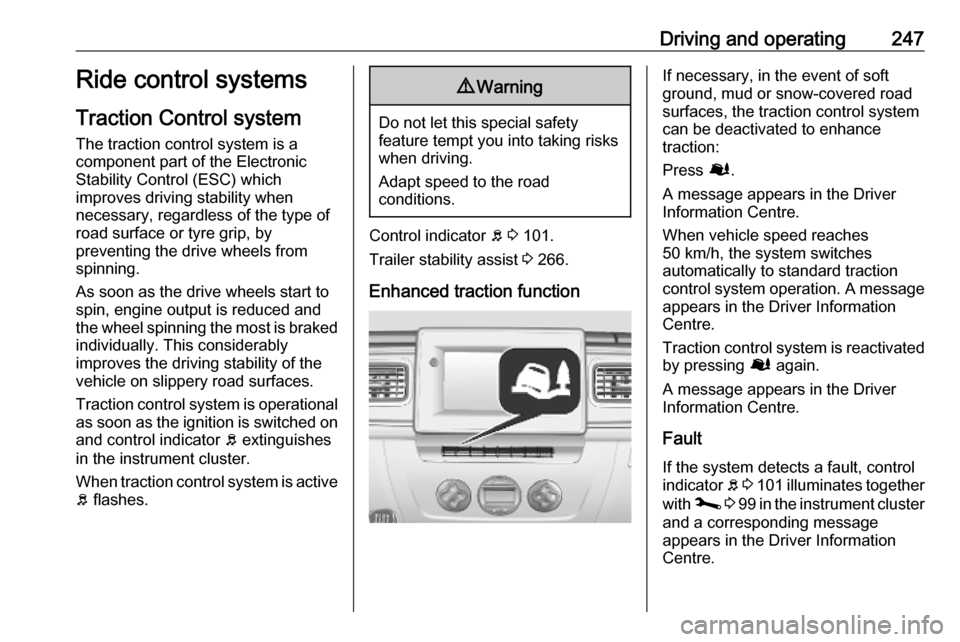
Enhanced traction function
If necessary, in the event of soft
ground, mud or snow-covered road
surfaces, the traction control system
can be deactivated to enhance
traction:
Press Ø.
A message appears in the Driver
Information Centre.
When vehicle speed reaches
50 km/h, the system switches
automatically to standard traction control system operation. A message
appears in the Driver Information
Centre.
Traction control system is reactivated by pressing Ø again.
A message appears in the Driver
Information Centre.
Fault
If the system detects a fault, control
indicator b 3 101 illuminates together
with j 3 99 in the instrument cluster
and a corresponding message
appears in the Driver Information
Centre.
Page 250 of 353
248Driving and operatingThe traction control system is not
operational. Have the cause of the
fault remedied by a workshop.
Vehicle messages 3 106.
Driver Information Centre 3 105.
Electronic Stability Control
The Electronic Stability Control (ESC) improves driving stability when
necessary, regardless of the type of
road surface or tyre grip. It also
prevents the drive wheels from
spinning.
As soon as the vehicle starts to
swerve (understeer / oversteer),
engine output is reduced and the wheels are braked individually. This
considerably improves the driving
stability of the vehicle on slippery road
surfaces.
ESC is operational as soon as the
ignition is switched on and control indicator b extinguishes in the
instrument cluster.
When ESC comes into action b
flashes.9 Warning
Do not let this special safety
feature tempt you into taking risks
when driving.
Adapt speed to the road
conditions.
Control indicator b 3 101.
Trailer stability assist 3 266.
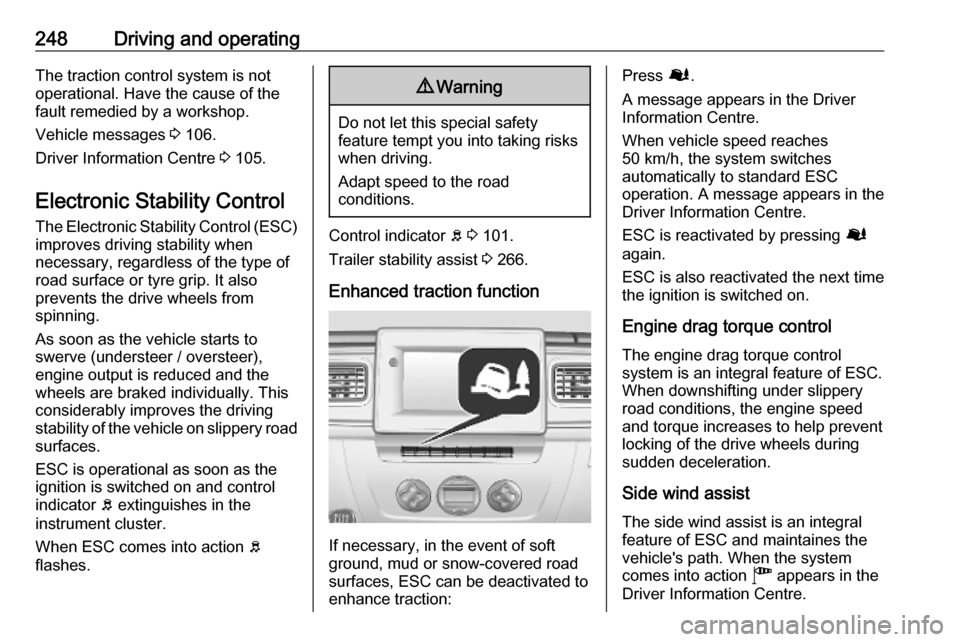
Enhanced traction function
If necessary, in the event of soft
ground, mud or snow-covered road
surfaces, ESC can be deactivated to
enhance traction:
Press Ø.
A message appears in the Driver
Information Centre.
When vehicle speed reaches
50 km/h, the system switches
automatically to standard ESC
operation. A message appears in the
Driver Information Centre.
ESC is reactivated by pressing Ø
again.
ESC is also reactivated the next time
the ignition is switched on.
Engine drag torque control The engine drag torque control
system is an integral feature of ESC. When downshifting under slippery
road conditions, the engine speed
and torque increases to help prevent
locking of the drive wheels during
sudden deceleration.
Side wind assist The side wind assist is an integralfeature of ESC and maintaines the
vehicle's path. When the system
comes into action " appears in the
Driver Information Centre.
Page 252 of 353
250Driving and operatingFor safety reasons the cruise control
cannot be activated until the brake
pedal has been operated once.
Do not use the cruise control if it is not advisable to maintain a constant
speed.
With manual transmission
automated, only activate cruise
control in automatic mode.
Control indicators m and U 3 103.
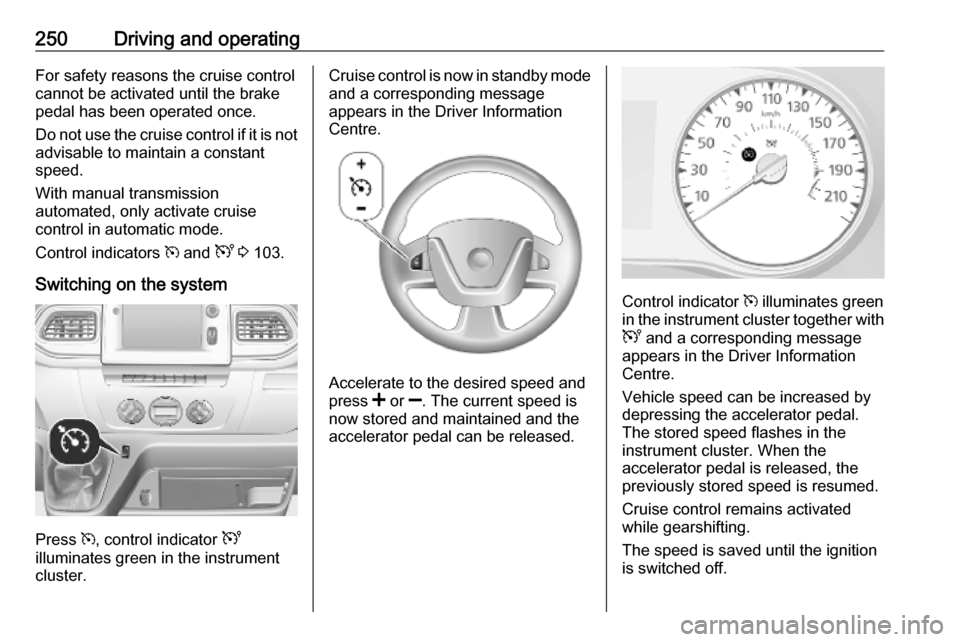
Switching on the system
Press m, control indicator U
illuminates green in the instrument
cluster.
Cruise control is now in standby mode
and a corresponding message
appears in the Driver Information
Centre.
Accelerate to the desired speed and
press < or ]. The current speed is
now stored and maintained and the
accelerator pedal can be released.
Control indicator m illuminates green
in the instrument cluster together with
U and a corresponding message
appears in the Driver Information
Centre.
Vehicle speed can be increased by
depressing the accelerator pedal.
The stored speed flashes in the
instrument cluster. When the
accelerator pedal is released, the
previously stored speed is resumed.
Cruise control remains activated
while gearshifting.
The speed is saved until the ignition
is switched off.
Page 255 of 353
Driving and operating253Deactivation of the functionality
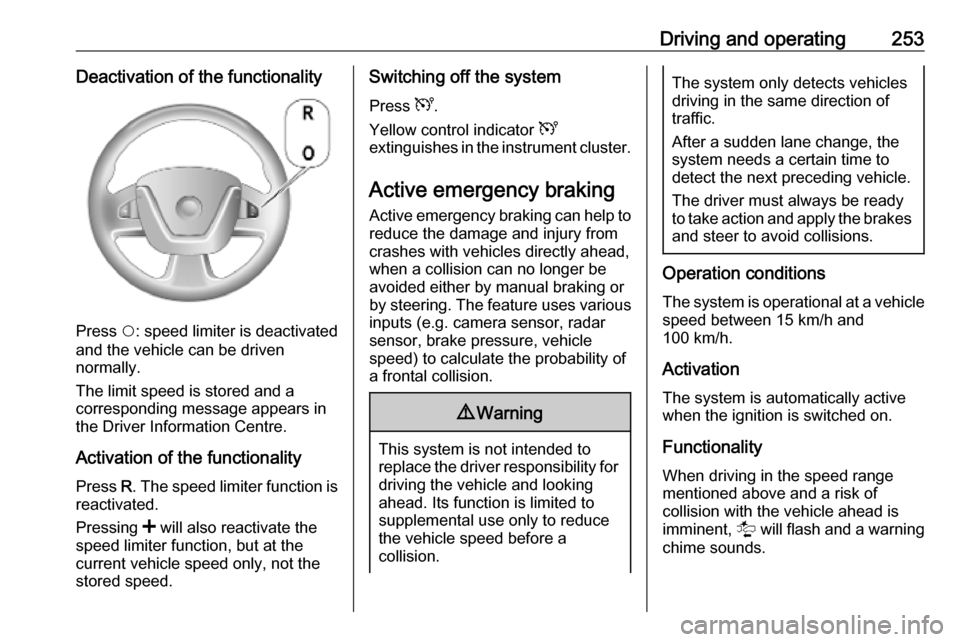
Press $: speed limiter is deactivated
and the vehicle can be driven
normally.
The limit speed is stored and a
corresponding message appears in
the Driver Information Centre.
Activation of the functionality Press R. The speed limiter function is
reactivated.
Pressing < will also reactivate the
speed limiter function, but at the
current vehicle speed only, not the
stored speed.
Switching off the system
Press U.
Yellow control indicator U
extinguishes in the instrument cluster.
Active emergency braking Active emergency braking can help toreduce the damage and injury from
crashes with vehicles directly ahead,
when a collision can no longer be
avoided either by manual braking or
by steering. The feature uses various
inputs (e.g. camera sensor, radar
sensor, brake pressure, vehicle
speed) to calculate the probability of
a frontal collision.9 Warning
This system is not intended to
replace the driver responsibility for driving the vehicle and looking
ahead. Its function is limited to
supplemental use only to reduce
the vehicle speed before a
collision.
The system only detects vehicles
driving in the same direction of
traffic.
After a sudden lane change, the
system needs a certain time to
detect the next preceding vehicle.
The driver must always be ready
to take action and apply the brakes and steer to avoid collisions.
Operation conditions
The system is operational at a vehicle
speed between 15 km/h and
100 km/h.
Activation The system is automatically activewhen the ignition is switched on.
Functionality
When driving in the speed range
mentioned above and a risk of
collision with the vehicle ahead is
imminent, l will flash and a warning
chime sounds.
Page 256 of 353
254Driving and operatingThe indicator light l and the chimes
stop when the system detects that a
collision is not imminent anymore.
Just before the imminent collision, the
system brakes automatically to
reduce the impact speed of the
collision or prohibit a crash.9 Warning
Do not rely on the system to brake
the vehicle. Active emergency
braking will not brake outside of its
operating speed range and only
responds to detected vehicles.
Deactivation and re-activation
Active emergency braking can be
deactivated with the vehicle
stationary and the ignition switched
on:
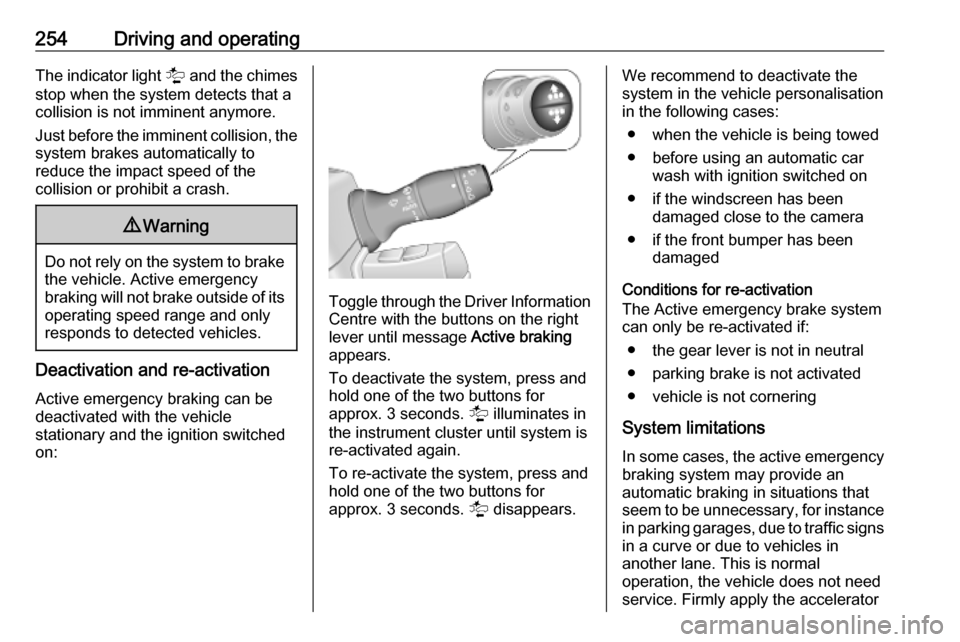
Toggle through the Driver Information
Centre with the buttons on the right
lever until message Active braking
appears.
To deactivate the system, press and
hold one of the two buttons for
approx. 3 seconds. l illuminates in
the instrument cluster until system is
re-activated again.
To re-activate the system, press and hold one of the two buttons for
approx. 3 seconds. l disappears.
We recommend to deactivate the
system in the vehicle personalisation
in the following cases:
● when the vehicle is being towed
● before using an automatic car wash with ignition switched on
● if the windscreen has been damaged close to the camera
● if the front bumper has been damaged
Conditions for re-activation
The Active emergency brake system
can only be re-activated if:
● the gear lever is not in neutral
● parking brake is not activated
● vehicle is not cornering
System limitations In some cases, the active emergency
braking system may provide an
automatic braking in situations that
seem to be unnecessary, for instance in parking garages, due to traffic signs
in a curve or due to vehicles in
another lane. This is normal
operation, the vehicle does not need
service. Firmly apply the accelerator